*It has been updated with the latest information as of December 5, 2025.

Korean Bowing Jeol: 5 Shocking Secrets That Instantly Impress
If you searched for Korean bowing (Jeol), you probably want three things fast: what it means, which bow to use, and how not to embarrass yourself in front of someone’s parents, boss, or grandmother. This guide is built for that exact moment—when your brain is running a silent panic slideshow while your body tries to remember where to put your hands.
I still remember the first time I was truly faced with a Korean bow. It was less a polite nod and more a theatrical, almost spiritual performance.
I was meeting the family of a close Korean friend, and I was so nervous my hands were clammy. They came out, a whole procession of aunts, uncles, and cousins, and when my friend’s grandfather stepped forward, he didn’t just greet me; he bowed. Deeply. It was so low I thought he was looking for something he dropped.
I, an awkward foreigner, responded with a clumsy half-bow and a cringe-worthy “hello.” I felt like I had just tried to shake the Queen’s hand while wearing my pajamas.
Afterward, my friend laughed and explained what was really happening. He told me that this wasn’t just a greeting; it was a conversation. A silent, powerful declaration of respect, humility, and history. He told me the bow had a name—Jeol—and that it wasn’t one thing, but many. Each bow had a different story, a different meaning, and a different set of rules.
Fast forward a few years, and I’ve learned a lot. What I’ve come to understand is that the Korean bow is one of the most beautiful and complex forms of non-verbal communication in the world. It’s a physical manifestation of a society built on the principles of respect and harmony. It’s a language you can learn, and once you do, you unlock a whole new level of understanding and connection with Korean people.
It’s not about being perfect, trust me. It’s about showing that you care enough to try. So, if you’ve ever felt that same sense of awkwardness or curiosity, you’re in the right place. We’re going to dive into the surprisingly deep world of Korean bowing (Jeol) and uncover its secrets. Are you ready?
Let’s get into it. Below is a detailed map to help you navigate this guide. Feel free to click on any section that catches your eye.
Table of Contents
The “Why” Behind the Bow: The Philosophical Roots of Korean Bowing (Jeol)
Before we get into the nitty-gritty of how to perform a bow, let’s talk about why it’s so important in the first place. You can do the physical motions perfectly, but if you don’t understand the “why,” it will feel hollow. It’s like trying to play a beautiful piece of music without knowing the emotion behind the notes.
In Korea, the concept of Jeol is deeply rooted in Confucian ideals that shaped family structure, education, and public life. Think of Confucianism less as a religion and more as a social operating system. It emphasizes respect for elders, responsibility within relationships, and harmony gained through mutual obligation.
Every time you bow, you are, in a very real sense, acknowledging your place within this social structure. You are showing humility and recognizing the status and experience of the person in front of you. This isn’t about being subservient; it’s about acknowledging the intricate web of relationships that holds society together. It is a graceful shorthand for saying, “I see your role in my life, and I am entering this conversation with care.”
Think of it like a human version of a tree’s root system. The branches and leaves (individuals) may be visible, but the true strength and stability come from the unseen, interconnected roots (relationships). The bow is a way of watering those roots, keeping the entire system healthy and stable.
For a long time, I thought a bow was just a formality. But after living here and making real connections, I realized it’s closer to a cultural “reset.” It softens the room. It lowers heat before a conversation even starts. In respect-heavy contexts—meeting a partner’s family, greeting a teacher, or attending a ceremony—Jeol helps you participate in the atmosphere rather than merely observe it.
If you enjoy seeing how etiquette threads through other Korean rituals, you might also like these etiquette rules for Korean tea, where respect is expressed not only through posture, but through pace, silence, and the choreography of offering a cup.
The 5 Core Types of Jeol You Must Master
So, you’ve grasped the philosophy. Great. Now, let’s get practical. Not all bows are created equal. The depth of the bow tells a story, and using the wrong one can be like showing up to a black-tie event in a T-shirt and flip-flops. Let’s break down the most important ones, from the most formal to the most common.
I want you to imagine each bow on a spectrum of formality. On one end, you have the full, profound bow for the most solemn occasions. On the other, you have a quick head nod that’s a part of daily life. We’re going to walk through each one so you’re never caught off guard.
Here’s a quick decision shortcut you can keep in your head:
- Big family holidays or ceremonies? Think Keun-jeol.
- Meeting elders, professors, or senior colleagues? Default to Pyeong-jeol.
- Someone slightly older or higher in rank you know well? Use Pan-bae.
- Children performing etiquette? That’s Aegil-jeol.
- Everyday courtesy in busy modern life? Saenghwal-jeol is your safe bet.
It can feel a bit like learning a dance, and in many ways, it is. But once you get the steps down, the grace and rhythm will come naturally. Let’s start with the one you’ve probably heard about the most: the big, grand bow.
1. Keun-jeol (큰절) – The Grand, Full Bow
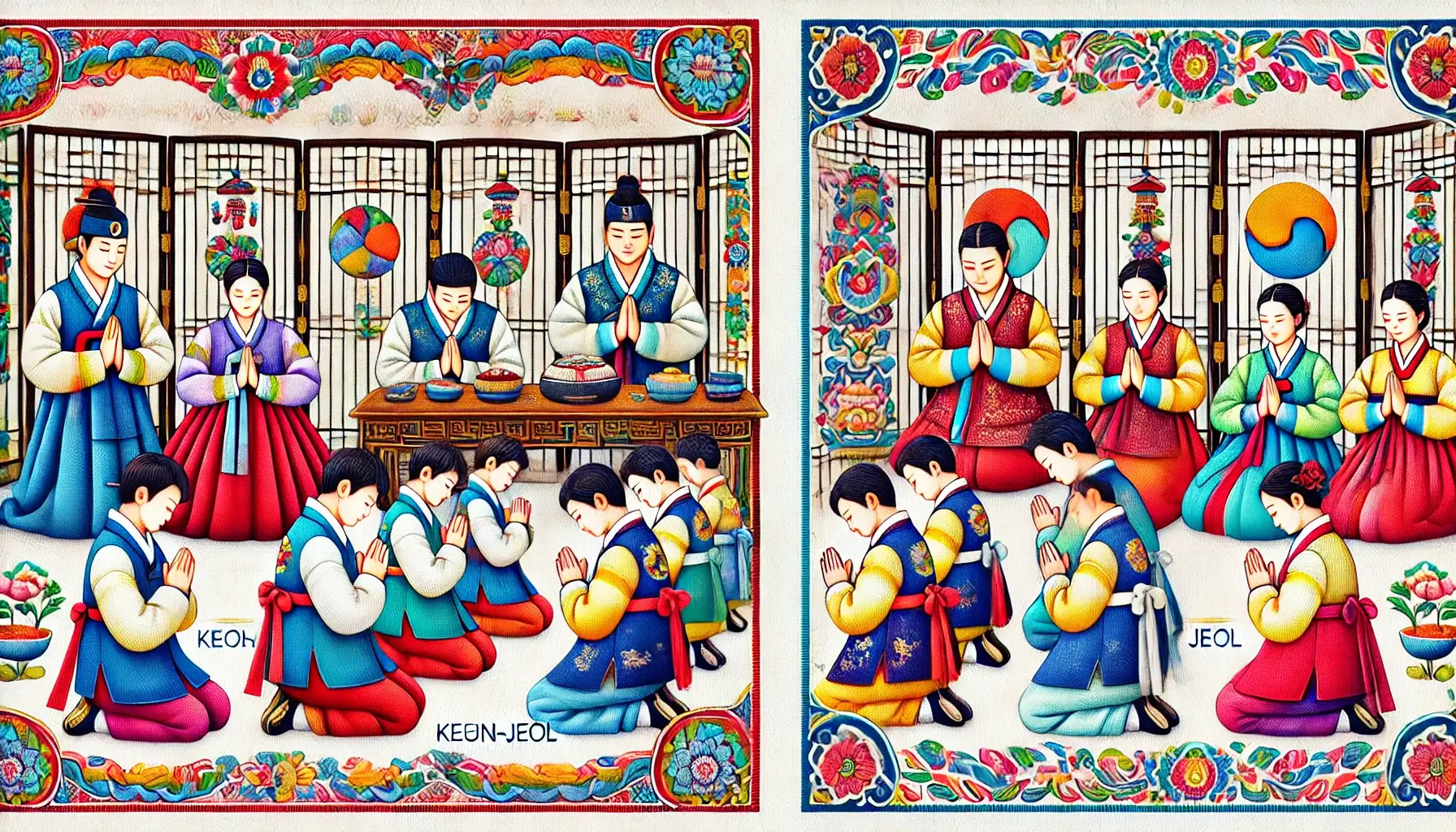
This is the big kahuna. The grand gesture. The full-monty of bowing. Keun-jeol literally means “big bow,” and that’s exactly what it is. This is not for a casual encounter at the coffee shop. This is for the most respectful and solemn occasions, and it is a full prostration. It involves kneeling down on the floor and touching your forehead to the ground. It is an act of deep reverence and humility.
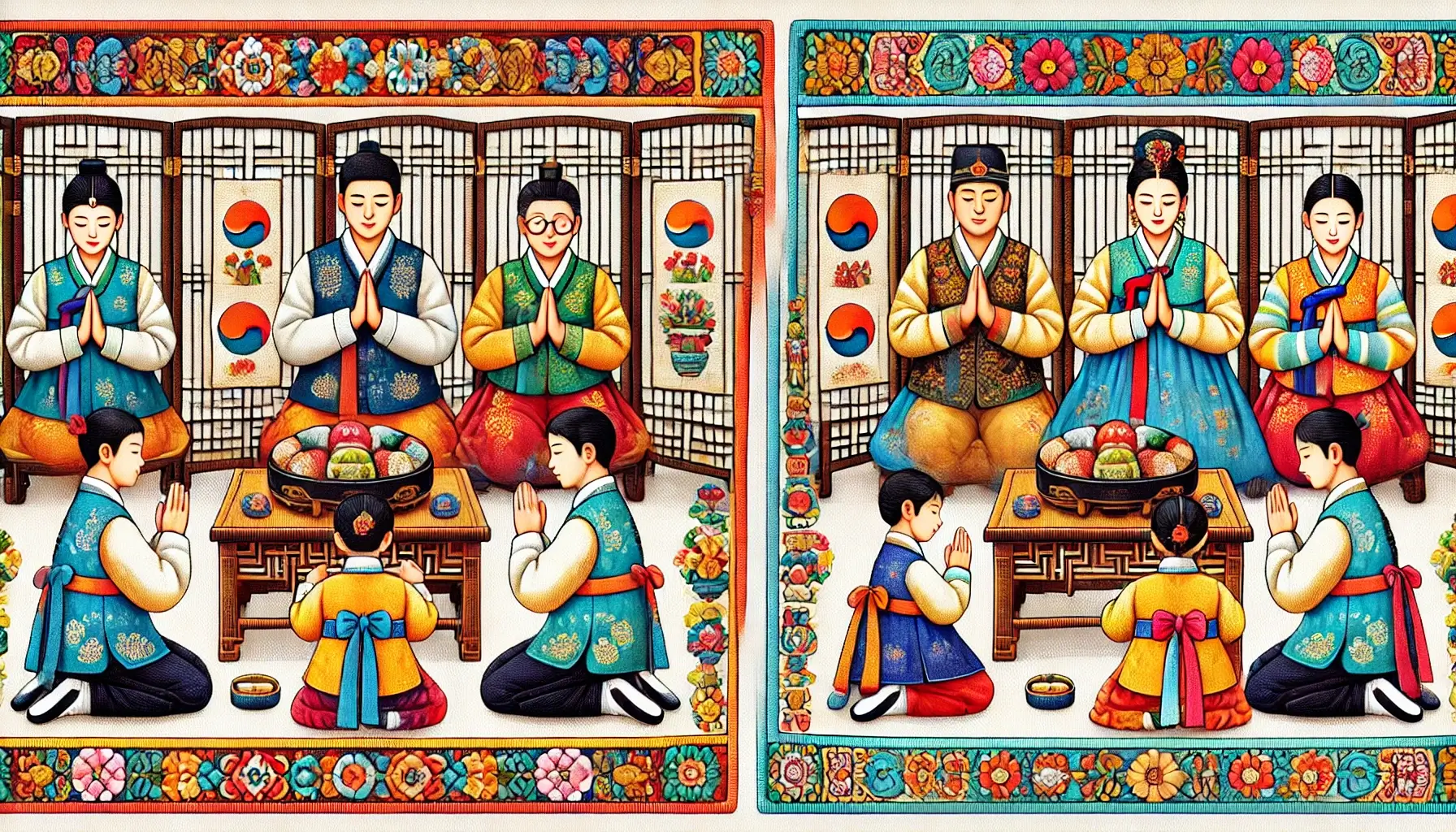
You’ll see this bow performed during traditional weddings, for ancestral rites (Jesa), and for New Year’s Day greetings (Seollal) to elders. It’s an intensely personal and powerful act. When you perform a Keun-jeol, you are literally lowering yourself completely, showing that you hold the other person in the highest possible regard.
It’s an honor to receive a Keun-jeol, and it’s a profound sign of respect to give one. I remember watching my friend’s cousins do this for their grandmother on New Year’s. The room fell completely silent. You could feel the weight of tradition and love in the air.
If you want to see how this bow appears in another high-ritual setting, you may find it helpful to explore traditional Korean wedding customs, where Keun-jeol becomes part of a larger sequence of symbolic respect between families.
One practical note foreigners often miss: the environment matters. If you’re invited to a family Seollal gathering, there is usually a visual “flow” to the Keun-jeol sequence—where to line up, when to kneel, and how many times to bow. You do not need to know this in advance. You just need to watch the nearest cousin who looks competent and move one beat behind them like a backup dancer with good manners.
2. Pyeong-jeol (평절) – The Everyday Formal Bow
Pyeong-jeol translates to “normal bow” or “ordinary bow.” This is the bow you’ll use most often in formal situations. It’s the one you perform when you’re greeting an elder, a teacher, or a senior colleague. It’s the standard for showing respect without the full prostration of a Keun-jeol.
A Pyeong-jeol involves bending at the waist about 45 to 90 degrees. It’s a sign of profound respect, but it’s not reserved for ceremonial events. It’s for the important people in your life who deserve more than a simple nod. Think of it as the go-to formal handshake of Korea. It says, “I respect your age and experience,” without the full ritual of the grand bow.
When I first started bowing, I’d always overthink it. “Am I bowing too low? Not low enough?” But my Korean friend told me, “Just feel it. If you’re sincere, they’ll know.” And it’s true. The best Pyeong-jeol looks calm, steady, and unhurried—like your body is saying respect before your mouth can catch up.
In workplace settings, this bow also quietly signals professionalism. If you’re new to a Korean office (or even a short business trip), a clean Pyeong-jeol paired with a simple greeting can do more relational work than a long English introduction. It’s one of the reasons Korean etiquette feels so efficient: you communicate intention in two seconds of posture.
3. Pan-bae (반배) – The Half Bow
Pan-bae translates to “half bow” and is used for people you are close with, but who are still your seniors, or for people of a similar age. It’s a quick, respectful bend of the head and shoulders, usually around 15 to 30 degrees at the waist.
It strikes the perfect balance between familiarity and respect. I use this one all the time with my friend’s older brother, who is a few years my senior. It’s our little silent language. It says, “Hey, I respect you, but we’re cool, you know?”
This is also the bow that saves you in those social gray zones—when you’re not sure whether someone is older, but you suspect they might be. Pan-bae is polite without being overly formal. In other words, it’s the diplomatic bow.
4. Aegil-jeol (애길절) – The Bow for Children
Aegil-jeol is the bow that a child performs for an adult. It’s a simplified version of the formal standing bows that is age-appropriate and part of early education in etiquette.
It’s beautiful to watch a small child, maybe just three or four years old, bow respectfully to their grandparents. It’s not just cute; it’s the first lesson in a lifelong curriculum of respect. The child is learning that relationships are the foundation of everything—family, community, and identity.
This is also why Korean etiquette often feels embodied, not theoretical. Values are taught through repeatable actions: bow, receive, thank, offer. If you’re curious about other family-centered traditions that train respect through ritual, consider reading about Korean ancestral rites (Jesa).
5. Saenghwal-jeol (생활절) – The Modern Head-Nod
In modern Korean society, especially among younger generations and in casual, fast-paced environments, a more informal bow has become common. Saenghwal-jeol translates to “living bow” or “daily life bow.” It’s basically a quick, slight bend of the head and shoulders.
It’s what you might do to greet a convenience store worker, a delivery driver, or a friend you see on the street. It’s not a deep bow, but it is a gesture of courtesy and acknowledgment. You’ll see this everywhere in Seoul. It’s quick, efficient, and sincere in its own quiet way.
For many visitors, this is the first bow they naturally adopt because it’s low-pressure. Think of it as the cultural equivalent of holding a door open: small, ordinary, but deeply social.
A Step-by-Step Guide: How to Perform a Korean Bowing (Jeol) Correctly
Okay, now for the mechanics. This is where a lot of people get nervous. Don’t be! It’s actually a lot simpler than it looks, and once you practice a few times, it will become second nature. There are slight differences between the bowing styles for men and women, which is an important detail that often gets overlooked.
The most useful way to think about proper Jeol is “calm alignment.” You’re not throwing your body forward. You’re offering a controlled, respectful hinge from the waist, with your hands signaling formality.
The General Rule: The Power of The Hands
The position of your hands is a critical part of the bow. In most formal bows, your hands are clasped together in front of you. This is called Gon-su (공수). For men, the left hand is placed over the right hand. For women, the right hand is placed over the left hand. This detail shows a deep understanding of the proper etiquette and will earn you major points.
If you remember only one technical detail from this entire article, let it be this. The hands are the quiet clue that you understand the rules. Even when your bow angle is slightly off (which is normal at first), correct Gon-su can communicate seriousness and good intent.
Bowing for Men
1. The Stance: Stand straight and tall, with your feet together. Your head should be up, and your shoulders should be relaxed.
2. Hand Position: Place your left hand over your right hand. Your hands should be clasped together in front of your stomach.
3. The Movement: Hinge at your waist, bending forward. The key is to keep your back straight and your chin tucked in.
4. The Angle: The depth of your bow depends on the type of bow you are performing (45-90 degrees for Pyeong-jeol, 15-30 degrees for Pan-bae).
5. The Return: Hold the bow for a brief moment, then slowly and gracefully return to an upright position.
6. The Gaze: Your eyes should be focused on the ground, not on the person you are bowing to. This is a sign of humility.
Pro tip: In business settings, pairing a modest Pyeong-jeol with a clear self-introduction often lands better than a rushed English greeting. The bow sets the tone; your words fill in the details.
Bowing for Women
1. The Stance: Similar to men, start with a straight posture and your feet together.
2. Hand Position: For women, the right hand should be placed over the left hand. Your hands should be clasped together in front of your stomach.
3. The Movement: Hinge at your waist, keeping your back straight. The movement should be smooth and fluid.
4. The Angle: The angle is the same as for men, depending on the formality of the bow.
5. The Return: Slowly and gracefully return to a standing position.
6. The Gaze: Your eyes should be on the ground.
I know, it sounds a bit complicated. But trust me, you’ll get the hang of it. I remember practicing in front of a mirror, feeling ridiculous, but it helped so much. Just focus on the core movements, and the rest will follow. And don’t forget the Gon-su! It’s a small detail that makes a big impact.
If you’re learning Jeol specifically for family gatherings, it may help to rehearse the “sequence” rather than a single bow: walk in, pause, hands set, bow, return, greet. That tiny rhythm will make your movement look confident even if you still feel like a nervous piano student at their first recital.

The Psychology of the Korean Bowing (Jeol): It’s More Than Just a Gesture
Now that we’ve covered the “what” and the “how,” let’s talk about the “so what.” Why does this matter? What is the deeper, more psychological impact of the bow? I think this is where the real magic happens.
The act of bowing, for both the giver and the receiver, is an acknowledgment of a shared social reality. It’s a psychological reset button. In a society where hierarchy is so important, the bow is a way of clarifying your position and showing your respect without having to say a word. It removes ambiguity and creates a sense of social harmony.
Think about it. In a Western context, you shake hands. It’s a brief, equal gesture. But what if one person holds on for too long? What if the grip is too weak? It can be awkward and can create a sense of discomfort. The bow, on the other hand, is a more defined, less ambiguous gesture. It’s a clear, polite signal that you are acknowledging the other person and their status.
It also fosters a sense of humility. When you bow to someone, you are, for a moment, literally lowering your head and humbling yourself. This is an act of trust and respect. It shows that you are not just a collection of your own thoughts and desires, but that you are part of a larger community, and that you value the relationships within that community more than your own ego.
When you see a K-Pop idol bowing deeply to their fans, it’s not just for show. It’s a culturally legible way to communicate gratitude. For international fans, this can be a useful lens: the bow is not a performance of weakness; it’s a performance of accountability and appreciation.
In my experience, Jeol also changes the person doing it. The moment you slow your body down to offer respect, your mind often follows. If you’ve ever had a tense conversation soften after a well-timed gesture of humility, you already understand why this tradition has lasted so long.
A Quick Guide to Jeol Infographic
Keun-jeol (큰절)
The Grand Bow
🙇♂️
Occasions: Ceremonial, ancestral rites, weddings, New Year.
Meaning: Highest respect and reverence.
Pyeong-jeol (평절)
The Formal Bow
🧍♂️
↘️
Occasions: Elders, teachers, formal greetings.
Meaning: Profound respect for a senior.
Pan-bae (반배)
The Half Bow
🧍♂️
↘️
Occasions: Slightly senior colleagues, older friends.
Meaning: Respect and familiarity combined.
Saenghwal-jeol (생활절)
The Head-Nod
🧍♂️
↘️
Occasions: Casual, everyday greetings, strangers.
Meaning: Simple courtesy and acknowledgment.
Common Mistakes to Avoid While Practicing Korean Bowing (Jeol)
You’re not going to be perfect right away, and that’s okay. Koreans are very forgiving of foreigners who are trying to learn their culture. But knowing these common pitfalls will help you avoid some potentially awkward moments and show that you’ve done your homework.
I’ve made a few of these myself, so I speak from experience. The first time I met my friend’s younger brother, I bowed deeply to him out of habit. My friend burst out laughing. “Why are you bowing to my little brother?” he said. It was an honest mistake, but it taught me a valuable lesson: context is everything.
Here are a few things to keep in mind.
1. Bowing too deeply to someone younger: In most everyday situations, you don’t need a formal bow for someone younger than you. If you’re unsure of age, a light Pan-bae or Saenghwal-jeol is safer than a full Pyeong-jeol.
2. Over-formalizing service encounters: While a simple nod or slight bow is okay, a deep bow is not necessary for service workers. A small, courteous acknowledgment is perfect.
3. The awkward handshake-bow combo: This is a classic foreigner move. You go in for a bow, but the other person goes in for a handshake, and you end up in a strange, half-bow, half-handshake hybrid. The best way to avoid this is to pause for half a second and let the other person choose the first move.
4. Assuming one bow is always enough: In some ritual contexts, a bow is part of a set. During New Year greetings or family ceremonies, you may see repeated bows. Observation is your best guide.
5. Hands in pockets or casual posture: This is a big no-no. It can read as disrespectful or careless. Even a small daily bow looks more sincere when your hands are visible and your posture is aligned.
6. Treating Jeol like a performance test: The biggest hidden mistake is anxiety. The cultural goal is respect, not perfection. A slightly imperfect bow with evident sincerity will almost always land better than a stiff, over-rehearsed one.
The Modern Jeol: Evolving Traditions and the Future of Korean Bowing (Jeol)
You might be wondering, “Is all this still relevant in a modern, globalized Korea?” The short answer is yes, but it’s also evolving. Just like any living culture, traditions change to meet the needs of a new generation.
The rise of social media and global influence has meant that the deepest, most formal bows are reserved for the most important occasions. The Saenghwal-jeol (the head nod) has become incredibly common in daily life, especially in professional and casual settings. Young people are still taught the proper way to bow, but they adapt it for their lives.
However, the spirit of the bow remains. The core value of respect for elders and a harmonious society is still deeply ingrained in the culture. The physical gesture may become less pronounced, but the meaning behind it is still very much alive.
I’ve seen young Koreans bow to their parents, their grandparents, and their teachers. It’s a habit taught early and practiced often. Even when the gesture is small, the value system behind it is steady.
So, as you practice your bow, remember that you are not just learning a physical motion. You are participating in a living, breathing tradition that has been passed down for centuries. You are bridging a cultural gap and showing that you care enough to understand and respect a beautiful part of Korean heritage.
Practical Tips for Your First Jeol
Feeling a little overwhelmed? Don’t be. My advice is to start small and just try. The effort itself is what matters most. Here are a few final, practical tips to help you on your journey.
1. Start with the head nod: If you’re nervous, just start with a simple, respectful head nod. This is your safe zone.
2. Follow the leader: When in doubt, follow the lead of the Korean person you are with. Watch what they do and mirror their actions.
3. Learn one “family scenario” and one “work scenario”: Practicing a Keun-jeol for a holiday and a Pyeong-jeol for introductions covers most real-life needs.
4. Practice makes calm: Spend five minutes in front of a mirror. Not to become perfect, but to remove the panic from your body.
5. Focus on sincerity: At the end of the day, sincerity is what matters most. The people you are bowing to will be able to feel your genuine respect.
Remember, this isn’t a test. It’s an opportunity to connect with people on a deeper, more meaningful level. So go out there, be respectful, and start your journey into the wonderful world of Korean culture.
FAQ: Korean Bowing (Jeol)
Do foreigners have to bow in Korea?
You’re not “required” to bow, but a small respectful bow is one of the easiest ways to show cultural awareness. In most settings, a simple Saenghwal-jeol or Pan-bae paired with a greeting is more than enough and is usually appreciated.
What is the safest bow if I’m unsure of someone’s age or status?
Pan-bae is often the safest middle-ground. It communicates respect without feeling overly formal. If the setting is professional or the person is clearly senior, shift upward to a Pyeong-jeol.
Is it okay to bow and shake hands at the same time?
Yes, especially in business contexts. The key is not to overthink it. If the other person initiates a handshake, you can add a slight bow. That small combination often feels natural and respectful.
When would I actually need to perform a Keun-jeol?
Keun-jeol is typically reserved for major traditional events: New Year greetings to elders, certain wedding rituals, and ancestral rites. If you’re invited into these spaces, a family member will usually guide you through the timing and sequence.
What is Gon-su and why does it matter?
Gon-su is the formal hand position used during bows. For men, the left hand goes over the right; for women, the right hand goes over the left. It’s a small detail that signals you understand the etiquette, even if your bow angle isn’t perfect yet.
Learn More About Korean Etiquette Explore Korean Greeting Culture The Roots of Confucianism
If this guide helped, you may enjoy exploring related cultural layers across the site—from family rituals to everyday etiquette. Korean bowing is one doorway into Korean culture, but the deeper story is how respect becomes a lived, practiced language.
Korean bowing, Jeol, Korean etiquette, Korean culture, respect
🔗 Japanese Tea Ceremony Posted 2025-08-13 09:25 UTC 🔗 Japanese Grammar Nuances for JLPT N2/N1 Posted 2025-08-13 11:27 UTC 🔗 Jeong Posted 2025-08-14 07:01 UTC 🔗 Mythical Korean Animals Posted 2025-08-15 04:12 UTC 🔗 Korean Traditional Games Your Kids Posted (no date provided) 🔗 You Won’t Believe How Much Fun Your Kids Can Have Posted 2025-08 (Blogspot timestamp)