Five Mythical Korean Animals and Their Unbelievable Stories

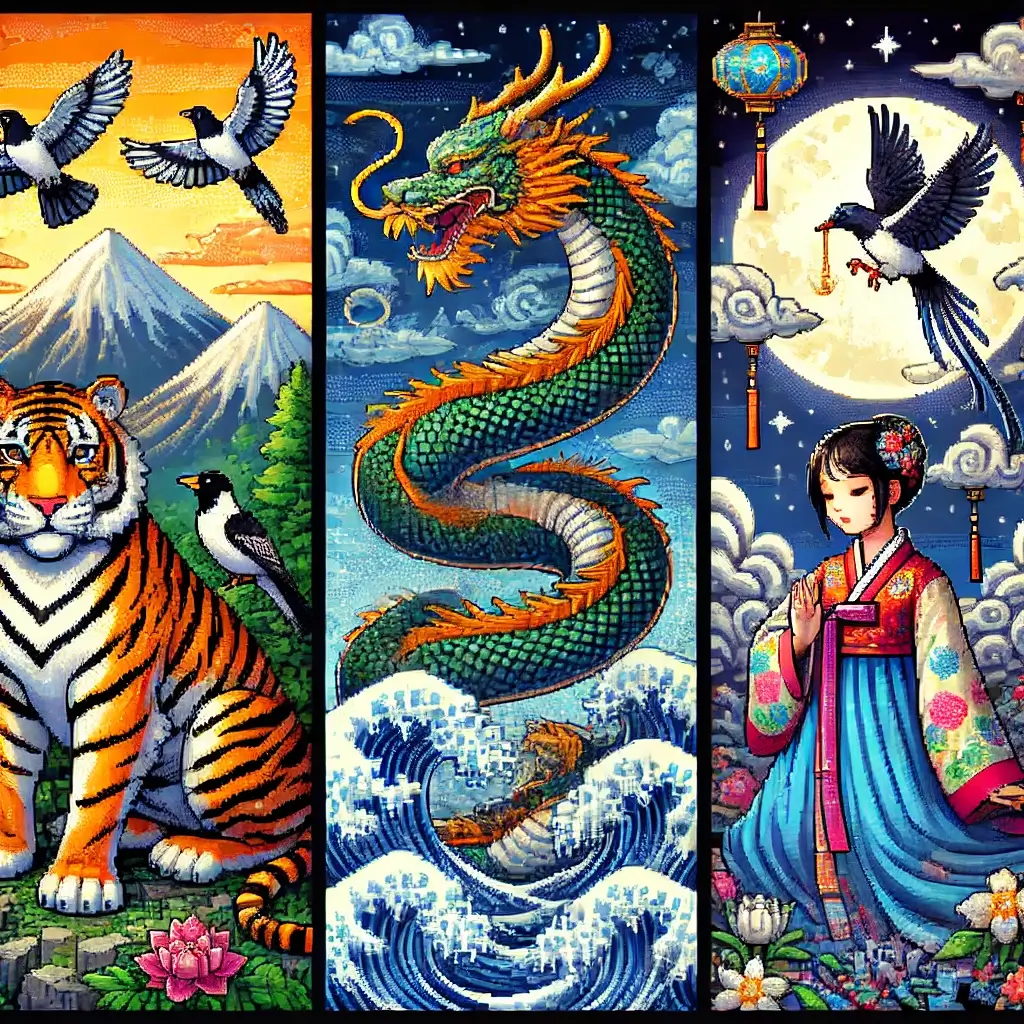
Pixel art of a Korean tiger (horangi) with a magpie in the mountains, inspired by minhwa, symbolizing protection and good fortune in Korean folklore. Five Mythical Korean Animals and Their Unbelievable Stories
Five Mythical Korean Animals and Their Unbelievable Stories 3

Five Mythical Korean Animals and Their Unbelievable Stories

Ever wonder why certain animals just pop up everywhere in Korean dramas, movies, and even art?

I mean, it’s not a coincidence that a fiery dragon or a wise old tiger appears at just the right moment.

If you’re anything like me, you’ve probably caught yourself googling the meaning behind these creatures, only to fall down a rabbit hole of fascinating folklore.

I’ve spent countless hours digging through ancient texts and talking to historians—seriously, it’s my jam—and I’m here to tell you that these aren’t just fantasy creatures.

They are woven into the very fabric of Korean identity, holding deep, complex meanings that go way beyond a cool-looking design.

So, buckle up, because we’re about to explore the incredible world of Korean animal symbolism, and trust me, your mind is about to be blown.

Let’s dive into the stories of five of the most powerful and enchanting animals that define Korean mythology.

Table of Contents: The Power of Five Korean Animals

The Tiger: Korea’s Mountain Guardian

The Fierce Protector with a Soft Spot for Humanity

Ah, the tiger.

No animal is more synonymous with Korea than the tiger.

The Korean Peninsula itself is said to resemble a tiger crouching in the mountains, a powerful and majestic image.

In fact, for centuries, Korea was known as the “Land of Tigers” because they roamed the mountains freely.

Now, you might think of a tiger as just a ferocious predator, but in Korean folklore, it’s so much more.

The tiger, or ‘horangi,’ is a complex character—a fearsome guardian, a mountain god’s messenger, and sometimes even a foolish, comical figure.

It’s the ultimate paradox.

One moment, it’s a terrifying beast, and the next, it’s the subject of a funny folk tale meant to teach a lesson.

The most famous story involving the tiger is, of course, the Dangun myth, the founding story of the first Korean kingdom, Gojoseon.

In this tale, a tiger and a bear wanted to become human.

They had to endure a hundred days in a cave, eating only mugwort and garlic.

The bear persevered, turning into a woman who became the mother of Dangun, the founder of Korea.

The tiger, however, couldn’t handle the challenge and ran away.

This story might seem to put the tiger in a negative light, but it actually solidifies its role as a spiritual, albeit impatient, being.

It’s the wild, untamable force of nature.

Despite its failure in this story, the tiger remained an incredibly important figure.

In folk art, known as ‘minhwa,’ the tiger is often depicted with a magpie, creating a popular image called ‘Jakhodo.’

The magpie, which symbolizes good news, is seen chiding the tiger, which represents evil spirits.

This painting was hung on doors at the New Year to ward off bad luck and welcome good fortune.

The tiger, in this context, is a powerful ‘seongin’ or messenger of the mountain god, here to protect the home.

So, the next time you see a painting of a funny-looking tiger with a magpie on a branch, you’ll know it’s not just a cute picture—it’s a powerful talisman for protection and good luck.

It’s a reminder that even the fiercest creatures can serve a greater purpose.

And let’s not forget the white tiger.

In Korean mythology, a white tiger is an incredibly rare and sacred creature.

It is said that a tiger turns white after it has lived for a thousand years and gained wisdom and enlightenment.

The white tiger is one of the “Four Symbols” (Sasin), guarding the west and symbolizing justice and power.

So, when you see a white tiger in a story, you know it’s not just a regular animal; it’s a divine being that holds immense spiritual power.

It’s the ultimate protector, the one who watches over the land and its people.

In a world where we often see tigers as symbols of raw, unbridled power, Korean folklore adds a layer of depth and humanity.

They are not just scary monsters; they are guardians, tricksters, and symbols of a nation’s wild and resilient spirit.

To learn more about the tiger’s role in Korean culture and history, check out these trusted sources:

National Folk Museum of Korea – The Tiger Korea.net – The Tiger’s Prominence

The Dragon: The Benevolent Ruler of Water

Not All Dragons Are Greedy Fire-Breathers!

Okay, let’s talk dragons.

If you’re used to European mythology, you probably picture a scaly, winged beast hoarding gold in a cave and breathing fire.

But get that image out of your head right now.

Korean dragons couldn’t be more different!

They are benevolent, wise, and, most importantly, tied to water.

In Korean folklore, the dragon, or ‘yong,’ is a powerful bringer of rain, clouds, and good fortune.

They live in rivers, lakes, and oceans, and their very existence is a blessing to the land.

This deep connection to water is crucial in an agricultural society.

Farmers would pray to the dragons for rain to ensure a good harvest.

They were seen as the ultimate source of life and prosperity.

Kings would often associate themselves with dragons to legitimize their rule, symbolizing their role as protectors of the land and their people.

You’ll see dragon motifs everywhere in ancient royal palaces and on the robes of kings, a clear sign of their power and divine authority.

One of the most intriguing aspects of Korean dragon lore is the ‘Imugi.’

The Imugi is a giant serpent, a lesser dragon that hasn’t yet achieved its full dragonhood.

It’s a story of ambition and transformation.

Legend says an Imugi can become a true dragon after a thousand years or if it catches a special magical orb, a ‘yeouiju.’

This is a powerful metaphor for personal growth and destiny.

It’s a reminder that everyone starts somewhere and that greatness is something you must earn through patience and perseverance.

It’s a journey, not a destination.

I find this so relatable.

We all have our “Imugi” phase, right?

That time when you’re working toward a big goal, maybe you’re not quite there yet, but you’re putting in the effort every day.

The Korean dragon reminds us that the journey is just as important as the final transformation.

Benevolent Dragon vs. Malevolent Dragon

A quick visual guide to the differences!

Characteristic Korean Dragon (Yong) European Dragon
Primary Element Water (Rain, Rivers) Fire
Symbolism Wisdom, Power, Benevolence, Fertility Greed, Destruction, Evil
Physical Appearance Often hornless, long serpent-like body, sometimes no wings Large, winged, often with scaly bodies and horns
Habitat Seas, rivers, lakes, clouds Caves, mountains, volcanoes

Want to learn more about the fascinating world of Korean dragons? Check out these links:

The Dragon in Korean Folklore Yong – Dragons in Temple Art

The Phoenix: The Royal and Auspicious Bird

A Symbol of Immortality and Unmatched Grace

When you hear “phoenix,” you probably think of a bird rising from its own ashes.

While that idea of rebirth is present in Korean folklore, the Korean phoenix, or ‘bonghwang,’ has an even deeper, more powerful meaning.

It’s not just about rising again; it’s about royalty, peace, and ultimate harmony.

The bonghwang is a majestic, mythical bird, often seen as the king of all birds.

You’ll find the bonghwang on the seals of the President of South Korea and on the garments of queens and empresses.

Why?

Because it represents the very essence of a wise and just ruler.

It is a symbol of a peaceful and prosperous nation, one where the leader rules with compassion and grace.

The phoenix only appears during a time of great peace and prosperity, or to herald the arrival of a truly benevolent and virtuous ruler.

So, its presence is a sign that things are good, or are about to be.

The bonghwang is also a symbol of immortality.

It’s often depicted with long, flowing tail feathers that represent the five virtues: righteousness, propriety, knowledge, benevolence, and sincerity.

It’s a beautiful, all-encompassing symbol.

When you see the phoenix, you’re looking at a hope for an eternal, peaceful, and balanced world.

I remember seeing a stunning embroidery of a bonghwang on a traditional hanbok once.

The intricate details, the vibrant colors—it wasn’t just pretty; it felt powerful.

It was like wearing a piece of history, a silent wish for a long and prosperous life, and a reminder to live with integrity.

That’s the beauty of these symbols: they carry so much history and so many hopes in a single image.

To dive deeper into the symbolism of the phoenix, check out this link:

The Radiant Symbolism of the Bonghwang

The Bear: The Mother of a Nation

Patience, Endurance, and the Birth of a People

I know, I know.

We already talked about the Dangun myth and how the tiger ran away.

But let’s be real, the bear deserves its own moment in the spotlight.

The bear, or ‘gom,’ is arguably one of the most important animals in Korean mythology because it gave birth to the founder of the nation.

In the Dangun myth, the bear was the one who endured the hundred days of eating only mugwort and garlic, and for that, it was rewarded with its wish to become human.

This isn’t just a fun story; it’s a testament to the core values of Korean culture: patience, perseverance, and resilience.

The bear symbolizes the hard-working, enduring spirit of the Korean people.

It represents the ability to overcome hardship and emerge stronger on the other side.

While the tiger embodies the wild, untamable side of nature, the bear represents the more domesticated, nurturing side.

It is a figure of motherhood and the foundation of the family and the nation.

Beyond the Dangun myth, bears are often seen as sacred beings, sometimes even mountain gods.

They are powerful yet gentle, strong yet patient.

When you see a bear in a Korean story, it’s not just a big animal; it’s a symbol of the very origins of the Korean people and the strength they found through enduring hardship.

It’s a reminder that sometimes, the quiet, patient ones are the ones who change the world.

The Gumiho: The Nine-Tailed Enigma

The Seductive Fox and the Quest for Humanity

Now, for my personal favorite, and probably the most popular one in modern media: the Gumiho.

The ‘gumiho’ is a nine-tailed fox, and it’s a creature of a thousand faces.

Sometimes it’s a malevolent, seductive monster that eats human livers to become human.

Other times, it’s a sympathetic, tragic figure who just wants to be loved and accepted.

In every story, however, the central theme remains the same: the Gumiho’s desperate desire to become human.

This isn’t just a spooky tale.

It’s a complex exploration of what it means to be human.

The Gumiho must often follow a set of strict rules to shed its fox form—rules like refraining from killing humans, helping others, or keeping its true identity a secret for a thousand days.

This struggle is the heart of the Gumiho myth.

It’s a metaphor for the human condition—the choices we make, the sacrifices we endure, and the moral battles we fight within ourselves.

The Gumiho, with its alluring beauty and dangerous nature, is a powerful symbol of duality.

It represents the fine line between good and evil, nature and civilization, and our wild, primal instincts versus our desire for love and belonging.

It’s the ultimate cautionary tale and a story of redemption all rolled into one.

When you’re watching a K-drama with a Gumiho, you’re not just watching a fantasy; you’re watching a timeless story about humanity itself.

Interested in the mysterious Gumiho? Learn more here:

Mythlok – The Gumiho and other creatures

The Legacy of Korean Animal Symbolism

More Than Just Legends

And there you have it.

These aren’t just silly folk tales; they are the heart of Korean culture.

They reflect the values, fears, and hopes of a nation that has endured so much.

From the fierce, protective tiger to the patient, nurturing bear, and the wise, benevolent dragon, these animals teach us about ourselves and the world around us.

They are a powerful reminder that history is alive in the stories we tell, and that a single symbol can carry the weight of a thousand years of wisdom.

So, the next time you encounter one of these animals in a story or a piece of art, you’ll know exactly what they stand for.

And maybe, just maybe, you’ll feel a little more connected to the incredible, storied culture of Korea.

I hope you enjoyed this deep dive.

What’s your favorite mythical Korean animal?

Let me know in the comments below!

Korean folklore, Tiger symbolism, Dragon mythology, Gumiho, Korean culture

🔗 Korean Pottery Kilns Forged Posted 2025-08-12 03:40 UTC 🔗 Regional Dialects Posted 2025-08-13 07:37 UTC 🔗 Japanese Tea Ceremony Posted 2025-08-13 09:25 UTC 🔗 Japanese Grammar Nuances for JLPT N2/N1 Posted 2025-08-13 11:27 UTC 🔗 Jeong Posted (No date provided) 🔗 3 Mind-Blowing Korean Dialects and Their Surprising Origins Posted 2025-08-13 00:00 UTC