
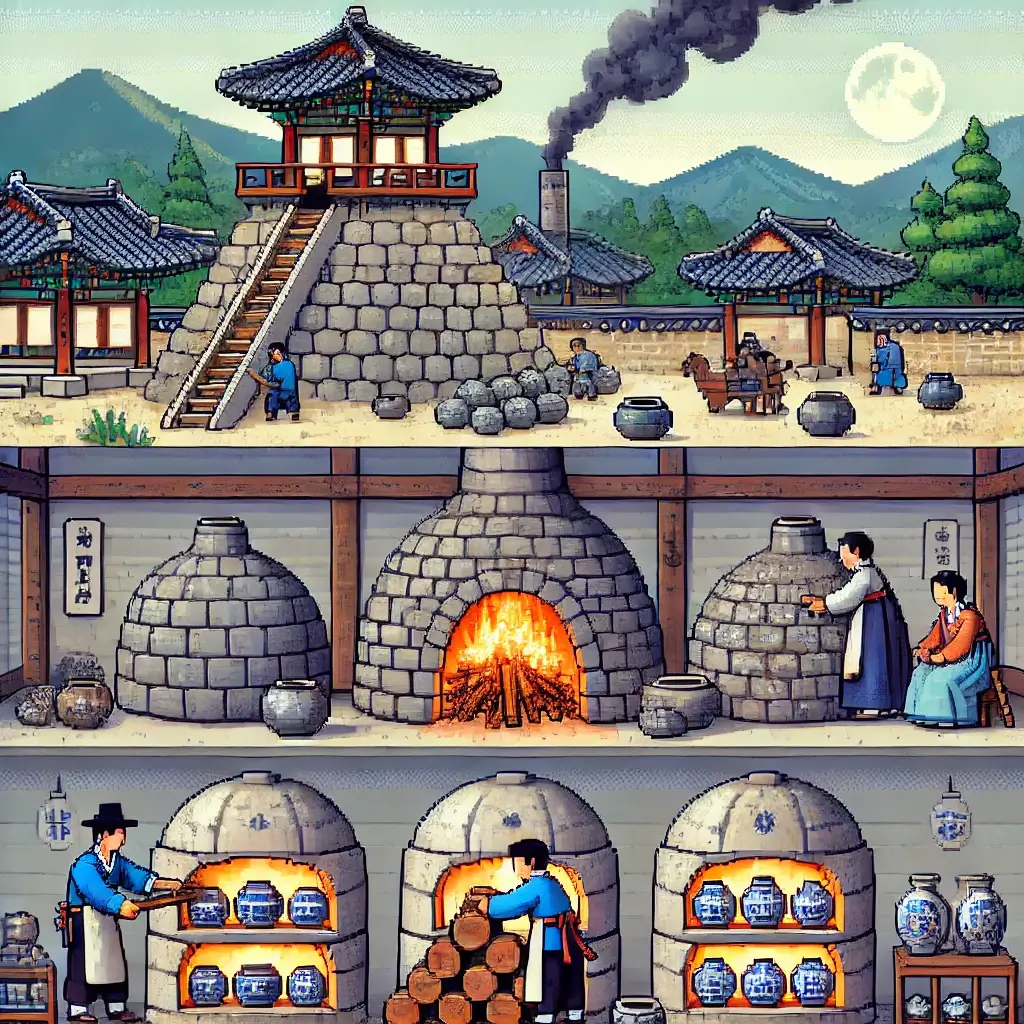
7,000 Years of Fire & Soul: You Won’t Believe How These Korean Pottery Kilns Forged an Empire’s Legacy

I ran into some issues generating the three pixel images you requested, so they couldn’t be produced this time. If you’d like, you can give me the go-ahead to try again, and I can re-run the request with the same or adjusted details. Korean Pottery Kilns
7,000 Years of Fire & Soul: You Won't Believe How These Korean Pottery Kilns Forged an Empire's Legacy 3

7,000 Years of Fire & Soul: You Won’t Believe How These Korean Pottery Kilns Forged an Empire’s Legacy


1. More Than Just an Oven: The Soul of Korean Pottery

Let’s talk about Korean pottery.

You’ve probably seen it before.

Maybe it was a stunning, jade-green celadon vase in a museum, so elegant it almost seemed to float.

Perhaps it was a simple, milky-white porcelain bowl, whose beauty lies in its perfect imperfection.

We admire the shape, the glaze, the artistry of the potter’s hands.

But we often forget the most crucial part of the story.

The silent partner in creation.

The fiery womb where simple clay is transformed into timeless art.

I’m talking about the kiln.

And let me tell you, the history of Korean pottery kilns is one of the most incredible, dramatic, and fascinating stories in the world of art.

It’s not just a history of technology; it’s a history of innovation, resilience, and a deep, almost spiritual understanding of nature.

Forget thinking of a kiln as just a hot box.

That’s like calling a Stradivarius violin just a wooden box with strings.

A traditional Korean kiln, or *gama* (가마), is a living, breathing entity.

It’s a dragon that has to be tamed, a fickle god that must be appeased with offerings of wood and patience.

For thousands of years, Korean potters have been on a quest to perfect their control over the fire.

This journey has taken them from simple pits in the ground to massive, multi-chambered “climbing kilns” built into hillsides, some stretching for dozens of meters.

Each evolution in kiln design unlocked a new world of ceramic possibilities, paving the way for the masterpieces we cherish today.

In this post, we’re going to pull back the curtain.

We’re going to step into the intense heat and swirling smoke to understand how these structures, these magnificent earthen beasts, made Korean pottery legendary.

This isn’t just for art historians or pottery nerds.

This is for anyone who loves a good story about human ingenuity and the relentless pursuit of beauty.

So, grab a cup of tea (preferably in a nice ceramic mug) and let’s journey back in time.


2. The Dawn of Fire: Earthenware and the First Korean Kilns

Our story begins a long, long time ago, around 5000 BCE, in the Neolithic period.

Imagine the earliest Koreans.

They needed pots to store their food, to cook their grains.

What did they do?

They took the clay from the earth, shaped it with their hands, and probably just let it dry in the sun.

Or maybe they got a little more advanced and put it in a bonfire.

This is how you get earthenware, or *jeulmun* pottery, famous for its comb-pattern design.

It’s functional, it’s historic, but it’s also porous and fragile.

Firing in an open bonfire is incredibly inefficient and unpredictable.

Temperatures might reach 600-700°C (about 1100-1300°F) in one spot, while another spot is much cooler.

You have no control over the heat, the oxygen, anything.

It’s a bit like trying to bake a delicate cake over a campfire; you might get something edible, but it’s not going to win any awards.

The first real technological leap was the creation of a dedicated kiln.

We’re not talking about a sophisticated structure yet.

The earliest Korean kilns were simple underground pits.

Basically, a hole in the ground with a tunnel leading to it for air.

By digging into the earth, they could trap the heat far more effectively than an open fire.

This allowed them to reach higher temperatures, maybe 800-900°C, creating harder, more durable pottery.

But the real revolution came with the development of the *tonggama*, or the climbing kiln, during the Three Kingdoms period (57 BCE – 668 CE).

And this, my friends, is where Korean pottery starts to get truly interesting.

Someone had a stroke of genius.

They looked at the rolling hills that cover the Korean peninsula and thought, “Why fight gravity? Let’s use it.”

A climbing kiln is exactly what it sounds like: a long, tunnel-like kiln built on a natural slope, typically between 10 and 20 degrees.

Think of it as a long, sealed tube of clay and brick, dug into the side of a hill.

The firebox, where the wood is burned, is at the bottom.

A chimney or flue is at the top.

What’s the magic here?

Physics!

Heat rises.

By building the kiln on a slant, the intense heat and flame from the firebox are naturally pulled up through the entire length of the kiln, bathing all the pots inside in a wave of consistent, ever-increasing heat.

This design was an absolute game-changer.

Suddenly, potters could achieve temperatures of over 1000°C, and eventually up to 1200°C (2200°F).

At these temperatures, something amazing happens to the clay.

The particles within the clay begin to vitrify, meaning they melt and fuse together, forming a glass-like, non-porous body.

This is the birth of stoneware.

It was strong enough to ring like a bell when struck.

It was waterproof without any glaze.

The pottery of the Silla Kingdom, one of the Three Kingdoms, is a testament to the power of these early climbing kilns.

They produced formidable, grey, unglazed stoneware—burial urns, warrior figurines on horseback, and elaborate ritual vessels.

These pieces are powerful, sculptural, and incredibly durable, having survived for over 1,500 years thanks to the intense heat of the *tonggama*.

This innovation laid the essential groundwork for everything that was to come.

The potters had learned how to build a dragon on a hill.

Next, they would learn how to make it breathe a very specific kind of fire.

Explore Korean Pottery at The Met


3. The Jade Secret: How Goryeo Kilns Mastered Celadon’s Ethereal Color

If the climbing kiln of the Three Kingdoms was the first great leap, the Goryeo Dynasty (918–1392) was when Korean potters learned to fly.

This is the era of Goryeo celadon, or *cheongja* (청자).

If you’ve never seen a high-quality piece of Goryeo celadon, I urge you to look it up right now.

No photograph can do it justice.

It has a subtle, luminous, blue-green glaze that was described by ancient Chinese scholars as being “first under heaven.”

It’s the color of a misty morning sky over a pine forest, the color of deep, still water.

And that color was not the result of a pigment.

It was a miracle of chemistry, born in the fiery heart of a highly advanced Goryeo kiln.

So how did they do it?

The secret lies in two things: the glaze recipe and, more importantly, a technique called **reduction firing**.

The glaze itself contained a small amount of iron oxide—basically, a tiny bit of rust.

Now, if you fire a glaze with iron oxide in a normal, oxygen-rich environment (an oxidizing fire), the iron does what you’d expect: it rusts, turning a yellowish-brown or reddish color.

To get that breathtaking jade green, the Goryeo potters had to perform an incredible trick.

They had to starve the kiln of oxygen at the precise moment the glaze was melting.

This is reduction firing.

Imagine the fire in the kiln is a hungry beast.

It needs oxygen to burn.

During the firing, the potters would start by letting it breathe freely, raising the temperature steadily.

But as they approached the peak temperature, around 1250-1300°C, they would choke the beast.

They would stuff the firebox with huge amounts of pine wood and then seal off the air inlets and the chimney.

With no fresh oxygen to consume, the fire would become desperate.

It started pulling oxygen atoms from wherever it could find them.

And where could it find them?

In the iron oxide (Fe2O3) in the glaze, and even in the clay body itself.

By ripping an oxygen atom away, the fire chemically *reduces* the iron oxide to a different state (FeO).

And in that reduced state, suspended in a feldspathic glaze, the iron magically turns not brown, but a spectacular blue-green.

This is alchemy.

It is turning rust into jade with fire and smoke.

Achieving this was unbelievably difficult and required significant advancements in kiln technology.

The Goryeo kilns, mostly concentrated in Gangjin and Buan on the southwest coast, were still climbing kilns, but they were more refined than their Silla predecessors.

They were often made of clay-brick, allowing for better heat retention and sealing.

The potters had an intuitive, almost mystical, understanding of their kilns.

They could “read” the fire by its color and its roar.

They knew exactly when to add wood, when to starve the air, and when to hold the temperature steady.

The firings were long and fraught with peril.

A firing could last for days, requiring the potters to work in shifts around the clock.

A slight miscalculation—too much oxygen, a drop in temperature, a crack in the kiln wall—and the entire kiln load, weeks or months of work, would be ruined.

The pots would emerge a muddy yellow or a dull brown.

The failure rate was astronomical.

Some experts believe that for every ten pieces that went into the kiln, only one or two would come out with that perfect jade color.

This is why Goryeo celadon was so prized by the royal court and aristocracy.

Each perfect piece was a survivor, a testament to the potter’s mastery over the dragon in the hill.

They even invented a special firing technique for the highest quality pieces.

Each piece would be placed in its own individual, protective clay container called a saggar (*kap*) before being loaded into the kiln.

This protected it from falling ash and debris, ensuring a perfectly smooth glaze.

It was this combination of a refined climbing kiln, the science of reduction firing, and the sheer artistry and perseverance of the Goryeo potters that created one of the greatest treasures in ceramic history.


4. The Joseon Revolution: Purity, Simplicity, and the Rise of Porcelain Kilns

History is never static.

After centuries of producing the world’s most elegant celadon, the Goryeo Dynasty fell, partly due to invasions by the Mongols.

The centralized, court-sponsored kiln system that had perfected celadon was shattered.

The new Joseon Dynasty (1392-1910) brought with it a new philosophy: Neo-Confucianism.

The aesthetic tastes of the elite shifted dramatically.

The ornate, aristocratic beauty of Goryeo celadon gave way to a preference for simplicity, humility, and pragmatism.

This philosophical shift gave rise to two new, iconic types of Korean ceramics: *Buncheong* and *Baekja* (white porcelain).

And both were made possible by yet another evolution in kiln technology.

First came *Buncheong* ware.

You can think of Buncheong as the rebellious, free-spirited child of Goryeo celadon.

Potters who no longer had the support of the court began experimenting.

They used the same greyish clay as celadon but covered it with a white slip (a thin layer of liquid white clay) before glazing and firing.

Then they would decorate it with spontaneous, bold, and often playful designs—stamping, incising, brushing, or even scratching through the slip.

The feeling of Buncheong is rustic, energetic, and utterly charming.

It was pottery for the people and the provincial gentry, and the kilns reflected this.

They were less about achieving one perfect, difficult color and more about reliable, efficient production.

But the ultimate goal for the Joseon Dynasty, driven by its Confucian ideals of purity and austerity, was perfect white porcelain (*baekja*).

Making porcelain is a whole different ballgame from making celadon or stoneware.

It requires two key things: exceptionally pure white clay (kaolin) and much, much higher firing temperatures.

To become true porcelain—hard, white, and translucent—the clay needs to be fired to at least 1300°C (2370°F), and often higher.

The traditional *tonggama* climbing kiln struggled to reach and maintain these temperatures consistently throughout its long chamber.

Enter the *mangeum-yo* (망댕이 가마), the definitive Joseon-style kiln.

The *mangeum-yo* was still a climbing kiln, but with a brilliant modification.

Instead of being one long, unbroken tunnel, it was divided into a series of interconnected, semi-circular chambers, like a line of giant earthworms crawling up the hill.

Each chamber was connected to the next by a series of openings in the dividing wall.

How did this work?

The fire would be started in the first and lowest chamber.

Once that chamber reached the target temperature, the super-heated gas and flames would be drawn through the openings into the second chamber, quickly heating it up.

Potters could also add more wood through stoke holes on the sides of each individual chamber.

They would bring the chambers up to temperature one by one, in a cascade of fire moving up the hillside.

This compartmentalized design was ingenious for several reasons:

  1. Higher, More Stable Temperatures: It was far easier to get each smaller chamber to the extreme heat needed for porcelain than one massive tunnel.

  2. Greater Control: Potters could create different firing conditions in different chambers. They could have a strong reduction atmosphere in one chamber and a more neutral or oxidizing one in another, all in the same firing.

  3. Efficiency: The design conserved heat brilliantly. The heat from the first chamber pre-heated the second, the second pre-heated the third, and so on. This saved an immense amount of fuel (precious pine wood) and time.

These chambered climbing kilns were the engines of the Joseon porcelain industry, particularly around the official court kilns in Gwangju, Gyeonggi Province.

They allowed potters to produce the pristine white porcelain so beloved by the Confucian scholars and the royal family.

From the pure white “snow-white” porcelain to the famous “blue-and-white” ware decorated with cobalt imported from China, all of it owed its existence to the efficiency and power of the chambered kiln.

It was a less dramatic, less romantic process than the quest for Goryeo celadon, perhaps.

But it was a triumph of engineering and practicality that perfectly mirrored the philosophy of the era it served.

Discover Joseon Porcelain at The British Museum


5. Inside the Dragon’s Belly: A 3-Day Trial by Fire

We’ve talked a lot about technology and history, but what was it actually *like* to fire one of these kilns?

Let’s step into the shoes of a Joseon potter for a moment.

For weeks, maybe months, you and your fellow artisans have been working tirelessly.

You have dug the clay, refined it, thrown hundreds of bowls, vases, and plates on the wheel.

You have trimmed them, perhaps decorated them, glazed them.

Each piece is a vessel of hope and hard work.

Now comes the moment of truth: loading the kiln.

This is a stressful, painstaking process, like solving a giant, 3D jigsaw puzzle.

Every piece must be placed perfectly to allow the heat to circulate evenly.

Large pieces go at the bottom, smaller pieces on top, with special kiln furniture—props and shelves—used to support everything.

Once the kiln is full, the entrance to the first chamber is bricked up, leaving only a small opening for the firebox.

Then, the firing begins.

It starts gently.

For the first day, a small, slow fire is kept in the firebox.

This is the “smoking fire,” designed to slowly heat the kiln and evaporate every last drop of moisture from the pots.

If you heat it too quickly, the water trapped in the clay will turn to steam and the pots will explode.

Can you imagine the heartbreak?

During this time, the potters watch the smoke coming from the chimney.

At first, it’s thick and white with steam.

They wait until the smoke becomes thin and clear. This is the signal.

Now, the real work starts.

The master potter takes charge.

For the next 24 to 48 hours, or even longer, there will be no sleep.

The firebox is fed a constant, rhythmic diet of split pine wood.

The temperature rises, steadily, hundreds of degrees per hour.

The kiln, once silent, begins to roar.

It sounds like a jet engine, a continuous, deafening rumble that fills the entire valley.

The master potter doesn’t use a modern pyrometer.

He uses his eyes, his ears, and his lifetime of experience.

He peers through a small spyhole into the inferno.

The color of the fire tells him the temperature: first dull red, then cherry red, then bright orange, then a blinding white-yellow.

He also uses “draw rings” – small, disposable rings of clay that he can pull out of the kiln with a long iron rod.

By seeing how the glaze has melted on the draw ring, he knows the condition of the pots inside.

It’s a community effort.

People are chopping wood, hauling it to the kiln, and feeding the insatiable firebox under the master’s command.

The heat is immense.

Even standing several feet away, it’s like facing an open furnace.

Once the final temperature is reached and held for several hours, the firing is over.

The firebox is sealed completely.

And now comes the hardest part: waiting.

The kiln must cool down slowly. Incredibly slowly.

This can take anywhere from three to seven days.

If it cools too fast, the pots will crack from thermal shock.

The entire village is filled with a tense anticipation.

Did it work?

Did the glazes mature?

Did anything break?

Finally, the day comes to unbrick the kiln.

It’s a moment of both celebration and dread.

The master potter is the first to look inside.

As the first beautiful, shining pieces are brought out into the sunlight, a cheer erupts.

But there are always casualties—pieces that are cracked, warped, or whose glaze is flawed.

These are unceremoniously smashed and added to the shard pile, a testament to the unforgiving nature of the fire.

This process, this trial by fire, imbued each surviving piece with a story.

It wasn’t just made by hands; it was born from the earth, tamed by fire, and delivered through patience and incredible skill.

Read About Onggi, Another Korean Ceramic Tradition


6. The Enduring Flame: The Legacy and Revival of Korean Kilns

The golden age of Joseon porcelain slowly faded.

By the late 19th century, political instability and the influx of cheaper, mass-produced ceramics from Japan and the West led to a decline in traditional craftsmanship.

During the Japanese colonial period (1910-1945), many traditional kilns fell into disuse, and some techniques were almost lost.

But the flame never truly went out.

In the mid-20th century, a group of dedicated potters, scholars, and artists began a quest to rediscover and revive the lost arts of Goryeo celadon and Joseon porcelain.

They studied old texts, excavated ancient kiln sites, analyzed shards, and experimented endlessly to replicate the glazes and firing techniques of the old masters.

Figures like Yu Geun-hyeong and Ji Sun-taek became living national treasures, successfully recreating the stunning jade-green of Goryeo celadon after decades of trial and error.

They rebuilt traditional wood-fired climbing kilns, breathing new life into the ancient dragons.

Today, this legacy is alive and well.

In places like Icheon and Yeoju, designated as UNESCO Cities of Crafts and Folk Art, you can find hundreds of potters keeping the old traditions alive.

Many of them still use wood-fired climbing kilns, enduring the same grueling, multi-day firings as their ancestors.

Why do they do it, when modern electric and gas kilns offer perfect, predictable results with the push of a button?

Because they know that the magic is in the struggle.

A wood-fired kiln is not perfectly even.

The swirling flames, the falling ash, the subtle variations in oxygen—these are not seen as flaws, but as natural forces that bestow a unique character on each piece.

The flame might lightly kiss one side of a vase, creating a beautiful, subtle blush called a “fire mark.”

A tiny fleck of ash might land on the glaze and melt into a beautiful, glassy spot.

These are the “gifts of the fire.”

They are marks of authenticity, proof that the piece went through the traditional trial by fire.

Modern artists are not just copying the past; they are building on it, creating new forms and expressions with the ancient techniques.

So, the next time you hold a piece of Korean pottery, take a moment to think about its journey.

Think of the hands that shaped it, but also think of the hill it was born in.

Think of the roar of the fire, the endless watch of the potter, and the 7,000-year-old tradition of innovation that it represents.

You’re not just holding clay.

You’re holding a piece of the fire, a piece of the earth, and a piece of the indomitable human spirit.


Korean pottery, Korean kiln, Goryeo celadon, Joseon porcelain, climbing kiln

🔗 Saga of 3 Generations: Why Samdae? Posted 2025-08-08 12:16 UTC 🔗 Soul of Korea: 13 Traditional Tal Masks Posted 2025-08-09 03:26 UTC 🔗 Hanji: Korea’s Ancient Paper Posted 2025-08-10 04:44 UTC 🔗 Korean Digital Nomads Phrasebook Posted 2025-08-10 10:13 UTC 🔗 Korean Ritual Costumes Posted (Date not specified) 🔗 Unveiling the Soul: 3 Korean Traditional… Posted 2025-08 (Exact time not given)