
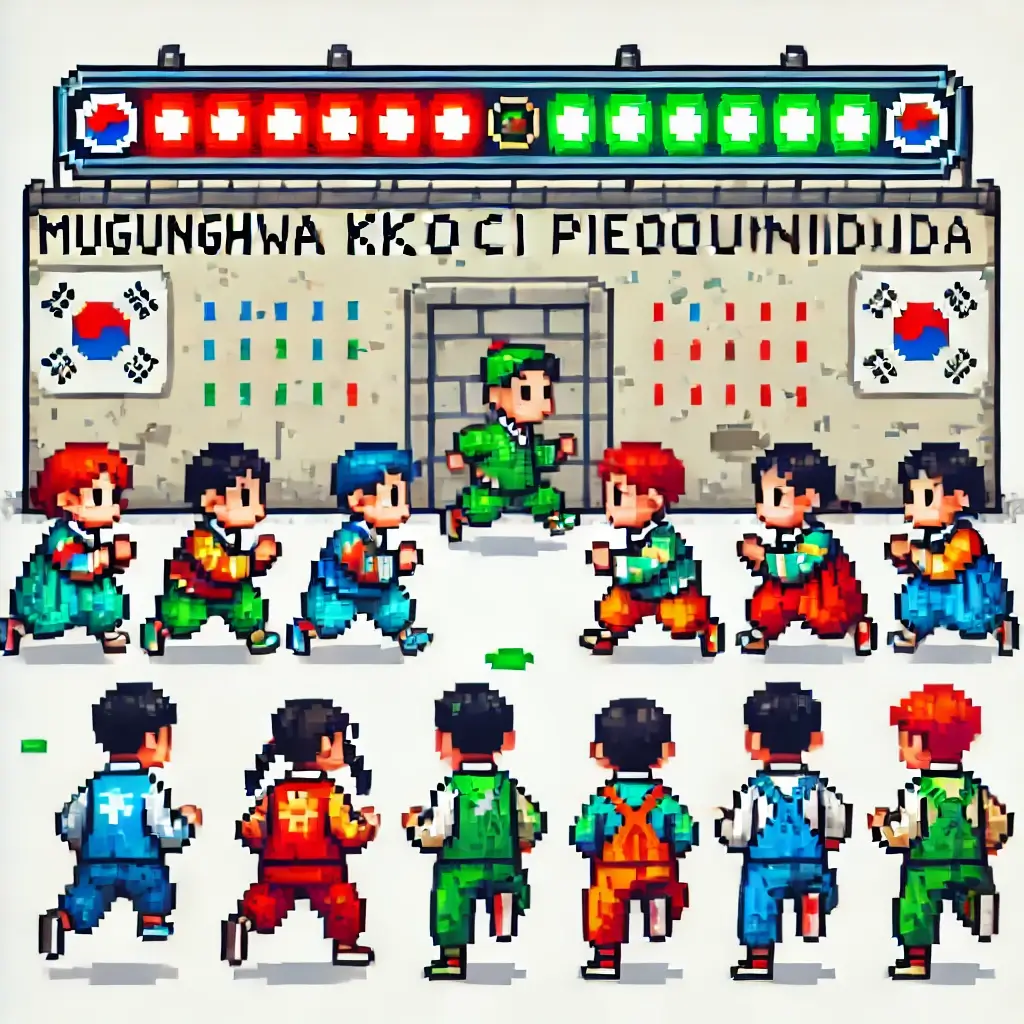
10 Korean Traditional Games Your Kids Will Absolutely Adore!
Hello, wonderful parents and educators! Are you on the lookout for a way to pull your kids away from their screens and into a world of imagination, laughter, and a bit of good old-fashioned competition?
I get it. We’ve all been there, watching our little ones get mesmerized by glowing rectangles.
But what if I told you there’s a treasure trove of fun just waiting to be explored, a secret handed down through generations?
That’s exactly what we’re diving into today—the enchanting world of **Korean traditional games for children**.
These aren’t just games; they are vibrant pieces of Korean culture, packed with lessons on teamwork, strategy, and resilience.
I remember playing these games myself as a kid, in the back alleys of Seoul, with my friends, until the streetlights came on.
The simple joy of chasing a friend in “Mugunghwa Kkoci Pieotseumnida” or the thrill of launching a “ddakji” was unmatched.
No fancy graphics, no in-app purchases—just pure, unadulterated fun.
So, grab a cup of your favorite tea, settle in, and let’s explore ten of these amazing games that will not only entertain your kids but also connect them with a rich and beautiful heritage.
Table of Contents
Why Traditional Games are a Secret Weapon for Child Development
Before we jump into the games themselves, let’s talk about why these old-school pastimes are so vital.
In our hyper-digital world, it’s easy to forget the simple power of face-to-face interaction and active play.
Traditional Korean games, much like traditional games everywhere, were born out of necessity—they were a way for communities to bond, for kids to burn off energy, and for valuable life skills to be passed down without anyone even realizing it.
They teach kids how to negotiate, how to be a good sport (whether winning or losing!), and how to use their bodies in new and exciting ways.
Think of it like this: a video game might teach a child how to solve a puzzle on a screen, but a game like **Juldarigi** teaches them that by working together, they can accomplish something impossible on their own.
It’s a lesson that stays with you forever.
So, let’s start our journey.
1. Mugunghwa Kkoci Pieotseumnida (무궁화 꽃이 피었습니다): The Korean Version of Red Light, Green Light
This is probably the most famous Korean children’s game, thanks to a certain popular TV show.
The name literally means “The mugunghwa flower has bloomed.”
Don’t worry, it’s not as poetic as it sounds.
It’s an absolute riot of a game, and the rules are incredibly simple, which makes it perfect for kids of all ages.
How to Play
One person is the “it” and stands with their back to the other players, facing a wall or a designated spot.
They cover their eyes and chant the phrase: **”Mugunghwa Kkoci Pieotseumnida!”**
While they’re chanting, the other players try to run as fast as they can towards them.
The moment the person finishes the chant and turns around, everyone must freeze.
And I mean, **absolutely freeze**.
If the “it” person sees anyone move, that person is caught and must join hands with “it,” forming a human chain.
The game continues until all players are caught, or someone is brave (or fast) enough to tag the “it” person and yell “Mugunghwa Kkoci Pieotseumnida!”
If a tag is successful, all the captured players are freed, and everyone runs back to the starting line.
The newly tagged person becomes the next “it.”
It’s a simple premise, but it leads to some truly hilarious and suspenseful moments.
You’ll see kids contort their bodies into the strangest, most awkward poses, all in the name of staying still.
2. Gonggi (공기): The Korean Five Stones Game
This is a classic that has been played by Korean children for centuries.
I can almost guarantee that any Korean adult you ask has a story about playing **Gonggi**.
The name “gonggi” translates to “air” or “stone,” and the game involves throwing and catching small stones or pebbles.
It’s a fantastic way to develop hand-eye coordination and fine motor skills.
You only need five small stones or plastic gonggi pieces, and a flat surface.
How to Play
The game is played in five stages, or “dahn.”
1st Dahn: The player tosses all five stones onto the ground, picks one up, throws it into the air, and before it lands, quickly picks up another stone and catches the thrown one.
This continues until all the stones have been picked up one by one.
2nd Dahn: This time, the player picks up the stones two at a time.
3rd Dahn: The player picks up one stone, then three stones.
4th Dahn: This is the most challenging one! The player throws one stone up, picks up all four remaining stones, and then catches the falling stone.
It’s harder than it sounds!
5th Dahn (The “Gonggi-jip”): The player holds all five stones in their palm, tosses them into the air, and quickly flips their hand over to catch as many as possible on the back of their hand.
Then, they toss the stones again and catch them in their palm.
The number of stones successfully caught is their score.
If a player fails at any step, their turn is over, and the next player goes.
The game can get pretty competitive, especially when players get to the higher stages!
3. Ddakji (딱지): The Epic Paper Flipping Game
Remember the TV show? Yes, this is that game.
**Ddakji** is a deceptively simple game of skill, physics, and a whole lot of dramatic flair.
The goal is to flip your opponent’s “ddakji” by slamming your own onto it.
The sound of a successful flip—a satisfying “thwack!”—is one of those childhood sounds that just never leaves you.
It’s also super easy to make your own ddakji from folded paper, which adds a wonderful element of creativity to the game.
You can use old magazines, newspapers, or even just regular paper.
How to Play
First, you need to make your ddakji.
It’s a simple, two-fold design that creates a thick, square paper tile.
Players take turns.
One player places their ddakji on the ground.
The other player then holds their own ddakji and slams it down with force, aiming to create enough air pressure to flip the one on the ground.
If they succeed, they win the opponent’s ddakji.
The game continues until one player has all the ddakji.
It’s a mix of brute force and technique.
Kids will spend hours perfecting their slam, trying to find just the right angle and force.
It’s a perfect example of a game that encourages experimentation and problem-solving without them even knowing it.
4. Yut Nori (윷놀이): The Family Board Game
While some games are for the playground, **Yut Nori** is the ultimate Korean family game, often played during holidays like Seollal (Lunar New Year).
It’s a game of strategy and luck, played with four specially shaped wooden sticks called “yut” and a game board.
The sticks act as dice, and the game is designed to be played by teams, which makes it perfect for family gatherings.
It’s a fantastic way to teach kids about probability and strategy in a fun, low-stakes environment.
How to Play
The game board is a circle with a cross inside.
Each team has four “mal” (horses or tokens) that they move around the board.
The yut sticks determine how many spaces a team can move.
The sticks are flat on one side and rounded on the other.
When you throw them, the combination of flat and rounded sides that land face up determines your move.
- Do (도): One flat side up = Move 1 space.
- Gae (개): Two flat sides up = Move 2 spaces.
- Geol (걸): Three flat sides up = Move 3 spaces.
- Yut (윷): All four flat sides up = Move 4 spaces and get another turn.
- Mo (모): All four rounded sides up = Move 5 spaces and get another turn.
The goal is to get all four of your team’s mal around the board and back to the starting point.
If one of your mal lands on the same space as an opponent’s, you can “catch” them and send them back to the start.
It’s a game of thrilling comebacks and heartbreaking losses, a true emotional roller coaster for the whole family!
5. Tuho (투호): The Traditional Arrow-Throwing Game
**Tuho** is a game with deep historical roots, once a popular pastime among the Korean aristocracy.
It’s a game of focus and accuracy, similar to horseshoes or cornhole, but with a more elegant feel.
The objective is to throw small arrows into a large, narrow-mouthed jar from a set distance.
It’s a fantastic way to teach kids patience and precision, and it’s something that can be easily set up in a backyard or a large room.
How to Play
You need a jar and several arrows (or sticks, or even rolled-up pieces of paper).
Players stand a certain distance from the jar and take turns trying to land their arrows inside.
The player who gets the most arrows into the jar wins.
It sounds simple, but the challenge is in getting the right arc and force, especially from a distance.
The game promotes concentration and a sense of calm, a nice contrast to some of the more boisterous games on this list.
6. Jegi Chagi (제기차기): The Korean Shuttlecock Kicking Game
**Jegi Chagi** is a simple yet addictive game that tests a player’s agility and balance.
It’s similar to hacky sack, but instead of a ball, you use a “jegi” (a Korean shuttlecock).
A jegi is traditionally made from a coin with a hole in the middle, wrapped in cloth or paper strips.
The objective is to kick the jegi into the air as many times as possible without letting it touch the ground.
How to Play
Hold the jegi and drop it.
As it falls, you use the inside or outside of your foot to kick it back up into the air.
You can’t use your hands, and you have to keep it airborne for as long as you can.
Players can compete against each other to see who can get the most kicks in a row.
It’s a great solo game for practicing, but it’s even more fun with friends, challenging each other to beat their personal bests.
This game is a fantastic way to improve gross motor skills and coordination.
7. Juldarigi (줄다리기): The Ultimate Tug-of-War
This is probably one of the most powerful and community-driven traditional Korean games.
**Juldarigi**, or tug-of-war, isn’t just a game; it’s a centuries-old ritual.
It’s a symbol of unity and cooperation, and it’s a game that brings entire communities together.
The sheer physical effort and teamwork involved are incredible.
It’s an unforgettable experience for kids, teaching them the value of collective strength.
How to Play
The rules are simple: two teams, a very long and thick rope, and a designated midpoint.
Each team pulls as hard as they can, trying to drag the other team over the center line.
This game requires strategy, a sense of rhythm, and most importantly, teamwork.
Kids learn to listen to their teammates, to pull in unison, and to keep going even when they feel like giving up.
It’s a fantastic metaphor for life and teaches a powerful lesson about community and shared goals.
8. Gonsarang (곤사랑): The Korean Jacks Game
**Gonsarang** is the Korean version of jacks, and it’s another one of those games that’s perfect for developing hand-eye coordination and concentration.
The name “Gonsarang” isn’t a widely used term, but the game itself is universally known as **”Gonggi-nori”** or simply **”Gonggi”** when played with stones.
I’ve included this because the name can sometimes vary, and it’s good to know the variations!
The game is the same as the “Gonggi” we discussed earlier, using five stones.
I’ve added this section to reinforce the idea of this beloved game’s cultural significance.
A Quick Recap
Just to reiterate, the game involves a series of increasingly difficult stages, from picking up stones one by one to a final, thrilling catch on the back of the hand.
It’s a game that’s perfect for a rainy day inside or a lazy afternoon outside.
It’s a testament to the fact that you don’t need expensive toys to have fun.
9. Ssang-yongjuldarigi (쌍용줄다리기): Double Dragon Tug-of-War
This is an incredible variation of **Juldarigi** that you might see during traditional festivals.
Instead of a single rope, two ropes are used, creating a “double dragon” effect.
The teams stand in a circle and pull on the ropes, often with music and cheering adding to the festive atmosphere.
The visual of two giant, coiling ropes being pulled by a mass of people is something to behold.
While a bit more complex for a simple playdate, the concept of **Ssang-yongjuldarigi** highlights the deep cultural importance of communal effort and harmony in Korean society.
It’s a perfect example of a game that’s not just about winning, but about celebrating togetherness.
Community and Unity in Play
This game is a great entry point for a discussion with your kids about what it means to be part of a community.
It’s about how everyone has a role to play, no matter how small, and how when we all work together, we can achieve something truly amazing.
It’s a beautiful and powerful lesson, wrapped in a fun, active game.
10. Ttattame (땃다매): The Korean Hopscotch
You might think you know hopscotch, but the Korean version, **Ttattame**, has a few unique twists!
The name “Ttattame” is a bit informal; it’s more commonly known as **”Sabal-ttagi”** or **”Gonggan-ttagi.”**
The game is played on a chalk-drawn court with a small stone or “mal.”
The goal is to move your stone through the squares while hopping on one foot, without touching the lines.
How to Play
A court is drawn on the ground with chalk.
It usually consists of a series of single and double squares.
The first player throws their stone into the first square.
They then hop on one foot through the court, skipping the square with the stone.
On the way back, they stop in the square before the stone, bend down (still on one foot!), pick up the stone, and hop out of the court.
If they successfully complete the round without touching a line or losing their balance, they get to throw their stone into the next square.
If they make a mistake, their turn is over.
The game is a fantastic workout for balance, coordination, and focus.
Beyond the Fun: The Amazing Benefits of Korean Traditional Games
Look, I’m not a doctor or a child psychologist, but as a human being who has seen the magic of these games firsthand, I can tell you they are so much more than just a way to pass the time.
These games are a secret weapon for your kids’ development.
Think about it:
- Physical Development: Games like **Jegi Chagi** and **Ttattame** build gross motor skills, balance, and coordination. They get kids moving, running, and jumping, which is something so many of our kids need more of.
- Cognitive Skills: From the strategic thinking in **Yut Nori** to the intense concentration required for **Gonggi**, these games sharpen young minds. They teach problem-solving, cause and effect, and forward-thinking.
- Social-Emotional Learning: This is where the real magic happens. Playing **Mugunghwa Kkoci Pieotseumnida** teaches kids about patience and following rules. **Juldarigi** is the ultimate lesson in teamwork and cooperation. They learn to celebrate wins together and support each other through losses.
- Cultural Connection: These games offer a tangible link to Korean history and tradition. They can spark curiosity about the culture, leading to conversations about family, heritage, and the stories of the past. It’s a beautiful way to connect with a new or ancestral culture.
Ready to Play? It’s So Much Easier Than You Think!
The best part about these **Korean traditional games** is that you don’t need to be an expert or have any special equipment.
A few sticks, some stones, or just your own two feet are all you need to get started.
Introduce one game at a time.
Start with something simple like **Mugunghwa Kkoci Pieotseumnida**.
The laughter and excitement will follow naturally.
And hey, maybe you’ll even get a little nostalgic and join in on the fun yourself!
I guarantee it’s a great workout.
Here are some of the links to help you learn more about these fascinating games and other aspects of Korean culture:
So, what are you waiting for? Let’s turn off the screens and bring some of these amazing **Korean traditional games** to life.
Your kids will thank you for it, and you’ll be creating memories that will last a lifetime.
Happy playing!
Korean traditional games, children’s games, Mugunghwa Kkoci Pieotseumnida, Ddakji, Yut Nori
🔗 Regional Dialects Posted 2025-08-13 07:37 UTC 🔗 Japanese Tea Ceremony Posted 2025-08-13 09:25 UTC 🔗 Japanese Grammar Nuances for JLPT N2/N1 Posted 2025-08-13 11:27 UTC 🔗 Jeong (정) Posted 2025-08-14 07:01 UTC 🔗 Mythical Korean Animals Posted — 🔗 9 Mythical Animals in Korean Folklore Posted 2025-08-13 UTC