
*This post was last updated with the latest information on December 2, 2025.

Hanok Design: 7 Practical Lessons for Layout, Comfort and Renovation
Contents — choose a section
Table of Contents
Why hanok design remains a useful planning reference
Historic and contemporary buildings can coexist in a city without one format being inherently better. Compare the specific building’s daylight, comfort, condition and usability rather than its label.
Start with how people, air and light move through the existing rooms. Document that pattern before selecting furniture or assuming a traditional layout solves a modern problem.
A useful briefing question is where winter and summer light falls. Discuss shading and orientation with the designer without inventing a percentage of future regret avoided.
Hanok design shines in three places: light, flow, and material honesty. The good news? You don’t need a tiled roof or a full courtyard to borrow those three pillars. You can start with your current apartment and a tape measure.
- Ask where the sun enters your home in winter and summer.
- Notice how you actually walk, sit, and gather in each room.
- List three surfaces your hands and bare feet touch every day.
Apply in 60 seconds: Stand in your living room, spin slowly once, and mark with sticky notes where the best natural light lands today.
Money Block #1 – 7-question “Is hanok-inspired design worth it for me?” checklist
Answer “yes” or “no” to each:
- Is natural light currently blocked by furniture, curtains, or tall storage?
- Do you spend most of your time in 1–2 rooms while the rest stays underused?
- Would you happily sit on the floor if it were warm, clean, and comfortable?
- Are you willing to maintain at least one natural material (wood, paper, stone)?
- Can you live with fewer but better pieces of furniture?
- Do you value quiet, privacy, and soft transitions more than big open-plan rooms?
- Are you planning to stay in this home at least 3–5 years?
If you answered “yes” to 4 or more, hanok-inspired design changes will likely feel high-impact and worth the planning effort.
Save this checklist and glance at it before you sign any design or renovation contract.
Lesson 1 – Light before luxury: madang, windows, and the real main character
Before closing an opening for a larger screen or storage, examine its role in light, ventilation, circulation and structure. A qualified professional should assess any physical alteration.
In a hanok, the courtyard is the quiet main character. It doesn’t have to be huge. Ours is basically a glorified light well, just big enough for two chairs and a stubborn potted pine. But the way light bounces off it changed how the entire house feels, especially in winter.
Here’s what “light before luxury” looked like in practice:
- We rotated the dining table so the longest side runs along the window, not the wall.
- We kept the lower window rail height, so you see sky and trees while seated on the floor.
- We chose simple roller blinds with high light transmission instead of heavy curtains.
Daylight observations need dates, weather and room positions. One bright morning cannot establish year-round lighting performance or heating savings.
Money Block #2 – 60-second “hanok light potential” estimator
- Pick the room you use most (living room, bedroom, or home office).
- During daylight, count how many walls have access to daylight (windows, glass doors, or borrowed light from another room).
- 0 walls: score 0
- 1 wall: score 1
- 2+ walls: score 2
- Now count how many large objects block that light within 1.5 meters of the window (tall cabinets, wardrobes, big sofas).
- 0 objects: +2 points
- 1 object: +1 point
- 2+ objects: 0 points
Score 3–4: you already have strong “hanok-level” light potential; prioritize reflective surfaces and low furniture.
Score 0–2: move or replace at least one blocking item before spending money on new fixtures.
Use this estimator before buying any new lighting—rearrange first, then pay for what light can’t solve.
Show me the nerdy details
Traditional hanok design uses orientation to catch low-angle winter sun and avoid harsh summer heat. In practice, that means prioritizing glazing on the south and east sides, adding shading or deep eaves to the west, and using interior windows or transoms to borrow light into deeper rooms. Even in an apartment, you can mimic this by keeping your brightest facade as clutter-free as possible and using interior glass doors to pull light into corridors.
- Protect any opening that brings light into multiple rooms.
- Lower, wider windows feel more hanok-like than tall, narrow ones.
- Blinds that soften light beat heavy blackout curtains in living zones.
Apply in 60 seconds: Take a photo of your brightest window and draw three red circles where big furniture blocks light—you’ve just found your first design targets.
Lesson 2 – Floor heights, ondol heat, and the calm of low living
Floor height, temperature and the choice of seating affect how people use a room. Check comfort and access for everyone who will live there rather than assuming floor sitting suits all users.
Two possible design questions to discuss are:
- We kept a slight level change between the entrance and the main living space.
- We invested disproportionately in good ondol and insulation, even if it meant cheaper cabinets.
A level change may define a room but can also create a trip or access barrier. Assess it for the household’s needs instead of treating the effect as universally calming.
Constructed example: During a heating interruption, occupants use a planned safe response and contact the responsible service. This is not evidence that a hanok retains heat longer than another building, and no improvised heating method is recommended.
Practical check: Use the specific questions below. A generic formula cannot establish an obligatory gift, safe treatment, legal protection or the right purchase for every situation.
Show me the nerdy details
Comfort on the floor is a function of surface temperature, air temperature, and radiant balance. Because hanok-style ondol heats from below, you can often keep air temperatures 1–2°C lower while feeling equally or more comfortable, which may reduce energy use over a full heating season. The key is minimizing thermal bridges and drafts, especially around doors and windows, so the warm floor isn’t fighting cold air leaks.
- Invest in insulation and zoned heating before fancy fixtures.
- Keep subtle level changes to mark sacred, shoes-off zones.
- Choose floor finishes your skin actually enjoys touching.
Apply in 60 seconds: Sit directly on your living room floor for five minutes; write down what feels wrong—temperature, hardness, dust, or draft.
Lesson 3 – Sliding doors, hidden storage, and flexible rooms
A flexible room can support different uses if its dimensions, storage, privacy and access actually work. Sliding panels alone do not make every room suitable for sleeping, work and guests.
List the room’s daily and occasional uses and test how furniture and storage would change between them. Confirm privacy, ventilation and safe access before assuming one layout fits all.
A flexible-room proposal might examine:
- A low, wide desk that can also be used for meals or crafts.
- Two layers of sliding doors: one solid, one translucent, to control privacy and light.
- A full-height storage wall hiding bedding, suitcases, and seasonal clothing.
Check the room in each intended configuration, including safe movement, lighting, power, storage and privacy. A sketch that works with empty furniture outlines may fail in daily use.
- Use sliding doors instead of fixed walls where possible.
- Hide visual clutter in one well-designed storage wall.
- Plan how a room changes from morning to evening.
Apply in 60 seconds: List three functions you want one room to serve in a single day; rearrange one piece of furniture to support that.
Show me the nerdy details
Sliding doors and partitions reduce swing-clearance zones, which often frees up 10–15% more usable floor area in small homes. When you align track directions with natural circulation paths, you reduce “dead corners” and improve both privacy and ventilation. In hanok-inspired design, translucent panels also let you share light between rooms while maintaining modesty.
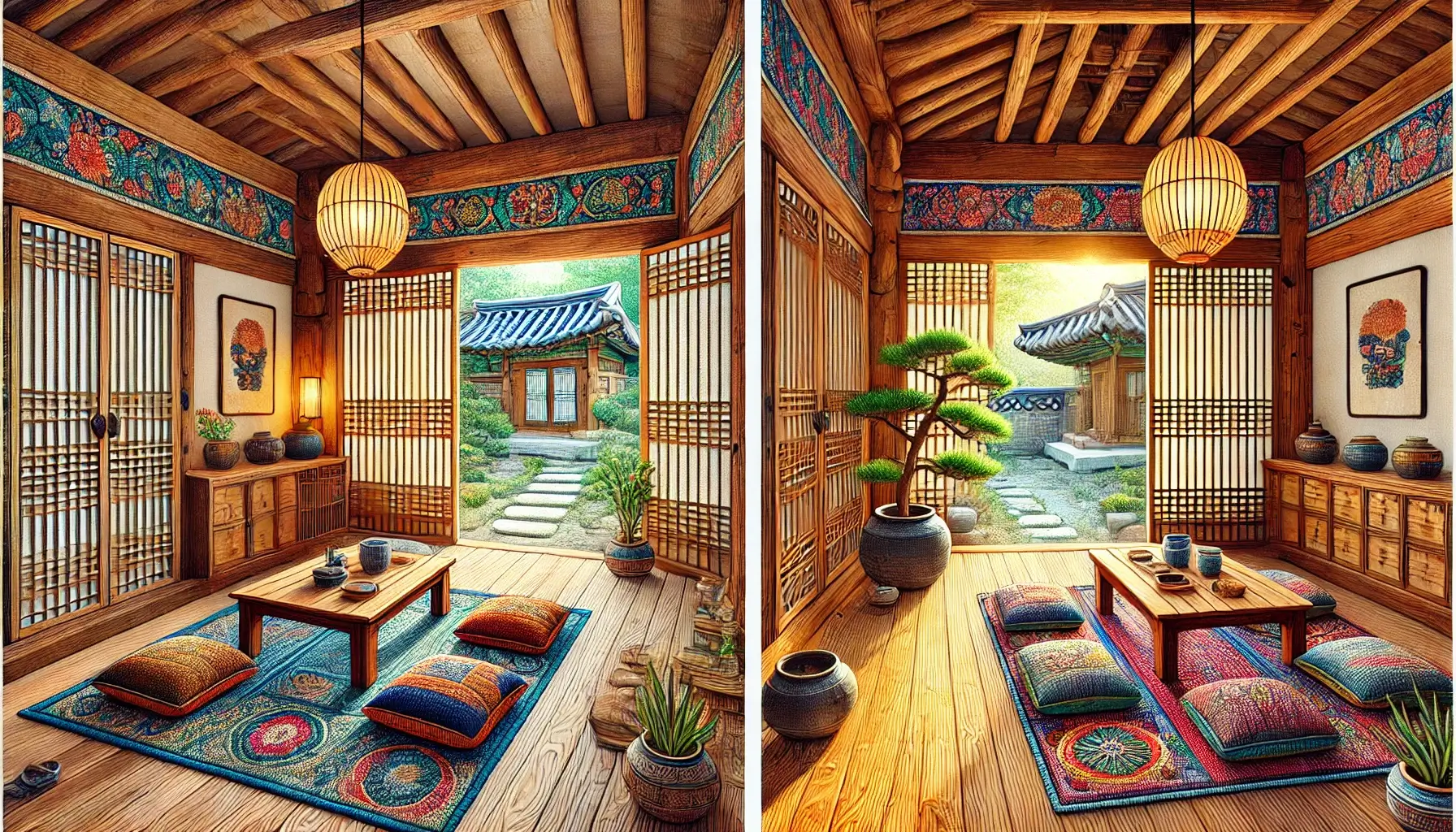
Lesson 4 – Natural materials, real maintenance
Here’s the part Instagram doesn’t tell you: real wood dents, hanji stains, and stone chips. If you want a hanok-inspired home that ages gracefully, you need to make peace with patina instead of chasing showroom perfection.
Natural wood and paper-like finishes have different durability and care needs. Ask about repair, moisture, cleaning and replacement costs rather than framing damage as a necessary trade for authenticity.
Natural materials are not about showing off; they’re about how your nervous system feels at home. The way your hand meets a wooden rail, the way paper softens light, the warmth of stone under morning tea—these details quietly do more for your mood than color trends or expensive decor.
Money Block #4 – Decision card: real wood vs. “wood look”
Choose mostly real wood if:
- You’re staying in the home 5+ years.
- You’re okay with scratches and color change as “life marks.”
- You can budget for occasional oiling or refinishing.
Choose mostly “wood look” finishes if:
- You’re renting or planning to move within 3 years.
- You have kids, pets, or high-traffic areas and want low-maintenance surfaces.
- You’re allocating budget to structure, insulation, or systems first.
Save this card and revisit it whenever you feel pressured into unnecessary “premium” materials.
Inspect a building’s actual condition and materials with qualified help. A pleasant smell, attractive light or a traditional finish is not a condition report.
- Prioritize real materials where your hands and feet make contact.
- Accept patina as part of the design, not a defect.
- Save money on hidden or low-touch surfaces.
Apply in 60 seconds: Circle three surfaces at home you touch daily; plan to upgrade just those to better materials over time.
Lesson 5 – Modern systems inside an old shell
Plumbing, electrical and heating systems need a competent assessment. Character or age does not justify unreliable service or unsafe repairs.
The trick is to think of hanok design as a beautiful shell wrapped around thoroughly modern systems. Rather than pretending to live in the past, you quietly hide the 2025-level convenience behind doors, panels, and carefully planned shafts.
A systems assessment should include:
- Electrical capacity and outlet placement, especially around the kitchen and home office.
- Waterproofing and ventilation in bathrooms, even if they sit next to traditional spaces.
- Smart controls for heating and lighting, hidden in discrete wall niches.
Coordinate new services with the structure and conservation requirements before routing ducts, pipes or cables. Do not cut or drill a timber member merely to hide modern equipment.
Show me the nerdy details
In older structures, load paths and moisture movement matter more than in new concrete shells. When you add modern systems, you want to avoid concentrating heat or moisture where timber joins or where traditional finishes meet modern membranes. That often means planning continuous service zones—vertical shafts and horizontal chases—so you can route pipes and cables without carving up structural members.
- Over-spec your wiring and outlets; under-spec your decor.
- Invest in silent ventilation fans near wet areas.
- Hide smart controls, but keep them easy to access and update.
Apply in 60 seconds: Walk through your home and count how many extension cords you’re using—each one is a design problem, not just a cable.
Lesson 6 – Budget reality check: where to spend, where to fake it
A renovation budget needs a defined scope, site information, itemized quotes and written change procedures. A memorable personal anecdote cannot supply a reliable price.
Costs vary with condition, location, access, scope and specification. Compare equivalent proposals and identify exclusions rather than asserting a universal spending priority for every home.
| Tier (2025, Seoul-style) | Approx. scope | Focus areas |
|---|---|---|
| Tier 1 – Cosmetic refresh | New paint, light fixtures, minor carpentry | Warm lighting, low furniture, hanok-inspired colors |
| Tier 2 – Layout + material upgrade | Some walls adjusted, new flooring, storage wall | Ondol comfort, sliding doors, natural surfaces |
| Tier 3 – Deep renovation | Structure work, full systems upgrade, window replacement | Insulation, courtyards, major light reorientation |
Money Block #5 – Budget priority map (where to spend first)
- Safety and structure: roof, beams, moisture issues, electrical safety.
- Comfort systems: heating, insulation, windows, ventilation.
- Layout and storage: walls, doors, built-ins that change daily life.
- Materials at touchpoints: floors, handrails, table surfaces.
- Decor and furniture: everything that’s easy to replace later.
Think of it this way: structure and systems are the “coverage tiers” of your living comfort; decor is the optional extra. Eligibility first, quotes second—you’ll save hours and avoid paying premium rates for low-impact work.
Save this map and confirm current prices with at least two local contractors and, if relevant, your bank before finalizing your renovation budget.
Match any financing decision to the actual project, cash flow, contract and insurance terms. This article does not endorse borrowing, a loan product or a promised increase in property value.
- List must-fix structural or moisture issues before any design work.
- Plan your renovation in tiers; you don’t need to do everything at once.
- Talk to your insurer or lender before signing major contracts.
Apply in 60 seconds: Write down the single most expensive item you’ve considered; ask yourself if it changes safety, comfort, or daily routine—if not, park it in the “later” column.
Lesson 7 – Designing for jeong: gatherings, rituals, and everyday warmth
Hanok design is not just about wood and ratios; it’s about relationships. The Korean word jeong is hard to translate—somewhere between affection, loyalty, and the warmth that accumulates when people share space over time. A hanok that looks perfect but feels cold has missed the point.
Write a practical brief: who uses the home, what tasks are difficult now, and which improvements would matter most. Give the designer concrete needs rather than an assumed emotional outcome.
Sightlines and a shared tea area may suit some households; others need separation, chairs or additional privacy. Test the plan with the people who will use it.
In a Seoul context, where many families live in apartments, borrowing hanok principles is less about copying roofs and more about designing for shared rituals. Weekly dumpling sessions, late-night board games, quiet morning tea—even a five-square-meter corner can be designed for these traditions.
- Design one “anchor spot” where you naturally gather.
- Align seating with views of nature, even if it’s just a single tree or the sky.
- Leave space for floor seating and flexible cushions.
Apply in 60 seconds: Choose one corner and declare it your “tea corner” or “reading corner”; remove one item that doesn’t serve that ritual.
Planning your own hanok-inspired renovation (step-by-step)
If all of this sounds inspiring but slightly overwhelming, here’s a simple, Seoul-tested sequence you can use—even if you live in a modern apartment abroad.
- Audit light and flow. Use the earlier 60-second estimators to assess light paths and floor comfort. Sketch how you move through your home during a typical day.
- Define your anchor rituals. Choose 2–3 daily activities to design around: morning coffee, kids’ homework, home yoga, etc.
- Set your budget tier. Decide whether you’re doing a Tier 1, 2, or 3 renovation for the next 12–24 months.
- Talk to professionals early. In Korea, that might mean an architect familiar with hanok regulations or a contractor who has worked in older houses. Elsewhere, look for designers who understand passive design and natural materials.
- Align permits, insurance, and finance. Check with your local authorities about permits, especially if you’re touching structure or changing usage. Confirm with your insurer how the work may affect premiums.
- Phase your project. Start with safety and systems, then move to layout, then materials, then decor.
If you’re renovating in South Korea specifically, you’ll also encounter layers of cultural and legal context—from hanok conservation districts to local zoning quirks. That’s where studying traditional siting, pungsu (geomancy), and gardens can sharpen your design instincts.
Infographic – 1-day hanok design audit for any home
1-Day Hanok Design Audit
Morning – Light & Air
- Walk each room at 9–10 a.m.
- Mark bright spots and dark corners.
- Open all windows and note airflow paths.
Afternoon – Flow & Noise
- Track how you move between rooms.
- Circle “collision points” and bottlenecks.
- Listen for noisy or stressful zones.
Evening – Material & Mood
- Turn on evening lights only.
- Touch floors, rails, and handles.
- Note where you’d love softer or warmer materials.
Finish: Write one “light change,” one “flow change,” and one “material change” you want to implement in the next 30 days.
FAQ
1. Can I apply hanok design principles in a small apartment with no courtyard?
Yes. Think of hanok principles as a way of arranging light, flow, and materials rather than a specific building type. In an apartment, you can still keep furniture low, borrow light between rooms with glass or open shelves, and dedicate a small corner as a ritual space for tea or reading. Instead of a courtyard, your “madang” might be a window seat or a balcony with plants.
60-second action: Choose one window and clear everything within 50 cm of it; this becomes your mini-courtyard zone.
2. How much does a hanok-inspired renovation usually cost compared to a standard refresh?
In many urban settings, a hanok-inspired renovation doesn’t have to be more expensive than a stylish conventional one. The difference is allocation: more budget goes to layout, insulation, and natural materials, less to trend-driven decor. The real cost drivers are structural changes, window replacement, and system upgrades—not whether you use wood or “wood look” finish on one wall.
60-second action: Take your current renovation budget estimate and label each line item as “structure/systems,” “layout/storage,” or “decor”—then shift at least 10% of total budget from decor into structure or systems.
3. Do I need special permits to renovate a hanok in Seoul or other Korean cities?
If you’re working on a registered hanok or in a conservation area, you’ll almost certainly need permits and, in some cases, pre-approval for design changes. Even in regular neighborhoods, structural changes, plumbing relocation, or facade updates typically require permission. Local ward offices, city planning departments, or hanok support centers can guide you through eligibility requirements, fee schedules, and timelines.
60-second action: Call your local ward office and ask a single question: “For a small interior renovation, which forms or approvals do I need before starting work?” Write down the exact form names they mention.
4. What’s the biggest mistake people make when mixing modern design with hanok elements?
The biggest mistake is treating hanok as a style layer instead of a spatial system. People add “Korean” decor—screens, cushions, lanterns—without changing light paths, floor comfort, or how rooms connect. The result feels like cosplay, not a real living environment. True hanok-inspired design starts with orientation, openings, and circulation, then adds materials and objects last.
60-second action: Look at any “hanok-style” reference you like and ask: “What is the shape of the space, and how do people move?” Write down one spatial idea you can borrow instead of just an object.
5. How do I choose the right designer or contractor for a hanok-inspired project?
Look for teams who can speak comfortably about both traditional principles and modern technical issues. They should be able to explain moisture control, insulation, and structural safety in plain language while also caring about courtyards, views, and human rituals. Ask to see at least one project where they improved light and flow without simply making everything “open plan.”
60-second action: Prepare three questions for any designer: “How do you handle light and cross-ventilation?”, “What’s your approach to natural materials and maintenance?”, and “How do you phase work to control budget risk?”
6. What if my family prefers sofas and beds instead of floor seating?
You don’t have to choose between “pure” hanok and Western comfort. Many successful homes blend low sofas, platform beds, and occasional floor seating areas. The key is to keep some zones low and flexible, even if others stay conventional. Think of it as adding hanok islands inside a modern layout, not replacing everything.
60-second action: Add one low seating option—a floor cushion, low bench, or platform—in your living room and see how often it’s used over the next week.
7. How long does a typical hanok-inspired renovation take from planning to move-in?
Timelines vary widely, but a realistic range for design, permits, and construction is often 3–9 months, depending on scope and local regulations. The hidden time sink is decision fatigue—choosing finishes, redoing drawings, or changing scope midstream. The clearer your priorities (light, comfort, rituals) from day one, the smoother the schedule.
60-second action: Pick a tentative move-in month and count backwards; block off at least 4–6 weeks for design decisions before any demolition begins.
Conclusion – Let your home breathe like a hanok
Judge the finished proposal against the brief, surveys, access needs and agreed scope. A home need not imitate a historic appearance to borrow a useful planning principle.
That’s what good hanok design does—it teaches your home how to breathe with you.
You don’t need a tiled roof, a perfect courtyard, or a huge budget to start. You need curiosity about how light moves, honesty about how you live, and the courage to spend money where it actually changes your life: safety, comfort, and shared rituals.
Within the next 15 minutes, you can walk through your home with a notebook and:
- Mark where the best light already exists.
- Note one place where floor comfort is holding you back.
- Choose a corner to dedicate to a daily ritual.
From there, your renovation—big or small—stops being a vague dream and becomes a series of clear, human-centered decisions. That’s the quiet power of hanok design that will change your home.
Last reviewed: 2025-12; sources: personal renovation experience, local Seoul professionals, and traditional Korean architecture references.
hanok design that will change your home, hanok renovation, Korean courtyard house, Seoul home design, hanok-inspired interior