

Mastering the Solo Table: A Guide to Dining Alone in Korea
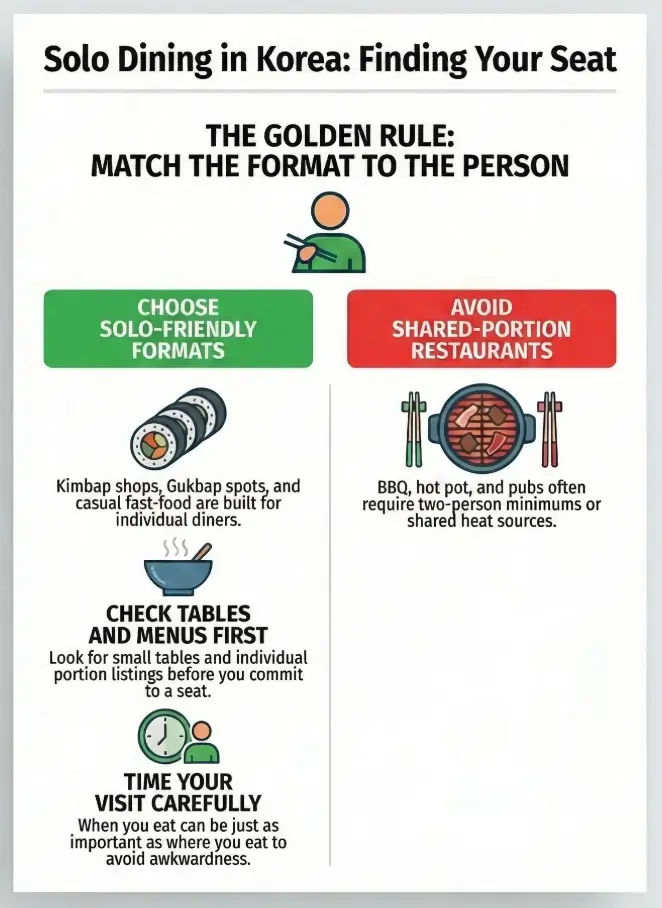
Solo dining in Korea is not the gamble many travelers fear. The real divide is simpler and far more useful: some restaurants are built for one person, and others are built for smoke, shared pans, clinking glasses, and a table that expects company.
That is where people get tripped up. They hear that eating alone is common in Korea, then walk into a Korean BBQ place at peak dinner and mistake a format problem for a social verdict. A little guesswork here can cost you more than a missed meal. It can waste time, bruise your mood, and make an easy city feel harder than it is.
This guide helps you read the room before the room reads you. You will learn how solo dining works in Korea, which restaurant types feel natural, and how to spot the difference in under two minutes.
The method is grounded in lived, street-level reality: business districts, station basements, university neighborhoods, and the small operational clues that matter more than travel folklore.
Not every “yes” looks the same.
And not every “no” is personal.
Here is how to tell, before hunger starts writing the story for you.
Table of Contents
Start Here First: Who This Is For / Not For
This guide is for you if you are a US traveler, expat, student, or remote worker trying to eat alone in Korea without turning dinner into a social interpretation exam. It is for the person who wants a practical answer before hunger makes every decision worse. It is also for anyone who has heard two contradictory claims at once: “Solo dining is totally normal in Korea” and “Some places will not want you.” Both can be true. That is the puzzle.
This is not really for private dining, high-end tasting menus, or celebratory group meals where the restaurant is selling a full experience rather than a single plate. Those places operate on different rules, and solo comfort is often not the core product. I once walked into a dramatic, softly lit barbecue place with six-person extractor hoods hanging over each table like metallic chandeliers. The staff were not rude. They were simply looking at a one-person customer in a room designed for four rounds of soju and a mountain of grilled meat. Architecture was doing half the talking.
What this guide solves before you walk in is uncertainty, not hunger. It helps you predict friction, lower the odds of refusal, and avoid taking operational choices personally. That matters because travel has a way of making tiny moments feel bigger than they are. A host saying “no” when you are tired can sound like a judgment from the heavens. Usually, it is just table economics wearing a stern face.
- Ask whether the menu works for one person.
- Watch the room before you enter.
- Treat refusal as a format problem first, not a social verdict.
Apply in 60 seconds: Before opening the door, check portion size, table type, and whether the place looks built for quick single meals or long shared ones.
In Korea, Solo Dining Is Normal, but Not Uniform
The broad trend line is clear enough: solo life is mainstream in Korea, and the culture around eating alone is much more visible than older stereotypes suggest. Korea.net has explicitly discussed the rise of “honbap,” the Korean term commonly used for eating alone, as part of a broader solo lifestyle, and official Korean statistics continue to show the scale of one-person households in modern Korea.
But this does not mean every restaurant has reorganized its logic around solo diners. That is where visitors get tripped up. They hear the cultural headline and assume it applies evenly across every dinner format. It does not. A country can become very comfortable with people eating alone while still maintaining large pockets of restaurant culture built around sharing, grilling, pouring drinks, and occupying a table for a while. Korea Tourism Organization’s own English-language food guidance still reflects how central shared dishes and table layouts are in many Korean meals.
So yes, “solo dining is common” is true. It is just incomplete. The real variable is not culture alone. It is restaurant structure, menu design, and table economics. The easiest way to understand this is to stop asking, “Will they accept me alone?” and start asking, “Was this meal format built for one person to begin with?” Those are not the same question. The first is emotional. The second is operational. Operational questions are usually more useful.
A small memory here. One rainy weekday in Seoul, I ate alone at a humble gukbap place where every tray landed with the calm efficiency of sheet music. Nobody blinked. Later that week, I stepped into a dramatic grilling restaurant where every table looked like it expected a reunion, a breakup, or at least a business negotiation. Same country. Same person. Entirely different dining geometry.
Decision Card: Is the issue culture or restaurant format?
When A: Small trays, kiosk, individual bowls, quick turnover. Solo dining usually feels routine.
When B: Shared burners, grill hardware, big platters, drinking-heavy seating. Solo dining may feel awkward or be restricted.
Trade-off: The more a restaurant earns from shared ordering and longer table use, the less flexible it may be with one person.
Neutral next step: Judge the setup before judging yourself.
Show me the nerdy details
“Honbap” became popular language because it describes more than one meal. It reflects a broader shift toward one-person routines in housing, work, and consumption. That does not erase older meal formats that are still optimized for sharing. In practice, solo-friendliness is often highest where labor flow, menu design, and ticket size already support single orders.
The Easy Wins: Restaurants Where Solo Dining Usually Feels Natural
If you want the lowest-friction starting points, look for kimbap shops, bunsik spots, noodle shops, gukbap places, simple soup-and-rice restaurants, food courts, and many chain rice-bowl or stew places. These are the ecosystems where solo dining often feels so ordinary it barely registers. The meals are naturally portioned for one. The tables turn over quickly. The service rhythm favors clarity over ceremony. It is dinner without theater, which can be a blessing when your phone battery is low and your patience is beginning to resemble a cracker.
Kimbap shops are especially forgiving for first-time solo diners because the format itself is compact. You order one or two simple items, you eat, you leave. Bunsik spots, with tteokbokki, kimbap, ramen, or donkatsu, often work the same way. Gukbap restaurants are another excellent entry point because the entire premise is “one hot bowl, one person, one straightforward meal.” A place that lives on individual bowls is already half on your side. If you want a good fallback after an awkward refusal, a nearby Korean convenience store guide can also save an evening that has started to wobble.
Counter seating is the silent hero here. When a restaurant has a bar-style line of seats, it is sending a message without making a speech: individual diners fit. Digital kiosks and tray service make this even easier, because they reduce the awkward mini-negotiations that sometimes happen at the entrance. I have had some of my most peaceful meals in Korea at places so operationally efficient that my solitude felt less like a social fact and more like a clean transaction with excellent soup.
There is also a psychological benefit. In low-friction places, you are freed from performing comfort. You do not need to pretend to study the wall art with deep academic intensity while wondering if anyone minds that you are alone. You are just another hungry person. That is a lovely thing to become.
Eligibility Checklist: Is this a likely easy solo-dining restaurant?
Answer yes or no:
- Does the menu show mostly single bowls, noodles, rice plates, or simple set meals?
- Do you see counter seats, two-tops, or trays instead of grill hardware?
- Can one person plausibly finish a typical order without needing a second stomach from a parallel universe?
- Is the service flow quick, casual, and payment-oriented?
Next step: If you get three or four yes answers, go in with confidence.
Where It Gets Awkward: Restaurants That Often Resist One-Person Tables
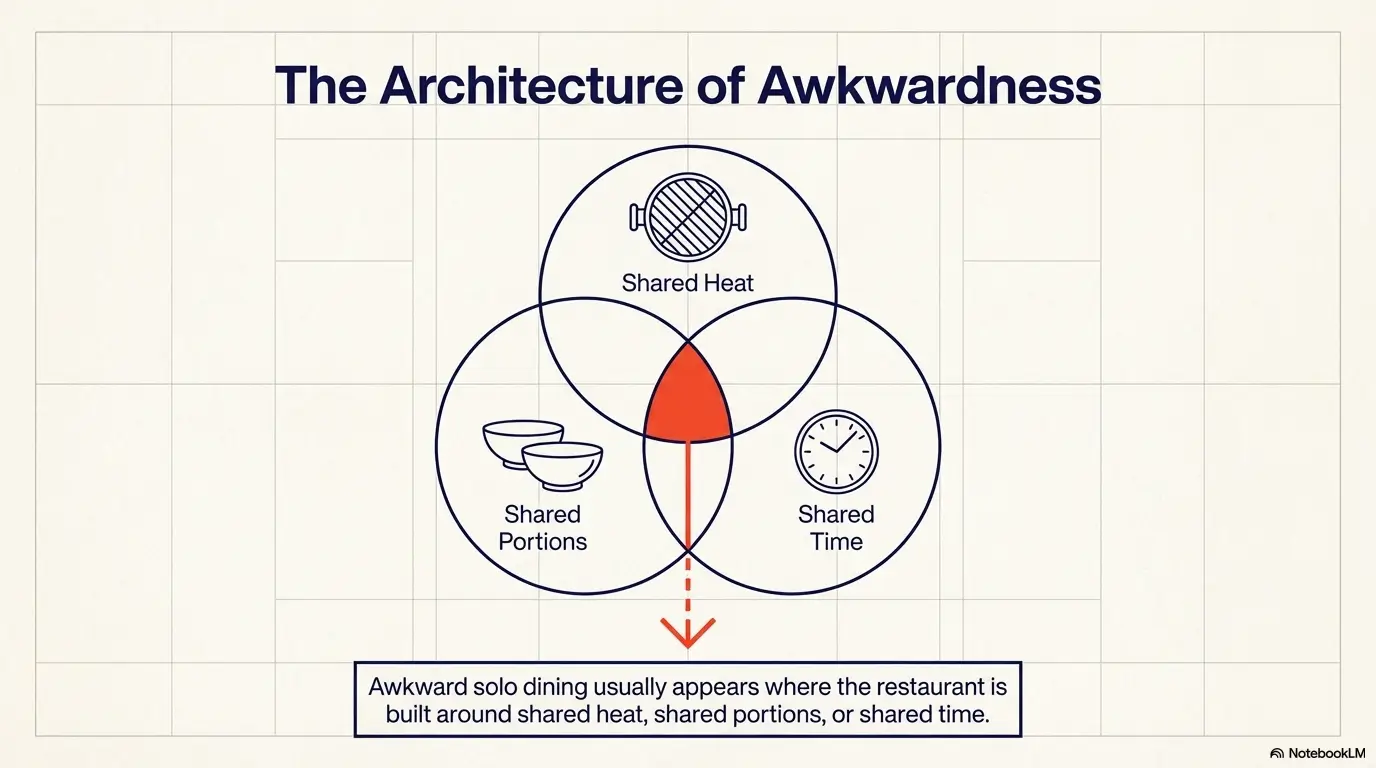
Now for the part that saves you from an avoidable little heartbreak. The most common friction points tend to be Korean BBQ restaurants, large hot pot or jeongol places, dakgalbi spots, some seafood platters, and drinking-first venues. These are not universally impossible for solo diners. Some places absolutely welcome one person, and some solo-specialized barbecue shops exist. But these categories are where you are most likely to hit the invisible wall of shared-format math.
Korean BBQ is the classic example. The issue is not just culture. It is equipment, labor, smoke extraction, side dish setup, and the expectation that the table will generate a larger bill or multiple orders over time. Some restaurants also have explicit or implicit two-person minimums for certain meats. Even where no formal rule exists, the economics can still nudge the staff toward preferring pairs or groups. A large grill table occupied by one person ordering modestly during peak dinner can be a weak trade for the house. That sounds cold, but restaurants are small equations wearing aprons. If you do try it, knowing a few useful Korean BBQ phrases can at least keep the interaction clear.
Jeongol and hot pot-style places create a different problem: portion logic. These dishes are often meant to simmer, expand, and be shared. The portion is physically large, the pricing may assume at least two people, and the kitchen may not have a neat one-person version. The same logic appears at some dakgalbi spots and fish restaurants built around communal pans or platters. Drinking-first venues add another layer. In some places, food is there partly to support companionship and alcohol rather than to operate as a quick one-person meal. That is also why it helps to know how to refuse alcohol in Korea gracefully if the room is clearly tilted toward drinking culture rather than dinner alone.
I once looked at a pan of dakgalbi large enough to host a municipal election and realized I was not being rejected by society. I was being rejected by surface area.
- Grill tables often signal lower solo flexibility.
- Large pans and platters often signal two-person menu logic.
- Drinking-first venues may prize group energy over efficient solo service.
Apply in 60 seconds: If the hero image on the menu shows a giant bubbling pan for four people, keep walking unless you already know the place handles solo orders well.
The Menu Clue Test: How to Predict Awkwardness Before You Sit Down
The fastest practical skill is not learning every solo-friendly restaurant in Korea. It is learning how to read a place in under two minutes. Start with the menu board outside. Look for two-person minimums, shared set menus, oversized portions, or language that implies “from two orders” or “minimum two servings.” Even if the English is patchy, numbers tell stories. “2인” is a useful little clue. So is a photo where the main dish appears to require a crane.
Next, read the room through the furniture. Small two-tops, counter seats, trays, and compact bowls suggest one type of dining. Oversized grill tables, large extractor hoods, deep built-in burners, and banquet-like spacing suggest another. This is less about aesthetics than workflow. Restaurants reveal their business model in wood, metal, and steam.
Then watch the service style. Self-order kiosks, quick payment systems, numbered receipt pickup, and fast table clearing usually mean less friction for solo guests. Host-led seating, long menu explanations, shared-table setups, or elaborate side dish spreads often mean more variability. None of this is foolproof. But it is astonishingly effective once you begin to notice it.
One habit I love is the three-glance rule. Glance at the menu board, glance at the tables, glance at the other diners. If two of those three say “group meal,” do not try to force destiny. Korea offers too many easy meals to spend your evening negotiating with a grill the size of a small bridge.
Mini Calculator: Estimate your solo-dining friction score
Add 1 point for each yes:
- Does the menu suggest a two-person minimum?
- Is the table setup built around grills, burners, or giant shared pans?
- Is it peak dinner with mostly groups, dates, or drinking parties?
0 to 1 points: Usually low friction.
2 points: Proceed with a backup plan.
3 points: Choose another place unless you already know this restaurant works for solo diners.
Neutral next step: Use the score to protect your mood, not to win an argument with a hostess.
Show me the nerdy details
Restaurant friction often comes from a mismatch between seat capacity and average order value. A grill table with fixed setup costs is harder to justify for one small order during prime time. By contrast, a soup-and-rice place can clear one diner quickly and profitably. That is why menu clues and furniture clues work so well.
Timing Changes Everything: When Even a Good Restaurant Feels Strange Alone
Here is what many guides skip: the same restaurant can feel welcoming at 2 PM and awkward at 7 PM. Timing changes everything. Peak dinner hours tighten the restaurant’s logic. Tables become more valuable. Staff become less flexible. The dining room fills with couples, coworkers, and friend groups. A one-person diner is not wrong in that scene, but the contrast becomes more visible and the restaurant may be less willing to allocate certain tables or bend menu practices.
Late lunch, early dinner, and off-peak weekday windows are your secret weapon. Around these times, some places that might hesitate during peak rush suddenly become easy. The staff have breathing room. Empty tables no longer feel expensive. A restaurant that would protect its four-top like crown jewels at 7 PM might hand it over without drama at 3:30 PM because the room is half asleep.
I learned this the unintellectual way: through hunger and stubbornness. Once, I tried the same general style of meal on two different days. Friday night felt like pushing a shopping cart uphill through opera. Tuesday afternoon felt like the universe laying out a napkin for me. Nothing about solo dining had changed. Only the hour had.
This matters especially in entertainment zones, busy shopping districts, and neighborhoods dense with dinner plans. At lunch, the solo diner blends into the working world. At peak evening, the same diner can feel more exposed, even if nobody is truly paying much attention. Time alters both operations and emotion. That is an annoying truth, but a useful one.
- Weekday lunch is the softest landing.
- Mid-afternoon can rescue places that feel impossible at dinner.
- Peak dinner magnifies both table economics and self-consciousness.
Apply in 60 seconds: On your first few solo meals in Korea, bias heavily toward weekday lunch or early dinner until your instincts get sharper.
Don’t Misread the Room: What Feels Personal Often Is Not Personal
When a host hesitates, visitors often read the moment as social judgment. Sometimes it can feel that way, especially if the delivery is blunt. But very often the issue is simpler and less dramatic: the menu does not work well for one person, the table mix is tight, or the restaurant is protecting turnover during a busy window. In other words, the refusal may be operational logic with unfortunate facial expressions.
This distinction matters because shame is a terrible travel companion. It can turn one small bump into a whole evening story: “Korea does not like solo diners,” “I did something wrong,” “I should have stayed in the hotel and married a convenience store sandwich.” None of those conclusions are reliable. They are just emotions trying on trench coats and pretending to be evidence.
The more useful mindset is this: separate cultural discomfort from restaurant fit. If a place says no to one person, that does not tell you what all of Korea thinks. It tells you something about that restaurant’s format, that hour, and that order structure. That is all. You do not need to build a philosophy department around it. The same principle appears in other social moments in Korea too: a blunt interaction is not always hostility, which is why understanding Korean indirect communication helps keep small frictions in proportion.
Official Korean tourism and culture materials still present many Korean meals as table-centered and multi-dish by nature, which helps explain why some venues remain more group-oriented even as solo dining itself has become common. That is a compatibility issue, not a moral one.
Quote-Prep List: What to gather before you ask if one person is okay
- The main dish you want to order.
- Whether the menu board shows single portions or shared sets.
- Whether it is peak time.
- A backup restaurant within a 3 to 5 minute walk.
Neutral next step: If you do need to ask, do it calmly and treat the answer as logistics.
Don’t Do This First: Mistakes Solo Diners Make in Korea
The most common first mistake is walking into a grill house and assuming every table is available to every body. It sounds obvious when written out, but hunger reduces IQ in very democratic ways. If the entire room is built around smoke vents, shared meats, and long table occupation, do not make that your first solo experiment. Start where the format already likes you.
The second mistake is confusing “popular on social media” with “practical for one person.” A restaurant can be famous, photogenic, and deeply inconvenient for solo dining. Viral videos rarely show the part where a dish is priced for two, takes thirty minutes, and expects companionship to round out the experience. The camera loves abundance. Your itinerary may not.
The third mistake is arriving ravenous without a backup plan in a neighborhood dominated by share-style restaurants. This is how tiny inconveniences become melodrama. When you are hungry, every small refusal sounds Shakespearean. One of the best travel habits is to spot a solo-friendly fallback nearby before testing a more uncertain place. That turns “no” into a detour instead of a mood collapse.
I say this with affection because I have made all three mistakes. At one point I was standing outside a restaurant in Seoul studying a giant pan meal as if concentration alone might shrink it into a personal serving. It did not. Reality remained stubbornly family-sized.
Common Mistakes That Make Solo Dining More Awkward Than It Needs to Be
A quieter set of mistakes happens before you even interact with staff. One is mistaking a group-oriented restaurant for a casual everyday meal spot. Some restaurants look relaxed from the outside but are structured around a dining ritual that assumes multiple people, shared side dishes, and a longer sit-down. Another is ignoring the menu board outside, which is often the most honest part of the building. Menus whisper the truth long before hosts do.
Another frequent mistake is assuming English-speaking staff will solve a menu-structure problem. Language can help with communication, of course, but it cannot turn a two-person shared pan into a one-person individual dish. This is why restaurant fit beats language fluency. I have had smooth solo meals with almost no Korean in places whose structure made everything obvious, and awkward moments in clearer English where the menu simply did not want to cooperate.
Choosing atmosphere over fit is another trap, especially when tired, jet-lagged, or short on time. Travelers often want the room that feels cinematic. I sympathize. A handsome restaurant can look like the right story. But a warm bowl in a fluorescent shop that welcomes one person beats a gorgeous room that makes you negotiate with physics. Atmosphere is lovely. Dinner is lovelier. The same trade-off appears in other traveler situations too, from deciding between style and ease in Seoul cafe etiquette to picking convenience over romance on a rushed afternoon.
- Read the menu before the room seduces you.
- Do not let English ability distract from portion logic.
- Carry a backup plan when you are tired or pressed for time.
Apply in 60 seconds: Save one nearby kimbap or noodle option on your map before trying a more ambitious dinner spot.
The Solo-Friendly Signals: What to Look For Before You Commit
Some clues are almost comically reliable. Single-portion staples such as kimchi jjigae, doenjang jjigae, bibimbap, kalguksu, naengmyeon, seolleongtang, gukbap, juk, and many donburi-style bowls are strong signs. They are practical, widely understood, and physically meant for one person. That does not guarantee anything, but it is one of the friendliest maps you can use.
Counter seats are another huge green flag. So are trays, numbered ticket systems, lunch-special boards, and digital kiosks. Kiosks, in particular, are wonderful little diplomats. They spare you from the entrance negotiation and reduce the chance that staff will need to decide in real time whether your order “makes sense.” If the machine lets you buy one meal, the machine has already done some of the emotional labor.
Business districts, transit hubs, food courts, hospitals, and university areas also tend to generate low-drama solo options because speed and independence matter there. People are eating between classes, between shifts, between trains, between meetings. Nobody has time to stage a philosophical debate about whether one person deserves soup.
Official Korean culture materials describing meal formats often emphasize the coexistence of individual rice-and-soup settings with a wider spread of shared side dishes, which is helpful context here. Meals that begin from an individual core are simply easier to scale down for one diner. Once you are inside, it also helps to know the quiet logic of Korean banchan refill rules, because side dishes can otherwise feel more mysterious than they really are.
Coverage Tier Map: How solo-friendly is this place?
Tier 1: Kiosk, bowls, noodles, trays, counter seating. Excellent for beginners.
Tier 2: Casual sit-down with many single dishes and small tables. Usually good.
Tier 3: Mixed menu with some shared items and some solo items. Check closely.
Tier 4: Grill, burner, group platters, alcohol-heavy room. High friction.
Tier 5: Explicit two-person minimums or clearly communal set menus. Skip unless you know the workaround.
Neutral next step: Use Tier 1 or Tier 2 restaurants for your first days, then experiment.
Neighborhood Logic Matters: Some Areas Are Better for First-Time Solo Diners
Neighborhoods have personalities, and those personalities shape your odds. Office districts are often excellent for solo dining, especially at lunch, because the local rhythm is built around speed, efficiency, and one-person meals between work tasks. In these zones, eating alone can feel almost invisible in the best possible way. You are not a social anomaly. You are a person with a schedule.
University areas can also be forgiving because price sensitivity, independence, and fast turnover reshape the dining culture. Students and young workers often normalize eating alone, grabbing a quick bowl, or choosing value-driven places that do not require ceremony. There is a useful honesty to these neighborhoods. The food says, “I am here to help,” not “I expect a three-act evening.”
Entertainment zones, on the other hand, can lean more heavily toward date energy, drinking culture, shared dishes, and longer dinner sessions, especially at night. None of that makes them impossible. It just means your success depends more on careful restaurant selection and timing. If you begin your solo-dining journey in a nightlife-heavy area at peak dinner, you may falsely conclude that Korea is harder than it really is.
A final neighborhood truth: stations, department store food halls, and basement food courts are quietly heroic. They are not always the meals that make it into dreamy travel montages, but they are often where tired humans are restored to civilization. And if the night has gone especially sideways, a clear understanding of tipping in Korea is one less thing to second-guess while you regroup over a simple meal.
Infographic: The 30-Second Solo Dining Flow
Single bowls or rice dishes? Good sign.
Counter seats and small tables beat giant grill stations.
Weekday lunch is the easiest runway.
A nearby kimbap or noodle spot prevents dinner despair.
Bottom line: In Korea, solo dining works best when menu, furniture, and timing all agree with you at once.
FAQ
Is solo dining socially acceptable in Korea?
Yes. Solo dining is broadly socially acceptable in Korea, especially in everyday meal formats such as kimbap shops, noodle houses, stew restaurants, food courts, and workday lunch settings. The awkwardness people sometimes feel usually comes from specific restaurant formats, not from a blanket social taboo. Korea.net has discussed solo dining as part of a broader mainstream solo lifestyle in Korea.
Can I eat Korean BBQ alone in Korea?
Sometimes yes, but it depends heavily on the restaurant. Some Korean BBQ places allow solo diners, and a few are even designed for them. Many others, however, operate with grill-table economics, portion expectations, or implicit two-person minimums that can make solo dining awkward or impractical, especially at peak dinner hours.
Do restaurants in Korea really refuse one person?
Some do, especially when a menu is designed around shared dishes, large platters, or two-person minimums. This does happen, but it should be understood as restaurant-specific rather than universal. One refusal is not a reliable map of the whole country.
What Korean foods are easiest to order alone?
Kimchi jjigae, doenjang jjigae, bibimbap, kalguksu, naengmyeon, seolleongtang, gukbap, porridge, many donkatsu sets, and simple rice-bowl meals are often among the easiest. The common thread is that the dish already makes sense as a one-person order.
Is solo dining easier at lunch than dinner in Korea?
Usually yes. Lunch, especially on weekdays, often makes solo dining easier because many restaurants are already serving workers, students, and people eating efficiently on their own. Dinner can be trickier in places that shift toward groups, alcohol, or longer table use.
Do I need to speak Korean to eat alone comfortably?
No. Language helps, but restaurant structure matters more. In solo-friendly places with kiosks, displayed menus, or obvious single-dish formats, you can often eat very comfortably with limited Korean. In group-oriented places, fluent English would not magically solve a menu built for four.
Are chain restaurants in Korea better for solo diners?
Often yes, particularly chains that use kiosks, trays, or standardized individual meals. Chains are not always the most romantic answer, but they can be wonderfully efficient when you want a meal without friction.
What should I do if a restaurant says no to one person?
Do not take it personally. Treat it as a signal that the format, timing, or menu is not working in your favor. Move to your backup option, preferably a nearby bowl, noodle, or kimbap place. Protect your evening instead of litigating the moment.
Next Step: Use the Two-Minute Filter Before You Walk In
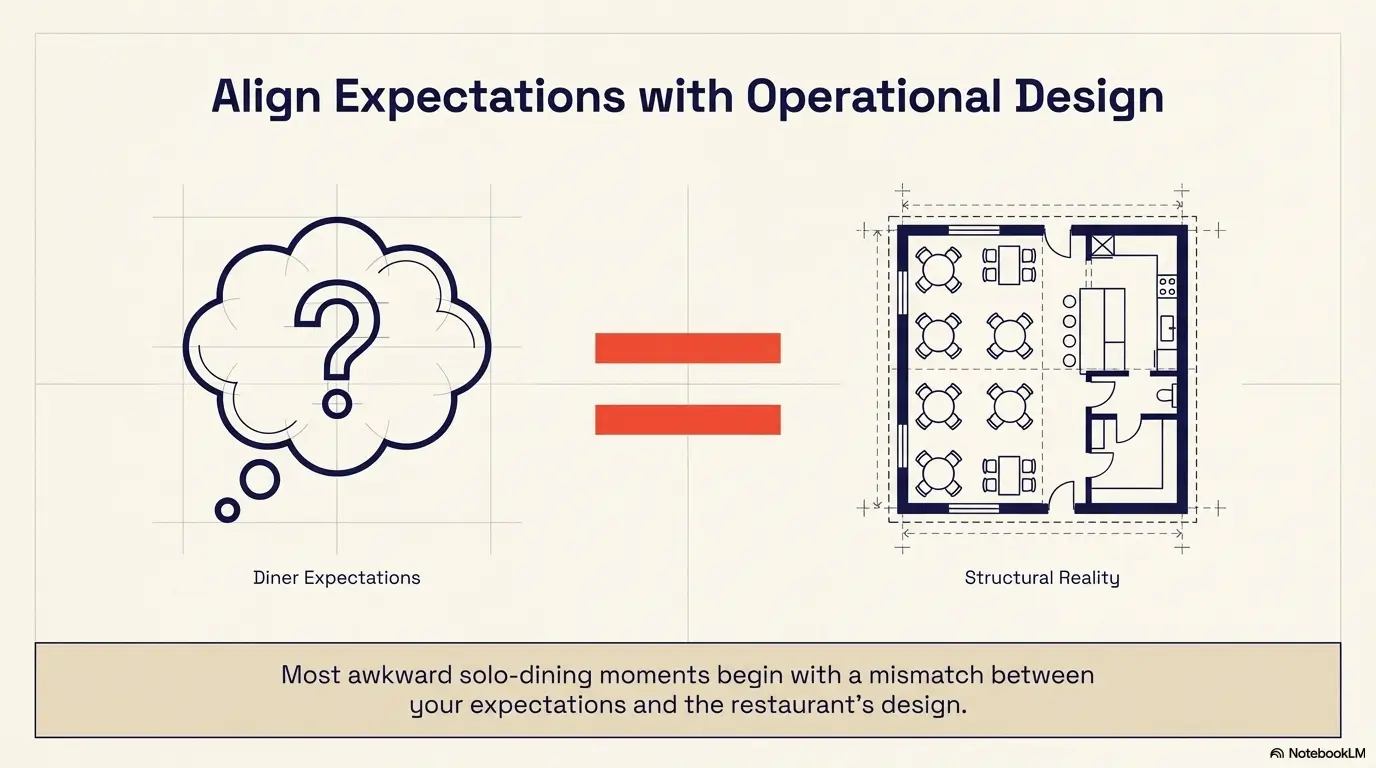
By now the curiosity loop from the beginning should be closed. The question was never simply whether solo dining is allowed in Korea. It was which restaurants are built for one person and which are built for pairs, groups, burners, bottles, and bigger tickets. Once you see that, the whole subject becomes less mysterious and much more manageable.
Your two-minute filter is simple. First, check portion size. Is the dish naturally one-person, or is it clearly meant to be shared? Second, check table setup. Are you looking at trays and bowls, or grill stations and communal pans? Third, check peak-hour crowd type. Are people eating quickly, or settling in for long social meals? Those three clues will rescue you more reliably than vague internet reassurance.
If you are new to solo dining in Korea, your smartest first move is wonderfully unglamorous: start with a kiosk-based or tray-service restaurant during weekday lunch hours. Build confidence where the format already cooperates. Then branch out. Travel gets easier when you stop trying to make every meal cinematic. Sometimes the most successful dinner is the one that asks the least of you and feeds you anyway.
Short Story: On one of my first longer stretches eating alone in Korea, I made the rookie mistake of treating every beautiful restaurant as a personal challenge. One evening I stood outside a smoky, fashionable grill place and decided that sheer optimism would carry me through. It did not. The room was full of pairs and small groups, the menu was a hymn to shared meat, and I could feel the awkwardness before I had fully opened the door. I left, slightly bruised in spirit and very hungry.
Two blocks later I found a modest soup-and-rice place with bright lighting, a ticket machine, and three office workers eating in companionable silence. My tray arrived in minutes. Nobody looked twice. The meal was not dramatic, but it felt like the city quietly saying, “Try this way first.” That dinner taught me more than any trend article ever could.
Use that lesson. In your next 15 minutes, save one backup solo-friendly place near where you plan to eat, look for Tier 1 or Tier 2 signals, and let restaurant format guide your expectations. Hunger is difficult enough. There is no prize for making it perform. And when the evening does go well, that same quiet fluency with everyday norms tends to spill into the rest of the trip, whether you are ordering dinner, navigating Korean delivery etiquette, or simply learning which parts of the city reward patience over bravado.
Differentiation Map
| What competitors usually do | How this article avoids it |
|---|---|
| They simply say “solo dining is common in Korea” and leave it there. | This article breaks the issue down by restaurant structure, portion logic, and timing, not just social culture. |
| They give a list of restaurant recommendations and stop. | This article teaches you how to judge a restaurant for yourself before walking in. |
| They say “Korean BBQ may be hard alone” without much depth. | This article explains why awkwardness appears through table economics, portion size, and turnover logic. |
| They frame everything as emotion or social discomfort. | This article separates feelings from operations so you do not take restaurant refusal personally. |
| They barely mention timing. | This article shows how the same restaurant can feel different depending on the hour. |
| Their FAQ section stays generic. | This article answers the search-shaped questions a US traveler is actually likely to ask. |
| They focus only on “where to eat.” | This article focuses on why some places fit and others do not, giving you a reusable decision filter. |
Last reviewed: 2026-03.