

Master the Grill: The 8-Phrase BBQ Script
Stop the mid-meal panic. From the first sizzle to the final bill, these essential Korean phrases ensure your meal flows as smoothly as the cold drinks.
1. The Golden Rule
1인분 (Il-in-bun)
The “unit” word. It means one portion, not one person. Always order by servings.
2. The Order
[Meat Name] [Number]인분 주세요.
“Please give us [Number] portions of [Meat].”
Essential Survival Phrases
- “Banchan 더 주세요” (Banchan deo ju-se-yo) — “More side dishes, please.”
- “Sang-chu 더 주세요” (Sang-chu deo ju-se-yo) — “More lettuce, please.”
- “Soju/Maekju 한 병 주세요” (Han byeong ju-se-yo) — “One bottle of Soju/Beer, please.”
- “Gogeom jom kka-ju-se-yo?” — “Could you help us grill/cut the meat?”
- “Gyesan-hae ju-se-yo” — “Check, please.”
- “Yong-su-jeung ju-se-yo” — “Receipt, please.”
“Save these to your Notes. Say them once out loud. Walk in calm.”
At a samgyeopsal (Korean BBQ) restaurant, order smoothly with a few core phrases: “삼겹살 2인분 주세요” (Two servings of pork belly, please), “물 주세요” (Water, please), “상추 더 주세요” (More lettuce, please), and “계산할게요” (We’ll pay). If you’re unsure, add “추천해 주세요” (Please recommend). Use “-주세요” for polite, natural requests.
Table of Contents
Say this first: the 8 “save me” phrases (works anywhere)
If you memorize nothing else, memorize these. They’re “table-safe”—meaning they don’t assume you know the menu, the grill rules, or the social choreography. I’ve watched confident travelers stumble not because they were rude, but because they tried to be too perfect. Korean restaurants are usually forgiving. Your job is to be clear, polite, and just a little warm. (If you want a bigger “carry-everywhere” set beyond BBQ, this Korean digital nomads phrasebook is the same idea: short lines, maximum usefulness.)
1) “안녕하세요” — Hello (start friendly)
2) “여기요” — Excuse me / Over here (get attention)
3) “~주세요” — Please give me ~ (polite request pattern)
4) “이거 뭐예요?” — What is this?
5) “추천해 주세요” — Please recommend
6) “물/휴지 주세요” — Water / Napkins, please
7) “괜찮아요” — It’s okay / No thanks
8) “계산할게요” — We’ll pay (check please)
A tiny realism note: “여기요” works best with eye contact + a small hand raise. Not snapping. Not shouting across the room. The vibe is: “I’m here, whenever you have a second.” I once tried a bold “저기요!” in a crowded place and immediately regretted my own volume. “여기요” saved me from myself.
- Use “~주세요” for polite requests.
- Use “여기요” gently to get attention.
- Use “괜찮아요” to decline without awkwardness.
Apply in 60 seconds: Save these eight lines in your Notes app and practice once out loud.
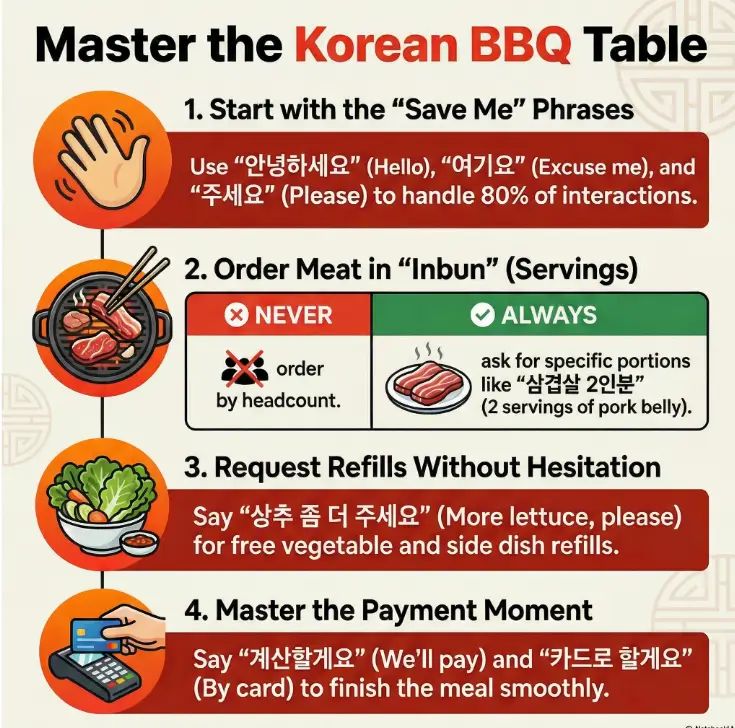
Order meat like a local: servings, cuts, and “one more round”
Korean BBQ ordering is built around shared plates, and the unit word that matters most is 인분 (servings). You don’t say “one order.” You say “two servings.” That’s the single biggest unlock for looking confident.
Servings language: “2인분/3인분” (two/three servings)
- “삼겹살 2인분 주세요.” — Two servings of pork belly, please.
- “목살 2인분이랑 항정살 1인분 주세요.” — Two servings of pork neck + one serving of pork jowl, please.
- “이거로 먼저 주세요.” — Start with this one.
Cuts you’ll see: quick meanings (no chef cosplay)
- 삼겹살 — pork belly (the classic)
- 목살 — pork neck/shoulder (leaner, still juicy)
- 항정살 — pork jowl (rich, tender)
- 갈매기살 — pork skirt (meaty, slightly chewy)
If you want to sound especially natural, add 좀 (a bit) or 먼저 (first) to soften the edges: “삼겹살 2인분 먼저 주세요.” It reads as “Whenever you can, start us with two servings.” (And if you’ve ever mixed up Korean counting or number forms under pressure, this quick guide on common Korean number mistakes is a surprisingly useful pre-dinner save.)
“One more round” phrases you’ll actually use
- “하나 더 추가할게요.” — We’ll add one more.
- “이거 한 인분 더 주세요.” — One more serving of this, please.
- “덜 맵게/안 맵게 해 주세요.” — Less spicy / Not spicy, please.
Tiny confidence hack: Point at the menu while saying the phrase. Clear + polite beats perfect pronunciation.
Show me the nerdy details
In spoken Korean, “~주세요” is a workhorse because it’s polite without sounding overly formal. You’ll also hear “~주실래요?” (Would you give…?) which is slightly softer, and “~주시면 돼요” (You can just give…) which can sound advanced. For beginners, stick to “~주세요” + a softener like “좀” (a bit) or “먼저” (first). It’s reliable, readable, and socially safe. If you want the deeper “why this ending works” breakdown, this explainer on Korean verb endings helps the whole “polite but natural” puzzle click.
- Default: “삼겹살 2인분 주세요.”
- Add variety: “목살 2인분 + 항정살 1인분.”
- Upgrade politeness: add “좀/먼저.”
Apply in 60 seconds: Pick your default order now so you don’t negotiate with your own anxiety at the table.
Here’s the part everyone messes up: “1인분” isn’t “one person”
Let’s be honest: you’re not “awkward.” You’re just missing the unit words. In many Korean BBQ spots, “1인분” is a serving size, not a headcount. That’s why minimum orders happen—especially for pork belly sets designed to share.
What “1인분” usually means (and why minimum orders happen)
Menus often price meat by serving. A two-person table might still be expected to order a minimum number of servings (common if the restaurant’s workflow assumes a baseline amount of meat on the grill). Nobody is trying to trap you—it’s just how the system stays efficient. I once walked in solo, confidently said “삼겹살 1인분,” and got the gentlest smile that said, “Sweetie… no.”
How to ask the minimum politely
- “최소 주문이 몇 인분이에요?” — What’s the minimum order (how many servings)?
- “혼자인데, 최소 주문 있어요?” — I’m alone—do you have a minimum order?
- “두 명인데, 2인분이면 돼요?” — We’re two—would two servings be okay?
Short Story: The “one serving” moment (and the quiet rescue)
I watched a couple at the next table whisper-argue over the menu like it was a legal document. Finally they said, very carefully, “삼겹살… 하나?” The server paused, smiled kindly, and asked, “두 분이세요?” (Two people?) Then, without making it weird, she offered the fix: “그럼 2인분부터 가능해요.” (Then it’s possible from two servings.) The couple nodded, relieved. Ten minutes later they were laughing, hands full of lettuce wraps, the earlier tension gone like smoke over the grill. The lesson wasn’t language—it was permission: it’s normal to ask the minimum, and it’s normal to be guided.
- Ask minimum: “최소 주문이 몇 인분이에요?”
- Confirm fit: “2인분이면 돼요?”
- Stay calm: the question is normal.
Apply in 60 seconds: Practice the minimum-order question once—it removes the biggest surprise.
Ssam & banchan requests: free refills without sounding demanding
The refill moment is where polite phrasing matters most—because you’re asking for something that often feels “extra.” Here’s the truth: at many Korean BBQ places, asking for more lettuce or side dishes is normal. You just want to phrase it like a human, not like a command line. (If you want the exact “what’s usually free vs when to ask first” breakdown, this guide on Korean banchan refill rules is a lifesaver.)
Core refill phrases (sound natural, not pushy)
- “상추 더 주세요.” — More lettuce, please.
- “마늘/고추/쌈장 더 주세요.” — More garlic / pepper / ssamjang, please.
- “반찬 더 주실 수 있어요?” — Could we get more side dishes?
- “이거 리필 돼요?” — Is this refillable?
If you want to make your tone softer, add 좀: “상추 좀 더 주세요.” It’s the difference between “More lettuce” and “Could we get a bit more lettuce?”
Refill sanity check (Yes/No) — so you don’t overthink it
- Is it lettuce / ssam veggies / basic banchan? → Usually safe to ask.
- Is it a premium side (special salad, cheese, expensive add-on)? → Ask first: “이거 리필 돼요?”
- Are you on your 3rd+ refill and the place is slammed? → Ask softly: “상추 좀 더 가능할까요?”
Neutral next step: Ask once, politely, and accept the answer without drama.
Personal note: I used to avoid refills entirely because I didn’t want to “be that customer.” Then a Korean friend looked at my tiny wrap and said, deadpan, “Why are you suffering?” The next time I asked, the server refilled lettuce like it was the most normal thing on earth. It was. I was the one making it weird.
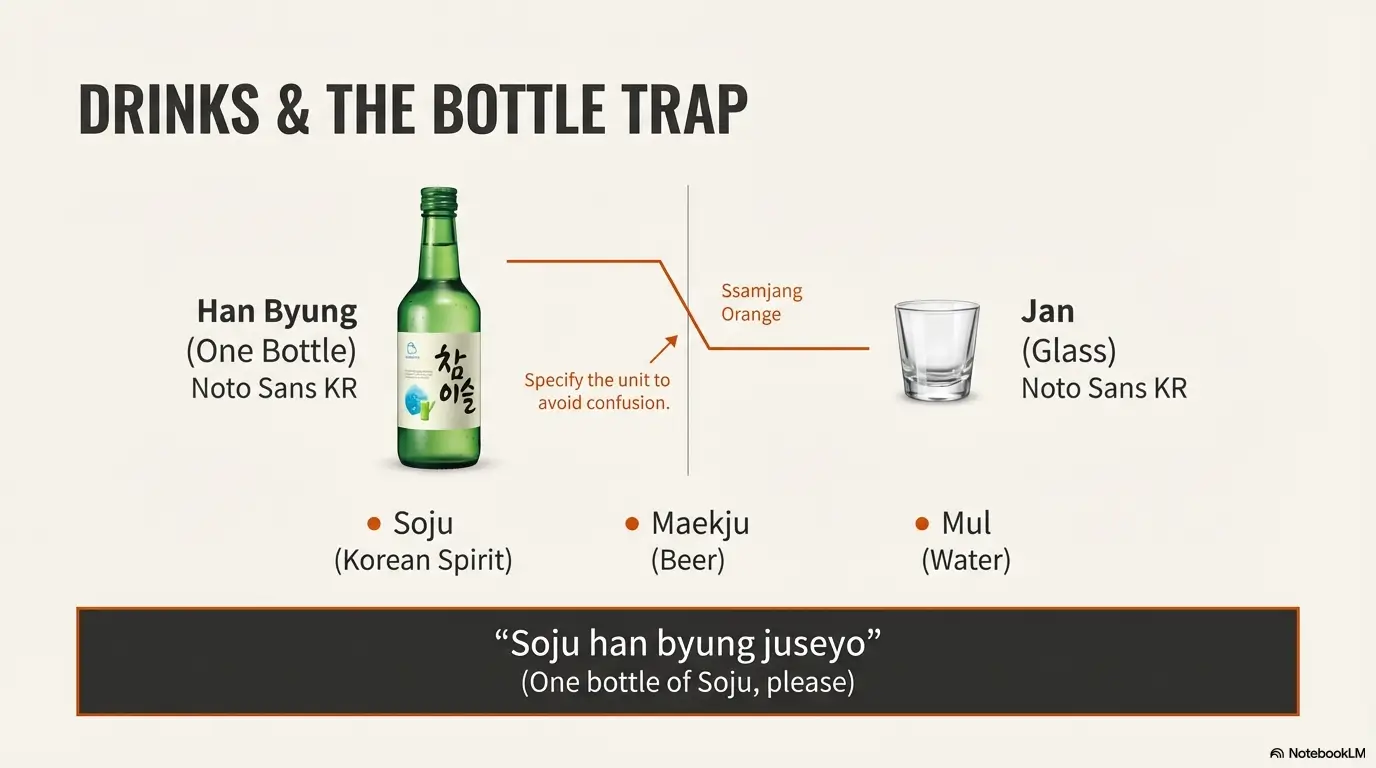
Drinks without confusion: soju, beer, and the “bottle vs glass” trap
Drinks are simple until they aren’t. The classic confusion is ordering a drink without specifying whether you mean a bottle or a glass. At Korean BBQ, bottles are common—especially for soju and beer.
Order bottles clearly
- “소주 한 병 주세요.” — One bottle of soju, please.
- “맥주 한 병 주세요.” — One bottle of beer, please.
- “소주랑 맥주 하나씩 주세요.” — One soju and one beer, please.
Ask for glasses/cups (this is normal)
- “잔/컵 주세요.” — Glass/cup, please.
- “얼음/탄산수 주세요.” — Ice / sparkling water, please.
- “추천 소주 있어요?” — Any recommended soju?
Neutral entity note (because you’ll probably use them): if you’re unsure about a label, apps like Papago or Google Translate can help with menu words—but for talking, short phrases beat screen time. I learned this after watching my phone struggle to translate “항정살” while the grill politely waited. If you like travel-with-context reading that makes small moments feel less mysterious, this broader Korean culture guide pairs nicely with phrase learning.
The grill dance: who cooks, when to flip, and how to ask for help
This is the part that makes first-timers feel “touristy”: the grill has rules, but nobody hands you the rulebook. Some places have staff cook for you; others expect the table to manage it. Either way, asking for help is normal. Truly.
Ask staff to grill (politely, without apology)
- “직원분이 구워주실 수 있어요?” — Can staff grill for us?
- “구워주시면 감사하겠습니다.” — If you could grill it for us, we’d appreciate it. (more formal)
Timing questions that won’t sound silly
- “지금 뒤집어야 해요?” — Should we flip now?
- “잘 익었어요?” — Is it cooked through?
- “조금 더 구울까요?” — Should we grill it a bit more?
Decision card: Should you ask staff to grill?
Ask staff when…
- You’re new and want less stress.
- The place is known for service grilling.
- You ordered thick cuts or specialty items.
Self-grill when…
- Staff seems stretched thin.
- You’re comfortable flipping and pacing.
- You want to control crispness.
Neutral next step: If you feel unsure, ask once: “직원분이 구워주실 수 있어요?”
Here’s what no one tells you: the “cool” move is not pretending you know—it’s being calmly direct. I’ve seen locals ask for grilling help when they’re busy talking or wrangling kids. This isn’t a test. It’s dinner.
Spice and allergies: gentle, clear, and not overly medical
Most samgyeopsal orders aren’t spicy by default, but side dishes, sauces, and stews can be. Keep allergy language clear and calm. You don’t need a speech—just a simple statement + a question. (If you’re traveling and you like having one “just in case” safety net, this guide on travel insurance in South Korea is the practical companion piece.)
Spice checks
- “맵나요?” — Is it spicy?
- “안 맵게 해 주세요.” — Please make it not spicy.
- “덜 맵게 해 주세요.” — Please make it less spicy.
Allergy phrasing (simple and direct)
- “땅콩 알레르기가 있어요.” — I have a peanut allergy.
- “새우 알레르기가 있어요.” — I have a shrimp allergy.
- “이거 들어가요?” — Does this contain it?
- “빼 주세요.” — Please leave it out (when possible).
A human tip: say the allergy line first, then point at the dish and ask “이거 들어가요?” That ordering keeps you from narrating your entire medical history in a noisy room. I once over-explained an allergy concern with a 40-second monologue. The server was kind—but my friends still tease me about the “PowerPoint.”
Common mistakes: don’t do these (and what to say instead)
These mistakes aren’t “cringe.” They’re just predictable. Fix them once, and you’ll feel instantly smoother at the table.
Mistake #1: Saying “one order” without servings
Instead: “삼겹살 2인분 주세요.” (Two servings, please.) If you’re not sure how hungry your group is, start with 2 servings for two people and add later.
Mistake #2: “Service” confusion (무료 서비스)
In Korean restaurants, “서비스” can mean a free extra (like a bonus side or small dish), not “customer service.” If someone says “서비스로 드릴게요,” it often means “We’ll give you this on the house.” You can respond with a warm: “감사합니다!” (Thank you!)
Mistake #3: Overusing “주세요” without context
“주세요” is great, but if you fire it like a machine gun, it can sound abrupt. Add softeners: “좀” (a bit), “더” (more), “먼저” (first). Example: “물 좀 주세요.” feels gentler than “물 주세요.” If you’re curious why tone shifts so fast between endings, this guide to polite vs casual Korean explains the “same words, different vibe” phenomenon really cleanly.
Mistake #4: Calling loudly
Instead: “여기요” + small hand raise. If you feel invisible, repeat once after a moment, not ten times in ten seconds. I’ve done the rapid-fire “here-yo here-yo” panic spiral. Don’t be me. One calm “여기요” is surprisingly powerful.
Second big mistake: the payment moment (split bills, cards, and receipts)
The meal can be perfect and you can still fumble the ending. Paying is where expats and travelers often freeze—especially if you want to split, need a receipt, or aren’t sure about cards. Here are clean phrases that keep it simple.
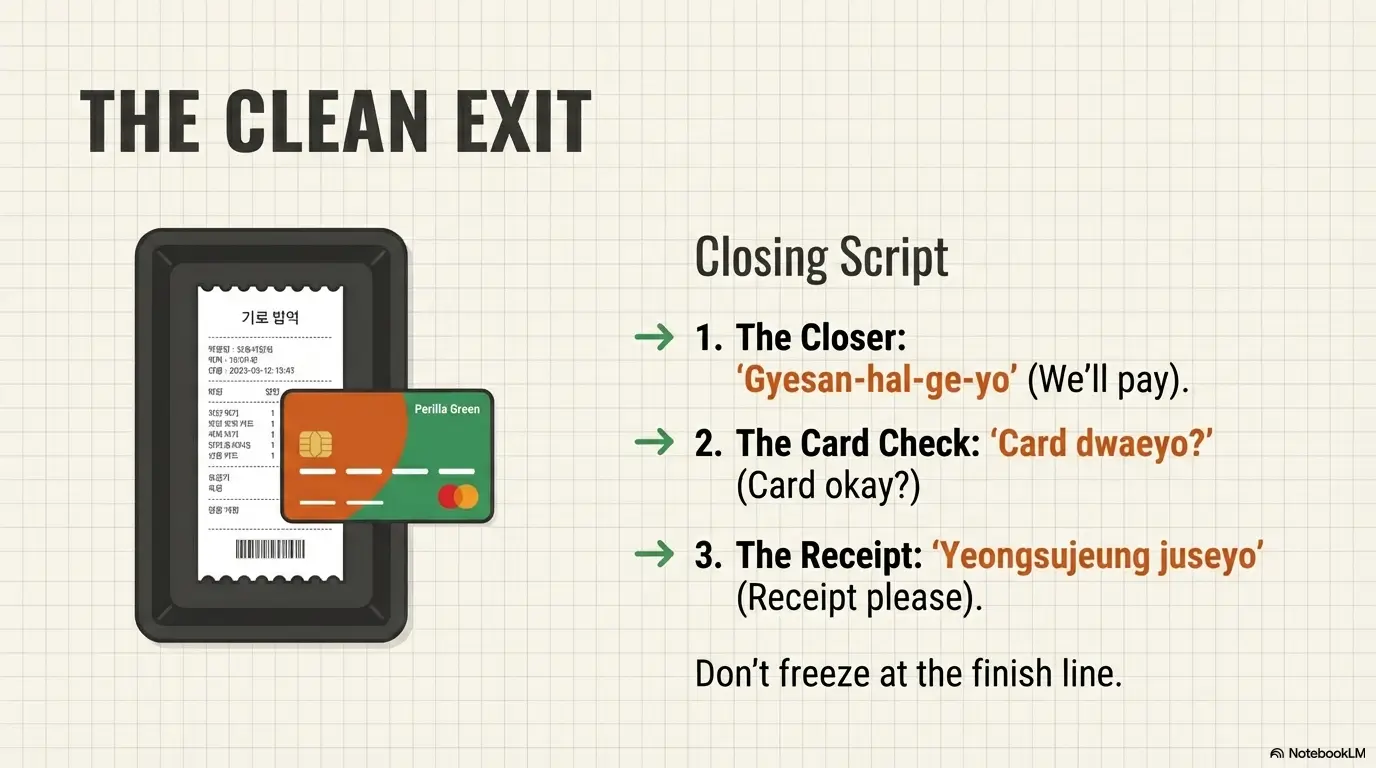
Core payment phrases
- “계산할게요.” — We’ll pay.
- “카드 돼요?” — Do you take card?
- “영수증 주세요.” — Receipt, please.
- “현금으로 할게요 / 카드로 할게요.” — Cash / Card.
Splitting the bill (simple version)
- “계산은 따로 할 수 있어요?” — Can we split the bill?
- “각자 계산 가능해요?” — Can we pay separately?
Mini calculator: “How many servings should we start with?”
Tip: A calm default is diners ≈ servings, then adjust.
Neutral next step: Use the output as your starting order, not a hard rule.
- “계산할게요.” (We’ll pay.)
- “카드로 할게요.” (By card.)
- “영수증 주세요.” (Receipt, please.)
Apply in 60 seconds: Pick your payment line now so you don’t stall at the finish.
Mini scripts by situation (copy/paste)
These are built for real table pacing. Copy them into your phone. Use them like training wheels. Nobody will mind. (And if your pronunciation is wobbly, your confidence will do the heavy lifting.)
Script A: first-time samgyeopsal order (meat + drinks + refills)
“안녕하세요. 삼겹살 2인분 주세요. 물도 주세요.”
Hello. Two servings of samgyeopsal, please. Water too, please.
“소주 한 병 주세요. 잔도 주세요.”
One bottle of soju, please. Glasses too, please.
“상추 좀 더 주세요.”
Could we get a bit more lettuce?
Script B: you’re unsure—ask for recommendations + “not spicy”
“추천해 주세요. 처음이에요.”
Please recommend. It’s my first time.
“이거 맵나요? 안 맵게 해 주세요.”
Is this spicy? Please make it not spicy.
“이거로 먼저 주세요.”
Let’s start with this one.
Script C: crowded room—get attention, add one more plate, pay fast
“여기요. 이거 한 인분 더 주세요.”
Excuse me. One more serving of this, please.
“물 좀 주세요.”
Water, please.
“계산할게요. 카드로 할게요. 영수증 주세요.”
We’ll pay. By card. Receipt, please.
If you want an extra layer of smoothness, start Script C with a smile + “죄송한데요” (Sorry, but…)—but only if you’ll say it naturally. The goal isn’t to perform “polite Korean.” The goal is to move dinner forward.
FAQ
Q1) How do you order samgyeopsal in Korean?
A) Say: “삼겹살 2인분 주세요.” (Two servings of pork belly, please.) Add drinks with: “물 주세요 / 소주 한 병 주세요.”
Q2) What does “2인분” mean at Korean BBQ?
A) It usually means two servings of a dish (a portion unit), not “two people.” Many BBQ menus price meat by the serving.
Q3) Do you say “check please” in Korean at restaurants?
A) A natural line is “계산할게요.” (We’ll pay.) You can add “카드로 할게요.” (By card.)
Q4) Is it rude to ask for more side dishes (banchan) at Korean BBQ?
A) Usually no—just ask politely: “반찬 더 주실 수 있어요?” (Could we get more side dishes?) If you’re unsure, ask: “이거 리필 돼요?”
Q5) What’s the easiest polite ending to use in Korean (“주세요” vs “합니다”)?
A) For restaurants, “~주세요” is the easiest polite request. “~합니다” is more formal and not necessary for ordering.
If you want the full “when formal is helpful vs when it feels stiff” picture, this Korean honorifics guide clarifies it without making it intimidating.
Q6) Do Korean BBQ restaurants usually cook the meat for you?
A) It depends on the restaurant. If you want help, it’s normal to ask: “직원분이 구워주실 수 있어요?”
Q7) How do you ask for less spicy food in Korean at a restaurant?
A) Say: “덜 맵게 해 주세요.” (Less spicy, please.) or “안 맵게 해 주세요.” (Not spicy, please.)
Q8) How do you ask to split the bill in Korea?
A) Try: “계산은 따로 할 수 있어요?” (Can we split the bill?) or “각자 계산 가능해요?” (Can we pay separately?)
Next step: your 60-second prep before you walk in
This is the part that flips you from “I hope I don’t mess up” to “I’ve got this.” Do it once, and your future self will feel weirdly grateful.
Save the “8 save me” phrases + practice aloud once
Pick a quiet moment—elevator, bathroom mirror, sidewalk—and say the phrases once. Your mouth needs a rehearsal more than your brain does. I used to think practicing was “cringe.” Then I realized: the only cringe thing is suffering quietly when one sentence could fix it. (If you’re starting from absolute zero, this guide on Hangul literacy makes pronunciation practice feel less like guesswork.)
Pick a default order you can build from
Default: “삼겹살 2인분 + 물 주세요.” Then add: “하나 더 추가할게요.” when you’re ready. Simple beats strategic.
1) Start
“안녕하세요”
Hello
2) Order in servings
“삼겹살 2인분 주세요”
Two servings, please
3) Refills
“상추 더 주세요”
More lettuce, please
4) Pay
“계산할게요”
We’ll pay
Use this flow when you feel stuck: greet → servings → refills → pay. That’s the whole night.
Phrase variants you’ll see online (and what they really mean)
When you google Korean BBQ phrases, you’ll see slightly different endings and versions. Here’s the quick decoder so you don’t second-guess yourself mid-meal.
“주세요” vs “주실래요?” vs “가능할까요?”
- “~주세요” — the easiest, standard polite request.
- “~주실래요?” — a bit softer (“Would you…?”). Nice, but not required.
- “~가능할까요?” — very gentle (“Would it be possible…?”). Great for extra refills in a busy room.
“저기요” vs “여기요”
Both can get attention. “여기요” tends to feel more “over here” and less sharp in crowded places. If you’re worried about tone, default to “여기요” + a small hand raise.
Operator-friendly phrase bank (search-style variants)
- Korean BBQ ordering phrases in Korean and English
- What to say at Korean BBQ restaurant samgyeopsal
- How to order samgyeopsal in Korean
- How to ask for more banchan in Korean
- How to ask for lettuce refill at Korean BBQ
- Korean phrases for asking staff to grill meat
- How to say check please in Korean restaurant
- How to split the bill in Korean
- Korean BBQ serving size “inbun” meaning
- Korean BBQ etiquette phrases
If you use Naver Map or Google Maps to pick a spot, you’ll often see photos of menus. Screenshot the menu, circle one cut, and rehearse exactly one sentence: “이거로 2인분 주세요.” That single move can save you two minutes of table stress. (Yes, I time these things.) If you’re planning the “where should we eat” part of the trip, this 14-day South Korea itinerary is an easy way to stack food stops without decision fatigue.
Conclusion: the calm-table checklist you’ll actually use
Remember the moment from the beginning—the menu in your hands, the quiet panic, the feeling that everyone else got the script but you? Here’s the secret: the script is short. It’s eight “save me” phrases, one serving sentence, one refill sentence, and one payment sentence. That’s it. Everything else is optional seasoning. And honestly? Once you’ve done this once, you’ll feel weirdly ready for everything else—yes, even Korean street food ordering in a crowded market.
Your 15-minute next step (do this today):
- Copy the three mini scripts into Notes.
- Choose your default order: “삼겹살 2인분 + 물 주세요.”
- Say it once out loud. Yes, really.
One last human note: you don’t have to “sound Korean” to be respected. You just need to be clear, polite, and willing to ask a simple question. Dinner is not a performance review. It’s a warm table, a small fire, and the chance to feel at home—one phrase at a time.
Last reviewed: 2026-01-26