
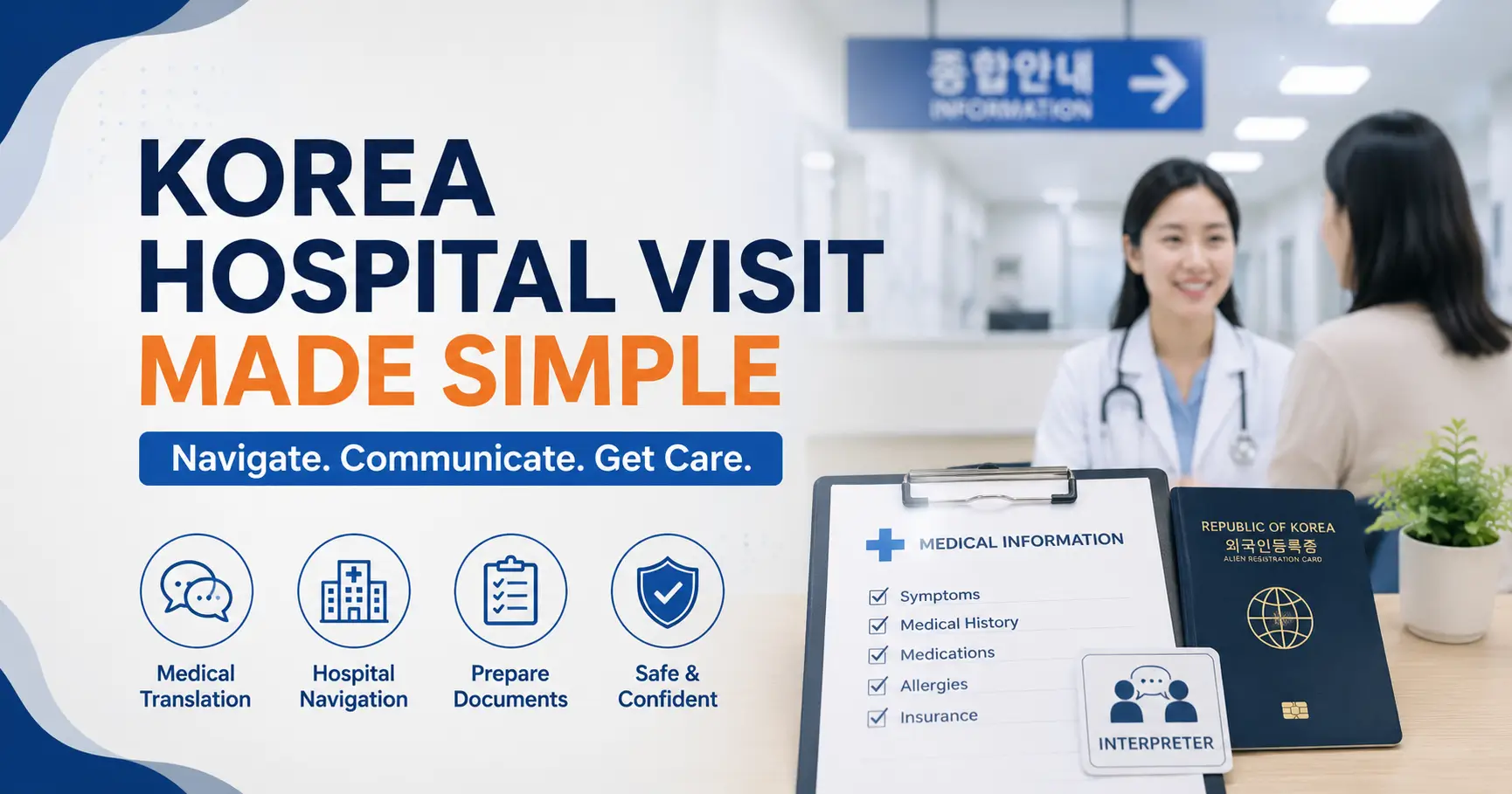
One of the strangest moments in Korea is realizing that the hospital can be brilliant and bewildering at the same time. The doctor may be excellent. The machines may hum with quiet precision. The waiting room may move faster than a subway transfer. But if you do not know which counter to visit, which paper to show, or whether the sentence you just nodded at was about payment, fasting, consent, or medication, the whole visit can feel like holding a map in the rain.
Medical translation and big hospital navigation in Korea matters because language gaps are not just inconvenient. They can affect diagnosis, consent, prescriptions, insurance claims, follow-up care, and your confidence at the exact moment your brain has turned into steamed rice.
This guide helps foreign residents, expats, international students, workers, spouses, and long-stay visitors prepare a safer hospital visit. You will learn how to choose the right hospital door, request interpretation, organize documents, avoid billing fog, and know when a language barrier becomes a medical safety issue.
- • Start small.
- • Prepare early.
- • Bring the paper trail.
- • And never let politeness replace understanding.
The Quick Safe Plan Before a Korean Hospital Visit
If you remember only one thing, remember this: prepare the communication before you prepare the taxi route. Confirm the department, ask whether interpretation is available, bring your ARC or passport, prepare insurance details, write your symptoms in simple language, and save the sentence, “I need medical interpretation before I consent.”
- For routine care: a neighborhood clinic may be faster and less stressful.
- For complex care: a university hospital or large general hospital may be worth the extra steps.
- For consent, surgery, hospitalization, serious diagnosis, or medication confusion: use qualified interpretation whenever possible.
Contents — choose a section
Table of Contents
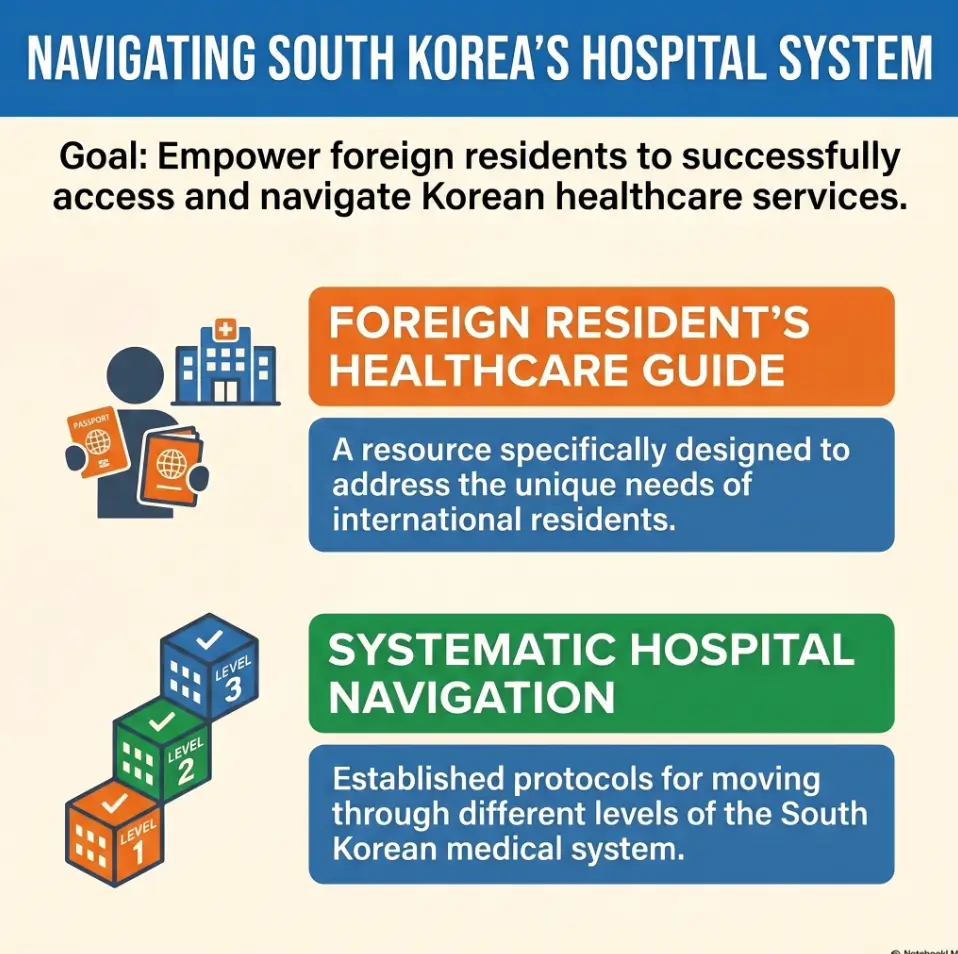
Why Korean Big Hospitals Feel Confusing Even When Care Is Excellent
Korean big hospitals often feel less like one building and more like a small city with blood-test stations, payment windows, numbered tickets, department desks, pharmacy routes, imaging floors, and elevators that seem to have attended graduate school.
That does not mean the care is poor. In many cases, the speed and coordination can be impressive. Korea is known for efficient clinics, fast testing, and a culture of medical checkups. If you have already read about health checkups in Korea, you know the system can move with almost orchestral timing when you know the sequence.
The problem is that big hospitals assume you understand the sequence.
The “one building, many counters” problem
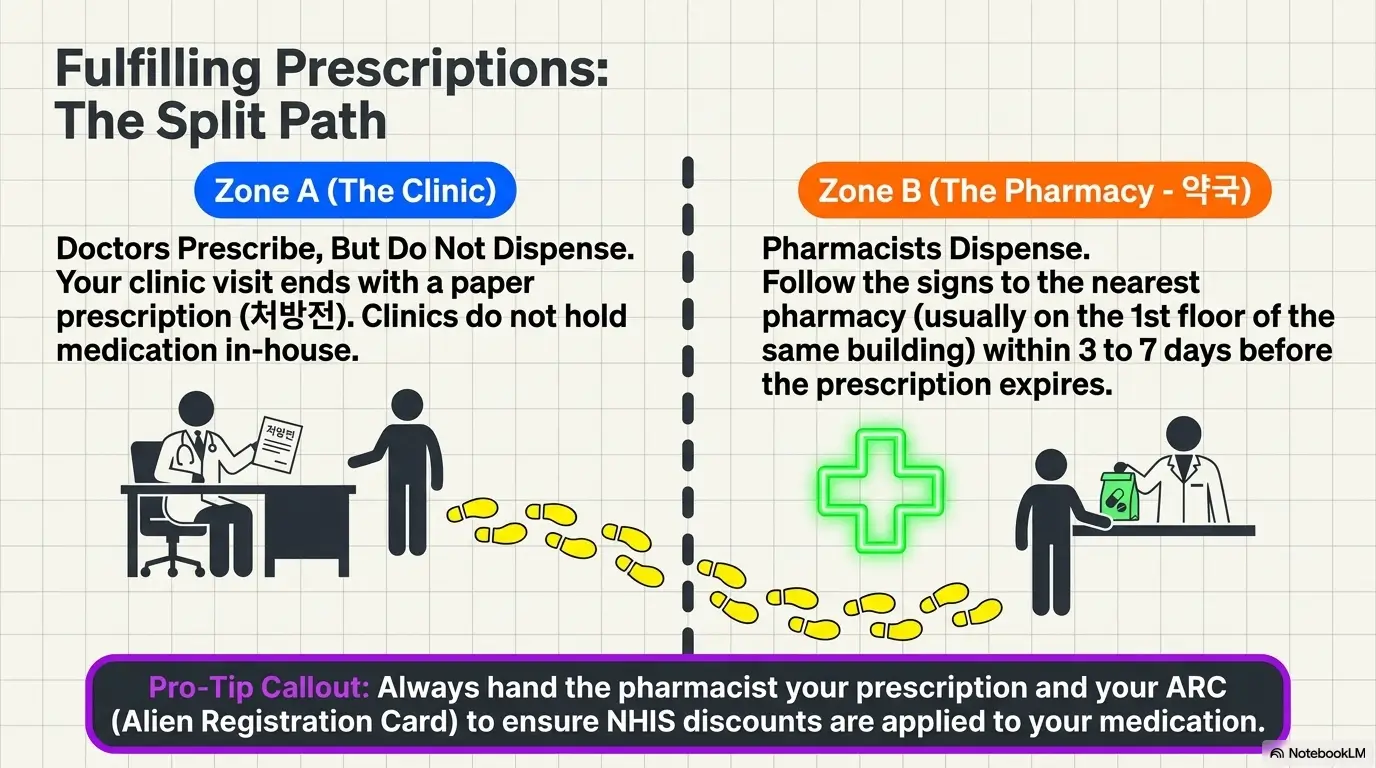
At a large Korean hospital, you may need to register before seeing the department. You may need to pay before a test. You may need to return to the department after the test. You may need to pay again before leaving. You may receive a prescription that must be filled outside the hospital, not inside it.
Each step may be reasonable. Together, they can feel like a paper maze wearing comfortable shoes.
Why university hospitals may require extra steps before the doctor
University hospitals often handle more complex cases. That means they may ask for a referral, prior records, appointment confirmation, insurance verification, or department routing before you meet the specialist.
This is especially important if you are coming from a smaller clinic. The clinic may give you a referral letter, test results, imaging files, or a Korean diagnosis name. Do not treat these as optional souvenirs. They are the little keys that open bigger doors.
The hidden stressor: language gaps at exactly the wrong moment
Most foreign residents can survive basic errands with gestures, translation apps, and the noble art of smiling while confused. Hospitals are different.
Medical language carries consequences. “Take twice daily” is not the same as “take two tablets daily.” “Allergy” is not the same as “upset stomach.” “Observe” is not the same as “discharge.” When the vocabulary gets sharper, casual translation gets wobblier.
- Confirm the department before arrival.
- Bring documents that explain your medical story.
- Ask about interpretation before the visit, not during the panic.
Apply in 60 seconds: Save your hospital’s main phone number and international clinic page before you need them.
Who This Is For, And Who Needs a Different Plan
This guide is mainly for foreign residents in Korea who are trying to use the Korean medical system as part of ordinary life. That includes office workers, teachers, international students, F-visa holders, spouses, long-term expats, digital nomads with extended stays, and families who suddenly need a pediatrician, specialist, or emergency room.
It is not mainly a cosmetic surgery tourism guide. Short-stay medical tourists often use coordinators, partner clinics, package services, and travel-linked support. Residents usually need something less glossy and more useful: how to move through the system when your child has a fever, your back gives out, your prescription is confusing, or your employer asks for hospital documents.
Foreign residents using Korean National Health Insurance
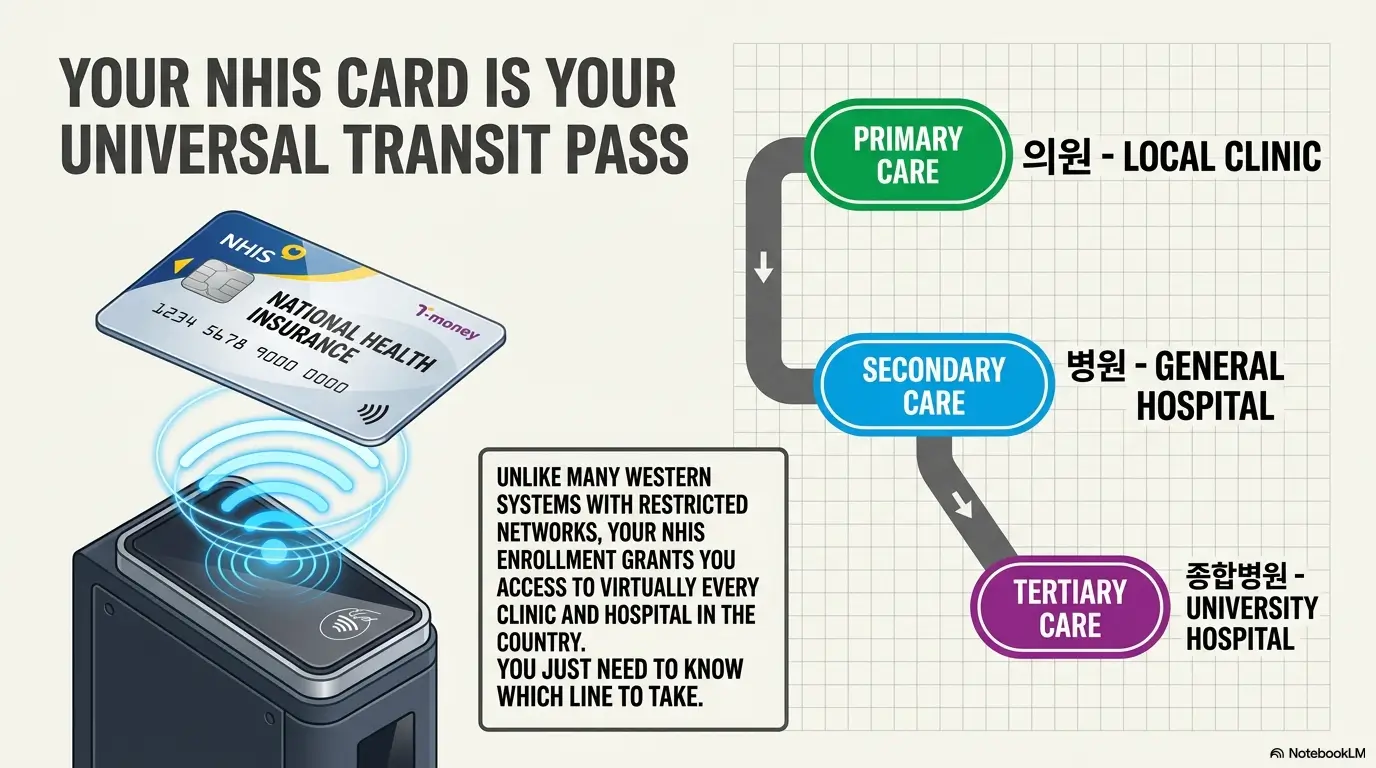
Korea’s National Health Insurance Service says foreign residents can receive the same coverage as Korean citizens once properly enrolled, but eligibility, contribution status, visa category, address registration, and documents still matter at the counter.
If you recently moved, changed visa status, started school, changed jobs, or missed a bill, do not assume the hospital desk can magically solve it while you are holding a urine sample cup and questioning your life choices.
International students, workers, spouses, and long-term expats
Students may have university support offices, but those offices may not accompany you to every appointment. Workers may depend on HR for insurance paperwork, but HR is not a medical interpreter. Spouses may have family support, but family members may soften, summarize, or misunderstand medical details out of kindness.
Kindness is lovely. Accuracy is safer.
Not for this situation: medical tourism as a short-stay visitor
If you are flying to Korea specifically for surgery, cosmetic treatment, dental work, fertility care, or a coordinated private package, you need a separate checklist. Ask the provider about interpreter credentials, medical records in English, aftercare, complication support, refund policies, insurance coverage, and what happens after you leave Korea.
Let’s be honest: “I’ll figure it out there” is not a plan
For low-stakes errands, improvising can be charming. For hospitals, improvising is expensive in attention. You may be tired, fasting, worried, in pain, or trying to understand a diagnosis in a second language. Give your future self a handrail.
Eligibility Checklist: Are You Planning Like a Resident Patient?
- Yes / No: Do you have an ARC or passport ready?
- Yes / No: Do you know whether your NHIS enrollment is active?
- Yes / No: Do you know the hospital department name in Korean or English?
- Yes / No: Do you have a referral letter if the hospital requires one?
- Yes / No: Can you explain your symptoms in one minute?
- Yes / No: Can you repeat medication instructions back clearly?
Neutral action line: If you answered “No” to two or more, prepare documents and language support before booking.
Before You Book: Choose the Right Door, Not Just the Famous Hospital
Foreign residents often search for the biggest hospital name first. That instinct makes sense. Famous hospitals feel safer from a distance. But the best hospital is not always the biggest one. It is the one that matches your condition, urgency, insurance status, language needs, and paperwork reality.
Korean healthcare has layers. Small clinics can be fast and practical. General hospitals can manage broader testing. University hospitals can handle complex specialties. International clinics can reduce communication friction, especially for residents who are still building Korean medical vocabulary.
International clinic vs regular department: what changes
An international clinic or international healthcare center may help with appointment scheduling, English communication, document routing, and guidance for foreign patients. Some are designed for resident expatriates as well as international patients.
That does not mean every doctor speaks English fluently, every document will be translated, or every department has immediate interpretation. It means you have a better starting door.
If the hospital has an international clinic, ask these questions before booking:
- Can you help me book the correct department?
- Is interpretation available for my language?
- Do I need a referral from a clinic?
- Should I bring previous test results or imaging?
- Can I receive receipts or medical certificates in English?
When a neighborhood clinic may be faster than a big hospital
For common colds, mild stomach issues, skin irritation, basic prescriptions, routine follow-up, or simple referrals, a local clinic may be faster and cheaper. Korean clinics often process patients quickly. If you are new to the style, why Korean clinics are so fast helps explain the rhythm.
The trade-off is that English support may be limited, and some clinics may not handle complex cases. Still, for the right problem, a clinic can be the sensible first stop.
When a big hospital is worth the extra bureaucracy
Choose a large hospital when you need a specialist, advanced imaging, complex diagnosis, surgery, hospitalization, cancer care, neurological evaluation, cardiac care, high-risk pregnancy support, or coordinated care across departments.
Think of it like choosing transportation. A bicycle is perfect for a corner store. It is less perfect for moving a piano across Seoul.
The quiet question to ask first: “Do I need a referral?”
Referral rules and practical requirements can vary by hospital, department, insurance status, and situation. Before booking, ask whether the hospital requires a referral letter from a clinic or another hospital.
Even when a referral is not strictly required, having one can make the visit smoother. It tells the specialist what has already been checked and why you are being sent onward.
Decision Card: Neighborhood Clinic vs Big Hospital
| Choose this | When it fits | Trade-off |
|---|---|---|
| Neighborhood clinic | Minor illness, routine prescription, referral request | Less English support, fewer advanced tests |
| Large general hospital | Specialist care, testing, complex symptoms | More counters, longer waiting, more documents |
| International clinic | Language support, foreign resident routing, document help | May not cover every specialty or urgent need |
Neutral action line: Match the hospital door to the medical risk, not to the famous name.
Medical Translation Is Not Just Language: It Is Risk Control
Medical interpretation is not about making the conversation prettier. It is about reducing error. A good interpreter helps both sides understand symptoms, timing, medication use, allergies, prior diagnoses, test instructions, risks, benefits, alternatives, and next steps.
A hospital visit is full of tiny hinges. One misunderstood word can swing the door the wrong way.
What a medical interpreter should clarify
A qualified medical interpreter should help clarify the exact meaning of the conversation without turning into a second doctor. The interpreter is there to support communication, not diagnose you, sell you a treatment, or decide for you.
Useful interpretation should cover:
- Your symptoms, timeline, and severity.
- Past diagnoses, surgeries, and hospitalizations.
- Medication names, dose, timing, and side effects.
- Allergies and adverse reactions.
- Test preparation, fasting, and follow-up timing.
- Consent forms, risks, benefits, and alternatives.
- Discharge instructions and warning signs.
What casual bilingual help may miss
A bilingual friend can be helpful for directions and basic logistics. But medical interpretation has traps. Friends may summarize too much. Family members may soften bad news. Coworkers may feel awkward discussing reproductive health, mental health, bowel symptoms, or medication mistakes. A child should not be placed in the role of medical interpreter for an adult’s serious care.
There is also the privacy question. Your manager may be kind. Your manager still does not need to know your colonoscopy details. The human body has enough mysteries without adding office gossip confetti.
Consent forms, surgery, hospitalization, and serious diagnoses
For surgery, hospitalization, cancer care, serious diagnoses, invasive testing, sedation, psychiatric crisis, pregnancy complications, or major medication decisions, do not rely only on casual translation or a phone app. Ask for a qualified interpreter, hospital international office support, or city-supported medical interpretation if eligible.
Seoul has operated medical interpretation support for eligible foreign residents and multicultural families, with priority often given to higher-stakes care such as surgeries, hospitalizations, examinations, and serious illness needs. Program details can change, so check the current application period, eligibility, languages, and request deadline before relying on it.
Here’s what no one tells you: translation apps get tired before doctors do
Translation apps can be useful for simple phrases. They can help you ask where the restroom is, confirm a counter number, or show a medication name. But they are not dependable for nuanced consent, dosage instructions, idioms, abbreviations, doctor handwriting, or fast multi-person conversations.
Use apps as a flashlight, not as the bridge.
Show me the nerdy details
Medical interpretation has a different risk profile from ordinary translation because the content is time-sensitive, technical, and often tied to consent. A safe communication loop should include three parts: the patient explains the problem, the clinician explains the assessment and plan, and the patient repeats the next step back in their own words. This “teach-back” style does not prove the plan is perfect, but it helps reveal misunderstandings before they become medication errors, missed follow-up visits, or unclear consent.
How to Request Interpretation Without Creating a Paperwork Fog
The best time to request interpretation is before the appointment. The worst time is when you are standing at reception, sweating into your coat, while the ticket machine blinks like a tiny bureaucratic lighthouse.
Interpretation takes scheduling. Hospitals may need to check language availability. City programs may require advance requests. Private interpreters may need appointment details, department names, and expected duration.
Ask before the appointment, not at the reception desk
When you call or message the hospital, keep your request short and specific:
“I am a foreign resident in Korea. I need medical interpretation for [language] for an appointment in [department]. Is interpretation available, and how do I request it?”
If you do not know the department, say your main symptom plainly. Avoid self-diagnosing unless a doctor has already given you the diagnosis.
Seoul residents: check city-supported interpretation options
Seoul has offered medical interpretation support programs for eligible foreign residents. These programs may have limits on language, request timing, number of uses, budget, and eligible medical situations. Do not assume last year’s details still apply. Check the latest Seoul Global Center, Seoul Foreign Portal, or city program information before planning a high-stakes appointment around it.
If you live outside Seoul, check your local multicultural family support center, foreign resident center, city hall foreigner support office, university international office, employer HR team, or hospital international clinic.
Medical tourism centers vs resident support programs
Medical tourism support and resident support are not always the same thing. Tourism centers may focus on visitors seeking treatment packages, while resident programs may focus on foreign residents facing language barriers in daily life.
Before you request support, clarify your status:
- Are you a resident or short-stay visitor?
- Are you using NHIS, private insurance, or self-pay?
- Is this routine care, advanced testing, surgery, or hospitalization?
- Do you need appointment booking help or only interpretation?
Build a “translation packet” before the visit
A translation packet is a one-page summary of your medical situation. It should be simple enough that an interpreter, doctor, nurse, or international clinic coordinator can understand it quickly.
Quote-Prep List: What to Gather Before Booking an Interpreter
- Hospital name and branch.
- Department name and doctor name, if known.
- Appointment date and expected duration.
- Your language pair, such as Korean to English.
- Reason for visit in one sentence.
- Whether consent, surgery, hospitalization, or test preparation is involved.
- Whether you need in-person, phone, or video support.
Neutral action line: Send the same details to the hospital, interpreter, or support center so everyone works from one version of the visit.
Bring This Folder: The Small Stack That Prevents Big Delays
Hospitals love documents because documents reduce guessing. Foreign patients sometimes dislike documents because documents reproduce in bags overnight like tiny office rabbits. Still, the right stack can prevent delays, repeat testing, billing confusion, and awkward counter conversations.
You do not need a museum archive. You need the practical essentials.
ARC, passport, insurance card, and contact details
Bring your Alien Registration Card if you have one, plus your passport if requested or if your ARC situation is in transition. If you are enrolled in NHIS, bring your insurance details. Keep your Korean address and phone number easy to show.
If you are new to Korean administrative life, Korea resident registration basics can help you understand why identity, address, and status often appear together in official systems.
Current medications: Korean name, English name, dose, frequency
Do not rely on memory for medication names. Bring the package, a photo of the label, or a written list. Include supplements, herbal products, injections, contraceptives, psychiatric medications, blood thinners, diabetes medications, and anything you take “only sometimes.”
Medication names can vary by country. A brand name from home may not mean much at a Korean counter, but the generic ingredient may.
Prior test results, referral letters, imaging, discharge summaries
Bring prior lab results, imaging CDs or files, referral letters, discharge summaries, pathology reports, vaccination records, and relevant translated documents if you have them.
For chronic conditions, bring a one-page summary. For recent injuries, bring dates. For pregnancy, bring gestational age and prior scan information. For surgery history, bring the procedure name and date if possible.
Symptom timeline: date, location, severity, triggers
A symptom timeline helps doctors work faster. Write it in plain English, then translate simple keywords if needed.
Use this format:
- Started: May 20, morning.
- Location: lower right abdomen.
- Severity: 7 out of 10 at worst.
- Pattern: worse after eating, better when lying still.
- Other symptoms: fever, nausea, no vomiting.
- Medicine tried: acetaminophen, 500 mg, twice.
Illustrative Scenario: The Folder That Spoke First
A foreign teacher in Seoul once arrived at a large hospital with a sore abdomen, a tired face, and exactly three Korean phrases. At reception, the first exchange started wobbling. Department? Referral? Insurance? Symptoms? The air grew thick. Then she opened a clear plastic folder. Inside were her ARC, medication list, recent clinic note, symptom timeline, and a phone number for a Korean-speaking coworker who had agreed to help only with logistics.
The receptionist’s shoulders dropped. The nurse pointed her to the right counter. The doctor still needed an interpreter for the medical conversation, but the visit stopped feeling like a locked room. The folder did not cure anything. It did something quieter and almost as valuable: it gave the system enough structure to help her.
- Bring identity and insurance details.
- Bring medication names and prior records.
- Bring a symptom timeline that a tired person can understand.
Apply in 60 seconds: Create a phone album named “Hospital Korea” and store photos of your key documents.
At the Hospital: Follow the Patient Journey Like a Train Map
A Korean big hospital visit is easier when you stop expecting one straight line. Think of it as a train map. You may move from registration to department desk, to payment, to test room, back to department, then to payment again, then to pharmacy.
Once you expect the transfers, they feel less personal. The hospital is not punishing you. It is routing you.
Registration: where identity, insurance, and department choice collide
At the first desk or kiosk, the hospital may confirm your identity, contact information, insurance status, appointment, and department. If your Korean is limited, show your appointment confirmation and prepared sentence.
Useful phrase:
“저는 외국인 환자입니다. 통역이 필요합니다.”
I am a foreign patient. I need interpretation.
Payment windows: why bills may appear before and after care
Payment in Korean hospitals can appear at more than one point. You may pay before a test, after a consultation, or before receiving documents. This can surprise people from systems where billing arrives weeks later, wearing the expression of a villain in a cardigan.
Ask whether the amount includes insurance. If you need reimbursement from private insurance, ask for itemized receipts before leaving.
Tests first, doctor later: do not panic
Sometimes you may be sent for blood work, urine testing, X-ray, CT, ultrasound, or other exams before the final conversation with the doctor. This does not always mean something is terribly wrong. It may simply be how the department collects information efficiently.
Still, ask what the test is for, whether you need to fast, when results will be reviewed, and where to go afterward.
Pharmacy routing: in-hospital vs outside pharmacy
Many Korean prescriptions are filled at outside pharmacies near the hospital. The prescription paper may show medication names, dosage, and timing, but the pharmacist may explain additional details verbally. This is one of the moments where translation matters.
If you are unsure, ask the pharmacist to write simple instructions or show the dose schedule. Do not leave with a bag of pills and a brave but empty smile.
Confirm department, referral, interpretation.
Show ARC/passport, insurance, appointment.
Follow payment and testing route.
Use interpreter for diagnosis and plan.
Request receipts, certificates, results.
Confirm dose, timing, warnings.
Common Mistakes That Make Korean Hospital Visits Harder Than Necessary
Most hospital mistakes are not dramatic. They are small. A missing referral. A forgotten medication name. A nod when you meant “please explain again.” A receipt not requested before leaving. The small mistakes gather like dust under a bed.
Here are the ones to prevent first.
Mistake 1: arriving without an appointment or department name
Some hospitals accept walk-ins for certain departments, but big hospitals may be appointment-driven. Showing up without a department name can send you into a routing spiral.
If you do not know the department, start with a clinic, international clinic, or hospital information line.
Mistake 2: assuming English support exists everywhere
Some doctors speak English well. Some nurses and staff may understand basic English. Some international clinics provide stronger support. But English availability is not guaranteed across every floor, desk, department, or shift.
Always verify language support before the visit.
Mistake 3: using machine translation for consent or dosage instructions
Machine translation can help with simple phrases, but consent and dosage require certainty. If you are signing something, starting a new medication, preparing for sedation, or agreeing to a procedure, ask for a human explanation you can repeat back.
Mistake 4: leaving without printed results or next-step instructions
Before leaving, ask:
- What is my diagnosis or working diagnosis?
- What medication am I taking and for how long?
- When should I return?
- What symptoms mean I should seek urgent help?
- Can I receive a copy of results, receipt, or certificate?
Mistake 5: forgetting to ask what happens if symptoms worsen
This question matters: “If this gets worse tonight, what should I do?”
It turns vague worry into a plan. Ask whether to go to the emergency room, call the hospital, return to clinic, stop medication, or watch for specific signs.
- Ask for the diagnosis or working diagnosis.
- Confirm medication timing and warning signs.
- Request documents before leaving the building.
Apply in 60 seconds: Add “What should I do if it gets worse?” to your phone notes.
Don’t Do This: The Translation Shortcuts That Can Backfire
When you are anxious, it is tempting to compress your story into one dramatic phrase. The body, sadly, is not always that cooperative. Clear details beat theatrical summaries.
A doctor does not need your best novel. A doctor needs the right clues.
Don’t translate symptoms into dramatic guesses
Say what you feel, where it is, when it started, and what changes it. Avoid jumping straight to “I think I have appendicitis,” “I have food poisoning,” or “My heart is failing” unless another clinician has already told you that.
Better: “Pain started near the belly button yesterday, moved to the lower right side today, worse when walking, fever started this morning.”
Don’t say “allergy” unless you mean allergy
In medical settings, allergy can mean a potentially serious immune reaction. If a medicine made you nauseated, dizzy, sleepy, or gave you stomach pain, say that specifically. If you had swelling, breathing trouble, hives, or anaphylaxis, say that clearly and urgently.
Don’t nod through medication instructions
Nodding is culturally smooth. It is medically dangerous when it hides confusion.
Use teach-back:
“I want to check that I understood. I take one tablet after breakfast and dinner for five days, correct?”
Don’t let embarrassment become the interpreter
Embarrassment is a terrible translator. It deletes symptoms, hides questions, and turns “I do not understand” into “Yes.” If the topic feels private, ask for professional interpretation or a staff member who can help discreetly.
If you are navigating cultural communication patterns, Korean indirect communication and Korean silence in conversation can help you understand why a calm pause does not always mean agreement or dismissal.
Billing, Insurance, and Receipts: The Money Trail You Should Not Ignore
Hospital billing is the part nobody wants to discuss until a claim is denied, a reimbursement form asks for a missing document, or a receipt sits in your bag like a cryptic fortune cookie.
Ask early. Ask politely. Ask before leaving.
Why NHIS status matters before the visit
NHIS status can affect what you pay at the counter. Foreign residents may be covered under Korean National Health Insurance when eligible and enrolled, but details can depend on visa type, residence status, employer enrollment, dependent status, contribution payments, and administrative updates.
For foreign residents, the NHIS runs foreign resident support channels and provides guidance in multiple languages. If your insurance status looks wrong, solve it through NHIS rather than assuming the hospital can correct everything instantly.
Ask for itemized receipts and medical certificates
If you need private insurance reimbursement, school documentation, employer sick leave, travel insurance, or overseas claim support, ask for the correct paperwork before leaving.
Useful documents may include:
- Itemized receipt.
- Payment receipt.
- Medical certificate.
- Diagnosis certificate.
- Prescription copy.
- Test result copy.
- English-language document, if available.
If you are using travel or overseas private coverage, the paperwork expectations may be strict. For wider insurance planning, travel insurance for South Korea is worth reviewing before you assume a claim will be simple.
Private insurance claims: documents to request before leaving
Private insurers often want proof of diagnosis, treatment date, provider name, charges, payment, and sometimes medication details. Ask your insurer in advance what documents they require from Korean hospitals.
If the hospital can issue English documents, confirm fees and timing. If not, you may need certified translation later.
When the bill looks strange: pause, ask, document
If the bill is higher than expected, do not panic at the counter. Ask whether NHIS was applied, whether any service was non-covered, whether the payment is partial or final, and whether additional charges may appear after testing or documentation.
Coverage Tier Map: What May Affect Your Out-of-Pocket Cost
| Tier | Situation | What to check |
|---|---|---|
| Tier 1 | Active NHIS, routine covered care | Confirm insurance applied at registration. |
| Tier 2 | NHIS plus private insurance | Request itemized receipts and diagnosis documents. |
| Tier 3 | NHIS status unclear | Contact NHIS foreign resident support. |
| Tier 4 | Self-pay or non-covered service | Ask for estimate and written charge details. |
| Tier 5 | Overseas claim or travel insurance | Confirm insurer document rules before treatment when possible. |
Neutral action line: Before paying, ask whether the amount is covered, non-covered, partial, or final.
When to Seek Help: Red Flags for Medical, Language, or System Trouble
Some problems should not wait for perfect translation, tidy paperwork, or a friend to finish work. When the body is waving a red flag, do not stand there admiring the fabric.
Medical red flags: symptoms that should not wait
Seek urgent medical help immediately for chest pain, trouble breathing, signs of stroke, severe allergic reaction, heavy bleeding, head injury, severe abdominal pain, sudden confusion, fainting, suicidal thoughts, pregnancy complications, severe burns, poisoning, or sudden weakness or numbness.
If you are unsure whether something is an emergency, choose safety. Call emergency services, go to an emergency room, or ask a trusted Korean speaker to help you contact urgent care. In Korea, emergency medical help is reached through 119.
Communication red flags: you cannot explain, consent, or repeat instructions
Language has become a safety issue when you cannot explain your symptoms, cannot understand risks and alternatives, cannot repeat medication instructions, or feel pressured to sign a consent form you do not understand.
Use this sentence:
“I need medical interpretation before I consent.”
In Korean:
“동의하기 전에 의료 통역이 필요합니다.”
Billing red flags: you do not understand what was charged
Billing confusion is not always danger, but it can create expensive mess. Ask for an itemized receipt, confirmation of insurance application, and explanation of non-covered services.
If you are living in Korea long-term, practical systems knowledge also matters outside hospitals. Guides like Korean phone plans for Americans and a Korean apartment move-in checklist can make daily-life emergencies easier because your phone, address, and documents are often part of the support chain.
Advocacy red flags: you feel pressured to decide without interpretation
If you feel rushed into a serious decision without understanding the diagnosis, options, risks, costs, or follow-up, pause and ask for interpretation. For non-emergency decisions, it is reasonable to ask for time, clarification, and written instructions.
- Use emergency care for red-flag symptoms.
- Ask for interpretation before signing serious consent forms.
- Get written next steps before leaving.
Apply in 60 seconds: Save “119” and your nearest emergency hospital name in your phone.
FAQ
Do big hospitals in Korea have English-speaking doctors?
Some do, especially in large hospitals, international clinics, and major city medical centers. But English support is not guaranteed in every department, at every counter, or during every shift. Confirm language support before booking, especially for specialist care, surgery, hospitalization, or serious diagnoses.
Can foreign residents get medical interpretation in Seoul?
Seoul has operated medical interpretation support programs for eligible foreign residents and multicultural families. These programs may have language, timing, budget, and use limits. Check the current Seoul Global Center or Seoul Foreign Portal information before relying on the service for an appointment.
Should I use Papago or Google Translate at a Korean hospital?
Translation apps can help with simple phrases, directions, and basic questions. They should not be your only support for consent forms, surgery, serious diagnoses, medication dosage, allergies, mental health crises, or complex treatment decisions. For high-stakes care, use qualified human interpretation whenever possible.
What documents should I bring to a Korean university hospital?
Bring your ARC or passport, insurance details, appointment confirmation, referral letter if required, medication list, prior test results, imaging files, discharge summaries, diagnosis notes, and a short symptom timeline. If you need reimbursement, ask what receipts and certificates are required before leaving.
Do I need a referral to visit a big hospital in Korea?
It depends on the hospital, department, medical issue, and insurance situation. Some large hospitals may require or strongly prefer a referral for specialist care. Ask before booking. Even when not required, a referral can help the doctor understand what has already been checked.
Can I use Korean National Health Insurance as a foreign resident?
Many foreign residents are enrolled in Korean National Health Insurance when they meet eligibility rules. Coverage can depend on residence status, enrollment, contributions, and administrative details. Confirm your NHIS status before hospital visits, especially after moving, changing jobs, changing visa status, or receiving a bill you do not understand.
What should I ask before surgery or hospitalization in Korea?
Ask for your diagnosis, procedure name, expected benefits, major risks, alternatives, anesthesia plan, expected stay length, discharge plan, medication instructions, total estimated cost, insurance coverage, and what warning signs require urgent help. Use interpretation before consent if you cannot explain the plan back clearly.
How do I get hospital receipts for overseas insurance claims?
Ask the hospital payment or document desk for itemized receipts, proof of payment, diagnosis certificates, prescription records, and test results. If your insurer requires English documents, ask whether the hospital can issue them and whether there is a fee. Do this before leaving the hospital if possible.
What if hospital staff speak some English but I still feel unsure?
Partial English can be enough for directions, but not always for medical decisions. Say clearly that you need interpretation or written instructions. Then use teach-back: repeat the plan in your own words and ask the staff to confirm whether you understood correctly.
Book language support for the actual appointment
Tell the hospital the department, appointment date, preferred language and whether you need help with registration, the consultation or both. Ask who provides interpretation, how it is arranged and what it costs. Bring a concise medication list and your main questions, and ask how to obtain records afterward. An administrative translator and a clinical interpreter may have different roles; do not assume that someone at an international desk will automatically attend the entire visit.
| Focus | What to check |
|---|---|
| Booking | Specify language, department, time and scope. |
| Visit | Prepare questions and relevant records. |
| Follow-up | Confirm written instructions and the route for clarification. |
A reader question: Can I rely on a friend to interpret every medical decision?
Ask the hospital about appropriate language support and explain your needs. A friend may help with logistics, but important explanations and consent should be understood by the patient.
Next Step: Make a One-Page Hospital Visit Card Today
A one-page hospital visit card is the simplest tool in this whole guide. It is not glamorous. It will not win design awards. It may, however, save you from explaining your blood type, medication, and emergency contact while dizzy under fluorescent lights.
Write your identity, visa status, emergency contact, and insurance details
Include your full name as it appears on your ARC or passport, date of birth, nationality, Korean phone number, Korean address, visa type if relevant, emergency contact, and insurance status.
If you move often or travel inside Korea, keep this updated. Korea is wonderfully connected, but a wrong phone number can still turn help into smoke.
List medications, allergies, diagnoses, and current symptoms
Use plain language. Include medication ingredient names if possible. For allergies, describe the reaction. For diagnoses, include the year diagnosed and your usual treatment.
Example:
- Allergy: Penicillin, hives and facial swelling.
- Medication: Metformin 500 mg, twice daily.
- Condition: Type 2 diabetes, diagnosed 2022.
- Current issue: Fever and cough since May 22.
Save one Korean sentence: “I need medical interpretation before I consent.”
Save this on your phone and on paper:
동의하기 전에 의료 통역이 필요합니다.
That sentence is not rude. It is clear. In a medical setting, clarity is a kindness to everyone.
Take a photo, print one copy, and keep it in your bag
Put the card in your wallet, bag, or passport pouch. Keep a photo in your phone. Share a copy with a trusted emergency contact if appropriate.
If you are raising children in Korea or supporting older family members, make a separate card for each person. For family life context, Korean grandparents and childcare and birth recovery centers in Korea show how family support and medical routines can overlap in Korean daily life.
- Put identity and insurance details at the top.
- List medications, allergies, and diagnoses clearly.
- Add one Korean sentence requesting interpretation before consent.
Apply in 60 seconds: Open a note on your phone and type your medication list now.
Conclusion
The hardest part of a Korean big hospital visit is not always the medicine. Often, it is the choreography: which counter, which document, which department, which payment window, which sentence you must understand before signing.
That is why medical translation and big hospital navigation in Korea should be treated as practical safety planning, not just expat convenience. The goal is simple: arrive with enough structure that the system can help you, and enough language support that you can make decisions with a clear head.
Within the next 15 minutes, make your one-page hospital visit card. Add your ARC or passport name, emergency contact, insurance status, medication list, allergies, and the Korean sentence requesting interpretation before consent. It is a small page. In the wrong moment, it can feel like a lantern.
Last reviewed: 2026-05.
Practical example and reader question added October 20, 2026. Existing source dates are retained; this addition is not a fresh verification of every earlier claim.