
Rural Korea, explained without the fog machine
How Rural School Closures, Empty Houses, and Aging Residents
Are Reshaping the Korean Countryside
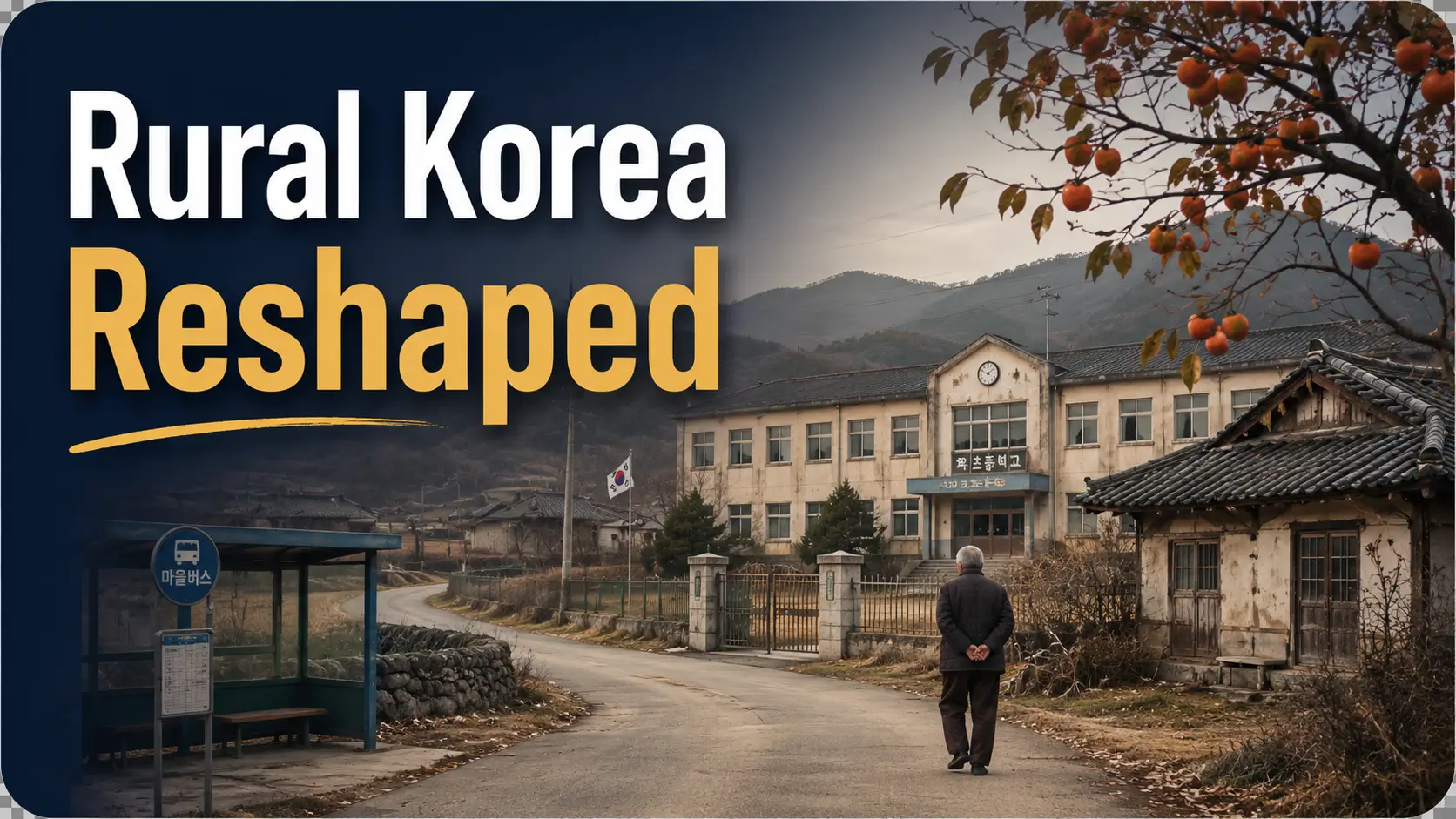
A village rarely changes all at once. First the classroom grows quieter. Then the bus comes less often. A farmhouse sits with its gate half-open for another winter. The neighbors still know who planted the persimmon tree, but fewer people are left to pick the fruit.
Rural Korea’s shift is not just a story about low birth rates. It is a chain reaction linking school rolls, empty homes, elder care, local budgets, transportation, inheritance paperwork, and the fragile social glue that keeps small communities functioning long after the population chart turns downward.
This guide is for readers who want to understand the Korean countryside without flattening it into either tragedy or travel-poster romance. You will learn how to read the signals, avoid easy myths, and think clearly about what rural livability can mean when a place becomes smaller, older, and still deeply alive.
See the chain
Connect schools, housing, aging, and services instead of treating them as separate headlines.
Avoid bad assumptions
Understand why vacant houses are not automatically bargains and closed schools are not just budget items.
Act with care
Use a simple three-signal map before writing, investing, visiting, researching, or planning around rural Korea.
The countryside is not disappearing in one dramatic thunderclap. It is being rewritten, line by line. 🧭
Snapshot
This article is for US and UK readers trying to understand rural Korea through policy, education, housing, elder care, travel, or real estate context. It explains how shrinking school-age populations, vacant houses, and aging residents interact, then gives you a practical way to compare one rural county or village before writing about it, visiting it, investing near it, or romanticizing it.
Contents — choose a section
Table of Contents
Before You Act: Read Rural Change With Humility
Rural Korea is a serious topic because it touches people’s homes, families, schools, inherited land, elder care, public budgets, and local identity. A village is not a case study in a jar. It is someone’s morning bus stop, someone’s mother’s pharmacy run, someone’s childhood classroom, and sometimes someone’s unresolved inheritance file.
This article can help you understand the patterns. It cannot tell you whether a specific house is a good purchase, whether a local redevelopment plan will succeed, or whether a particular school closure was justified. For any real estate, policy, academic, legal, or investment decision, confirm details with local records, qualified professionals, and current official data.
Use cautious verbs when you think about rural Korea: compare, check, ask, document, visit, listen, verify. They are not glamorous words, but they keep you from turning a living place into a decorative argument.
Key takeaway
Treat rural decline as a connected system, not a single problem. School closures, empty homes, aging residents, transport gaps, and local budgets often move together.
The Rural Chain Reaction Hiding in Plain Sight
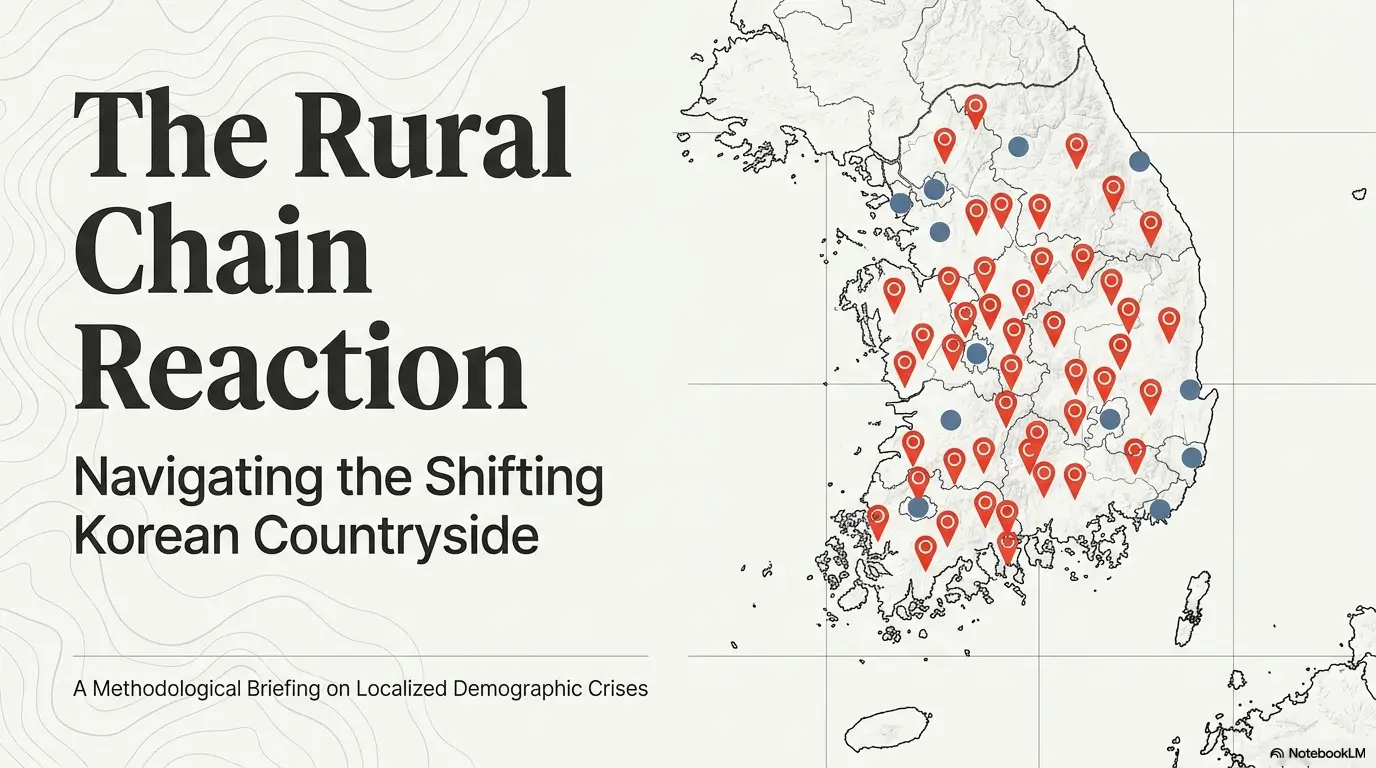
The simplest story says rural Korea is shrinking because there are fewer children. That is true, but it is too thin to be useful. A sharper explanation follows the chain: fewer children reduce school rolls, smaller schools become harder to maintain, school consolidation makes villages less attractive to young families, empty houses multiply, and older residents carry more of the daily work that keeps community life intact.
Once you see the chain, the countryside looks different. A closed school is no longer just an education decision. A vacant house is no longer just a property listing. An aging population is no longer just a demographic label. Each one is a signal that the village’s support systems may be losing density.
Why school closures are not just an education story
In a large city, a school can feel like one service among many. In a rural village, it can be the loudest proof that the future still has a local address. School gates bring parents, grandparents, buses, festivals, lunch suppliers, after-school programs, and the everyday choreography of children crossing streets in yellow hats.
When a school closes, the educational service may technically continue somewhere else. But the village loses a public rhythm. The calendar grows thinner. Families considering a move may cross the place off their list before they even ask about housing prices.
How empty houses become a signal of weakening local demand
An empty house is not always abandoned in the legal sense. It may have heirs, unclear title, emotional value, unpaid taxes, structural damage, or an owner who visits twice a year to cut weeds and remember someone. Still, visible vacancy changes how a village feels.
Empty homes can reduce confidence for nearby owners, increase maintenance burdens, and make newcomers wonder whether the community has enough services to support everyday life. The house becomes a small weather vane, pointing toward demand, inheritance friction, and the cost of repair.
Aging residents as the final pressure point, not the first cause
It is tempting to describe rural villages as “aging” and stop there. But older residents are often the people still maintaining local memory, seasonal work, neighbor care, village halls, informal transport, and daily check-ins. They are not the problem sitting at the end of the road. They are part of the infrastructure still holding the road together.
The pressure comes when the systems around them shrink: fewer buses, farther clinics, fewer nearby relatives, fewer shops, less school traffic, and local budgets stretched across too many roads, pipes, and public buildings.
Here’s the part most headlines skip…
Decline does not mean nothing happens. Rural Korea can be simultaneously older, emptier, tourist-friendly, culturally rich, agriculturally important, and full of policy experiments. A village may lose its elementary school and gain a weekend cafe. A county may lose young residents but attract retirees, remote workers, artists, or seasonal visitors.
The hard question is not whether rural places can still be charming. They can. The hard question is whether they can remain livable on Tuesday morning in February, when the road is icy, the clinic is far, and the bus schedule is less forgiving than the travel brochure.
Rural School Closures: When the Last Classroom Light Goes Out
Rural school closures tend to arrive wrapped in administrative language: consolidation, efficiency, student numbers, facility maintenance, resource allocation. Those words matter, but they can muffle the human meaning. In small communities, the school is often the last public institution that proves children still belong in the local future.
For educators and policy writers, the key is to separate three questions. Is the school educationally viable? Is the village socially dependent on it? And what support replaces the lost community function if the building closes?
Small schools as village anchors, not just public buildings
A rural school can function as a civic stage. Sports day, graduation, holiday performances, volunteer events, and parent gatherings all stitch the school into village identity. Even residents without school-age children may feel the school as a symbol of continuity.
When that anchor disappears, local identity does not vanish overnight. But a subtle question begins to hover: if children no longer gather here, who is this village being organized for?
What families lose when the nearest school moves farther away
A longer school commute is not just a line on a map. It affects sleep, after-school activities, grandparents’ caregiving routines, emergency pickups, and parents’ willingness to remain in the village. For families comparing rural housing options, school distance can outweigh a cheaper rent or larger yard.
For foreign readers, it may help to think of school consolidation in rural Korea alongside rural school district debates in the US or UK. The numbers may differ, but the emotional geometry is familiar: bigger schools can offer more programs, while longer distances can weaken community ties.
The transportation problem hiding behind “school consolidation”
School consolidation only works well when transportation works well. That means safe pickup points, reliable buses, weather planning, reasonable travel times, and coordination with parents’ work schedules. Without those supports, consolidation can turn a budget solution into a family-level burden.
One practical way to evaluate a rural education story is to ask: What changed after the closure besides the school address? Did bus service improve? Did after-school care follow the students? Did the old building receive a useful second life? Did families with young children stay?
School closure reading checklist
- Distance to the new assigned school
- Bus pickup location, travel time, and winter reliability
- After-school care access for working families
- Use plan for the closed school building
- Change in nearby homebuyer or renter demand
- Community role of the old school before closure
Why one closed school can change a village’s future buyer pool
A village without a local school may still attract retirees, second-home buyers, artists, farmers, or remote workers. But it becomes harder to attract families with young children unless transportation, childcare, and nearby services are unusually strong.
That matters for housing demand. If the buyer pool narrows, empty houses may remain empty longer. Renovation becomes riskier. Local shops lose weekday customers. The closure becomes a small hinge on which several other doors turn.
Empty Houses: Korea’s Quiet Countryside Inventory Problem
Empty houses in rural Korea invite quick fantasies. A foreign viewer sees a tiled roof, weeds at the gate, mountains behind it, and thinks: cheap farmhouse, quiet life, maybe a guesthouse. The fantasy is not always foolish. It is just incomplete, like reading only the first page of a contract because the paper feels nice.
Vacant homes are a housing issue, a legal issue, a maintenance issue, and a local confidence issue. They can be reused, but not all can be reused cheaply or quickly.
Vacant homes as more than abandoned property
Some homes are empty because the owner moved to a city. Some are tied up in inheritance. Some are structurally unsafe. Some still hold family belongings and memories. A house can look abandoned from the road while being emotionally occupied by a family that has not decided what to do.
That is why vacant-house policy is delicate. Demolition may improve safety and village appearance. Reuse may support newcomers or local businesses. But forced simplicity can create conflict if ownership, memory, and future use are not handled with care.
Why rural empty houses are harder to reuse than city apartments
City apartments are not simple, but they usually come with clearer markets, comparable sales, standardized utilities, and easier access to contractors. Rural houses can be more idiosyncratic. One home may need a new roof, heating upgrade, septic review, pest control, road access checks, and title clarification before it becomes livable.
The purchase price can be the least dramatic number. Repair costs, professional inspections, travel time, winter maintenance, and translation or legal support may matter more than the listing price.
Ownership, inheritance, and the paperwork fog
Rural properties may have older records, family ownership issues, informal boundaries, or heirs who disagree. A house that looks easy to buy may not be easy to transfer. For foreign buyers, language, residency status, financing, tax, and reporting rules add more steps.
Before paying for any rural property research service, agent, renovation estimate, or legal review, ask what they will verify in writing. A polished brochure is not a title check. A drone photo is not a structural inspection.
| Vacant-house question | Why it matters | What to verify before spending money |
|---|---|---|
| Who owns it? | Legal transfer may be harder than the listing suggests. | Current ownership record, heirs, liens, taxes, and seller authority. |
| Can it be lived in safely? | Cheap homes can hide expensive structural problems. | Roof, foundation, heating, plumbing, electrical, pests, mold, and drainage. |
| Can you reach it year-round? | Rural access can change with weather and road maintenance. | Road type, snow or ice risk, parking, emergency access, delivery access. |
| Are utilities reliable? | Renovation budgets can swell quickly. | Water, septic or sewer, heating fuel, electricity, internet, waste collection. |
| Does the village welcome reuse? | Community fit affects daily life and project success. | Local expectations, noise concerns, parking, guesthouse rules, village relations. |
Don’t assume every empty house is a bargain
A low purchase price can be a warning label wearing a cute hat. If a house is cheap because it needs major repairs, lacks access, has unclear title, or sits far from daily services, the total cost may surprise you.
For cautious buyers, students, journalists, and investors, the safer phrase is not “abandoned house in Korea for sale.” It is “rural property due diligence checklist.” Less romantic, yes. More useful, absolutely.
Aging Residents: The Human Infrastructure Left Behind
Older residents are often described through need: healthcare need, care need, mobility need. Those needs are real. But the description is incomplete unless it also includes contribution. Older residents keep gardens, watch homes, remember land histories, care for neighbors, organize village halls, call relatives, notice who missed lunch, and maintain the social circuits that do not appear on a budget spreadsheet.
In a shrinking village, this human infrastructure becomes both more important and more fragile. When the same few people keep everything running, resilience can become exhaustion wearing a polite smile.
Older residents are holding villages together with invisible labor
Many rural support systems are informal. A neighbor drives another neighbor to the clinic. Someone checks whether the lights are on at night. A local elder knows which house belongs to which cousin and who should be called before a repair crew arrives.
This work can be affectionate, practical, and deeply rooted. It is also vulnerable. If younger relatives live far away and local services shrink, older residents may become both the caregivers and the people needing care.
Healthcare access, bus routes, and daily errands become survival systems
For a visitor with a rental car, a 25-minute drive to a clinic feels manageable. For an older resident who no longer drives, the same distance can shape the entire week. Bus frequency, pharmacy access, grocery delivery, bank branches, post offices, and senior centers become part of the care network.
This is where rural decline becomes a service-design problem. A village does not only need houses. It needs workable routines for the people who actually live there.
Key takeaway
A rural village can look peaceful while daily life is logistically difficult. Always ask about clinics, buses, pharmacies, groceries, winter roads, and social support before judging livability.
Why “aging village” does not mean “inactive village”
Many older rural residents are active, skilled, and socially alert. They farm, volunteer, run small businesses, care for grandchildren during visits, maintain rituals, and hold historical knowledge that no database can fully replace.
But activity should not be used as an excuse to underfund support. A person can be strong and still need a bus. A community can be proud and still need accessible healthcare.
Let’s be honest: resilience has limits
Resilience is admirable until it becomes a polite word for abandonment. Rural residents should not have to prove heroic endurance before services are taken seriously. If a community is expected to shrink, planning should make daily life safer and easier, not merely cheaper.
That is the ethical center of rural policy: not how to preserve every village exactly as it was, but how to honor the people still there while making realistic decisions about schools, housing, care, and mobility.
The Population Math Behind the Countryside Shift
The countryside does not shrink because one number changes. It shrinks because several numbers line up in the same direction: fewer births, youth migration, Seoul-area concentration, aging households, smaller school cohorts, and service withdrawal. The result is not a cliff. It is more like a tide going out slowly enough that people keep arguing over whether the beach has changed.
Low fertility and youth migration are squeezing rural school rolls
Korea’s low fertility is often discussed nationally, but its effects are uneven. Rural districts with smaller population bases feel school-age decline more sharply. When fewer children are born and young adults leave for education or jobs, school rolls fall from both ends.
For a local elementary school, the issue is not abstract fertility. It is whether there are enough children in each grade to sustain teaching, social life, transportation, and facilities.
Seoul-area concentration keeps pulling young adults away
Young adults often move toward universities, jobs, hospitals, cultural life, dating pools, and professional networks. Once they build careers and families elsewhere, returning to a rural hometown can become emotionally meaningful but practically hard.
This matters for diaspora Koreans and policy-curious readers. A village may have many people who love it from afar. Love, however, does not automatically create a school roll, a clinic shift, or a weekday grocery customer.
Why rural decline can continue even when tourism looks lively
A rural county can attract weekend visitors while losing full-time residents. Cafes, festivals, guesthouses, and seasonal travel can bring money and attention, but they do not always rebuild permanent population.
Tourism can help, especially when it supports local owners and year-round services. But visitors do not need the same infrastructure as residents. They can leave before the pharmacy closes, before the bus gap matters, before winter maintenance becomes personal.
The uncomfortable feedback loop: fewer services, fewer newcomers
When population falls, services become harder to justify. When services shrink, newcomers become harder to attract. That loop can affect schools, clinics, shops, banks, bus routes, childcare, and even internet upgrades.
Breaking the loop usually requires coordinated planning, not one shiny project. A renovated school building helps more if housing, transport, healthcare, and local work options also make sense.
Official data starting points
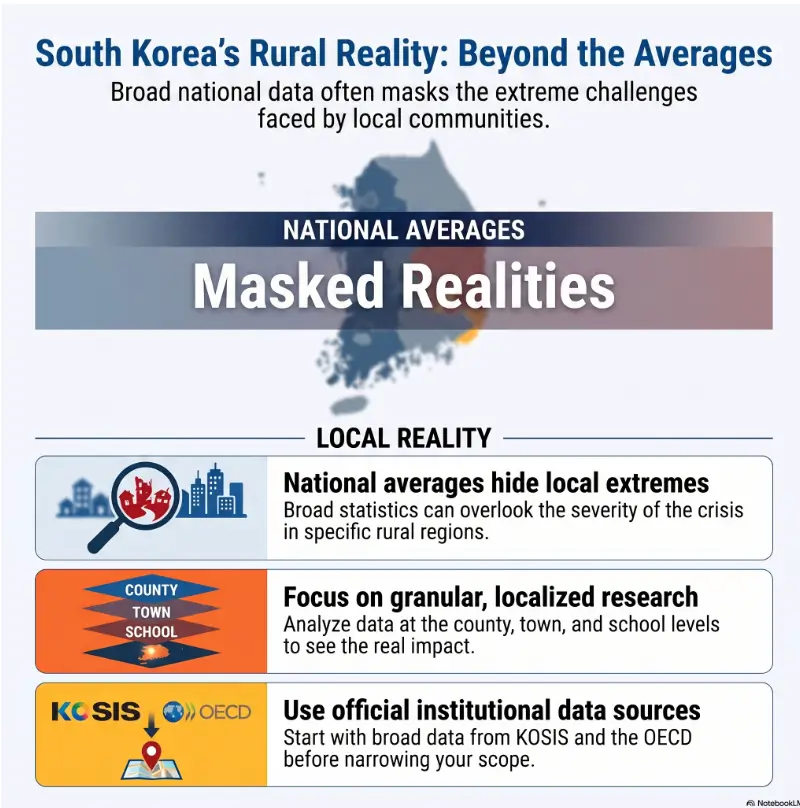
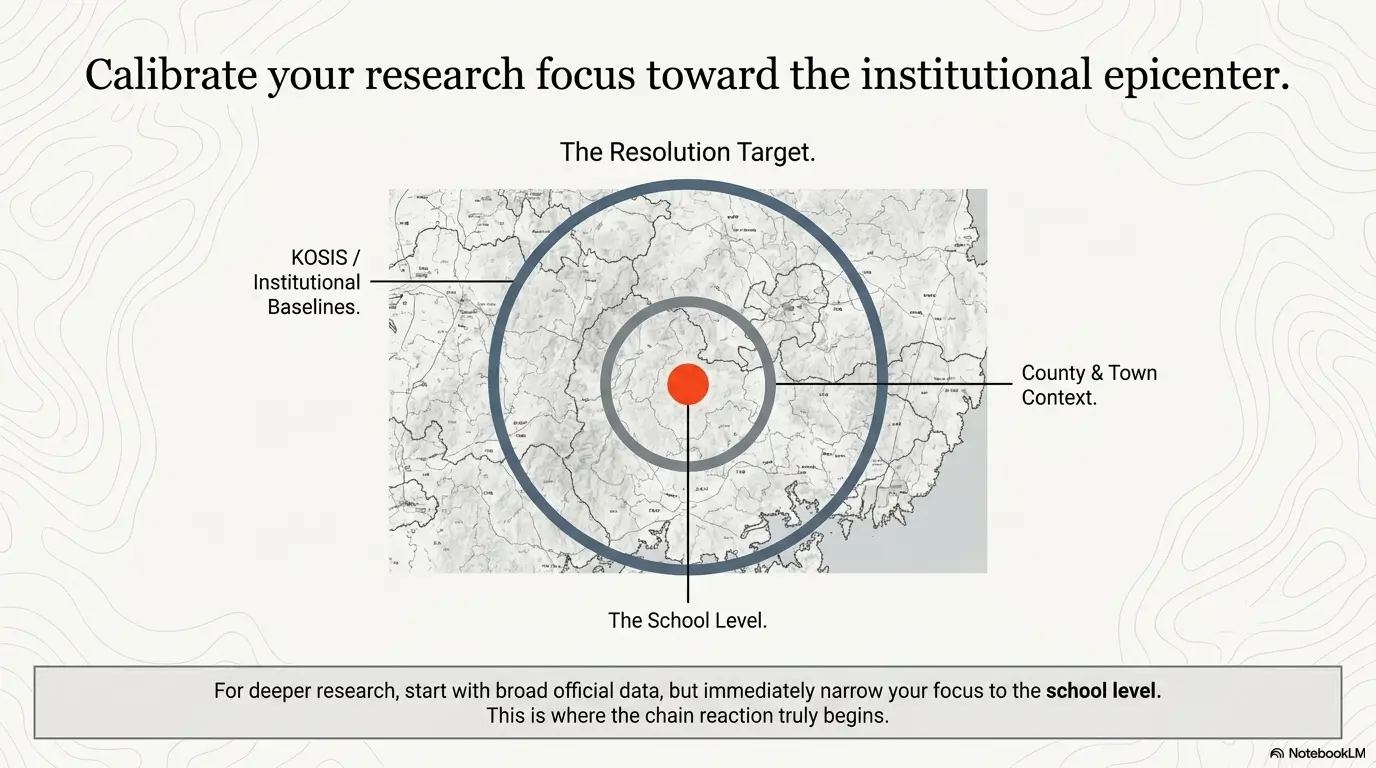
For deeper research, start with broad official or institutional data, then narrow to the county, town, and school level. National averages can hide local extremes.
Common Mistakes: What Outsiders Often Get Wrong
Rural Korea attracts strong narratives. Some readers want a tragedy. Some want a bargain. Some want a policy miracle. Some want a quiet farmhouse with good internet, clean title, reliable buses, friendly neighbors, mountain views, and no mosquitoes. The countryside, naturally, refuses to behave like a shopping filter.
Here are the mistakes that most often distort the picture.
| Common mistake | Why it misleads | Safer alternative |
|---|---|---|
| Treating school closure as a single-budget decision | It ignores family routines, local identity, transport, and future demand. | Ask what services replace the school’s community role. |
| Assuming empty houses can become instant rentals | Title, repair, access, utilities, and local rules may block reuse. | Build a due diligence checklist before estimating income. |
| Confusing tourism with repopulation | Visitors can raise weekend activity without adding schoolchildren or caregivers. | Separate visitor spending from full-time household formation. |
| Describing older residents as a burden | It erases the labor and knowledge that keep villages functioning. | Treat older residents as stakeholders and infrastructure holders. |
| Using national averages as local truth | County-level and village-level realities can differ sharply. | Compare local school, housing, age, and transport data. |
Mistake 1: Treating school closure as a single-budget decision
Budget matters. So does educational quality. But if analysis stops there, it misses the wider village effect. A school closure can reshape transportation needs, family settlement choices, elder caregiving, and the emotional confidence of a community.
Mistake 2: Assuming empty houses can be instantly converted into rentals
Rural rental demand is not automatic. A renovated house may still struggle if it is too far from transit, jobs, hospitals, schools, or shops. Guesthouse use may require permits, parking, neighbor acceptance, and year-round demand.
Before paying for renovation design, ask a colder question: who exactly will live here, for how long, and why this village instead of another one?
Mistake 3: Confusing rural tourism with long-term repopulation
A busy weekend market does not prove that rural decline has reversed. Visitors can bring energy, but permanent residents need clinics, schools, childcare, winter roads, jobs, waste collection, and mundane services that do not photograph well.
Mistake 4: Describing older residents as a burden instead of stakeholders
Older residents are not scenery in a policy drama. They are the people most affected by changes in buses, clinics, housing reuse, demolition, and public facility closures. Any serious plan must include their preferences, not just their age bracket.
The Policy Puzzle: Demolition, Reuse, or Managed Shrinkage?
Rural policy often gets trapped between two emotional extremes. One side wants revival, preferably with smiling families and restored schools. The other side assumes decline is unavoidable and public spending should retreat. Real life sits awkwardly between them, drinking vending-machine coffee at the county office.
Some places can attract new residents. Some can stabilize services for older residents. Some may need to remove unsafe buildings and concentrate support around stronger nodes. The goal is not to make every village young again. The goal is to make smaller places safer, more usable, and less lonely.
When renovation makes sense and when demolition is kinder
Renovation makes sense when a building has clear ownership, safe structure, realistic demand, service access, and a use that fits the community. Demolition may be kinder when a house is unsafe, legally stuck, too costly to repair, or harming nearby residents through pests, fire risk, or collapse risk.
The key is to avoid treating demolition as failure and renovation as virtue. Both can be thoughtful. Both can be careless. The difference is whether the decision is based on evidence, local consent, and long-term maintenance.
Why local governments need better vacant-house data
Vacant-house policy needs more than a count. Useful data should distinguish between structurally unsafe homes, seasonally used homes, legally transferable homes, homes with unclear ownership, and homes suitable for reuse after repair.
Without that detail, public programs may spend money on the wrong buildings, while genuinely reusable homes remain hidden behind paperwork fog.
How “shrinking smartly” differs from giving up
Smart shrinkage means accepting that some places will not return to their old population size, then designing services around the people who remain. It may involve stronger transport links, shared care hubs, mobile clinics, reused school buildings, safer demolition, and better housing information.
Giving up means letting services disappear without a plan. Smart shrinkage asks a harder question: if the population is smaller, what would dignity, access, and daily convenience look like now?
The question Korea cannot dodge: who pays for places built for more people?
Roads, schools, water systems, public buildings, clinics, and transport networks were often built for larger communities. When population falls, the cost per resident can rise. That creates hard budget choices.
The answer will not be one program. It will likely require national support, local prioritization, private reuse, nonprofit involvement, family care planning, and better coordination across education, housing, health, agriculture, and transport.
The Rural Reuse Decision Flow
1. Count
Map school status, vacant homes, age profile, buses, clinics, groceries, and public buildings.
2. Sort
Separate repairable assets from unsafe, legally stuck, or poorly located properties.
3. Match
Connect buildings to real users: elders, families, remote workers, students, visitors, farmers, or care providers.
4. Maintain
Budget for staff, repairs, heating, transport, insurance, access, and long-term management.
A building is not “saved” when it is photographed. It is saved when it has users, access, funding, maintenance, and local permission to matter.
What Empty Schools Could Become Next
Closed schools are emotionally charged because they still look ready for children. Desks, playgrounds, corridors, and gym floors can hold a kind of suspended afternoon. Reusing these spaces can be powerful, but only when the new use answers a real local need.
The best reuse projects do not ask, “What would look charming here?” They ask, “Who needs this building every week, and who will keep it warm, staffed, insured, repaired, and relevant?”
Care hubs for older residents and caregivers
A closed school can become a care hub if it is accessible, heated, safe, and connected to transport. Potential uses include day programs, meal services, caregiver respite, health screenings, exercise classes, and social activities.
The advantage is emotional as well as practical. A familiar building can become less painful when it continues to serve the people who watched generations pass through its gates.
Rural co-working spaces for remote workers, if transit and housing work
Remote work is often proposed as a rural revival tool. It can help, but only under certain conditions. A co-working space without decent housing, broadband, food options, transport, and community integration can become an attractive room that few people use.
For counties exploring this route, the practical comparison is not “old school versus shiny co-working space.” It is “full living package versus isolated renovation.” Workers need somewhere to live, eat, meet people, and handle daily errands.
Cultural guesthouses, language camps, and local history centers
Some closed schools may work as cultural spaces, artist residencies, local museums, language camps, or educational retreats. These projects can bring visitors and preserve memory. They can also support diaspora Koreans or international students who want to understand Korea beyond Seoul.
But cultural reuse should avoid turning rural life into stage design. A village is not a theme park for nostalgia. The best projects include local residents as narrators, partners, workers, and decision-makers.
The catch: reuse without residents can become stage design
A beautiful reuse project can still fail if it does not fit local life. The danger is especially high when outside investors, cultural planners, or travel brands focus on aesthetic appeal while ignoring transport, staffing, neighbors, and year-round demand.
Before funding, visiting, renting, or writing about a school reuse project, ask who benefits on ordinary weekdays. That question has a way of clearing the incense from the room.
| Reuse idea | Good fit when… | Risk to check |
|---|---|---|
| Senior care hub | Older residents live nearby and transport can be arranged. | Staffing, heating, accessibility, medical coordination. |
| Remote-work center | Housing, broadband, food, and community support exist. | Empty desks after launch excitement fades. |
| Language or culture camp | Seasonal demand is strong and local stories are respected. | Tourist performance replacing resident benefit. |
| Local history center | The building has strong memory value and local participation. | Maintenance costs without steady visitors. |
| Guesthouse or retreat | Permits, parking, neighbors, and access are workable. | Noise, seasonal demand, renovation overruns. |
The Rural Real Estate Trap: Pretty Photos, Hard Math
Rural real estate content travels well online because it offers a clean emotional script: leave the city, buy a quiet house, grow herbs, hear birds, become spiritually superior to your former inbox. Lovely. Also incomplete.
For investors, retirees, remote workers, and culture-curious buyers, rural Korea requires careful comparison. The best way to choose a rural property is not to start with the prettiest house. Start with services, access, legal clarity, and realistic use.
Repair costs can outrun purchase prices
A house can be inexpensive because the market is thin. It can also be inexpensive because the roof leaks, pipes are tired, insulation is weak, heating is inefficient, and contractors are not nearby. The cheaper the house looks, the more disciplined your inspection process should become.
Budget-conscious buyers should compare total cost, not purchase price. Include inspection, legal review, translation, taxes, repairs, utilities, furniture, internet setup, transport, and ongoing maintenance.
Septic, heating, road access, and winter maintenance matter
Rural comfort depends on unromantic systems. Heating fuel, insulation, plumbing, drainage, septic or sewer connection, waste collection, road width, snow or ice maintenance, emergency access, and delivery reliability all shape daily life.
If you are evaluating a village from abroad, ask for ordinary evidence: winter photos, utility bills, repair estimates, road videos, nearby bus stops, clinic distance, grocery options, and confirmation from a local professional who is not selling the dream.
Village acceptance is part of the asset, even if it is not on the deed
In rural areas, neighbor relationships can matter more than a glossy renovation plan. Parking, noise, dogs, guests, construction schedules, trash rules, shared paths, farming routines, and village expectations can affect whether a project feels welcome or resented.
This is especially important for guesthouse plans, remote-work retreats, or foreign buyers. Cultural fluency is not decoration. It is operational risk management with better manners.
Good / Better / Best: how to research before paying for help
| Research level | Best for | What to do | Money risk |
|---|---|---|---|
| Good: free desk research | Students, journalists, early curiosity | Check maps, public statistics, school status, transit, street views, and county websites. | Low, but easy to miss local realities. |
| Better: local verification | Serious travelers, remote-work planners, cautious buyers | Ask a local agent, translator, or consultant to verify access, utilities, ownership basics, and village context. | Moderate, but can prevent expensive assumptions. |
| Best: professional due diligence | Buyers, investors, renovation planners | Use qualified legal, tax, inspection, and construction professionals before committing funds. | Higher upfront cost, but safer for major decisions. |
Key takeaway
Do not buy the postcard before reading the utility bill. Rural property decisions should start with access, title, repairs, services, and community fit.
Separate a vacant-looking building from an available home
An apparently empty house does not establish ownership, permission to enter, structural condition or availability to rent. If considering a rural move, verify the exact property and ask the local authority or responsible owner about its status through the proper route. Check utilities, access, repairs, transport and current school provision independently. A wider story about school closures or aging does not settle whether one dwelling or village suits your household.
| Focus | What to check |
|---|---|
| Property | Owner, permitted use, condition and authority. |
| Services | Utilities, transport and current schooling. |
| Evidence | Distinguish observations, proposals and confirmed changes. |
A reader question: Can I use a school-closure headline to predict the next few years locally?
Ask the responsible education authority about confirmed decisions and current services. Keep proposals and demographic trends separate from an actual notice.
Build a Three-Signal Village Map Before You Decide
The safest way to understand rural Korea is not to ask whether a place is “dying” or “reviving.” Those words are too blunt. Instead, build a three-signal map. It works for journalists, policy students, travelers, diaspora readers, cautious buyers, and anyone trying to compare one rural county with another.
Signal 1: Check school status and distance to the nearest active school
Start with education because schools reveal the presence or absence of children. Look for active schools, recent closures, consolidation patterns, student transport, and reuse of closed buildings.
A village with no school may still be livable for retirees or remote workers. But if you are analyzing long-term family settlement, school distance is a core signal.
Signal 2: Count visible vacant homes and public reuse projects
Look for empty houses, abandoned-looking buildings, demolition notices, renovation projects, guesthouses, old schools, and community reuse efforts. The goal is not a perfect count from your laptop. It is a first impression of housing friction and local response.
If official vacant-house information is available, compare it with what you see on maps, local news, and county pages. New uploads, old blog posts, and tourism content can all distort timing, so keep dates in view.
Signal 3: Map healthcare, buses, grocery access, and senior services
Services reveal whether daily life is workable. Map the nearest clinic, hospital, pharmacy, grocery store, bus stop, senior center, bank, post office, and public office. Then ask how a non-driver would use them.
This one exercise often separates pretty rural imagery from actual livability. A place can be visually peaceful and logistically sharp-edged.
Illustrative Scenario: The house with the persimmon tree
A graduate student from London once chose a rural Korean village for a photo essay after seeing a house with a persimmon tree bending over a stone wall. The images were beautiful: rust, roof tiles, a narrow lane, autumn fruit glowing like lanterns.
Then she returned in winter. The nearest bus came rarely. The old elementary school had closed. The clinic was farther than she expected. The house was not abandoned, just waiting for three siblings to agree on what memory was worth.
Her final essay changed. It was no longer about emptiness. It was about distance: between heirs, between services, between seasons, between what a visitor sees and what a resident must solve.
The persimmon tree stayed in the opening photo. But this time, it was not a symbol of rural decay. It was a reminder to ask better questions.
15-minute village map template
- Choose one county or village, not “rural Korea” as a whole.
- Search for the nearest active elementary school and note travel distance.
- Look for closed school buildings or reuse projects.
- Scan maps for vacant-looking homes, old roofs, overgrown lots, and renovation signs.
- Map clinic, pharmacy, grocery, bus, senior center, and county office access.
- Write one paragraph on who the place currently serves best: elders, farmers, commuters, tourists, remote workers, families, or seasonal visitors.
Show me the nerdy details
A useful rural analysis should separate stock, flow, and access. Stock means what exists now: schools, houses, clinics, buses, public buildings, residents. Flow means movement over time: births, school enrollments, migration, vacancy changes, service reductions, renovations, demolitions. Access means how people reach what they need: road distance, bus frequency, winter reliability, caregiver availability, and digital connectivity.
The three-signal map works because it combines all three. School status shows demographic flow. Vacant homes show housing stock and demand friction. Services show access. When all three weaken together, the village may need managed support rather than simple revival messaging.
For serious research, compare several places rather than studying only the most photogenic one. A village with a closed school but strong bus access may face a different future than a village with cheap houses but weak healthcare access.
More official research starting points
Use official pages as starting doors, then narrow to local government, school, and property records where relevant.
Visit Korea’s education ministry Visit Korea’s interior ministry
FAQ
Why are rural schools closing in South Korea?
Rural schools close or consolidate when student numbers fall, facilities become hard to maintain, and education authorities decide that students can be served elsewhere. But the impact goes beyond education. A school closure can affect family settlement, transport needs, village identity, and local housing demand.
Are empty houses common in rural Korea?
Vacant homes are a visible issue in many rural areas, especially where population has aged or younger residents have moved away. The important point is that “empty” does not always mean legally abandoned or easy to buy. Ownership, inheritance, repair costs, and access can all complicate reuse.
Can foreigners buy abandoned houses in Korea?
Foreigners may be able to buy property in Korea, but rules, reporting duties, financing, taxes, land-use restrictions, and local details matter. Do not rely on social media claims or listing photos. Confirm the current rules with qualified legal, tax, and real estate professionals before paying deposits or fees.
What happens to old school buildings after closure?
Some closed schools remain unused. Others may become community spaces, cultural centers, training sites, guesthouses, care hubs, local museums, or private projects. The success of reuse depends on ownership, funding, maintenance, access, staffing, and whether the new use serves real community needs.
Why are young Koreans leaving rural areas?
Young adults often move for university, jobs, career networks, healthcare, culture, and family opportunities. Once they settle in larger cities, returning to a rural area can be difficult unless work, housing, childcare, schools, and services line up.
Is rural Korea disappearing completely?
No. Rural Korea is changing, not simply vanishing. Some villages are shrinking sharply, while others attract tourism, retirees, artists, farmers, remote workers, or public projects. The better question is whether smaller rural communities can remain livable, connected, and cared for.
Are government programs trying to revive empty villages?
Various national and local efforts have addressed rural depopulation, vacant housing, regional development, mobility, and aging services. Program details can change, so use official sources and local government pages for current information. Be cautious of any claim that one program can reverse rural decline by itself.
What should visitors understand before romanticizing rural Korea?
Beauty is real, but so are winter roads, long clinic trips, closed schools, thin bus schedules, and difficult property paperwork. Visit with curiosity and respect. Ask how daily life works for residents, not just how the village looks through a camera.
Your 15-Minute Next Step: Choose One County, Not One Fantasy
The biggest mistake is trying to understand “the Korean countryside” all at once. That phrase is too large. It turns real places into a misty noun. Choose one county, one village, or one closed school building and start there.
In the next 15 minutes, make a simple note with three headings: school, housing, services. Under school, write the nearest active elementary school and whether any closures appear nearby. Under housing, note visible vacant homes, reuse projects, or demolition signs. Under services, list the nearest clinic, pharmacy, grocery option, bus stop, and senior service point.
That small map will not give you the whole truth. But it will protect you from the thinnest stories: the tragedy story, the bargain story, the revival story, the postcard story. It will help you see rural Korea as residents experience it: through distances, routines, memories, repairs, buses, school gates, and the quiet bravery of ordinary maintenance.
Final practical promise
Before you write, invest, visit, or argue about rural Korea, compare one place across three signals: school status, vacant housing, and daily-service access. The countryside becomes clearer when you stop looking for a single answer and start reading the whole village.
Last reviewed: 2026-07
Practical example and reader question added October 20, 2026. Existing source dates are retained; this addition is not a fresh verification of every earlier claim.