
If you rent a home in South Korea, there is no single standardized “renters insurance” product that works exactly like the policy an American, Canadian, or British tenant may expect. In Korea, the risks are usually split among different products: insurance for your belongings, liability coverage for damage you cause, building insurance held by the owner, and a completely separate guarantee that may protect your jeonse deposit.
The distinction matters because the largest financial risk for many foreign tenants is not a stolen laptop or a kitchen fire. It may be a deposit worth tens or hundreds of millions of won. A normal home-fire policy does not turn into deposit protection simply because the word “insurance” appears on both products.
For a foreign tenant, the useful question is therefore not simply, “Do I need renters insurance?” It is: Which money am I trying to protect?
| What You Want to Protect | What to Look For in Korea | Main Warning |
|---|---|---|
| Your furniture, electronics and belongings | Home fire/property insurance with household-contents coverage | Building coverage alone may not cover your possessions |
| Damage you legally owe to a neighbor or another person | Personal or family liability coverage, or relevant fire liability coverage | Exclusions, deductibles and covered addresses matter |
| The rented property itself after certain tenant-caused accidents | Tenant liability or appropriate property/liability rider | Do not assume ordinary personal liability automatically covers every rented-property loss |
| Your jeonse or large rental deposit | Jeonse deposit-return guarantee | This is not ordinary renters insurance |
Table of Contents
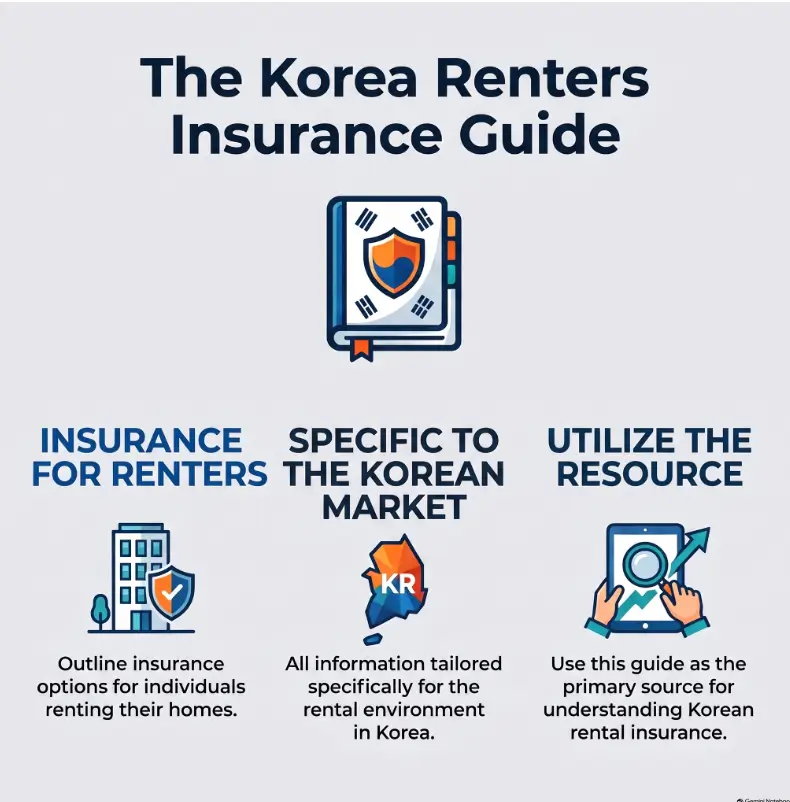
Is Renters Insurance Legally Required for Tenants in Korea?
There is no general nationwide rule requiring every residential tenant in South Korea to buy a U.S.-style renters insurance policy. Your lease, however, may contain contractual obligations concerning damage, restoration, insurance or responsibility for particular facilities, so the contract still deserves a careful read.
Korean law does impose fire-insurance obligations on owners of certain designated buildings. For example, the statutory “special building” system includes qualifying large apartment buildings, and the owner rather than the residential tenant carries the relevant statutory insurance obligation.
That should not be translated into “the landlord’s insurance protects me.” An owner’s policy may principally protect the building and liabilities defined by that policy. It does not automatically insure your laptop, furniture, bicycle, clothing or every liability you may personally incur.
The Korean Equivalent of Renters Insurance Is Usually a Package of Coverages
If your goal is the familiar renters-insurance combination of contents protection plus liability protection, search Korean policies by what they actually insure rather than by expecting a product literally labeled “renters insurance.”
Household contents: gajaedogu (가재도구)
Korean home-fire insurance products may allow coverage for household contents separately from the building itself. A current KB Insurance home-fire product, for example, states that customers may insure the building, household contents, or both.
For a tenant, this distinction is useful. You generally have an insurable interest in the possessions you own, while the apartment structure normally belongs to the landlord.
Depending on the policy and optional riders, Korean home policies may address risks such as fire, explosion, theft, water-related damage or temporary accommodation. Those features are not universal. The policy wording, insured amount, deductible and exclusions determine the actual protection.
Liability: baesang chaegim (배상책임)
Liability coverage matters when an accident creates a legal obligation to compensate someone else. A leaking washing-machine connection that damages the apartment below, for example, raises a different insurance question from water damaging your own furniture.
Korean policies often use terms such as family daily-life liability (가족일상생활중배상책임) or specific fire liability coverage. Do not choose a policy merely because the word “liability” appears in the brochure. Check whether your actual risk is included.
- Is the rented address correctly listed on the policy?
- Does the coverage include water-leak liability?
- Is fire or explosion handled under a separate rider?
- What deductible applies to property damage?
- Does the policy cover damage to the landlord’s rented property itself, or only damage to third parties?
- Who qualifies as an insured family member?
The fifth question is particularly important. Damage to property you rent or control may be treated differently from damage to a neighbor’s property. If your main concern is accidentally damaging your landlord’s apartment, ask the insurer specifically whether the proposed coverage responds to that scenario.
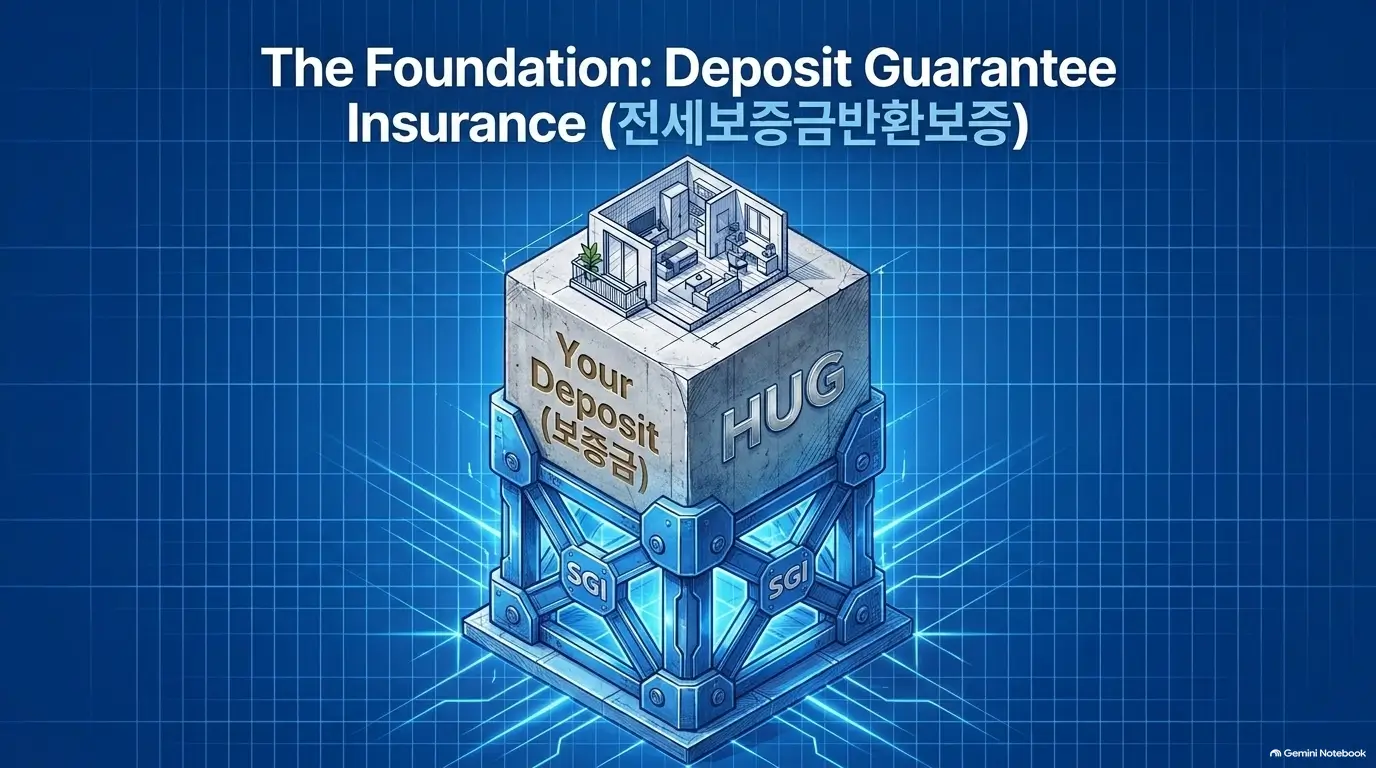
Jeonse Deposit Insurance Is a Completely Different Protection
If you paid a large jeonse deposit, deposit protection is likely the higher-value decision. A home-fire or household-contents policy protects against defined property risks. A jeonse deposit-return guarantee is designed around the landlord’s obligation to return the rental deposit when the lease ends.
The Housing and Urban Guarantee Corporation, usually called HUG, currently offers a Jeonse Deposit Return Guarantee. As of September 2026, its general product information states that eligible deposits are capped at KRW 700 million in the Seoul metropolitan area and KRW 500 million elsewhere, and the application ordinarily must be made before half of the lease term has passed.
Foreign tenants should not assume that Korean nationality is required for every deposit guarantee. HUG’s current documentation expressly provides procedures for foreign applicants, including foreign-registration documentation. Its document guidance for the return guarantee lists a Certificate of Fact on Alien Registration and a foreign registration card for foreign tenants, with additional documents possible depending on the transaction.
Eligibility still depends on the lease, the property, the deposit, the timing and whether the tenant has established the required housing-law protections. A foreign passport by itself does not make an otherwise ineligible lease insurable.
Foreign Tenants Must Check Which Guarantee Provider They Are Using
This is one of the easiest places for an English-speaking renter to make an expensive assumption: Korean deposit guarantees are not interchangeable.
HUG states that foreign tenants can use its return guarantee when the applicable requirements are satisfied. By contrast, the Korea Housing Finance Corporation’s current Jeonse Keeper Guarantee eligibility check states that all tenants must be Korean nationals.
| Guarantee Route | Foreign Tenant Position | What to Do |
|---|---|---|
| HUG Jeonse Deposit Return Guarantee | Foreign tenants may qualify | Check property, deposit, registration, fixed-date and timing requirements |
| HF Jeonse Keeper Guarantee | Current standard eligibility requires Korean nationality | Do not assume HUG eligibility transfers to HF |
| Private guarantee/insurance product | Depends on provider rules | Confirm nationality, residence status, property and underwriting directly |
For a foreign renter with a substantial deposit, checking the guarantee provider before signing the lease is much better than discovering the nationality or property restriction after transferring the money.
Your Residence Registration Can Matter More Than Your Nationality
Foreign tenants can receive important protection under Korea’s housing lease system, but the administrative steps are not identical to those used by Korean citizens.
Korean court precedent recognizes foreign registration and a properly reported change of residence as performing the relevant function of resident registration and move-in reporting for Housing Lease Protection Act purposes. HUG therefore looks at whether a foreign tenant has established the required opposability and preferential-payment conditions, rather than simply asking whether the tenant is Korean.
In practical terms, a registered foreign tenant should pay close attention to three things: actual possession of the home, accurate foreigner residence registration at that address, and the fixed date, called hwakjeongilja (확정일자), on the lease where required for priority protection.
This is one reason an insurance purchase cannot repair every bad lease decision. If the property, registration or timing fails the guarantee provider’s requirements, shopping for another household-insurance rider does not solve the deposit problem.
What Foreigners Should Ask Before Buying a Korean Home Policy
Private insurance access is partly a product and insurer issue rather than a single national eligibility rule. A foreign resident may encounter more friction with identity verification, Korean-only online applications, phone authentication or insurer underwriting than a Korean applicant.
For example, KB Insurance provides multilingual consultation for foreign customers and states that residents using its foreign-member identification process should enter the name and number exactly as shown on the foreign registration card. That does not mean every KB product is automatically available to every foreigner; it shows why the practical question is often how this particular insurer verifies and accepts this particular applicant.
Before paying a premium, ask the insurer or licensed agent these questions in one conversation:
- Can a registered foreign tenant be the policyholder and insured person for this product?
- Can I insure household contents without insuring a building I do not own?
- Does the policy cover fire damage to my belongings?
- Does it cover theft, and what evidence is required for a claim?
- Does liability coverage include water damage to the unit below?
- Does any coverage apply when I damage the apartment I rent from my landlord?
- Are fire and explosion liabilities excluded from ordinary daily-life liability and covered elsewhere?
- What is the deductible for each major claim type?
- Are there waiting periods for leakage or other coverages?
- What must I do if I move to another Korean address?
Those answers are more valuable than comparing premiums alone. A cheaper policy that excludes the one accident you are worried about is merely a smaller receipt.
Do Not Insure the Landlord’s Property by Accident
A Korean home-insurance application may ask whether you own or occupy the property and may separately request a building insured amount and a household-contents insured amount. This deserves attention if you are renting.
Ask the insurer which portion represents your own insurable interest. A tenant who owns KRW 20 million of furniture and electronics has a different insurance problem from the landlord who owns the KRW 500 million apartment.
Do not copy the apartment’s market price into an insurance field simply because it looks like the obvious number. Building insurance values, reconstruction values, contents values and rental deposits are different concepts.
A Cheap Policy Is Not Necessarily the Cheapest Decision
Korean home-insurance premiums depend on the insurer, building type, structure, age, insured amount, policy period and selected riders. Rather than publishing a false “typical renter premium,” it is more useful to compare quotes on identical coverage.
| Quote Item | Why It Changes the Comparison |
|---|---|
| Household contents insured amount | A lower limit can make a premium look artificially cheap |
| Water-leak coverage | May have a separate deductible or waiting period |
| Daily-life liability | Coverage scope and exclusions differ |
| Fire liability | May be separated from ordinary liability |
| Theft | Not every home policy includes it automatically |
| Temporary accommodation | Useful after serious damage but may be optional |
| Policy term | A multi-year contract is not directly comparable with a one-year arrangement |
Ask each insurer for the coverage schedule or product explanation, then compare the same six or seven lines. Insurance becomes much less mysterious once every quote is forced onto the same page.
When Renters Insurance Is Worth Considering
A household contents and liability policy becomes more relevant when replacing your belongings would be financially painful, when your home presents meaningful water-leak or fire exposure, or when you want protection against defined liabilities to neighbors.
It may be less important if you own very little, your existing policies already cover the relevant risk, or the proposed Korean policy mainly insures property that belongs to the landlord.
But a large jeonse deposit changes the calculation. If most of your housing wealth is sitting in the landlord’s hands, deposit protection may deserve attention before optional contents riders.
Decision rule: Protect the catastrophic number first. For one renter, that may be KRW 15 million of possessions. For another, it may be a KRW 250 million jeonse deposit.
Your 10-Minute Renter Insurance Check
Before requesting quotes, open your lease and write down five facts. This small exercise prevents most category mistakes.
- Your deposit: How many won could be at risk if the landlord cannot return it?
- Your possessions: Roughly what would it cost to replace your furniture, computers, appliances, clothing and other belongings?
- Your address status: Is your foreigner residence registration correctly updated to the rented home?
- Your lease protection: Have you completed the relevant fixed-date and occupancy steps?
- Your accident exposure: Is your main concern fire, leakage, theft, liability to neighbors, damage to the landlord’s property, or deposit recovery?
You can now ask for the right product instead of simply asking an insurer, “Do you sell renters insurance?” In Korea, that wording can hide several completely different financial problems.
When One Professional Conversation May Be Worth It
You normally do not need a lawyer merely to buy household contents insurance. If the insurer can explain the policy in a language you understand and your lease is straightforward, comparing product explanations yourself may be enough.
A licensed insurance professional can be useful when the insurer’s online system will not accept your foreign registration information, when you need confirmation about a specific liability exclusion, or when several policies may overlap.
Legal or specialist housing advice becomes more rational when the problem is no longer an insurance purchase but a threatened deposit: suspicious liens, a landlord already unable to repay, foreclosure activity, conflicting registrations, a missed guarantee deadline or a dispute about your lease rights. At that stage, the unresolved question is legal recovery rather than which household policy has the nicer brochure.
FAQ About Renters Insurance in Korea
Can a foreigner buy home or renters insurance in South Korea?
Potentially, yes. Private-insurer eligibility and application channels vary. Registered foreign residents may be able to verify themselves using their foreign registration information, but a particular product can still have underwriting or application restrictions. Confirm eligibility with the insurer before relying on an online quote.
Does my landlord’s fire insurance cover my belongings?
Do not assume it does. A landlord or building policy may protect the structure or defined liabilities without insuring possessions owned by the tenant. Ask to see what is actually insured rather than relying on the fact that some insurance exists.
Can a foreign tenant get HUG jeonse deposit protection?
HUG currently provides a route for foreign tenants who satisfy its product and Housing Lease Protection Act requirements. Foreign applicants may need foreign-registration evidence and additional documents. Eligibility still depends on the property, deposit amount, lease status, timing and protection requirements.
Can I buy a jeonse guarantee after most of my lease has already passed?
Do not wait until move-out. HUG’s standard return-guarantee information currently sets the application deadline before half of the lease period has elapsed. If you are near that point, verify eligibility directly with HUG rather than assuming a late application will be accepted.
Will renters insurance pay my jeonse deposit if my landlord cannot return it?
Ordinary contents, fire or liability insurance should not be treated as deposit-return protection. Jeonse deposit recovery requires a qualifying deposit guarantee or the applicable Korean housing-law remedies.
Before You Pay for a Policy
Take your lease, foreign registration card and one sheet of paper. Write four headings: deposit, belongings, neighbor liability, landlord property. Put the amount or risk you want protected under each.
Then make the insurer tell you which line each proposed coverage actually protects. If the biggest number is your jeonse deposit, check the deposit-guarantee route separately before spending time polishing a household-insurance package.
That simple separation is the core of renters insurance in Korea: one home, several risks, and several very different forms of protection.
Last reviewed: 2026-10