
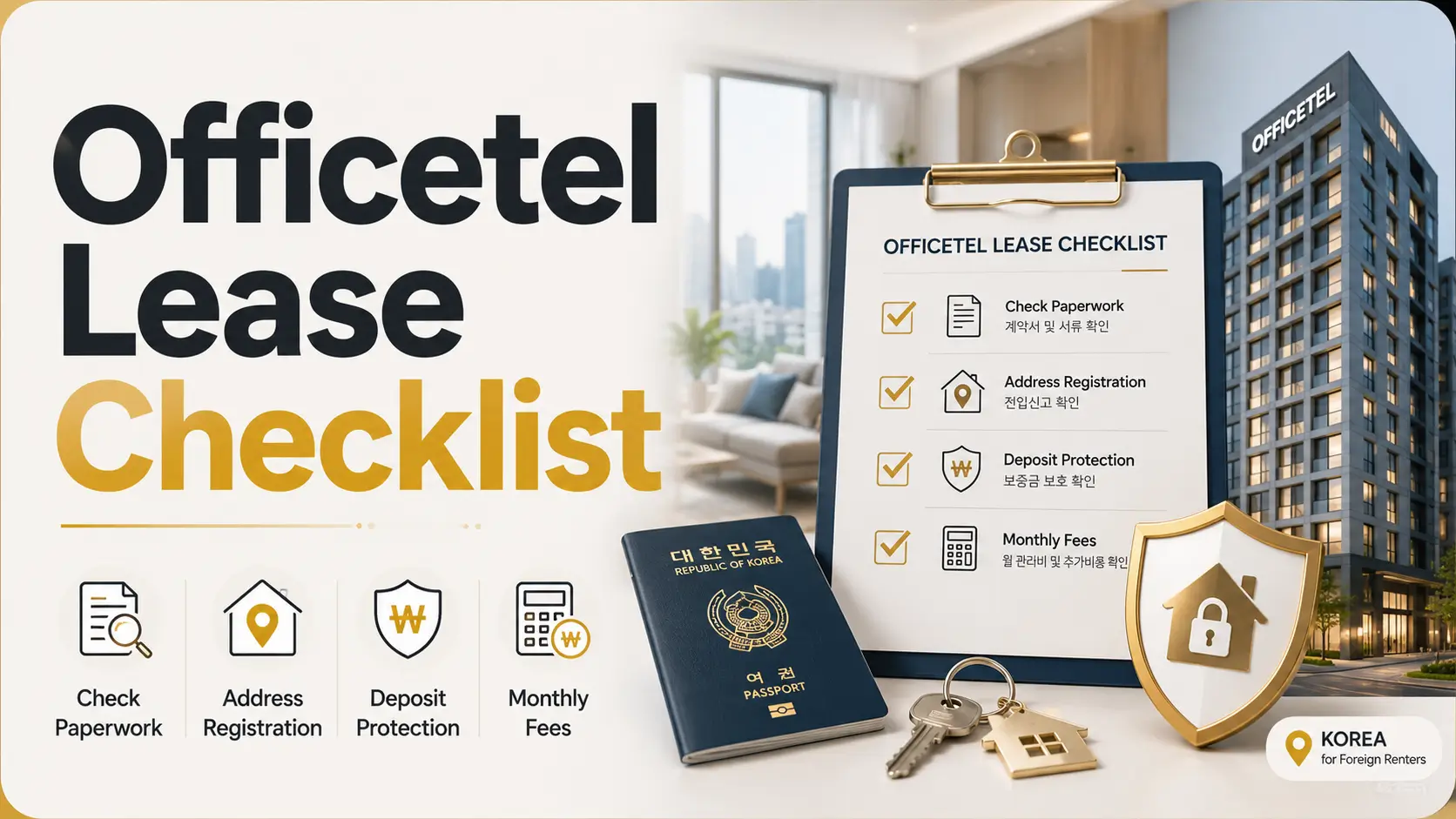
Foreigner-friendly renting in Korea starts before the viewing
What Foreign Renters Should Know About Officetels
Before Signing a Lease
An officetel can look beautifully simple from the doorway: one clean room, a tidy kitchenette, a tower lobby with polished stone, maybe a convenience store glowing downstairs at midnight. For a foreign renter in Korea, though, the real story is not only the floor plan. It is the contract, the address registration, the deposit trail, the building-use category, and the quiet little fees that arrive every month like polite envelopes with sharp teeth.
This guide is written for renters who need practical clarity before money moves. Maybe you are arriving for work, study, language school, family, or a remote-work chapter in Seoul, Busan, Incheon, Daejeon, Daegu, or Jeju. Maybe the realtor says the unit is “foreigner friendly.” That phrase can be useful, but it is not a contract term, not a deposit shield, and not proof that address reporting will work.
The aim here is calm prevention. You will learn what to ask, what to document, when to pause, and how to build a one-page lease check sheet before signing. Think of it as checking the seams of a suitcase before a long journey. The wheels may roll beautifully, but the zipper still matters.
Protect the deposit
Learn what to verify before wiring a large payment.
Check the paperwork
Understand address reporting, lease reporting, and fixed-date basics.
Spot hidden costs
Separate rent, maintenance fees, utilities, parking, and repairs.
🏠 The safest officetel lease is not the prettiest one. It is the one you can explain clearly before signing.
Snapshot
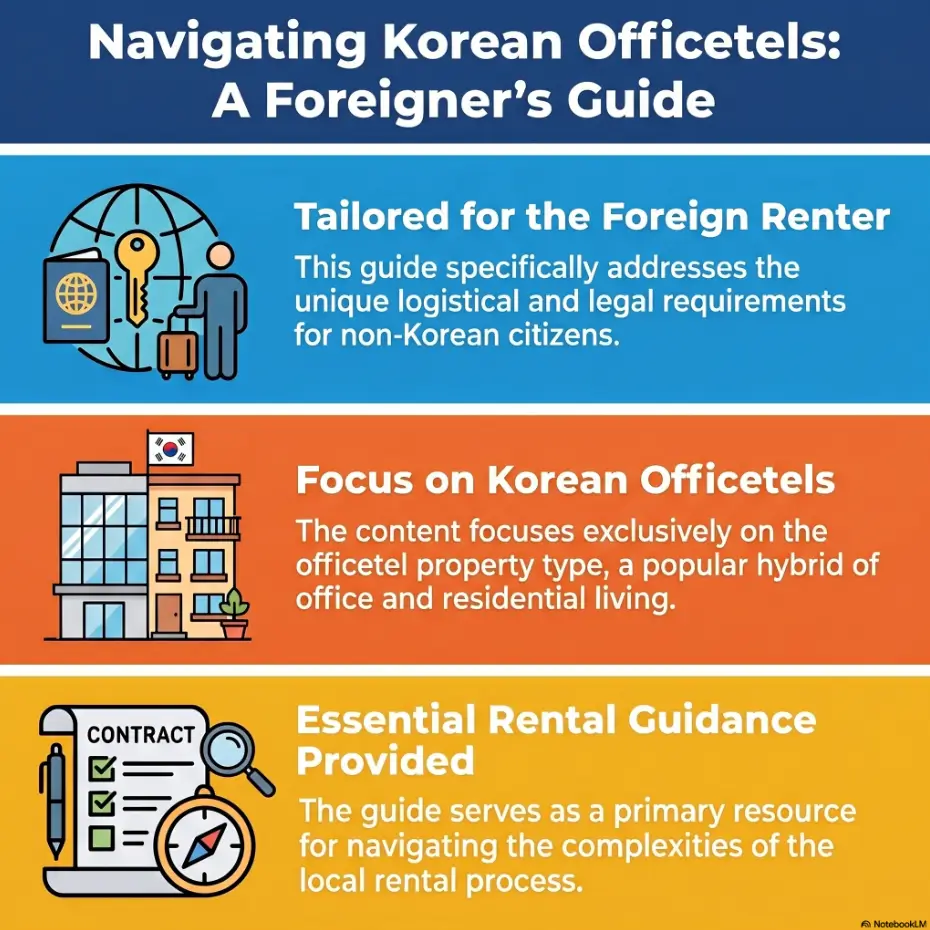
This article is for foreign renters considering an officetel lease in Korea. It helps you avoid deposit risk, registration problems, surprise fees, and contract confusion. By the end, you will be able to compare units more safely, question vague promises, and create a simple lease check sheet before paying money.
Table of Contents
Safety and Disclaimer Before You Use This Guide
This article is general rental education for English-speaking readers considering officetels in Korea. It is not legal, immigration, tax, financial, or real estate advice. Housing rules can vary by building, local district office, contract type, landlord situation, visa status, and timing.
Before signing a lease or paying a large deposit, verify the details with the local district office, immigration office, a licensed real estate agent, a tenant support service, or a qualified legal adviser. If the Korean contract and the English explanation do not match, the Korean contract usually carries the practical weight in a dispute. Treat translation as a bridge, not a life jacket.
Key takeaway
Do not treat an officetel lease as a casual room booking. For foreign renters, the lease affects housing, deposit recovery, address reporting, visa paperwork, and daily living costs. A clean checklist before signing is cheaper than a beautiful regret afterward.
Also remember that Korea has several rental customs that may feel unfamiliar to US and UK readers. Large deposits are common. Verbal explanations may happen quickly. Realtors may use practical shorthand. Maintenance fees may be discussed separately from rent. A unit that is available for move-in may still raise questions about address reporting, business use, or lease documentation.
The safe posture is simple: slow the signing process down until each major item can be written in one sentence. If you cannot explain the deposit, owner identity, registration path, monthly fees, and move-out refund process, you are not ready to sign yet.
Officetel Basics Foreign Renters Often Misread
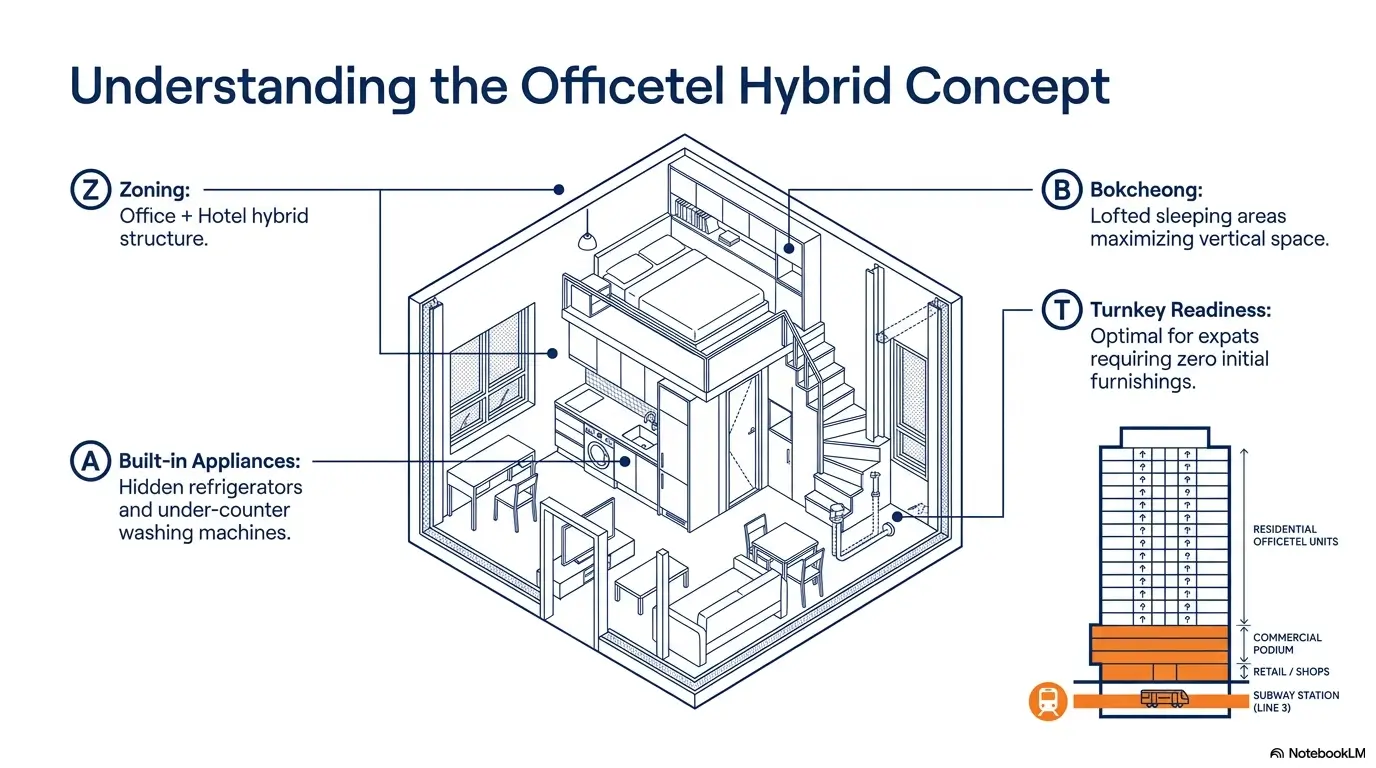
An officetel is a Korean building type that often blends compact living space with office-style convenience. The word itself comes from “office” and “hotel,” which already hints at the confusion. Some officetels function almost exactly like studio apartments in everyday life. Others sit in buildings where the official use, management rules, tax treatment, or registration details may be more complicated.
For a newcomer, the visual cues can be misleading. A bed, washing machine, induction cooktop, shower booth, shoe cabinet, and skyline view do not automatically answer the legal or administrative questions. The room can feel residential while the paperwork still needs checking.
Why an officetel is not always “just a studio apartment”
In everyday conversation, many people describe officetels as studio apartments. That is understandable. They are often small, urban, and designed for one person or a couple. Many are close to subway stations, universities, business districts, hospitals, and entertainment areas. They can be practical for students, English teachers, office workers, freelancers, and digital nomads who want a lock-and-leave home base.
But “studio apartment” is a lifestyle description. It is not enough for lease safety. Foreign renters should ask whether the unit can be used as a residence, whether address registration is permitted, whether the lease can be reported, and whether the contract identifies the unit and owner clearly.
A simple rule helps: judge the unit twice. First, judge it as a place to live. Second, judge it as a file of documents. The first judgment tells you whether you like the sunlight. The second tells you whether your deposit and paperwork have a place to stand.
The residential-versus-business-use detail that can change everything
Some officetels are used by residents. Some are used by small businesses. Some buildings contain a mixture of both. That mixed identity is one reason foreign renters should ask direct questions before paying a deposit.
Ask the agent or landlord: “Is residential use allowed for this specific unit?” Then ask the follow-up that matters more: “Can I report this address as my residence as a foreign tenant?” These are not rude questions. They are practical seatbelts.
If the answer is vague, such as “Everyone does it,” “It should be fine,” or “Do not worry,” ask for the process in writing. A good answer should identify where the reporting is done, what documents you will need, and whether the landlord or agent has handled the same process for foreign tenants before.
Here is what no one tells you: the room can look simple while the paperwork is not
The most dangerous rental problems often begin in ordinary rooms. Nothing looks dramatic. The walls are clean. The realtor is friendly. The landlord answers quickly. The elevator smells faintly of coffee and floor polish. Then, after move-in, the renter learns that address reporting is blocked, the maintenance fee is far higher than expected, or the deposit was wired before ownership was checked.
That is why this guide focuses less on interior charm and more on friction points. A foreign renter may need the address for alien registration or change-of-residence reporting. A student may need proof of residence for school paperwork. A worker may need stable documentation for employer records. A remote worker may need predictable monthly costs and clear internet arrangements.
Before you fall in love with the view, fall in like with the documents. Romance can wait until after the bank account, contract, and address all agree with each other.
Officetel first-look checklist
- Can the unit be used as a residence?
- Can a foreign tenant report this address?
- Is the lease in the owner’s name or a verified proxy’s name?
- Are rent, deposit, maintenance fees, and utilities separated clearly?
- Is the move-out deposit refund date written clearly?
- Are repair duties and restoration duties written in the contract?
Who This Guide Is For and Who Should Be More Cautious
Officetels can be excellent for the right renter. They can also be risky for someone who needs a large deposit arrangement, cannot read the contract, or does not have support for administrative tasks. The goal is not to scare you away. It is to help you decide whether an officetel fits your situation before your money starts wearing shoes.
Best fit: renters who want compact city living with office-style convenience
An officetel may suit you if you want a compact, central place near transit. It may be especially practical if you are living alone, planning a short-to-medium stay, working long hours, studying nearby, or prioritizing a secure building with elevators, parcel areas, and commercial facilities.
It can also be a good fit if you are comfortable with apartment-style rules. Many officetel buildings have clear expectations about trash sorting, recycling, noise, parking, deliveries, elevator use, and move-in scheduling. For renters who like predictable systems, that can feel reassuring.
The best officetel renter is not necessarily the richest renter. It is the renter who asks boring questions early. Boring questions are tiny umbrellas. They look dull until the rain starts.
Riskier fit: renters using a large deposit without Korean-language support
If the deposit is large, your verification standard should rise. A small deposit monthly rental may still require care, but a large key-money or jeonse-style arrangement deserves a slower process. You should understand the owner record, liens or mortgage concerns when relevant, deposit protection steps, refund timing, and how to respond if the landlord delays payment after move-out.
Language gaps can multiply risk. A realtor may explain the contract in English, but the contract itself may be Korean. A landlord may make a helpful promise in a chat message, but the written clause may say something narrower. If you cannot read the contract, use help before signing, not after the relationship has already become tangled yarn.
If you are already reading about large deposits, you may also find this related guide on jeonse deposit protection in Korea helpful for understanding why paperwork and timing matter so much.
Not ideal: anyone who cannot confirm address reporting before signing
For many foreign residents, address reporting is not a decorative formality. It can connect to immigration records, official notices, banking, school administration, employment paperwork, national health insurance, and local services. If the landlord or agent says address registration is not possible, pause.
Some travelers or very short-term guests may not need the same setup as a registered long-term resident. But if you are signing a lease and living in Korea under a status that requires residence reporting, the address issue belongs near the top of your checklist.
Simple fit map
| Green light | Small or moderate deposit, clear registration path, owner identity verified, fees written down. |
| Yellow light | Large deposit, Korean-only contract, vague maintenance fee, unclear repair duties. |
| Red light | No address reporting, payment requested to unrelated account, refusal to document promises, pressure to rush. |
Address Registration: The Quiet Deal-Breaker
Address registration is one of the least glamorous parts of renting in Korea, but for foreign tenants it can become the hinge of the whole lease. A unit may be comfortable, affordable, and perfectly located. If it cannot support your required residence reporting, it may be the wrong unit.
The key question is not only “Can I live here?” It is “Can I officially live here?” Those two sentences sound nearly identical, but they can lead to very different outcomes.
Why foreign renters should ask about address reporting before paying
Ask about address reporting before any major payment. Not after signing. Not after move-in. Not after you discover your visa paperwork needs a valid residential address. Earlier is kinder to your future self.
Use a clear question: “Can I report this officetel as my residence as a foreign tenant?” Then ask: “Which office handles it, and what documents should I bring?” A practical agent should be able to discuss the contract copy, identification, and local reporting office without turning the conversation into fog.
If you need broader context on Korean address systems, this guide on Korea resident registration can help you understand why local records play such a large role in everyday administration.
How change-of-residence reporting connects to immigration compliance
Foreign residents in Korea may need to report a change of residence within a short legal window after moving. Local offices and immigration channels may be involved depending on your status and timing. Because the timing can be strict, do not leave the address question floating in the air like a balloon over traffic.
A renter who moves first and tries to fix the paperwork later can lose valuable time. The better sequence is to confirm the registration path, sign a clear contract, prepare required documents, move in, and report the address within the relevant window.
For local administrative context, readers living in Seoul may also want to review how local district offices in Korea work, because many rental and residence questions eventually lead to a gu office, dong community center, or similar local desk.
Do not assume “move-in possible” means “registration possible”
“Move-in possible” usually means the room is physically available. It does not automatically mean the address can be reported for your needs. It also does not prove the landlord will cooperate with lease reporting, fixed-date documentation, or other paperwork.
This distinction matters because foreign renters often receive informal reassurance. A phrase like “many foreigners live here” is useful social information, but it is not enough. Ask whether those foreign renters were able to complete the official process you need.
Key takeaway
If you need residence reporting, ask about it before paying. A beautiful officetel that cannot support your official address needs can become an expensive waiting room.
Deposit Protection Starts Before the Contract Ink Dries
In Korea, deposit protection is not something to think about only when moving out. It starts before signing. The safest renter behaves like a careful archivist: every payment, name, account, clause, and receipt belongs in the file.
This is especially true for foreign renters who may be unfamiliar with Korean lease terms. A deposit can be modest, or it can be large enough to make your stomach turn into a small, anxious orchestra. Either way, documentation is your steady percussion.
Why a clean lease paper trail matters more than a pretty lobby
A pretty lobby does not return your deposit. A clear paper trail helps. Before paying, you should know who receives the money, why that person or entity is authorized to receive it, which unit the payment covers, and how the payment appears in the contract.
Save bank transfer records, receipts, chat messages, contract drafts, final contract pages, management fee explanations, photos from move-in, and any repair notes. If the landlord promises to replace an appliance or repaint a wall, ask for that promise in writing. Calm documentation can prevent a future argument from becoming a theater production.
Fixed date, lease reporting, and proof of the rental relationship
Korean rental paperwork may include concepts that are unfamiliar to renters from the US or UK. A fixed date can help establish timing and priority in certain lease situations. Lease contract reporting may also help prove the rental relationship. The exact steps and effects depend on your case, so confirm locally rather than relying on a friend’s old experience.
The practical point is this: do not hide the lease from the official world if official reporting is required or useful for protection. If a realtor or landlord discourages official paperwork without a clear reason, treat that as a serious warning sign.
The one question to ask: “How exactly is my deposit protected?”
This question is powerful because it demands a process, not a mood. A weak answer sounds like “It is safe.” A better answer explains the contract, owner identity, payment account, reporting steps, fixed date, and refund procedure. If the deposit is large, it may also include discussion of insurance or guaranty options where available and suitable.
Ask the question slowly. Then listen for nouns. Office names. Document names. Dates. Account holders. Contract clauses. A safe process has nouns you can write down.
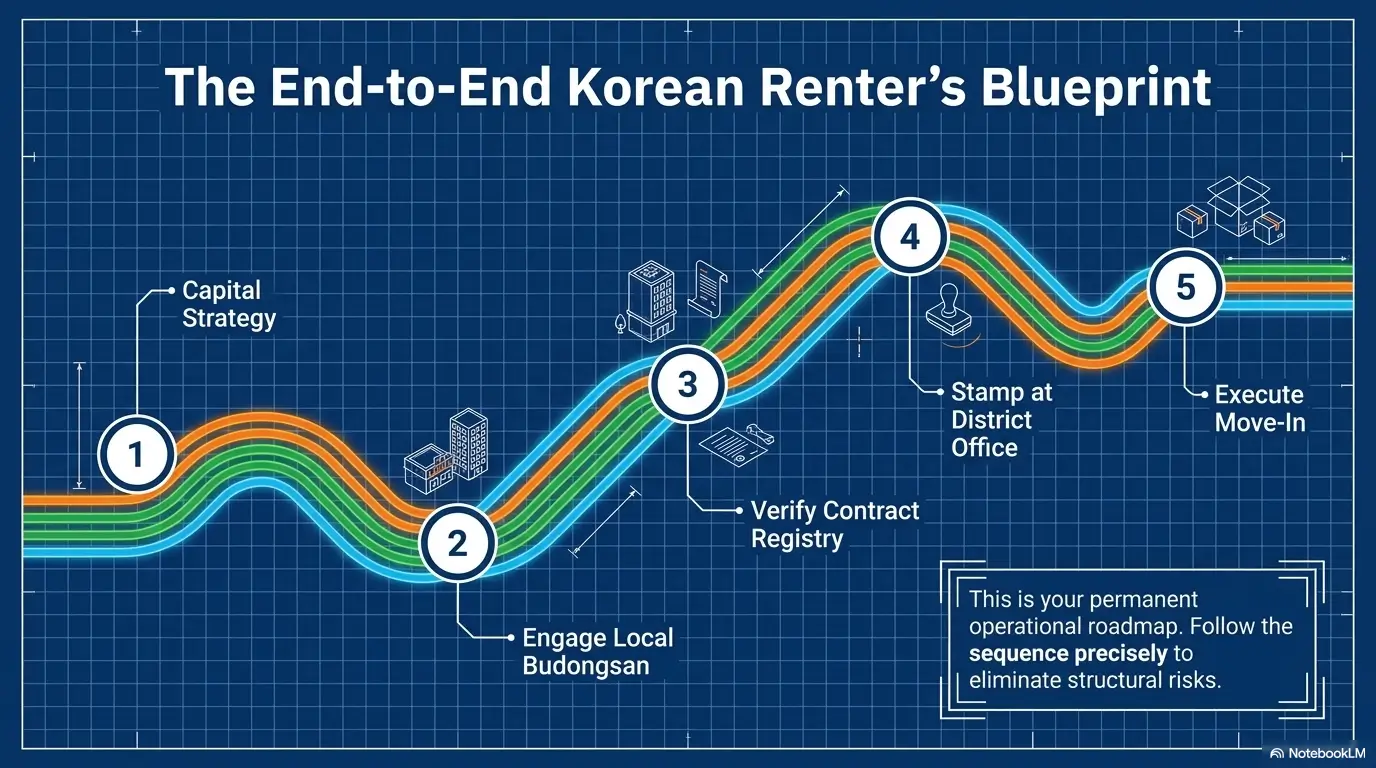
Officetel lease safety flow
1. Confirm use
Residential use and building rules make sense.
2. Confirm address
Foreign residence reporting is possible.
3. Check owner
Lease name, owner record, and payment account align.
4. Separate costs
Rent, deposit, fees, utilities, and parking are listed.
5. Report and date
Lease reporting and fixed-date steps are checked locally.
6. Save everything
Contracts, receipts, photos, and messages stay in one folder.
Maintenance Fees: The Monthly Bill Hiding in Plain Sight
Officetel rent can look attractive until the maintenance fee steps out from behind the curtain. In many buildings, monthly management fees are separate from rent. They may cover shared building costs, security, cleaning, elevator maintenance, common electricity, basic services, or other items. Utilities may be included, partially included, or billed separately.
A renter comparing two units should not compare rent alone. Compare total monthly cost. Cheap rent with a large maintenance fee is not cheap. It is wearing a cheap-rent costume.
Separate rent from building management fees before comparing prices
Ask for the monthly rent, deposit, maintenance fee, and estimated utilities as separate numbers. Do not accept a vague “around this much” if you are budgeting tightly. Ask whether the management fee is fixed or variable. Ask whether it changes by season. Heating and cooling costs can behave very differently in summer and winter.
For example, Unit A may be listed at lower rent than Unit B, but Unit A may have higher management fees, separate internet, paid parking, and expensive heating. Unit B may look slightly more expensive but cost less over six months. Spreadsheets may not be romantic, but they are excellent roommates.
Ask what is included: internet, water, heating, parking, cleaning, security
Included services vary. Some units include internet. Some do not. Some buildings include certain water or common charges. Electricity and gas may be separate. Parking may require a separate application or fee. Trash handling may require designated bags or building-specific procedures.
Ask for the latest management fee statement if possible. A real statement can reveal categories that a casual explanation misses. It can also show whether the building has seasonal variation. If you are a remote worker who runs heating, cooling, monitors, and appliances all day, your cost pattern may differ from a renter who leaves for work each morning.
Let us be honest: the cheap rent can be wearing an expensive hat
The phrase “low rent” has a lovely sparkle. But the true monthly cost includes the full stack: rent, maintenance fee, utilities, internet, parking, renter’s insurance if used, commute costs, laundry costs if needed, and any recurring service fees.
A foreign student may care most about predictable total cost. A freelancer may care about internet and power reliability. A teacher may care about commute simplicity and building quiet. A family member visiting often may care about guest rules. Your budget is not one number. It is a small ecosystem.
Monthly cost comparison table
| Cost item | Question to ask | Why it matters |
|---|---|---|
| Rent | Is this fixed for the lease term? | It is the number most listings show first. |
| Maintenance fee | What exactly is included? | It can change the real monthly price. |
| Utilities | Are electricity, gas, water, and heating separate? | Seasonal bills can surprise new renters. |
| Internet | Is service already installed and included? | Remote workers and students need reliability. |
| Parking | Is parking available and charged separately? | Urban parking can be limited or expensive. |
Jeonse, Wolse, and Ban-Jeonse: Do Not Translate Too Quickly
Korean rental terms can look simple when translated, but the financial reality may be very different from what US or UK renters expect. “Deposit” can mean a small security deposit, a large key-money payment, or a major jeonse-style sum that functions unlike ordinary Western renting.
Before choosing an officetel, understand the payment structure. Your lease type shapes your risk, monthly cash flow, deposit exposure, and need for verification.
Why “deposit” in Korea can mean something much larger than US renters expect
In many US and UK rentals, a deposit might equal one month’s rent or several weeks of rent. In Korea, deposits can be much larger. Under some arrangements, the tenant pays a major deposit and lower monthly rent. Under jeonse, the tenant may pay a very large deposit instead of ordinary monthly rent, with the expectation that the landlord returns it at the end of the lease.
That structure can be normal in Korea, but normal does not mean risk-free. A large deposit requires a different level of checking. You should understand the property’s ownership, debt risks, priority issues, refund timing, and the exact protection steps available to you.
How monthly rent and key money shift your financial risk
Wolse usually involves monthly rent plus a deposit. Ban-jeonse often sits between monthly rent and jeonse, with a larger deposit and reduced monthly rent. The trade-off is simple in shape but serious in consequence: the more money you place into the deposit, the more important deposit recovery becomes.
Budget-conscious renters sometimes choose a higher deposit to lower monthly payments. That can make sense if the paperwork is sound and the renter understands the risk. But if the deposit represents your emergency savings, tuition funds, relocation budget, or family support, be careful. A lower monthly bill can feel comfortable while a large deposit quietly carries the weight of a piano.
The refund question foreign renters should ask before they ask about furniture
Furniture matters. A desk, mattress, washing machine, and refrigerator can affect daily comfort. But the deposit refund question matters more: “When and how will my deposit be returned at the end of the lease?”
Ask whether the refund depends on finding a new tenant. Ask what happens if you leave early. Ask whether cleaning, restoration, unpaid fees, or damages may be deducted. Ask how deductions are calculated and documented. These questions may feel less fun than checking the view, but they are much better than learning the answers during move-out week.
Show me the nerdy details
Lease safety often depends on the sequence of events. In plain English, you want the contract to identify the unit, owner or lawful representative, deposit, rent, term, move-in date, refund timing, and payment account. Then you want official reporting or fixed-date steps, when applicable, to happen within the proper window. The reason timing matters is that rental protection systems often care about when your lease became visible in official records and when your residence was properly reported. This is why “I will do it later” can be risky. The paperwork should be part of move-in planning, not a forgotten errand after the boxes are unpacked.
Ownership Check: The Name on the Lease Matters
Before wiring money, match the names. The owner, landlord, contract party, proxy signer, and bank account should make sense together. When they do not, stop and ask why. Sometimes there is a legitimate explanation. Sometimes the explanation has more holes than a colander at a rain festival.
Match the landlord, owner record, bank account, and contract identity
Ask who owns the unit. Ask whose name appears on the lease. Ask whose bank account will receive the deposit and rent. If a proxy signs, ask for proper documentation showing authority. If the realtor handles payment instructions, still verify that the payment path matches the contract.
Do not rely on “This is normal” as the entire explanation. Many things can be normal and still require documentation. A safe payment path should be boring, direct, and easy to describe.
Watch for subleases, proxy signers, and “friend of the owner” arrangements
A sublease or proxy arrangement is not automatically wrong. But it raises the need for proof. Does the person signing have authority? Does the owner know and consent? Does the building allow the arrangement? Will address reporting still work? Will your deposit be protected in the same way?
Foreign renters can be vulnerable when they do not understand the relationship between the person showing the room and the person who legally controls it. A friendly person with a key is not always the person who can safely receive your deposit.
Do not wire money until the payment path makes legal sense
Pressure is a warning sign. If someone says the room will disappear unless you pay immediately, take a breath. Good units do move quickly, especially in popular neighborhoods, but speed should not erase basic checks.
Before wiring money, write a one-line payment explanation: “I am paying this amount to this account because this person is the owner or authorized party for this specific unit under this contract.” If you cannot complete that sentence, you are not ready to transfer funds.
Payment-path risk scorecard
| Signal | Risk level | What to do |
|---|---|---|
| Owner, lease, and bank account match | Lower | Still save records and confirm reporting steps. |
| Proxy signer with documents | Medium | Verify authority before payment. |
| Payment to unrelated personal account | High | Stop and seek help before wiring money. |
| Refusal to document payment terms | High | Do not pay until terms are written. |
Contract Clauses That Deserve a Second Look
A lease contract is not just a price sheet. It is a map of future disagreements. The clauses that feel boring on signing day often become the clauses that matter most when something breaks, plans change, or the deposit refund becomes tense.
If the contract is in Korean and you cannot read it comfortably, get help. Do not depend only on a quick verbal translation. A lease is a quiet document until it suddenly starts speaking very loudly.
Early termination: what happens if your visa, job, or school plan changes?
Foreign renters may face sudden changes. A job contract may end. A school program may shift. A visa process may take longer than expected. Family needs may pull you home. Your lease should explain what happens if you need to leave early.
Ask whether you must find a replacement tenant. Ask whether fees apply. Ask how much notice is required. Ask whether the landlord can deduct from the deposit. If the answer is “We will discuss later,” ask for the current understanding to be written into the contract or a signed addendum.
Repairs: who pays when the boiler, appliance, or door lock fails?
Officetels often include built-in appliances or fixtures. A washing machine, air conditioner, refrigerator, induction cooktop, boiler, digital door lock, ventilation system, or window blind may already be installed. If something fails, who pays?
Contracts may distinguish between ordinary wear, tenant-caused damage, consumable parts, and landlord maintenance duties. Ask about this before signing. Take move-in photos and videos. Test appliances before or during move-in. Report defects quickly in writing.
If you want a broader move-in preparation list, this Korean apartment move-in checklist can help you think through photos, utilities, and first-day checks that also apply to many officetel rentals.
Restoration clauses: the tiny sentence that can eat your deposit
Restoration clauses describe what condition the unit must be in when you leave. They can affect deductions for cleaning, wall damage, nail holes, appliance damage, flooring, wallpaper, smoke odor, pet damage, or unauthorized changes.
Do not assume that “normal wear and tear” means the same thing in every rental conversation. Ask what deductions are common. Ask whether professional cleaning is required. Ask whether furniture can be moved. Ask whether adhesive hooks, shelves, curtain rods, or internet installation holes create restoration problems.
Short Story: The desk, the deposit, and the sentence nobody read
Mina arrived in Korea for a one-year research program and found a tidy officetel near the subway. The room had a wide desk, a bright window, and a washing machine that sang a cheerful little tune at the end of each cycle.
She signed quickly because classes started in three days. The agent explained the rent in English, and everyone seemed kind. She took photos of the view, but not the scratched floor under the desk.
At move-out, the landlord pointed to a restoration clause and blamed her for the floor damage. Mina had no move-in photo, no written note, and no proof that the scratch was already there.
The lesson was painfully small: photograph the boring things. Corners, floors, stains, appliances, locks, windows, and walls. The boring things are where deposit arguments like to hide.
Key takeaway
Before signing, read the lease as if something has already gone wrong. The best clauses are not cheerful. They are clear.
Building Rules Can Shape Daily Life
A lease gives you the unit. Building rules shape the days inside it. Officetels can have detailed expectations around trash, noise, pets, smoking, deliveries, parking, visitors, business activity, and shared facilities. These rules may not feel important during a quick viewing, but they can change your daily comfort.
Trash sorting, delivery storage, parking, pets, smoking, and noise rules
Korea has specific trash sorting and disposal systems, and buildings may have their own routines. Ask where to place food waste, recyclables, general trash, boxes, and large items. Ask whether designated bags are required. Ask when disposal is allowed.
Delivery culture is convenient in Korea, but buildings vary in how they handle parcels and food delivery. Some have parcel rooms. Some require pickup from the lobby. Some restrict riders from upper floors. If you order often, the building’s delivery rhythm matters.
Pets and smoking deserve special attention. A listing may say “pet possible,” but the building may have size limits, noise rules, cleaning duties, elevator etiquette, or extra deposit expectations. Smoking may be restricted inside units, balconies, hallways, rooftops, or building entrances.
Short-term guests and business use: harmless detail or contract problem?
Some renters assume that a compact officetel is flexible for everything: living, working, hosting guests, running a small business, or letting friends stay. Do not assume. Ask what the lease and building rules allow.
If you work from home quietly on a laptop, that may be different from receiving clients, storing products, filming commercial content, or using the address for business registration. If you expect frequent guests, ask whether there are access-card rules, overnight guest concerns, or parking limits.
The hallway test: what the building culture tells you before signing
During a viewing, spend two extra minutes noticing the building. Are hallways clean? Are notices posted in Korean only? Are there warnings about noise, trash, smoking, unpaid fees, or delivery problems? Does the elevator feel overloaded at certain times? Is the lobby secure or chaotic?
The hallway is the building whispering. Listen. A unit can be lovely, but if the building culture clashes with your life, daily friction will collect like dust on a windowsill.
Building-rule question list
- Where and when do residents dispose of trash and recycling?
- Are pets allowed in this unit and building?
- Is smoking banned inside the unit or building areas?
- How are deliveries and parcels handled?
- Is parking included, paid, limited, or unavailable?
- Are short-term guests or overnight visitors restricted?
- Can I work from home, and are there limits on business use?
- Are move-in and move-out times restricted by building management?
When to Seek Help or Stop Before Signing
Some rental questions can be solved with one more message. Others require a pause. The difficulty is knowing which is which. When housing, immigration records, and large deposits overlap, a small uncertainty can become a large problem.
Get help if the landlord says address registration is not allowed
If you need to report your residence and the landlord says registration is not allowed, stop and verify with an official or qualified source. Do not solve the problem by ignoring it. Immigration paperwork does not become kinder because the room has good light.
There may be situations where a certain arrangement is not suitable for your status. There may also be misunderstandings. The point is not to panic. The point is to avoid signing a lease that cannot do the administrative job you need it to do.
Get help if the deposit is large and refund terms are vague
A vague refund process is a serious problem. If the landlord cannot explain when the deposit returns, how deductions work, and what happens if a new tenant is not found, you need more clarity before signing.
Large deposits deserve professional review when possible. A licensed agent, legal clinic, tenant support center, or lawyer may help you understand documents, owner records, and protection options. Paying for advice may feel annoying. Losing a deposit feels much worse.
Get help if the Korean contract differs from the English explanation
If the agent explains one thing but the Korean text says another, do not sign until the difference is resolved. Even small wording gaps can matter. “Can leave early anytime” is not the same as “may terminate early after finding a replacement tenant and paying agreed costs.”
Ask for the contract to be revised, translated properly, or reviewed. A bilingual friend can help with ordinary wording, but for large deposits or legal concerns, use qualified help when possible.
Get help if the realtor discourages official reporting or documentation
A realtor who explains the proper process is useful. A realtor who discourages documentation without clear reasoning is a warning light. You do not need every conversation to feel suspicious, but you should protect yourself when someone asks you to rely only on trust.
Trust is lovely. Receipts are lovelier when money is involved.
Key takeaway
Stop before signing if you cannot confirm address reporting, owner identity, payment path, refund terms, or the meaning of Korean contract clauses. A pause is not failure. It is risk control.
FAQ
Can foreigners rent officetels in Korea?
Yes, foreigners can rent officetels in Korea, but the safe process depends on the unit, contract, landlord, visa needs, and address reporting requirements. Do not rely only on a listing that says “foreigner friendly.” Confirm the paperwork before paying.
Is an officetel legally the same as an apartment?
Not always. An officetel may feel like a studio apartment, but building use and administrative treatment can differ. Ask whether the specific unit allows residential use and whether your residence can be reported there.
Can I register my address at an officetel?
Sometimes yes, but do not assume. Ask the landlord or agent directly before signing. Then verify the process with the relevant local office or immigration channel if address reporting is important for your status.
What happens if my officetel does not allow address registration?
If you need official residence reporting, the unit may not be suitable. Get advice before signing or paying a large deposit. Ignoring the issue can create immigration and administrative problems later.
Are officetel maintenance fees included in rent?
Often they are separate. Ask for rent, maintenance fee, utilities, internet, parking, and other recurring charges as separate numbers. Compare total monthly cost, not rent alone.
Is jeonse safe for foreign renters?
Jeonse can be used by foreign renters, but it involves a large deposit and requires careful verification. Check owner identity, property risk, contract terms, fixed-date and reporting steps, and deposit return procedures before committing.
What documents should I check before signing an officetel lease?
At minimum, review the lease, owner or proxy information, payment account, building address and unit number, deposit and rent terms, maintenance fee details, repair clauses, early termination terms, and move-out refund terms. For large deposits, seek qualified help.
Should I use a real estate agent or rent directly from the landlord?
A licensed agent can help with documents and process, but you still need to verify details. Direct landlord rentals may save fees in some cases, but they can also increase risk if you lack Korean-language support or do not know what to check.
What should I do if the landlord refuses to return my deposit?
Gather your contract, payment records, messages, move-in and move-out photos, fee statements, and written requests. Then seek help from a tenant support service, legal adviser, or relevant authority. Deposit disputes are document-heavy, so your records matter.
Your 15-Minute Next Step Before You Pay Anything
Before you send a deposit, build a one-page lease check sheet. It does not need to be elegant. It needs to be honest. Open a blank document or notes app and write the unit address, landlord name, payment account, deposit, rent, maintenance fee, utility rules, contract term, address reporting status, lease reporting plan, repair duties, early termination rule, and refund date.
Then mark each line as confirmed, unclear, or risky. If too many lines are unclear, the answer is not “hope harder.” The answer is to ask better questions or get help.
One-page officetel lease check sheet
- Write the exact deposit, rent, maintenance fee, and estimated utilities.
- Write the owner name, lease signer, and payment account holder.
- Confirm residential use and address reporting for a foreign tenant.
- Confirm lease reporting or fixed-date steps with the proper office when applicable.
- Write the move-in date, lease end date, and deposit refund date.
- List repair duties for appliances, boiler, air conditioner, lock, walls, and flooring.
- List restoration duties and possible deductions.
- Save contract pages, receipts, messages, and move-in photos in one folder.
This final check may feel small, but it changes the conversation. Instead of asking “Do I like this room?” you ask “Can this lease safely support my life in Korea?” That is the better question. The room is where you sleep. The paperwork is what lets you sleep well.
Key takeaway
Give yourself 15 minutes before paying. If the lease cannot survive a one-page checklist, it is not ready for your signature.
Last reviewed: 2026-05