
Foreign renter guide for Korea
Korea Wolse vs Jeonse for Foreigners:
Cash Flow, Deposit Risk, and the Paperwork That Matters
Renting in Korea can feel strangely elegant at first: spotless lobbies, warm floors, fast brokers, contracts printed before your coffee cools. Then the numbers arrive. Wolse asks for monthly rent. Jeonse asks for a mountain of cash and returns it later, if everything goes right.
For foreigners, the real choice is not simply “rent versus deposit.” It is a triangle of cash flow, legal timing, and exit risk. A low monthly payment can look beautiful until your deposit sits behind a mortgage, tax claim, illegal unit problem, or landlord who suddenly cannot refund on move-out day.
This guide turns wolse, jeonse, and banjeonse into a practical decision system. You will learn what to check before wiring money, what paperwork protects you, when professional help is worth paying for, and how to avoid treating a Korean lease like a handshake wrapped in optimism.
Compare the real cost
See how monthly rent, locked cash, opportunity cost, and FX timing change the answer.
Spot deposit danger
Use register checks, building checks, and timing questions before sending large funds.
Leave with a checklist
Build a simple deposit safety folder before signing, moving in, and moving out.
The safest lease is not the cheapest one. It is the one you can understand, verify, and exit cleanly. 🏠
Snapshot
This article is for US and UK expats, remote workers, teachers, students, military-adjacent renters, and overseas investors comparing wolse, jeonse, or banjeonse in Korea. It helps you price the tradeoff between monthly rent and deposit risk, check the right documents, ask better broker questions, and decide whether DIY review is enough or professional help is worth the cost.
Table of Contents
Before You Act: High-Stakes Rental Money Needs Paper First
This guide is educational, not legal, tax, immigration, real estate, or financial advice. Korea’s rental rules can depend on your visa status, foreigner registration timing, residence reporting, property type, lease wording, building legality, senior claims, tax arrears, guarantee eligibility, and local office procedure.
That sounds like a lot because it is a lot. A jeonse deposit can be life-savings money, not “just housing money.” Before paying a large deposit, confirm the facts with a licensed broker, a qualified Korean legal professional, a city foreign resident support service, or a trusted bilingual adviser who can read the Korean documents directly.
Key takeaway: do not treat the deposit as “held safely” just because it is refundable.
A refundable deposit is only as safe as the lease paperwork, property priority order, landlord solvency, building legality, and your ability to enforce your rights if something goes wrong.
What this article can help you do
It can help you compare wolse versus jeonse in practical terms, build a pre-signing checklist, understand why foreigner paperwork timing matters, and prepare better questions for a broker or adviser.
It cannot tell you whether a specific apartment is safe, whether your deposit is fully protected, whether your visa creates a particular legal outcome, or whether a guarantee product is available to you today. Those questions need document review.
The safest mindset before signing
Think like a careful lender, not just a renter. In a high-deposit lease, you are effectively placing a large amount of money into someone else’s housing situation and hoping the repayment path remains clean.
That does not mean jeonse is automatically bad. It means jeonse needs risk pricing. If the savings are small but the deposit risk is large, the deal may be wearing a silk jacket over a cracked chair.
Wolse vs Jeonse in One Minute: Cash Flow or Cash Concentration
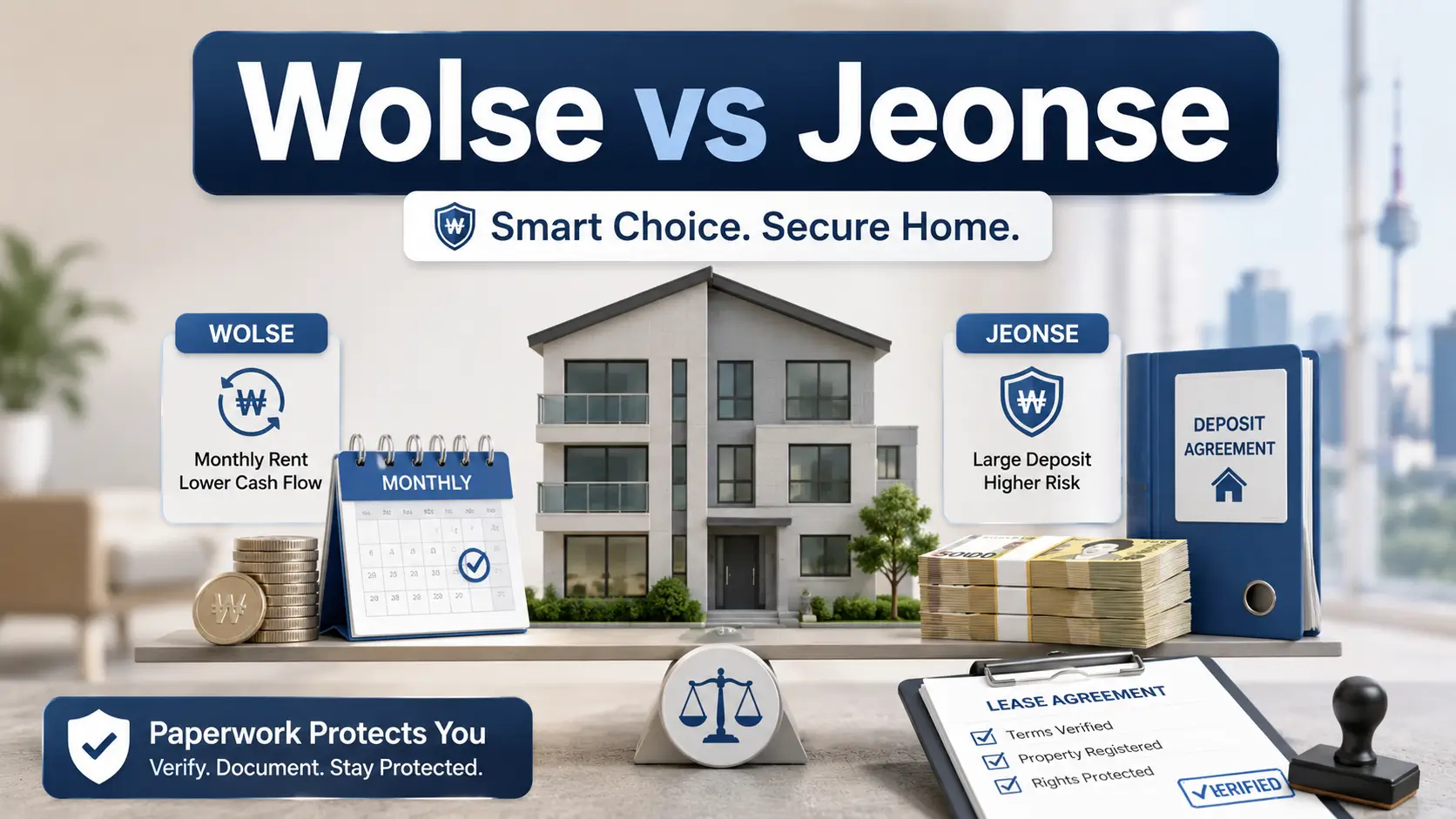
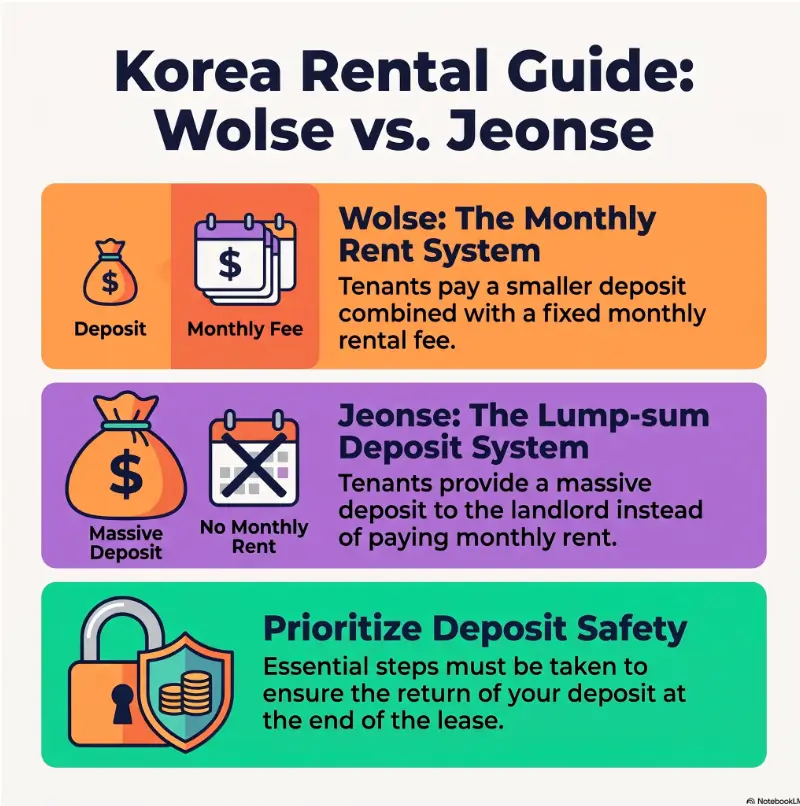
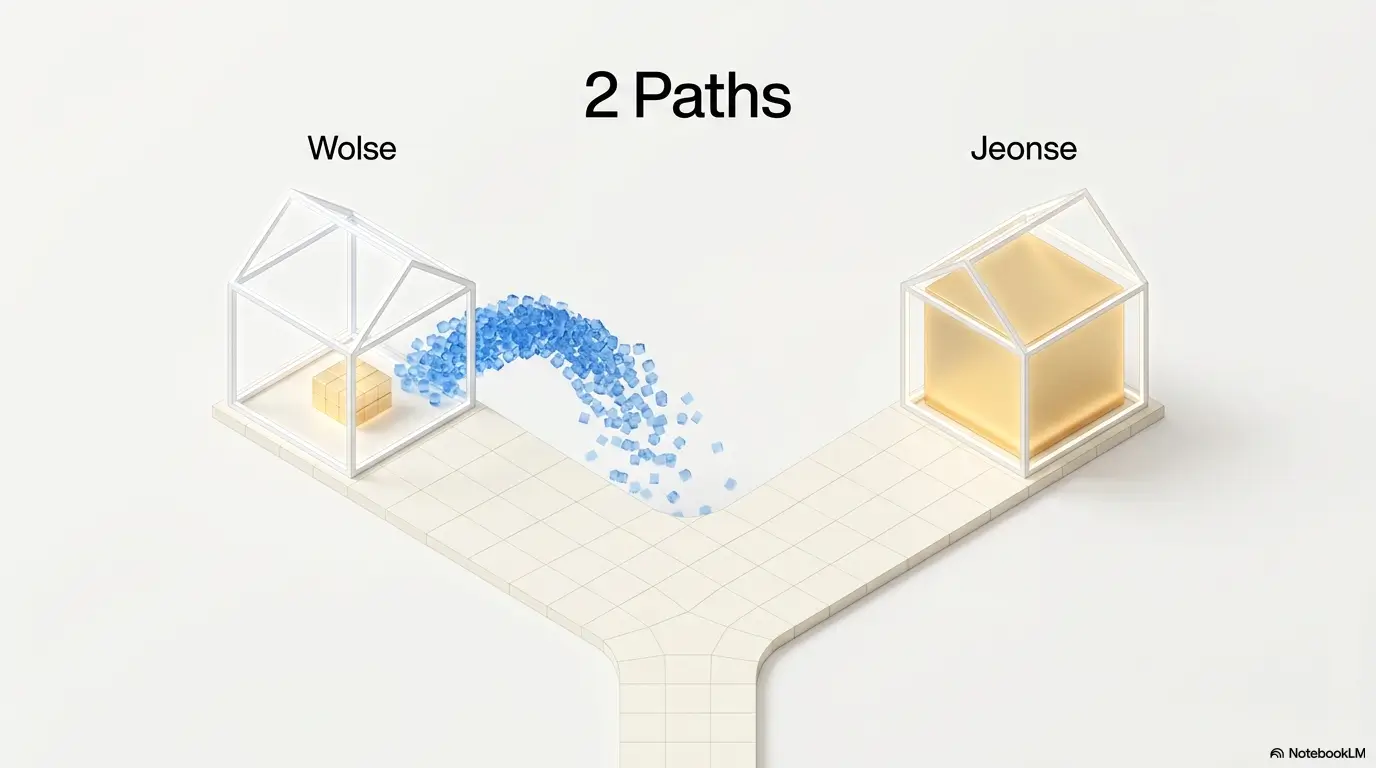
Wolse is the familiar monthly-rent model: you pay a smaller deposit plus rent each month. Jeonse is Korea’s lump-sum deposit model: you pay a much larger refundable deposit and usually pay little or no monthly rent. Banjeonse sits between them, using a mid-sized deposit and reduced monthly rent.
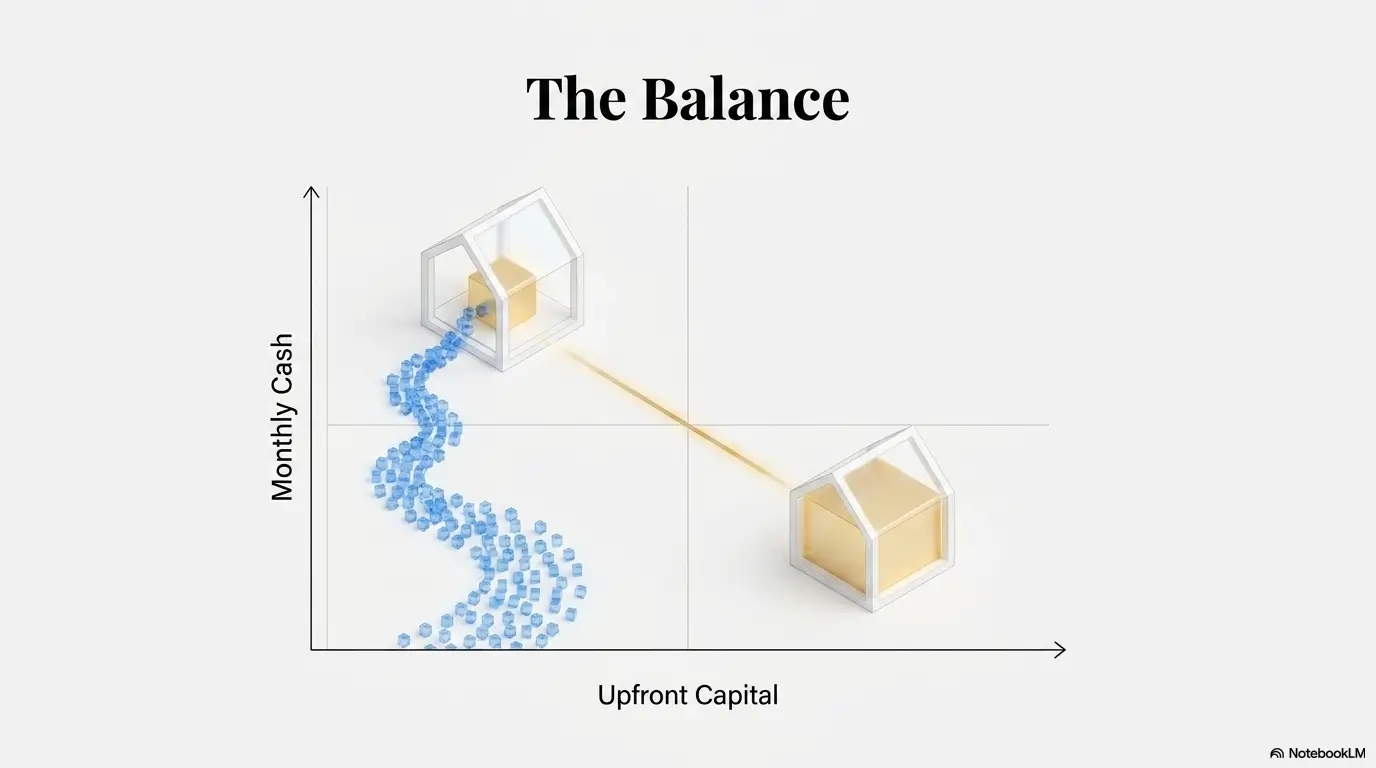
For foreigners renting in Korea, wolse often feels simpler because less money is trapped with the landlord. Jeonse can look cheaper month to month, but it concentrates risk into one very large number. That number must come back to you when the lease ends, and the return is not something to leave to good vibes and a polite smile.
Wolse: smaller deposit, monthly rent, cleaner exit math
Wolse is easier to understand for most US and UK renters. You compare the deposit, monthly rent, management fees, utilities, contract length, renewal terms, and likely move-out deductions.
The downside is obvious: rent leaves your account every month. If you are paid in dollars, pounds, or another currency, your won rent may become more expensive when exchange rates move against you.
The upside is equally important: your deposit exposure is usually lower. If a dispute happens, the amount at risk may be painful, but it is less likely to threaten your entire relocation budget.
Jeonse: huge deposit, low monthly rent, bigger refund risk
Jeonse can be attractive when you have substantial cash and want lower monthly housing cost. A family staying in Seoul for two years may love the idea of reducing monthly rent, especially if school, commute, and neighborhood stability matter.
But jeonse is not “free housing.” It is a deposit-heavy structure where your cash sits in the property arrangement. If the landlord cannot return the deposit, if the property has senior claims, or if the building enters auction, your exit can become slow and stressful.
Key takeaway: jeonse may lower rent, but it raises concentration risk.
If one bad event can put most of your liquid savings at risk, the monthly savings need to be large enough to justify that exposure. The cheaper-looking lease may not be the cheaper decision.
Banjeonse: the hybrid most foreigners forget to price
Banjeonse is a middle path. You pay a larger deposit than a typical wolse arrangement, but less than full jeonse, and you also pay monthly rent. For many foreigners, it can be a reasonable compromise when cash flow and risk tolerance are both tight.
The mistake is treating banjeonse as automatically safer. It still requires document checks. A mid-sized deposit can still be large enough to hurt if the refund path breaks.
| Rental model | Best fit | Main advantage | Main risk |
|---|---|---|---|
| Wolse | Foreign renters with limited Korean paperwork experience or uncertain stay length | Lower deposit exposure | Monthly cash-flow pressure |
| Jeonse | Renters with strong cash reserves, long stay plans, and professional document review | Lower monthly rent | Large deposit refund risk |
| Banjeonse | Renters who want lower monthly rent without locking full jeonse cash | Balanced monthly cost and deposit size | Still needs strong deposit checks |
The Three-Document Test Before Any Deposit
Before you fall in love with the balcony, the subway line, or the officetel lobby that smells faintly of new paint and espresso, run the three-document test. This is the fastest way to move from “the apartment looks nice” to “the deposit has a defensible path home.”
You can learn more about housing types in Korea through related guides on officetel leases in Korea, Korean villa rentals, and Korean apartment move-in preparation. Different property types can carry different practical risks, so the documents matter more than the label on the listing.
Document 1: real estate register
The real estate register helps you confirm who owns the property and whether there are mortgages, attachments, liens, or other claims that may affect your deposit position. You want the latest version, not a screenshot from last week living its best unverified life.
Ask the broker to explain the owner name, property address, mortgage amount, senior claims, and any recent ownership changes in plain English. If the explanation feels foggy, pause the transaction.
Document 2: building register
The building register helps confirm whether the unit is legally recognized and whether the structure matches what is being rented. This matters for villas, rooftop units, subdivided spaces, and “too perfect for the price” listings.
A lovely room can still be an unauthorized conversion. If the unit’s legal status is unclear, it may affect guarantee eligibility, enforcement options, financing, and move-out disputes.
Document 3: lease contract with a fixed-date plan
The Korean lease contract controls. An English summary is helpful, but it should not be treated as the legal engine unless a qualified professional confirms how the versions interact.
Your contract plan should answer four timing questions: when you take possession, when you complete residence reporting, when you obtain a fixed date, and who handles lease reporting if required.
Infographic: the deposit safety triangle
1. Real Estate Register
Owner, mortgage, senior claims, transfers, and legal priority clues.
2. Building Register
Legal use, unit status, unauthorized conversion risk, and address match.
3. Lease Plan
Possession, residence report, fixed date, payment trail, and move-out refund path.
If one corner is weak, slow down. A safe deposit needs all three corners to hold.
Legal Protection Starts After Paperwork, Not a Handshake
Foreign renters often focus on the contract signing moment. In Korea, the paperwork after signing can be just as important. Taking possession, completing foreigner registration steps, reporting your residence, and obtaining a fixed date may affect your practical protection.
Official legal guidance from Korea’s EasyLaw explains that foreign nationals may receive protection under the Housing Lease Protection Act when they complete the relevant alien registration and residence reporting steps. Use this as a reminder to confirm your own timeline, because timing can decide whether the paper shield is actually in your hand.
Alien registration and residence card timing
Foreigners staying in Korea for more than 90 days generally need to complete foreigner registration and obtain a residence card, often still casually called an ARC. The practical issue for renters is timing: if you sign before your registration and address process is ready, ask how your lease protection steps will be completed.
This is especially important for teachers arriving on a new visa, students moving from temporary housing, remote workers switching districts, and families who need a stable address for school, banking, phone contracts, delivery apps, and identity verification. For the administrative side of life, the guide to Korean identity verification for foreigners can help you understand why one missing step can ripple through daily tasks.
Residence change report and the 15-day clock
After moving, foreign tenants may need to report a change of residence within a defined period. Do not treat this as a boring errand. It may connect to whether your lease can stand against third parties.
Plan your lease schedule backward. If you move in on Friday night, ask where and when you can complete the residence report, what documents are needed, whether your local district office handles it, and whether you need an appointment.
For local admin basics, your next useful read may be how local district offices in Korea work and Korea resident registration concepts. Foreign residents use different procedures from Korean citizen resident registration, but the local-office rhythm is still worth learning.
Fixed date: the tiny stamp with serious muscle
A fixed date on your lease can help establish preferential repayment rights when the legal conditions are met. In plain English, it helps show when your lease existed, which can matter if the property later faces auction or competing claims.
Ask the broker: “Where do I get the fixed date, what documents do I need, and when exactly should I do it?” If the answer is “later, no problem,” translate that as “I need a clearer plan before sending money.”
Show me the nerdy details
In Korean lease risk, several ideas stack together. Possession shows you actually occupy the dwelling. Residence reporting can help create opposing power against third parties. A fixed date may help with preferential repayment rights. The real estate register can reveal senior claims. The building register can reveal whether the unit is legally recognized. None of these works best alone. They are more like a chamber quartet: each instrument matters, but the protection comes from timing and harmony.
For foreign tenants, the practical concern is not memorizing Korean legal doctrine. It is asking the right sequence questions before the deposit leaves your account: what happens first, what happens same day, what document proves it, and who confirms completion?
Jeonse Risk Stack: The Deposit Is Only as Safe as the Building
Jeonse has a poetic promise: pay once, live quietly, avoid monthly rent. But under the floor heating and tidy shoe cabinet, the legal and financial stack matters. A nice landlord is not collateral. A polished lobby is not priority. A broker’s confidence is not a refund guarantee.
If you choose jeonse, your due diligence should be stricter than it would be for a low-deposit wolse. The larger the deposit, the more your rental decision resembles a private credit decision.
Owner, mortgage, senior claims, and surprise transfers
The real estate register should match the person receiving the money. Confirm the owner name, address, and identity. If the money is going to a different account, stop and ask for a documented, professionally reviewed explanation.
Mortgages and other claims can affect your position if the property is sold through auction or if the landlord’s finances unravel. A low-priced jeonse with heavy senior debt is not a bargain. It may be a trap dressed as a discount.
Tax arrears and claims you may not see at first glance
Tax arrears can complicate deposit recovery. Ask your broker or adviser what can be checked, what cannot be checked, and what documents or confirmations are available before payment.
This is one reason professional help can be worth considering for large deposits. The fee may feel irritating in the moment, but the cost of a missed senior claim can be far worse.
Deposit insurance and guarantee limits
Korea Housing & Urban Guarantee Corporation, often called HUG, offers guarantee products connected to jeonse deposit return. These can be useful, but they are not magic armor. Eligibility can depend on the property, lease, timing, deposit amount, and other conditions.
Do not sign first and investigate later. Ask before signing whether a jeonse deposit return guarantee is available for the specific unit, what documents are needed, when you must apply, and what exclusions may apply.
Key takeaway: insurance is a shield, not permission to skip due diligence.
A guarantee may reduce some refund risk if you qualify, but it does not make a bad building, unclear contract, late application, or weak paperwork suddenly safe.
| Jeonse check | Why it matters | Question to ask before paying |
|---|---|---|
| Latest real estate register | Shows owner and registered claims | “Can you explain every registered claim in English?” |
| Owner identity | Reduces fake-owner and wrong-account risk | “Does the bank account match the verified owner?” |
| Building register | Flags illegal or mismatched units | “Is this exact unit legally registered for residential use?” |
| Tax and senior claim review | May affect repayment order | “What can be checked before the deposit is wired?” |
| Guarantee eligibility | May help with refund risk | “Can this exact lease qualify, and by what deadline?” |
Wolse Risk Stack: Smaller Deposit, Still Real Friction
Wolse is usually less terrifying than jeonse because less cash is locked with the landlord. But smaller deposit risk does not mean no risk. Wolse renters still face monthly payment pressure, renewal friction, move-out deductions, maintenance disputes, and contract language they may not fully understand.
If you are new to Korea, wolse can be the wiser first lease simply because it buys you time to learn the housing system without tying up a giant deposit. Your first apartment in Korea does not have to be your final thesis on Korean real estate.
Monthly rent burden and won-based budgeting
Wolse makes the cost visible every month. That is annoying, but it is also honest. You can budget rent, utilities, maintenance fees, internet, phone, transport, and food without pretending your cash is cost-free.
For students, English teachers, remote workers, and short-term expats, predictability may matter more than theoretical savings. If your income is uncertain or paid overseas, leave a buffer for exchange-rate movement and delayed transfers.
Move-out deductions and gray-zone fees
Wolse deposits are smaller, but landlords may still deduct for cleaning, damage, unpaid utilities, key replacement, wallpaper issues, pet damage, or disputed wear and tear. Photograph everything at move-in. Save utility bills. Keep broker messages.
A good move-in checklist can pay for itself in one argument avoided. Your phone camera is not glamorous, but it is a faithful little witness.
The cheap wolse trap
Suspiciously low wolse can hide problems: poor insulation, mold, noisy neighbors, illegal subdivision, awkward management fees, weak heating, long commutes, or a landlord who treats repairs like ancient folklore.
Before choosing the cheapest monthly option, compare total living cost. A cheaper unit that adds taxi rides, heating bills, mold cleanup, and lost sleep may become the most expensive apartment in your budget.
Key takeaway: wolse reduces deposit concentration, but it does not remove contract risk.
Read the Korean terms, document move-in condition, confirm repair responsibility, and budget for monthly rent in won with a currency buffer.
Banjeonse and the USD Earner Problem
Many foreign renters are not paid neatly in Korean won. A remote worker may earn dollars. A military spouse may have US-based income. An overseas investor may think in pounds or dollars while paying deposits in won. That makes the wolse versus jeonse decision more than a housing comparison. It becomes a currency and liquidity decision.
Banjeonse can help when full jeonse feels too exposed but standard wolse feels too expensive monthly. Still, the hybrid only works if you price the deposit and rent together.
The opportunity cost hiding in the deposit
If you put a large amount into jeonse, that money cannot sit in your emergency fund, savings account, brokerage account, home-country debt payoff plan, or business cash reserve. The deposit may come back, but the time value of that money is real.
A useful comparison is simple: estimate the rent you save, then subtract the income or flexibility you lose by locking the deposit. If the risk-adjusted savings look thin, wolse or banjeonse may be more rational.
FX risk: when dollars become won at the wrong moment
Foreign renters often convert a large sum into won for jeonse. If the exchange rate moves badly before move-out, your returned won may buy fewer dollars or pounds than expected. You might recover the same won amount but still feel poorer in your home currency.
For wolse, currency risk appears monthly. For jeonse, it appears in a large lump. Neither is perfect. The right answer depends on how long you will stay, how you earn, how much cash you need accessible, and how much uncertainty your nervous system can carry before breakfast.
A simple cash-flow comparison
Before signing, create a small table for your actual options. Do not compare abstract wolse and abstract jeonse. Compare Apartment A, Apartment B, and Apartment C with real deposit amounts, monthly rent, management fees, commute cost, deposit protection plan, and move-out risk.
| Factor | Wolse | Banjeonse | Jeonse |
|---|---|---|---|
| Cash locked upfront | Lower | Medium | High |
| Monthly rent pressure | Higher | Medium | Lower |
| FX exposure for USD earners | Monthly | Mixed | Large lump-sum |
| Refund risk | Usually lower | Medium | Highest |
| Best for uncertain stay | Often yes | Sometimes | Usually no without strong protections |
Cost, Service, and Professional Help: What Is Worth Paying For?
Foreign renters often try to save money by doing everything alone. That can work for a low-deposit wolse in a straightforward building with a clear contract. But for a large jeonse deposit, professional review can be less of a luxury and more of a seatbelt.
You do not need to hire every service under the sun. You need to match the help to the risk. The goal is not to spend more. The goal is to avoid being penny-wise and deposit-foolish.
Free help: good for orientation, not final approval
City foreign resident centers, official legal information pages, university offices, employer relocation staff, and trusted community guides can help you understand the system. They are useful for vocabulary, process, and early red flags.
Free help may not review your exact lease, property register, building register, and payment trail in enough detail. Treat it as map-reading, not bridge inspection.
Paid help: worth considering when the deposit is large
For large deposits, consider paying for document review from a qualified professional who can read Korean legal terms and explain the risks in plain English. This may include a Korean lawyer, trusted bilingual real estate adviser, or broker with documented experience supporting foreign tenants.
Ask exactly what the service includes. A vague “we will check everything” is not enough. You want a checklist of documents reviewed, issues flagged, and action steps before payment.
Good, Better, Best setup for foreign renters
| Setup | Best for | What it includes | What to watch |
|---|---|---|---|
| Good | Low-deposit wolse | Licensed broker, latest register, move-in photos, clear contract summary | Do not skip Korean contract review just because deposit is smaller |
| Better | Medium deposit or banjeonse | Broker plus bilingual document review, building register check, fixed-date plan | Confirm who is responsible for each filing step |
| Best | Large jeonse deposit | Professional legal review, register analysis, guarantee eligibility check, payment trail plan | Apply before signing or before deadlines pass, not after trouble starts |
Questions to ask a broker or adviser before paying
- Are you a licensed real estate broker, and can I verify your license?
- Can you provide the latest real estate register and building register?
- Does the owner name match the contract and receiving bank account?
- Are there mortgages, liens, attachments, or other senior claims?
- Is the unit legally registered as described in the listing?
- Can this exact lease qualify for a deposit return guarantee?
- When and where will I complete residence reporting and fixed-date stamping?
- Which Korean contract terms matter most if there is a refund dispute?
- What happens if the landlord cannot return the deposit on move-out day?
Mistakes and Red Flags Before You Wire Money
Rental pressure can make smart people strangely obedient. The broker says another tenant is waiting. The landlord wants a quick deposit. The apartment is sunny. The commute is perfect. Suddenly, wiring money feels like “securing the opportunity.”
Slow down. Urgency is where expensive mistakes breed.
Mistake 1: paying before seeing the latest register
Do not rely on old documents or verbal summaries. The property register can change. Ask for the latest version close to signing and again before sending major funds if timing has shifted.
If someone says, “It is normal, do not worry,” ask them to show you where the document proves it. Politeness is welcome. Proof is better.
Mistake 2: assuming the English summary controls
English summaries help foreign renters understand the deal, but the Korean contract usually carries the legal weight. If there is a conflict, you do not want to discover it after the landlord refuses a deposit refund.
Pay for translation or review when the deposit is large. At minimum, confirm renewal, termination, repairs, management fees, deposit refund date, payment account, and special clauses.
Mistake 3: choosing jeonse because locals do it
Korean renters may have family support, better language access, local legal familiarity, established banking relationships, and stronger intuition for neighborhood risk. A foreigner arriving with a suitcase, a new phone number, and a half-working banking app is playing a different game.
That does not make foreigners helpless. It means your process should be more deliberate. Use the guides on Korea’s mobile app ecosystem and online shopping in Korea to understand how identity, address, and payment systems can affect everyday life after move-in.
Real-world example: the discount that was not a discount
Imagine a US teacher choosing between two Seoul apartments. Apartment A is wolse with a manageable deposit and predictable monthly rent. Apartment B is jeonse with almost no monthly rent, but the deposit requires most of the teacher’s savings. The broker says the landlord is “kind” and the unit will go quickly.
The teacher asks for the latest register and building register. A mortgage appears. The unit is also described differently from the listing. The broker says it is common and not a problem.
Instead of wiring money, the teacher pays for a document review. The adviser explains that the deposit position is weaker than expected and guarantee eligibility is uncertain. Apartment B still looks cheaper monthly, but the refund risk is not worth the savings.
The lesson is plain: the better bargain is the one you can safely leave.
Key takeaway: never let urgency replace verification.
A legitimate landlord and broker should understand why a foreign tenant needs time to check identity, property documents, reporting steps, and deposit protection options.
| Red flag | Why it matters | Safer response |
|---|---|---|
| “Wire now, documents later” | You may lose leverage after payment | Request documents first and pause payment |
| Bank account does not match owner | Raises wrong-recipient or fraud risk | Ask for verified written explanation and professional review |
| Broker cannot explain liens | You may not understand priority risk | Get another adviser or skip the unit |
| English summary differs from Korean contract | The Korean wording may control | Translate and reconcile before signing |
| Guarantee eligibility is vague | You may miss deadlines or be ineligible | Confirm before signing and save written proof |
FAQ
Is wolse safer than jeonse for foreigners in Korea?
Wolse is often lower-risk from a deposit exposure perspective because less cash is locked with the landlord. But it is not automatically safer in every way. You still need a clear contract, move-in photos, repair terms, and a plan for utilities, management fees, and deposit deductions.
Can foreigners get Korean tenant protection for jeonse?
Foreign tenants may receive protection when the required foreigner registration, residence reporting, possession, and fixed-date steps are completed as applicable. Because timing and details matter, confirm your exact situation with official guidance or a qualified professional before relying on protection.
What is a fixed date on a Korean lease?
A fixed date is an official date stamp or confirmation connected to the lease. It can help establish when the lease existed and may support preferential repayment rights when other legal requirements are satisfied. Ask where to obtain it, when to obtain it, and what documents you need.
Do I need alien registration before signing a lease?
You may be able to sign a lease before every administrative step is complete, but that does not mean it is wise to ignore the timeline. If you do not yet have your residence card or address reporting plan, ask how and when your lease protection steps will be completed after move-in.
What happens if my Korean landlord does not return the deposit?
Deposit non-return can become a serious legal and financial problem. Save your contract, payment records, register copies, messages, move-in photos, move-out notices, and any promise of refund timing. Seek help early from a qualified professional, city support service, or official dispute support channel.
Is HUG deposit insurance available for every jeonse apartment?
No. Guarantee availability can depend on the property, contract, deposit amount, timing, and eligibility rules. Ask about the exact unit before signing, and confirm deadlines. Do not assume you can apply later after risk appears.
Should US expats choose wolse if they are paid in dollars?
Not always, but US-dollar earners should compare currency risk carefully. Wolse creates monthly exchange-rate exposure. Jeonse creates a larger lump-sum conversion issue. Banjeonse may balance the two, but only after checking deposit safety and total cost.
What documents should I check before paying a jeonse deposit?
At minimum, ask for the latest real estate register, building register, Korean lease contract, owner identity confirmation, payment account confirmation, deposit protection plan, and a fixed-date and residence-reporting timeline. For large deposits, consider professional review before payment.
Your 15-Minute Next Step: Build a Deposit Safety Folder
Before you message another broker or tour another apartment, make a deposit safety folder. It can be a cloud folder, notes app, or simple spreadsheet. The format matters less than the habit: every claim about the apartment should have a document, photo, or written message behind it.
In the next 15 minutes, create five sections: property documents, contract drafts, payment records, registration and fixed-date plan, and move-in evidence. Then, for every apartment you consider, save the latest register, building register, broker license information, landlord payment details, and lease draft before making a decision.
If you are comparing several Korean rental options, include nearby practical guides such as apartments for rent in Seoul, jeonse deposit protection, and jeonse insurance in your research folder. A rental decision becomes calmer when your information sits in one place instead of scattered across chats, screenshots, and midnight panic tabs.
15-minute deposit safety folder checklist
- Create a folder named “Korea lease documents.”
- Add subfolders for register, building register, contract, payments, and move-in photos.
- Save the broker’s name, office, license details, and contact information.
- Write one note titled “Questions before payment.”
- Add this question at the top: “What proves my deposit can come back?”
The better choice between wolse and jeonse is not decided by culture, pride, or what another expat did. It is decided by your stay length, cash reserves, income currency, risk tolerance, document strength, and the quality of the refund path. In Korea, a warm floor is lovely. A clean exit is lovelier.
Last reviewed: 2026-07