

Restaurant liability insurance in South Korea can cost only a few tens of thousands of won per year for a narrow compulsory liability policy, while broader restaurant insurance can cost considerably more once customer injuries, food-related claims, property damage, fire, gas risks, theft, and business assets are added. There is no single national “restaurant liability insurance price” because several different Korean insurance categories can apply to the same business.
For a useful 2026 reference point, KB Insurance currently publishes an example of KRW 30,100 for one year of disaster liability insurance for a 250-square-meter general restaurant. In a separate commercial-property example, its liability section for a 100-square-meter general restaurant is priced at KRW 29,700 per year. These figures are illustrations for specified risks and limits, not universal restaurant quotes.
The biggest mistake is therefore shopping by premium before identifying which insurance your restaurant legally needs. Floor area, building level, access to the street, business classification, fire-safety status, policy limits, property values, food liability, and optional cover can all change both the required policy and the final cost.
Table of Contents
How Much Does Restaurant Liability Insurance Cost in Korea?
Current published examples provide better guidance than a made-up national average. They show that the answer depends heavily on what is being insured.
| Published example | Example restaurant | Illustrative premium | What the figure represents |
|---|---|---|---|
| Disaster liability insurance | General restaurant, 250㎡ | KRW 30,100 for 1 year | Compulsory-style third-party disaster liability example |
| Facility-owner liability section | General restaurant, 100㎡ | KRW 29,700 for 1 year | Liability section within a broader commercial property product example |
| Small-business restaurant package | Rest-food business, 100㎡ | KRW 187,600 for 1 year | Broader package including property and several liability-related covers |
The first figure comes from KB Insurance’s current disaster liability insurance example. The company shows a 250㎡ general restaurant with KRW 150 million of bodily-injury death coverage per person and KRW 1 billion of property coverage at a total annual premium of KRW 30,100. KB also states that its minimum premium of KRW 20,000 applies when the calculated premium falls below that level.
The second and third examples illustrate why “liability insurance cost” can become slippery. A current KB commercial property example prices a facility-owner liability section for a 100㎡ general restaurant at KRW 29,700, while another current KB small-business package example includes property, facility liability, food liability, gas liability, and theft protection for a 100㎡ rest-food business at KRW 187,600 a year.
These amounts should not be treated as a KRW 29,700-to-KRW 187,600 market price range. They insure different things, use different limits and deductibles, and are based on specific underwriting assumptions. Their value is that they reveal the scale difference between a narrow liability section and a more complete restaurant insurance package.
First Find Out Which Compulsory Insurance Applies
For Korean restaurants, the legal classification of the premises matters as much as the menu. Two restaurants of the same size can face different compulsory-insurance rules because one opens directly onto the street while the other operates upstairs or underground.
Disaster Liability Insurance for 100㎡+ Restaurants
The Ministry of the Interior and Safety lists rest-food businesses and general restaurants with a total business floor area of at least 100 square meters among facilities potentially subject to compulsory disaster liability insurance. The policy is designed to compensate third parties for bodily injury or property damage caused by specified disasters such as fire, explosion, and collapse.
The ministry’s official disaster liability insurance guidance also contains an important exclusion: a facility that is already required to carry fire liability insurance under the Multi-use Businesses Safety Control Act is excluded from the disaster-liability requirement. Certain special buildings covered by another compulsory fire-insurance regime are also excluded.
In other words, seeing “100㎡ or more” does not finish the analysis. You still need to determine whether the premises falls into another compulsory category.
Multi-Use Business Fire Liability Insurance
Korea’s Easy Law service explains that a rest-food business, bakery, or general restaurant generally falls within the relevant multi-use-business rules when its total floor area is at least 100㎡, or at least 66㎡ when the establishment is underground.
There is an important ground-floor exception. A qualifying restaurant is generally excluded from that particular multi-use-business category when it is on the first floor or a floor directly connected with ground level and its main entrance leads directly outside. The official Easy Law restaurant fire-safety guidance explains the current threshold, ground-floor exception, other-insurance rules, and penalties.
This creates a practical division. A large street-level restaurant may need disaster liability insurance, while a restaurant of similar size on an upper floor or in a basement may instead fall under the multi-use-business fire liability regime. Building-specific facts can change the result, so obtain the facility’s official classification rather than choosing a policy from the restaurant’s trade name alone.
What Does the Compulsory Insurance Actually Cover?
Compulsory liability insurance is primarily about damage suffered by other people. It is not the same thing as insurance for your own kitchen equipment, furniture, stock, renovation costs, or lost sales.
For disaster liability insurance, the current government framework provides substantial statutory limits for third-party losses, including up to KRW 150 million per person for death and up to KRW 1 billion per accident for property damage. Injury and permanent-disability limits vary by injury or disability classification.
Multi-use-business fire liability insurance uses a comparable structure for fire and explosion liability. Korean law requires qualifying operators to insure third-party death, injury, permanent disability, and property losses. Current rules provide KRW 150 million per person for death and up to KRW 1 billion for property damage per accident, with injury and disability amounts determined under statutory schedules.
Those are large numbers, but they do not mean every accident at a restaurant is covered. A compulsory fire or disaster policy should not automatically be treated as coverage for food poisoning, a customer slipping on a wet floor, damage to your own equipment, employee injuries, cyber incidents, delivery accidents, or closure-related lost income.
Why Broader Restaurant Liability Costs More
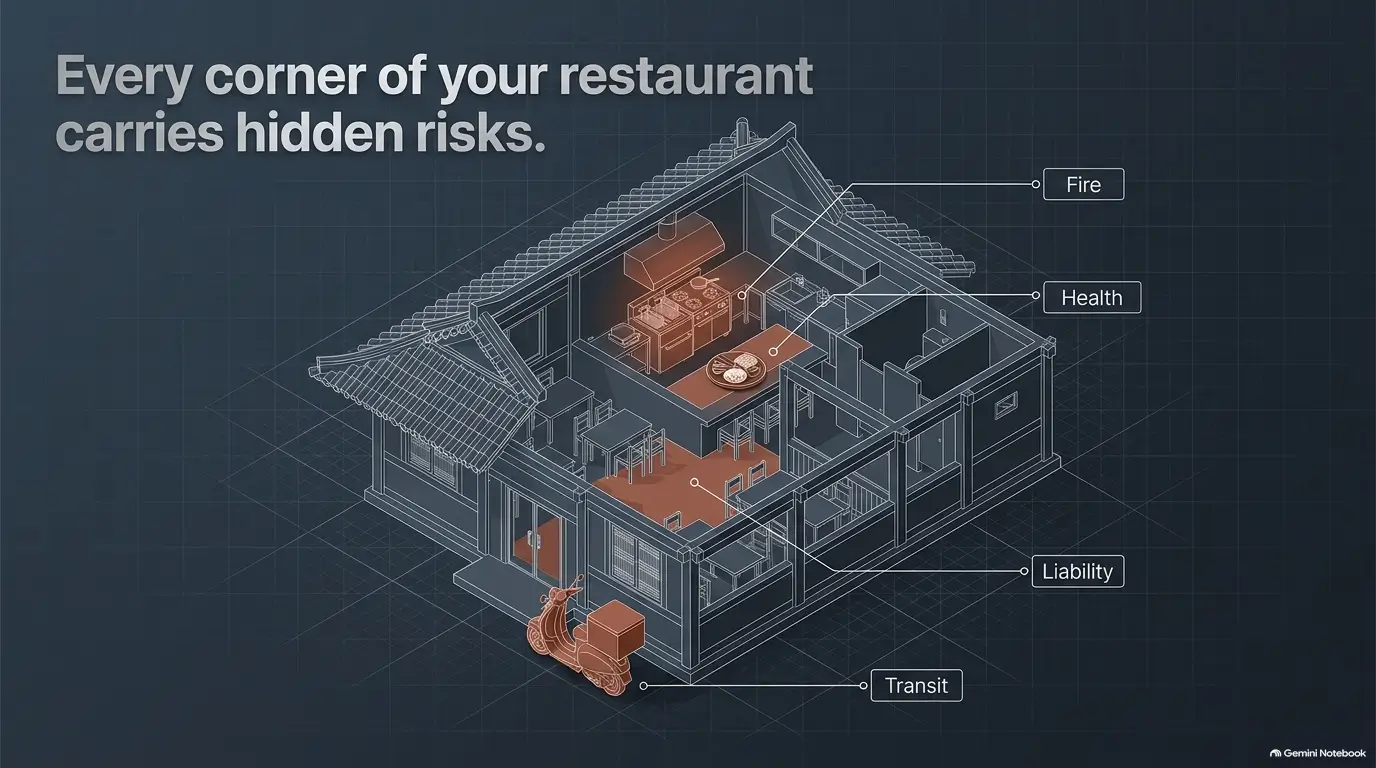
A restaurant has more liability exposure than fire alone. Oil, boiling liquids, stairs, wet flooring, table grills, glassware, food preparation, gas appliances, customer belongings, deliveries, and crowds can create losses that sit outside a narrow compulsory policy.
A broader restaurant insurance programme may therefore combine several layers:
- Facility-owner or premises liability: claims when a customer or other third party is injured or their property is damaged because of the premises or its management.
- Food or product liability: claims involving food supplied by the restaurant, subject to the exact policy wording and exclusions.
- Fire and explosion liability: including the applicable compulsory cover where required.
- Property insurance: damage to insured buildings, tenant improvements, fixtures, equipment, furniture, and stock.
- Gas liability: where relevant to the installation and legal requirements.
- Business interruption: lost profit or continuing expenses following a qualifying insured event.
- Theft and other property risks: where included in the selected product.
KB’s current small-business example is useful here. For a 100㎡ rest-food business, its published annual premium is KRW 187,600 under the stated assumptions, with fire/property coverage plus facility-owner liability, food liability, gas liability, and theft-related protection. The insurer expressly warns that premiums change according to the individual risk.
This policy-stack idea is not unique to restaurants. If you want to see how exclusions, sublimits, custody risks, and different liability sections can change a Korean business policy, the site’s Korea dog daycare liability insurance guide uses the same event-by-event method of reading commercial insurance rather than relying on the product name alone.
What Changes a Korean Restaurant Insurance Quote?
The premium is not simply “price per square meter.” For multi-use-business fire liability, Korean regulations expressly allow insurers to consider factors such as the type of business, floor area, fire frequency for the business category, fire-risk assessment results, regulatory violations, and recognised safety-management status when differentiating rates.
For broader commercial insurance, the quote can also change with the restaurant’s construction, floor, cooking method, insured property value, equipment, gas use, requested liability limits, deductible, turnover, claims history, and optional extensions. An open-flame barbecue restaurant and a small dessert café may occupy the same area while presenting very different underwriting files.
Five details to give every insurer the same way
To make competing quotations genuinely comparable, give each insurer or broker the same registered business category, exact insured floor area, floor and exit arrangement, building construction details, annual sales information requested by the insurer, and the same desired limits and deductibles. Also disclose cooking equipment, gas systems, delivery activities, previous claims, and any additional services.
If one quotation is dramatically cheaper, compare what disappeared before celebrating. The deductible may be higher, food liability may be absent, property limits may be lower, a compulsory section may not have been included, or a critical endorsement may use narrower wording.
A KRW 30,000 Policy and a KRW 200,000 Policy May Both Be Reasonable
Suppose Restaurant A only needs the relevant compulsory disaster liability policy and already has its property exposure handled elsewhere. A premium around the scale of the current KRW 30,100 published example may be plausible under similar underwriting conditions.
Restaurant B wants one policy to address its own property, customer injury, food liability, gas exposure, theft, and other operational risks. Its premium can reasonably be several times higher because it is transferring several additional risks to the insurer.
The cheaper policy is not necessarily underpriced, and the expensive policy is not necessarily overpriced. They may be solving entirely different problems. Comparing only the bottom-line premium is a little like comparing the price of a fire extinguisher with the price of a sprinkler system because both contain the word “fire.”
Do Restaurants Under 100㎡ Need Liability Insurance?
Being under 100㎡ does not mean the restaurant has no liability exposure. It can mean that a particular compulsory disaster-liability rule does not apply, depending on the business and premises.
The Ministry of the Interior and Safety has previously promoted voluntary disaster liability protection for restaurants below 100㎡. More importantly, a small restaurant can still face ordinary legal liability if a customer is injured, property is damaged, or food causes compensable harm. A lease, franchise agreement, lender, shopping centre, or commercial counterparty may also impose its own insurance requirements.
For a small shop, the useful question is therefore not merely “Am I legally forced to buy insurance?” It is “Which uninsured event could I realistically have to pay for myself?”
Food Poisoning Requires a Separate Coverage Check
Do not assume a fire or disaster liability policy automatically covers a foodborne-illness claim. Ask specifically whether the quotation includes 음식물배상책임 or another food/product liability section, what event triggers coverage, and what limits, deductibles, exclusions, and aggregate limits apply.
This distinction is visible in current insurer examples. KB lists food liability separately from facility-owner liability in its small-business restaurant package. That separation is a useful reminder that “someone was hurt at my restaurant” is not one insurance category.
Shared kitchens require another check. Under Korea’s Food Sanitation Act framework, a shared-kitchen operator is subject to a separate liability-insurance requirement for consumer damage caused by food-related hazards. That rule should not be casually applied to every ordinary restaurant tenant, but businesses operating through a shared-kitchen model should confirm who holds the required policy and how individual users are treated.
Foreign Restaurant Owners Should Separate Insurance From Business Status
A foreign founder can insure a business correctly and still have separate issues involving the Korean entity, immigration status, business registration, licensing, lease rights, tax registration, or authority to operate the restaurant. Insurance does not cure defects in those areas.
Foreign investors using a Korean company should keep these files aligned from the beginning. If your restaurant is tied to an investment-based immigration structure, the site’s Korea D-8 investor visa guide explains why incorporation, investment evidence, business registration, tax records, banking, and actual business activity need to tell the same administrative story.
For insurance quotations, make sure the Korean legal entity name, business registration number, actual operating address, restaurant category, floor area, and insured party are correct. A quotation written around the wrong entity or wrong premises is a dangerous place to save money.
How to Get a Useful Restaurant Insurance Quote
Before requesting prices, collect the business registration certificate, restaurant licence or filing information, exact address, floor-area documents, building use and construction information, lease details, property values, cooking and gas-equipment information, annual sales figures requested by the insurer, and previous insurance or claim records.
Then ask the insurer or licensed broker to answer six questions in writing: Which compulsory policy applies to this exact premises? Is the compulsory coverage included in the proposed package? Does the policy cover customer slips and other premises injuries? Is food liability included? What are the deductible and annual aggregate? Which important restaurant exposures remain uninsured?
Also ask whether legal defence costs reduce the liability limit, whether temporary or outdoor operations are covered, and whether delivery activity creates a separate motor or commercial-auto exposure. A premises policy should not be assumed to cover a restaurant motorcycle or car merely because the journey began at the kitchen door.
The Bottom Line
For a Korean restaurant, a narrow compulsory liability policy may cost only around tens of thousands of won per year under current published examples. KB Insurance, for example, currently shows KRW 30,100 a year for disaster liability insurance on a 250㎡ general restaurant under its specified assumptions.
Broader protection costs more because it solves more problems. Current insurer examples show a separate 100㎡ general-restaurant facility-owner liability section at KRW 29,700 a year and a broader 100㎡ small-business restaurant package at KRW 187,600 a year under different assumptions. Those are useful reference points, not a universal price range.
Start with the premises, not the premium. Confirm the registered restaurant category, measured floor area, building floor, street-exit arrangement, and whether the business falls under disaster liability, multi-use-business fire liability, a special-building regime, or another requirement. Then compare voluntary liability and property cover on identical limits and deductibles.
That order turns a vague question such as “How much is restaurant liability insurance in Korea?” into the question an insurer can actually answer: “What will it cost to insure this restaurant, in this building, against these specific risks?”
This article provides general information about South Korean restaurant insurance and does not determine the legal or insurance status of a particular premises. Insurance obligations, underwriting rules, premiums, exclusions, and policy wording can change. Confirm current requirements with the competent Korean authority and a Korean-licensed insurer or insurance professional before relying on a quotation.