

Professional indemnity insurance in South Korea can protect consultants when a client alleges that professional advice, an error, an omission, or a failure in contracted services caused financial loss. In Korea, you may also see the concept described as professional liability insurance or errors and omissions insurance, often shortened to PI or E&O.
For an ordinary management, strategy, marketing, technology, HR, or other business consultant, the important question is usually not simply, “Is PI insurance mandatory in Korea?” The more useful questions are whether your specific regulated activity requires insurance, whether a client contract requires it, what type of claim your policy covers, where a claim may be brought, and whether the policy will still respond to work performed before your current policy year.
A consultant advising a Korean startup from Seoul has a very different exposure from an engineering consultant approving technical specifications, an IT firm configuring a client’s systems, or a US consultancy whose Korean subsidiary signs contracts with multinational clients. The insurance needs to follow the actual work rather than the word “consultant” on the business card.
This guide explains the practical insurance questions to resolve before buying or renewing PI cover in South Korea. It provides general information rather than a determination of coverage or Korean legal advice. Policy terms, professional regulations, client requirements, and underwriting decisions vary.
Table of Contents
What Professional Indemnity Insurance Actually Covers
Professional indemnity insurance is primarily concerned with liability arising from professional services rather than ordinary accidents at your office.
For example, a Korean client might allege that a consultant recommended a flawed implementation plan, omitted an important risk from a report, delivered incorrect technical advice, mishandled confidential material, or failed to perform a professional service to the standard required by the engagement.
Current Korean-market product information illustrates the distinction. Chubb Korea’s professional indemnity guidance describes cover for legal liability arising from failures in professional duties such as negligence, carelessness, mistakes, or omissions. Its published summary also identifies legal damages and certain legal expenses among potentially covered losses, subject to the actual policy wording and limits.
That does not mean every mistake is insured. PI policies contain definitions, conditions, deductibles, limits, exclusions, notification requirements, and sometimes endorsements that can completely change the result.
PI Insurance Is Not the Same as General Liability
This is one of the most important distinctions for a consulting business.
| Risk | Insurance commonly considered | Example |
|---|---|---|
| Professional advice or service failure | Professional indemnity / E&O | A client alleges that your recommendation caused a financial loss |
| Third-party bodily injury or property damage | Commercial general liability | A visitor is injured at your office |
| Cyber incident or data breach | Cyber insurance | Client data is exposed after an account compromise |
| Employee injury | Applicable workers’ compensation and employer liability arrangements | An employee is injured while working |
| Claims against directors or officers | D&O insurance | An executive is accused of wrongful management conduct |
A consultant can therefore have excellent premises liability insurance and still have a large uninsured gap when the allegation is that the advice itself caused the loss.
Conversely, buying PI does not automatically solve cyber, employment, bodily injury, property damage, or directors’ liability exposures. Technology consultants in particular should examine the border between professional liability and cyber coverage rather than assuming one policy quietly swallows the other.
Is Professional Indemnity Insurance Mandatory for Consultants in Korea?
Do not rely on a blanket yes-or-no answer.
South Korea regulates insurance activity through its insurance legislation, but individual professional sectors can also have their own rules. A generic management or business consultant should therefore distinguish three separate sources of an insurance requirement:
- Law or professional regulation: a regulated profession or activity may have sector-specific insurance, compensation, licensing, or financial-responsibility requirements.
- Client contract: a customer may require a specified PI limit before work begins.
- Tender or vendor qualification: a large Korean or multinational client may require a certificate of insurance as part of procurement even when a general statute would not independently require that consultant to buy PI.
The current Korean Insurance Business Act provides the broader regulatory framework for insurance business and insurance solicitation. Your exact professional activity may sit under additional legislation, licensing rules, contractual standards, or client procurement requirements.
If your consultancy touches regulated financial services, architecture, engineering, healthcare, valuation, legal services, insurance, or another licensed profession, identify the precise activity before assuming that rules for ordinary management consulting apply.
The Client Contract May Matter More Than the Headline Policy Limit
Imagine that your policy shows a KRW 1 billion limit. That number looks comforting. It does not tell you whether a specific contractual claim is covered.
A consulting agreement can create obligations that go beyond the liability you would otherwise have under Korean law. This matters because professional indemnity policies commonly restrict or exclude certain liabilities assumed purely by contract.
Chubb Korea’s current professional indemnity summary, for example, identifies contractually increased liability among its principal exclusions. The exact meaning depends on the wording, but the practical lesson is universal: have the insurance and the consulting contract read together.
Pay particular attention to provisions dealing with:
- unlimited liability;
- indemnities;
- guaranteed outcomes;
- service levels and performance warranties;
- liquidated damages;
- intellectual-property indemnities;
- confidentiality and data-security liability;
- liability for subcontractors;
- consequential or indirect loss;
- governing law and dispute forum.
A client asking for a KRW 500 million insurance certificate while imposing uncapped contractual liability has not magically capped your exposure at KRW 500 million. The insurance limit and the contractual liability cap are two different pieces of paper.
Claims-Made Coverage Can Create the Most Expensive Timing Mistake
Professional liability insurance deserves special attention to timing.
The Korean market includes professional liability forms written on different coverage triggers. KB Insurance’s current product register, for example, lists both occurrence-basis and claims-made professional liability products. You should therefore never assume that the policy operates one way simply because it is called professional indemnity insurance.
Under a claims-made structure, coverage commonly turns on when a claim is first made, together with whatever reporting, prior-acts, retroactive-date, and policy-period conditions appear in the wording.
A Korean court decision involving an accountant’s professional liability policy reproduced wording under which the relevant claim had to be first made during the policy period and written notice had to be received by the insurer during that period. The case is a useful reminder that notification wording can materially affect professional liability coverage.
When comparing policies, ask the broker to explain in writing:
- Is the policy claims-made, occurrence-based, or another form?
- What is the retroactive date?
- Are services performed before that date excluded?
- Can circumstances that may lead to a future claim be notified?
- How quickly must a claim or circumstance be reported?
- What happens when you change insurers?
- Is an extended reporting period available after cancellation or non-renewal?
For a consultant with five years of client work behind them, the retroactive date can be more commercially important than a small saving in this year’s premium.
A Practical Example: The Project That Fails After Renewal
Consider a hypothetical Seoul consultancy that completes a digital-transformation project in November. Its PI policy expires on December 31, and the firm moves to another insurer in January.
In March, the client alleges that the November advice caused a costly operational failure.
The consultant now needs answers to several questions. Did the old policy cover claims reported after expiry? Does the new policy have full prior-acts coverage? Did anyone receive an angry email in December that should have been reported as a circumstance? Is the November work earlier than the new policy’s retroactive date?
There is no safe answer without reading the policies. This is precisely why continuity matters in PI insurance.
What Consultants Should Ask to Have Covered
The correct list depends on the consultancy, but the following questions make a useful starting point.
Negligent professional services
Confirm that the description of professional services in the schedule is broad enough to reflect what you actually sell. “Management consulting” may not automatically include software configuration, recruitment, training, outsourced project management, design work, or regulated financial advice.
Defense costs
Ask whether legal-defense expenses are inside or outside the liability limit, whether insurer consent is required before appointing counsel, and whether arbitration and mediation costs are treated differently.
Subcontractors
Many consulting firms use independent specialists. Confirm whether your liability arising from their work is insured and whether the subcontractor itself must maintain PI insurance.
Intellectual property and media liability
A presentation, marketing strategy, software implementation, research report, or training material can create copyright, trademark, defamation, or other content-related allegations. Chubb Korea’s current PI summary notes that certain defamation and intellectual-property exposures may be available by endorsement, illustrating why these risks should be asked about explicitly rather than assumed.
Confidentiality
If your consultancy handles client plans, source code, customer information, due-diligence material, pricing models, trade secrets, or employee data, determine where professional liability ends and cyber or privacy insurance begins.
Korean Consultants With Foreign Clients Need an Extra Coverage Test
A Seoul address does not mean every dispute will stay in Seoul.
A Korean consultant could advise a California parent company, prepare work for a London transaction, subcontract to a Singapore vendor, and sign an agreement applying New York or English law. The policy therefore needs to be checked for both territorial coverage and jurisdictional coverage.
Ask what happens if:
- services are delivered to a US client;
- the client files a lawsuit in the United States;
- the agreement selects English law;
- work is performed partly outside Korea;
- a Korean subsidiary is insured but the overseas parent signed the engagement;
- the client requires itself to be named in a certificate or endorsement.
International placements can also create regulatory and program-structure questions. Lockton Korea, for example, identifies management consultants among the professional-indemnity clients it serves. For a multinational group, ask whether the recommended arrangement is a standalone Korean policy, a local policy connected to a global program, or another compliant structure.
If you are physically working from Korea for overseas customers, insurance should not become a substitute for checking the business itself. Our guide to South Korea workation visa and tax risks explains why consultants need to separate visa permission, personal tax, invoicing, fixed-base questions, and employer or business exposure.
What Determines the Cost of PI Insurance in Korea?
There is no single reliable public rate that can tell every consultant what Korean PI insurance should cost. Commercial professional liability is underwritten around the risk being transferred.
A useful quotation usually depends on some combination of:
- annual consulting revenue;
- type of professional services;
- largest client and largest contract value;
- domestic versus overseas revenue;
- US or other high-severity jurisdiction exposure;
- requested limit and deductible;
- past claims or known circumstances;
- years in business;
- use of subcontractors;
- contractual liability and indemnity clauses;
- regulated or technical services;
- desired retroactive coverage;
- cyber, IP, confidentiality, or media extensions.
Two consultants with identical revenue can therefore receive very different quotes. A low-risk advisory firm working under capped Korean contracts is not the same underwriting problem as a technology consultant signing US contracts with broad indemnities and responsibility for production systems.
A premium quote without the corresponding limit, deductible, retroactive date, exclusions, territorial scope, and professional-services definition is not a useful comparison.
Build a Broker-Ready Quote File
You can often improve the quality of the underwriting conversation by preparing one concise file before asking for quotes.
- Describe every consulting service you provide.
- State current and expected annual revenue.
- Separate Korean and overseas revenue.
- Identify the largest client and largest contract.
- List the countries whose law or courts appear in your client contracts.
- Provide your standard consulting agreement.
- Identify subcontracted services.
- Disclose previous claims and circumstances accurately.
- Provide the current policy and retroactive date if you are already insured.
- State the PI limit required by important clients.
This gives the broker more than a company name and revenue number. It shows what can actually go wrong.
Do Not Buy PI Before You Know Which Entity Is Doing the Work
A foreign founder may personally provide advice, own an overseas consultancy, establish a Korean corporation, or contract through more than one entity. Insurance should follow that structure.
If you are forming a Korean company, our Korea D-8 investor visa and business setup guide explains why the company, investment, banking, tax, office, and immigration records need to tell one consistent story.
Then ask the insurance version of the same question: Which entity signs the engagement letter? Which entity invoices the client? Who employs the consultants? Does the policy insure the Korean subsidiary, the foreign parent, individual directors, past employees, and subcontractors where relevant?
Do not assume that a parent company’s policy automatically covers a newly formed Korean company merely because the names look related.
Employees, Freelancers and Subcontractors Need Separate Attention
A consulting firm’s staffing model can affect both insurance and Korean employment risk.
If someone is called a freelancer but is managed like an employee, the contract label may not settle the underlying legal relationship. Our guide to Korean employment contracts and contractor classification explains why actual control, working conditions, duties, and the relationship in practice matter.
For PI purposes, separately ask whether mistakes by employees, former employees, temporary personnel, outsourced specialists, and independent subcontractors fall within the insured-person and professional-services definitions.
Five Exclusions Worth Reading Before Anything Else
Policies vary, but a first-pass review should pay particular attention to these areas.
- Known circumstances. A dispute already brewing before inception may not become newly insurable simply because no lawsuit has been filed yet.
- Dishonesty and intentional misconduct. Professional liability is not a license for fraud or deliberate wrongdoing.
- Contractually assumed liability. Your contract may promise more than the policy covers.
- Employment disputes. Claims arising from employment practices commonly belong elsewhere.
- Cyber and data events. Some professional policies provide limited related cover, while other losses require dedicated cyber insurance.
Also review exclusions connected with bodily injury, property damage, intellectual property, insolvency, sanctions, fines and penalties, related entities, prior claims, particular territories, and services outside the declared business description.
How to Compare Two Korean PI Quotes
Put the quotations side by side and compare the following items before looking at premium.
| Item | What to check |
|---|---|
| Professional services | Does the definition match everything you actually do? |
| Limit | Per claim, aggregate, or both? |
| Deductible | Does it apply to damages, defense costs, or both? |
| Defense costs | Inside or outside the limit? |
| Coverage trigger | Claims-made, occurrence, or another basis? |
| Retroactive date | How much prior work is protected? |
| Territory | Where may services be performed? |
| Jurisdiction | Where may claims be brought? |
| Subcontractors | Is vicarious liability covered? |
| IP / confidentiality | Included, endorsed, sublimited, or excluded? |
| Contractual liability | Which client obligations fall outside cover? |
| Notification | When and how must claims or circumstances be reported? |
The cheapest premium can become the most expensive policy if the service description, retroactive date, or jurisdiction clause excludes the claim you were actually trying to insure.
What to Do When a Client Threatens a Claim
Do not wait for a stamped court document before checking the notification clause.
A demand for repayment, allegation of professional error, written reservation of rights, threatened counterclaim, serious customer complaint, or communication from the client’s lawyer can potentially matter under a claims-made policy.
- Preserve the engagement agreement and amendments.
- Save emails, messages, drafts, reports, meeting notes, and approval records.
- Do not rewrite old records after the dispute appears.
- Read the policy’s notification clause immediately.
- Contact the broker or insurer using the required process.
- Do not admit liability or agree to a settlement before checking the policy requirements.
- Obtain Korean legal advice where the value, contractual issues, or litigation exposure justifies it.
The purpose is not to turn every unhappy email into a courtroom drama. It is to avoid discovering six months later that an early warning should have been reported while the policy was still active.
PI Insurance Does Not Replace Visa or Personal Medical Insurance
Foreign consultants sometimes encounter several insurance requirements at once and understandably blend them together.
Professional indemnity protects the consulting business against specified professional-liability claims. It is not personal health insurance, travel medical insurance, workers’ compensation, or immigration-compliance insurance.
For example, a consultant using Korea’s remote-work route may separately need medical and repatriation coverage meeting the applicable visa requirements. Our Korea digital nomad visa insurance guide explains that separate issue.
Where to Verify an Insurer or Get Insurance Information in Korea
Before treating a quotation or intermediary as authoritative, verify the parties involved and request the actual policy wording.
The General Insurance Association of Korea consumer portal provides insurance-company information, consumer guidance, consultation resources, and complaint-related information. Its disclosure pages also identify Korean non-life insurers and branches operating in the market.
For a commercial PI placement, however, an online product page is only the beginning. Ask the insurer or appropriately authorized broker for the quotation, schedule, endorsements, policy wording, application form, and written explanation of any material point on which your purchase depends.
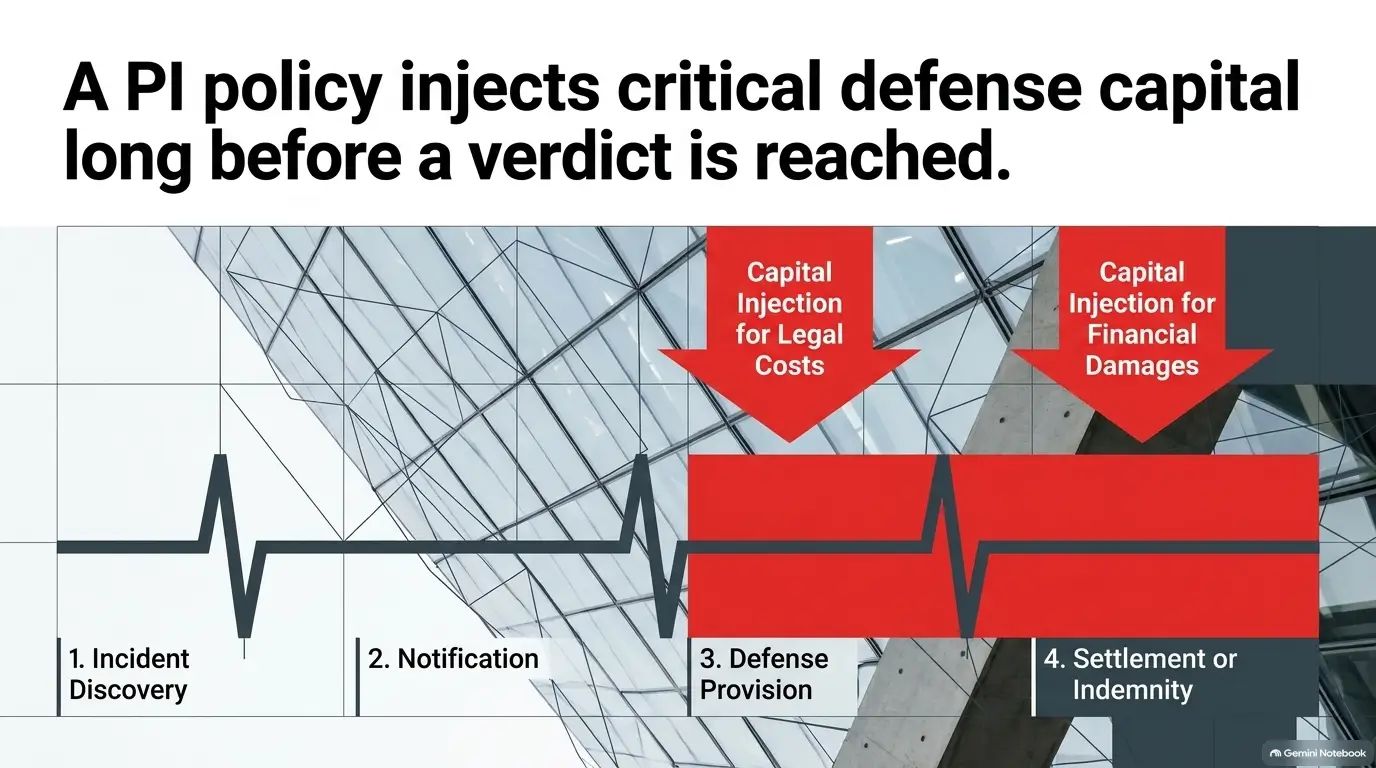
The 12-Question PI Checklist for a Korea Consultancy
- Which legal entity is insured?
- What exact consulting services are covered?
- Is the policy claims-made or occurrence-based?
- What is the retroactive date?
- What constitutes a reportable claim or circumstance?
- Are legal-defense costs inside the limit?
- Are subcontractors and former employees covered where needed?
- Are confidentiality, IP, defamation, and cyber-related claims covered or excluded?
- Which countries are included in the territory?
- Which courts or legal jurisdictions are covered?
- Do your client contracts create liabilities broader than the policy?
- What happens to prior work when you cancel, change insurer, sell the company, or stop consulting?
The Bottom Line
For consultants in South Korea, professional indemnity insurance is best treated as a contract-and-claims problem rather than a box-ticking purchase.
Start with the work you actually perform. Identify which entity signs the contract, where the client can sue, what liability the contract creates, whether the policy is claims-made, how far back prior work is covered, and which exclusions cut across your most valuable services.
Then compare the insurance quotations.
A large limit printed on the first page is useful only after the definitions, exclusions, retroactive date, notification clause, territory, jurisdiction, and professional-services wording agree to let the claim through the door.