

The cost of hiring a personal injury lawyer in South Korea is not set by one national price list. A foreign claimant may be quoted an initial attorney fee, a success-based fee for a civil claim, separate court expenses, or a combination of these. The total can change considerably depending on the value of the claim, the seriousness of the injury, whether liability is disputed, and whether the case settles or proceeds through trial and appeal.
For foreigners, language support, translated medical records, overseas communication, and questions about insurance or residence outside Korea can also affect the work required. The safest way to compare lawyers is therefore not to ask only, “How much is the lawyer?” but to request a written explanation of what the quoted fee covers, what is charged separately, and what happens if the case settles early or goes to court.
Table of Contents
How personal injury lawyer fees work in Korea
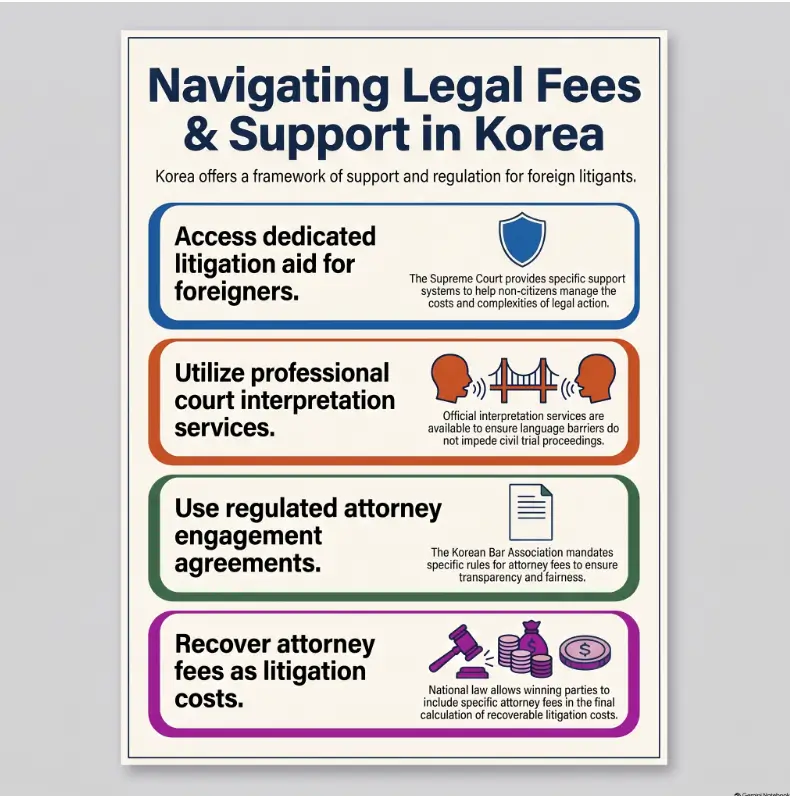
Korean lawyers generally agree their fees directly with clients rather than applying a universal government tariff for private representation. The Korean Bar Association’s professional rules state that fees should be reasonable in light of factors such as the difficulty of the case, the attorney’s work and time, experience, and the benefit provided to the client. They also call for the scope of representation, fees, payment method, and excluded expenses to be clearly agreed when a case is accepted.
That makes the engagement agreement particularly important for a foreign client. Two firms may describe their prices differently even when the likely overall cost is similar.
Initial or fixed attorney fee
A law firm may require an initial fee when it accepts the case. Depending on the agreement, this may cover tasks such as reviewing accident records, medical documents and insurance correspondence, communicating with the opposing party, preparing a damages claim, negotiating a settlement, or beginning litigation.
Do not assume that an initial fee automatically covers every stage of a lawsuit. Ask whether first-instance litigation, an appeal, enforcement proceedings, expert evidence, and settlement negotiations are included or priced separately.
Success-based fees in civil injury cases
Some civil representation agreements may also include compensation linked to the outcome of the case. The wording matters. A contract might define the relevant result by reference to money recovered, an increase over an insurer’s offer, or another agreed measure.
A foreign client should ask exactly how the fee is calculated. For example, determine whether the calculation is based on the gross settlement, the amount remaining after medical expenses, or another figure defined by the contract. Also ask whether taxes and case expenses are included in or added to the lawyer’s quoted fee.
Do not automatically apply rules about criminal defense fees to a personal injury damages claim. Korean courts have treated success-fee agreements in criminal cases differently from ordinary civil fee arrangements, so the nature of the representation matters.

There is no reliable single “average lawyer fee” for every injury case
Published internet price ranges can be misleading because “personal injury” may describe anything from a relatively straightforward traffic claim to a severe disability case involving disputed causation, future earnings, expert evidence, and several years of litigation.
For that reason, a useful quotation should identify the work being priced rather than merely provide one headline number.
| Cost item | What to clarify |
|---|---|
| Consultation | Free or paid, length of consultation, document review included or not |
| Initial attorney fee | Which negotiation or litigation stages it covers |
| Success-based fee | Percentage or formula, calculation base, and payment timing |
| Court fees | Whether filing and service costs are included |
| Expert or appraisal costs | Who pays initially and whether prior approval is required |
| Translation or interpretation | Whether the firm provides language support and how it is billed |
| Appeal | Included in the original agreement or treated as a new engagement |
Court costs are separate from the lawyer’s private fee
Starting a civil lawsuit can create costs in addition to the fee paid to your lawyer. Depending on the case, these can include filing-related charges, service costs, witness expenses, appraisal fees, interpretation costs, and other expenses required for evidence or proceedings.
Korean civil procedure rules can require the party benefiting from a procedural step to advance certain costs. For example, the plaintiff normally advances service costs, while a party requesting certain evidence may have to advance expenses associated with witnesses, appraisers, or interpreters.
This is one reason a lawyer’s initial quotation should be separated into professional fees and case expenses. A low headline attorney fee can still produce a substantially larger total bill if translations, expert opinions, medical evaluations, or appeal work are excluded.
Can you recover your lawyer fees if you win?
Winning a Korean civil case does not necessarily mean that the opposing party reimburses every won you paid your lawyer.
Under Article 109 of Korea’s Civil Procedure Act, attorney fees may be treated as litigation costs only within the amount permitted under Supreme Court rules. The applicable rule calculates the recoverable amount according to the value of the litigation and other prescribed criteria, subject to the amount actually paid or payable.
This distinction is important when estimating the economics of a claim. Your private engagement contract determines what you owe your lawyer. The litigation-cost rules determine how much may potentially be shifted to the opposing party through the court-cost process. Those figures are not necessarily the same.
Why foreigners may face additional costs
Foreign nationality does not by itself create a special lawyer-fee schedule, but an international element can add work to a case.
- Medical records may need translation.
- Police, insurance, employment, or immigration documents may require additional review.
- A client living overseas may need remote meetings and international document handling.
- Evidence of overseas income or medical treatment may require translation or authentication.
- Court interpretation may be necessary if a party cannot participate adequately in Korean.
Korean courts maintain procedures for foreign litigants and court interpreters. Court information also distinguishes general assistance for foreign visitors from interpretation used during an actual trial, which is arranged through the court handling the proceedings.
Ask the law firm whether English or another required language is handled directly by the lawyer, by multilingual staff, or through a separate interpreter. The answer can affect both communication and cost.
Foreigners can apply for litigation aid in appropriate cases
A foreign claimant should not assume that Korean litigation aid is limited to Korean citizens. The Korean judiciary’s information for foreign litigants states that foreigners may apply for litigation aid.
The program can cover qualifying costs including court stamp fees, service fees, attorney fees, witness travel expenses, appraisal costs, and other legally recognized litigation expenses. Eligibility generally depends on financial circumstances and whether it is not apparent that the applicant will lose the case.
This does not mean every foreign injury claimant receives a free lawyer. Litigation aid requires an application and a court decision. Someone who may have difficulty funding litigation should therefore ask about eligibility early rather than assuming that private representation is the only possible route.
What usually makes an injury case more expensive?
The lawyer’s workload usually matters more than the client’s nationality. Factors that can materially increase the work involved include disputed responsibility for the accident, multiple defendants, permanent disability, substantial future medical expenses, lost-income calculations, disagreement over medical causation, expert testimony, extensive medical records, unsuccessful negotiations, and appeals.
A relatively clear insurance claim that settles after document review and negotiation may require a different fee arrangement from a claim involving contested medical evidence and a full trial.
For an injury arising from a traffic collision, the insurance and settlement issues may overlap with the questions covered in this guide to Korea car accident settlements for foreigners.
If the alleged injury resulted from medical treatment rather than an ordinary accident, legal and expert costs can operate differently. See the separate guide to medical malpractice lawyer costs in Korea.
Documents to prepare before asking for a quote
A lawyer can usually give a more useful fee explanation when the basic facts are organized. Before contacting firms, prepare what you already have rather than ordering unnecessary new documents solely for an initial inquiry.
- A short timeline of the accident or incident
- Police or accident reports, if available
- Medical diagnoses and treatment records
- Hospital bills and receipts
- Photos, video, or other evidence of the incident
- Insurance-company correspondence
- Employment and income documents if claiming lost earnings
- Any settlement offer already received
- Your current location and ability to attend proceedings in Korea
If some documents are only in English or another language, ask before paying for certified translations. The lawyer may not need every document translated at the beginning of the case.
Questions to ask before signing a Korean lawyer agreement
- What exactly is included in the initial fee?
- Is there a separate success-based fee, and how is it calculated?
- Does the quoted amount include VAT or other taxes where applicable?
- Which court expenses are excluded?
- Will I be charged separately for translation or interpretation?
- Does the agreement cover settlement negotiations and the first trial?
- Would an appeal require a new fee agreement?
- Who pays appraisal or medical expert costs initially?
- What happens to the fee if the case settles quickly?
- How will settlement money and lawyer fees be documented?
Get important fee terms in writing. This matters especially when discussions take place partly in English but the engagement agreement is written in Korean. If there are two language versions, ask which version controls if the wording differs.

Is hiring a lawyer financially worthwhile?
The answer depends on the likely value and complexity of the claim rather than on a universal minimum settlement amount.
For a small, undisputed claim, the cost of full litigation may be disproportionate to the amount in dispute. For a serious injury involving permanent impairment, substantial lost income, disputed liability, or an insurer contesting causation, professional representation may address issues that are difficult to evaluate from a settlement offer alone.
A useful comparison is therefore expected net recovery after legal and case costs, not simply the lawyer’s upfront price. Ask each firm to explain the likely stages of the case and which additional expenses could arise before comparing quotations.
Bottom line
There is no single trustworthy figure that answers how much every foreigner will pay a personal injury lawyer in Korea. Fees are privately agreed and vary with the work required, the claim value, the evidence, the litigation stage, and the structure of the engagement.
The most useful step is to obtain a written quotation that separates the initial attorney fee, any outcome-based fee, court expenses, translation or interpretation charges, expert costs, and appeal fees. Also remember that even if you win, Korean litigation-cost rules do not automatically reimburse the full amount you privately agreed to pay your lawyer.
Foreign litigants who cannot afford the necessary costs should also check whether court litigation aid may apply before abandoning a potentially viable claim.
- Supreme Court of Korea – Litigation Aid for Foreigners
- Supreme Court of Korea – Civil Trial Procedures
- Supreme Court of Korea – Interpretation Services for Foreigners
- Korean Bar Association – Rules on Attorney Fees and Written Engagement Agreements
- National Law Information Center – Rules on Attorney Fees Included in Litigation Costs