
Foreign residents can qualify for mortgages in South Korea, but there is no single published “foreigner mortgage rate.” The interest rate you are offered normally comes from the bank’s standard mortgage pricing plus adjustments for your credit profile, income, loan structure, collateral, banking relationship, and other underwriting factors.
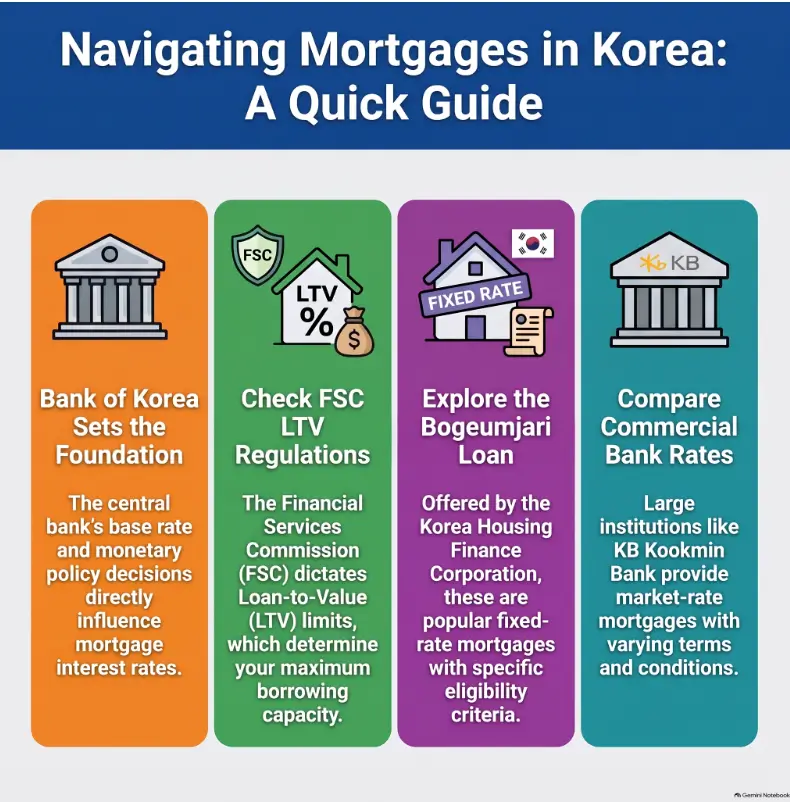
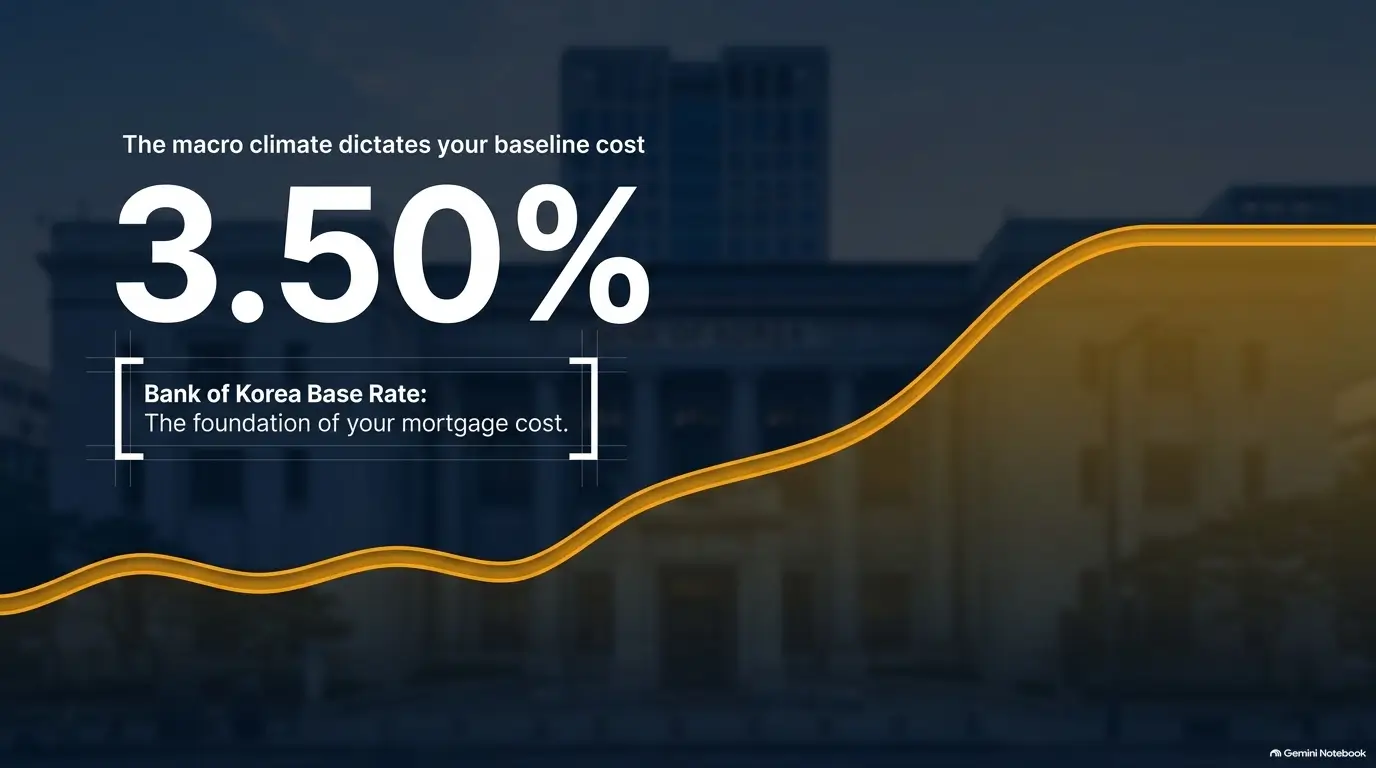
As of September 22, 2026, the Bank of Korea Base Rate is 3.00%, after the Monetary Policy Board raised it from 2.75% on August 27. The most recent Bank of Korea lending-rate statistics available are for July 2026, when the average rate on newly issued loans across deposit-taking banks was 4.27%. That figure covers loans generally, however, and should not be treated as a mortgage quote for an individual foreign borrower.
A more useful benchmark comes from current commercial-bank mortgage pricing. For example, KB Kookmin Bank published a residential mortgage illustration dated August 27, 2026 showing rates ranging from 4.26% to 6.56%, depending on the reference rate and structure used. The bank explicitly notes that the actual rate varies according to the customer’s credit conditions, repayment structure, loan purpose, and banking relationship.
Table of Contents
What mortgage rate can a foreigner expect in Korea?
For planning purposes, the safest approach is not to start with a supposed “foreign borrower rate.” Instead, check the current published mortgage range at several Korean banks and then find out where your own application falls within that range.
The following figures illustrate the market environment rather than guaranteeing what any foreign applicant will receive:
| Reference | Rate or range | What it tells you |
|---|---|---|
| Bank of Korea Base Rate | 3.00% | Monetary-policy benchmark, not a retail mortgage rate |
| Average new bank loans, July 2026 | 4.27% | Broad lending-market benchmark, not mortgage-specific |
| KB residential mortgage example, Aug. 27, 2026 | 4.26%–6.56% | Example of current commercial mortgage pricing before individual underwriting |
The KB example assumes specified conditions including residential collateral, installment repayment, a 30-year term, and a stated credit-grade assumption. That matters because a foreign applicant should not read the lowest advertised rate as an automatic offer.
Does being a foreigner automatically mean paying a higher interest rate?
There is no nationwide rule establishing one mandatory mortgage surcharge simply because the borrower is a foreign national. What can make the effective offer less attractive is the underwriting profile that often accompanies a foreign-resident application.
A bank may need to assess how reliably it can verify your income, how much Korean credit history you have, the stability of your residence in Korea, your existing debts, and whether the documentation supporting your finances is sufficient. Each lender applies its own credit standards in addition to government lending regulations.
That distinction is important. A higher quote does not necessarily mean the bank has a published “foreigner rate.” It may instead reflect a higher customer-specific spread, fewer available discounts, a different loan term, or a more conservative assessment of the application.
The factors that can change your actual mortgage rate
1. Your income and how easily the bank can verify it
Stable income documented through Korea’s tax and payroll systems is generally easier for a Korean bank to evaluate than income that exists mainly outside Korea.
If you are employed in Korea, expect the bank to examine documents such as employment records, income certificates, withholding-tax documents, salary deposits, and other evidence of continuing earnings. When income comes from overseas, ask the lender before signing a property contract exactly which documents it accepts and how much of that income it will recognize for underwriting.
2. Korean credit history
A borrower with established Korean banking and repayment history gives a lender more domestic data to evaluate. A newly arrived foreign resident may have strong finances but still present a relatively thin Korean credit file.
This can affect approval conditions, available discounts, or the amount the bank is willing to lend even when the property itself is acceptable collateral.
3. Your residence status and expected stay in Korea
Residence documentation can matter because the lender is making a long-term credit decision. Long-term residents can therefore present a different underwriting profile from applicants whose permission to remain in Korea expires relatively soon.
Do not assume that one visa category automatically guarantees a particular rate or loan term. Bank policies can differ, so eligibility and maximum maturity should be confirmed directly with each lender before committing to a purchase.
4. Fixed versus variable mortgage pricing
Korean mortgages may be priced using short-term or longer-term financial-bond reference rates, with the bank adding a customer-specific spread and subtracting any applicable preferential-rate discounts.
KB’s August 27 example demonstrates how much this reference-rate choice can matter. Its published illustration showed a 4.26% minimum rate using a six-month financial-bond benchmark, 4.60% using a 12-month benchmark, and 5.06% using a five-year benchmark under the example conditions. The corresponding maximum illustrated rates were 5.76%, 6.10%, and 6.56%.
A lower initial variable rate may reduce the payment today, while a longer fixed period can provide greater payment certainty. Compare the structure, not just the first percentage printed on the bank’s rate sheet.
Mortgage limits can matter more than the interest rate
For many buyers in Korea, the first financing problem is not whether the mortgage costs 4.5% or 5.0%. It is how much the bank is legally and commercially able to lend.
South Korea applies loan-to-value and borrower repayment regulations to housing loans. In speculation-regulated areas, the Financial Services Commission has confirmed an LTV limit of 40% for relevant mortgages, down from 70% following the regulatory changes introduced in October 2025.
In the Seoul metropolitan area and designated regulated areas, purchase-purpose mortgage caps also vary with the property’s market value. Under the rules effective from October 16, 2025, the maximum is KRW 600 million for homes valued at KRW 1.5 billion or below, KRW 400 million for homes above KRW 1.5 billion and up to KRW 2.5 billion, and KRW 200 million for homes valued above KRW 2.5 billion. These ceilings operate in addition to other lending restrictions and bank underwriting.
Because Korean housing-credit rules can change, confirm the rules applying to your property location, purchase date, ownership status, and borrower circumstances when obtaining a bank quotation.
Do foreigners qualify for Korea’s cheaper government-backed mortgages?
This is where comparing headline rates can become misleading.
Korea Housing Finance Corporation’s Bogeumjari Loan can offer standardized long-term fixed-rate financing. For September 2026, the standard Akime Bogeumjari rates were 4.90% for a 10-year term through 5.20% for a 50-year term, before eligible preferential-rate reductions. However, the program’s eligibility rules require the applicant to be a Republic of Korea national as defined by the program, while specifically including registered overseas Koreans and qualifying foreign-national Koreans within that category.
That means an ordinary foreign national should not compare a subsidized or policy-mortgage rate with a commercial-bank quotation and assume both products are available. Check the eligibility rules first.
Example: why a small rate difference matters
Consider a hypothetical KRW 400 million mortgage repaid over 30 years with equal monthly principal-and-interest payments.
| Interest rate | Approx. monthly payment |
|---|---|
| 4.5% | About KRW 2.03 million |
| 5.0% | About KRW 2.15 million |
| 5.5% | About KRW 2.27 million |
| 6.0% | About KRW 2.40 million |
These are hypothetical amortization calculations rather than current bank quotations. A change of one percentage point can alter the monthly payment by several hundred thousand won on a large mortgage, which is why obtaining multiple individualized quotations can be worth more than chasing a single advertised headline rate.
What to bring when asking a Korean bank for a mortgage quote
The exact document list varies by lender and applicant, but you should be prepared to establish your identity, Korean residence status, income, employment, existing debts, source of funds, and details of the property.
- Passport and Korean residence identification
- Residence or immigration-status documentation
- Employment certificate
- Korean income and tax documents
- Recent salary or bank-account records
- Information on existing Korean and overseas debts
- Property purchase contract when available
- Property registration and valuation information requested by the lender
- Documents explaining overseas funds or overseas income when relevant
Ask for a written or clearly documented quotation showing the benchmark rate, additional spread, discounts, fixed or variable period, repayment method, maturity, early-repayment charge, and any conditions required to keep preferential rates.
How to compare Korean mortgage offers as a foreign resident
Comparing only the advertised APR-like headline percentage can hide important differences. A practical comparison should put the entire loan structure side by side.
- Ask at more than one bank. Individual underwriting can produce materially different results.
- Compare the actual offered rate. Do not compare one bank’s minimum promotional rate with another bank’s individualized quote.
- Confirm the maximum loan amount. LTV, regulatory loan caps, repayment-capacity rules, and bank underwriting can all restrict the amount.
- Check how long the rate remains fixed. A five-year fixed period and a six-month variable rate are different products even if today’s rates look close.
- Calculate the payment at a higher future rate. This is especially useful for variable-rate borrowing.
- Check fees and early-repayment conditions. They matter if you expect to refinance, sell, or repay a large amount early.
Buying versus renting in Korea
A mortgage is not automatically the best housing solution simply because you qualify for one. Foreign residents who are uncertain about how long they will remain in Korea should compare ownership costs with Korea’s jeonse and wolse rental systems before committing substantial capital.
For the rental side of that decision, see Korea Apartment Lease for Foreigners. If you are evaluating Seoul property from an ownership or investment perspective, Seoul Real Estate Investment provides related context, while Korea Property Tax for Foreign Owners addresses another cost that should be considered separately from mortgage interest.
The bottom line
Foreigners should think of Korean mortgage pricing as an individualized bank quote rather than a special nationwide foreigner interest rate. In the current 2026 rate environment, published commercial mortgage examples sit broadly in the mid-single-digit range, but the exact result can move considerably according to the benchmark chosen, credit profile, income documentation, discounts, loan term, property, and applicable lending regulations.
Before signing a purchase contract that depends on financing, take the property details and your income documents to several banks and ask each one for both the maximum lendable amount and the actual interest-rate structure. Those two numbers together are far more useful than a generic online mortgage-rate estimate.
- Bank of Korea – Monetary Policy Decision and Base Rate
- Financial Services Commission – Housing Mortgage and LTV Regulations
- Korea Housing Finance Corporation – Bogeumjari Loan Interest Rates
- Korea Housing Finance Corporation – Bogeumjari Loan Eligibility and Product Information
- KB Kookmin Bank – Home Mortgage Loan Rates and Conditions