

Cross-Border Property Tax Guide
Korea Property Tax for Foreign Owners: The Bills You See and the Ones You Miss
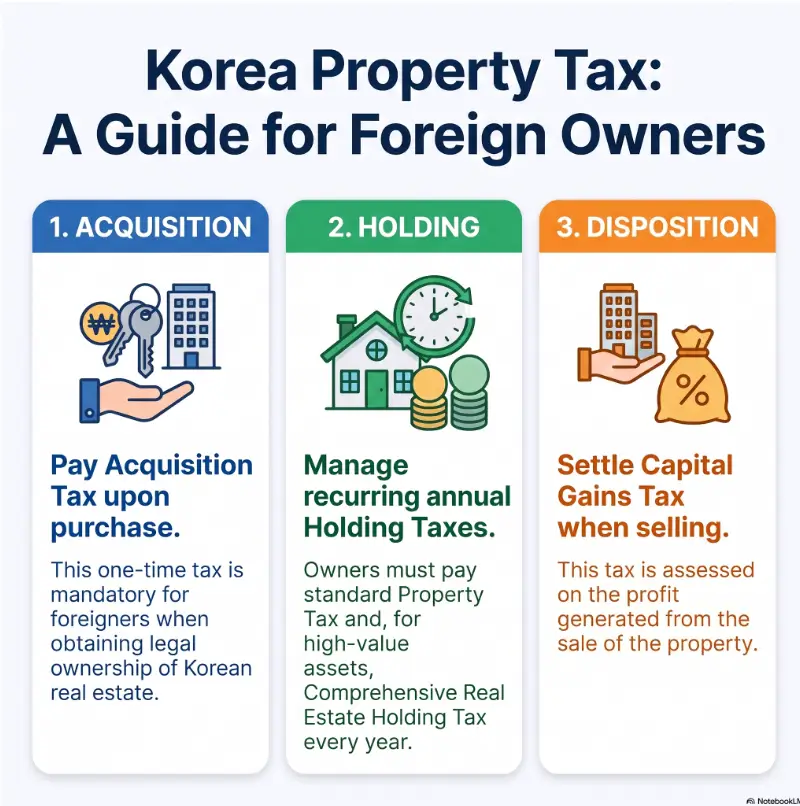
Buying a Korean apartment can feel wonderfully concrete: a contract, a key code, the click of the door closing behind you. The tax system is less visible. It arrives in layers, from acquisition costs at closing to annual local tax, possible national holding tax, rental-income filings, and the final reckoning when the property is sold.
For a US citizen or tax resident, there is a second ledger running in parallel. Korea may tax the property because it sits in Korea, while the United States may tax or require reporting because of who owns it. The two systems do not use identical values, exchange rates, depreciation rules, or filing categories.
This guide turns that thicket into an ownership-cycle map. You will learn which costs belong to buying, holding, renting, and selling; why June 1 deserves a red circle on the calendar; what records preserve your cost basis; and when a local accountant is enough versus when a coordinated Korea-US tax team may be worth the fee.
The most useful tax plan is not a clever rate trick. It is a clean trail from purchase money to final sale proceeds. 🧾
Snapshot
This article is for foreign individual owners, especially US citizens, green-card holders, US tax residents, expats, landlords, and buyers comparing Korean homes, officetels, buildings, or land. It explains where tax costs appear, which deadlines and records matter, and how to decide whether you need a local filer, a cross-border adviser, or a more detailed ownership model before signing.
Table of Contents
Before You Act: Tax Rules Age Faster Than Paint
Tax and legal notice
This guide offers general education, not individualized Korean or US tax advice. Your result can change with residency, ownership share, property classification, assessed value, acquisition date, use, financing, other Korean holdings, and current legislation. Confirm rates, deductions, deadlines, treaty treatment, and filing forms with qualified Korean and US advisers before closing, filing, restructuring ownership, or selling.
Nationality, residency, and ownership are three different questions
A foreign passport does not create one universal “foreigner property tax rate.” Korean tax treatment can depend more heavily on whether you are a Korean tax resident or nonresident, what type of property you own, how many Korean properties are aggregated to you, and whether the owner is an individual or an entity.
The US side asks a different set of questions. A US citizen or resident alien generally remains subject to US tax on worldwide income, including income from foreign rental property, even while living abroad.
What this guide can do, and what it cannot
It can help you identify the tax events, collect the right documents, recognize dangerous assumptions, and prepare better questions. It cannot calculate your final bill without current assessed values, ownership history, residency facts, applicable deductions, and transaction documents.
Think of this article as the airport map, not the boarding pass. It shows where the gates are. Your adviser still needs to verify the flight.
Key takeaway
Never ask only, “What is the Korean property tax rate?” Ask, “Which tax, for which property classification, on which date, under whose ownership, and in which country’s return?”
The Four-Tax Map: Follow the Property Through Its Life
Korea’s official foreign-investment guidance separates acquisition tax, annual property tax, comprehensive real estate holding tax, transfer income tax, local income tax, and related surtaxes. Foreign acquisition also sits within real estate reporting, registration, and foreign-exchange procedures.
The ownership-cycle tax map
Tax one: Acquisition tax turns the contract price into a closing budget
The purchase price is merely the first line. Acquisition tax can vary according to the property type, transaction, number of homes, buyer profile, and current rules. Local education tax, rural-area surtax, registration-related expenses, legal work, brokerage, translation, and banking costs may sit beside it.
A cautious buyer requests a written closing-cost worksheet before the final payment date. Do not settle for a verbal percentage whispered across a real estate office desk. Ask which line is tax, which is a government fee, which is a professional fee, and which amount is only an estimate.
Tax two and three: Annual local tax may be followed by a national bill
Ordinary property tax is local. Comprehensive real estate holding tax is national and may apply when aggregated publicly assessed values exceed the relevant deductions for a category of property. One bill does not prove that the other cannot arrive.
Tax four: Income and sale events create their own returns
Rent is not simply cash collected. It becomes a ledger of income, deposits, expenses, repairs, interest, depreciation, management fees, and supporting evidence. A sale creates another calculation, usually starting with proceeds minus adjusted basis and qualifying costs, then adding special rules for holding period, use, residency, and property type.
| Stage | Questions to answer | Documents to keep |
|---|---|---|
| Buying | What is the official classification? What taxes and fees are due at closing? | Contract, acquisition report, registry, invoices, remittance records |
| Holding | Who owns it on June 1? What is the current assessed value? | Assessment notice, tax bills, ownership-share record, address updates |
| Renting | Is it residential, commercial, mixed-use, monthly rent, or deposit-heavy? | Lease, bank statements, expense receipts, depreciation schedule |
| Selling | What is the Korean basis and the separate US-dollar basis? | Closing statement, improvement invoices, tax filings, FX evidence |
The June 1 Rule: A Single Date Can Move the Bill
Who owns the property on June 1?
Korean property tax generally looks to the owner on June 1. Local guidance also explains that housing property tax is commonly billed in July and September, while buildings and land follow their applicable billing periods.
This is why a late-May closing and an early-June closing can create different legal taxpayers for that year’s holding tax. The property has not changed. The calendar has.
Real-world example: Two closing dates, one apartment
Suppose Mina buys an apartment from Daniel. If the legal ownership transfer is completed on May 29, Mina may be the June 1 owner for property-tax purposes. If completion occurs on June 3, Daniel may remain the June 1 taxpayer.
The contract can require one party to reimburse the other for an agreed share, but that private allocation does not automatically rewrite the local government’s taxpayer record. A reimbursement clause is an economic arrangement between parties; the statutory liability follows the legal rules.
The closing-date checklist
- Confirm the expected registration or legal transfer date, not only the contract-signing date.
- Identify who will be the June 1 owner.
- Ask whether the contract includes a property-tax adjustment.
- Specify how reimbursement will be calculated and documented.
- Verify the mailing address or electronic-notice method after transfer.
- Keep proof of payment even when the other party reimburses you.
Key takeaway
Before signing a May or June closing schedule, ask for one sentence in writing: “Who is expected to be the June 1 owner, and how will this year’s holding taxes be allocated between buyer and seller?”
Foreign owners who are unfamiliar with local administration may also benefit from understanding how Korean district offices handle everyday public services. The correct office for local tax questions is usually connected to the property’s location, not the owner’s overseas address.
The Assessed-Value Trap: Market Price Is Only One Number
One property can carry four different values
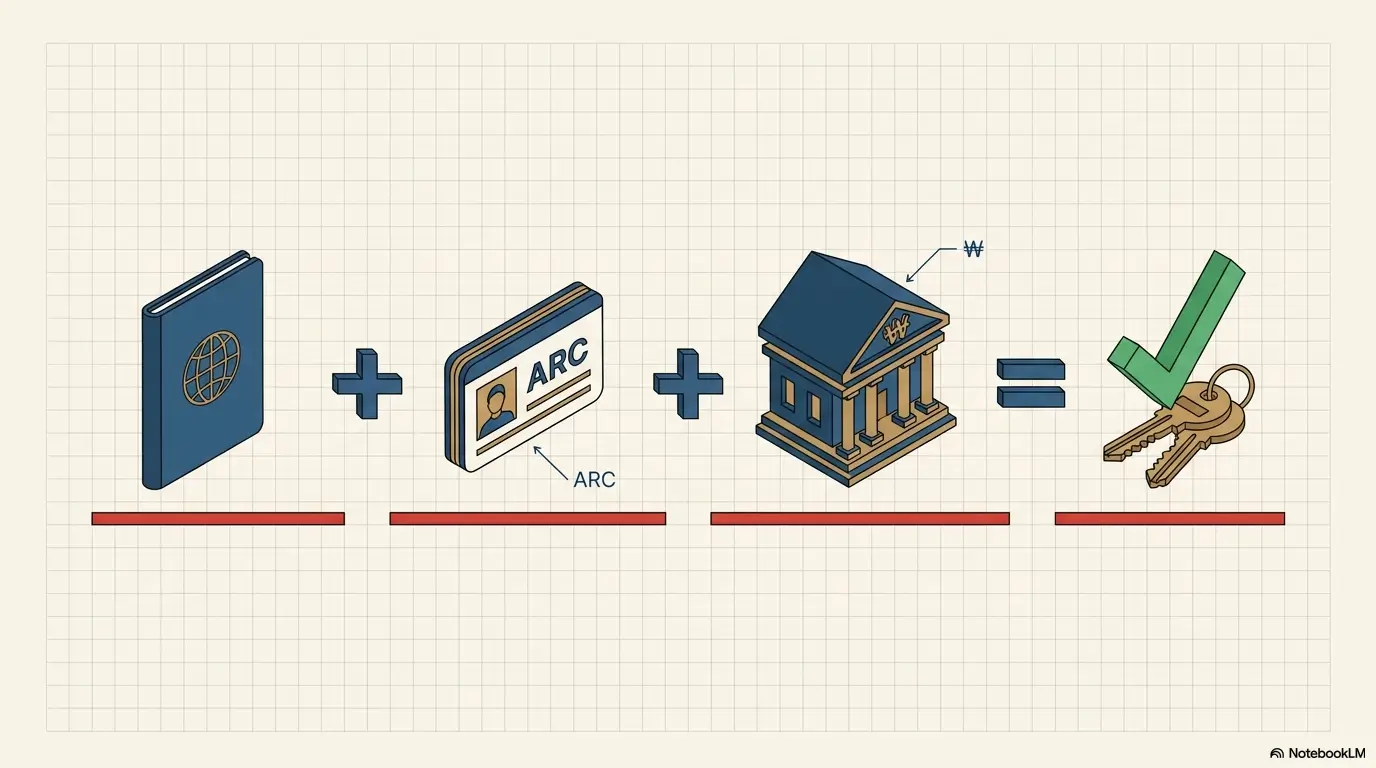
Your contract price, online asking price, bank appraisal, and publicly assessed value may all differ. Tax calculations can start from an official assessment rather than the price shown in a property listing.
That difference cuts both ways. A property bought below a nearby asking price is not automatically taxed from the bargain price forever. Conversely, a high market price does not mean every annual tax simply multiplies that figure by a flat percentage.
Classification changes the calculation path
A house, ordinary building, commercial unit, officetel, general aggregate land parcel, separately aggregated land parcel, and specially taxed land do not necessarily travel through the same formula. Use matters too. An officetel marketed with glossy residential photographs may have legal, registration, rental, and tax characteristics that deserve separate review.
For a practical housing context, see this guide to an officetel lease in Korea. The word “officetel” is not a substitute for confirming the registry, official use, actual use, and tax treatment.
The calculation has layers, not one magic percentage
- Confirm the property category and owner.
- Find the official assessed value for the relevant tax year.
- Apply the statutory taxable-base adjustment or fair-market-value ratio, where applicable.
- Apply the correct rate structure and any deductions or caps.
- Add attached local or national surtaxes where required.
- Compare the result with notices and prior-year workpapers.
Show me the nerdy details
A tax threshold and a tax base are not the same thing. Crossing a deduction threshold does not necessarily expose the property’s entire assessed value to the top rate. Progressive brackets, deductions, ownership shares, special one-home rules, taxable-base ratios, and tax-credit or burden-cap mechanisms can alter the result.
For cross-border work, keep four labeled columns: Korean assessed value, Korean tax basis, US-dollar adjusted basis, and exchange-rate source. Mixing those figures in one spreadsheet is how tidy numbers become tax fog.
What to verify before trusting an online calculator
- The calculator’s tax year and update date
- Whether it handles foreign or nonresident owners
- Whether it aggregates additional Korean property
- Whether it distinguishes housing, buildings, and land
- Whether it includes ownership shares and one-home assumptions
- Whether attached taxes are included or shown separately
- Whether the result is an estimate or filing-ready calculation
Property Tax vs. Comprehensive Holding Tax: The Possible Second Envelope
Local bill, national bill
Ordinary property tax is administered locally. Comprehensive real estate holding tax is administered nationally and generally reviews property by category after aggregation at the owner level. The National Tax Service describes it as a tax on the portion exceeding the relevant deduction after values are aggregated by property type as of June 1.
That structure explains why examining one apartment in isolation can be misleading. Another home, land parcel, or ownership interest may change the owner-level result.
Joint ownership is a model, not a slogan
Splitting ownership may divide assessed value between individuals, but it can also affect financing, succession, control, deductions, sale mechanics, gift-tax exposure, and the paperwork required when one owner lives abroad. “Joint ownership saves tax” is too blunt to be useful.
Model at least three moments before choosing shares: annual holding tax, sale tax, and transfer at death or by gift. A structure that trims one year’s bill can create a thornier exit.
Foreign addresses create a boring but costly risk
Tax notices can be missed when the registered address is outdated, overseas mail is delayed, a property manager assumes the owner received the notice, or electronic access fails because identity verification is incomplete.
Set a calendar reminder to check local and national liabilities rather than waiting for an envelope. Korea’s digital services often require identity and account setup, so the guide to Korean identity verification for foreigners may help you anticipate access problems.
| Issue | Ordinary property tax | Comprehensive holding tax |
|---|---|---|
| Authority | Local government | National Tax Service |
| Core focus | Taxable property at the local level | Owner-level aggregation by property category |
| Key date | Generally June 1 ownership | Generally June 1 ownership and aggregation |
| Common mistake | Using market price as the only input | Reviewing one property without other holdings |
| Best preparation | Assessment notice and classification | Complete owner-by-owner Korean property schedule |
Rental Income: Korea Taxes the Property Before America Sees the Return
Build a Korean rental ledger, not a folder of screenshots
A property manager’s monthly summary is useful, but it is not a complete tax ledger. Track gross monthly rent, deposits, management charges collected from the tenant, repairs, insurance, loan interest, taxes, agent commissions, legal fees, furnishings, and capital improvements.
Label each expense with three questions: Is it deductible in Korea? Is it deductible or depreciable in the United States? Do both countries recognize it in the same year? The answer is often not identical.
Jeonse and large deposits need their own analysis
Korea’s deposit-heavy rental structures do not behave like an ordinary US security deposit in every tax or financial context. A large jeonse deposit can affect financing, deemed-rent questions, cash management, repayment risk, and the records needed at sale.
Owners and renters should also understand deposit protection mechanics. This guide to jeonse deposit protection explains why registry timing, priority, and documentation matter beyond the tax return.
Residential and commercial rent may split the workflow
Commercial or mixed-use property may raise business-registration, invoicing, and value-added-tax questions that do not arise in the same way for a straightforward residential lease. An officetel used as a residence may still require a careful classification review rather than a guess based on the tenant’s furniture.
The US return does not vanish at the Pacific
US citizens and resident aliens generally report worldwide income. IRS rental guidance addresses rental income, operating expenses, repairs, property taxes, interest, and depreciation, commonly reported through Schedule E for individual owners.
Korean income tax paid on rental profit may support a US foreign tax credit when the requirements are met. Korean acquisition tax and annual property tax generally do not become foreign income tax credits merely because they are taxes. The IRS states that the credit generally applies to qualifying foreign income taxes or taxes in lieu of income tax, while property taxes are generally ineligible for the credit.
Key takeaway
Keep separate Korean and US depreciation schedules from the first rental year. Reconstructing them during a sale is the accounting equivalent of looking for one black sock in a dark hotel room.
| Rental record | Korean file | US file |
|---|---|---|
| Rent and deposits | Lease terms, receipts, deemed-rent review where relevant | Dollar conversion and rental-income classification |
| Repairs | Invoice, payment proof, business purpose | Repair versus improvement analysis |
| Improvements | Capital-cost support | Basis and depreciation schedule |
| Loan interest | Loan statement and use of funds | Expense allocation and currency conversion |
| Korean income tax | Filed return and payment receipt | Foreign tax credit workpaper, if eligible |
Selling the Property: Basis, Currency, and Remittance
Reconstruct the cost basis before listing, not after accepting an offer
Your starting file should include the purchase price, qualifying acquisition taxes and transaction costs, legal and brokerage fees, and documented capital improvements. Ordinary repairs and capital improvements should not be tossed into one bucket.
Invoices matter. Bank transfers matter. A renovation photograph proves that something changed, but it may not prove who paid, how much, when, or whether the work should increase basis.
Holding period, use, and residency shape the sale workflow
Korean capital-gains treatment can vary with the property category, holding period, number of homes, residence-related conditions, registration, and whether the seller is resident or nonresident. Nonresident sellers may face additional filing, representation, documentation, or tax-clearance steps.
Korea’s National Tax Service states that a nonresident transferring real estate is responsible for filing and paying the capital gains tax within the filing period.
One sale can produce two different gains
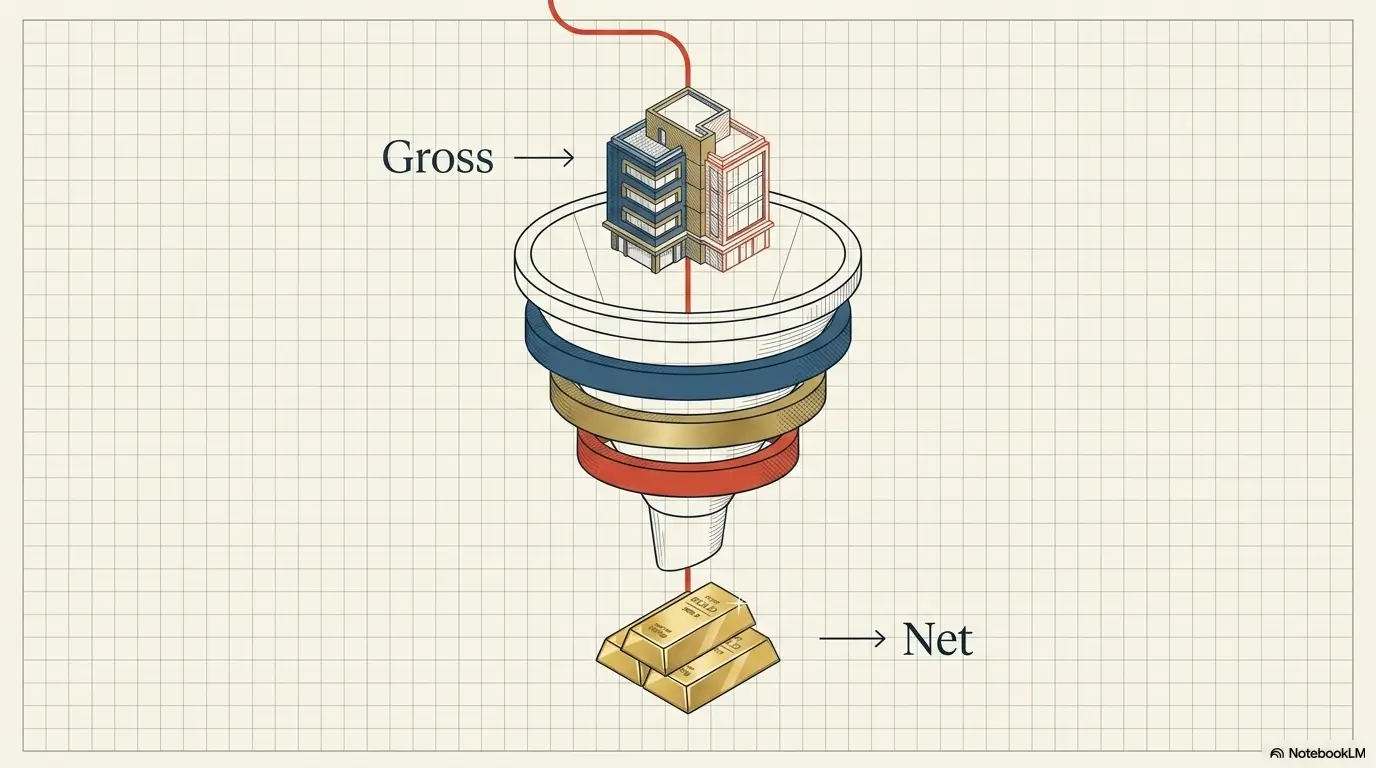
Korea calculates the transaction in won. The US return generally needs dollar amounts. Acquisition cost, capital improvements, depreciation, selling expenses, and proceeds may need conversions using appropriate historical or transaction-date exchange rates.
As a result, a modest won gain can become a different dollar gain, and vice versa. Currency movement is not decoration around the tax calculation. It is part of the calculation.
Do not lose the original remittance trail
Foreign owners may need acquisition, registration, tax-payment, and foreign-exchange documents when moving sale proceeds abroad. Keep bank advice, incoming-funds records, currency-exchange confirmations, contracts, registry documents, and tax receipts together rather than scattered across expired email links.
Key takeaway
Create the sale file while you still own the property. Once the buyer is waiting, the bank is requesting documents, and a filing deadline is approaching, every missing receipt acquires a little crown and begins issuing orders.
| Sale-file item | Why it matters | Best time to collect it |
|---|---|---|
| Original contract and registry | Supports acquisition date, owner, and price | At purchase |
| Acquisition-tax and fee receipts | May support basis or transaction history | At closing |
| Improvement invoices | May support basis adjustments | As work is completed |
| Rental depreciation schedules | Affects adjusted basis and US sale reporting | Every tax year |
| Foreign-exchange records | Supports funding and dollar calculations | At each transfer |
| Korean tax filings and receipts | Supports compliance and potential US credit work | Immediately after filing |
Cost Planning: DIY, Local Help, or a Cross-Border Team?
Professional fees should match complexity. Paying for a multinational team to review one simple personal-use apartment may be excessive. Using a free calculator for a rented, jointly owned, entity-held property with a planned sale can be false economy.
Good, better, best support levels
| Level | Best fit | What it includes | Main limitation |
|---|---|---|---|
| Good: Organized DIY | Personal-use property, one owner, no rent, no sale planned | Official notices, calendar reminders, document folder, basic translation help | Does not resolve classification or cross-border questions |
| Better: Korean tax professional | Rental income, nonresident filing, multiple Korean holdings, upcoming sale | Korean returns, local tax review, filing calendar, sale preparation | May not prepare US forms or dollar-basis workpapers |
| Best: Coordinated Korea-US team | US taxpayer with rent, entity ownership, large gain, gift, inheritance, or complex exit | Aligned assumptions, two-country basis, foreign tax credit review, reporting map | Higher fees and more document requests |
Questions to ask before paying an adviser
- Do you regularly work with foreign individual owners of Korean real estate?
- Will you confirm the property’s tax classification and assessed value?
- Do you handle nonresident rental or sale filings?
- Will you provide a written filing calendar and document request list?
- Can you coordinate with a US international tax preparer?
- Who will calculate the US-dollar basis and depreciation?
- Are tax notices, amendments, and authority responses included in the fee?
- What work is fixed-fee, hourly, or outside scope?
Warning signs that a cheap quote may cost more later
Be cautious when a provider gives a final tax number before reviewing the registry, assessed value, ownership share, other Korean property, residency, rental history, or acquisition documents. Also pause when someone promises that a spouse’s name, a company, or a quick transfer will automatically reduce tax.
The best way to choose a Korea property tax adviser is not by searching for the smallest fee. Compare scope, cross-border experience, response process, languages, deliverables, and who remains responsible after the return is filed.
Common Mistakes That Make Ordinary Taxes Expensive
Budgeting only for the annual property-tax notice
The ownership cycle includes acquisition costs, annual holding taxes, possible comprehensive holding tax, rental-income filings, sale tax, banking costs, translations, and professional fees. A low annual bill does not prove that the property is inexpensive to own.
Keeping records by year instead of by property
A property-centered file is easier to audit and easier to sell. Keep the acquisition documents, annual notices, rental ledgers, improvements, bank records, and sale documents together, with annual tax returns linked from the same index.
Assuming Korea and the United States see the same transaction
The countries may differ on currency conversion, depreciation, expense timing, residence relief, entity classification, and foreign tax credits. Maintain separate workpapers and a reconciliation page that explains every difference.
Confusing the property with the account or entity that holds it
Directly owned foreign real estate is generally not itself a specified foreign financial asset reported on Form 8938. An interest in a foreign corporation, partnership, trust, or estate that owns the real estate may be reportable when applicable thresholds and rules are met.
Separately, Korean bank accounts used for rent, deposits, taxes, or repairs may create FBAR or Form 8938 questions. The account and the apartment are not the same asset, even when every won in the account belongs to the apartment.
| Common mistake | Safer alternative |
|---|---|
| Using the asking price as the annual tax value | Confirm the official assessment and property classification |
| Ignoring June 1 during closing negotiations | Document the statutory taxpayer and contract reimbursement |
| Combining Korean and US gains in one currency worksheet | Maintain separate won and dollar calculations |
| Calling every renovation a repair | Classify repairs and capital improvements with invoices |
| Assuming joint ownership always saves money | Model holding, sale, gift, and inheritance consequences |
| Waiting for overseas mail | Use reminders, electronic access, or an authorized local contact |
| Creating an entity before modeling the exit | Review Korean and US tax and reporting consequences first |
Key takeaway
The costliest mistake is usually not choosing the “wrong” tax rate. It is making an ownership, rental, or sale decision before anyone has mapped both countries’ consequences.
FAQ About Korea Property Tax for Foreign Owners
Do foreigners pay a special property tax rate in Korea?
Nationality alone is usually not the only factor. Property type, assessed value, number of homes, ownership share, use, residency, and whether an individual or entity owns the property can matter more. Confirm the current rule for your exact transaction rather than using a broad “foreigner rate.”
What taxes does a foreigner pay when buying Korean property?
Acquisition tax is the main purchase tax, with possible attached local taxes and transaction expenses. Registration, legal, brokerage, translation, banking, and foreign-exchange costs may also affect the closing budget. The exact amount depends on the property and buyer profile.
How is annual Korean property tax calculated?
The calculation generally begins with official assessment and classification, then applies the relevant taxable-base mechanism, rate structure, and attached taxes. It is not normally a single flat percentage of the online market price.
Who pays property tax if a home is sold near June 1?
The June 1 owner is generally central to the statutory property-tax liability. Buyer and seller may negotiate a private reimbursement, but the contract allocation should be documented separately from the government’s taxpayer determination.
Does one Korean apartment trigger comprehensive real estate holding tax?
It depends on current assessed value, ownership share, owner-level aggregation, property category, available deductions, and special conditions. Count all relevant Korean holdings before reaching a conclusion.
Can a foreign owner pay Korean property tax from overseas?
Payment may be possible through Korean electronic systems, a Korean bank account, or an authorized representative, depending on access and verification. Set up the payment method before the due date and do not rely solely on mailed notices.
Is Korean rental income taxable in the United States?
US citizens and resident aliens generally report worldwide income, including foreign rental income. Expenses, depreciation, currency conversion, passive-activity rules, and potential foreign tax credits require separate US analysis.
Must Korean property be reported on FBAR or Form 8938?
Direct ownership of foreign real estate is generally not itself reported on FBAR or Form 8938. Related Korean financial accounts may be reportable, and an interest in a foreign entity that owns the property may be a specified foreign financial asset. Review each asset separately.
Should I buy in a company or my personal name?
There is no universal answer. Compare acquisition tax, annual tax, rental taxation, sale taxation, financing, liability, succession, Korean compliance, and US entity-reporting obligations before forming or using an entity.
Your 15-Minute Next Step: Build the One-Page Tax File
Open a blank document and write the following facts on one page. Do not calculate anything yet. The aim is to replace a foggy property story with a clean set of inputs.
- Legal owner and ownership percentage
- Korean tax residency and US tax residency
- Property address, registry details, and official classification
- Contract price, completion date, and registration date
- June 1 owner for the current year
- Current publicly assessed value
- Personal, vacant, rental, commercial, or mixed use
- Other Korean property held by the same owner
- Rent, deposits, major expenses, and loan details
- Original funding route and foreign-exchange records
- Korean and US professionals responsible for each filing
- Next filing, payment, lease, refinancing, or sale date
Then attach the purchase contract, registry extract, acquisition report, tax notices, receipts, renovation invoices, leases, bank records, and exchange documents. Buyers who are still preparing for possession may also use this Korean apartment move-in checklist to keep practical handover tasks from colliding with tax paperwork.
That single page becomes your briefing note for a district tax office, Korean accountant, US preparer, bank, property manager, or future buyer. It also exposes the missing facts while there is still time to find them.
The quiet advantage
Cross-border property tax becomes less intimidating when every number has a label, every document has a home, and every adviser knows which part of the bridge they are responsible for. Spend 15 minutes building the page now. Future you may open it years later and feel the rare luxury of being expected by your own past.
Last reviewed: 2026-08