

Moving a dog or cat to South Korea does not normally mean paying for days of quarantine. If your pet arrives with the required microchip, government-issued health certificate and, when required, a qualifying rabies antibody test, Korean quarantine inspection can usually be completed on the day of arrival.
The expensive branch begins when one of those items is missing, expired, mismatched or unacceptable. Then the pet may need testing, microchipping or extended quarantine at the owner’s expense, and in some cases return transportation can become the worst-case cost.
For budgeting, separate the move into four different bills: pre-departure veterinary and certification costs, airline transportation, Korean quarantine, and veterinary care after arrival. Pet insurance is a fifth decision, but it should not be confused with insurance for the journey itself.
Table of Contents
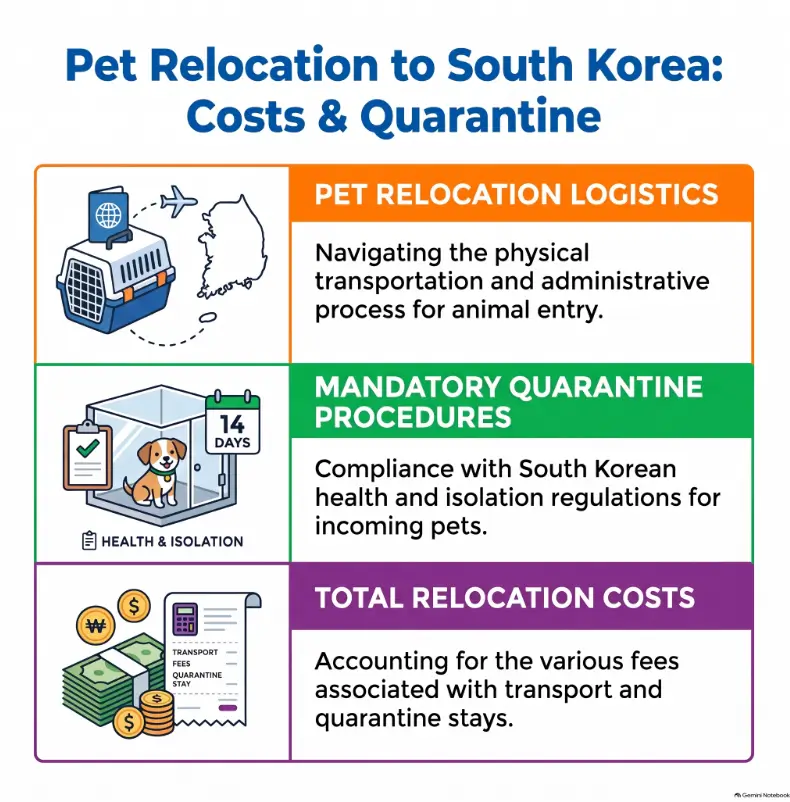
How Much Does It Cost to Move a Pet to Korea?
There is no reliable universal total. Two owners flying the same route can spend very different amounts because laboratory charges, government certification, crate size, airline rules and the animal’s medical condition are set independently.
| Cost component | Who sets the cost? | What changes the bill? |
|---|---|---|
| Pre-travel veterinary visit | Veterinary clinic in departure country | Exam, vaccination status, microchip work and required paperwork |
| Rabies antibody test | Vet and approved laboratory | Country, laboratory, sample handling and shipping |
| Official export health certificate | Departure-country veterinary authority | Country-specific certification process and official-vet requirements |
| Airline pet transportation | Airline | Route, pet plus carrier weight, aircraft and transfer itinerary |
| Korean quarantine application | Korean government | Standard application versus additional testing or quarantine |
| Extended quarantine | Depends on the corrective action required | Missing microchip, inadequate rabies evidence, testing or other deficiencies |
| Veterinary care after arrival | Korean animal hospital | Region, hospital, pet size, tests, imaging, medicines and treatment |
| Pet insurance | Insurer | Age, breed, medical history, coverage percentage, deductible and exclusions |
For a straightforward move, the airline fee may be the largest single predictable charge. For a problematic move, correcting quarantine documentation can matter far more than saving a small amount on the flight.
The Korean Quarantine Rule That Changes the Cost
Korea’s system is better understood as an entry inspection rather than mandatory isolation for every imported pet. Dogs and cats are inspected on arrival, and the documents determine whether the animal can be released or must remain under quarantine control.
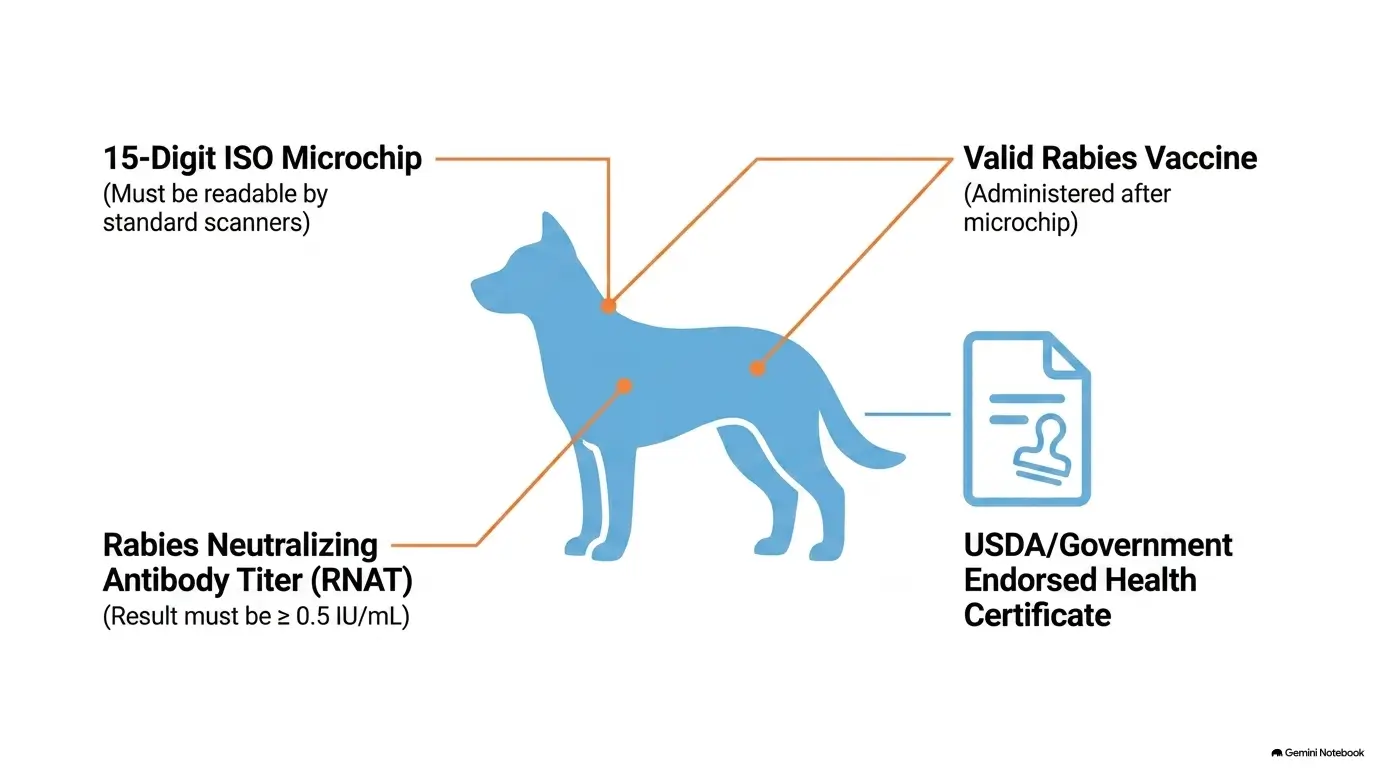
For a dog or cat aged 90 days or older arriving from an area that Korea does not treat as rabies-free, the core requirements generally include:
- an identifiable microchip, normally compliant with ISO 11784/11785 standards;
- a current rabies vaccination;
- a rabies-neutralizing antibody test result of at least 0.5 IU/ml;
- the antibody test performed within the period accepted by Korea, generally within 24 months before shipment; and
- an official animal health or quarantine certificate issued or endorsed through the competent veterinary authority of the exporting country, with the required identification and test information.
Dogs and cats younger than 90 days, and animals originating from areas Korea currently recognizes as rabies-free, can be exempt from the rabies antibody test. The microchip and official certificate requirements still matter.
Korea’s official guidance also contains additional disease-certification rules for certain origins, including Australian cats and dogs or cats arriving from Malaysia. Rabies-free status and disease controls can change, so check the current Korean requirements rather than relying on an old relocation checklist. A Korean government embassy page provides a useful English-language explanation of the dog and cat import requirements for Korea.
The microchip number is a document-matching problem, not just a microchip problem
A pet can have a perfectly functional microchip and still encounter trouble if the number printed on the official certificate or laboratory report does not match the chip that Korean quarantine staff scan.
Before departure, ask the vet to scan the pet and compare the number digit by digit with the rabies titer report and export certificate. That five-minute check can protect far more money than shopping around for a slightly cheaper carrier.
A private vet certificate may not be enough
One assumption that causes problems for foreign owners is treating an ordinary veterinary health letter as equivalent to an official export certificate. Korea requires documentation connected to the competent veterinary authority of the exporting country.
The exact workflow therefore depends on where you are leaving from. Your private veterinarian may perform the examination and prepare documents, while a government veterinary authority or authorized official veterinarian completes or endorses the export process. Confirm that sequence in your departure country before booking a non-refundable flight.
What Does Korean Pet Quarantine Cost?
The Korean fee schedule lists a KRW 10,000 quarantine application fee per application for dogs and cats. The relevant framework appears in Korea’s Enforcement Rule of the Act on the Prevention of Contagious Animal Diseases, available through the National Law Information Center.
That figure should not be mistaken for the maximum cost of a failed inspection. If an animal cannot be released because a required microchip or rabies test is missing or unacceptable, the owner can face additional testing, veterinary procedures, transport, quarantine-facility costs and potentially return transportation.
Cost rule: compliant paperwork usually keeps Korean quarantine inexpensive. Documentation failure is what turns quarantine into a serious moving expense.
Do not deliberately plan to complete the rabies antibody test after arriving simply because Korean procedures may allow deficiencies to be corrected in some circumstances. The animal may remain in quarantine while the requirement is completed, and those costs and delays belong to the owner.
Airline Pet Fees to Korea: Current Benchmarks
Airline pet fees are separate from your normal baggage allowance. More importantly, paying for a passenger ticket does not automatically reserve space for the animal.
Current policies from two major Korean carriers show how quickly pet size changes the economics.
| Airline | Small pet in cabin | Long-haul benchmark up to 32 kg including carrier | 33–45 kg including carrier |
|---|---|---|---|
| Korean Air | Pet + carrier up to 7 kg | KRW 300,000 / USD 300 on qualifying long-haul routes | KRW 600,000 / USD 600 |
| Asiana Airlines | Pet + carrier up to 7 kg | KRW 290,000 / USD 290 on U.S., Europe and Oceania routes | KRW 590,000 / USD 590 |
These are airline benchmarks, not universal relocation quotations. Currency treatment, route classification, aircraft, departure country and connecting carrier can change what you actually pay.
Korean Air’s current pet policy allows cabin transport when the pet and carrier together weigh no more than 7 kg. Its checked-pet rules allow larger animals subject to age, carrier, aircraft, route and breed restrictions.
Asiana’s current pet policy also uses a 7 kg combined cabin limit and publishes separate route and weight-based fees.
Pet space must be approved before you rely on the booking
Both airlines require advance approval for pet transportation. Their international reservation deadlines are generally at least 48 hours before departure, but treating 48 hours as your planning window is risky. Aircraft pet capacity can be limited.
Confirm that your exact flight can accept the animal before locking yourself into a difficult-to-change itinerary.
The 7 kg threshold can change the entire move
The cabin limit includes the carrier. A 6.5 kg dog in a 1 kg carrier is therefore not a 6.5 kg airline pet.
Weigh the pet inside the actual travel carrier. If you are close to the limit, do not budget on cabin transport until the airline confirms compliance.
Breed and aircraft restrictions can matter more than price
Airlines restrict some dangerous breeds and may prohibit snub-nosed or brachycephalic animals from traveling in the hold because of respiratory risk. Aircraft type and temperature can also restrict checked-pet transport.
If your dog or cat cannot travel as ordinary accompanied baggage, you may need an air-cargo or specialist pet relocation solution. That is a different pricing system and can be substantially more complicated than the passenger pet fees above.
Pet Insurance Does Not Mean Your Move Is Insured
There are at least two different risks hiding behind the word “insurance.”
- Transportation risk: what happens if the pet is injured, lost, delayed or otherwise affected during the international move?
- Veterinary risk after arrival: how much of future treatment at Korean animal hospitals will a Korean or international pet insurance policy reimburse?
A medical pet insurance policy should not be assumed to cover airline transport, quarantine charges or relocation-company problems. Likewise, paying a relocation company does not automatically mean your pet’s future Korean veterinary bills are insured.
Check these terms before buying Korean pet insurance
- Eligibility: Can a foreign resident actually complete enrollment with the identification and tax-residency status you hold?
- Entry age: Is your pet still young enough for first enrollment?
- Waiting periods: When does illness coverage actually begin?
- Pre-existing conditions: Which prior diagnoses, symptoms or treatment histories are excluded?
- Reimbursement: Is coverage 50%, 70% or another percentage, and what deductible applies?
- Annual and per-visit limits: How much financial protection exists when a large bill arrives?
- Dental, orthopedic and breed-related conditions: Are they covered, delayed or excluded?
- Claims: What Korean veterinary records and receipts must you submit?
Foreign residents can encounter an additional layer of friction because some Korean direct-insurance channels use domestic identity verification and impose their own tax-residency or customer-onboarding rules. A product existing in Korea does not automatically mean every newly arrived foreign owner can purchase it through the same online channel.
If your pet has an existing medical condition, get the coverage decision before assuming insurance will make Korean treatment inexpensive. Insurance purchased after relocation generally cannot be treated as a blank cheque for medical history that already exists.
What Do Vet Visits Cost After Moving to Korea?
South Korea now provides much better veterinary price visibility than many newcomers expect. Animal hospitals must post specified fees, and the Ministry of Agriculture, Food and Rural Affairs publishes regional price data through the Animal Hospital Medical Fee Disclosure System.
The latest completed nationwide annual survey available for this article is the 2025 survey, covering 3,950 animal hospitals and 20 disclosed treatment categories.
| Veterinary item | 2025 national average |
|---|---|
| Initial consultation | About KRW 10,520 |
| Dog combined vaccine | About KRW 26,337 |
| Cat combined vaccine | About KRW 39,478 |
| Rabies vaccination | About KRW 24,803 |
| Complete blood count | About KRW 35,973 |
| X-ray | About KRW 46,917 |
| Dog hospitalization | About KRW 65,040 per day |
| CT | About KRW 601,333 |
| MRI | About KRW 722,789 |
These figures are comparison benchmarks, not package prices. A hospital bill can include several items together, and medicines, anesthesia, interpretation, emergency care, procedures or additional testing can materially change the total.
There is also meaningful variation between hospitals and regions. The useful question is therefore not simply, “What does a Korean vet cost?” It is, “What does this specific clinic charge for the services my pet is likely to need?”
If your pet arrives healthy and satisfies the import requirements, there is no general rule requiring you to purchase CT scans, blood panels or other expensive medical services simply because the animal has moved to Korea.
Build Your Pet-Move Budget Before You Buy the Ticket
A useful budget starts with separate lines rather than one guessed relocation number.
- Microchip: confirm whether the existing chip is acceptable and readable.
- Rabies vaccination: confirm validity and timing.
- Rabies antibody test: add vet, laboratory and sample-shipping costs if required.
- Export certificate: add private-vet and government-certification charges from your departure country.
- Carrier: price the exact airline-compliant carrier, not a generic pet bag.
- Airline: obtain the pet fee for the exact flight and total pet-plus-carrier weight.
- Korean quarantine: include the standard application fee and keep separate contingency funds for a document problem.
- Ground transport: check whether your airport transfer can accommodate the carrier.
- First Korean vet visit: budget it separately if you want a post-move health review, medicines or preventive care.
- Insurance: add only the premium from an actual quote after checking exclusions and eligibility.
Illustrative example: for an eligible small pet traveling on a Korean Air long-haul route at the current up-to-32-kg fee level, the known transportation and Korean quarantine application charges alone can begin with approximately USD 300 plus KRW 10,000. The owner’s departure-country veterinary examination, rabies testing, government certification and carrier still need to be added.
That is more useful than publishing a seductive but unreliable claim that “moving a pet to Korea costs $X.” The uncertain part of the bill is often created before the animal ever reaches Incheon.
When Is a Pet Relocation Company Worth Paying For?
DIY may be enough when one healthy dog or cat is traveling with you on a direct flight, the airline accepts the pet, the microchip and rabies records are clear, and your departure country’s official certification procedure is straightforward.
One specialist consultation may be enough when you have completed most of the process but need someone to check a certificate sequence, unusual itinerary, cargo requirement or breed restriction before you commit money.
Full relocation help becomes easier to justify when the pet must travel as unaccompanied cargo, several airlines are involved, the animal exceeds accompanied-baggage limits, a brachycephalic breed creates transport restrictions, you are moving many animals, or a country-specific health requirement makes the paperwork difficult to coordinate.
If you obtain relocation quotes, ask each company to separate airline or cargo charges, veterinary work, government certification, crate, customs or quarantine handling, ground transportation and its own service fee. Otherwise two quotations that look different may simply include different things.
FAQ: Bringing a Dog or Cat to Korea
Does every pet have to stay in quarantine after arriving in Korea?
No. A dog or cat with compliant documentation and a satisfactory arrival inspection can generally be released on the day of arrival. Extended quarantine becomes relevant when entry requirements cannot be confirmed or additional procedures are required.
Can I have the rabies antibody test done after arriving?
Korean procedures can permit missing testing to be completed after arrival in some cases, but the pet may remain under quarantine until the requirement is satisfied and the owner bears the resulting expense. It is therefore a fallback, not a sensible money-saving strategy.
Will pet insurance pay for Korean quarantine?
Do not assume it will. Veterinary medical insurance, airline liability and relocation or transit coverage are different products and risks. Check the written policy for quarantine, transport and travel exclusions before relying on any reimbursement.
What if I am bringing many dogs or cats?
Korea applies an additional advance procedure when importing ten or more dogs or cats, including advance notification and approval relating to quarantine-facility use. This is a situation to confirm directly with the Animal and Plant Quarantine Agency before arranging transportation.
Your 15-Minute Check Before Paying the Airline
Put your pet in the actual travel carrier and record the combined weight. Then place the microchip number, rabies vaccination date, rabies antibody result and export-certificate requirement on one page.
Compare every occurrence of the microchip number. If those records agree, confirm that the antibody result is at least 0.5 IU/ml when the test is required, and verify that your departure country’s official veterinary authority can issue or endorse the Korean entry certificate on your timeline.
Only then ask the airline to approve the pet on the exact flight you intend to buy.
That sequence protects the two things most likely to disappear during an international pet move: money and time. The cheapest Korean quarantine is the one that ends at the airport because the paperwork already tells the right story.
Last reviewed: 2026-08
- Health Insurance in Korea for Foreigners: What Coverage Actually Means
- South Korea Digital Nomad Insurance: What Foreign Residents Should Check
- Travel Insurance Claim Denied in Korea: What to Check Next
- How to Use Korean Addresses for Taxis and Airport Transfers
- Using Korean Websites on Foreign Phones and Devices