
Read a celadon museum label in this order: object form, date, body material, decoration, then glaze. A line that says “stoneware with incised decoration under celadon glaze” tells you how the design was made as well as what covers it. Start with that line, then look for the detail the label describes.
You can practice with three traceable Goryeo objects: an incised bowl and an inlaid box at The Metropolitan Museum of Art, then a National Museum of Korea bowl whose title and description call out different surfaces. Open the collection records and keep the accession numbers handy. Each record is linked where you need it.
Contents
1. Start with the vessel form
Find the noun in the celadon museum label title before interpreting the pattern. A bowl, a covered box, and a bottle ask you to inspect different parts of the object. On a bowl, check the interior and the outer wall. On a covered box, see whether the photograph shows the lid in place. On a bottle, trace the profile from mouth to foot before moving in to the design.
A label may use a general English noun such as “bowl” or a Korean form name such as maebyeong (매병). Copy the label’s wording first so you can find the record later. When a record has separate title and medium fields, the title is usually the best place to start looking for a form or named motif and the medium is the best place to look for the technique.
Try a quick viewing habit. Read the object noun, then look away from the text and find one feature of the form. For example, find where a lid meets its base or locate the foot under a bowl. When you return to the label, you can mentally assign details to a part of the vessel. This is especially helpful when the museum uses one small label for several works in a display case.
2. Separate the period from the object date
The Met records both examples under the Goryeo dynasty (918–1392). It narrows the incised bowl to the 11th–12th century and dates the inlaid box to the 13th–14th century. The dynasty range and the object date answer different questions. Use the narrower date when comparing these specific pieces, and retain the range exactly as the museum gives it.
If all you see on a celadon museum label is “Goryeo,” describe it at that level. A more precise date may appear in the full collection record, but some pieces remain broadly dated there as well. In your notes, write the narrower date on its own line when the museum supplies one. That makes it less likely that a dynasty date will be mistaken for the date of a particular object.
A date from the credit line answers a different question again. The Met bowl’s credit line includes 1915, the year associated with the gift. That is a useful record of how the object entered the museum. Its object date remains the museum’s 11th–12th-century attribution. Before repeating a number in a caption, look at the name of the field beside it.
3. Break the medium line into body, decoration, and glaze
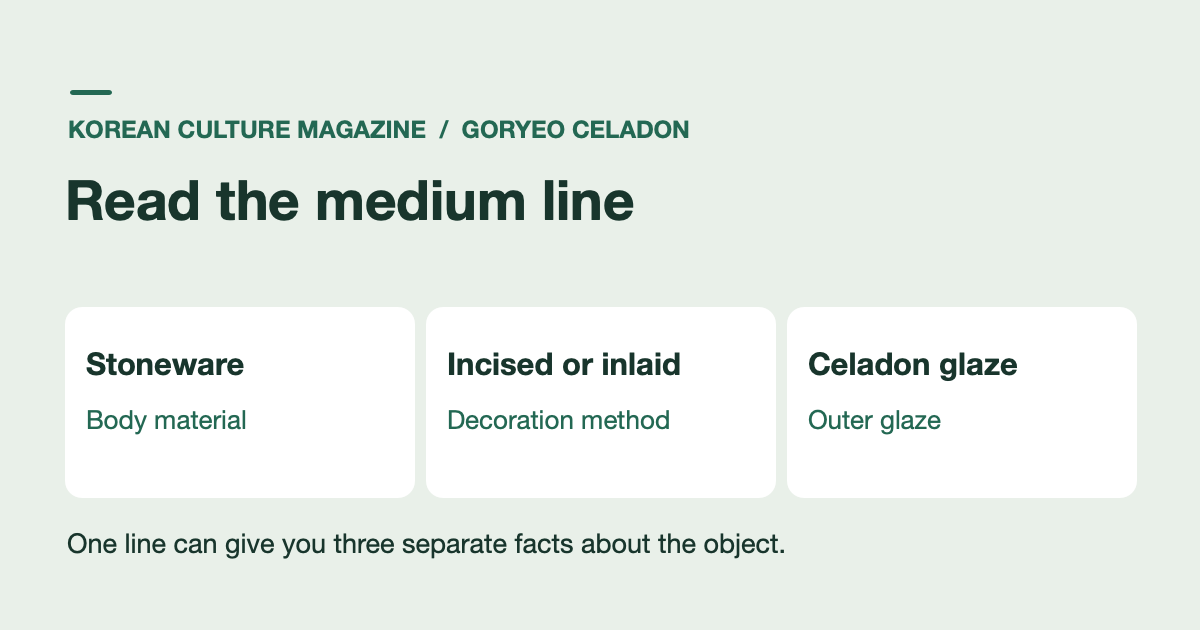
In The Met’s wording for the bowl, “stoneware” names the body material, “incised decoration” names the method, and “under celadon glaze” locates the decoration in relation to the glaze. Write these in three separate fields if you are taking notes. A short label that gives only “celadon” may leave the body or decoration unspecified. Check the longer record before filling the gaps.
When comparing two objects, read the celadon museum label medium line directly under each title. If the first says stoneware with incised decoration under celadon glaze and the second says stoneware with inlaid decoration under celadon glaze, the key change is one word. You can organize the visual comparison around that word. Later, add color or scale as a separate observation of your own.
A photograph can make one area look lighter than another because of the curve of the vessel or the lighting. Treat those areas as places to inspect in another view and compare them with the written medium. If your interest is the material history behind the terminology, see our Goryeo celadon guide to glaze and inlay.
4. Tell incised decoration from inlay
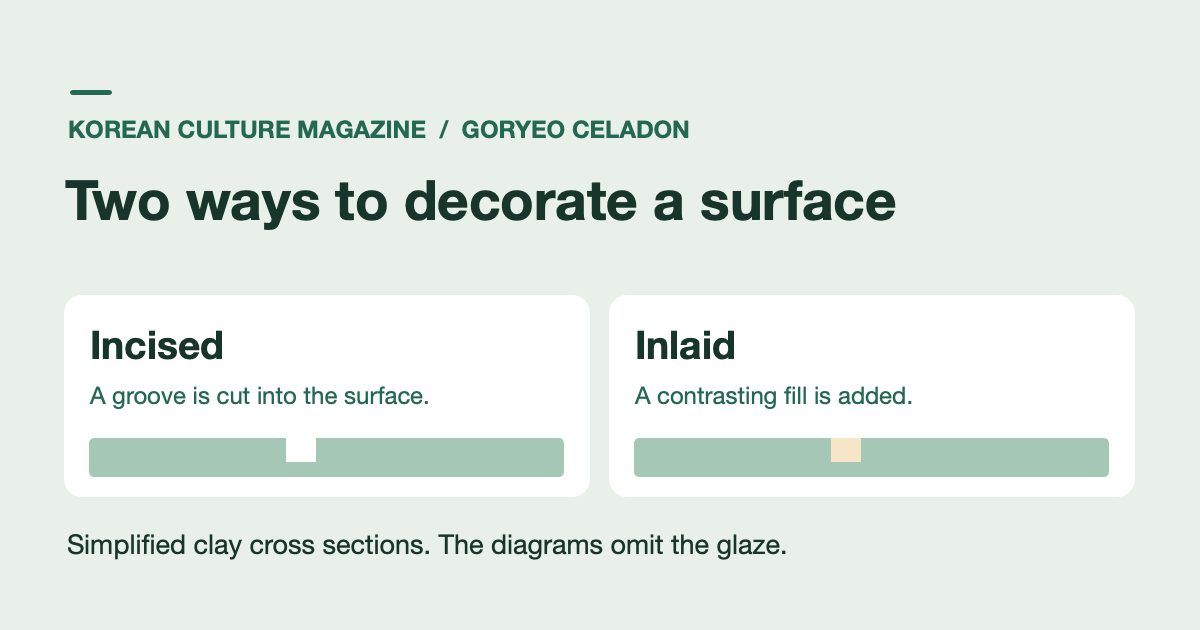
Incised describes cutting a line into the surface. In a photograph, look for the line where it crosses a gently curved lit area. The effect can be subtle, so use a closer view if the outline seems to disappear. Inlaid, often translated from 상감 (sanggam), describes adding contrasting material to recessed marks. The National Museum of Korea’s curator discussion describes the use of contrasting clay in a Goryeo celadon bottle.
The teaching cross sections show the basic distinction. The visual evidence on a real vessel is more complex. A groove can look dark, and an inlaid motif can be fine. The strongest comparison combines what a catalog explicitly identifies with a view where you can point out the corresponding line or motif.
Use this order as you read a celadon museum label in front of the object. First find the technique word. Next find the area it refers to. Then use the available picture or gallery viewpoint to compare the line with the surrounding surface. If you can see the difference on one side but the other side is hidden, keep that limitation in your notes. A detail photograph or a second museum view can answer a question left open by the display.
5. Compare three real collection records
The incised bowl. Open The Met record 15.160.10 and find the technique in the medium field. The title is simply “Bowl.” Use the fuller medium to direct your eye toward the incised lines, and use the recorded dimensions to orient yourself when a tight crop makes size hard to judge. The entry lists a diameter of 17.9 cm.
The inlaid box. Open The Met record 62.97.8a, b. The title names cranes and clouds, and the medium identifies inlay beneath celadon glaze. Its recorded diameter is 4.4 cm. Compare that number against the bowl’s diameter before comparing the apparent size of marks in their photos. The photographs show the objects at different scales.
The bowl with two clues. Open the National Museum of Korea record Deoksu3147. The title names an inlaid cloud-and-crane design. The description identifies simple incised flower branches on the outer surface. Use the museum’s views, or its 3D view if available, to look separately at the surfaces. The Korean record gives the accession number as 덕수3147.
Look inside and outside the same bowl


Photos: National Museum of Korea (국립중앙박물관), 청자 상감 구름 학 무늬 완 (Deoksu3147), KOGL Type 1. Numbered markers added by Korean Culture Magazine.
| Object | Technique or surface to check | Accession number |
|---|---|---|
| Met bowl | Incised decoration beneath celadon glaze | 15.160.10 |
| Met box | Inlaid crane and cloud design beneath celadon glaze | 62.97.8a, b |
| National Museum of Korea bowl | Title names inlay. Description identifies exterior incised flower branches. | Deoksu3147 |
The two bowl labels are a deliberate comparison. The short Met title calls the vessel by its form. The Korean museum title gives a prominent motif, and the description draws attention to another surface. Read the medium field and description together before making any claim about the whole object.
A five-minute practice exercise
Choose one of the three records and make a line of celadon museum label notes before looking at the answer example below. Use the same fields for each object so you can compare them side by side. Start from a fresh record page if you are practicing with someone else. One person can read the label, and the other can find the applicable part of the object in the museum view.
- Write down the title and accession number exactly as they appear.
- Separate the dynasty and object date. Leave the narrower date blank when the record supplies only a period.
- Underline the body, technique, and glaze terms in the medium.
- Identify one photographed surface. Record a second view you would need to answer anything still unclear.
Answer example. For Met 15.160.10, write: “Bowl. Goryeo dynasty. 11th–12th century. Stoneware. Incised decoration. Celadon glaze.” Then add “17.9 cm diameter” in a size field. Move to Deoksu3147 and add the detail from the written description about exterior flower branches. Those short lines preserve enough context for another person to locate and review both records.
To try a fresh comparison, start with the outer face of the covered box. Then check the alternate museum view to see what it shows of the lid or top. Write down the viewpoint before you name the design. That one habit will also help if you read a catalog that presents only a single photo for an object in a group.
Keep a traceable record of what you saw
Use three lines when a celadon museum label is short. Put the museum’s facts on the first line, what you can see on the second, and an open question on the third. This leaves room to look closely without attributing every observation to the museum. It also makes it easier for another reader to check which part of your note came from a catalog and which part came from a photograph.
| Field | Write down | Example for the Korean museum bowl |
|---|---|---|
| Record | Object identifier and the information the museum supplies | Deoksu3147. Goryeo. Title identifies an inlaid cloud-and-crane design. |
| Surface | Which part of the vessel your note describes | Outer wall. The catalog description identifies incised flower branches. |
| Question | What a second view or the full record could clarify | Where is the named inlaid motif visible in the museum views? |
Keep the original wording of the accession number in that first line. The case, spacing, and punctuation can be meaningful when the museum uses a family of related identifiers. The Met’s suffix letters for the box are part of the citation as shown on the record. Keep the museum name with the number, since another collection may have its own numbering system.
Next, describe each surface as specifically as the view permits. “Pale motif near the rim” tells someone where to look when you send them the record. “Inlaid” tells them what the record identifies as a technique. If you have only seen the outer wall, make that part of the observation. A photograph that includes the lid and the body can still hide the underside or interior.
A bilingual record can make this process easier. Copy 청자 (cheongja, celadon), 음각 (eumgak, incised decoration), or 상감 (sanggam, inlay) when that is the term you see. The English description may give a longer phrase that identifies where a motif appears. Keep the two labels beside the same accession number so you can find the exhibit again even if a title is translated differently elsewhere.
When you compare dates on a celadon museum label, keep museum fields separate. For Deoksu3147, the English record gives Goryeo as the period and Gaeseong area under provenance. The latter tells you what the record reports about the place associated with the object. That field alone supplies no specific kiln attribution. If you are interested in the wider vocabulary of Korean ceramic categories, see our comparison of celadon, buncheong, and white porcelain.
Measurements on a celadon museum label work better when the field is specific. Height, mouth diameter, and base diameter describe different parts of the same bowl. In the Korean record, the mouth is listed at 17.6 cm and the bottom at 5.3 cm. If you copy one number into a gallery note, keep its label. Without that detail, a later reader may mistake the size of the opening for the size of the foot.
Bonus test: look at the photograph first
Find a dark curve around a petal on the front of this bowl. Write one sentence naming where the line is and how its color compares with the surrounding surface. Then open the answer and check your observation against the celadon museum label.
Reveal the museum’s answer
A useful observation is “The line around a front petal looks darker than the glaze beside it.” The Met’s Bowl with flowers, waves, and a cloud record dates the piece to the 12th century and identifies its decoration as incised. Celadon glaze pooled in the grooves and darkened during firing.
Compare that with the inlaid crane on Deoksu3147 above. Both photographs show tonal contrast. To identify the technique, check the medium field and the museum’s description alongside what you see.
For a quick celadon museum label card, use this sequence: form, period, material, method, glaze, surface, accession number. Read the card from left to right once before you write any interpretation. If a line about color or a motif leaves you uncertain, carry that line into your question field. On your next visit or online session, return to that question and check another view.
You can run the same comparison with someone who reads Korean while you read English. Start with a shared accession number and ask each person to identify one detail in the record. Compare how the object title and medium name the same item. When the descriptions emphasize different details, keep both references in the note so the next reader can see where each detail came from.
Celadon museum label FAQ
Does “celadon” tell me which decoration method was used? Look for a separate word like incised or inlaid. In these examples, both techniques appear with celadon glaze, and the glaze term alone leaves the method open.
Why record the accession number? Vessel names are often short and reused. A number such as 15.160.10 or Deoksu3147 identifies the particular museum record when you return to it later. If you are comparing photographs, include the museum and accession number together.
What if a label uses a Korean term I cannot look up? Copy the Hangul and the accession number first. Compare the museum’s English record if one is available. For another exercise using an object from a different medium, try our guide to reading a jogakbo museum label.
Editorial note. The label readings come from the linked museum records. The Met’s photographs are public domain. The National Museum of Korea’s photographs of Deoksu3147 are credited under KOGL Type 1, with numbered markers added for this guide. The diagrams were made for this guide. The exercise can be repeated with the online records.