
A Korean franchise agreement should not be reviewed by asking whether the royalty percentage looks reasonable. The larger question is whether the registered disclosure document, the contract, the territory map and the exit mechanics tell the same economic story.
For a prospective franchisee, three clauses deserve particular attention. The royalty clause determines how much of your future revenue leaves the store. The territory clause determines how much competition the franchisor can place around you. The exit clause determines how expensive it may become to leave when the business no longer makes sense.
Korean law gives franchisees meaningful protections in all three areas, but it does not replace careful contract review. There is no single legal royalty percentage, “exclusive territory” can contain important carve-outs, and the statutory restrictions on a franchisor terminating you are not the same thing as a free right for you to terminate early.
This article applies primarily to a franchisee signing or reviewing a unit-level franchise agreement for a business operating in South Korea. Master franchise, regional franchise, joint-venture and cross-border licensing arrangements can require additional analysis.
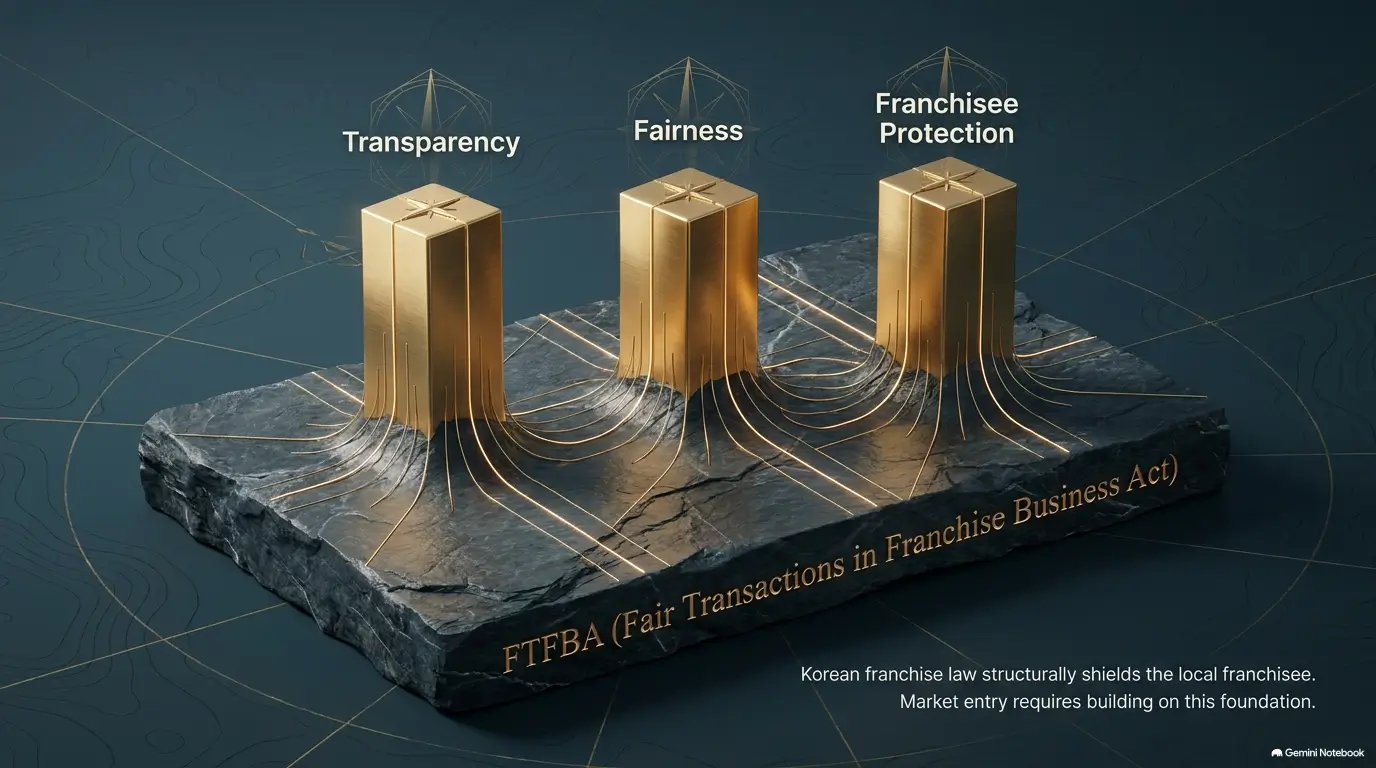
As of August 2026, the principal statute is the Fair Transactions in Franchise Business Act, commonly called the Franchise Business Act (가맹사업법). A further amendment is scheduled to take effect on December 31, 2026, principally strengthening rules concerning registered franchisee associations and regional franchise headquarters. The core individual-franchise rules discussed below are based on the law currently in force.
Table of Contents
First Check Whether the Full Franchise Act Applies to the Franchisor
Before relying on the territory or termination protections described later, check one easily overlooked issue: Korean law has an exclusion for certain very small franchisors.
Under the rules in force in August 2026, the exclusion can arise where the total franchise payments made during the first six months do not exceed KRW 1 million, or where the franchisor falls below the applicable annual-sales threshold. The general sales threshold is KRW 50 million. If the franchisor operated a directly owned store for at least one year before starting the franchise business, the relevant threshold is KRW 200 million. The sales-based exclusion does not apply where the franchisor has at least five franchisees.
This distinction matters because the statute expressly keeps certain protections applicable even to small franchisors, including important rules on disclosure registration, provision of disclosure documents, false or exaggerated information, return of certain franchise payments and deposit protection. Other provisions are not preserved by that exception in the same way.
That means you should not automatically assume that the statutory territory protection in Article 12-4 or the franchisor-termination procedure in Article 14 applies identically to every tiny franchise operation. If the brand is new, has few stores or reports unusually low sales, determine the franchisor’s status before treating those protections as guaranteed.
For an established chain this may be a five-minute issue. For a new Korean concept being sold aggressively to foreign entrepreneurs, it can change the legal analysis.
Start With the Disclosure Document, Contract and Territory Schedule
A franchise salesperson may describe the deal in one presentation. Korean law divides the important information across several documents. Review them together.
| Document | What to Extract | What Must Match |
|---|---|---|
| Registered information disclosure document | Franchisee payments, network information, restrictions, operating conditions and franchisor information | The economic burden described in the contract |
| Neighboring-franchisee document | Nearby existing franchise locations | Your site assumptions and territory risk |
| Franchise agreement | Payments, territory, term, transfer, termination and operating obligations | What you were actually promised |
| Schedules and annexes | Territory map, mandatory products, equipment, fees and special conditions | The main agreement and disclosure document |
The information disclosure document is called the jeongbo gonggaeseo (정보공개서). Do not treat a PDF emailed by a salesperson as sufficient merely because its title says “disclosure.” The important question is whether it is the registered disclosure document applicable to the brand and transaction.
You can use the Korea Fair Trade Commission’s franchise information disclosure system to check registered franchise information.
When the proposed store location has been determined, the franchisor must also provide information concerning nearby franchisees. The statutory document generally identifies the 10 franchisees closest to the proposed store within the relevant metropolitan city or province, or all of them if fewer than 10 operate there.
This document has practical value beyond legal compliance. It gives you a list of operators who may know whether delivery zones overlap, whether the franchisor has opened stores aggressively nearby and whether the actual operating costs resemble the sales presentation.
Do not ignore the Korean waiting period
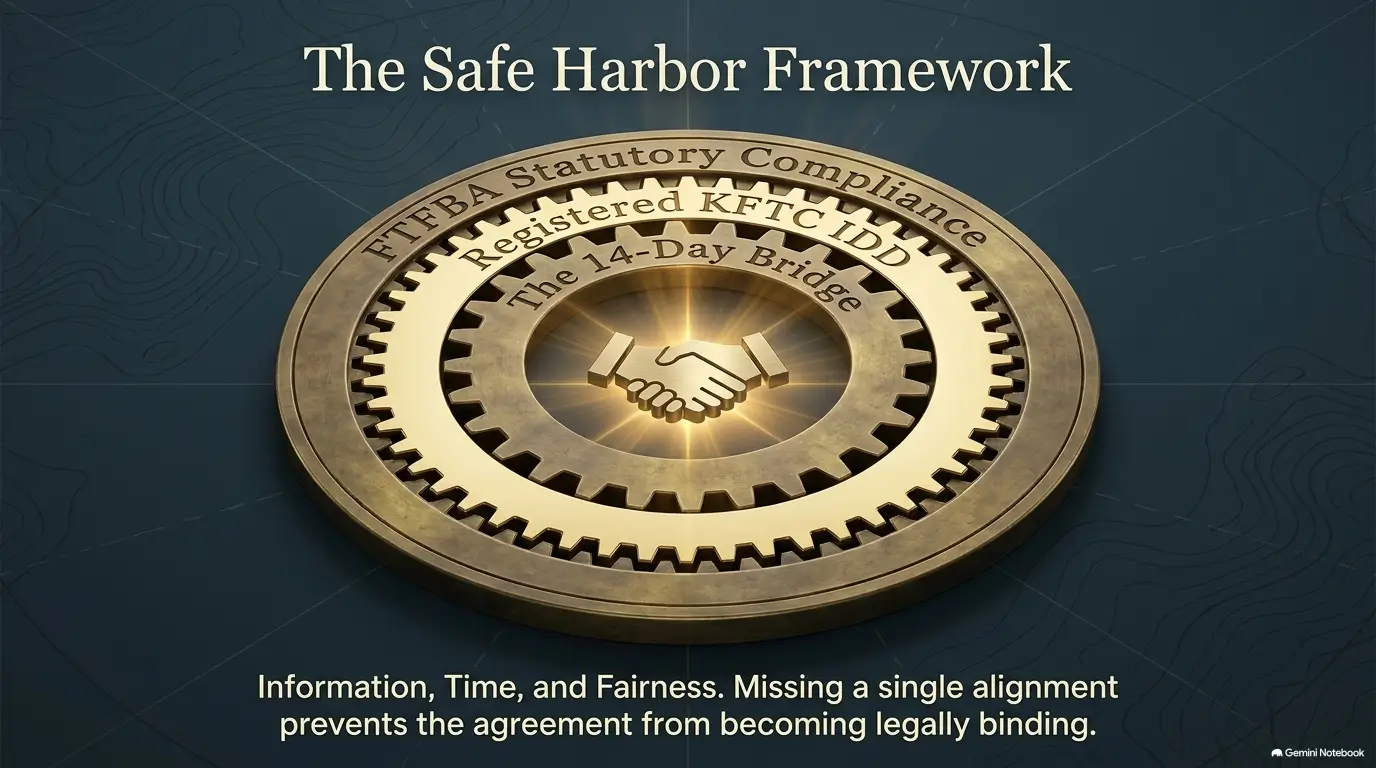
A franchisor generally cannot receive the relevant franchise payment or conclude the franchise agreement until 14 days have passed after providing the registered disclosure materials as required by law. The statutory period can be reduced to seven days where the prospective franchisee has obtained advice on the disclosure document from a lawyer or registered franchise trader (가맹거래사).
There is also a 14-day rule concerning advance provision of the franchise agreement itself, again reducible to seven days where the prospective franchisee obtains the specified professional advice on the agreement.
Do not interpret the seven-day option as a reason to accelerate a deal. Its purpose is not to turn professional review into an express lane to payment. Record the date on which each document was actually delivered and use the period to reconcile the documents.
Royalties: Calculate the Total Franchise Take, Not One Percentage
Korean franchise law does not provide one universal percentage that makes a royalty automatically reasonable or unreasonable. The Act instead regulates matters such as disclosure, contractual content, required payments and unfair practices.
A 3% royalty can therefore be more expensive than a 6% royalty if the first franchise also forces the franchisee to buy heavily marked-up products, use expensive designated services and contribute separately to advertising.
For review purposes, stop using “royalty” as shorthand for your entire payment burden. Build a payment map.
- Initial franchise or joining fee
- Fixed monthly royalty
- Percentage-of-sales royalty
- Minimum monthly royalty
- Mandatory product or ingredient purchases
- Equipment and fixture charges
- POS, software or platform fees
- Advertising and promotional contributions
- Training or retraining charges
- Store-renovation or branding costs
- Renewal fees
- Transfer or assignment fees
- Termination-related payments
The statutory definition of franchise payments is broader than the English word “royalty.” It can include payments made for the franchise right, trademark use, support, training and other consideration connected with obtaining or maintaining the franchise.
Read the royalty formula word by word
If the agreement states that the royalty is a percentage of sales, identify exactly what “sales” means.
- Gross sales or another sales measure?
- Before or after discounts?
- How are refunds treated?
- Are delivery-app transactions included?
- Are coupons funded by the franchisor treated differently from store-funded discounts?
- Does the calculation use POS records controlled by the franchisor?
- Is there a minimum payment even when sales fall?
- Is the quoted amount inclusive or exclusive of applicable tax?
A percentage without a defined denominator is not a complete price.
Mandatory purchasing can matter more than the stated royalty
Korea’s franchise rules now require particular attention where the franchisor compels the franchisee to transact with the franchisor or a designated party. The franchise agreement must address the relevant types of compulsory real estate, services, facilities, goods, raw materials and other specified items, together with the method used to calculate their supply prices.
This is especially important for restaurants, cafés, beauty businesses and retail concepts where the economic return to the franchisor may be embedded in ingredients, packaging, equipment or designated purchasing rather than expressed entirely as a royalty percentage.
If the contract says “purchase at prices designated by headquarters,” ask for the pricing mechanism. If it says the price can be changed, identify the trigger, notice period and whether any objective reference point exists.
| Charge | Your Review Question |
|---|---|
| Sales royalty | What sales figure is multiplied by the rate? |
| Fixed fee | Can it increase during the term? |
| Mandatory purchases | How is the supply price calculated? |
| Advertising | Is it separate from the royalty and how is the contribution determined? |
| Technology | Can the franchisor replace the system and pass through additional costs? |
| Remodeling | Who can require it, when, and who bears the cost? |
For comparison purposes, convert every recurring obligation into the same time period. A brand with a low headline royalty but high mandatory purchasing costs should not be compared with another brand by royalty percentage alone.
Territory: The Map Matters More Than the Word “Exclusive”
For franchises covered by the relevant provisions of the Franchise Business Act, the franchisor must establish the franchisee’s sales territory and state it in the franchise agreement.
During the franchise term, the franchisor generally may not, without good cause, open its own direct store or another franchise store of the same type of business within that protected territory. The rule also reaches the relevant stores of affiliated companies as provided by the Act.
This protection is stronger than a vague sales promise such as “we normally give each franchisee about one kilometer.” The contract should let you identify the protected area without asking the salesperson what they meant.
A useful territory clause answers six questions
- Where does the territory begin and end? Prefer a map, defined boundary or unambiguous geographic description.
- What business is protected? The legal restriction concerns the same type of business, not necessarily every business using a related brand.
- What channels are included? Check delivery, online orders, kiosks, pop-ups, shop-in-shop operations and institutional locations.
- Are special commercial zones carved out? Airports, hospitals, universities, department stores, stations or large retail complexes may appear in contractual exceptions.
- What happens if you relocate? Determine whether the protected territory travels with the store or must be renegotiated.
- What happens at renewal? A change to an existing territory during renewal is not simply a matter of the franchisor redrawing the map whenever it wishes.
The statute provides that where prescribed circumstances such as a significant change in the commercial district justify changing an existing sales territory at renewal, the franchisor must reach agreement with the franchisee.
That makes the renewal clause and territory clause inseparable. A franchisee can have an attractive territory today but weak protection against a substantially different commercial deal at the next renewal.
Delivery and online sales deserve their own sentence
A common foreign-reader assumption is that “exclusive territory” works like a blanket prohibition on all competing brand activity within a radius. Korean franchise territory law is more specific.
Do not assume that the statutory rule automatically resolves online sales, app-based delivery, a related concept using a different brand, a supermarket concession or another format. Those questions may depend on the definition of the same type of business, the actual customer market and the contract.
If delivery accounts for a material part of expected revenue, ask for a written explanation of delivery-zone allocation before signing. A physical-store radius can look generous on paper while two stores compete for almost the same app customers.
Territory disputes are not theoretical. The Korea Fair Trade Mediation Agency continues to publish franchise mediation matters involving alleged territory encroachment. Its dispute mediation system also provides a route for eligible franchise disputes when direct negotiation fails.
Exit Clauses: Separate Franchisor Termination From Your Own Early Exit
The most expensive misunderstanding in an exit clause is assuming that both parties have symmetrical cancellation rights.
They often do not.
Where the statutory termination protection applies, a franchisor seeking to terminate because of a franchisee breach must normally identify the breach, provide a cure period of at least two months and give written notice at least twice stating that the agreement will be terminated if the breach is not corrected.
The Act provides exceptions for circumstances where continuing the franchise relationship is difficult, so “two notices and two months” should not be treated as an absolute rule for every form of serious misconduct.
More importantly, that statutory protection limits termination by the franchisor. It does not create an equivalent general rule saying the franchisee may walk away on two months’ notice without financial consequences.
| Exit Event | Main Issue | What to Review |
|---|---|---|
| Franchisor terminates for breach | Statutory notice and cure protections may apply | Breach definition, cure process, immediate-termination exceptions |
| Franchisee leaves early | Contract becomes especially important | Notice, damages, fees, debranding, inventory and continuing obligations |
| Agreement expires | Renewal rules are separate from termination rules | Renewal window, refusal grounds, notice and term history |
| Franchisee sells the store | Transfer may avoid a pure termination | Consent, buyer qualifications, transfer fee and release of seller |
Build the exit cost before you calculate the entry cost
Before signing, search the agreement for every consequence triggered by termination, expiration or non-renewal.
- Early-termination payment or liquidated damages
- Unpaid royalties becoming immediately due
- Outstanding supplier invoices
- Return or destruction of manuals and confidential materials
- Removal of signs and trademarks
- Store restoration or rebranding costs
- Repurchase or non-repurchase of inventory
- Equipment return obligations
- Software or POS termination fees
- Confidentiality obligations after termination
- Post-termination competitive restrictions
- Personal guarantees that survive business closure
Then check the contracts sitting beside the franchise agreement. Closing the franchise does not automatically terminate a commercial lease, equipment lease, loan, personal guarantee or third-party service agreement.
A franchise that can be terminated for KRW 10 million but leaves the owner responsible for two years of rent is not a KRW 10 million exit.
A large termination penalty is not automatically valid or automatically void
Korean contract law permits parties to agree in advance on damages for non-performance. Under Article 398 of the Civil Act, however, a court may reduce an agreed amount of damages if it is unduly excessive. An agreed penalty is presumed to be liquidated damages under that provision.
Standard-form contract provisions can also be scrutinized under Korea’s Act on the Regulation of Terms and Conditions, including rules concerning unfair terms, excessive predetermined damages and clauses governing cancellation or termination.
This does not mean that a franchisee can ignore a contractual penalty because it feels high. Nor should you assume the amount written in the agreement will inevitably be enforced in full. The legal character of the clause, the circumstances, the actual loss and the drafting can matter.
If a substantial early-exit payment is one of the reasons you are hesitating to sign or one of the reasons you cannot leave an existing franchise, that is a sensible point for targeted Korean legal advice.
Renewal and Transfer Can Be Worth More Than a Lower Royalty
A profitable franchise acquires value only if the operator can keep it long enough or transfer that value to a buyer. For that reason, renewal and transfer clauses deserve the same attention as the headline royalty.
Under Article 13 of the Franchise Business Act, a franchisee may make a statutory renewal request during the period from 180 days to 90 days before expiration. Within the protected period, the franchisor generally may not reject the request without a valid statutory reason.
The statutory right to request renewal is limited, however. It may be exercised while the total franchise relationship, including the original term, does not exceed 10 years.
The 10-year rule does not mean that the franchisor must automatically grant ten years from day one. It concerns the statutory renewal-request protection. Nor does reaching ten years mean every possible contractual or fairness issue disappears. It means the Article 13 renewal right should no longer be treated as the same protective backstop.
A transfer clause may provide a cleaner exit than cancellation
Korean franchise agreements must address the transfer of the business. For an operator who later wants to leave, the ability to sell the store may be far more valuable than a favorable termination clause.
Ask:
- Does the franchisor have to approve the buyer?
- What qualifications can it require?
- Is there a transfer fee?
- Must the buyer complete new training?
- Can the franchisor require remodeling before approving the transfer?
- Does the seller receive a written release after transfer?
- Do personal guarantees end automatically or require separate release?
- Does the buyer receive a fresh franchise term or only the remainder of yours?
A franchise with a strong resale mechanism may be financially safer than a franchise with a slightly lower ongoing royalty but no practical transfer path.
Foreign Franchisees Should Check the Korean-Language Control Points
Foreign owners have one additional contract risk: believing that an English summary represents the legally operative deal.
If you receive Korean and English versions, check the governing-language clause. If the Korean version controls in the event of inconsistency, review the Korean operative text rather than polishing the English translation.
Pay particular attention to Korean terms for:
- Franchise payments: 가맹금
- Sales territory: 영업지역
- Termination or cancellation: 해지 / 해제
- Liquidated damages or penalty: 손해배상액의 예정 / 위약금
- Renewal: 갱신
- Transfer of business: 영업양도
- Joint or personal guarantee: 연대보증
The exact Korean wording matters because English translations sometimes collapse legally different ideas into the same word. “Termination,” for example, can obscure the distinction between ending an ongoing contract and rescinding a contract on a different legal basis.
Confirm who is actually contracting with you
Check the franchisor’s exact Korean legal entity, not only the brand name on the sign. The company licensing the trademark, supplying products and receiving payments should be identifiable from the documents.
If you are signing through a Korean corporation, also distinguish obligations of the company from any obligations you sign personally. A personal guarantee can turn a failed limited-liability business into a personal financial problem.
A franchise contract does not create immigration status
Foreign entrepreneurs should also keep franchise approval and immigration approval separate. Signing a Korean franchise agreement, investing capital or opening a store does not by itself establish eligibility for a particular Korean visa.
If the business is being acquired as part of an investment-based stay plan, review the Korea D-8 investor visa requirements independently before making a non-refundable franchise payment. The franchise contract and immigration case solve different problems.
Your 15-Minute Korean Franchise Contract Check
Before discussing price again with the franchisor, run this check using the registered disclosure document, franchise agreement and all schedules.
- 1. Record the delivery dates. Write down when you received the disclosure document and contract.
- 2. Confirm registration. Match the brand and franchisor against the KFTC disclosure system.
- 3. Check the small-franchisor gate. Do not assume every Franchise Act protection applies without checking.
- 4. List every payment. Separate initial fees, royalties, advertising, systems and mandatory purchasing.
- 5. Define the royalty base. Highlight the contract definition of sales used for the calculation.
- 6. Check mandatory supply pricing. Find the method used to calculate prices for compulsory goods or services.
- 7. Find the territory map. Do not accept a verbal radius.
- 8. Mark the territory exceptions. Look for delivery, online sales, special commercial zones and other formats.
- 9. Calculate the exit stack. Add termination payments, debranding, lease exposure, equipment and guarantees.
- 10. Calendar the renewal window. Record both the contract expiry date and the 180-to-90-day statutory period where applicable.
- 11. Test the transfer route. Determine how you could sell the business rather than close it.
- 12. Write unanswered questions down. Ask for written answers or contract amendments rather than relying on a sales conversation.
If one important promise appears only in KakaoTalk, email or a presentation, but not in the disclosure materials, contract or annexes, treat that as an unresolved issue rather than a completed promise.
When Is Professional Franchise Agreement Review Worth Paying For?
Not every Korean franchise contract requires full legal representation. The sensible level of help depends on what remains uncertain after you perform the document comparison yourself.
DIY may be enough
A self-review may be reasonable where the franchise is established, the disclosure document and agreement match, the territory is clearly mapped, there is no personal guarantee, the exit payment is modest and you understand the Korean operative text.
The Korea Fair Trade Commission also publishes industry-specific standard franchise agreement forms. These are recommended models rather than automatic replacements for your contract, but they can help identify provisions worth comparing.
One professional consultation may be enough
A targeted consultation can be good value where one issue dominates the decision: an unusual termination penalty, a vague territory carve-out, a mandatory-supplier pricing clause, a personal guarantee or an unclear transfer restriction.
A registered franchise trader can advise on franchise disclosure documents, franchise agreements, franchisor charges, profitability and certain franchise mediation matters. A Korean lawyer becomes more important where you need an enforceability opinion, contract negotiation, damages analysis, dispute strategy, litigation advice or review of obligations extending beyond franchise regulation.
Full legal help may be justified
More extensive representation becomes rational where substantial capital is exposed, the transaction includes a master or regional franchise, a foreign company is involved, personal guarantees are requested, multiple contracts are interdependent, a dispute has already begun or a threatened termination could shut down the business.
Before hiring anyone, ask for the scope in writing:
- Will you review both the disclosure document and contract?
- Will you compare the Korean and English versions?
- Will you review the territory map and annexes?
- Does the review include the lease or personal guarantee?
- Will you identify negotiable clauses and propose replacement wording?
- Will I receive a written issue list?
- How is the fee calculated, and are translation or other third-party costs separate?
The most useful review is not one that declares the entire agreement “safe.” It is one that identifies which clauses can materially change your cash flow, operating freedom or exit cost.
Korean Franchise Agreement FAQ
Does Korean law set a maximum franchise royalty?
There is no single nationwide royalty percentage that applies to all Korean franchises. Review the disclosed and contractual payment structure, including mandatory purchases and additional fees, rather than looking only for a legal percentage ceiling.
Can a Korean franchisor open another store near mine?
Where the relevant statutory protection applies, the franchisor must establish a sales territory and generally cannot open its own or another franchise store of the same type of business within that territory during the agreement without good cause. The actual boundary, business format and contractual exceptions still need to be checked.
Can I leave the franchise if the store is losing money?
Operating losses do not automatically create a cost-free statutory cancellation right. Review the franchisee termination clause, contractual damages, transfer provisions, lease obligations and any specific breach by the franchisor before deciding how to exit.
Can an excessive Korean franchise termination penalty be challenged?
Potentially. Korean law allows courts to reduce liquidated damages that are unduly excessive, and unfair standard-form terms can also face statutory scrutiny. Whether a particular clause can be reduced or invalidated depends on its wording and circumstances, so do not simply refuse payment based on the amount alone.
Does the 10-year renewal rule guarantee me a franchise for 10 years?
No. The rule concerns the period during which the statutory right to request renewal can be exercised. Renewal can still be refused for legally recognized reasons, and the details of the original term, renewal request and franchisee compliance matter.
Your Next 15 Minutes
Open the disclosure document, franchise agreement and territory schedule side by side. On one sheet of paper, write only three numbers or answers:
- Your real monthly franchise payment formula, including more than the headline royalty.
- Your exact protected territory, including every exception that could place another sales channel or store near you.
- Your realistic exit cost, including the franchise agreement, lease, equipment and personal guarantees.
If you cannot produce those three answers from the documents you have already received, do not solve the uncertainty with another sales meeting. Ask for the missing document, calculation or clause in writing first.
Last reviewed: 2026-10