
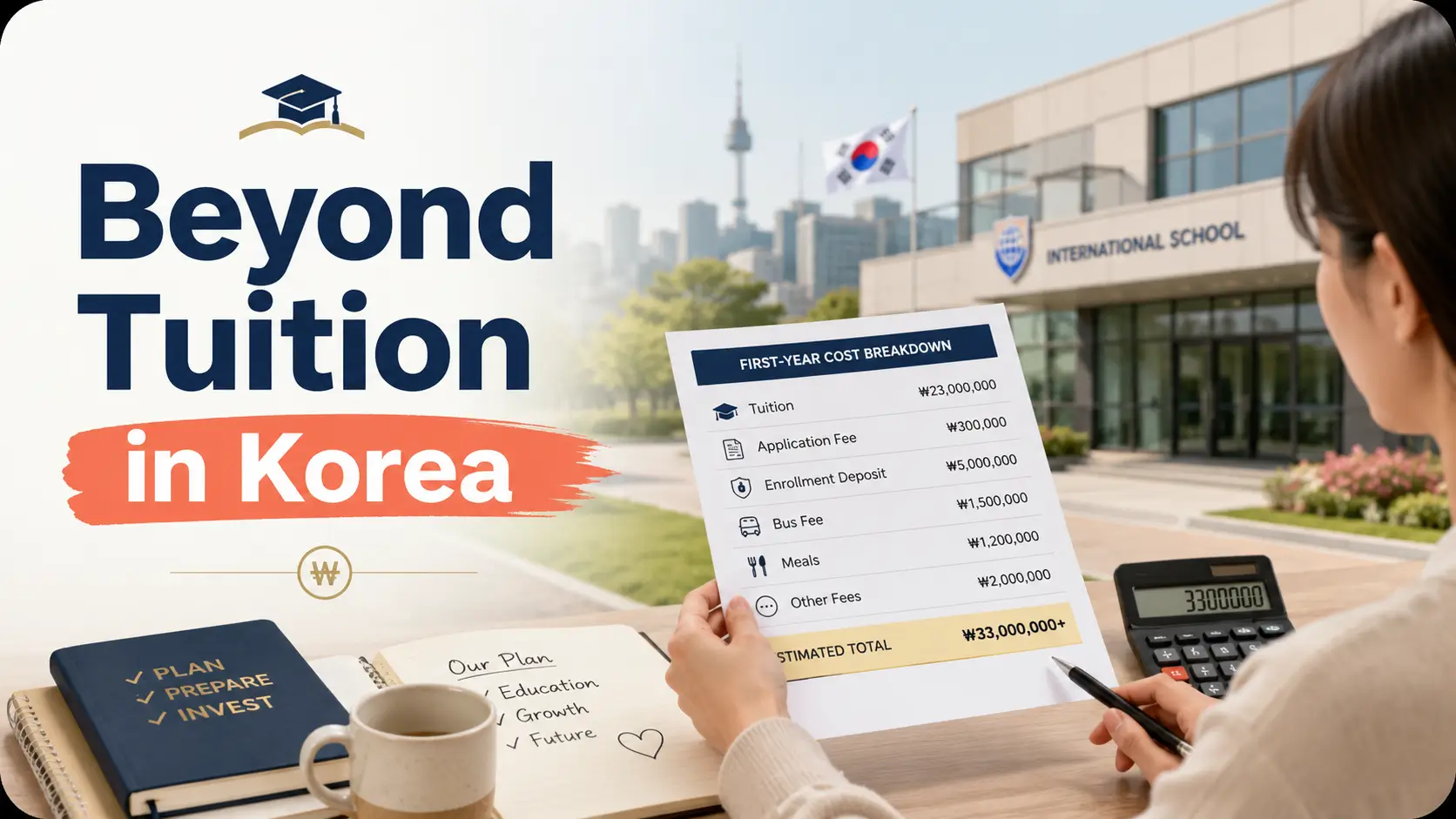
International school tuition in Korea is only the largest line on the bill, not the whole bill. For the 2026–27 school year, major Seoul-area schools publish separate charges for applications, registration or entrance, deposits, buses, meals, examinations, learning support and other services. Some schools also divide tuition between Korean won and U.S. dollars.
For a relocating family, the better question is therefore not simply, “What is the tuition?” It is: How much cash must we pay in the first year, which charges disappear after year one, which money can come back, and what happens if we leave Korea early?
The numbers below use published 2026–27 fee schedules from the schools themselves. Always open the linked official fee page again before transferring money because grade placement, bus routes, payment deadlines and school policies can change.
Table of Contents
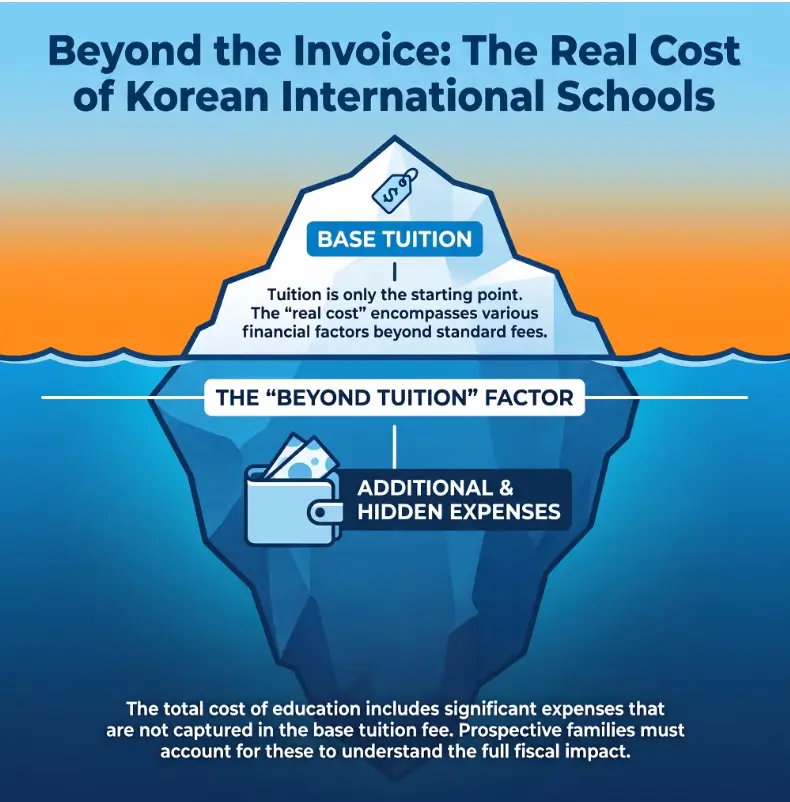
The Fast Answer: Build a First-Year Cost, Not a Tuition Comparison
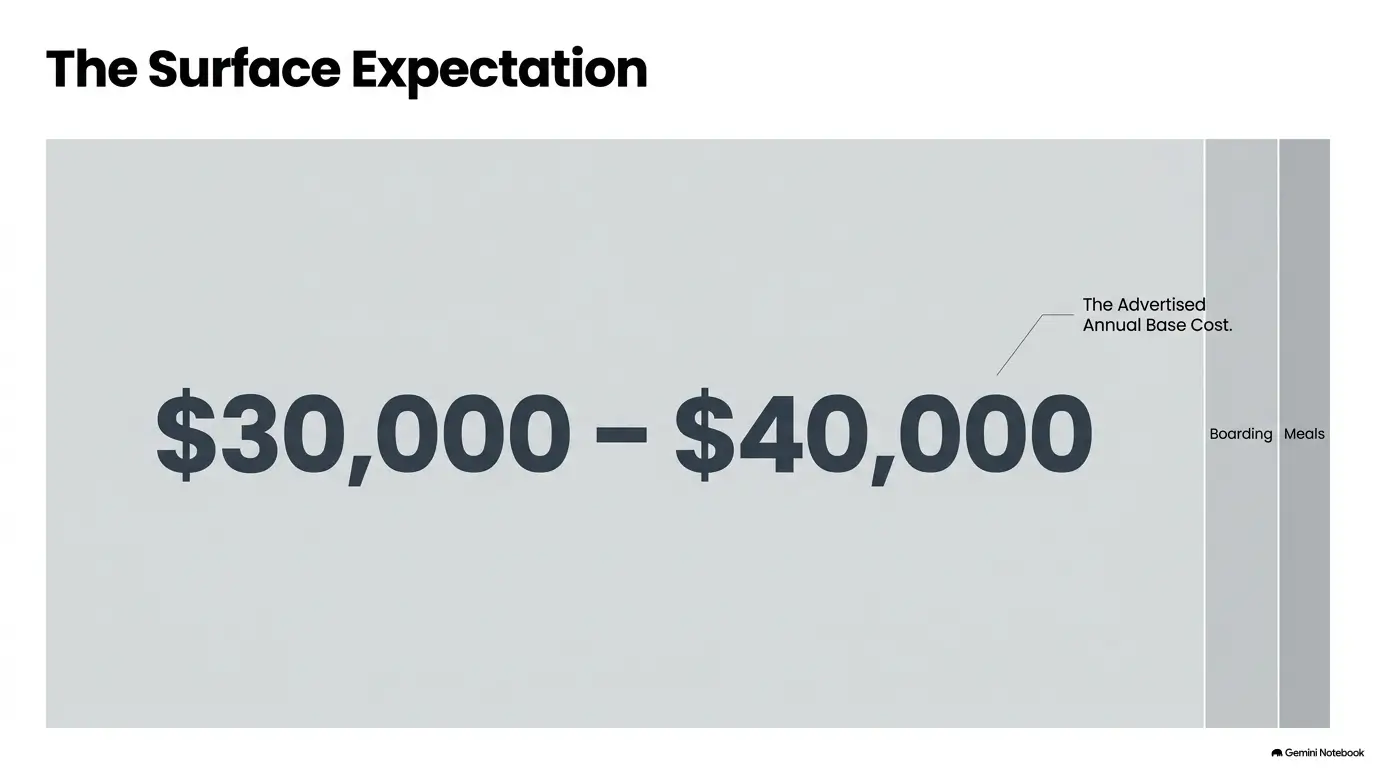
For the schools reviewed here, published annual round-trip bus charges alone range from about KRW 3 million to KRW 6.3 million. A new student can also face several million won in non-refundable entrance, registration or development charges before meals or optional activities are counted.
A useful first-year calculation is:
First-year cash requirement = tuition + non-refundable new-student charges + refundable deposits + transport + recurring extras + payment costs.
Keep the refundable items visible, but do not treat them as permanently spent. At the same time, do not ignore them merely because they may eventually come back. A KRW 3 million deposit still has to leave your bank account today.
2026–27 International School Fees: What the Official Schedules Show
The following comparison uses elementary-age tuition where possible so that the figures are reasonably comparable. Grade systems differ among American, British and IB schools, so use the table as a budgeting map rather than a school ranking.
| School | 2026–27 tuition example | New-student charges | Round-trip bus |
|---|---|---|---|
| Seoul Foreign School | K–Grade 5: KRW 27.285m + USD 13,500 | KRW 450,000 application + KRW 650,000 registration + KRW 5.5m entrance | KRW 4.2m |
| Seoul International School | Grades 1–5: KRW 22.88m + USD 8,140 | KRW 500,000 application + KRW 4m initial registration | KRW 3m |
| Korea International School, Pangyo | Grades K–5: KRW 21.95m + USD 10,780 | KRW 400,000 application + KRW 400,000 registration + KRW 4m entrance; KRW 200,000 refundable book deposit | KRW 3.25m or KRW 3.6m depending on route area |
| Dwight School Seoul | Kindergarten–Grade 12: KRW 36.334m | KRW 100,000 application + KRW 300,000 assessment + KRW 5m development fund; KRW 200,000 refundable library deposit | KRW 3.96m |
| Dulwich College Seoul | Years 1–6: KRW 43.05m annual fee | KRW 400,000 application + KRW 4m capital levy + KRW 3m placement deposit, subject to the school’s refund terms | KRW 5m |
| Chadwick International | Village School: KRW 28.59m + USD 16,230 | KRW 400,000 application + KRW 1m matriculation + KRW 5m capital development fee | KRW 6.3m |
One difference jumps out immediately: Seoul Foreign School, Seoul International School, KIS Pangyo and Chadwick publish tuition with both a KRW portion and a USD portion. That matters if your salary, savings or employer education allowance is denominated in only one currency.
Do not convert the USD component once and save that KRW figure permanently in your budget. Unless the school offers a fixed conversion mechanism, the effective won cost can move even when the published tuition itself has not changed.
Application Fees Can Become a Large Sunk Cost Before Admission
Application charges deserve attention because families often apply to several schools while waiting for admission decisions, grade availability or relocation confirmation.
Using the KRW application amount published by each school, applying to all six schools in the table would require KRW 2.25 million in application fees alone. Dwight also lists a separate KRW 300,000 assessment fee.
That money should be treated differently from tuition. At the schools above, application charges are generally identified as non-refundable. A rejection, waitlist placement or later decision to choose another school does not automatically turn the fee into refundable money.
Before submitting a paid application, confirm three things:
- whether your child is legally eligible for that type of school in Korea,
- whether the school is accepting applications for the relevant grade and year, and
- whether a seat is realistically available or the grade is already operating a waitlist.
Seoul Foreign School, for example, asks prospective families to inquire about availability before submitting the full paid application. That is a useful sequence to imitate even when another school uses a different admissions process.
Check the School’s Korean Legal Category Before You Pay
A foreign parent can easily assume that every institution marketed in English as an “international school” belongs to one legal category. Korea is more specific.
The Korean government’s International School Information service distinguishes foreign schools from foreign educational institutions and other categories. The distinction can change which Korean admission rules apply.
For a Korean-law foreign school (외국인학교), the government’s current guidance identifies eligible groups including foreign children, Korean nationals who have lived abroad for more than three years, and certain children of naturalized Korean citizens. Domestic students are generally limited to 30% of enrollment, although the ceiling may be increased to 50% under applicable local education rules.
For elementary and secondary foreign educational institutions established under the separate foreign-educational-institution framework, the government describes admission qualification differently, while also applying rules concerning the proportion of domestic students.
Eligibility to apply is not the same as admission. A school can still consider transcripts, recommendations, English proficiency, assessments, interviews, age placement, learning-support needs and available seats.
This is one of the places where a home-country assumption can become expensive. Having a foreign passport does not mean that every English-language private school in Korea must admit your child, and a Korean passport does not automatically make every international-school route unavailable.
Transport Can Add KRW 3 Million to KRW 6.3 Million a Year
For 2026–27, Seoul International School publishes a KRW 3 million optional bus fee. KIS Pangyo lists KRW 3.25 million for specified Bundang areas and KRW 3.6 million outside that radius. Dwight lists KRW 3.96 million, Seoul Foreign School KRW 4.2 million, Dulwich KRW 5 million and Chadwick KRW 6.3 million for its listed Seoul and Pangyo service.
The more important question is not simply the annual fee. It is whether the route works for your actual address.
Before signing a housing contract around a school, ask the transportation office for:
- the current pickup and drop-off area,
- estimated morning pickup time,
- estimated ride duration,
- whether a seat is currently available,
- late or activity-bus availability,
- one-way options,
- what happens if you move during the academic year, and
- the bus refund policy if your child withdraws.
Dulwich expressly notes that routes and stops depend on distance and bus availability. A published annual bus price is therefore not a promise that the school will create a convenient stop beside an apartment you have already rented.
For families relocating within the Seoul area, school choice and housing choice often become one decision. If you are also deciding how to structure your Korean rental, the site’s guide to wolse vs jeonse for foreigners can help separate the housing cash requirement from the school budget.
The Hidden Costs Are Usually in the Small Print, Not the Tuition Line
“Hidden cost” does not necessarily mean that a school concealed a charge. In most cases, the charge is published. The problem is that families compare tuition while the financially important details are scattered across admissions, transportation, payment and refund documents.
Meals
Dwight lists daily school meals at KRW 7,200 for Asian, Western or vegetarian meals and KRW 10,700 for halal meals. Chadwick publishes KRW 7,250 per meal for Pre-K through Grade 4 and KRW 8,350 for Grades 5 through 12. Dulwich states that school lunches are not included in its tuition.
A daily meal charge can look trivial next to a tuition bill measured in tens of millions of won. Multiplied over the school calendar, it becomes a separate annual budget line.
Examinations and senior-year charges
Dwight’s 2026–27 schedule lists KRW 1 million for Grade 10 MYP examination fees and KRW 1.5 million for Grade 12 Diploma examination registration and fees. Seoul Foreign School lists a KRW 450,000 Grade 12 senior fee and KRW 100,000 early-exam fee per examination. Seoul International School lists a KRW 300,000 senior fee and notes that AP fees vary by subject or test.
High-school families may also spend outside the school on optional test preparation. That cost should not be confused with tuition or required school fees. If it is relevant to your child, compare it separately using the guide to SAT prep hagwons in Korea.
Learning support
Learning support can change the comparison dramatically. Dwight lists its Full Quest Program at 50% of tuition and states that for a student offered admission conditional on Quest participation, the charge is not optional.
If your child may need academic, language or learning support, do not ask only whether the school “offers support.” Ask what assessment determines eligibility, whether the support can become a condition of admission, what it costs, and whether the fee continues every year.
Technology, uniforms and activities
Inclusions vary enough that a simple tuition comparison can become misleading. Chadwick identifies specified iPad or MacBook equipment by grade. Dulwich states that school uniforms are not included in tuition, while most extracurricular and CAS activities are included and Years 3 through 13 tuition includes an annual residential trip.
Chadwick states that its tuition includes field trips and Outdoor Education trips, while separate Global Programs have variable pricing. The correct comparison is therefore not “Which school has trips?” It is “Which compulsory or likely activities will generate another invoice?”
Translation and Document Costs Can Appear Before Enrollment
Foreign families can incur application costs even before assessment begins because documents may need to be translated or formally prepared.
Dwight states that school records and supporting documents not completed in English require an official English translation. Seoul Foreign School’s admissions requirements also specify translation and notarization requirements for certain birth-certificate documentation.
Do not invent a blanket translation budget. The cost depends on the document, language, number of pages and whether notarization or another formal step is required. Instead, send the admissions office a list of the documents you already have and ask which versions are acceptable before ordering translations.
This prevents a particularly irritating form of relocation waste: paying to translate a document that the school would have accepted in another format.
Payment Method Can Create Another Layer of Cost
Do not assume a large tuition bill can be paid by international credit card simply because the admissions application was completed online.
KIS issues separate individualized account information for KRW and USD payments. Dwight’s published 2026–27 payment instructions require bank transfer, state that tuition is paid in Korean won, and place bank fees, charges and clearing costs on the parent. Chadwick’s application instructions also state that the sender is responsible for the wire-transfer fee when paying the application fee.
Before moving money, ask the finance office:
- which currency must be sent to which account,
- whether the receiving account is student-specific,
- whether intermediary and receiving-bank fees must be added,
- whether the school must receive the full invoiced amount net of bank charges,
- whether installment plans have a fee or interest charge, and
- what evidence of payment should be retained.
If you will be living in Korea and need local banking for tuition and household payments, see the practical guide to opening a Korean bank account as a foreigner.
Installments are not automatically free. Seoul International School lists a KRW 500,000 installment fee for its three-payment option and KRW 750,000 for its five-payment option. Dwight’s 2026–27 schedule states that approved installment payments may carry 2% installment interest.
KIS also publishes late-payment charges that increase according to how long the balance remains overdue. This is a good example of why the payment calendar belongs in the cost comparison, not in a folder you open after enrollment.
Do Not Double-Count Deposits That Are Credited Toward Tuition
School terminology can make a spreadsheet surprisingly treacherous. An “enrollment fee,” “deposit,” “registration fee” and “placement deposit” do not necessarily perform the same financial job.
For example, Dwight requires a KRW 3 million enrollment deposit for newly admitted students, but its published schedule states that this amount is applied to 2026–27 tuition. Adding both full tuition and that deposit as separate permanent costs would therefore double-count part of the tuition.
By contrast, Seoul International School’s KRW 4 million initial registration fee is listed separately from tuition and is non-refundable. Dulwich’s capital levy and placement deposit have their own refund conditions.
| Charge type | What to ask | Budget treatment |
|---|---|---|
| Non-refundable application fee | Is any part returned if admission is denied? | Treat as sunk cost once paid |
| Entrance or development fee | Is it separate from tuition? | Add if it is genuinely additional |
| Deposit credited to tuition | Does it reduce the later tuition balance? | Track cash timing, but do not double-count |
| Refundable deposit | What conditions and deadlines control the refund? | Include in first-year cash, separate from permanent cost |
That single distinction can remove several million won of spreadsheet error.
Three First-Year Examples Show What Tuition Alone Misses
The examples below are illustrative calculations using the schools’ published 2026–27 fees. USD components remain in USD because converting them at a temporary exchange rate would create false precision.
Example scenario: Seoul Foreign School, Kindergarten to Grade 5
Published tuition is KRW 27.285 million plus USD 13,500. Add the KRW 450,000 application fee, KRW 650,000 registration fee, KRW 5.5 million entrance fee and KRW 4.2 million annual round-trip bus fee.
Illustrative first-year amount before meals and other personal costs: KRW 38.085 million plus USD 13,500.
Example scenario: Dwight, Kindergarten to Grade 5
Begin with KRW 36.334 million tuition. Add KRW 100,000 application, KRW 300,000 assessment, KRW 5 million new-student development fund, KRW 200,000 refundable library deposit, KRW 35,000 annual Parents’ Association fee and KRW 3.96 million round-trip bus.
Illustrative first-year cash requirement before meals and optional items: KRW 45.929 million.
The KRW 200,000 library deposit is potentially refundable, so this amount is a cash requirement, not a statement that every won becomes a permanent cost. The KRW 3 million enrollment deposit that Dwight applies toward tuition is not added again.
Example scenario: Dulwich, Years 1 to 6
Published annual tuition is KRW 43.05 million. Add the KRW 400,000 application fee, KRW 4 million capital levy, KRW 3 million placement deposit and KRW 5 million round-trip bus fee.
Illustrative first-year cash requirement before lunch, uniforms and personal expenses: KRW 55.45 million.
Dulwich describes the capital levy and placement deposit as subject to refund terms. The placement deposit is not refundable if the family cancels admission after accepting the place. Read the current enrollment terms before treating either amount as money that will certainly return.
Withdrawal Rules Can Matter More Than a Small Tuition Difference
International families are unusually exposed to midyear moves. An employer may relocate a parent, a visa situation may change, or the family may return home earlier than planned.
That makes the withdrawal schedule a financial term, not administrative fine print.
KIS Pangyo’s 2026–27 schedule provides different tuition and bus refunds depending on the withdrawal period. The published tuition refund falls from 90% before the school year’s opening period to 65%, 40% and 25% as the year progresses, with no scheduled tuition refund in the final listed period beginning March 15, 2027.
Dwight also publishes a declining refund schedule, eventually reaching no refund in its final listed period beginning April 3, 2027. Chadwick and Seoul International School use their own late-entry and withdrawal schedules.
These are school contract policies. They are not one universal Korean refund formula that applies identically to every international school.
If there is a realistic chance your Korea assignment will end early, compare schools using the date at which your family might actually leave. A KRW 2 million tuition difference can matter less than a much larger difference in recoverable tuition.
Your 12-Number Check Before Accepting a School Place
Once an offer arrives, open the current invoice or official fee schedule and fill in these twelve lines before transferring money:
- 1. Tuition in KRW
- 2. Tuition in USD or another currency
- 3. Application and assessment fees already spent
- 4. Non-refundable registration, entrance, matriculation or development fees
- 5. Refundable deposits
- 6. Deposits that are credited toward tuition
- 7. Round-trip or one-way bus cost
- 8. Meal cost
- 9. Required examination, technology, uniform or learning-support charges
- 10. Installment interest, installment fees or bank charges
- 11. Payment deadlines and late charges
- 12. Refund percentage at your family’s most plausible withdrawal date
If an employer provides an education allowance, run the same list through the employer’s policy. “International school tuition covered” does not necessarily tell you whether the company reimburses buses, meals, deposits, development funds, application fees, USD components or bank charges.
A Lower-Tuition School Can Still Cost Your Family More
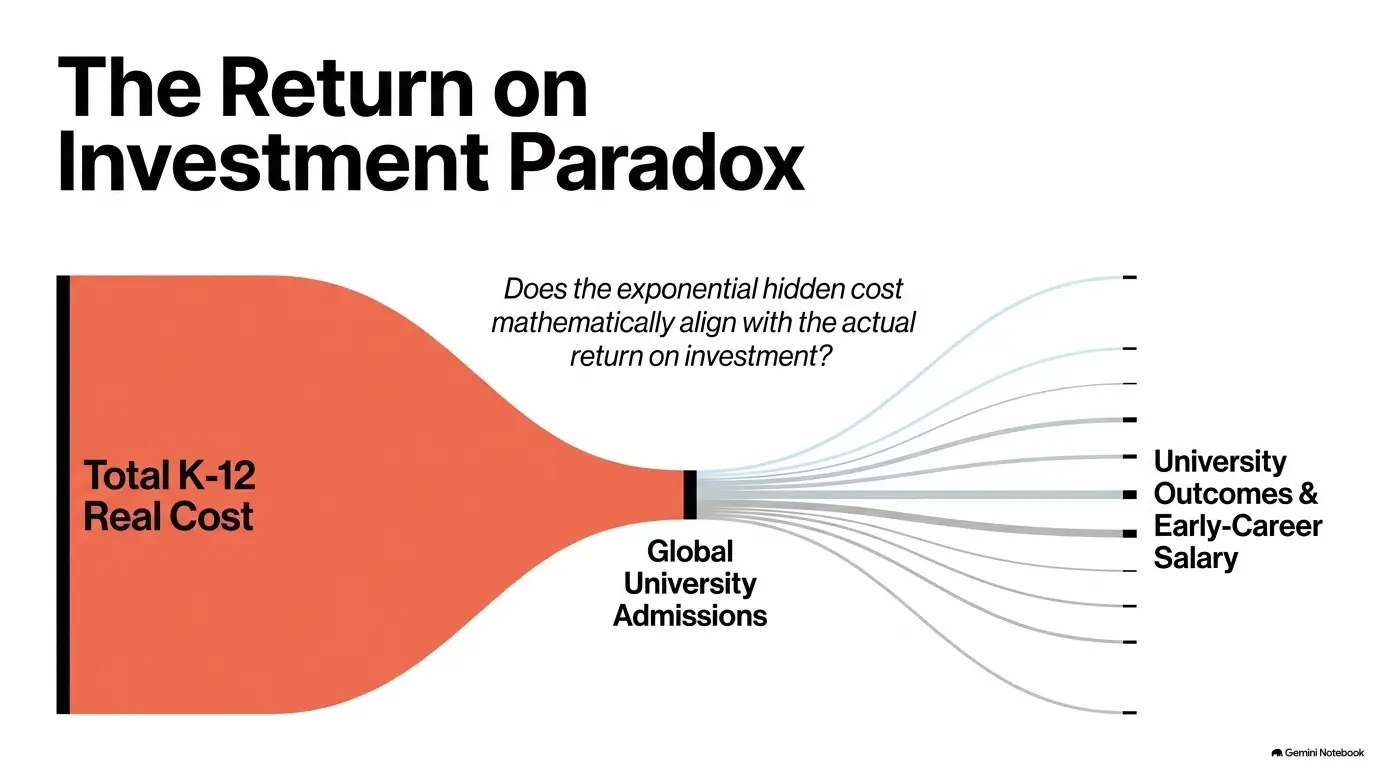
A school that is KRW 4 million cheaper on paper may require a KRW 5 million bus, a longer commute and a housing location that raises your rent. Another school may publish higher tuition but include activities, trips or examinations that appear as separate costs elsewhere.
For a relocating family, compare four totals rather than one:
- school cash cost,
- housing effect,
- commuting effect, and
- early-withdrawal exposure.
This turns an attractive tuition figure into a household decision. That is the number you actually have to live with.
International School Tuition in Korea FAQ
Can I pay every international school fee entirely in Korean won?
Is an enrollment deposit always an extra fee?
Can a family starting halfway through the year simply pay half tuition?
Does paying the application fee mean my child’s place is secured?
Your Next 15 Minutes
Put your top three schools into three spreadsheet columns. Add five rows first: tuition by currency, non-refundable new-student charges, refundable cash, transport and expected recurring extras.
Then add one final row called “What we lose if we leave Korea early.” Open each school’s current refund schedule and enter the amount that would remain unrecoverable at the month when your family’s relocation risk is highest.
That calculation is far more useful than deciding that one school is “cheaper” because its tuition headline happens to be smaller.
Last reviewed: 2026-10