
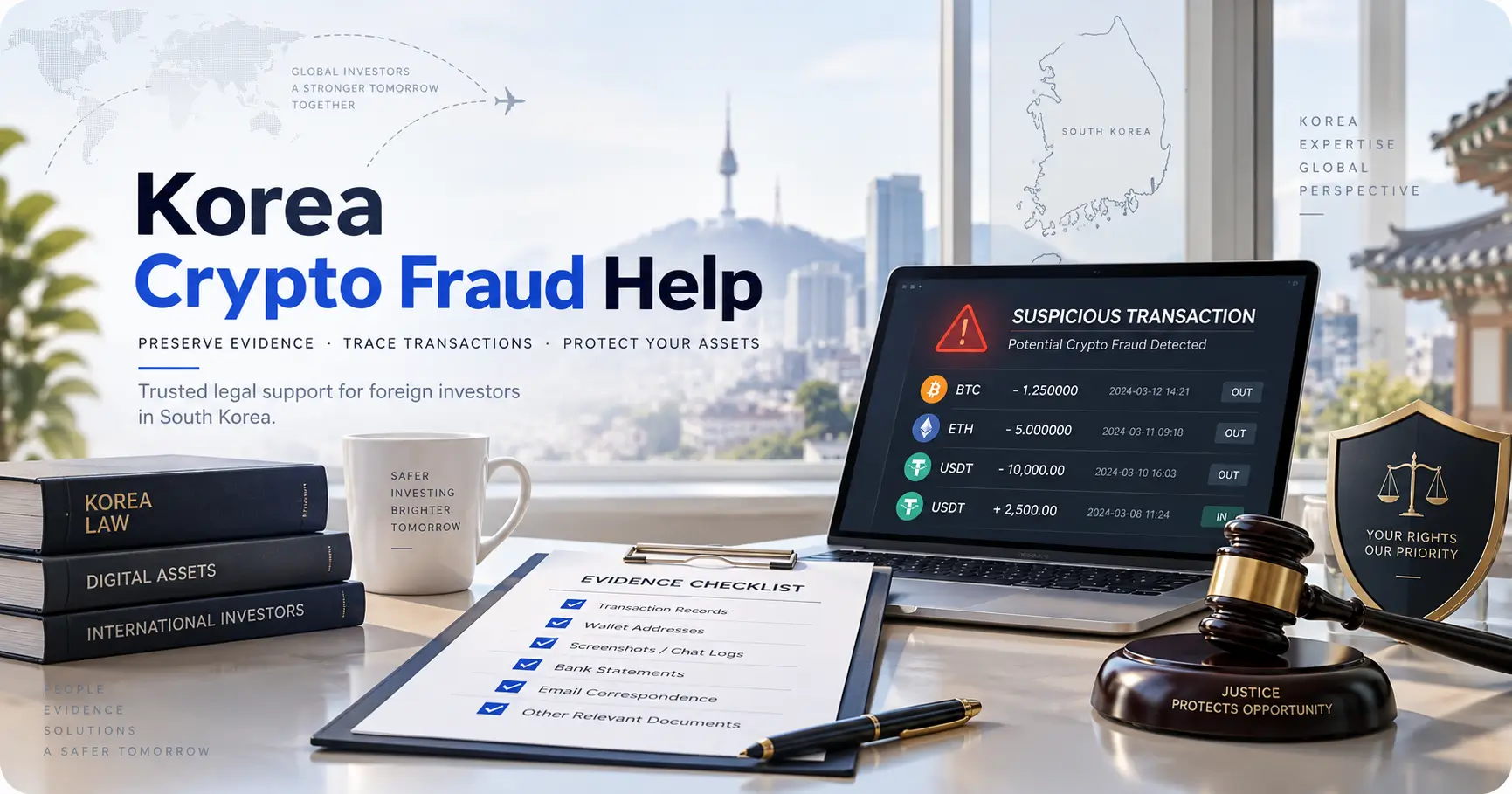
If you are looking for a Korea cryptocurrency fraud lawyer for foreign investors, start with a Korean-qualified attorney who can assess both the alleged fraud and the practical route to recovering assets. English-language service matters, but so do experience with victim complaints, urgent asset-preservation applications, and cross-border evidence.
First, stop sending money, preserve your transaction records, and contact the bank or exchange you actually used through its independently verified support channel. Ask what fraud-response and record-preservation steps are available. Do not wait until you have selected a lawyer to report an ongoing loss.
This guide concerns South Korea and is written for overseas investors, including US and UK residents. It explains how to evaluate legal help; it does not determine whether a particular loss is recoverable. A Korean-looking website, Korean phone number, or claimed Seoul office does not by itself establish where the operator or assets are located.
Table of Contents
Establish the Korean connection before paying a retainer
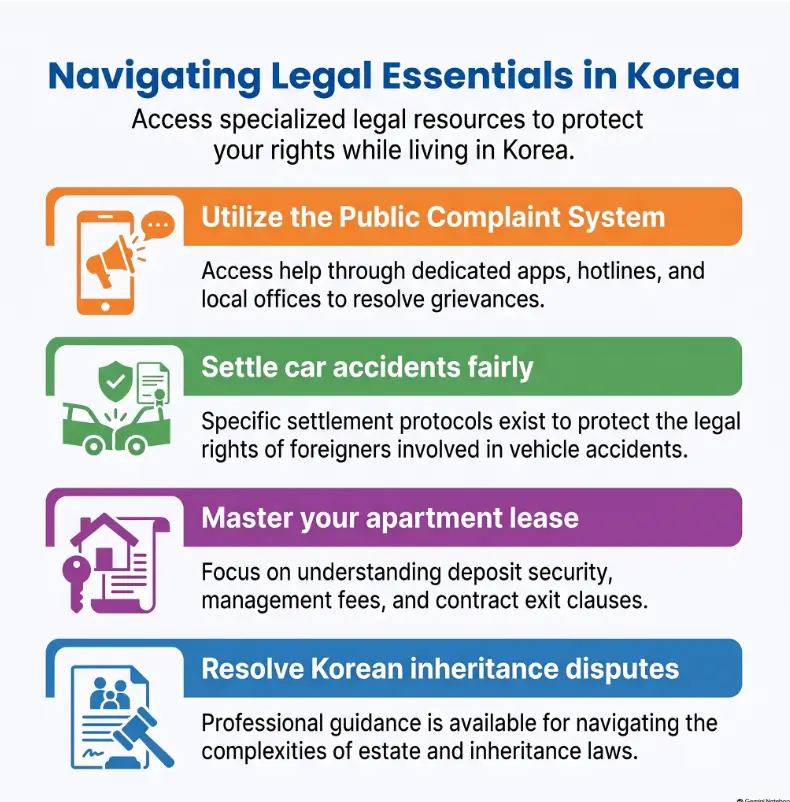
Your first consultation should answer a concrete question: What can this lawyer realistically do in Korea? Supply evidence of any Korean company, individual, bank account, exchange account, contractual counterparty, or asset connected to the transaction. Separate independently verified facts from claims made by the person who solicited your investment.
Ask counsel to explain jurisdiction, the likely defendant, and where any eventual order would need to be enforced. A payment passing through an exchange does not, by itself, establish that the exchange committed fraud or owes you compensation.
Hypothetical example: an investor in London sends USDT to a platform advertising a Seoul headquarters. The only supporting evidence is an address copied onto its website. Before financing Korean litigation, the investor needs an assessment of whether the operator, recipient account, or reachable assets genuinely connect the dispute to Korea. The advertisement alone cannot answer that question.
Preserve evidence that connects the promise to the payment
A useful evidence file shows what was represented, why you transferred assets, where they went, and what happened afterward. The FBI’s cryptocurrency reporting guidance specifically requests addresses, transaction hashes, token amounts and types, dates, and communication details.
- Transfer records: transaction hashes, sending and receiving addresses, blockchain network, token, amount, timestamp and time zone, plus exchange withdrawal records.
- Payment ownership: bank statements and account records connecting you to the funds. Keep actual payments separate from profits displayed on the suspect platform.
- Representations: original messages, emails, advertisements, agreements, promised returns, and statements about withdrawals or licensing.
- Identity clues: usernames, phone numbers, email addresses, domains, company names, and any documents supplied by the operator.
- After the transfer: withdrawal attempts, additional payment demands, support responses, and existing complaint reference numbers.
Keep original files and complete conversations where possible. Add a short chronological summary, but do not replace the originals with an edited narrative. Label translations and retain the source-language material. Record the blockchain network: a token name alone may not identify the relevant transaction.
Never include a seed phrase, private key, password, or authentication code in a consultation packet. A transaction hash identifies a transfer; a private key can give someone control over assets.
Separate reporting, asset preservation, and recovery
Ask for a plan that distinguishes these tasks. A police report documents suspected crime. An asset-preservation measure aims to protect a potential source of payment. Recovery requires a lawful route for returning or collecting assets. Completing one task does not establish that the others have happened.
Reporting suspected fraud
Korean police provide the Electronic Cybercrime Report & Management system, or ECRM. Its guidance generally requires a police-station appearance and statement after online submission, with a limited exception for certain multiple-victim cases. Investigators may still request attendance.
If you are abroad, ask counsel and the receiving police office how your complaint and statement should be submitted. Do not assume an online form completes the process or that appointing a lawyer removes every attendance requirement. ECRM also distinguishes the victim’s online reporting route from procedures for representatives.
Preserving assets before they disappear
Ask whether provisional attachment, known as 가압류 in Korean, is appropriate. Articles 276–280 of the Civil Execution Act in KLRI’s English translation address provisional seizure for monetary claims, the need to preserve enforcement, supporting grounds, and possible court-required security.
This is a court process, not a service a tracing company can promise to activate. Ask which identifiable asset or claim the proposed application would target, what evidence supports it, and what security or expenses may be needed. Counsel should confirm the current Korean text and the procedure applicable to the particular asset.
Obtaining and collecting compensation
Korean police guidance describes a compensation-order procedure for qualifying criminal cases, including fraud. Ask whether your loss is suitable for that route or requires a separate civil claim. Neither a conviction nor a compensation request guarantees that assets will be available for payment. See the compensation-order explanation on the ECRM reporting page.
Before authorizing a lawsuit, request an assessment of collection prospects alongside legal merits. Ask counsel to identify relevant deadlines immediately and explain whether any proposed filing preserves your civil rights; do not assume the criminal investigation answers that question.
Understand what Korea’s crypto protections cover
The Virtual Asset User Protection Act took effect on July 19, 2024. The Financial Services Commission’s implementation announcement describes protections for user deposits and virtual assets, regulation of unfair trading, and supervisory powers over virtual asset service providers.
The FSC expressly warns that the law does not guarantee the safety of virtual assets. Its announcement also distinguishes suspicious trading reports to the Financial Supervisory Service from suspected fraudulent schemes, which should be reported to investigative authorities.
For your consultation, describe the conduct precisely: a fabricated investment platform, false statements inducing payment, unauthorized transfers, suspected market manipulation, or a withdrawal dispute. Ask which rules applied when it happened and which claims the evidence supports. A fall in token value alone does not establish fraud, and an operator’s claim to be “regulated” is not a repayment guarantee.
How to evaluate an English-speaking Korean lawyer
Begin with the individual attorney’s identity. The Korean Bar Association website provides lawyer-search and disciplinary-information services. Check the Korean name and office details independently, then contact the office using details you verified yourself. A genuine lawyer’s identity can still be copied by an impersonator.
Confirm who will give Korean-law advice, who will handle filings, and who will communicate with you in English. A polished international website is not a substitute for identifying the responsible attorney.
- Relevant experience: ask about representing fraud victims, handling digital-asset evidence, and pursuing asset preservation or collection. Token-launch advisory work is a different task.
- Initial deliverable: request a written assessment of the Korean connection, missing evidence, urgent options, and likely next stage.
- Tracing: ask whether outside analysts are needed, what their report would establish, and how it would support a specific legal step.
- Communication: agree on the English-speaking contact, update schedule, translation arrangements, and approval process for additional spending.
- Conflicts: identify relevant exchanges, promoters, companies, and other parties so the firm can check whether it can act.
A useful answer acknowledges missing facts. Be cautious when someone quotes a recovery percentage before reviewing the transaction records, identifying the recipient, or assessing reachable assets.
Ask for a staged fee proposal
There is no verified case-specific price in this guide. Request a written quote that separates the initial assessment, criminal complaint work, urgent applications, civil proceedings, and collection. Ask what happens if the initial review finds no useful Korean connection.
The proposal should identify the billing currency and whether taxes, translation, court charges, external tracing, overseas service, and travel are included. Court-required security should be identified separately from the lawyer’s fee. Require approval before major additional costs.
If any outcome-based payment is proposed, ask counsel to explain its legal permissibility for the exact work involved and define its trigger. Do not accept a vague “success” clause spanning criminal representation and civil recovery.
The sensible spending question is: what will the next paid stage establish or preserve? A limited assessment may be worthwhile even when full litigation is not. Conversely, identifiable assets at risk may justify urgent advice before a lengthy investigation is complete.
Coordinate reports from the US or UK
US investors can submit cryptocurrency scam information through the FBI’s Internet Crime Complaint Center. UK readers can use Report Fraud; its guidance directs people living in Scotland to report through 101. These reports do not establish that a Korean complaint or court application has been filed.
Keep one consistent chronology and share relevant reference numbers with your lawyers and investigators. If more than one legal team is involved, agree who handles Korean proceedings, home-country reporting, exchange contact, and any overseas enforcement assessment.
Before signing overseas, ask the Korean firm which identification, authorization, translation, notarization, or apostille requirements actually apply. Avoid paying to authenticate an entire evidence bundle without instructions. Also ask whether interviews or hearings could require your participation and how those arrangements would be confirmed.
Avoid a second loss to a recovery scam
The FBI warns about cryptocurrency recovery services, especially those charging upfront fees. A legitimate attorney may charge a retainer, so the fee alone is not the test. Verify identity, the engagement terms, and the work being purchased.
Stop and independently check any demand to pay “release tax,” send more crypto to unlock recovered funds, disclose wallet secrets, or install remote-access software. A tracing report is not proof that its author controls the assets or has authority to return them.
Your first legal consultation should leave you with four clear answers: what connects the case to Korea, what evidence is missing, what can be done urgently, and what the next stage costs. Choose counsel who can explain those answers without promising a result that the evidence cannot support.