

A U.S. citizen can become a Korean tax resident even while remaining fully subject to U.S. tax filing rules. For Korean tax purposes, the key questions are whether you have a domicile in Korea or maintain a place of residence in Korea for at least 183 days. The 183 days do not necessarily have to be consecutive, and your job, family, housing, and other living arrangements can sometimes make you a Korean resident before you reach a simple day-count threshold.
That makes the Korea tax residency test more nuanced than “stay six months and you become taxable.” U.S. citizens also face a second layer because the United States generally continues taxing its citizens on worldwide income regardless of where they live.
This guide explains the Korean residency test, what happens when you qualify as a resident, how the U.S.-Korea income tax treaty fits into the picture, and why becoming a Korean tax resident does not mean your U.S. filing obligations disappear.
Table of Contents
The Short Version: Are You a Korean Tax Resident?
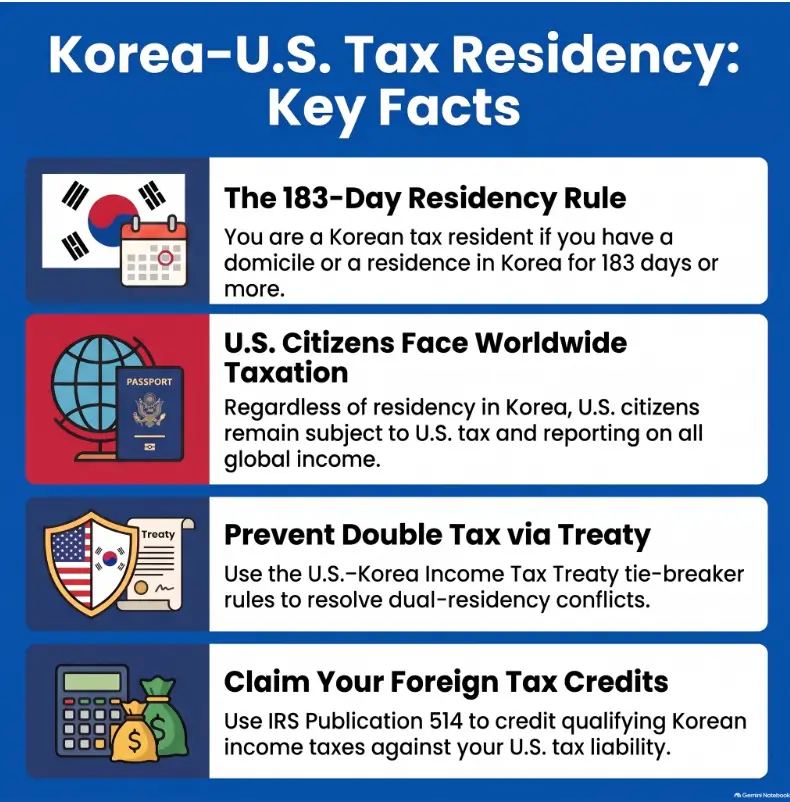
Under Korean income tax rules, an individual generally qualifies as a resident if the person has either a domicile in Korea or a place of residence in Korea for 183 days or more.
The first part is easy to overlook. You do not necessarily need to wait until day 183 if the facts already establish that Korea is your domicile for Korean tax purposes.
- You may be treated as having a Korean domicile if your occupation normally requires you to live in Korea continuously for at least 183 days.
- You may also be treated as having a domicile if family members live with you in Korea and your occupation and assets indicate that you are likely to remain for at least 183 days.
- If you do not have a Korean domicile, accumulating at least 183 days with a place of residence in Korea during the relevant tax period can independently produce resident status.
U.S. citizenship is not an exception to these rules. Korea applies its own residence test when determining whether an American living in Korea is a Korean resident or nonresident for income tax purposes.
The 183-Day Rule Is Not Simply a Six-Month Visa Rule
Immigration status and tax residency are related facts, but they are not the same legal test. A visa may determine how long you are allowed to remain in Korea. It does not, by itself, determine whether you are a resident for Korean income tax purposes.
The Korean National Tax Service states that a person can have a place of residence in Korea for 183 days during one taxable period without those 183 days being consecutive.
For purposes of calculating a period of residence, the period generally runs from the day after entry into Korea through the day of departure. Certain temporary absences can also require closer examination. For example, an absence that is clearly temporary in light of family residence, assets, or the purpose of travel may not necessarily break the underlying Korean residence relationship.
This is one reason frequent travelers should avoid using passport stamps as their only tax-residency test. A spreadsheet of arrival and departure dates is useful, but it does not replace the domicile analysis.
Readers with a location-independent job may also want to compare these rules with the site’s guide to Korea tax residency for digital nomads.
Korean Domicile Can Matter Before Day 183
The Korean concept of domicile focuses on objective living relationships rather than a taxpayer simply declaring, “My real home is still in America.”
Relevant Korean facts can include whether you live with family in Korea, whether your employment requires a long Korean stay, and whether your assets and circumstances indicate an ongoing life in Korea.
Consider two simplified examples.
Example 1: A one-year Seoul employment contract
An American moves to Seoul in February under an employment contract that is expected to keep the employee in Korea for a full year. The person rents an apartment and works primarily from a Korean office.
It would be risky to assume that Korean residency can begin only after the physical day count reaches 183. An occupation requiring residence in Korea for at least 183 days is specifically relevant to the Korean domicile rules.
Example 2: Repeated shorter stays
Another American spends several separate periods in Korea during the same tax year while maintaining accommodation here. No single stay lasts 183 days.
That does not automatically prevent resident status. The accumulated residence period and the broader domicile facts still need to be considered.
What Changes If Korea Treats You as a Resident?
The distinction matters because Korean residents generally face a broader Korean income-tax base than nonresidents.
A Korean nonresident is generally taxed by Korea on Korean-source income. A resident can potentially fall within Korea’s rules for income from both Korean and foreign sources.
However, there is an important rule for foreign nationals who have lived in Korea for a relatively short period.
The five-out-of-ten-year rule for foreign residents
A foreign resident whose aggregate period of having a domicile or place of residence in Korea is five years or less during the preceding ten-year period can receive different treatment for certain foreign-source income. In general, foreign-source income falling within this rule is taxable in Korea when it is paid in Korea or remitted to Korea.
This distinction can be particularly important for Americans with U.S. investments, foreign brokerage accounts, rental income, consulting businesses, pensions, or other assets outside Korea.
Do not reduce this rule to “foreign income is tax-free for five years.” The nature of the income, where it is sourced, whether it is paid or remitted into Korea, and your residence history all matter.
Americans moving money between countries can also review the related discussion of Korea remittance and tax issues for expats.
Being a Korean Tax Resident Does Not End U.S. Tax Filing
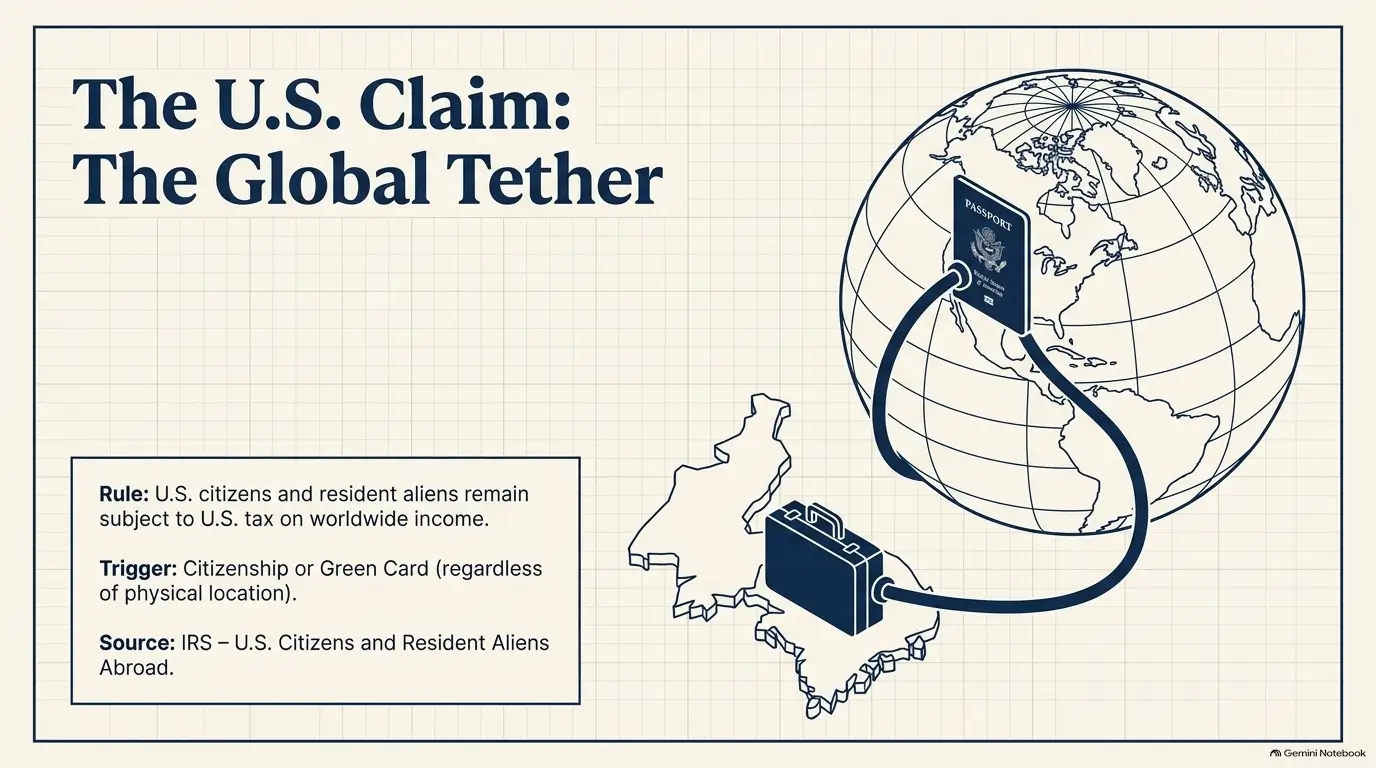
This is the part that surprises many Americans. The United States generally taxes U.S. citizens on worldwide income even when they permanently live abroad.
So an American living in Seoul might simultaneously have Korean income-tax obligations and continue filing a U.S. federal income-tax return.
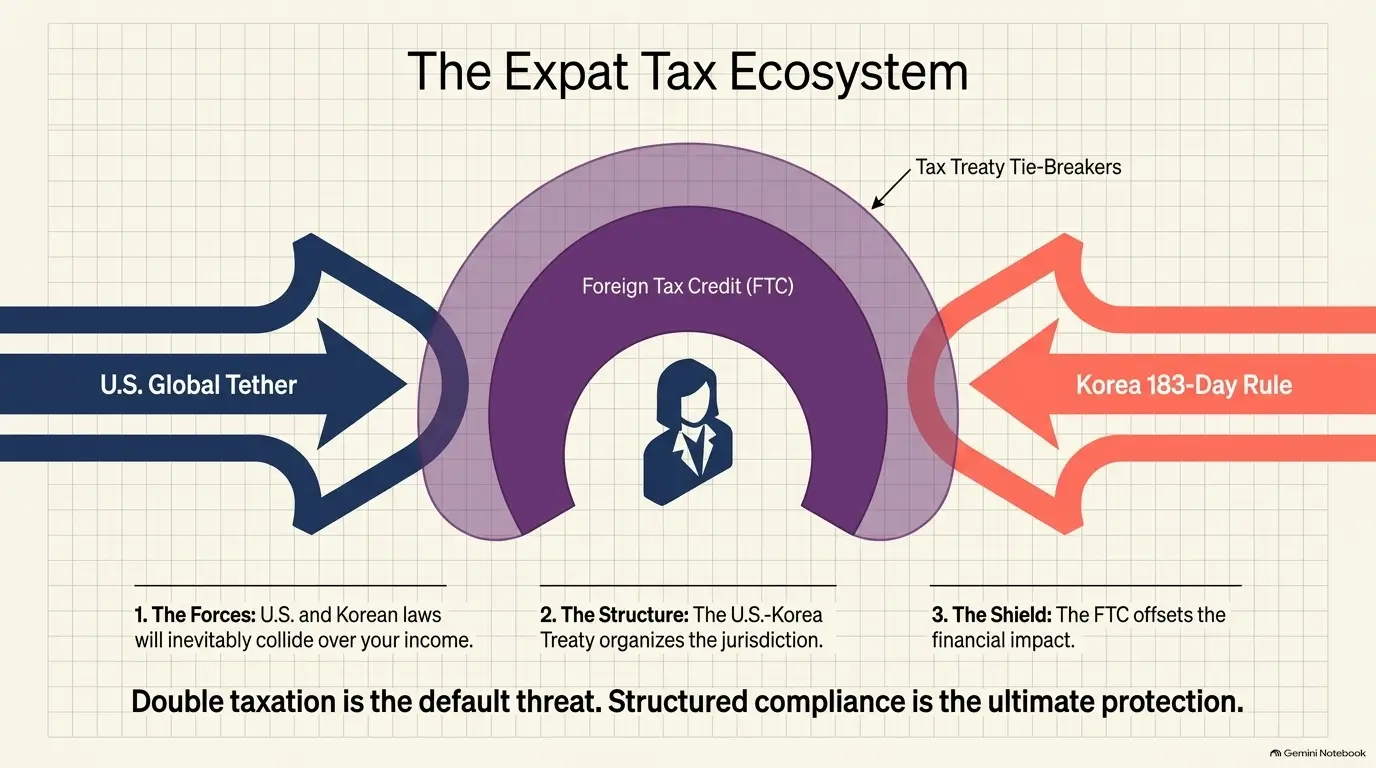
That does not necessarily mean paying full income tax twice. U.S. rules include mechanisms designed to address foreign taxation, most notably the foreign tax credit and, for eligible taxpayers, the foreign earned income exclusion.
Foreign tax credit
If qualifying Korean income tax is paid or accrued on foreign-source income that is also subject to U.S. tax, a U.S. citizen may be able to claim a foreign tax credit, commonly using Form 1116.
The credit is governed by limitations and income categories, so Korean tax paid does not automatically translate dollar-for-dollar into an unrestricted U.S. refund.
Foreign earned income exclusion
Some Americans working in Korea can instead, or in combination with other rules where permitted, use the foreign earned income exclusion. For the 2026 U.S. tax year, the maximum foreign earned income exclusion is $132,900 per qualifying individual.
Eligibility requires more than simply working outside the United States. Among other requirements, the taxpayer must have a foreign tax home and satisfy either the bona fide residence test or the physical presence test.
Under the physical presence route, the taxpayer generally needs at least 330 full days of physical presence in one or more foreign countries during a qualifying 12-month period.
Crucially, the U.S. 330-day physical presence test is not the same thing as Korea’s 183-day residence rule. They answer different tax questions under different legal systems.
For a broader overview of the American side, see U.S. expat tax in Korea.
How the U.S.-Korea Tax Treaty Handles Residence
The United States and South Korea have an income tax treaty. When an individual is treated as a resident of both countries for treaty purposes, Article 3 contains a sequence of tie-breaker rules.
- Permanent home: Which country has a permanent home available to you?
- Center of vital interests: If a permanent home exists in both countries or neither, where are your personal and economic relationships closer?
- Habitual abode: If that remains unresolved, where do you habitually live?
- Citizenship: If habitual abode does not settle the issue, citizenship becomes relevant.
- Competent-authority agreement: Certain unresolved cases may ultimately require agreement between the two governments’ competent authorities.
This treaty analysis is separate from merely counting Korean days. It is also important not to assume that obtaining treaty residence in Korea magically converts a U.S. citizen into an ordinary U.S. nonresident taxpayer.
The Treaty Has a Saving Clause
The U.S.-Korea treaty contains what tax practitioners call a saving clause. In broad terms, it preserves the United States’ ability to tax its citizens and certain residents as though the treaty had not come into effect, subject to specified exceptions.
That is why an American should not read the treaty tie-breaker and conclude, “I am a Korean treaty resident, therefore I no longer file or pay U.S. tax.” The treaty also contains relief-from-double-taxation provisions, and U.S. domestic mechanisms such as the foreign tax credit remain central to many expat tax calculations.
Treaty analysis becomes particularly important when substantial investment income, pensions, equity compensation, self-employment income, business ownership, or income sourced in both countries is involved.
Remote Work Performed in Korea Can Still Matter
Another common misconception is that income remains purely “American income” because the employer or customer is located in the United States and payment goes to a U.S. bank account.
Tax sourcing rules do not necessarily follow the location of the payer or bank account. For U.S. foreign-earned-income purposes, for example, compensation for personal services is generally sourced according to where the services are physically performed.
A software developer sitting in Busan and working remotely for a California employer therefore should not assume the salary is outside Korean tax considerations merely because payroll never touches a Korean bank.
Remote workers using Korea’s longer-stay immigration options may find the related guide to South Korea workation visa tax risks useful as well.
A Practical Residency Checklist for Americans in Korea
Before deciding whether you are a Korean tax resident, collect the underlying facts instead of starting with a conclusion.
- List every Korean entry and departure date for the tax year.
- Identify when you first established accommodation available for ongoing use in Korea.
- Review your Korean employment or consulting contract and expected assignment length.
- Identify where your spouse and dependent family members live.
- Record significant Korean assets and continuing living arrangements.
- Calculate how many years during the preceding ten-year period you have maintained a domicile or place of residence in Korea.
- Separate Korean-source and foreign-source income.
- Track foreign income that is transferred or paid into Korea.
- Identify Korean income taxes paid or accrued that may potentially support a U.S. foreign tax credit.
- Review separate U.S. foreign-account and foreign-asset reporting obligations.
If you are employed locally, the site’s Korea tax filing guide for English teachers also illustrates some of the practical filing issues faced by foreign employees.
Three Mistakes to Avoid
Mistake 1: “I stayed fewer than 183 consecutive days, so I am definitely a nonresident.”
Not necessarily. Korea’s 183-day analysis can involve accumulated presence during the tax period, and domicile can create residency independently of reaching a simple day-count milestone.
Mistake 2: “I pay tax in Korea, so I no longer need a U.S. return.”
U.S. citizens abroad generally remain subject to U.S. worldwide-income reporting and filing rules. Foreign tax credits and exclusions may reduce double taxation, but those benefits generally operate through the U.S. filing system rather than replacing it.
Mistake 3: “The treaty means I can choose whichever country has lower tax.”
A tax treaty is not a menu. Domestic law applies first, treaty provisions may modify the result, and the U.S.-Korea treaty’s saving clause preserves significant U.S. taxing rights over U.S. citizens.
When Professional Cross-Border Tax Advice Is Worth Considering
A straightforward Korean salary and a simple U.S. Form 1040 may be manageable with ordinary expat tax software or routine professional preparation. The case becomes more sensitive when residency itself is disputed or substantial foreign assets are involved.
Consider obtaining advice from a professional familiar with both Korean and U.S. international taxation if you have significant U.S. investment income, own a company or partnership, hold stock options or restricted shares, receive retirement or pension income, operate a remote business, own rental property, have large foreign financial accounts, or may need to rely on a specific treaty position.
The costliest mistake is often not paying tax in two countries. It is assuming that one country’s definition of residence automatically controls the other country’s rules.
Bottom Line
For a U.S. citizen in South Korea, Korean tax residency begins with Korean law: domicile in Korea or a qualifying place of residence for at least 183 days. The 183 days need not always be consecutive, and employment, family, assets, and living arrangements can establish a Korean domicile independently of a mechanical day count.
If you become a Korean resident, your Korean tax exposure can expand, although qualifying foreign nationals within the five-out-of-ten-year residence rule receive special treatment for certain foreign-source income.
At the same time, U.S. citizenship generally keeps worldwide-income reporting within the U.S. tax system. The foreign tax credit, foreign earned income exclusion, and U.S.-Korea income tax treaty can reduce conflicts between the two systems, but they do not turn Korean residence into an automatic exit from U.S. taxation.
For Americans planning a long stay, the most useful first step is therefore not asking, “Have I hit 183 days yet?” It is mapping your actual residence, work, family, income, and remittance facts across both countries.
- Korea National Tax Service – Easy Guide for Foreigners’ Year-end Tax Settlement – Explains Korean resident vs. nonresident status, the 183-day rule, domicile, and taxation of foreign residents.
- Korea Income Tax Act – Statutes of the Republic of Korea – Official English-language statutory text defining a Korean tax resident as an individual with a domicile or qualifying place of residence in Korea.
- IRS – U.S. Citizens and Resident Aliens Abroad – Explains that U.S. citizens generally remain subject to U.S. tax and reporting on worldwide income while living abroad.
- IRS Publication 514 – Foreign Tax Credit for Individuals – Official IRS guidance on claiming foreign tax credits for qualifying income taxes paid to countries such as South Korea.
- IRS – United States–Korea Income Tax Treaty – Full text of the U.S.–Korea income tax treaty, including residence rules, treaty tie-breakers, double-tax relief, and the saving clause.