
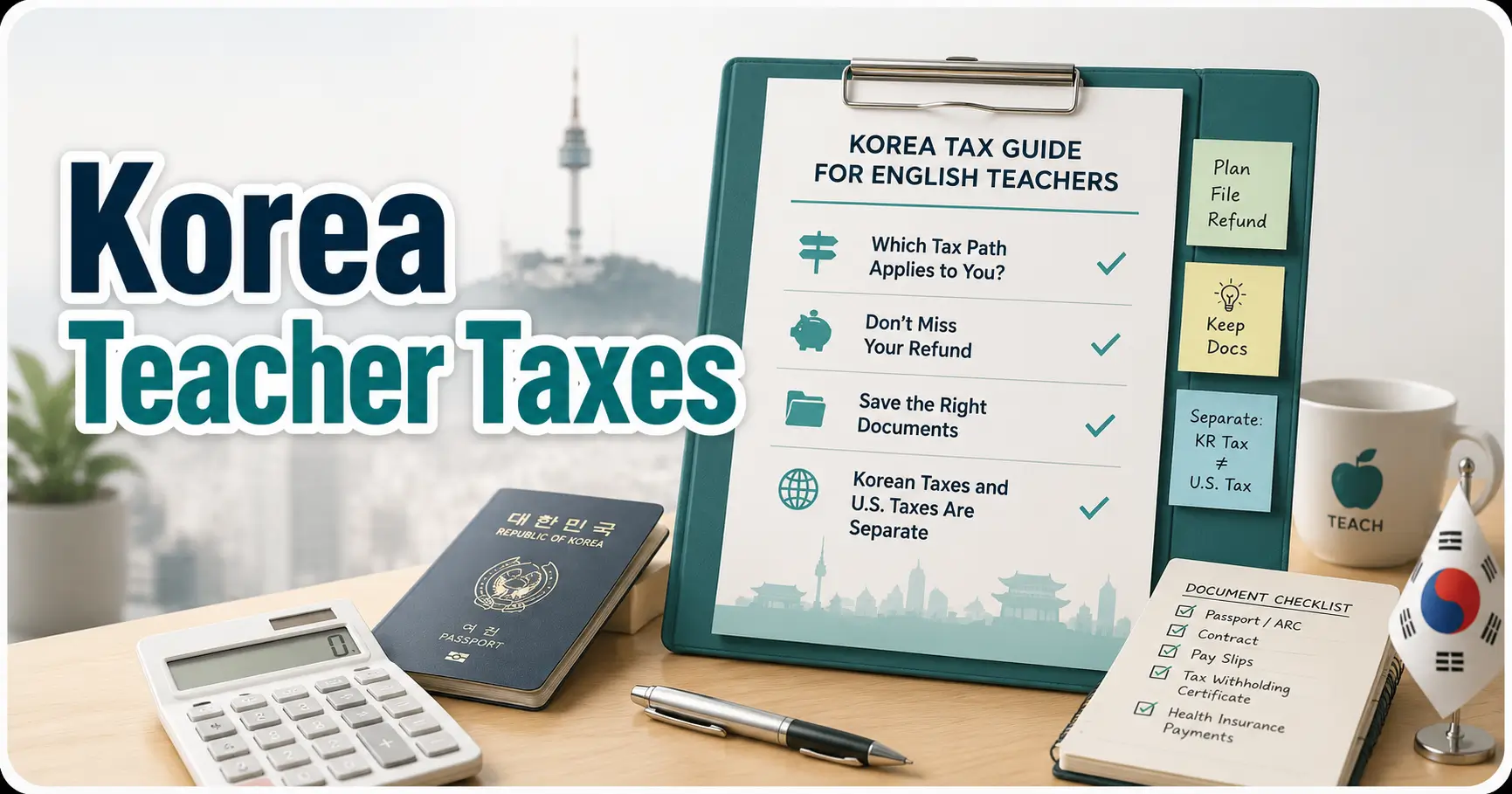
Practical tax guide for English teachers in Korea
Korea Tax Filing for English Teachers:
What to Check Before You Miss a Refund or Trigger a Problem
Korean tax season can feel like standing in a school hallway after the bell rings: everyone seems to know where to go, except you were handed three different forms, two payroll answers, and one rumor from a group chat. For English teachers, the real question is rarely “Do foreigners pay tax in Korea?” It is usually “Which tax path am I actually on?”
A public school teacher, hagwon teacher, university instructor, independent contractor, and US citizen abroad may all need different checks before filing. Some teachers finish through employer year-end settlement. Others need a May global income tax return. Americans often have a second filing story waiting across the ocean, even after Korean tax was withheld.
This guide gives you a calm decision map, not a panic foghorn. You will learn how to read your status, what documents to save, where treaty exemptions can go wrong, when Korea’s flat-rate option deserves a calculator, and why “my school handled it” is useful but not always complete.
Find your tax door
Employee, contractor, year-end settlement, or May filing.
Protect your documents
Save the records that matter before payroll memories fade.
Separate Korea and US tax
Korean filing does not automatically close the US file.
Best use of this article: read it before you calculate anything, then build a tax folder that makes your next decision much less noisy. 🧾
Snapshot
This guide is for English-speaking teachers in Korea who want to understand payroll withholding, year-end settlement, May filing, treaty exemption paperwork, contractor status, and the separate US tax return issue. By the end, you should know what to ask payroll, which documents to save, when DIY filing may be enough, and when a Korean or US expat tax professional may be worth the cost.
Contents — choose a section
Table of Contents
Before You Act: Tax Rules Are Not School Gossip
This article is educational, not tax, legal, immigration, or financial advice. Korean tax filing depends on your residency status, income type, employer reporting, contract wording, school type, treaty eligibility, and documents. US tax filing depends on separate US rules, not on whether your Korean school withheld tax.
Use this guide as a checklist and conversation starter. Before claiming an exemption, choosing a flat-rate option, skipping a May return, or assuming your US filing is finished, confirm the details with the National Tax Service, your payroll office, a qualified Korean tax professional, or a US expat tax preparer.
Key takeaway
If you remember one sentence, make it this: Korean withholding is evidence, not the final verdict. Your real filing duty depends on the full year, all income sources, and whether your employer actually completed settlement for you.
Who this guide fits
This guide is built for E-2 teachers, public school teachers, hagwon teachers, university instructors, after-school teachers, and English-speaking teachers who earned income in Korea. It is especially useful if you received a Korean payslip but still cannot tell whether you were treated as an employee or contractor.
It also fits US citizens and US resident aliens living in Korea who need to separate Korean income tax from US filing duties. That second file can sit quietly in the drawer until tax season taps the glass.
Who should not use this alone
Do not rely on a general article alone if you have rental income, crypto trades, stock sales, business income, YouTube income, private tutoring income, multiple countries of residence, a tax notice, or a treaty dispute with your school. A teacher with one clean salary and a teacher with side income plus US brokerage accounts are not playing the same game.
The more your year looks like a drawer full of mixed receipts, the more professional help may be worth considering. That does not mean you are in trouble. It means you should price clarity before you price regret.
Official resources to bookmark first
The Korean National Tax Service publishes foreigner tax materials, year-end settlement materials, global income tax filing guides, and relevant forms. For US readers, the IRS and FinCEN provide the main official pages for US citizens abroad, Form 2555, and FBAR rules.
The First Fork: Employee, Contractor, or “3.3%” Teacher?
The first tax question is not “Do I work at a hagwon?” or “What visa am I on?” It is whether your income was treated as employment income, business income, or another category. Your visa matters for immigration. Your tax treatment depends on how the income is reported and what your real work arrangement looks like.
Many teachers discover the problem through a small number on a payslip: 3.3%. In Korea, that often signals withholding commonly associated with freelance or business income rather than normal employment withholding. It may be routine in some arrangements, but it is not a magic stamp that makes every classification correct.
Why your visa does not answer everything
An E-2 visa tells you that you are authorized to teach under certain conditions. It does not automatically tell you whether the income was reported as employment income for Korean tax purposes, whether your employer completed year-end settlement, or whether you have to file a May return.
Two teachers can both hold E-2 visas and still have different payroll setups. One may receive regular employment withholding, pension contributions, health insurance, and year-end settlement. Another may see 3.3% withholding and later need to file global income tax.
Payslip clues that matter
Your payslip is not a novel, but it has plot. Look for Korean income tax withholding, local income tax, National Pension, National Health Insurance, employment insurance, severance accrual, housing allowances, bonuses, and any line that suggests business-income withholding.
If you do not understand the payslip, ask payroll for a plain-English explanation. Keep the reply. A short email today can become a lantern in May.
| Clue | What it may suggest | What to ask next |
|---|---|---|
| Regular income tax and local tax withholding | Possible employment income treatment | Will the school complete year-end settlement for me? |
| 3.3% withholding | Possible business or freelance income treatment | Do I need to file a May global income tax return? |
| Pension and health insurance deductions | Payroll benefits may be handled through the school | Can I receive annual wage and withholding documents? |
| No clear tax lines | Possible reporting gap or unclear payslip | How was my income reported to NTS? |
The 3.3% label is not a tax plan
Some teachers hear “3.3%” and assume their tax is finished. That can be expensive. Withholding is usually a prepayment, not always a completed return. If you were treated as having business income, the May filing season may be where your real calculation happens.
This is also where refunds may appear. If too much was withheld, filing may help. If not enough was withheld, filing may reveal tax due. Either way, guessing is the most expensive free option.
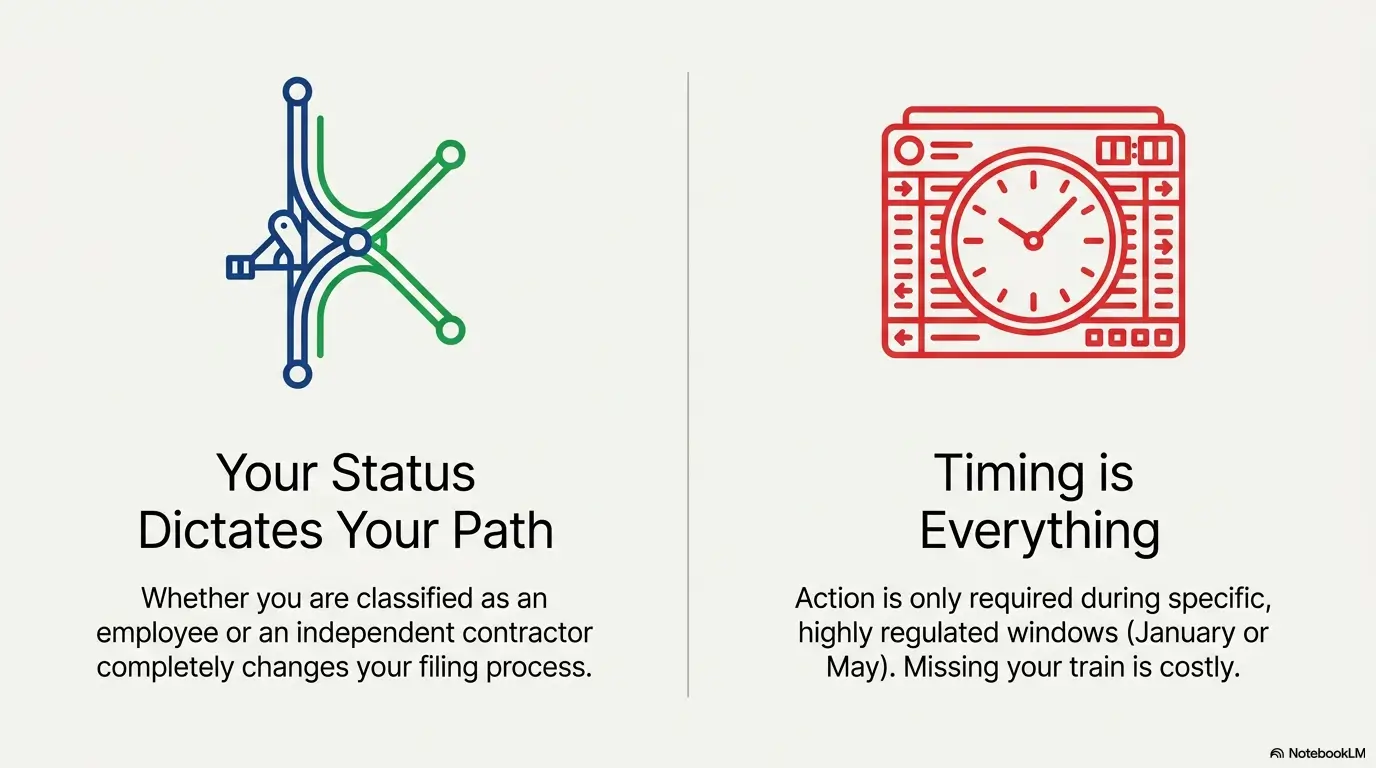
January or May: Which Korean Tax Door Are You Walking Through?
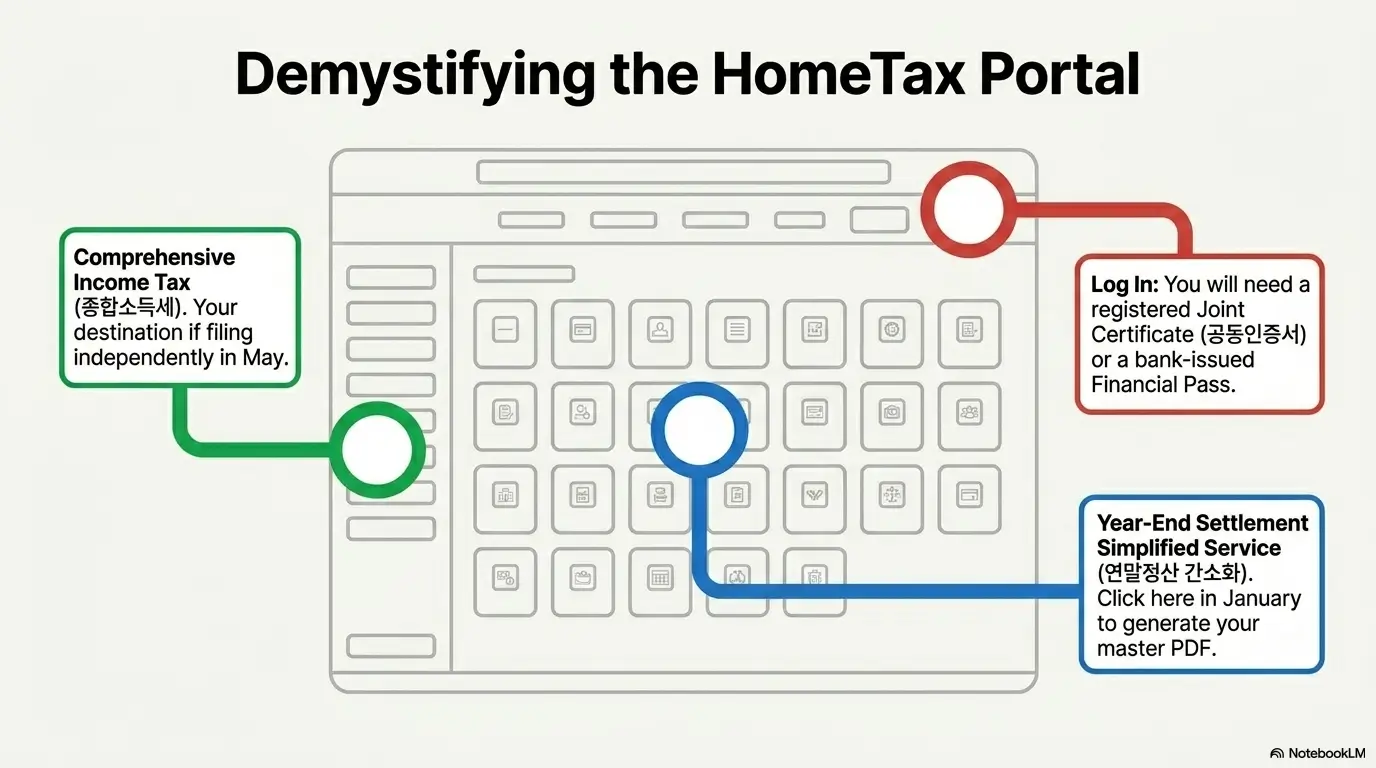
Korean tax filing has two doors many teachers hear about: year-end settlement around the start of the following year, and global income tax filing in May. The door you use depends on your income type and whether your employer fully handled the settlement.
Year-end settlement is often the employee path. May global income tax filing is often relevant when you have business income, multiple income sources, side income, or items not fully settled by an employer.
Year-end settlement: when your employer handles the first pass
For many employees, the employer calculates annual employment income tax through year-end settlement. You may submit deduction documents, confirm personal details, and later receive a refund or pay a small additional amount through payroll.
This is not the same as saying every teacher is finished. If you changed jobs, earned income elsewhere, had freelance lessons, or were not treated as a regular employee, you need another check.
Global income tax return: when May becomes your filing month
May matters when income was not fully settled through an employer. Teachers with 3.3% withholding, private lessons, online tutoring, business income, multiple workplaces, or mixed income should be especially careful.
The May return can feel intimidating, but it is also the place where over-withholding, deductible expenses, or missing records may be corrected. Treat May as a calendar checkpoint, not a punishment.
The quiet trigger: side tutoring, freelance classes, and multiple schools
A teacher may think, “My main school handled my tax,” while forgetting weekend tutoring, online classes paid into a Korean bank account, editing work, or a second campus. These small streams can change the filing picture.
Before you decide you are done, list every income source earned during the calendar year. Do not start with what was taxed. Start with what was earned.
Key takeaway
Ask payroll one clean question: “Was my full-year income fully settled through year-end settlement, or do I need to file separately in May?” Save the answer with your tax folder.
Korea teacher tax decision flow
1. Identify income type
Employment, business, freelance, mixed, or unclear.
2. Check settlement
Did your employer complete year-end settlement?
3. List side income
Private classes, online work, second schools, bonuses.
4. Confirm documents
Payslips, withholding receipt, treaty forms, bank records.
5. Decide next action
DIY, NTS help, Korean tax pro, or US expat preparer.
The Treaty Exemption Trap: The Benefit That Disappears If Your School Type Is Wrong
Foreign teacher treaty exemptions are one of the most repeated tax topics in Korea’s expat teaching circles. They are also one of the easiest places to blend half-true stories into one confident mistake.
Treaty benefits depend on the relevant tax treaty, your country of residence, your school type, the nature of the work, required documents, timing, and whether the institution qualifies. A benefit available to one teacher at a public school or university may not apply the same way to a hagwon teacher.
Do not blend public school, university, and hagwon rules
Public schools, universities, and private language institutes can sit in different tax categories for treaty purposes. The practical mistake is easy: a teacher hears that “foreign teachers are exempt for two years,” then applies that sentence to the wrong institution.
The safer sentence is this: some qualified foreign teachers may be eligible for treaty-based Korean income tax exemption if the treaty and institution conditions are met and the proper documents are submitted.
The certificate-of-residence problem
Treaty claims often require proof that you are a resident of the treaty country for tax purposes. For US teachers, that may involve requesting a US certificate of residency before the Korean side can process the exemption claim.
This document issue is where many teachers stumble. The classroom starts in March, payroll begins immediately, and the certificate arrives after the tax conversation has already grown teeth.
Treaty relief is a document story, not a rumor
A treaty benefit is not something to claim because another teacher said it worked. Ask your school which exact exemption form is needed, whether they recognize your institution type as eligible, and whether they will apply the exemption through payroll or require a refund process later.
If payroll seems uncertain, do not argue from memory. Ask for the official basis and get a Korean tax professional involved before the filing window becomes a hallway sprint.
Flat Tax Math: When a Simple 19% Choice Quietly Costs More
Korea’s foreign-worker flat-rate option is often described as a clean 19% income tax choice, excluding local income tax. Clean sounds attractive when tax forms look like a cabinet of tiny locked drawers. But clean is not always cheaper.
The main issue is trade-off. Choosing a flat-rate treatment can mean giving up other deductions, exemptions, and credits. For a higher-income foreign worker with few deductions, it may be worth comparing. For a teacher with ordinary salary, eligible deductions, and benefits, the regular calculation may come out better.
Why lower-looking tax can erase benefits
A flat percentage feels simple because it avoids many moving parts. But those moving parts may be where your refund lives. Deductions, credits, and regular tax brackets can matter.
Do not ask, “Is 19% good?” Ask, “What is my total tax under the flat-rate option compared with regular taxation after deductions and credits?” That is the grown-up version of the question, with better shoes.
The break-even question
The flat-rate decision depends on salary size, deductions, benefits, school reporting, and whether you qualify at all. The option should be priced, not admired from across the room.
If the difference is small, convenience may matter. If the difference is large, professional comparison may pay for itself quickly.
| Option | Best fit | Watch out for | Decision step |
|---|---|---|---|
| Good: payroll explanation | Simple employee situation | Payroll may not compare all options | Ask for regular tax vs flat-rate estimate |
| Better: DIY calculator check | Comfortable record keepers | Input mistakes can distort the result | Use official guidance and save assumptions |
| Best: professional comparison | Higher salary, mixed income, uncertainty | Professional fees vary | Ask for a side-by-side written comparison |
Show me the nerdy details
The flat-rate comparison is not just “salary multiplied by 19%.” A meaningful comparison should look at gross income, taxable income, deductions, credits, local income tax, employer-provided benefits, treaty position, and whether the option is available for the tax year in question. If someone gives you an answer without asking about deductions or income type, treat it as a sketch, not a final map.
Reconcile teaching income before choosing a filing route
Create one row per payer with the payment period, gross amount, withholding, actual deposit and document received. Separate salary from any other work and flag inconsistencies for the payer or adviser. The NTS guide published in 2026 covers returns for 2025; match guidance to the income year. A withholding label or a colleague’s refund cannot determine your classification, treaty position or final liability.
| Focus | What to check |
|---|---|
| Income | Payer, period, gross amount and income type. |
| Withholding | Reconcile statements with actual payments. |
| Filing | Confirm the applicable year, route and unresolved questions. |
A reader question: Does an amount withheld prove that no further filing is needed?
No. Confirm your own income types and completed settlement or return records. Ask about any remaining filing obligation instead of treating a bank deposit as a tax assessment.
Documents That Save You at 11:47 PM
Tax problems often look like math problems, but many are document problems in costume. The teacher who saves payslips, contract pages, withholding receipts, and bank records can answer questions faster than the teacher trying to reconstruct February from memory and a coffee-stained KakaoTalk thread.
Korean documents to save
Start with your contract, payslips, annual wage and withholding receipt, alien registration details, school business information if available, housing allowance records, bonus records, severance documents, and bank deposits showing pay received.
If you interact with the Korean health system or local offices while living in Korea, related records can also help you understand your broader residency and administrative trail. For practical life-admin context, you may find guides on Korean National Health Insurance for foreigners and local district offices in Korea helpful.
Treaty documents to save
If you plan to claim a treaty exemption, keep the certificate of residence, exemption application, correspondence with payroll, and any school confirmation about eligibility. Save both the submitted form and the school’s reply.
Do not assume your school will keep everything forever. Staff change. Email accounts close. Filing memories evaporate politely.
US documents to save
US teachers should keep Korean wage proof, Korean tax paid records, bank maximum balances, housing costs if relevant, US tax documents, student loan interest records, brokerage statements, and proof of days inside and outside the United States if residency tests matter.
For FBAR, the number that often matters is not your year-end balance. It is the maximum aggregate value of foreign financial accounts during the year.
Document checklist
- Employment contract and any renewal agreement
- Monthly payslips and annual withholding receipt
- Proof of housing, airfare, bonuses, and settlement allowance
- Certificate of residence and treaty-exemption forms, if used
- Korean bank statements showing pay deposits and maximum balances
- Payroll emails confirming year-end settlement or May filing need
- Departure records if leaving Korea before the next tax season
Illustrative example: the leaving-Korea folder
A teacher finishes a contract in late February and leaves Korea before May. At the airport, the suitcase is tidy, but the tax file is not. The school email closes. The payroll manager changes. The bank app becomes harder to access from abroad. Suddenly, one missing withholding receipt turns into three late-night messages across time zones.
The safer move is simple: before departure, download your payslips, annual tax documents, pension and health insurance records, bank statements, and school tax contact. If you are American, record your highest Korean bank balances for the year. The folder takes less time than a farewell dinner and ages much better.
The US Return Is Not Cancelled by Korean Filing
For US citizens and US resident aliens, Korean filing and US filing are separate systems. Paying Korean income tax does not automatically cancel a US tax return requirement. It may help through foreign tax credits or other calculations, but it does not close the file by itself.
The IRS generally expects US citizens and resident aliens abroad to report worldwide income if they meet filing requirements. Some taxpayers may qualify for the foreign earned income exclusion using Form 2555, while others compare that route with foreign tax credit treatment. This is a choice to calculate carefully, not a coin toss over breakfast.
Form 2555, foreign tax credit, and why you should not guess
Form 2555 is used by qualifying taxpayers to claim the foreign earned income exclusion and, in some cases, housing exclusion or deduction. The foreign tax credit is a different approach that may reduce US tax based on qualifying foreign taxes paid or accrued.
Neither option is automatically best. The better choice can depend on Korean tax paid, income level, housing costs, future plans, retirement contributions, state tax issues, and whether you have investment income. If your situation is more than one clean teaching salary, professional comparison may be a sensible paid service.
FBAR: the bank-account threshold that surprises teachers
FBAR is separate from your income tax return. A US person may need to file FinCEN Form 114 when the aggregate value of foreign financial accounts exceeds $10,000 at any time during the calendar year.
A severance payment, airfare reimbursement, pension refund or transfer can change the balances relevant to US account reporting. FinCEN states the FBAR threshold as aggregate foreign financial-account value exceeding USD 10,000 at any time during the calendar year for a US person with a financial interest or signature authority. Do not test each account against USD 10,000 in isolation, or confuse this threshold with an income-tax exemption. Keep statements and apply the current FBAR instructions for valuation and reporting.
Key takeaway
If you are American, build two folders: one for Korean tax and one for US tax. The same payslip may help both, but the rules are not the same animal.
Common Mistakes: Small Choices That Create Expensive Confusion
Most teacher tax problems do not begin with fraud or grand drama. They begin with reasonable assumptions: “My school handled it,” “3.3% means done,” “I left Korea so it no longer matters,” or “I paid tax in Korea, so the US will not care.” Small assumptions can become costly if nobody checks them.
Mistakes that look harmless
The most common mistake is filing nothing because tax was withheld. Withholding can be enough for some employees after year-end settlement, but not for every teacher and not for every income stream.
Another common mistake is confusing income tax with pension, health insurance, or local income tax. These are different lines. They may all reduce your take-home pay, but they do not all answer the same tax question.
Mistakes that cost money
Claiming treaty exemption without confirming school type can create payroll trouble. Ignoring side income can create May filing issues. Leaving Korea without final documents can turn a simple refund check into a slow paper chase.
For US teachers, forgetting FBAR or US income reporting because the Korean refund felt final is another classic trap. The Korean tax story and US tax story may overlap, but they do not erase each other.
| Common mistake | Why it causes trouble | Safer alternative |
|---|---|---|
| Assuming withholding means finished | Withholding may not equal final filing | Confirm year-end settlement or May filing need |
| Copying another teacher’s treaty claim | Nationality and school type may differ | Check treaty, institution type, and required forms |
| Ignoring side tutoring | Extra income may require reporting | List every income source before filing |
| Leaving Korea without records | Documents become harder to retrieve | Download a departure tax folder before your last day |
| Treating Reddit math as official guidance | Online examples may not match your facts | Use official pages and written payroll answers |
What to ask before paying for help
Paid tax help can be worth it when it prevents errors, recovers refunds, or saves hours of confusion. But do not buy vague comfort. Ask specific questions before hiring a preparer or advisor.
- Do you handle foreign teacher tax filing in Korea?
- Can you compare year-end settlement and May global income filing duties?
- Have you handled 3.3% teacher withholding situations?
- Can you review treaty-exemption eligibility and documents?
- For US preparers, do you handle Form 2555, foreign tax credit, FBAR, and Korea-sourced wage proof?
- Will I receive a written summary of what was filed and what to keep?
When to Seek Help Before Filing
DIY tax filing can be enough for a simple teacher with one employer, clear year-end settlement, no side income, no treaty claim, and no US filing complications beyond a standard expat return. The moment your facts become mixed, help may be a good value rather than a luxury.
Korean tax help triggers
Consider Korean tax help if you were paid as a contractor but worked like an employee, changed schools mid-year, had 3.3% withholding, taught private lessons, received unclear housing or airfare payments, are claiming treaty exemption, or are leaving Korea before the next tax season.
Help is also wise if you receive a notice from NTS or your school payroll office. Notices reward calm reading, not drawer-stuffing.
US expat tax help triggers
Consider US expat tax help if you have foreign bank balances near or above the FBAR threshold, US investments, crypto, student loan tax questions, self-employment income, rental income, state residency issues, or uncertainty between Form 2555 and foreign tax credit treatment.
Teachers who plan to stay abroad long term should be especially careful. A choice that looks fine for one year may affect future credits, carryovers, or filing strategy.
| Situation | DIY may be enough when… | Paid help may be worth it when… |
|---|---|---|
| One Korean employer | Payroll confirms full year-end settlement | You changed schools or records are unclear |
| 3.3% withholding | You understand May filing and records are clean | You are unsure whether you were misclassified |
| Treaty exemption | School clearly confirms eligibility and forms | School type, timing, or certificate status is uncertain |
| US filing | One salary, clear documents, no extra assets | FBAR, investments, crypto, or credit vs exclusion issues exist |
Key takeaway
The best tax help is specific. Avoid paying for vague reassurance. Pay for classification checks, document review, option comparison, and a written record of what was filed.
FAQ
Do English teachers in Korea need to file a Korean tax return?
Some employees may be handled through employer year-end settlement, while contractors, teachers with 3.3% withholding, teachers with side income, or teachers with multiple income sources may need to file a May global income tax return. Confirm with payroll and NTS guidance instead of assuming.
Is year-end settlement the same as filing a tax return?
Year-end settlement is an employer-led annual tax calculation for employment income. It may complete the process for many employees, but it does not automatically cover freelance income, side tutoring, multiple employers, or unclear contractor treatment.
Do hagwon teachers file differently from public school teachers?
They can. The filing path depends on how the hagwon reports income, whether the teacher is treated as an employee or contractor, and whether any treaty or payroll issue applies. Public school and university treaty discussions should not be copied onto a hagwon situation without checking.
Can US English teachers in Korea avoid Korean income tax?
Some US teachers may qualify for treaty-based exemption in specific teaching situations, but eligibility is conditional. Nationality alone is not enough. School type, documents, timing, and treaty rules matter.
What is the 3.3% tax withholding for teachers in Korea?
It is commonly associated with business or freelance income withholding. For teachers, it should be treated as a classification clue, not a final answer. If you see 3.3% withholding, ask whether you need to file a May global income tax return.
Do American teachers in Korea still file US taxes?
Many US citizens and resident aliens abroad still have US filing obligations based on worldwide income rules. Form 2555, foreign tax credit, FBAR, and other rules may apply depending on the facts.
Does free housing count as taxable income in Korea?
Housing treatment depends on how it is provided, reported, and documented. Do not assume it is always tax-free or always taxable. Keep housing contract records, allowance details, and payroll explanations.
What happens if I leave Korea before tax season?
You may still need documents or filing support after leaving. Before departure, download payslips, withholding receipts, bank records, pension documents, and payroll contact details. If you are American, record your Korean account maximum balances for US reporting checks.
Can I get a Korean tax refund as an English teacher?
Possibly. Refunds depend on withholding, income type, deductions, credits, year-end settlement, May filing, and treaty eligibility. A refund is not guaranteed, but clean records make the answer easier to find.
Build a 30-Minute Tax Folder Before You Calculate Anything
The cleanest next step is not opening a calculator. It is building a folder. Tax clarity begins with proof: what you earned, how it was reported, what was withheld, what your school settled, and whether another country still wants a return.
Give yourself 30 minutes. Make one folder named “Korea Tax Filing 2025” or the relevant year. Inside it, create subfolders for Korean payroll, treaty documents, US filing, bank records, and questions for payroll. This is small admin work with cathedral-level usefulness.
The 15-minute version
- Save your contract, latest payslip, and annual withholding receipt.
- Write down your status: employee, contractor, 3.3%, public school, hagwon, university, or mixed.
- List every Korea-sourced income stream from the calendar year.
- Ask payroll: “Was my income fully settled, or do I need to file separately in May?”
- If you are American, record your highest Korean bank balances for the year.
That is enough to move from fog to first light. You may still need professional help, but you will arrive with records instead of scattered questions.
One calm final rule
Do not let the loudest person in the staff room become your tax strategy. Use official guidance, written payroll answers, and proper documents. Korea tax filing for English teachers is manageable when you sort the doors in the right order: status first, income second, documents third, filing path fourth, US obligations fifth.
Your next move
Open your folder now and save just three files: your contract, your latest payslip, and one payroll email asking whether you are fully settled or need a May return. Tiny hinge, big door.
Last reviewed: 2026-07
Practical example and reader question added October 20, 2026. Existing source dates are retained; this addition is not a fresh verification of every earlier claim.