
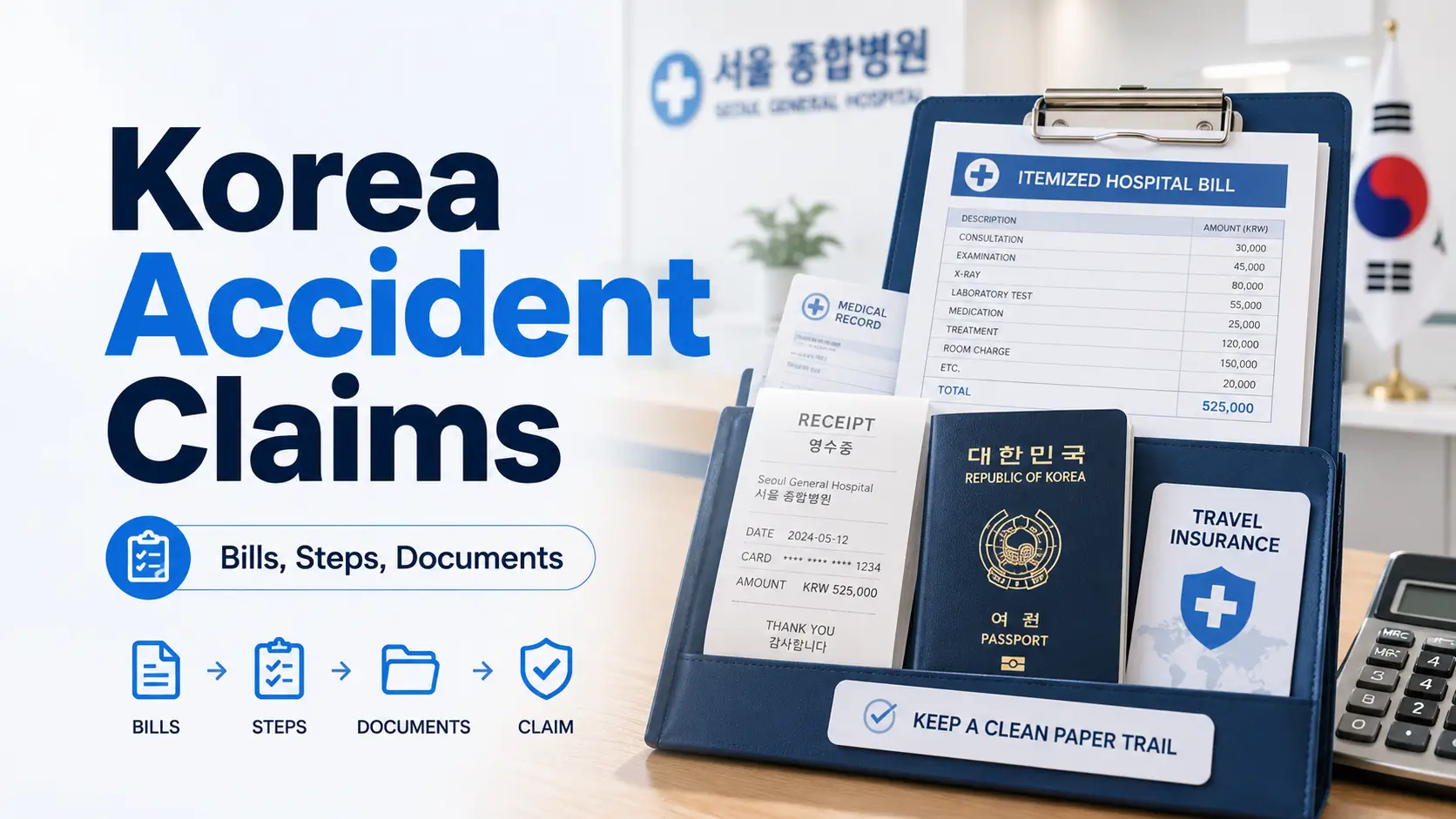
Tourist Accident Claim Guide
Korea Medical Bills After a Tourist Accident:
Claim Steps and Documents
An accident abroad can turn an ordinary hospital receipt into a small administrative maze. The treatment may be excellent, yet the paperwork can arrive in Korean, the insurer may be asleep in another time zone, and your flight home may be only two days away.
The safest approach is not to chase reimbursement while you are frightened or in pain. Get appropriate care first. Then build a clean paper trail showing what happened, what treatment was medically provided, what you paid, and which expenses belong to which coverage.
This guide walks you from the hospital desk to the insurer’s decision, including direct billing, English documents, police records, translations, third-party claims, and the quiet mistakes that can leave an otherwise valid claim gathering dust.
Protect the claim
Know what to record during the first 24 hours.
Collect the right papers
Separate receipts, itemized bills, medical evidence, and accident proof.
Avoid wasted expense
Confirm translation, direct-billing, and professional-help requirements before paying.
The goal is simple: leave Korea with a claim file, not merely a card slip. 📁
Snapshot
This guide is for short-term visitors who received medical care after an accident in South Korea. It helps you identify who may pay, collect claim-ready hospital and accident documents, submit a traceable reimbursement package, and recognize when insurer, translation, medical, or legal help may be worth considering.
Contents — choose a section
Table of Contents
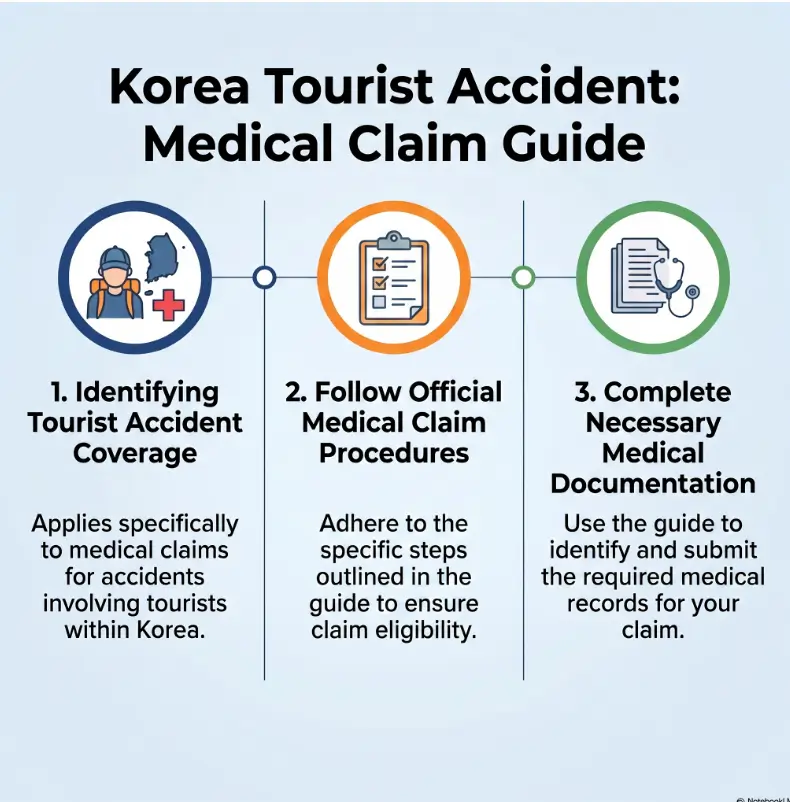
Before You Act: Treatment First, Claim Strategy Second
Medical treatment and insurance administration run on different clocks. A broken wrist, head injury, breathing problem, or rapidly worsening symptom cannot wait for an insurer’s call center to open.
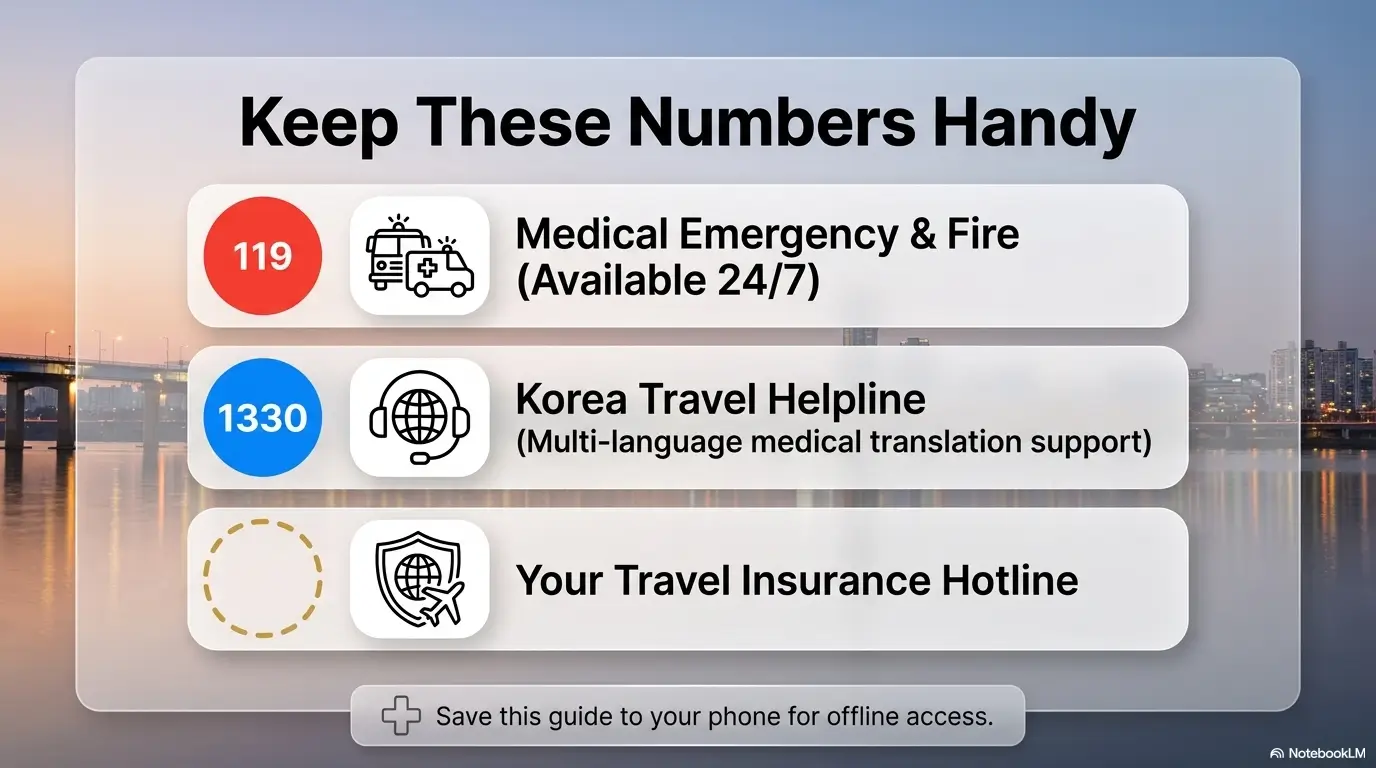
In a medical emergency in South Korea, call 119. For police assistance, call 112. The U.S. Department of State also maintains practical guidance on medical care and insurance while traveling abroad.
Before You Act
This article provides general education, not personal medical, legal, or insurance advice. Policies differ in deductibles, exclusions, notice periods, translation rules, preauthorization requirements, and covered activities. Confirm important decisions with your treating clinician, insurer, assistance provider, or qualified adviser. Never delay urgent care while waiting for claim approval.
Who this guide fits
The process below is most useful for tourists, visiting families, business travelers, and travel coordinators dealing with emergency-room care, outpatient treatment, hospitalization, ambulance services, dental emergencies, prescriptions, imaging, or accident-related follow-up care.
It also helps a parent organizing a child’s records or a companion handling paperwork while the injured traveler rests. In those cases, the person collecting documents should keep the patient’s passport details, policy information, and any signed authorization readily available.
Who needs different guidance
This is not a substitute for resident-specific advice. Foreign residents who qualify for Korea’s National Health Insurance follow a different payment and coverage process. The distinction matters because a short-term tourist usually cannot assume access to the same benefits as an enrolled resident.
For resident coverage questions, see this separate guide to Korean National Health Insurance for foreigners.
You may also need specialized guidance if the injury occurred while working, studying under a sponsored program, competing professionally, participating in a high-risk activity, or driving a rental vehicle. Those situations can involve employer coverage, school insurance, auto liability, waivers, or policy exclusions that sit outside an ordinary tourist medical claim.
Key Takeaway
Think of the case as two connected folders: one folder proves the medical expense, while the other explains the accident. Some claims need both, and one folder cannot always repair gaps in the other.
The First 24 Hours: Protect Your Health and the Paper Trail
Get the appropriate level of care
Use emergency services for potentially serious injuries rather than choosing a clinic solely because it appears easier to bill. Chest pain, major bleeding, severe allergic reactions, loss of consciousness, breathing difficulty, suspected spinal injury, or rapidly worsening symptoms require medical judgment, not insurance guesswork.
For less urgent injuries, an international clinic or hospital international center may help with language support and paperwork. Your choice should still be based on medical suitability, location, operating hours, and the type of treatment required.
Travelers unfamiliar with the admission process can review this guide to Korean hospital admission before interpreting requests for registration information, deposits, consent forms, and discharge documents.
Notify the right insurance contact
Look for the insurer’s emergency-assistance or travel-assistance number, not only the general customer-service line. The assistance provider may coordinate hospital communication, interpreters, medical review, transportation, or a guarantee-of-payment request.
- Ask for a claim number or assistance case number.
- Record the representative’s name and the time of the call.
- Ask whether admission, surgery, imaging, or follow-up care requires preauthorization.
- Confirm whether the policy uses reimbursement, direct billing, or both.
- Ask whether the insurer requires notice within a stated period.
- Request written confirmation through email or the insurer portal.
Do not assume that notifying a credit-card issuer automatically opens a travel-insurance claim. The benefit administrator may be a separate company with its own forms, deadlines, and evidence standards.
Capture the accident while details are fresh
Write a factual timeline before memory begins sanding off the edges. Record the date, time, precise location, weather or surface conditions, sequence of events, symptoms, and who was present.
- Photograph the scene, visible injuries, damaged belongings, signs, barriers, and lighting conditions.
- Collect witness names, phone numbers, and email addresses.
- Save taxi, ambulance, map, and location-history records.
- Ask the hotel, venue, tour operator, rental company, or attraction for an incident number.
- When police attend, record the station, officer details, and report reference.
A medical claim and a liability claim may become separate files even though they grow from the same fall or collision. The travel insurer may assess covered medical expenses without deciding whether a driver, hotel, guide, or business was legally at fault.
The Five-Stage Claim Trail
1. Care
Get medically appropriate treatment.
2. Notify
Open an insurer or assistance case.
3. Record
Preserve accident facts and contacts.
4. Collect
Obtain bills, records, and payment proof.
5. Submit
Send one indexed, traceable package.

Who Pays the Korean Hospital First?
The practical answer is often the traveler. Many international patients pay the hospital by cash or card and request reimbursement afterward. That does not mean direct billing is impossible. It means direct billing should be verified rather than assumed.
Self-payment followed by reimbursement
Under the reimbursement model, the hospital treats you as the payer. You settle the bill, obtain supporting documents, and submit them to the insurer. The insurer then decides which charges satisfy the policy’s coverage, deductible, exclusions, and medical-necessity rules.
Keep enough available credit or emergency funds to handle a deposit or initial charge if possible. A hospitalization may involve an estimated deposit before the final cost is known, followed by a settlement calculation at discharge.
Direct billing and guarantees of payment
Some international hospital centers work with selected insurers or assistance companies. The insurer may send a guarantee-of-payment letter stating which expenses it expects to cover.
A guarantee is not necessarily a blank check. You may still owe a deductible, copayment, excluded service, nonmedical charge, upgrade, private room difference, deposit, or expense incurred before authorization.
Ask both sides the same three questions:
- Has the hospital received and accepted the guarantee?
- Which services and dates does the guarantee cover?
- What amount may remain the patient’s responsibility?
Three coverages that are not interchangeable
| Coverage source | What it may address | What to verify |
|---|---|---|
| Domestic U.S. health insurance | Emergency or out-of-network medical care abroad under some plans | Overseas coverage, network rules, deductible, claim form, and reimbursement rate |
| Travel medical insurance | Eligible treatment for a covered illness or accidental injury during the trip | Exclusions, activity restrictions, preexisting-condition terms, notice, and documentation |
| Evacuation or repatriation coverage | Approved transport to an appropriate facility or home country | Who selects the destination, medical approval, transport method, and assistance coordination |
| Credit-card travel benefit | Specific benefits attached to an eligible card purchase | Trip-payment requirement, benefit type, limits, administrator, and filing deadline |
Medicare and Medicaid generally do not pay ordinary medical costs outside the United States. Private domestic plans vary, so compare the policy language rather than relying on the familiar logo printed on your insurance card.
For a broader pre-trip comparison of medical and evacuation coverage, see this guide to travel insurance for South Korea.
Key Takeaway
“The insurer has been contacted” does not automatically mean “the hospital will not charge me.” Confirm the payment route, covered dates, excluded charges, and remaining patient balance in writing.
The Document Pack That Can Make or Break the Claim
A single receipt rarely tells the whole story. Insurers commonly need evidence answering four different questions:
- What happened? Accident evidence and a consistent account.
- What was medically wrong? Diagnosis, clinical findings, and treatment records.
- What was charged? An itemized bill showing individual services.
- What did you actually pay? Final receipt, card confirmation, or other payment evidence.
Hospital billing documents
Ask the billing or documentation desk for the most complete version available. The names used by hospitals differ, so describe what you need rather than relying on one English label.
- Final payment receipt
- Itemized or detailed medical-expense statement
- Deposit receipts and final settlement statement
- Separate emergency-room, inpatient, outpatient, imaging, ambulance, and pharmacy charges
- Credit-card payment confirmation when requested by the insurer
- Refund or adjustment statement if the hospital later changes the balance
A total receipt proves that money changed hands. An itemized statement explains what the money purchased. Insurers often need both.
Medical evidence
The exact records depend on the injury and policy. Ask the insurer for its checklist, then compare it with what the hospital can issue before discharge.
- Medical certificate or physician’s statement
- Diagnosis and diagnosis code, when available
- Emergency-room record
- Admission and discharge summary
- Operation or procedure report
- Prescription and pharmacy receipt
- Imaging and laboratory reports
- Follow-up instructions
- Travel-restriction or fitness-to-fly letter when medically relevant
A medical certificate may require the treating physician’s involvement. Do not assume the records desk can create a doctor’s opinion after you have left. Ask during the consultation or before discharge whether a later request would require another appointment.
Prescription medicine may also generate a separate pharmacy receipt and medication record. This guide to Korean pharmacies for foreigners explains why the clinic and pharmacy paperwork may arrive as two separate bundles.
Accident evidence
Accident documentation becomes especially important when another person, driver, business, or tour operator was involved. Depending on the event, the file may include:
- Police report or police reference information
- Traffic Accident Fact Confirmation where applicable
- Ambulance or emergency-dispatch record
- Hotel, venue, attraction, or tour incident report
- Other driver’s identifying and insurance information
- Witness details, photographs, video, maps, and damaged-property records
For practical steps on requesting and using law-enforcement documentation, read the separate Korea police report guide. Korea’s official Government24 service information also describes the Traffic Accident Fact Confirmation process, although identity, authorization, and issuance options should be confirmed for your particular case.
Identity and travel documents
- Passport identity page
- Entry, itinerary, or booking evidence if requested
- Insurance certificate and policy number
- Proof that the eligible trip was purchased with the required card, if claiming a card benefit
- Authorization form if a parent, companion, employer, or representative is handling the claim
Before-Checkout Document Check
- Passport spelling matches the medical documents.
- Treatment dates and provider details are visible.
- The diagnosis or reason for treatment is documented.
- The bill is itemized, not merely totaled.
- The final payment status is clear.
- Every page is legible, complete, and scanned.
Review the CDC Travel Insurance Guide
The Claim Sequence: From Hospital Desk to Insurer Decision
A strong submission is not a shoebox emptied onto an insurer portal. It is a short, chronological explanation supported by documents that are named, grouped, and easy to cross-check.
Step 1: Open the claim
Provide the policy number, accident date, location, brief factual description, current medical status, and contact information. Avoid speculation about fault, diagnosis, or long-term outcome.
A useful opening description might read: “I slipped on a wet hotel entrance floor in Seoul on July 12 and injured my left wrist. I was assessed at a nearby hospital the same evening and received imaging and immobilization.” It is factual, compact, and easy to compare with the records.
Step 2: Confirm the insurer’s exact checklist
- Claim filing deadline
- Required claim and medical-authorization forms
- Original-document requirements
- Acceptable file formats and upload limits
- Translation or certification standards
- Proof-of-payment requirements
- Coordination with domestic health, auto, or liability insurance
- Separate forms for evacuation, trip interruption, baggage, or companion expenses
Ask whether the deadline requires the complete claim or merely initial notice. The answer affects how you manage hospital records that may take additional time to issue.
Step 3: Build one chronological submission
- One-page cover summary and claim number
- Completed claim form
- Accident timeline and supporting incident evidence
- Medical certificate and treatment records
- Itemized bills
- Final receipts and proof of payment
- Passport, policy, and travel evidence
- Translation documents, if required
- Related transport, accommodation, or flight-change claims in a clearly separated section
Name files in plain chronological order, such as “01-Cover-Summary,” “02-Police-Reference,” “03-Medical-Certificate,” and “04-Itemized-Bill.” Your future self, the claims examiner, and anyone helping with an appeal will silently thank you.
Step 4: Submit, track, and follow up
Use the insurer portal, secure email, assistance-company upload, or trackable mail when originals are required. Save the submission receipt and take screenshots of uploaded filenames.
- Record every call, date, representative, and promised action.
- Answer requests in writing where possible.
- Ask whether new documents reset or pause the review period.
- Request a written explanation for any reduction or denial.
- Keep copies of everything sent, including envelopes and cover letters.
Illustrative example: One bill, three missing answers
A traveler sprains an ankle on a stairway and pays the Korean hospital with a credit card. Back home, she submits the card slip and a photograph of the ankle. The insurer asks for more information.
The card slip proves payment, but it does not identify the consultation, X-ray, brace, medication, or diagnosis. The photograph shows swelling, but it does not establish what a clinician found or why treatment was medically provided.
She requests an itemized statement, medical certificate, and treatment summary from the hospital. She also adds the hotel incident report and a short timeline. The claim can now be assessed because each document answers a different question.
The lesson is not that more paperwork is always better. It is that every important claim question needs an identifiable answer.
Show me the nerdy details
Claims often separate eligibility, coverage, valuation, and recovery rights. Eligibility asks whether the traveler, trip, incident, and policy were active. Coverage asks whether the treatment falls within the insured benefit. Valuation asks how much is payable after deductibles, limits, exchange calculations, and noncovered charges.
Recovery rights concern money received from another insurer or responsible party. This is why an insurer may request other-insurance information or warn against signing an early liability release. The same hospital bill should not quietly produce duplicate recovery beyond what contracts and law permit.
One Accident, Three Possible Claim Paths
The medical treatment may look similar across accidents, but the evidence and responsible parties can change sharply. A taxi collision, hotel fall, and guided activity injury should not be documented as though they were the same event wearing different shoes.
Traffic accident in Korea
- Record vehicle plates, driver details, insurer information, and passenger status.
- Preserve dashcam, taxi receipt, ride-booking, location, and police-reference information.
- Ask whether a Korean auto insurer has opened a bodily-injury file.
- Do not casually admit fault or sign documents you do not understand.
- Separate medical expenses from damaged luggage, phone, clothing, or other property.
A travel insurer may pay eligible expenses and later seek recovery from an auto-liability insurer. Alternatively, it may require the liability claim to be considered first. Confirm the coordination process rather than sending both insurers inconsistent accounts.
Slip, fall, or injury on commercial property
Ask the hotel, restaurant, attraction, resort, or shopping center to create an incident report. Record the exact area and request preservation of surveillance footage as soon as practical because video-retention periods may be limited.
Photograph the floor, steps, railings, warning signs, mats, lighting, debris, or obstruction. Include wider views showing the surrounding area, not only a close-up that makes the location impossible to identify.
Tour, sport, or adventure activity accident
- Identify the tour operator and any subcontractor.
- Save the booking page, activity description, safety briefing, and waiver.
- Record guide names, group members, weather conditions, and equipment used.
- Preserve helmet, harness, rental, or inspection records when relevant.
- Ask who arranged rescue, ground transport, or evacuation.
Some travel policies exclude or limit particular sports, alcohol-related incidents, competitions, professional activities, or conduct contrary to local rules. Do not reshape the facts to fit the policy. Provide a consistent account and ask for a written coverage decision.
Key Takeaway
Payment of medical benefits does not necessarily mean the insurer has decided who caused the accident. Coverage under your policy and compensation from a responsible third party are related questions, not identical ones.
Korean Records, English Claims: Where Translation Goes Wrong
English issuance is not the same as translation
A hospital-issued English receipt is an original document produced in English. A translated Korean record is a second document explaining the source. Insurers may treat those differently.
Ask the hospital which materials can be issued directly in English. Receipts and itemized statements may be easier to obtain in English than full clinical notes, imaging reports, nursing records, or specialist documentation.
Confirm the required translation standard before paying
| Option | Best suited to | What to confirm |
|---|---|---|
| Hospital-issued English document | Receipts, itemized statements, certificates, or summaries the hospital can produce directly | Whether the document contains every field the insurer requires |
| Informal translation | Personal understanding or an insurer that accepts a simple translation | Whether the insurer permits self-translated or noncertified material |
| Professional translation | Longer medical records or terminology-sensitive documents | Translator qualifications, format, turnaround, and confidentiality |
| Certified or notarized translation | Cases where the insurer, court, lawyer, or authority expressly requests it | The exact certification wording and whether notarization is truly necessary |
Do not purchase the most expensive translation package simply because it sounds official. Ask the insurer to state the accepted standard in writing. A paid certification that nobody required is paperwork in a tuxedo.
Protect the Korean originals
- Attach each translation to the corresponding source document.
- Preserve stamps, signatures, barcodes, page numbers, and hospital headers.
- Do not replace or rewrite the original diagnosis.
- Use consistent filenames linking the translation and source.
- Keep unedited scans in addition to compressed upload copies.
The name-mismatch problem
Korean hospital systems may display foreign names in a different order, omit spacing, or shorten a long name. Before leaving, compare the record with the passport and insurance policy.
When a spelling cannot be corrected immediately, ask whether the hospital can add passport number, date of birth, or another identifier connecting the patient to the record.
For a deeper look at interpreters, translated records, and service selection, see this guide to medical translation in Korea.
Key Takeaway
Ask what translation level is accepted before hiring anyone. The safest file keeps the Korean original, the translation, and the document identity tied together page by page.
Claim Mistakes That Turn Receipts Into Dead Weight
Waiting until you return home to request records
Remote requests may require identity verification, signed authorization, a representative, international payment, or another physician appointment. Collect the core documents before leaving whenever your condition allows.
Submitting only the total bill
A total amount does not explain medical necessity or identify individual charges. Pair the final receipt with the itemized bill and treatment evidence.
Giving a vague or changing accident account
Minor differences in memory are human. Large differences in dates, locations, symptoms, or cause can trigger additional questions. Build one factual timeline and correct mistakes promptly rather than allowing several versions to circulate.
Assuming every travel card includes overseas medical insurance
Trip cancellation, common-carrier accident, baggage delay, rental-car damage, and emergency medical coverage are separate benefits. Read the benefits guide and confirm which administrator handles the specific claim.
| Common mistake | Safer alternative | Why it matters |
|---|---|---|
| Keeping only the card slip | Request the final receipt and itemized statement | Separates proof of payment from proof of treatment |
| Calling only general customer service | Contact the emergency-assistance provider | May unlock medical coordination or direct-billing support |
| Paying for certified translation immediately | Confirm the insurer’s accepted translation level | Avoids unnecessary cost and delay |
| Discarding pharmacy and taxi receipts | Save all medically connected expenses | Some benefits are assessed separately from the hospital bill |
| Signing an early release | Review its effect before accepting | A release may affect later liability or recovery rights |
| Waiting for every document before giving notice | Open the claim, then supplement it | Helps protect against notice deadlines |
Free, mid-level, and professional help
| Approach | Good fit | Typical support | Main caution |
|---|---|---|---|
| Good: DIY claim file | Simple outpatient treatment, clear coverage, English records, no disputed liability | Insurer portal, hospital records desk, personal scanning and indexing | Easy to overlook separate benefits or deadlines |
| Better: Assistance and translation support | Hospitalization, Korean-only records, direct-billing questions, complex follow-up | Insurer assistance company, hospital international center, professional translator | Confirm fees and responsibilities before paying |
| Best for complex cases: Qualified professional review | Major injury, denial, permanent impairment, disputed fault, proposed settlement | Claims specialist, treating doctor, licensed lawyer, or other appropriate adviser | Professional help should match the actual issue and jurisdiction |
A straightforward outpatient claim may not justify paid support. A major injury involving multiple insurers, long-term effects, or a liability release is different. Match the cost of help to the financial and legal weight of the decision.
When Medical, Insurance, Translation, or Legal Help May Be Worth It
Return for medical care when symptoms worsen
Do not allow a tidy claim file to become more important than your health. Seek urgent assessment if symptoms become severe, rapidly worsen, or suggest a medical emergency. Call 119 when immediate emergency assistance is needed.
Ask the hospital’s international center for help when
- You cannot communicate effectively with billing or records staff.
- The insurer has issued a guarantee-of-payment letter.
- The insurer needs English documents or a specific medical certificate.
- Follow-up treatment must be coordinated before departure.
- You need to understand how records can be requested after returning home.
Escalate to the insurer or assistance provider when
- Admission, surgery, evacuation, or repatriation is proposed.
- The hospital requests a large deposit.
- The insurer and assistance company provide conflicting instructions.
- The hospital has not received a promised guarantee.
- A complete claim remains inactive without a clear reason.
- A denial does not identify the policy wording or missing evidence.
Consider legal advice when
- The injury may cause permanent impairment or substantial lost income.
- Responsibility is disputed and important evidence may disappear.
- A Korean liability insurer or business requests a release.
- Several vehicles, businesses, insurers, or countries are involved.
- You are uncertain about legal deadlines or preserving a claim.
- The insurer has denied a financially significant claim after appeal.
Before hiring paid help, ask what problem the professional will solve, which jurisdiction they can advise on, how fees are calculated, what documents they need, and whether a less costly step should be tried first.
Professional-Help Check
Paid help is most useful when it protects evidence, interprets a disputed policy or release, coordinates a medically complex return, or prevents a financially serious mistake. It is less useful when the only task is uploading a clear receipt the insurer has already accepted.
Find Korea Emergency and Medical Resources
FAQ: Korea Tourist Accident Medical Claims
Do tourists have to pay Korean hospital bills upfront?
Many tourists should be prepared to pay at least part of the bill and claim reimbursement later. A hospital may request a deposit for admission or expensive treatment. Direct billing may be available when the hospital has an arrangement with the insurer and receives acceptable authorization, but it is not automatic.
Can a Korean hospital bill my U.S. health insurer directly?
Sometimes, but only when the hospital, insurer, or assistance company can support the arrangement. Confirm whether the provider is recognized, whether a guarantee of payment is required, which services are included, and what balance remains yours.
Which hospital documents should I request in English?
Start with the final receipt, itemized medical-expense statement, medical certificate, discharge or treatment summary, and prescription information. Ask the insurer which documents must be in English and which can be submitted in Korean with translation.
Is a Korean police report required for a travel-insurance claim?
Not for every medical claim. A simple illness or accidental injury may be supported primarily by medical evidence. Police or incident documentation becomes more important for traffic collisions, crimes, disputed accidents, third-party responsibility, or policy provisions requiring official evidence.
What if the hospital gives me documents only in Korean?
Keep the originals and ask the insurer whether it accepts Korean records, ordinary professional translation, certified translation, or another format. Do not pay for notarization or certification until the required standard is confirmed.
Can I claim taxi, hotel, flight-change, or companion expenses?
Possibly, but these may fall under emergency transportation, trip interruption, additional accommodation, or companion benefits rather than ordinary medical coverage. Keep receipts and obtain medical evidence explaining why the expense was necessary.
What if the insurer says treatment was not medically necessary?
Ask for the written reason, cited policy wording, and appeal process. Compare the decision with the treating physician’s notes, diagnosis, tests, and treatment plan. A physician’s clarification may help when the records do not clearly explain why the service was ordered.
Can someone obtain my Korean medical records after I return home?
Possibly. Hospitals may require identity documents, signed authorization, proof of relationship, representative documents, payment, or a specific request form. Ask the hospital before departure for its remote-request and representative-access rules.
What changes when the injured traveler is a child?
A parent or legal guardian may need to supply proof of identity, relationship, policy eligibility, and authority to request records. Keep the child’s passport details consistent across the hospital, insurer, police, and travel documents.
Should I accept a payment offered by a hotel or driver?
Do not assume a quick payment has no strings attached. Ask whether it requires a release, settles only immediate expenses, affects future claims, or must be reported to your insurer. Consider qualified advice before signing away rights after a serious injury.
Your 15-Minute Next Step Before Checkout
Before leaving the hospital, open one physical folder or cloud folder and place five core items inside:
- Medical certificate or physician-supported diagnosis document
- Itemized medical-expense statement
- Final receipt and proof of payment
- Treatment, emergency-room, or discharge summary
- Police, accident, or incident record when another party was involved
Scan every page, photograph thermal receipts before they fade, and name each file by date and provider. Then send the insurer one written question:
Copy this claim-completeness request
“Please confirm whether my claim file is complete. If anything is missing, identify each required document, the accepted language or translation standard, and the submission deadline in writing.”
That small request closes the most dangerous gap: believing the file is complete when the insurer is quietly waiting for one more page. A claim rarely becomes easier with time, distance, and fading thermal paper. Build the file while the hospital signs are still above your head and the details are still within reach.
Last reviewed: 2026-09