
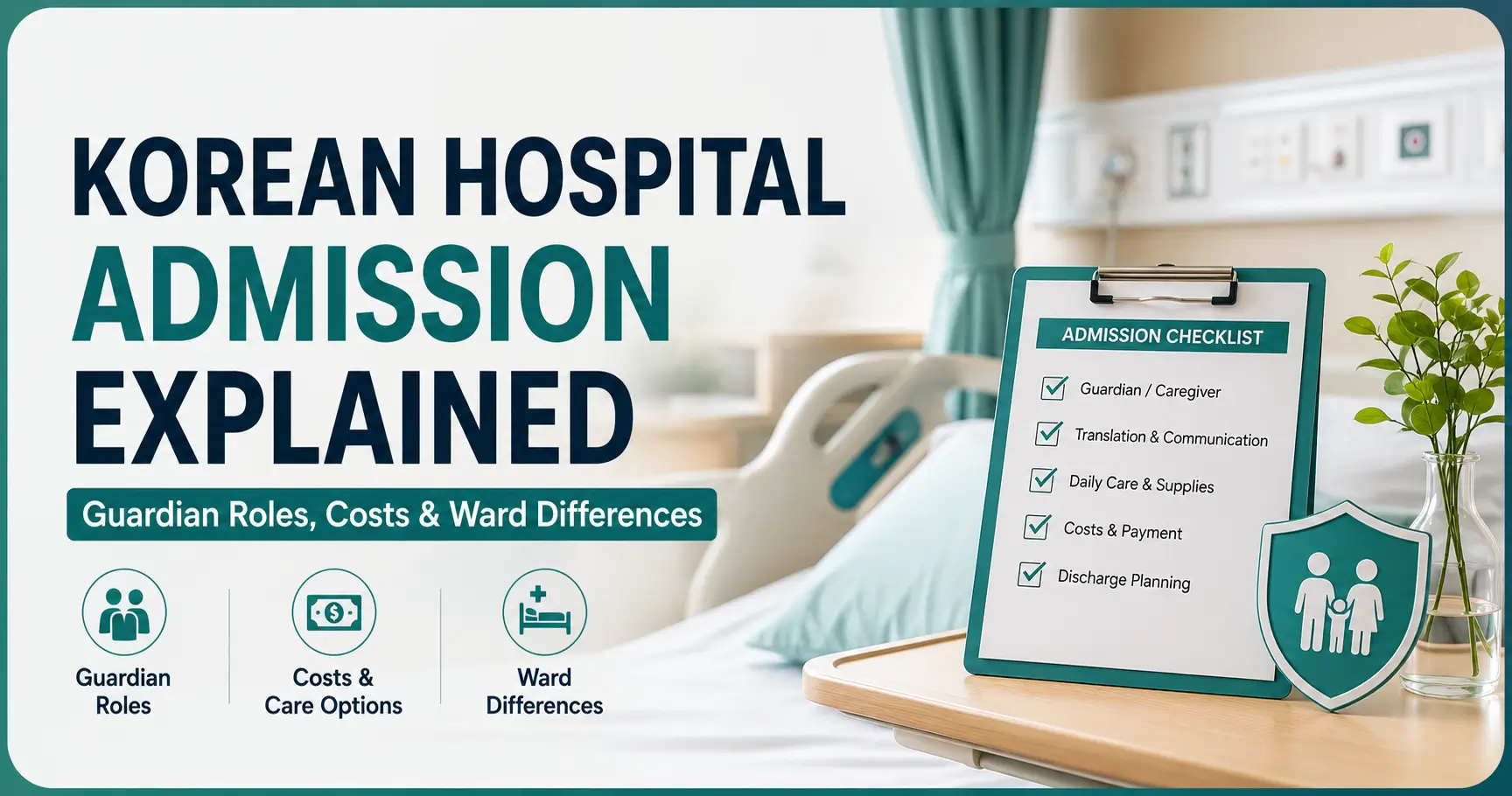
Navigating Korean Hospital Admission & Guardian Culture
A Korean hospital admission can feel strangely efficient until the first practical question lands on the bed rail: “Who is the guardian?” For many US travelers, expats, exchange students, medical tourists, and Korean American families, that word carries more weight than expected. Hospital admission culture in Korea often includes family care expectations because inpatient life may involve hospital staff, family guardians, and sometimes paid caregivers working in parallel.
The problem is not only cultural. It is practical. Who brings supplies? Who hears updates? Who helps the patient sit up, eat, translate, pay, and prepare for discharge? If you guess wrong, the first night can become a tiny storm of missed instructions, awkward phone calls, and wallet weather.
Here is the calm version:
- No suitcase full of panic.
- No heroic midnight spreadsheet.
- Just the questions, roles, costs, and ward differences that help you walk into admission with clearer eyes.
Note: Hospital admission culture in Korea refers to the way inpatient care may expect a “guardian” or caregiver to support daily non-medical needs, communication, errands, and family decision flow. Korea has expanded Integrated Nursing Care Services to reduce bedside family burden, but availability can vary by hospital, ward, diagnosis, staffing, room type, and policy.
Admission Night Reality Check
The first night is where expectations reveal themselves. In the US, many patients assume the hospital care team will handle nearly every bedside need. In Korea, the medical treatment may be excellent and fast, yet the surrounding care ecosystem can ask more of family, friends, or hired help than visitors expect.
Before the patient changes into hospital pajamas, ask three plain questions: Does this ward require a guardian? Is Integrated Nursing Care Service available? Who handles translation, billing, and discharge planning after hours?
Table of Contents
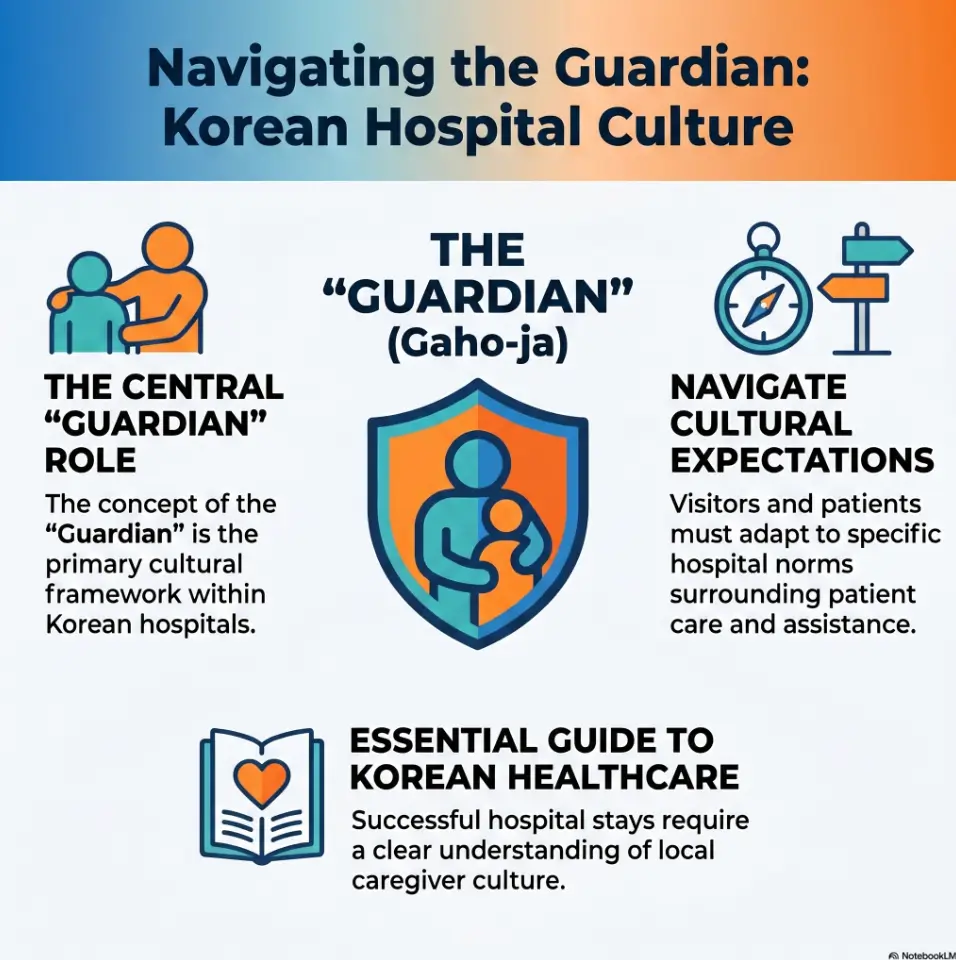
The “Guardian” Role: What US Patients May Not Expect
The bedside person is not just a visitor
In many Korean hospital conversations, the word “guardian” does not mean a legal guardian in the narrow US paperwork sense. It often means the person the hospital can rely on: the bedside helper, main contact, decision messenger, payment coordinator, and emotional anchor. That is a lot of hats for one tired human. It is less “visitor with grapes” and more “small family operations desk.”
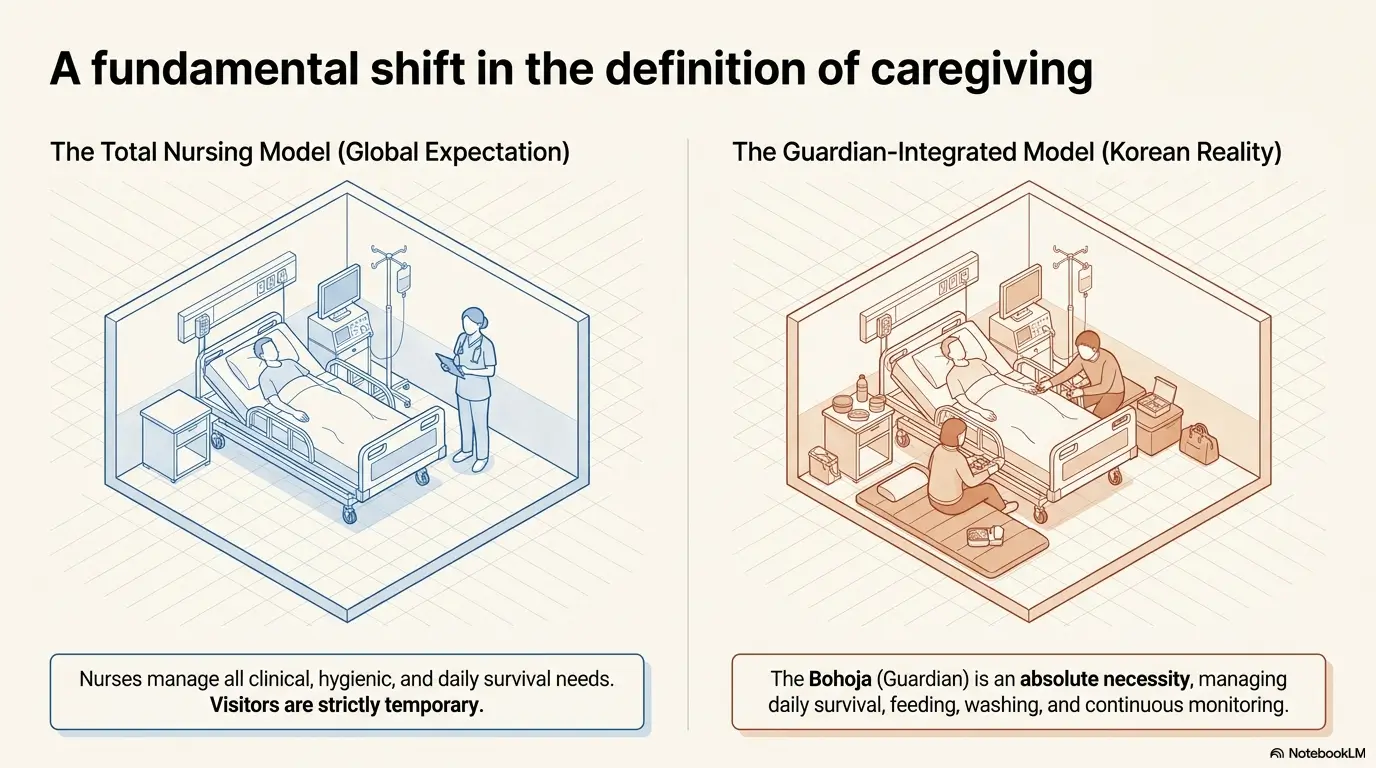
This can surprise Americans because US hospital visitors are usually treated as optional comfort support. They may help, of course, but they are not typically assumed to be part of the care workflow. In Korea, especially outside Integrated Nursing Care Service wards, the family presence may be more woven into the practical rhythm of the stay.
Family may become the translation bridge, errand runner, comfort anchor, and decision messenger
A guardian may be asked to clarify symptoms, remember medication history, buy supplies from a nearby shop, help with meals, receive physician updates, or relay information to relatives. For a foreign patient, the role can expand quickly if Korean-language communication becomes difficult.
This is why a bilingual cousin who “can help a little” may suddenly become the human switchboard. If you have ever watched one person translate lab results, explain insurance, calm an aunt, and locate slippers before 9 a.m., you know the sound of invisible labor humming under fluorescent lights.
Why this feels normal in Korea but surprising to Americans
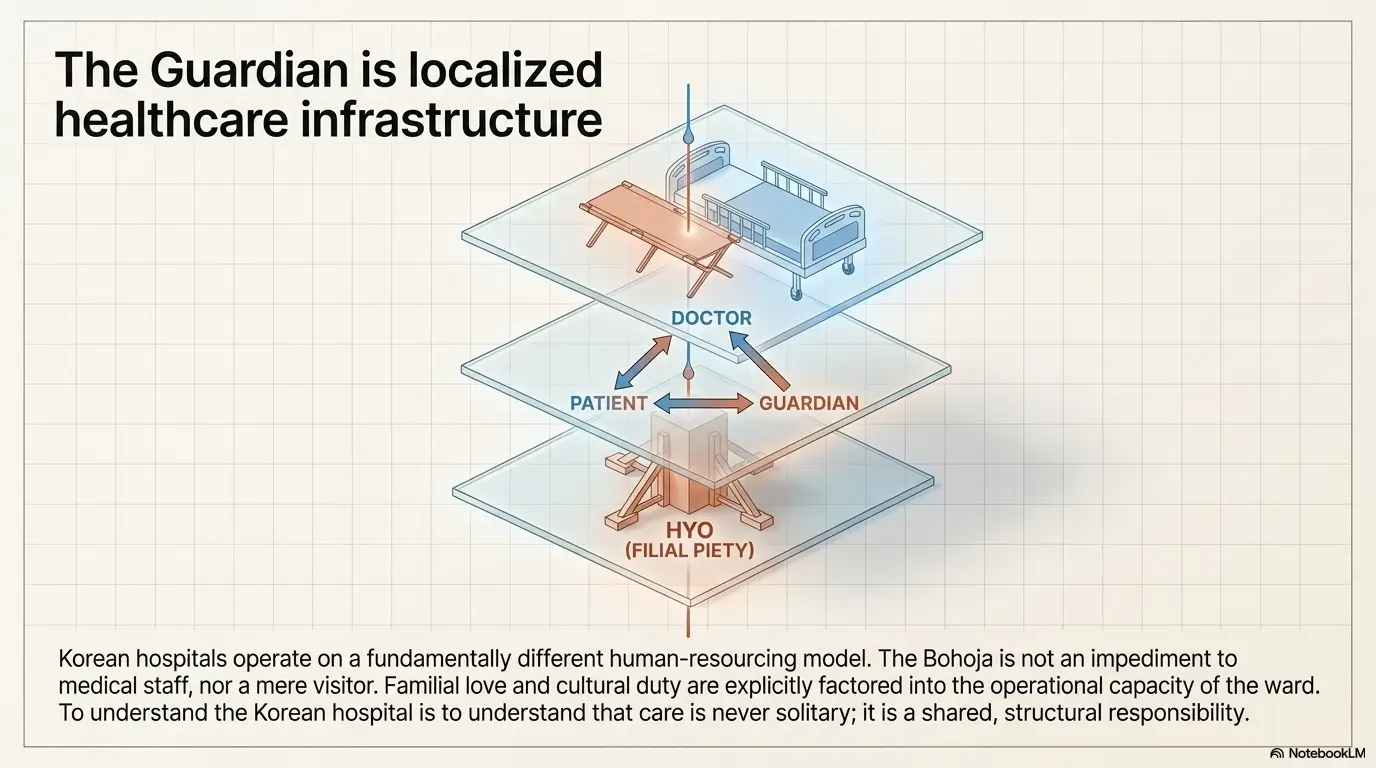
Korean family culture often assumes relatives step in during serious life events. Hospitalization is one of those moments. The expectation comes from a mix of filial duty, hospital staffing history, ward routines, and social trust. It is not simply that Korean families are “closer” or that US families are “less caring.” That would be too thin, like soup made from a rumor.
Different systems assign different work to different people. A US patient may expect the institution to absorb more daily care. A Korean hospital may assume a family guardian or caregiver will cover certain non-medical gaps unless the ward’s model says otherwise.
- Ask what the guardian is expected to do on that specific ward.
- Separate visitor rules from caregiver rules.
- Choose one reliable contact person before admission becomes hectic.
Apply in 60 seconds: Write down the name, phone number, language ability, and availability of the main hospital contact.
The Hidden System: Why Korean Hospitals Historically Leaned on Families
Nursing roles developed differently from many US hospital expectations
Korean hospitals have long balanced medical treatment, nursing workload, family support, and private caregiving in ways that differ from many US inpatient expectations. Nurses perform clinical care, medication administration, monitoring, and patient coordination. But hands-on daily living support has not always been included in the same way US patients may imagine.
That difference matters most when the patient cannot move easily, is recovering from surgery, needs help eating, or cannot advocate clearly. The patient may receive strong clinical care but still need a human nearby for ordinary tasks that suddenly become enormous. Water. Socks. Phone charger. The call button just out of reach. The tiny kingdom of bedside needs.
Daily living support can fall outside what US patients assume “hospital care” includes
In the US, inpatient stays are expensive enough that many families assume daily support is built into the bill. Korea’s system can feel more affordable in some areas, especially for those covered by National Health Insurance, but the surrounding caregiving expectations can be more family-dependent.
Foreign residents should understand the basics of Korean National Health Insurance for foreigners before a serious admission. Insurance can affect medical billing, but it does not magically answer every caregiver, translation, private room, or supply question.
The quiet gap between medical treatment and hands-on caregiving
The most important distinction is this: medical treatment and bedside life are related, but they are not identical. Treatment asks, “What is the diagnosis and plan?” Bedside life asks, “Who helps the patient get through the next six hours safely?”
That gap is where family expectations appear. Not because anyone wants confusion. Usually the opposite. Korean hospitals often move quickly, and family support can help information and logistics move quickly too. But for foreigners or Korean Americans who are used to different assumptions, the gap can feel like a trapdoor.
Show me the nerdy details
Think of inpatient care as three overlapping layers: clinical care, daily living assistance, and administrative coordination. Clinical care includes diagnosis, medication, procedures, monitoring, and physician orders. Daily living assistance includes eating, repositioning, hygiene support, mobility help, and comfort needs. Administrative coordination includes consent, billing, insurance, translation, discharge planning, and family updates. Integrated Nursing Care Service aims to bring more daily support inside the formal ward staffing model, but ordinary wards may still rely more heavily on family or paid caregivers.
Not Every Hospital Stay Is the Same: Ward Type Changes Everything
General wards may expect more family or paid caregiver involvement
A general ward can be the place where family expectations are most visible. The patient may share a room with several others. Families may rotate in and out. A paid caregiver may sit nearby for another patient. The ward may feel communal, efficient, and occasionally louder than a library being rearranged by pigeons.
Ask whether the patient is expected to have a guardian present overnight. Some wards may strongly prefer it. Others may discourage it because of space, infection control, or staffing model. Never assume based on one hospital story from a friend, because Korean hospital policies can differ sharply.
Integrated Nursing Care Service wards reduce the need for family guardians
Integrated Nursing Care Service wards are designed to reduce the need for family members or private caregivers to stay at the bedside. The core idea is simple: shift more patient support into a professional nursing and care assistant team structure.
That can be especially helpful for solo travelers, exchange students, working expats, and families who cannot stay overnight. It may also reduce friction among relatives. Fewer “Who is sleeping in the chair tonight?” negotiations. Fewer emotional spreadsheets.
Private rooms, shared rooms, ICU, pediatric care, and surgical recovery can follow different rhythms
Room type changes expectations. A private room may allow different family presence than a multi-bed ward. ICU often has stricter visitor rules. Pediatric admission may place heavier expectations on a parent or guardian. Surgical recovery can shift rules before and after the operation.
For medical tourists, the hospital’s international clinic or coordinator may explain many of these details. Still, get the ward-specific answer. The admission desk knows the general policy. The nursing station knows the night reality.
Korean Hospital Admission Support Map
General ward, integrated nursing ward, ICU, pediatric unit, private room, or surgical floor.
Mobility, confusion, pain, eating help, fall risk, post-op limits, or isolation rules.
One spokesperson, interpreter access, records, medication list, and emergency phone tree.
NHIS status, travel insurance, private insurance, caregiver cost, private room charges, and receipts.
Plain-English rule: do not ask “How do Korean hospitals work?” Ask “How does this ward handle this patient tonight?”
Integrated Nursing Care: Korea’s Big Attempt to Remove the Bedside Burden
What Integrated Nursing Care Service actually means
Integrated Nursing Care Service is Korea’s effort to reduce reliance on family guardians and privately hired caregivers during hospitalization. In these wards, nurses and care support staff take on more of the assistance that might otherwise fall to relatives.
For a foreign patient without local family, this can be the difference between a manageable stay and a logistical opera in five languages. It does not mean the family disappears from decisions. It means the family may not need to provide constant bedside support for daily needs.
Why it matters for exhausted families and solo patients
Caregiving fatigue is real. A hospital chair at 3 a.m. can make anyone philosophical. Or cranky. Usually both. Families may want to help but cannot safely stay every night, especially if they have jobs, children, long commutes, or health problems of their own.
For exchange students and expats, the stakes are sharper. They may not have relatives in Korea. Their closest support might be a roommate, school administrator, employer, or friend from a language exchange group who never expected to become a hospital liaison.
The catch: access may depend on hospital, bed availability, patient condition, and ward policy
Integrated Nursing Care Service is not a universal guarantee for every admission. Availability can depend on the hospital, department, bed status, diagnosis, patient condition, and staffing. A patient may be eligible in one setting but not another.
Ask early. Ask clearly. Ask again if the patient transfers wards. Hospital life has plot twists. A ward transfer can quietly rewrite the rules.
- Ask whether the service exists for the department admitting the patient.
- Ask whether a bed is available today, not in theory.
- Ask what family support is still expected even on that ward.
Apply in 60 seconds: Add “Integrated Nursing Care available?” to the top of your admission question list.
Who This Is For / Not For
For US visitors, expats, exchange students, medical tourists, and bilingual family members
This guide is for people who may enter a Korean hospital with US-shaped expectations. That includes tourists who get sick during travel, English teachers on E-2 visas, exchange students, remote workers, military families, medical tourists, and Korean Americans helping relatives.
It is also useful for people who already understand Korean culture socially but have not dealt with inpatient care. Knowing how to order gukbap politely is charming. Knowing who signs a consent form and who stays overnight is more useful when a fever spikes.
For Korean Americans trying to help relatives without misunderstanding the system
Korean American families can face a special kind of confusion. They may speak some Korean, know family etiquette, and still miss hospital-specific expectations. A relative may assume they understand everything because they are Korean American. That assumption can be unfair and exhausting.
If family roles, age hierarchy, or indirect requests create pressure, background on Korean family expectations and Korean indirect communication can help decode why no one asks directly until everyone is already tense.
Not for replacing direct hospital instructions, emergency guidance, or physician advice
This article is not medical advice, legal advice, insurance advice, or a substitute for hospital instructions. Infection-control rules, caregiver policies, consent requirements, and payment procedures can change by hospital and situation.
Use this guide to prepare better questions, not to override the people caring for the patient.
Money Block: Admission Readiness Checklist
| Question | Yes / No | Next Step |
|---|---|---|
| Do we know the ward type? | Yes / No | Call the admission desk or nursing station. |
| Do we know whether a guardian is expected? | Yes / No | Ask before nighttime visitor rules begin. |
| Do we have medication and allergy details? | Yes / No | Prepare a one-page note in English and Korean if possible. |
| Do we know insurance status? | Yes / No | Confirm NHIS, travel insurance, or private coverage. |
Neutral action line: Complete the missing “No” items before the first overnight period.
The Family Expectation Trap: What No One Explains at Admission
Here’s what no one tells you…
The family expectation trap is not usually a formal announcement. It appears in small moments. A nurse asks who will stay. A doctor calls one relative for updates. Someone says to bring personal items. A billing desk asks about insurance. The patient needs help eating. The family realizes the system has been assuming a coordinator all along.
That is why early questions matter. You are not being difficult. You are preventing confusion from breeding in the corners.
Admission may come with unspoken assumptions about who will stay, call, pay, translate, and decide
Ask who the hospital expects to contact for updates. Ask whether the hospital provides interpreter support or whether the family must arrange translation. Ask who receives billing explanations. Ask who should be present for rounds or major decisions.
US families may be used to patient portals, HIPAA-style privacy routines, and formal consent processes. Korea has its own legal and hospital procedures, and family involvement may still be socially expected. Do not rely on vibes. Vibes are poor medical administrators.
Why “Do I need a guardian?” should be asked before the first night
Nighttime is when vague plans become expensive. If the ward expects a guardian and no one can stay, you may need to discuss a paid caregiver, transfer options, Integrated Nursing Care availability, or other support. If overnight family presence is not allowed, you need a different plan for communication and patient comfort.
Short Story: The Chair Beside Bed 14
On a rainy Tuesday in Seoul, a Korean American daughter flew in thinking her father’s admission would work like the hospitals she knew in California. The surgery was scheduled. The doctor was kind. The nurses moved with brisk precision. Then evening arrived, and the smallest questions became the loudest ones. Who had his medication list? Who could explain his allergy to contrast dye in Korean?
Who knew whether he needed a guardian overnight? She sat in the plastic chair beside Bed 14, shoes tucked under her feet, learning the system one whispered question at a time. By midnight, she had made a one-page note: contacts, medications, insurance, interpreter request, caregiver availability. The next morning felt different. Not easy, exactly. But less foggy. The lesson was plain: in Korea, preparation is not only documents. It is assigning the human bridge before the river rises.
Common Mistakes US Families Make During Korean Hospital Admission
Mistake 1: Assuming nurses will provide all daily bedside assistance
Korean nurses may be highly skilled and busy, but the ward model determines what bedside assistance is built into staffing. Do not assume help with every daily need is automatic. Ask what the patient can expect when they need assistance eating, toileting, walking, or changing position.
Mistake 2: Waiting until nighttime to ask about caregiver rules
By nighttime, offices may close, staff may change, and options may narrow. Ask during admission, before fatigue turns every sentence into soup.
Mistake 3: Not asking whether paid caregivers are allowed, required, or recommended
Paid caregiver rules vary. Some hospitals may have lists, agencies, or informal recommendations. Others may restrict outside caregivers or have specific registration requirements. Ask what is allowed and whether the hospital has approved procedures.
Mistake 4: Treating translation as “nice to have” instead of safety-critical
Translation is not decoration. It affects consent, medication safety, pain reporting, discharge instructions, and billing clarity. If the patient does not understand Korean comfortably, ask for interpreter support or an international clinic contact as early as possible.
Foreign families who are new to Korean systems may also benefit from understanding Korean administrative culture. Hospitals can be efficient, but documents, timing, and department boundaries often matter more than casual reassurance.
- Ask caregiver questions before the evening shift.
- Do not rely on one relative’s old hospital experience.
- Treat language support as part of patient safety.
Apply in 60 seconds: Text the family contact: “Please ask the nursing station about guardian, caregiver, and translation rules today.”
Don’t Do This: Arriving With US Hospital Assumptions in Your Suitcase
Don’t assume visitor rules equal caregiver rules
Visitor rules and caregiver rules are not always the same. A hospital may limit casual visits while allowing a registered guardian. Or it may allow daytime visits but restrict overnight stays. Infection-control policy can change quickly during outbreaks or ward-specific risks.
Ask, “Who is allowed to stay with the patient, at what times, and under what registration rules?” That one sentence can save an entire family chat from becoming a courtroom drama.
Don’t assume every ward allows overnight family presence
Some wards may not allow overnight family presence because of safety, space, or infection-control concerns. Others may expect it. The only reliable answer is the answer from that ward today.
Don’t assume the same policy applies after surgery, isolation, transfer, or discharge planning
Hospital status can change. A patient may move from emergency admission to general ward, from surgery to recovery, from shared room to isolation, or from inpatient care to discharge planning. Each move can change who may stay, what help is needed, and who must receive instructions.
If the patient is in Korea for a planned procedure, pair hospital questions with broader logistics such as travel insurance for South Korea and local phone access. A working phone number can be as important as a toothbrush when the ward needs to reach you.
Money Block: Decision Card, Family Guardian vs Paid Caregiver vs Integrated Nursing
| Option | Best When | Trade-Off |
|---|---|---|
| Family guardian | A trusted person can stay, translate, and coordinate. | Fatigue, work conflicts, and uneven medical understanding. |
| Paid caregiver | The patient needs frequent daily support and family cannot stay. | Extra cost, availability, language fit, and hospital approval. |
| Integrated Nursing Care | Available on the right ward for the patient’s condition. | May depend on bed status, department, and eligibility. |
Neutral action line: Ask the nursing station which option is realistic for this patient tonight.
The Money Layer: Family Care, Paid Caregivers, and Insurance Confusion
Why caregiver costs may sit outside the bill you expected
Hospital billing and caregiver support are not always the same bucket. A patient may receive coverage for covered medical services while still facing out-of-pocket costs for private caregiving, private room upgrades, personal supplies, meals for guardians, or translation-related services.
For foreigners, NHIS status matters. Short-term tourists may rely on travel insurance or private payment. Long-term residents may have NHIS coverage depending on visa and enrollment rules. Korean Americans visiting relatives may be surprised that family ties do not automatically equal local insurance coverage.
What to ask about National Health Insurance, private insurance, and out-of-pocket care support
Ask the hospital billing desk what is covered, what is not, and what must be paid before discharge. If travel insurance is involved, ask whether the insurer requires preauthorization, English documents, itemized receipts, diagnosis codes, or direct billing approval.
If you are a foreign resident, review health checkup routines in Korea before a crisis arrives. Routine system literacy is boring until it becomes heroic.
The small receipt questions that prevent big wallet weather
Receipts matter. Ask for itemized statements. Ask whether caregiver expenses are paid to the hospital, an agency, or a caregiver directly. Ask whether receipts can be issued in English. Ask whether private insurance needs specific documentation.
Money Block: Quote-Prep List for Paid Caregiver or Extra Support
- Patient diagnosis, mobility level, and fall risk.
- Expected dates and hours of coverage.
- Language needs: Korean, English, or both.
- Hospital approval or registration requirements.
- Payment method, cancellation rules, and receipt format.
- Tasks allowed: meal help, toileting support, mobility assistance, errands, or observation.
Neutral action line: Use the same list for every caregiver conversation so quotes are comparable.
Communication Is Care: The Family’s Role in Decisions and Updates
Why hospitals may expect one reliable contact person
Hospitals need clarity. Families need updates. Patients need calm. These needs collide when five relatives call separately, each with a slightly different version of the story. Choose one spokesperson who can answer calls, take notes, ask questions, and update everyone else.
This is especially important in Korean families where hierarchy and respect may shape who speaks first. A younger bilingual relative may understand the doctor best, while an elder relative may hold decision authority. Discuss this before the hallway becomes a parliament.
How to prepare medication lists, diagnosis notes, allergies, and prior records
Create a one-page admission note. Include the patient’s full name, date of birth, passport or alien registration details if relevant, emergency contacts, medications, allergies, conditions, surgeries, insurance information, and preferred language.
If the patient has records from the US, bring summaries rather than a full paper mountain. A concise medication list beats a chaotic folder every time. The folder may look impressive, but the nurse cannot treat origami.
Let’s be honest…
Family communication can get messy because everyone is scared. Fear wears many costumes: anger, silence, over-questioning, dramatic group chats, and sudden expertise from a cousin who once watched a medical drama.
The cure is not perfect harmony. The cure is a simple communication plan.
A calm family spokesperson can prevent five panicked phone trees from blooming at midnight
Ask the hospital who will call with updates. Ask when physicians usually round. Ask whether the patient portal, text messages, phone calls, or in-person updates are used. Ask who handles discharge instructions.
For etiquette around names, titles, and respectful address, Korean titles versus first names can help families avoid small communication frictions with staff. Courtesy will not solve every problem, but it keeps the room breathable.
- Use one main contact for hospital updates.
- Keep a shared note for family questions.
- Confirm discharge instructions in writing when possible.
Apply in 60 seconds: Start a phone note titled “Hospital Questions” and add the first three things you need clarified.
When to Seek Help
Seek immediate hospital help if symptoms worsen, pain changes, breathing becomes difficult, confusion appears, or the patient feels unsafe
If the patient has worsening pain, breathing difficulty, sudden confusion, fainting, chest pain, severe bleeding, allergic symptoms, new weakness, uncontrolled fever, or feels unsafe, contact the nurse immediately. Do not wait for the family spokesperson. Do not wait for a better translation moment. Safety outranks etiquette.
If language is a barrier, use simple words, gestures, translation apps, and the call button. “Pain worse.” “Breathing hard.” “Dizzy.” “Confused.” Plain language can be powerful when time is thin.
Ask for a nurse manager, social worker, international clinic, or patient relations office if caregiving expectations are unclear
If the family is confused about guardian rules, paid caregiver options, discharge planning, or translation, ask who can formally explain the policy. Large hospitals may have international healthcare centers, social work teams, or patient relations offices. Smaller hospitals may route questions through the ward nurse or administration desk.
If an issue becomes formal, Korea’s public complaint culture and administrative channels may be useful background. Understanding the tone and steps behind the Korea public complaint system can help you stay calm and specific rather than turning frustration into fog.
Contact your insurer or embassy support resources if language, billing, or medical evacuation concerns arise
Travel insurers may need early notice for hospitalization. Embassies usually do not pay bills or give medical orders, but they may provide lists of local resources, help with emergency communication, or support citizens in serious situations.
For infection-control questions, follow hospital rules even if they feel strict. Visitor limits, masks, hand hygiene, and isolation policies are not personal insults. They are part of protecting patients, staff, and families in a building full of vulnerable people.
Next Step: Ask These Questions Before the First Hospital Night
“Does this ward require a family guardian or paid caregiver?”
Ask this exactly. Do not soften it into “Can someone visit?” Visiting and caregiving are different. The answer should include whether someone may stay overnight, whether registration is needed, and what tasks the guardian is expected to handle.
“Is Integrated Nursing Care Service available for this admission?”
Ask whether the service is available on the patient’s ward and whether the patient qualifies. If not, ask what support alternatives exist. The goal is not to win a debate. The goal is to map the night before the night maps you.
“Who should we contact for translation, billing, discharge planning, and after-hours changes?”
These four categories often live in different corners of the hospital. Get names, phone numbers, office hours, and backup contacts when possible.
One concrete action: create a one-page admission note with patient details, contacts, medications, allergies, insurance info, and caregiver availability
This single page is the humble hero of Korean hospital admission planning. It does not need fancy formatting. It needs accuracy. If possible, prepare it in English and Korean. If not, keep the English simple enough for translation.
Money Block: Mini Admission Support Calculator
Use this simple tool to estimate how many support hours your family may need to plan around. It does not store information.
Estimated uncovered support hours will appear here.
Neutral action line: Use the result as a conversation starter with the nursing station, not as a medical rule.
FAQ
Do Korean hospitals require family members to stay overnight?
Some Korean hospital wards may expect or allow a family guardian to stay overnight, while others may restrict overnight presence or provide more formal support through Integrated Nursing Care Service. The answer depends on the hospital, ward, patient condition, room type, infection-control rules, and current staffing model. Ask the nursing station directly before the first night.
What is a hospital guardian in Korea?
A hospital guardian is often the patient’s main support person and contact. This person may help with communication, supplies, translation, daily comfort, family updates, and practical decisions. It does not always mean a legal guardian in the US sense, so ask what the hospital expects the guardian to do.
Can I be admitted to a Korean hospital without family nearby?
Yes, many people are admitted without nearby family, including foreigners, students, and workers. The harder question is what support the patient will need during admission. Ask whether Integrated Nursing Care Service is available, whether paid caregivers are allowed, and whether the hospital has an international clinic or interpreter support.
What is Integrated Nursing Care Service in Korea?
Integrated Nursing Care Service is a ward model designed to reduce dependence on family guardians and private caregivers by providing more nursing and care support within the hospital team. Availability is not universal. It can vary by hospital, department, bed status, and patient condition.
Do Korean nurses provide the same bedside help as US nurses?
Korean nurses provide clinical care, monitoring, medication administration, and many essential nursing functions. However, the amount of daily living assistance included in the ward routine may differ from what US patients expect. That is why family guardians, paid caregivers, or Integrated Nursing Care wards may become important.
Can foreign patients hire paid caregivers in Korean hospitals?
Often, foreign patients can discuss paid caregiver options, but rules vary by hospital. Some hospitals may have approved processes, agencies, or restrictions. Ask whether paid caregivers are allowed, how they are registered, what tasks they can perform, what language they speak, and how payment and receipts work.
Are caregiver costs covered by Korean National Health Insurance?
Caregiver costs may not be covered the same way medical services are covered. Coverage depends on the patient’s insurance status, the service type, hospital billing structure, and whether care is part of a formal ward model. Ask the hospital billing desk and insurer before assuming reimbursement.
What should US travelers prepare before a hospital admission in Korea?
Prepare a passport, local contact number, insurance details, medication list, allergy list, diagnosis history, emergency contacts, payment method, translation plan, and caregiver availability. Also ask whether the ward expects a guardian, whether Integrated Nursing Care is available, and who handles after-hours communication.
Conclusion: Make the First Night Boring, in the Best Way
The first surprise in a Korean hospital is rarely the medical skill. It is the human architecture around the bed: guardian, family contact, paid caregiver, interpreter, billing desk, ward policy, and discharge plan. Once you see that architecture, the system becomes less mysterious.
Hospital admission culture in Korea often includes family care expectations because the bedside role has historically been shared across hospital staff, relatives, and sometimes hired caregivers. Integrated Nursing Care Service has changed that pattern in many places, but not everywhere and not for every patient.
Your next step is small enough to do in 15 minutes: create a one-page admission note with patient details, medications, allergies, insurance, emergency contacts, language needs, and caregiver availability. Then add three questions at the top: “Does this ward require a guardian?” “Is Integrated Nursing Care available?” “Who is our contact after hours?”
That is how the first night becomes boring.
And in a hospital, boring can be beautiful.
Last reviewed: 2026-05.