
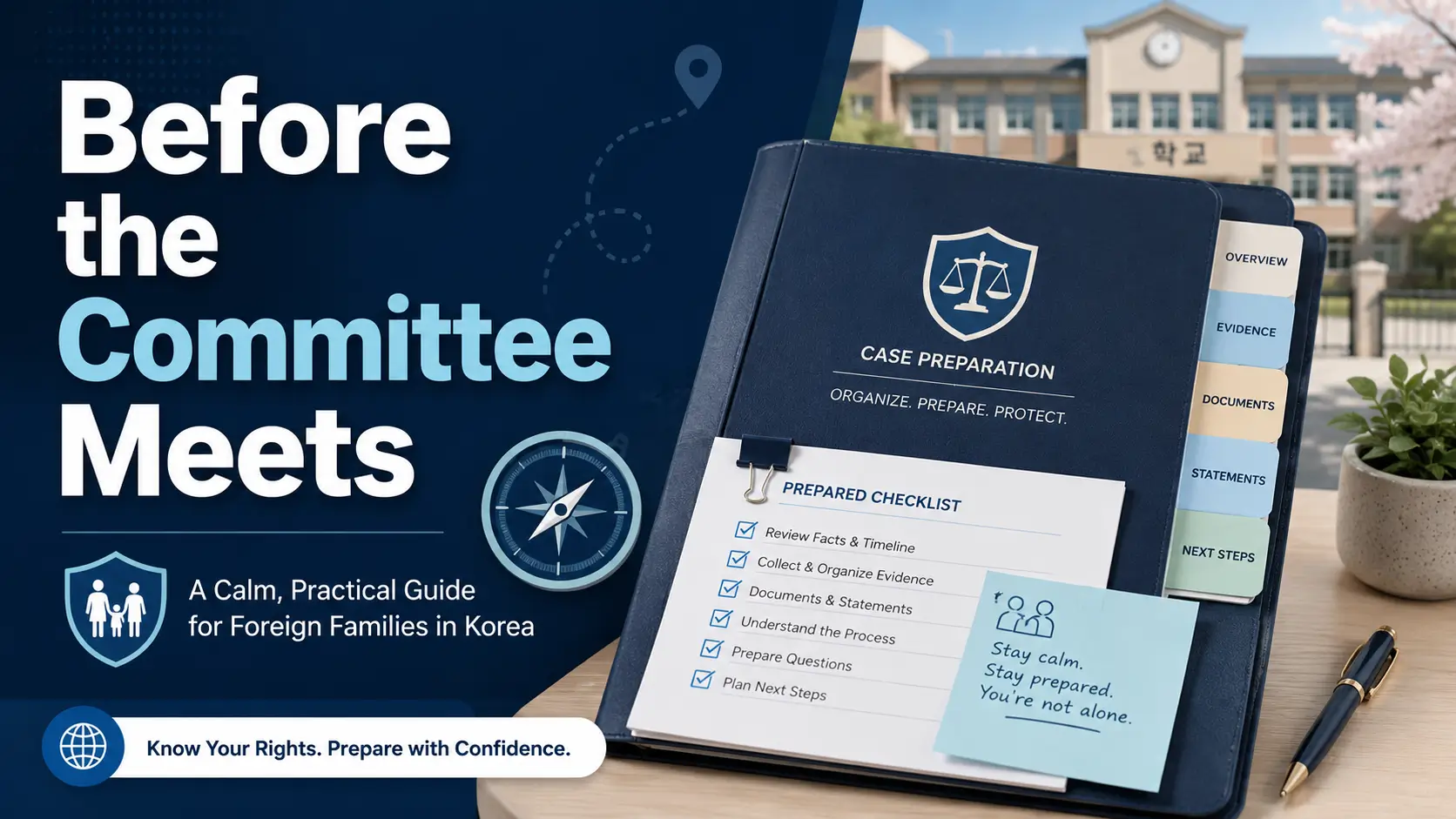
Parent guide for foreign families in Korea
Korea School Bullying Legal Process for Foreign Families:
What Parents Need to Do Before the Committee Meets
A school bullying notice in Korea can feel like a door closing too quickly. One moment your child is talking about lunch, KakaoTalk messages, or a hallway incident. The next moment, you are hearing unfamiliar words: hakpok, committee, Office of Education, written statement, protective measure, police report.
For foreign families, the hard part is rarely just the law. It is the speed, the Korean paperwork, the social pressure to “keep things quiet,” and the fear that one badly translated sentence could bend the whole story out of shape. This guide gives you a calm parent-facing map, not legal theater.
You will learn how school violence cases may move from report to district-level review, what victim and accused-student measures can look like, when police or juvenile procedures may run separately, and how to build a clean case packet before the room gets crowded with opinions.
Know the path
See how a school report can become an Office of Education committee case.
Protect the record
Build timelines, evidence labels, translation notes, and written requests.
Avoid costly mistakes
Handle private pressure, angry texts, unclear notices, and appeal risk carefully.
Best next step: do not wait for the committee date. Start the one-page case packet tonight. 🧭
Snapshot
This guide is for foreign parents, expat guardians, international-school families, and Korean-American households trying to understand Korea’s school bullying legal process. It explains what may happen after a report, how to prepare for a school violence committee, what documents to collect, when to seek qualified help, and how to take the next calm step without getting swallowed by rumor, pressure, or panic.
Table of Contents
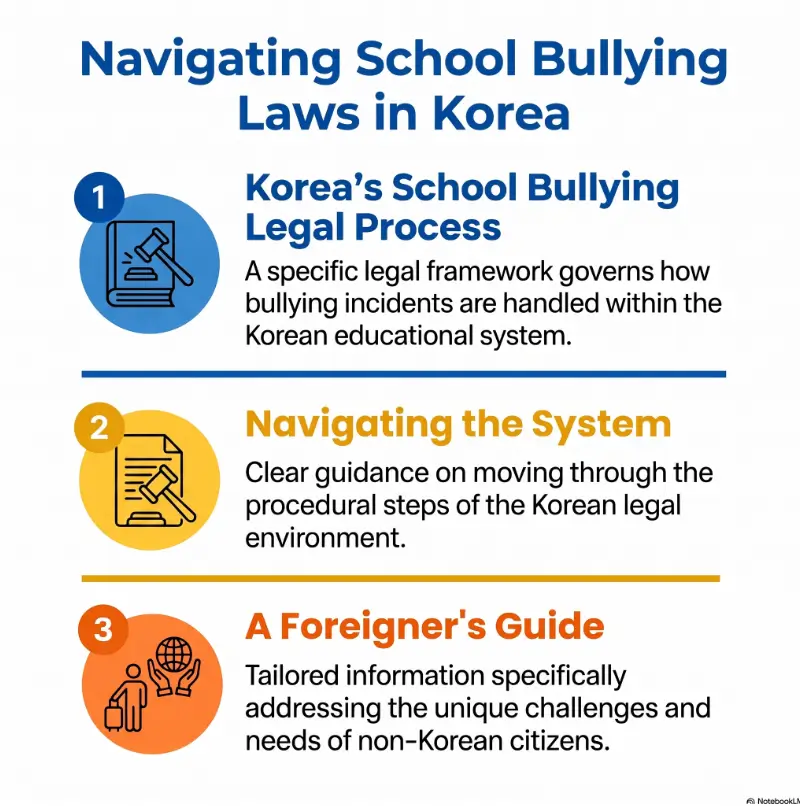
Before You Act: What This Guide Can And Cannot Do
A Korea school bullying case can affect safety, student records, school placement, family stress, police contact, and future schooling. That is why this article begins with a sober note: this is general information for parents, not legal advice for your child’s specific case.
The goal is to help you understand the common process, ask better questions, organize evidence, and avoid preventable mistakes. For a serious case, especially one involving injury, threats, sexual misconduct, cyberbullying, disability-related harm, or retaliation, consider speaking with a qualified Korean attorney, school counselor, medical professional, police officer, or consular resource.
Before you act
If your child is in immediate danger, separate the students first, seek medical care if needed, preserve evidence, and report urgent threats through the proper school or emergency channels. Do not treat a blog article, a group chat, or another parent’s story as a substitute for professional help.
Why Foreign Families Need A Different Map
Foreign families often face two processes at once: the official Korean school violence process and the unofficial social process around it. The official side may involve written reports, a committee, protective measures, disciplinary measures, and possible appeal. The unofficial side may involve parent chats, private apologies, translated rumors, and pressure to “solve it quietly.”
The danger is that the unofficial process can damage the official record. A rushed apology, vague statement, or angry message can later become part of the case atmosphere. Think of every written word as a small tile in a mosaic. Some tiles shine. Some cut.
Two Reader Types This Guide Serves
If your child may be the victim, your priorities are safety, documentation, school response, recovery support, and preventing retaliation. If your child has been accused, your priorities are fairness, a careful statement, avoiding panic admissions, understanding possible measures, and getting the child support before the story hardens.
Witness families need care too. A witness can become a target, a translator, a rumor carrier, or a key factual voice. Help your child describe only what they personally saw, heard, received, or sent.
Official Resources To Keep Nearby
For legal text, the most useful starting point is Korea’s official English law database. For education policy updates, the Ministry of Education’s English pages may also help parents find official context. These links are not a substitute for legal advice, but they are steadier than playground folklore.
First 24 Hours: The Quiet Window That Shapes The Case
The first day after a school bullying incident is not for perfect strategy. It is for preserving facts before the story starts changing shape. Children forget sequence. Adults fill gaps. Chat rooms delete messages. Screenshots disappear into the digital fog.
Your job is to slow the room down. You do not need to accuse, defend, or negotiate immediately. You need a timeline, evidence, safety needs, and a written request for the current official status.
Write The Timeline Before Memories Melt
Start with a simple sequence: date, time, place, people involved, what happened, who saw it, what was said, what evidence exists, and what the school did afterward. Do not decorate the timeline with conclusions. “A pushed B near the stairwell at 2:10 p.m.” is stronger than “A has always been cruel.”
Ask your child to describe events once in a calm setting. Avoid repeated interrogations. A tired child trying to please an anxious parent can accidentally revise the story with each retelling.
Key takeaway
The best first document is not a dramatic letter. It is a clean timeline with dates, locations, names, witnesses, evidence, and unanswered questions.
Save Evidence Before It Vanishes
Save screenshots of KakaoTalk messages, Instagram DMs, class group chats, gaming chats, photos, school emails, medical records, and teacher messages. Preserve the full screen where possible, including date, time, sender, and context. A cropped insult may feel powerful, but a full thread is usually more useful.
If there are injuries, take clear photos in good light and seek medical care when appropriate. Ask for documentation that explains the injury without turning the doctor into a detective. Medical records can support timing, pain, treatment, and recovery needs.
Ask What Has Been Officially Reported
Foreign parents often hear three different versions of the same event: what a teacher said verbally, what another parent heard, and what was formally reported. Ask the school in writing whether a school violence report has been filed, whether the matter has been sent or may be sent to the district Office of Education, and what deadlines apply.
If your family needs interpretation, request it early. Do not wait until the committee meeting to discover that “I understand conversational Korean” is not the same as “I understand legal-school procedure Korean under stress.”
| First-day task | Why it matters | Parent-friendly wording |
|---|---|---|
| Write a timeline | Prevents memory drift | “Here is our current factual timeline. Please confirm what the school has recorded.” |
| Save full evidence | Shows context, dates, and sequence | “We are preserving the full chat thread, not only selected screenshots.” |
| Request status | Clarifies whether the official process has started | “Please tell us whether this has been officially reported as school violence.” |
| Ask for interpretation | Reduces translation errors | “Please advise what interpretation support is available for parents.” |
What Counts As School Bullying In Korea?
Korea’s school violence framework is not limited to a hallway fight. It can include physical violence, threats, confinement, extortion, coercion, defamation, insult, sexual violence, cyberbullying, ostracism, and repeated behavior that causes physical, mental, or property harm to a student.
For foreign families, the hardest cases often sit in the gray zone: exclusion from group chats, mocking Korean ability, pressuring a student to buy snacks, spreading edited photos, or making “jokes” that only one child finds funny. A single incident may matter. A pattern may matter more.
Physical, Cyber, And Social Harm
Physical harm is usually easier to explain because there may be visible injury, CCTV, witnesses, or medical records. Cyberbullying is more slippery. It can move across KakaoTalk rooms, anonymous accounts, gaming platforms, photo sharing, and school rumor loops.
Social exclusion can be difficult for foreign parents to document because it may look quiet from the outside. A child may still attend class, eat lunch, and come home with no bruises, while the real damage happens in the invisible architecture of peer groups.
The Gray Zone Foreign Families Often Miss
Language-based harassment can be minimized as teasing. Cultural misunderstanding can be used as a fog machine. A foreign student may not know which Korean words were insulting, threatening, sexual, or discriminatory until another adult explains them.
Write down exact Korean phrases when possible. Do not replace them too quickly with soft English words. “Teasing” and “threat” are not twins. They are neighbors with very different keys.
When “Kids Being Kids” Becomes Formal
Minor conflict, rude behavior, and one-time misunderstandings do happen in schools. Not every painful moment becomes a formal school violence case. But when there is harm, repetition, power imbalance, coercion, sexual conduct, threats, cyber spread, or retaliation, the school may need to treat the matter formally.
The practical question is not “Is this dramatic enough?” The better question is: “What happened, what harm resulted, what evidence exists, and what safety step is needed now?”
Useful internal reading for parents in Korea
If the case overlaps with family safety, reporting concerns, or emotional support, these related guides may help: child protection in Korea, mental health visits in Korea for foreigners, and medical translation in Korea.

The School Report Path: From Homeroom Teacher To Office Of Education
A Korea school bullying case often begins with a parent, student, teacher, counselor, or school administrator reporting an incident. The school may first gather basic facts and take immediate safety steps. Depending on the situation, the matter may move beyond the school to the relevant district Office of Education.
Parents sometimes assume the principal controls everything. In many school violence matters, district-level structures matter. That distinction is important because the person who comforts you in a school office may not be the person who decides the formal outcome.
How A Complaint Enters The System
A complaint may begin with a written parent email, a student disclosure, a teacher report, a counselor conversation, a police contact, or evidence sent to the school. If the school receives information that suggests school violence, ask how it is being recorded and what procedure follows.
Keep your first message calm and factual. The subject line can be simple: “Request for official process status regarding school violence report.” A boring subject line is sometimes a gift. It lets the facts walk in wearing shoes.
When The School Tries To Keep It Informal
Some schools may encourage a private apology, a teacher-mediated conversation, or a “let’s not escalate” approach. Informal resolution may be appropriate for some lower-risk misunderstandings, but it can be dangerous when there is injury, threat, sexual misconduct, cyber spread, retaliation, disability-related harm, or a major factual dispute.
Ask this question in writing: “Is the school treating this as a formal school violence matter or an informal student conflict? Please explain the current status and next procedural step.”
What The Office Of Education May Review
The district Office of Education’s school violence committee may review issues such as prevention, victim protection, aggressor-student guidance and discipline, and dispute mediation. Parents may be asked to submit statements, evidence, and requests related to safety, recovery, discipline, or correction of facts.
Do not assume the committee will automatically understand your child’s language barrier, disability, immigration stress, or international-school context. State relevant context clearly and briefly, with evidence where possible.
Process map: the parent version
1. Incident
Harm, threat, exclusion, cyber issue, or reportable event
2. School report
Teacher, counselor, principal, or parent records facts
3. District review
Office of Education committee may review evidence
4. Measures
Victim protection, discipline, counseling, separation
5. Challenge or parallel track
Appeal, police, juvenile, or support process may continue
School Violence Deliberative Committee: The Room Behind The Curtain
The school violence committee is where many families feel the temperature rise. By the time parents enter the room, the case may already have a record: school notes, submitted statements, screenshots, teacher summaries, medical documents, and prior messages.
That does not mean the outcome is already sealed. It does mean your preparation should begin before the meeting, not in the elevator on the way there.
What Evidence The Committee Usually Wants
The committee may look for sequence, credibility, harm, intent, repetition, witness accounts, digital evidence, injury records, school response, and what each side is requesting. Parents should avoid flooding the committee with emotional material that does not prove anything.
A clean evidence list is better than a chaotic folder. Label each item with a date, source, short description, and why it matters. For example: “Screenshot A, March 4, KakaoTalk class chat, shows student X telling others not to sit with Y.”
What Parents May Be Asked To Submit
Parents may submit written statements, evidence, requests for protective measures, explanations of harm, translation notes, medical documents, and witness information. Accused-student families may submit a factual response, context, correction of errors, evidence of misunderstanding, or support steps already taken.
The statement should not read like a social media post. It should read like a calm record prepared for adults who have limited time and serious responsibility.
What Is Already Decided Before The Hearing?
Parents often wonder whether the committee is a real review or a performance. The honest answer is that preparation matters because written materials can shape how people understand the facts before anyone speaks. That is true in schools, hospitals, courts, and nearly every room where humans read files before meeting people.
So do not depend on charm, tears, anger, or improvisation. Prepare the record. Bring a concise statement. Ask for interpretation. Make your request specific.
Show me the nerdy details
In a school bullying case, evidence tends to matter in four layers: occurrence, context, harm, and requested remedy. Occurrence shows whether something happened. Context shows whether it was isolated, repeated, retaliatory, coercive, sexual, discriminatory, or part of group behavior. Harm shows physical injury, mental distress, attendance impact, treatment need, or educational disruption. Remedy explains what the family wants the school or district to do next: separation, counseling, correction of records, no-contact instruction, class change, treatment support, or another measure. If your packet only proves that everyone is upset, it is weak. If it links facts to harm and harm to a specific request, it becomes far easier to review.
Victim Protection And Accused Student Measures: What Can Actually Happen
Korea’s school violence process is not only about punishment. It also addresses victim protection, aggressor-student guidance, education, discipline, mediation, and the prevention of further harm. Foreign parents should understand both sides of the measure list, even if they feel firmly on one side of the case.
Why? Because a family that understands the possible outcomes can make better requests, respond more carefully, and avoid being surprised by record consequences.
Victim Protection Is More Than An Apology
Victim protection may include counseling, temporary protection, treatment, recovery support, class change, or other needed protective steps. In some cases, attendance concerns may arise if a child cannot safely or emotionally return to class right away.
Parents should connect each requested protection to a concrete need. “My child is scared” matters, but “My child has panic symptoms when entering the same classroom and has a clinic appointment scheduled” is more actionable.
Accused Student Measures Can Be Serious
Measures for an aggressor student may range from a written apology and no-contact order to school service, community service, special education, counseling, suspension, class change, transfer, or expulsion in applicable settings. Some measures may affect school records, so accused-student families should not treat the first statement casually.
If your child is accused, do not coach them to deny everything reflexively. Also do not pressure them to confess to words they do not understand. Help them tell the truth clearly, including what they did, did not do, saw, heard, sent, received, or misunderstood.
Disabled Students Need Extra Care
When disability-related harm is involved, documentation becomes even more important. The issue may include not only the incident itself, but also communication needs, vulnerability, school support, accommodations, and whether adults understood the student’s situation.
For neurodivergent students, students with language delays, or students with physical or sensory disabilities, ask whether the school has considered support needs during interviews, meetings, statements, and safety planning.
| Situation | Free or low-cost step | When paid help may be worth considering |
|---|---|---|
| Minor one-time conflict with clear facts | Written timeline, teacher meeting, parent request for monitoring | If the school record is inaccurate or retaliation begins |
| Repeated cyberbullying | Save full threads, report to school, request safety measures | If images, threats, sexual content, or anonymous accounts are involved |
| Injury or medical treatment | Medical visit, photos, school incident record | If there is a police report, serious injury, or cost dispute |
| Accused student facing serious discipline | Careful factual statement and evidence review | If transfer, suspension, record impact, or juvenile process is possible |
| Language barrier | Ask for interpretation and translate evidence labels | If Korean notices, statements, or hearing preparation are unclear |
Common Mistakes Foreign Families Make Under Pressure
Pressure makes smart people clumsy. In school bullying cases, the clumsiest moments often happen before the official meeting. A parent sends a volcanic text. A child rewrites the story five times. Someone signs a Korean document they only half understand.
The goal is not to become cold. The goal is to become careful.
Mistake: Trusting Verbal Promises Without Written Confirmation
A teacher may sincerely say, “We will handle it.” Another parent may say, “We will make sure it stops.” Those words may be comforting, but they are not a record. Follow important conversations with a short confirmation email.
Try: “Thank you for speaking with us today. To confirm our understanding, the school will review the incident, tell us whether it has been officially reported, and advise next steps by Friday.”
Mistake: Sending Angry Texts To The Other Family
Anger is understandable. Angry texts are rarely useful. They can distract from your child’s case, create a separate conflict, or become evidence of parental pressure.
If you must communicate with the other family, keep it short, factual, and preferably through the school when the matter is serious. Do not negotiate safety in a late-night chat room while everyone’s nervous system is holding a drum solo.
Mistake: Ignoring Korean-Language Notices Until The Deadline Bites
A Korean notice may look routine until it contains a deadline, hearing date, requested statement, or appeal period. Translate notices quickly and save the original. If you are unsure, ask the school to explain the deadline in writing.
Families who already use Korean school services may find it helpful to keep a translation workflow ready. Your guide to Korean mobile apps may also be useful if school notices, banking, maps, or identity tools are involved.
Parent checklist: do less damage today
- Do not post names, photos, screenshots, or accusations online.
- Do not sign Korean documents you cannot fully understand.
- Do not let your child delete messages.
- Do not promise silence in exchange for a private apology.
- Do not assume international schools follow the same process as a US school.
Do Not Do This: Informal Settlements That Backfire
Private settlement pressure can arrive wearing polite clothes. “Let’s not hurt the children.” “A committee will make everyone suffer.” “Just accept the apology.” “Do not ruin my child’s future.” Some of these concerns may be sincere. They can also pull families away from safety and documentation.
Not every conflict needs a formal fight. But serious harm should not be traded for a handshake that evaporates the next week.
Do Not Trade Silence For A Private Promise
A private promise may not protect your child at school, correct the official record, address group behavior, stop retaliation, or pay for treatment. If a resolution is discussed, ask what will be written, who will enforce it, and how safety will be monitored.
If you are asked to sign anything, pause. Translate it. Ask what rights, claims, school procedures, or future statements it may affect. If the case is serious, get professional review before signing.
Do Not Post Accusations Online
Online accusations can create defamation risk, privacy problems, school discipline issues, or harm to minors. Even if you believe every word is true, public posting can make the situation harder to solve.
If you are furious, write the message in a private draft and do not send it. Then turn the useful facts into a timeline. Fire is warm in a hearth and disastrous on curtains.
For families navigating speech, online posts, and reputation risk in Korea, this related guide on defamation law in Korea may help you understand why public accusations can become their own problem.
Do Not Let An Apology Replace Facts
An apology may be healing, but it is not always a complete solution. Ask whether the apology includes acknowledgment of specific conduct, agreement not to contact or retaliate, correction of rumors, support for recovery, and school monitoring.
For accused-student families, an apology should also be careful. A child can apologize for harm without admitting to exaggerated facts. When the facts are disputed, wording matters.
Police, Juvenile Court, And School Process: Three Tracks, One Child
A school violence committee decision is not the same as a police outcome. Korea school bullying cases may involve school procedure, criminal complaint, juvenile procedure, civil compensation, or child protection concerns, depending on the facts.
Parents need separate folders for separate tracks. Mixing them together is how documents get lost and decisions get misunderstood.
When Bullying May Become A Police Case
Police contact may become relevant when conduct involves assault, injury, threats, sexual misconduct, coercion, extortion, property damage, illegal filming, image sharing, or severe cyber conduct. The school may still proceed with its process even if police or juvenile procedures are separate.
If police are involved, do not treat a school statement as a casual note. Ask what you are being asked to provide, who will receive it, and whether you should seek legal help before your child gives a formal statement.
Juvenile Procedures For Younger Students
When a child is young, the response may differ from an adult criminal case. Juvenile procedures can focus on protection, guidance, correction, and rehabilitation. That does not mean the matter is harmless. It means the system may use a different doorway.
Parents should ask whether any police, juvenile, child protection, or court-related contact exists. Get the name of the agency, the date, the requested action, and the document deadline.
Keep Documents Separated
Create separate folders: school, Office of Education, medical, police, translation, and parent communication. Each folder should have a one-page index. This sounds fussy until you are trying to find one screenshot five minutes before a meeting.
| Track | Main question | Common documents | Parent caution |
|---|---|---|---|
| School | What happened and what safety steps are needed? | Teacher notes, school emails, incident report, statements | Confirm whether the case is formal or informal |
| Office of Education | What committee measures are appropriate? | Evidence packet, parent statement, medical records, translation notes | Prepare before the hearing date |
| Police or juvenile | Did conduct violate criminal or juvenile rules? | Complaint, statement, evidence, summons, investigation notes | Consider legal help before formal statements |
| Medical or counseling | What harm and recovery needs exist? | Clinic records, treatment plan, attendance notes | Keep records factual and dated |
Language Access: The Translation Gap That Can Change The Story
Language access is not a luxury in a school bullying case. It is part of accuracy. A parent who misunderstands a notice may miss a deadline. A child who cannot explain nuance may sound evasive. A translated statement that softens threats into teasing may shrink the harm.
Ask for interpretation support early and keep Korean and English versions aligned. The goal is not perfect literary translation. The goal is procedural clarity.
Request Interpretation Early
Send a written request: “Because our family needs English-language support for accurate participation, please tell us what interpretation or translation support is available for meetings, notices, and committee-related communication.”
If the school cannot provide interpretation, consider whether a professional interpreter, bilingual advocate, attorney, or trusted adult can help. Avoid relying on your child as the main interpreter in a case that involves their own stress.
Translate Evidence Labels, Not Just The Final Statement
Many parents translate the final letter but leave evidence messy. Translate the labels too. A reviewer should be able to understand what each screenshot is, who sent it, when it was sent, and why it matters.
For example, write: “Evidence 3: KakaoTalk message sent by student B on May 10 at 8:42 p.m. The Korean phrase means ‘Do not talk to her tomorrow.’ This supports the exclusion pattern described in the timeline.”
Small Wording, Large Consequences
Words like joke, threat, exclusion, coercion, apology, reconciliation, retaliation, and settlement can carry different weight. If a Korean document uses a term you do not fully understand, ask for an explanation before signing or responding.
Translation packet checklist
- Original Korean notice saved as a PDF or clear photo.
- English working translation attached behind it.
- Deadline highlighted in both versions.
- Names, dates, and school terms checked twice.
- Unclear words listed in a “questions for school” section.
Appeals, Objections, And When To Seek Help Immediately
If the decision feels wrong, incomplete, or unfair, families may have options to object or pursue administrative appeal depending on the measure and procedure. The appeal should not be treated as a second first draft. It should begin with the record you built before the first decision.
Deadlines matter. Translation matters. The exact decision document matters. If you are considering an appeal, move quickly and ask a qualified professional to review your options.
What To Collect Before Challenging A Measure
Collect the decision document, submitted statements, evidence list, school communications, meeting notices, medical records, interpretation requests, and any explanation of reasoning. If you believe facts were misunderstood, identify the exact error and the evidence that corrects it.
Do not simply write, “This is unfair.” Write, “The decision states X, but Evidence 4 and Teacher Email 2 show Y.” Specific beats thunder.
When Professional Help Is Worth Considering
Professional help may be worth considering when the case involves serious injury, sexual misconduct, criminal allegations, student-record consequences, school transfer, disability-related bullying, language-based harassment, immigration stress, retaliation, or an upcoming hearing date you do not understand.
A budget-conscious family may start with a one-time document review or consultation. A higher-risk case may require more active representation. The best way to choose a provider is to ask about school violence experience, language support, fees, expected scope, document preparation, and communication style.
Questions To Ask Before Paying For Help
Whether you contact an attorney, interpreter, counselor, or school-violence consultant, ask practical questions before paying. You are not buying magic. You are buying judgment, clarity, and process support.
| Provider type | Useful for | Questions to ask before paying |
|---|---|---|
| Korean attorney | Serious discipline, police, appeal, disputed facts | Have you handled school violence committee cases? What is included in the fee? |
| Interpreter or translator | Meetings, notices, evidence labels, parent statements | Can you handle school/legal terminology? Can you keep terms consistent? |
| Medical professional | Injury, anxiety, sleep issues, treatment documentation | Can you document symptoms, treatment, and attendance impact clearly? |
| Counselor | Recovery, trauma support, school return planning | Can you coordinate school-related support if needed? |
| Consular resource | Emergency support, navigating local systems | What can and can’t you assist with in school or police matters? |
Next Step: Build A One-Page Case Packet Tonight
When everything feels too large, make it smaller. A one-page case packet helps parents speak clearly, school staff respond more accurately, and professionals review the matter faster. It also protects you from the parent-brain blizzard that arrives five minutes before a meeting.
The packet does not need to be fancy. It needs to be clean, dated, and easy to scan.
Page One: Incident Timeline
List each incident in order. Include date, time, location, students involved, witnesses, what happened, evidence, and school response. If something is unknown, write “unknown.” Do not guess.
Page Two: Evidence List
Number every item. Screenshot 1. Teacher email 2. Medical record 3. Photo 4. Witness note 5. Then add a one-sentence explanation for each item. This turns a messy folder into a readable record.
Page Three: Requested Outcome
State what you are asking for. Examples may include separation, no contact, counseling, correction of rumors, class monitoring, treatment support, interpretation, written process status, or review by the appropriate office. Make the request proportionate to the facts.
Page Four: Translation Notes
List Korean terms, unclear phrases, translated screenshots, and any words that may change meaning. If your child heard a Korean phrase but does not know the spelling, write the sound as best as possible and ask for help confirming it.
Copy-ready email structure
- Thank the school for speaking with you.
- State that you are requesting official process status.
- Attach the timeline and evidence list.
- Ask whether the matter has been formally reported as school violence.
- Ask what deadlines, meetings, or parent statements are expected.
- Request interpretation support if needed.
FAQ: Korea School Bullying Legal Process For Foreign Families
Can A Foreign Child File A School Bullying Complaint In Korea?
Yes. A foreign child attending school in Korea can report school bullying concerns. The family should ask the school how the complaint is being recorded, whether it is treated as a formal school violence matter, and what support is available for language access.
Does The School Have To Report Bullying To The Office Of Education?
Many school violence matters may move through formal school and district-level procedures. The exact path can depend on the facts and applicable rules. Parents should ask the school in writing whether the matter has been officially reported and what the next procedural step is.
Can Parents Attend The School Violence Committee Meeting?
Parents or guardians may be involved in the process and may be asked to submit documents or attend meetings depending on the procedure. Ask the school or Office of Education what participation is expected, what documents are needed, and whether interpretation support is available.
What Happens If My Child Is Accused Of Bullying In Korea?
Do not panic and do not dismiss it. Ask for the official allegation, evidence, deadlines, and process status. Help your child prepare a truthful factual statement. If serious discipline, police contact, or record impact is possible, consider legal advice before submitting a formal response.
Can School Bullying Affect A Student’s Korean School Record?
Some measures may have record consequences depending on the type of measure and current rules. Because record rules can matter for future schooling, families should confirm the specific consequence of any proposed or decided measure with the school, Office of Education, or a qualified professional.
Can Bullying Become A Police Case In Korea?
Yes, some conduct may create a separate police or juvenile track, especially if there is injury, threat, sexual misconduct, coercion, extortion, image sharing, or severe cyber conduct. The school process and police process should be tracked separately.
Should Foreign Parents Hire A Korean Lawyer For School Bullying?
Not every case requires a lawyer. A lower-risk misunderstanding may be handled with careful documentation and school communication. Legal help may be worth considering when facts are disputed, discipline is serious, police are involved, deadlines are unclear, or the family cannot understand Korean documents confidently.
What Should I Do If The School Pressures Us To Settle Privately?
Ask for the official process status in writing before agreeing to anything. Do not sign documents you cannot fully understand. If the case involves injury, threats, sexual misconduct, cyber spread, retaliation, or major record consequences, seek qualified help before accepting a private resolution.
Can I Ask For An Interpreter During The Process?
Yes. Ask early and in writing. If school-provided interpretation is not available or not enough, consider arranging qualified language support. Avoid making your child interpret meetings about their own case whenever possible.
Your 15-Minute Parent Action Before The School Calls Again
School bullying cases make parents feel as if they must solve everything at once. You do not. Tonight, do one useful thing: build the first page of the packet.
Open a document. Write the date. Add five headings: incident timeline, evidence list, safety concerns, requested next step, translation questions. Fill in only what you know. Mark unknowns honestly. Save the file with today’s date.
Then send one calm email asking the school to confirm the official process status, deadlines, and interpretation support. That single written request will not solve the whole case, but it can give the next conversation a floor. In a difficult room, a floor is no small thing.
Final parent move
Do not chase every rumor tonight. Preserve facts, request status, ask for language support, and keep your child safe. Procedure becomes less frightening when it is turned into pages, dates, and one steady next step.
Last reviewed: 2026-07