
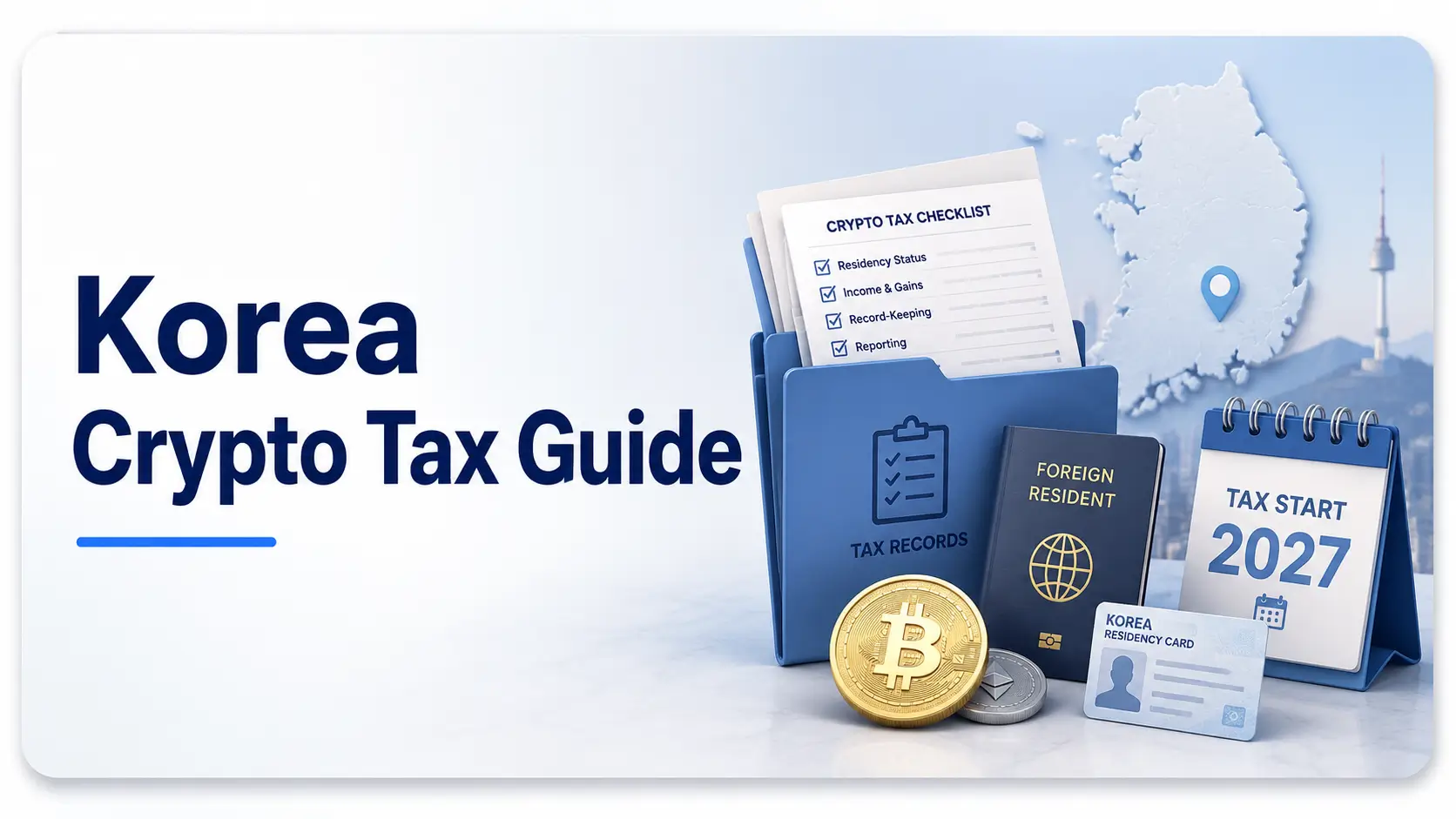
Foreign resident crypto tax guide
Crypto tax in Korea is not just a rate. For foreign residents, the sharper question is usually where your taxable life sits: your days in Korea, your address, your visa history, your Korean bank links, your exchange accounts, and the chilly little CSV files nobody wants to download until tax season is already breathing on the window.
The confusing part is that nationality is only one piece of the puzzle. A US, UK, Canadian, Australian, EU, or other foreign passport does not automatically place your crypto gains outside Korean tax analysis. If your life, work, residence, or exchange activity is tied to Korea, your record-keeping needs to grow up before your portfolio does.
This guide gives you the practical map: what the scheduled 2027 crypto tax date means, why residency is the first fork in the road, how overseas exchanges can still leave evidence breadcrumbs, and what to put in a Korea Crypto Tax Residency File before you sell, move, stake, lend, or leave.
Residency first
Separate visa status, physical presence, domicile, and tax residency before assuming Korea can or cannot tax you.
Records beat memory
Build clean evidence for acquisition cost, exchange activity, wallet transfers, fees, and KRW conversion dates.
Cross-border caution
Home-country filing duties, Korean exchange accounts, and offshore crypto reporting can overlap in inconvenient ways.
Quiet goal: fewer surprises, cleaner files, calmer decisions before your coins move. 🧾
Snapshot
This article is for expats, remote workers, foreign spouses, international students with income, and long-stay crypto investors in Korea. It helps you understand the tax residency problem, compare DIY record-keeping with paid help, avoid common filing mistakes, and create one practical file system before selling or moving coins.
Before You Act: What This Guide Can and Cannot Do
Korea crypto tax for foreign residents is a high-stakes topic because a small assumption can become an expensive filing problem. The big trap is thinking the answer lives in one word: expat, non-Korean, remote worker, tourist, resident, student, HODLer, trader.
Real tax analysis is less tidy. It cares about facts: how long you stayed, where you had a home, whether you had a Korean address, what exchange accounts you used, how gains were realized, what records exist, and whether another country still expects a tax return from you.
Before You Act
This guide is educational only. It is not tax, legal, accounting, immigration, or investment advice. Use it to organize your questions, spot risks, compare record-keeping options, and prepare better conversations with a qualified Korean tax professional, especially before selling large positions, leaving Korea, or filing across countries.
The fast answer, without the false comfort
Korea’s virtual asset income tax has been delayed several times and is currently scheduled to apply from January 1, 2027. Public tax summaries generally describe gains from virtual asset transfers and lending for individuals as taxable “other income,” commonly discussed at a combined 22% rate including local income tax, subject to the rules in force when the tax actually applies.
For foreign residents, the tax question is not simply “Am I Korean?” It is “Am I a Korean tax resident, did I have Korean-source activity, what records support my position, and does my home country also want a piece of the paperwork?”
The practical promise of this guide
You will not walk away with a magic answer for every wallet, country, and exchange. That would be suspiciously neat, like a suitcase that folds itself.
You will walk away with a decision map: what to check first, which records to preserve, where paid help may be worth considering, and how to reduce the odds that a future filing season turns into a scavenger hunt through old screenshots.
Key takeaway
Do not move a large amount of crypto, close an exchange account, leave Korea, or file a return based only on a headline rate. Start with residency, records, and timing.
The 2027 Crypto Tax Date: The Deadline People Keep Misreading
The most repeated Korea crypto tax fact is also the one most likely to be misunderstood. People hear “2027” and assume there is nothing to do now. That is the paperwork trap.
If taxation begins from January 1, 2027 as currently scheduled, the painful part may not be the tax rate itself. It may be proving what you paid for assets bought years earlier, moved through multiple exchanges, bridged across wallets, or mixed with staking rewards, gas fees, airdrops, and KRW or USD conversions.
What is currently scheduled
The National Tax Service’s resident virtual-asset tax guidance describes the regime scheduled from January 1, 2027. Check the current enacted rule and guidance before a transaction or filing; a scheduled start date does not resolve residency, income classification or other reporting obligations.
A cautious reader treats 2027 not as permission to ignore the issue, but as a record-keeping deadline wearing plain clothes.
Useful official starting points: review Korean tax information for foreigners and current government notices before making decisions.
Why the 22% headline needs context
The often-cited combined 22% rate sounds simple, but the calculation behind it can be anything but simple. Taxable income generally depends on proceeds, acquisition cost, related expenses, timing, and classification.
For a casual investor with one Korean exchange account and clean KRW purchases, the file may be manageable. For a remote worker who used Coinbase, Binance, Kraken, Korean exchanges, cold wallets, and DeFi protocols, the same headline rate can hide a small cathedral of record problems.
What to do before the law actually bites
Before the start date, export your historical transactions. Download deposit and withdrawal records. Label wallet transfers. Save evidence of purchase price. Keep proof of fees. Preserve exchange reports before a platform changes formats, restricts access, or disappears into the foggy museum of old crypto infrastructure.
| If you wait until filing season | If you prepare monthly |
|---|---|
| You may chase missing CSVs across closed accounts. | You keep exchange exports while access is easy. |
| Wallet transfers may look like unexplained disposals. | You label self-transfers while memory is fresh. |
| Acquisition cost may be hard to prove. | You preserve purchase records, fees, and conversion dates. |
| Professional help may cost more because cleanup takes longer. | Your accountant can review a tidy file instead of performing archaeology. |
Resident vs Nonresident: The Fork in the Road
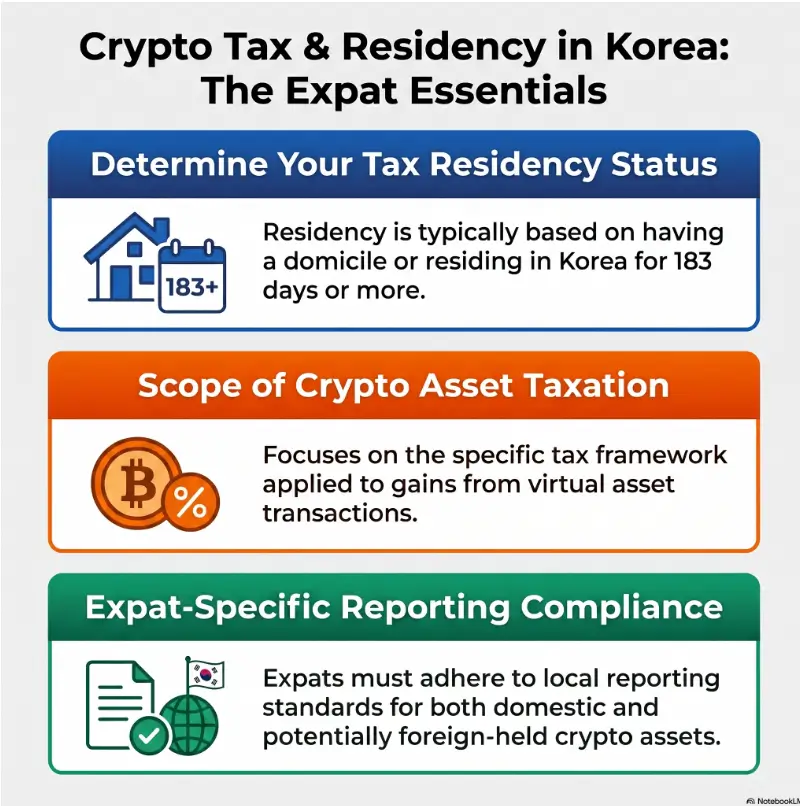
For foreign residents, residency is the main gate. Korean tax residency can depend on domicile, residence, duration of stay, family and economic ties, and other facts. A foreign passport does not automatically keep Korean tax law outside the room.
Many expats start with the wrong question: “Can Korea tax foreigners?” A better question is: “Based on my facts, am I a resident or nonresident for Korean tax purposes during the relevant period?”
The 183-day issue deserves its own spotlight
Korean residency analysis includes domicile and residence-duration rules. Keep a continuous record across calendar years and ask a qualified adviser which counting rule applies to the relevant period. Do not import a professional-summary headline into your filing position without checking the enacted text and effective date.
Do not reduce this to a casual day count in your head. Entry and exit records, housing, employment, family location, bank accounts, and practical life ties can matter. Your calendar is evidence, but it is not always the whole story.
Korean tax resident: worldwide crypto may enter the room
If you are treated as a Korean tax resident, Korea may look more broadly at your income position. That can raise difficult questions about gains on overseas exchanges, crypto lending, income received while living in Korea, and whether offshore records need to be reviewed.
This is especially important for foreign residents who trade casually but live deeply in Korea: an officetel lease, ARC history, Korean phone number, Korean bank account, and regular local work can create a paper trail that feels ordinary in daily life but meaningful in a tax review.
If housing ties are part of your situation, related practical guides such as how officetel leases work in Korea and Korea resident registration basics can help you understand the administrative context around residence evidence.
Nonresident: Korean-source activity still matters
Nonresident status does not mean Korean activity becomes invisible. Korean-source income, Korean exchange activity, Korean banking links, or transactions connected to Korea can still deserve review. The exact answer depends on the facts and the law in force at the time.
A tourist making tiny trades abroad during a short visit is different from a foreign resident living in Seoul, receiving salary, using a Korean exchange, and selling crypto into KRW. Same asset class, different tax weather.
Key takeaway
Before asking whether a crypto gain is taxable, ask which tax identity you had at the time: resident, nonresident, arrival year, departure year, or treaty-position gray zone.

Do Not Treat Your Visa Type as Your Tax Answer
Visa status matters, but it is not the same thing as tax residency. This is where many foreign residents make a beautifully human mistake: they assume the immigration label explains the tax result.
An E-2 teacher, F-6 spouse, D-10 job seeker, student, startup employee, long-stay freelancer, or remote worker may all have different facts. Tax law asks where your taxable life is anchored. Immigration paperwork asks whether and how you can stay.
Immigration and tax paperwork speak different dialects
The visa office may care about eligibility, sponsorship, permitted activities, and period of stay. The tax office may care about domicile, residence, source of income, reporting duties, and records.
Those worlds overlap, but they are not twins. Treat them as cousins who attend the same family dinner and remember different parts of the conversation.
The dangerous sentence: “I’m foreign, so Korea cannot tax me”
This sentence is the tax version of leaving your umbrella at home because the sky was polite in the morning. Foreigners can become Korean tax residents. Nonresidents can still have Korean-source issues. Home-country tax duties may continue.
A safer sentence is: “I need to confirm my Korean tax residency, Korean-source activity, and home-country reporting position before I rely on any conclusion.”
| Common assumption | Safer question |
|---|---|
| My visa type decides my tax result. | What do my residence facts and tax rules say? |
| I used an overseas exchange, so Korea is irrelevant. | Was I a Korean tax resident when the gain occurred? |
| I filed US taxes, so Korea is done. | Do both countries require reporting, credits, or treaty review? |
| I did not sell, so records do not matter. | Will I be able to prove acquisition cost when I do sell? |
Use a transaction ledger before asking whether a movement is taxable
Record the date, asset, quantity, wallet or exchange, fees and the purpose of each movement. In a constructed record, label a transfer between your own wallets separately from a sale, reward or payment, and retain evidence linking the addresses. Those labels organize the facts; they do not determine the tax result. Ask about the rules for the relevant year, residence position and transaction type rather than applying one headline implementation date to every crypto-related receipt.
| Focus | What to check |
|---|---|
| Movement | Date, asset, quantity and counterpart accounts. |
| Purpose | Own-wallet transfer, disposal, reward or other receipt. |
| Review | Applicable year, status, valuation and reporting questions. |
A reader question: Does moving coins without receiving cash establish that nothing needs review?
No. Preserve the transaction context and ask about classification and reporting for your circumstances. Do not treat a wallet balance or exchange summary as a complete tax conclusion.
Cost Basis: The Tiny Number That Can Become a Giant Problem
Cost basis is the small hinge on a heavy door. It is the amount you paid for the crypto, usually adjusted for fees and relevant costs under applicable rules. When you sell, transfer in a taxable way, lend, or otherwise realize income, cost basis helps determine whether you have a taxable gain.
The problem is not that cost basis is conceptually hard. The problem is that crypto investors scatter it across old emails, bank statements, exchange exports, wallet addresses, gas fees, token swaps, and half-remembered “I think that was in 2021” moments.
Acquisition cost is where crypto tax gets sharp teeth
For foreign residents in Korea, acquisition cost may involve multiple currencies. You might buy BTC in USD on a US exchange, move it to a hardware wallet, transfer it to a Korean exchange, sell into KRW, and later need to explain the chain clearly.
Save purchase price, trade confirmation, fees, deposit dates, withdrawal dates, wallet addresses, exchange names, and currency conversion evidence. Do not assume the final exchange report will know what happened before the asset arrived.
Moving coins is not always selling coins
A transfer between your own wallets is often different from a sale, but poor records can make it look confusing later. If your Korean exchange receives crypto from an external wallet, the platform may not know whether that wallet belongs to you, what you paid, or whether the incoming asset had a prior taxable history.
Label self-transfers immediately. A note written today is evidence. A note reconstructed next year is fog wearing a hat.
Illustrative example: the harmless transfer that looked expensive
Imagine Maya, a Canadian resident in Busan on a long-term work visa. She bought ETH in 2022 on an overseas exchange, moved it into a cold wallet, then transferred part of it to a Korean exchange in 2027 before selling into KRW.
The sale itself is easy to see. The purchase history is not. If Maya did not save the 2022 acquisition records, fees, wallet labels, and exchange exports, her tax preparer may spend expensive hours rebuilding the trail. Worse, unsupported cost basis can make the taxable gain look larger than it really was.
The lesson is not “never move crypto.” The lesson is “move records with the coins.”
Cost basis checklist
- Original purchase date and time
- Purchase price in original currency
- Exchange or wallet used
- Trading fees, gas fees, and transfer fees
- Deposit and withdrawal history
- KRW conversion method used for Korean reporting
- Self-transfer labels between your own wallets
- Evidence of staking, lending, airdrops, forks, or rewards
Overseas Exchanges: Comfortable, Convenient, and Often Foggy
Overseas exchanges feel clean because they sit outside Korea’s everyday banking system. That comfort can be misleading. A platform may be foreign, but your tax residency, KYC details, bank transfers, IP logs, address history, and reporting frameworks can still matter.
The old offshore mindset says, “They cannot see it.” The modern tax transparency trend says, “Please do not build a financial plan on invisibility.”
CARF changes the mood music
The OECD’s Crypto-Asset Reporting Framework is designed to support automatic exchange of tax information related to crypto-asset transactions. Korea has signed the CARF multilateral competent authority agreement, which points toward broader cross-border reporting of residents’ crypto activity among participating jurisdictions.
That does not mean every past transaction is instantly visible to every tax office. It does mean the long-term direction is less secrecy, more standardized reporting, and more pressure on investors to keep clean records.
For the reporting framework background, use the official OECD and Korean government pages rather than social media summaries.
Korean address, phone, and bank details are breadcrumbs
If an overseas exchange has your Korean address, Korean phone number, Korean bank funding path, or residence self-certification, those details may become relevant. They do not automatically decide your tax result, but they can support a factual story about where you lived and traded.
Foreign residents often need Korean mobile verification, banking, apps, and local services for ordinary life. For context on how tightly Korean digital life can connect identity, phone access, and services, see this practical guide to the Korean mobile app ecosystem.
The exchange-location comparison
| Where activity happens | What may be easier | What may be harder | Record to save |
|---|---|---|---|
| Korean exchange | KRW trades and local reports may be clearer. | Prior cost basis may be missing if coins arrived from outside. | KRW deposits, withdrawals, trade history, fees. |
| Overseas exchange | Historical USD or home-country records may be available. | Korean tax treatment may still matter if you are resident. | Full transaction CSVs, KYC country, tax reports. |
| Cold wallet | You control custody and movement history. | Tax reports are not automatic. | Wallet labels, transaction hashes, ownership notes. |
| DeFi protocol | On-chain activity can be traceable. | Classification and valuation may be messy. | Protocol logs, wallet addresses, reward dates, valuation notes. |
Staking, Airdrops, Lending, NFTs: The Unfinished Edges
The cleanest public discussion of Korea’s scheduled virtual asset tax has usually focused on transfers and lending. Real crypto life, of course, is not so polite. People stake, bridge, borrow, lend, mint, earn rewards, receive airdrops, wrap tokens, and buy NFTs that may or may not behave like art, access passes, financial assets, IP rights, or digital souvenirs with tax shoes on.
For foreign residents, these categories are where DIY confidence should slow down. The tax result can depend on timing, valuation, classification, and whether your home country has different rules.
Staking rewards are not just “free coins”
Staking can create two layers of questions: what happens when you receive the reward, and what happens later when you sell, swap, or transfer it. You may need records for the date received, fair value, wallet address, protocol, fees, and later disposal.
Even if Korean guidance is still developing for a specific activity, your records should not wait for perfect clarity. Tax law often arrives late and asks for yesterday’s documents with tomorrow’s seriousness.
Airdrops and forks can become valuation puzzles
Airdrops and hard forks may look effortless in a wallet. Tax reporting can ask less poetic questions: when did you control the asset, what was it worth, was it income, what happened when you sold it, and can you prove the numbers?
Save screenshots, transaction hashes, project notices, dates of receipt, exchange listings, and valuation sources. Do not rely on a later chart if the token barely traded when you received it.
NFTs may be collectibles, income, IP, or something stranger
NFTs are not one tax object wearing one uniform. They may represent art, membership, gaming items, royalties, commercial rights, or speculative assets. A foreign resident who mints, flips, collects, or earns royalties from NFTs may need more specialized help than a simple spot trader.
Key takeaway
The stranger the crypto activity, the more valuable clean records become. Staking, DeFi, airdrops, lending, mining, and NFTs are not the place to keep one heroic spreadsheet and hope.
Common Mistakes Foreign Residents Make
Most crypto tax problems do not begin with bad intentions. They begin with overconfidence, missing files, and the quiet belief that future-you will somehow enjoy cleaning up present-you’s chaos.
Future-you has plans. Be kind to them.
Mistake 1: Filing in the US and assuming Korea is finished
US citizens and green-card holders may have US tax obligations even while living abroad. That does not automatically erase Korean obligations if Korea also treats you as resident or if you have Korean-source activity.
The same idea can apply to other home countries. Canadians, Australians, UK residents, EU nationals, and others may have home-country rules, departure rules, foreign tax credit questions, or reporting duties. Do not assume one filing system politely cancels the other.
Mistake 2: Using one spreadsheet after three exchanges and five wallets
A manual spreadsheet can work for a disciplined, low-volume investor. It becomes fragile when you add multiple exchanges, cold wallets, staking, DeFi, NFT activity, and KRW conversions.
When your spreadsheet needs its own mythology, compare paid crypto tax software or professional reconstruction help. You do not need the fanciest option. You need one that can import your exchanges, handle your wallet types, export usable reports, and let a Korean tax professional review the logic.
Mistake 3: Ignoring KRW conversion dates
A USD gain, KRW gain, and exchange-reported gain may not match neatly. Crypto prices move. FX rates move. Fees happen. Time zones sulk in the corner.
Save the method you used for KRW conversion and be consistent unless a professional tells you otherwise. The goal is not artistic valuation. The goal is defensible reporting.
Mistake 4: Selling before residency review
Large disposals before arrival, during Korean residence, or after departure may have different consequences. If you are planning a major sale near a move date, get advice before clicking sell.
This is not about tax evasion. It is about timing clarity, documentation, and avoiding a preventable cross-border filing knot.
Mistake checklist
- Assuming nationality controls tax residency.
- Closing an exchange account before exporting full history.
- Moving coins without labeling self-transfers.
- Ignoring fees, gas, and failed transaction costs.
- Mixing personal trading with business or creator income.
- Relying on screenshots instead of full CSVs.
- Waiting until departure week to find a Korean tax professional.
The 30-Minute Monthly Record-Keeping Stack
The best crypto tax system is not heroic. It is boring enough to repeat. Thirty minutes a month can save days of expensive cleanup later, especially for foreign residents whose records may sit across countries, banks, wallets, and languages.
Think of it as brushing your portfolio’s teeth. Not glamorous. Very useful.
Step 1: Export before platforms change formats
Once a month, download trade history, deposit history, withdrawal history, fiat deposits, fiat withdrawals, fee reports, staking reports, and tax reports if available. Save the original files without editing them.
Create a separate working copy if you want to clean or merge data. Keep the untouched original as your evidence file.
Step 2: Label wallet transfers while memory is fresh
For every major wallet transfer, write a short note: “Self-transfer from Ledger to Korean exchange,” “Moved ETH to staking wallet,” “Bridge to Layer 2,” or “Test transfer before larger move.”
A one-line note can prevent a tax preparer from mistaking a transfer for a disposal or spending billable time guessing at your intent.
Step 3: Save residency evidence beside tax evidence
Crypto records alone may not answer the foreign-resident question. Keep passport entry and exit records, ARC or visa records, lease agreements, Korean address proof, employment contracts, school enrollment records, bank opening dates, and departure documents if relevant.
If you are still figuring out local systems, guides like Korean phone plans for Americans and local district offices in Korea can help you understand the administrative paper trail that often surrounds daily life.
Infographic: the calm-file method
Four folders that make Korea crypto tax less chaotic
1. Residency
Entry and exit records, ARC, visa, lease, address proof, employment or school records.
2. Exchanges
Korean and overseas trade history, deposits, withdrawals, fiat records, fees, reports.
3. Wallets
Wallet labels, transaction hashes, self-transfer notes, staking and DeFi logs.
4. Review
Questions for tax professionals, treaty concerns, home-country filing notes, open issues.
Show me the nerdy details
If you want a stronger file, create a transaction index. Give each major transfer a short ID such as “2027-03-ETH-LEDGER-UPBIT-01.” Use the same ID in your spreadsheet, wallet note, exchange export folder, and tax question list.
This makes a cross-border review easier because your preparer can follow the story across different records without decoding your entire crypto life from scratch. It also helps you catch missing links, such as a withdrawal with no matching deposit or a wallet transfer with no ownership note.
| Monthly task | Time needed | Why it matters |
|---|---|---|
| Export exchange CSVs | 10 minutes | Preserves official platform records before formats change. |
| Save fiat bank proof | 5 minutes | Connects crypto trades to KRW, USD, or other currency flows. |
| Label wallet transfers | 10 minutes | Reduces confusion between self-transfers and possible disposals. |
| Update open questions | 5 minutes | Creates a focused agenda for professional help. |
When Paid Tax Help May Be Worth the Money
Not every foreign resident needs a premium crypto tax service. A low-volume investor with one exchange, clean purchases, no staking, no DeFi, and no cross-border filing duty may be able to organize records with a spreadsheet and basic professional review.
But paid help can become worth it when the cost of being wrong is higher than the cost of asking early.
You traded on Korean and foreign exchanges in the same year
Mixed exchange activity is a strong signal to slow down. Korean exchanges may have KRW reporting. Overseas exchanges may have USD or home-country reports. Wallet transfers may connect them in ways that are obvious to you and confusing to everyone else.
Before hiring help, ask whether the provider has experience with foreign residents, crypto cost basis, overseas exchanges, and Korea-specific reporting. A general preparer may be excellent for salary income but uncomfortable with multi-wallet crypto reconstruction.
You are American, Canadian, Australian, British, or EU-based with home-country duties
Cross-border filing can involve foreign tax credits, treaty questions, residency tie-breakers, home-country crypto rules, foreign account reporting, and timing differences. You may need coordination between a Korean tax professional and a home-country tax professional.
This is not always cheap, but it can be cheaper than fixing inconsistent filings later.
Good, better, best help options
| Option | Best for | Typical strength | Watch out for |
|---|---|---|---|
| DIY spreadsheet | Low-volume investors with one or two platforms. | Low cost and full control. | Easy to miss fees, transfers, and KRW conversions. |
| Crypto tax software | Multiple exchanges and wallets with importable records. | Faster matching and cleaner reports. | May not solve Korea-specific residency or classification questions. |
| Korean tax professional | Foreign residents, large sales, Korean exchange activity. | Local law and filing context. | May need your organized records before giving useful advice. |
| Cross-border tax team | US or home-country filing plus Korean exposure. | Coordinates timing, credits, and dual reporting. | Higher cost, so prepare a focused question list first. |
For official Korean government context on crypto reporting cooperation, review the Ministry of Economy and Finance CARF announcement.
Questions to ask before paying
Provider question checklist
- Have you handled foreign residents with Korean and overseas crypto exchange records?
- Can you review tax residency facts, not just transaction totals?
- How do you want CSVs, wallet labels, and fiat records organized?
- Do you coordinate with US, UK, Canadian, Australian, or EU tax preparers if needed?
- How do you handle unclear areas such as staking, airdrops, NFTs, and DeFi?
- What do you charge for cleanup if records are incomplete?

FAQ
Do foreign residents pay crypto tax in Korea?
They may, depending on tax residency, Korean-source activity, timing, and the rules in force when income is realized. A foreign passport alone does not decide the answer. Confirm your facts with a qualified Korean tax professional before relying on a conclusion.
Is Korea crypto tax based on nationality or residency?
Residency and source of income usually matter more than nationality. Your visa type, address, days in Korea, domicile, work ties, family ties, and economic base may all be relevant. Nationality can still matter for home-country filing duties, especially for US citizens and green-card holders.
When does Korea’s crypto tax start?
Current public guidance indicates Korea’s virtual asset income tax is scheduled to begin on January 1, 2027. Because the start date has been delayed before and policy debate continues, check current official guidance before selling, filing, or moving assets based on timing.
Are overseas crypto exchange gains taxable in Korea?
They may be relevant if you are a Korean tax resident when the gain is realized. Nonresidents may have a narrower Korean tax exposure, but Korean-source activity can still matter. Overseas exchange location does not automatically remove the need for Korean tax analysis.
Does Korea tax staking or airdrops?
Detailed treatment can be less clear than ordinary transfer or lending income. Staking, airdrops, forks, DeFi, mining, and NFTs may require careful classification, valuation, and timing analysis. Keep detailed records and ask a professional before assuming they are tax-free or simple.
What records should foreign residents keep for Korean crypto tax?
Keep exchange CSVs, trade confirmations, deposit and withdrawal history, fiat bank records, wallet labels, transaction hashes, fee records, KRW conversion notes, residency evidence, visa or ARC records, lease dates, and home-country tax filings where relevant.
Can US citizens owe both US and Korean tax on crypto?
Possibly. US citizens and green-card holders often have ongoing US tax filing duties while living abroad. If Korea also treats the person as a tax resident or sees Korean-source activity, dual reporting, credits, treaty review, and timing issues may arise.
What happens if I leave Korea before selling crypto?
Departure timing can matter, but it does not automatically erase prior Korean tax issues. Your residency period, asset activity, exchange records, and sale timing should be reviewed before you leave, especially if you may lose access to Korean accounts, phone verification, or local documents.
Are Korean exchange reports enough for taxes?
Not always. Korean exchange reports may show local trades, deposits, withdrawals, and KRW amounts, but they may not know your original acquisition cost if crypto came from an overseas exchange or wallet. Keep upstream records too.
Should foreign residents hire a Korean tax accountant?
Consider it if you have large gains, multiple exchanges, overseas wallets, staking, DeFi, NFTs, home-country filing duties, departure plans, or uncertainty about residency. A short paid review can be worthwhile if it prevents a larger cleanup later.
Build Your Korea Crypto Tax Residency File in 15 Minutes
The calmest next step is not selling, moving, or panic-refreshing crypto news. It is creating one folder that makes your future tax life easier.
Name it Korea Crypto Tax Residency File. Inside it, create four subfolders: Residency, Exchanges, Wallets, and Questions. That is enough structure to begin.
Your 15-minute action plan
- Create the main folder: Korea Crypto Tax Residency File.
- Add passport entry and exit records if you have them available.
- Add ARC, visa, lease, address, or employment records that help explain your Korea timeline.
- Download current-year CSVs from every Korean and overseas exchange you used.
- Create a simple note called Open Questions for Tax Review.
- Write down any large sales, planned moves, staking activity, airdrops, NFTs, or unclear wallet transfers.
That is it. A humble folder, five useful records, and a question list. Not dramatic. Not glamorous. But in cross-border tax life, calm often begins as a properly named file.
Final practical note
The goal is not to fear Korean crypto tax. The goal is to stop letting your records live in scattered tabs, old wallets, and hopeful memory. Build the file now, review your residency before major transactions, and ask better questions before the numbers harden into a filing position.
Last reviewed: 2026-07
Practical example and reader question added October 20, 2026. Existing source dates are retained; this addition is not a fresh verification of every earlier claim.