
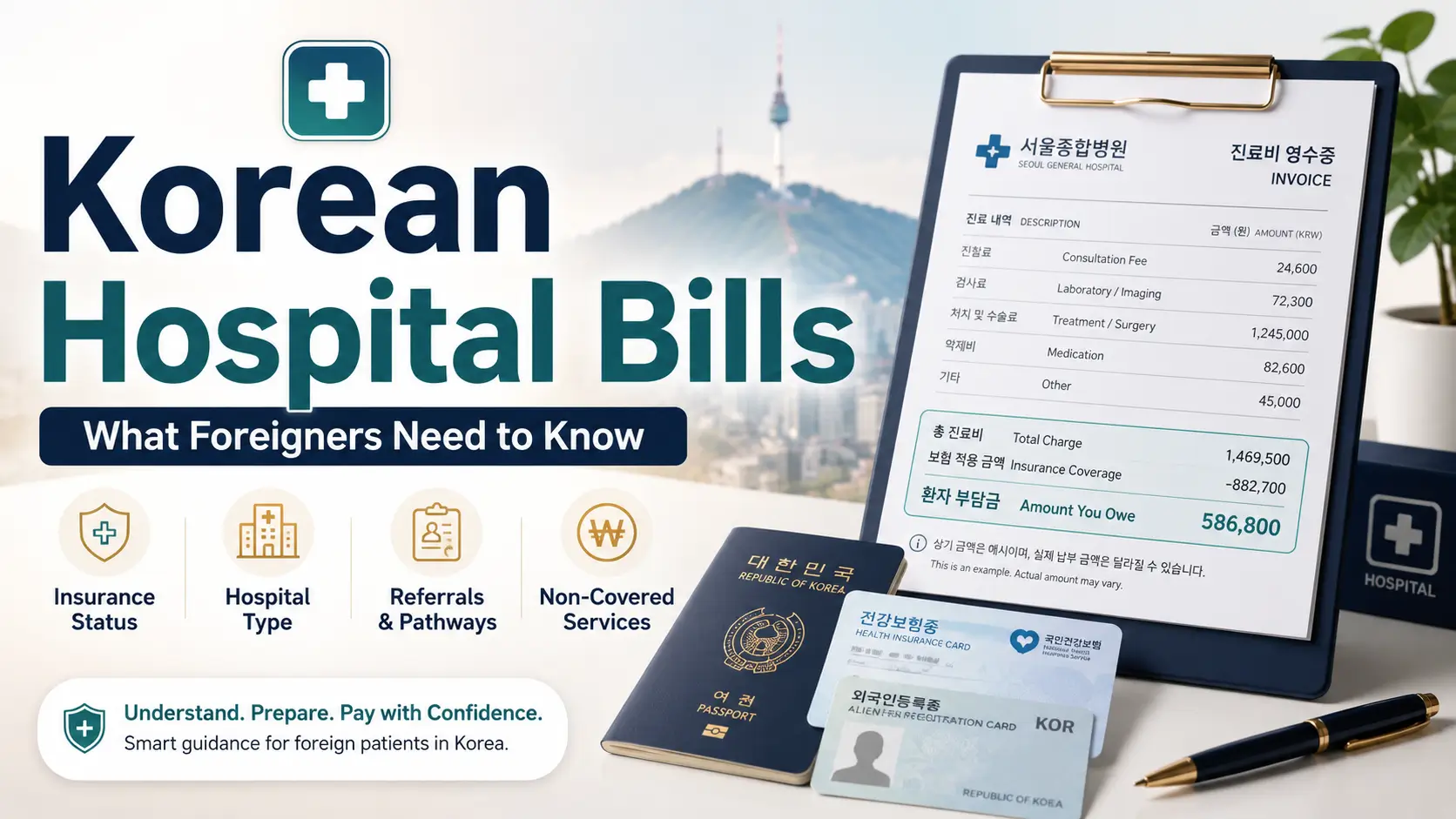
South Korea medical cost guide for foreign patients
Korean Hospital Bills for Foreigners:
How Much Can You Really Owe?
A Korean hospital bill can look reassuringly small, right up until one missing referral, one private room, or one non-covered item changes the arithmetic. The amount you owe is not determined by nationality alone. It is shaped by your insurance status on the treatment date, the type of hospital you enter, and the billing category attached to every test, material, medication, and procedure.
This guide is for tourists, international students, expats, military families, remote workers, and anyone holding an invoice written in dense Korean medical shorthand. It will help you estimate your exposure, ask sharper questions before treatment, and recognize when a bill needs clarification rather than a hurried credit-card swipe.
You will not find a magic universal price list here. You will find the more useful thing: a repeatable method for separating insured care from full-pay charges, comparing hospital options without delaying necessary treatment, and building the documents needed for reimbursement or review.
The central rule: verify the patient category before trying to estimate the price. One checkbox can move the decimal point. 🧾
Snapshot: This article is for foreign patients who need to plan, understand, or question a South Korean medical bill. By the end, you will know how insurance status, hospital level, referral rules, covered categories, private rooms, and travel-insurance procedures affect the balance, plus the exact documents and questions to use next.
Contents — choose a section
Table of Contents
Before You Act: This Is a Billing Map, Not a Quote
This guide explains common billing mechanics, documents, and decision points. It cannot confirm your personal NHIS eligibility, diagnose whether a service was medically necessary, interpret a private insurance contract, or decide whether a hospital charge was lawful.
Before relying on any estimate, confirm the treatment date, institution type, insurance category, referral status, room type, and expected non-covered services with the hospital billing office. For coverage disputes, contact the National Health Insurance Service, the Health Insurance Review and Assessment Service, or your private insurer as appropriate.
Safety takeaway: Do not delay emergency evaluation because you are comparing prices. Stabilize the medical problem first, then organize the bill, records, and insurance claim.
Who this guide fits
- A tourist facing an emergency-room deposit or full-pay invoice
- An international student unsure whether enrollment has started
- An employee or dependent checking workplace coverage
- A long-term resident with a premium or eligibility interruption
- A parent collecting documents for a child’s overseas insurance claim
- A remote worker comparing NHIS, travel insurance, and private reimbursement
Who needs a different pricing pathway
Planned cosmetic procedures, fertility services, dental reconstruction, comprehensive health screenings, and other medical-tourism packages may use separate contracts, coordinators, deposits, and price structures. For those services, obtain a procedure-specific written estimate and cancellation policy rather than assuming ordinary NHIS billing rules apply.
The First Fork: Is Your Korean Insurance Active Today?
Insurance status is the first question because it changes the bill before a doctor orders a single test. Active NHIS members generally receive the same benefit structure as Korean members for eligible care, while uninsured patients and patients receiving non-covered services may be billed the provider’s full charge.
Foreign employees at covered workplaces are generally enrolled through employment. Many other qualifying foreign residents enter regional, or self-employed, coverage based on residence and visa rules. Six months is a common threshold, but it is not a universal start date for every visa or student category.
Employment, regional enrollment, and dependent status
Workplace coverage usually involves employer reporting and payroll contributions. Regional enrollment is handled directly through NHIS and can be affected by residence status, time in Korea, and contribution payment. Dependent status has separate income, property, family-relationship, and documentation requirements, so a spouse or child should not assume coverage merely because the employee is insured.
For a broader explanation of eligibility categories, see this guide to Korean National Health Insurance for foreigners.
An ARC proves identity, not active benefits
Korean medical institutions use identification to verify the patient. A passport, Alien Registration Card, Korean driver’s licence, or mobile health-insurance card may serve that purpose, but identity verification does not by itself prove that benefits are active on the appointment date.
Run a same-day eligibility check
- Confirm the exact effective date of NHIS coverage.
- Ask whether the patient is listed as employed, regional, or dependent.
- Check that the name and foreign registration number match hospital records.
- Confirm that premiums are not creating a benefit restriction.
- Ask the hospital to verify eligibility for the actual treatment date, not merely today.
For regional foreign members, contribution arrears can lead to benefit restrictions under current rules. That is one reason “I have an insurance number” and “this visit will process as insured” are not interchangeable statements.
Key takeaway: Ask, “Was my NHIS eligibility active on the treatment date, and did the hospital process this visit under that eligibility?” That question is more useful than simply asking whether you are enrolled.
The Five-Layer Equation Behind a Korean Hospital Bill
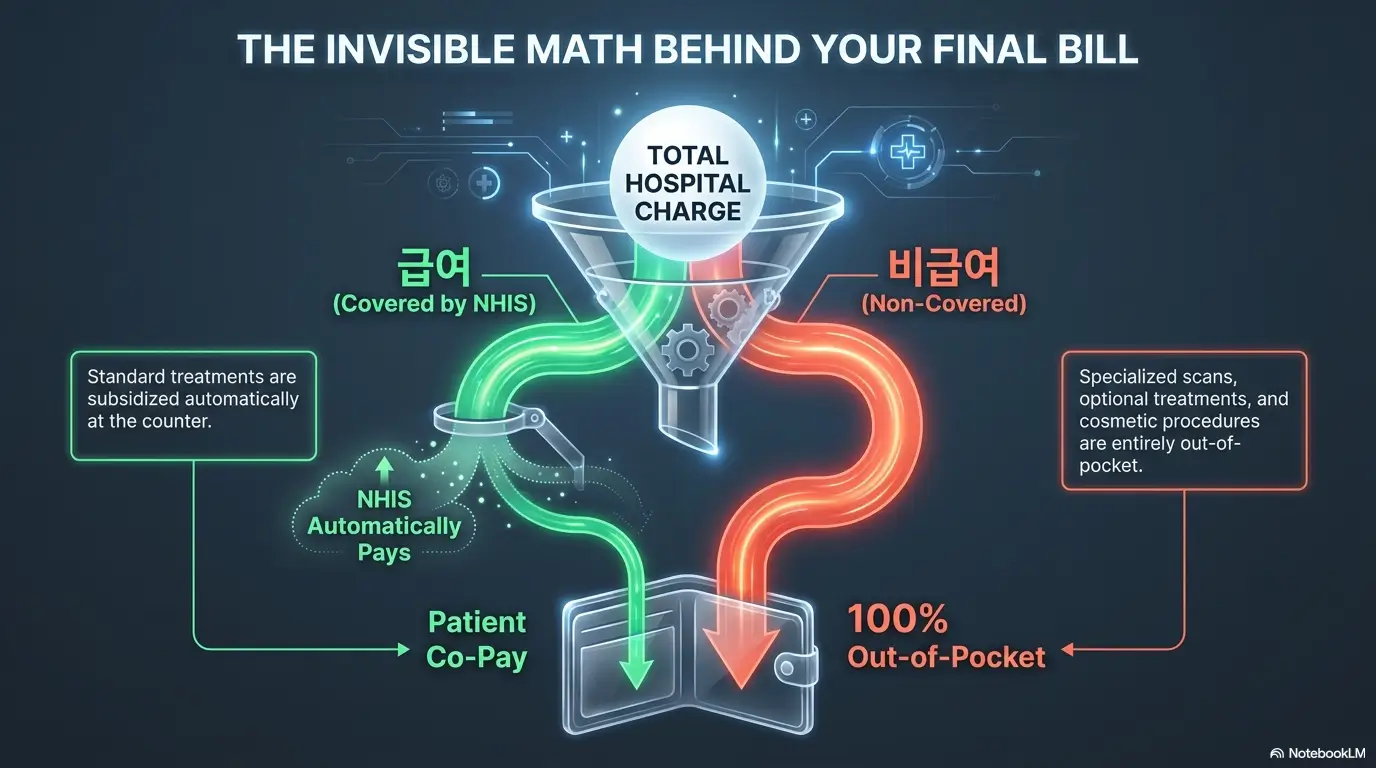
A hospital’s total charge is not the same as the amount a patient owes. Think of the bill as five transparent sheets laid on top of one another. When you separate them, the number becomes easier to explain and easier to challenge.
Standard covered copayments are only one slice
For standard NHIS-covered treatment, the general inpatient patient share is 20%. General outpatient shares rise by institution level: clinics are generally 30%, hospitals 40%, general hospitals commonly 45% or 50% depending on location classification, and tertiary hospitals 60%. Different rules can apply to particular services, registered conditions, drugs, and benefit categories.
| Care setting | General NHIS patient share for covered care | What can still raise the bill |
|---|---|---|
| Inpatient admission | Generally 20% | Non-covered treatment, room upgrade, materials, caregiver costs |
| Local clinic outpatient | Generally 30% | Tests, injections, imaging, non-covered options |
| Hospital outpatient | Generally 40% | Facility level, diagnostics, specialist services |
| General hospital outpatient | Generally 45% or 50% | Location classification, advanced diagnostics, non-covered items |
| Tertiary hospital outpatient | Generally 60% | Referral issues, high-complexity testing, excluded or non-covered care |
These percentages are not a price promise. A 30% share of a simple clinic consultation and a 30% share of a visit involving ultrasound, laboratory work, and a non-covered injection are very different numbers.
The quiet extras live outside the treatment line
- Private or upgraded room charges
- Interpretation and translation
- Medical certificates and English-language records
- International patient coordination
- Ambulance or other transportation
- Private caregiver or family accommodation
- Courier fees for records sent overseas
Illustrative example: The same scan, three very different bills
Imagine three patients receive the same type of imaging. Patient A has active NHIS, starts at a clinic, carries a referral, and receives a covered scan at the appropriate hospital. Patient B has active NHIS but accepts a non-covered upgrade after hearing only that it is “better.” Patient C is a tourist who pays the full hospital charge and later files a travel-insurance claim.
The medical service may sound identical in casual conversation, yet the payment path is not. Patient A pays an insured share. Patient B pays the insured portion plus the non-covered upgrade. Patient C may pay everything upfront, then recover some, all, or none of it depending on the policy, authorization, and documents.
Show me the nerdy details
A useful estimate can be written as: expected patient payment = covered patient share + selectively covered share + full patient-payment items + non-covered charges + non-medical extras, minus any direct insurer payment already authorized.
Do not subtract a hoped-for travel-insurance reimbursement from the hospital balance unless direct billing has been formally approved. Reimbursement is a separate transaction and may arrive only after claim review.
The Hospital Name Hides a Bill Multiplier
In Korea, a clinic, hospital, general hospital, and tertiary hospital are not interchangeable labels. They signal different roles, capabilities, referral expectations, and patient-share structures.
A local clinic is often the sensible first door
For non-emergency symptoms such as a mild respiratory illness, uncomplicated skin problem, routine prescription issue, or initial musculoskeletal evaluation, a neighbourhood clinic may offer faster access and a lower outpatient share. It can also produce the referral needed when higher-level care is appropriate.
Korean clinics often move quickly, which can surprise foreign patients. This guide to why Korean clinics are so fast explains the pace and what to prepare before a short appointment.
General hospitals add capability and billing layers
A general hospital may be the right choice for admission, multiple specialties, advanced imaging, or complex testing. The trade-off is not simply a higher consultation fee. A larger facility creates more opportunities for facility-level charges, specialist services, materials, and diagnostic bundles.
A tertiary hospital is an expensive shortcut without the right referral
NHIS patients generally need a referral from a first-stage institution to receive ordinary insurance benefits at a tertiary hospital. Recognized exceptions include emergency patients, childbirth, dentistry, rehabilitation medicine, family medicine, and haemophilia-related care. Going directly without a qualifying exception can increase the financial burden.
Money-saving rule: Do not choose a university hospital solely because the name feels safer. For non-emergency care, ask whether a clinic evaluation and referral would preserve coverage and shorten the administrative maze.
| Option | Often suitable for | Cost-control question |
|---|---|---|
| Clinic or public health centre | Initial evaluation, minor illness, routine follow-up | Can you treat this here, or issue a referral? |
| Hospital | Specialist care, moderate diagnostics, possible admission | Which expected items are non-covered? |
| General hospital | Multiple specialties, advanced testing, inpatient care | Can you give a written estimate by benefit category? |
| Tertiary hospital | Complex, severe, or highly specialized cases | Is a referral required for my visit and department? |
If admission is likely, review the practical steps in this guide to Korean hospital admission for foreigners, including documents, rooms, and discharge preparation.
One Line Item Changes Everything: Covered or Non-Covered?
“Not covered” does not automatically mean unnecessary. A physician may recommend a test, device, medication, material, or treatment that is not included in ordinary NHIS benefits. The practical question is whether you understand the classification, the price, the alternatives, and the reason before agreeing.
Ask the hospital to separate five categories
- NHIS-covered charges
- Your ordinary insured copayment
- Selectively covered services with a different patient share
- Full patient-payment items
- Non-covered charges set outside ordinary NHIS reimbursement
An estimate that shows only one grand total is hard to evaluate. A category-by-category estimate reveals which costs may count toward NHIS protections, which may be compared across providers, and which may require separate insurer approval.
Non-covered prices can vary by provider
HIRA publishes provider-level information for designated non-covered items through its website and the Health e-Eum mobile app. The published information is useful for comparison, but HIRA also warns that collection and verification periods can create differences between displayed and currently operated prices. Confirm the price directly with the hospital before treatment.
Use this script before the scan, injection, implant, or room upgrade
English: “Is this covered by NHIS? What is my expected patient payment? Is there a covered or lower-cost alternative? Please show the price before I agree.”
Korean: “이 항목은 건강보험이 적용되나요? 제가 낼 예상 금액은 얼마인가요? 보험 적용되는 대안이나 더 저렴한 대안이 있나요? 동의하기 전에 가격을 보여 주세요.”
Good, better, best: Choose the support level that matches the risk
| Support level | What it includes | When it may be enough | What to verify before paying |
|---|---|---|---|
| Good: Free DIY check | Hospital estimate, NHIS confirmation, HIRA price search, saved receipts | Routine clinic care or a simple planned test | Coverage date, referral, category, total expected payment |
| Better: Bilingual assistance | Interpreter, translated estimate, insurer call support | Complex consent, language barriers, several non-covered options | Hourly fee, scope, confidentiality, record format |
| Best: Coordinated professional review | Hospital international office, insurer case manager, billing review, clinical clarification | Admission, surgery, major claim, large disputed balance | Who represents whom, fees, authority, written deliverables |
Paid translation or coordination is not automatically better. A free hospital interpreter or international desk may be enough for a routine visit. Paid help becomes more valuable when the consent is complex, the amount is large, or the insurer needs specific English-language records. See this guide to medical translation in Korea for practical options.
The Copayment Ceiling Has Holes
Korea’s annual copayment ceiling can reimburse eligible insured copayments above an income-linked threshold. It is valuable protection, but it is not a maximum on every won appearing on a hospital invoice.
What the ceiling is designed to cover
NHIS sets an annual ceiling according to contribution or income level. For 2026, the published limits vary by contribution decile and whether stays in a long-term care hospital (요양병원) exceed 120 days. The listed range is KRW 900,000 to KRW 8,430,000 for the ordinary category, and KRW 1,430,000 to KRW 10,960,000 for the category involving more than 120 days in a long-term care hospital (요양병원). Eligibility and calculation should be confirmed directly with NHIS.
What commonly sits outside the ceiling
- Non-covered services
- Selectively covered services
- Full out-of-pocket charges
- Dental implants
- Higher-grade room charges specified by the rules
- Some tertiary-hospital outpatient care for minor conditions
- Specified assistive devices, childbirth expenses, and other exclusions
These exclusions explain how a patient can reach an insured copayment ceiling and still owe a substantial hospital balance. A tourist without NHIS should not assume the ceiling applies at all.
Key takeaway: The ceiling protects eligible insured copayments, not the entire invoice. Ask the billing office to mark which line items are expected to count toward the ceiling and which are excluded.
Read the Bill Before You Pay It
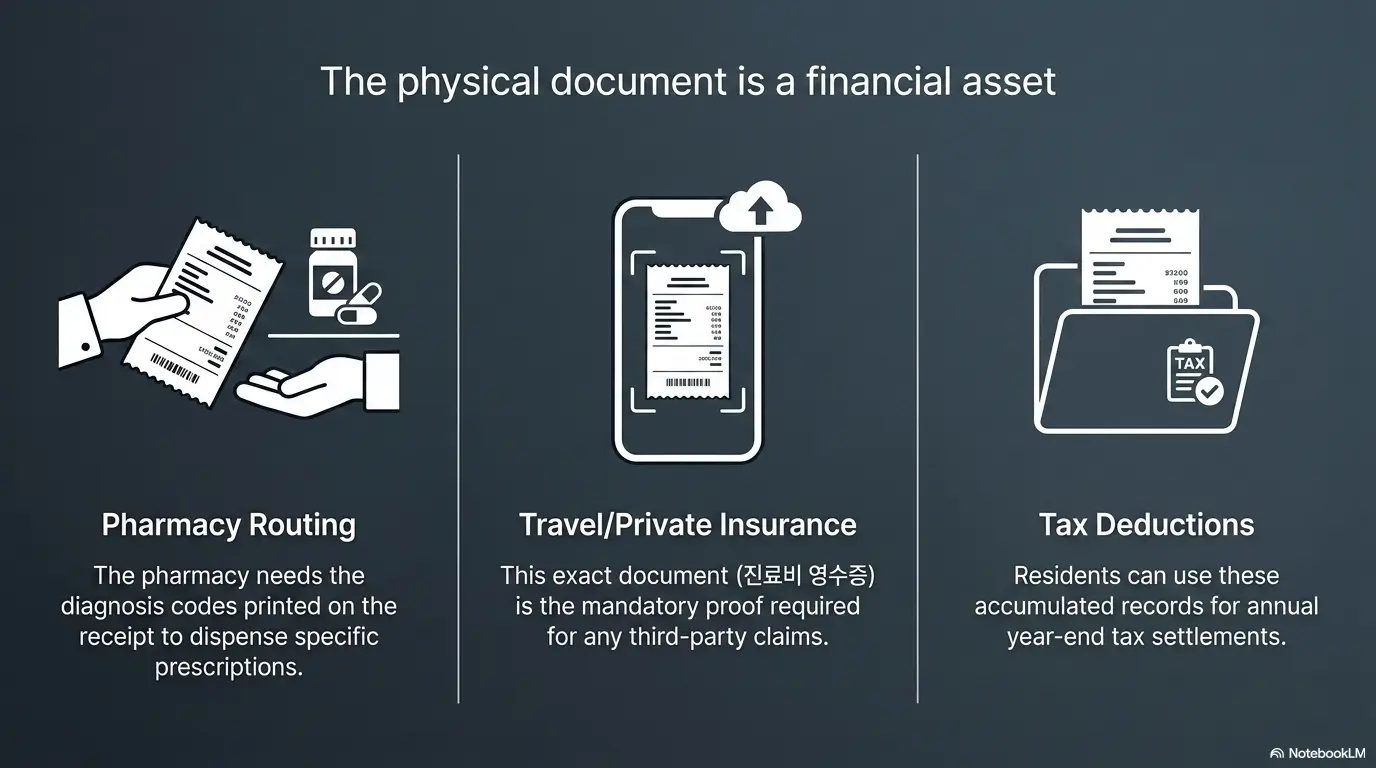
A card receipt proves payment. It does not explain the medical bill. For reimbursement, review, or correction, you need documents that show what happened and how each charge was classified.
Request the four-document billing packet
- An itemized medical-expense statement
- The official payment receipt or proof of payment
- A diagnosis certificate, medical certificate, or discharge summary as required
- Prescriptions, test reports, and treatment records requested by the insurer
Ask whether English versions are available and whether they carry an extra fee. Before leaving Korea, check names, dates of birth, passport or registration numbers, treatment dates, diagnosis wording, and payment totals. A one-character mismatch can send a foreign claim into bureaucratic winter.
Match each charge to a service
| Check | What to look for | Question to ask |
|---|---|---|
| Date and quantity | Duplicate tests, repeated materials, extra inpatient days | Was this item used more than once? |
| Room type | Private, semi-private, or standard room | When did the room category change? |
| Benefit category | Covered, selective, full-pay, non-covered | Why was this classification applied? |
| Medication | In-hospital drugs versus outside pharmacy prescriptions | Is this charge included elsewhere? |
| Materials and devices | Implants, braces, disposables, special equipment | Was a covered alternative available? |
| Documents and coordination | Certificates, translation, international desk fees | Is this a medical charge or an administrative service? |
Clarify before alleging overbilling
“Please explain which items were covered, selectively covered, fully patient-paid, or non-covered, and why each category was applied. Please also show any duplicated, cancelled, or adjusted entries.”
Escalate through the right channel
- Hospital billing office: incorrect patient details, duplicate entries, room classification, missing insurance processing, or estimate discrepancies
- NHIS: eligibility, benefit status, contribution issues, patient-share rules, and ceiling questions
- HIRA: whether certain full-pay or non-covered charges should have been treated as insured benefits
- Private or travel insurer: authorization, exclusions, claim documents, reimbursement, and appeal
- Medical dispute service or qualified adviser: allegations involving treatment harm, consent, negligence, or broader legal issues
HIRA’s medical-fee verification service can examine whether amounts paid as non-covered or full patient payment should have been covered under NHIS rules. The service has eligibility and scope limits, and an itemized receipt is a core document.
Key takeaway: A billing dispute is won or lost in the paperwork long before anyone uses the word “dispute.” Get the itemized statement, receipt, diagnosis record, and insurer requirements while the visit is still fresh.
Travel Insurance: The Claim Can Fail After Treatment
Travel insurance often operates as reimbursement, not a hospital discount. Unless direct billing is approved, the patient may need to pay the Korean provider first and submit a claim later.
Preauthorization matters more than many travellers expect
For non-emergency imaging, hospital admission, transfer, or surgery, contact the insurer or assistance company as early as reasonably possible. Ask whether authorization is required, whether a particular hospital must be used, and whether the insurer needs to speak with the treating physician.
“Medically necessary” is a policy definition
A Korean physician may reasonably recommend a service, yet the overseas insurer may still apply exclusions, benefit limits, pre-existing-condition wording, or its own medical-necessity criteria. Do not assume a doctor’s recommendation guarantees reimbursement.
Build the claim packet before leaving Korea
- Itemized charges with dates and quantities
- Official paid receipt and payment method
- Diagnosis and treatment summary
- Doctor’s notes or medical certificate when requested
- Prescription and pharmacy receipt
- Test reports, imaging reports, or discharge summary
- Proof of travel dates and policy coverage
- Authorization or assistance-company reference number
- Certified or hospital-issued English translation if required
Prescription drugs are often paid at a separate pharmacy after the clinic visit, so keep both the prescription and pharmacy receipt. This guide to filling prescriptions in Korea explains the handoff between clinic and pharmacy.
What to compare before buying travel medical coverage
| Feature | Why it matters in Korea | Question to ask |
|---|---|---|
| Emergency medical limit | Uninsured admission or surgery can create a large upfront balance | Is the limit per trip, per person, or per condition? |
| Direct billing network | Cashless care is not available at every hospital | Which Korean hospitals can receive a guarantee of payment? |
| Preauthorization rules | Non-emergency care may require approval | What must be authorized before treatment? |
| Pre-existing conditions | Definitions and stability periods vary | What prior symptoms, treatment, or medication are excluded? |
| Translation and records | Claims may require English documents | Are translation costs covered? |
| Evacuation or repatriation | Transfer decisions can be expensive and clinically sensitive | Who decides whether transport is medically required? |
For policy-planning questions, see this broader guide to travel insurance for South Korea. Read the actual policy wording, not only the sales summary.
When Emergency Care Cannot Wait
Call 119 or seek immediate help for severe breathing difficulty, chest pain, major bleeding, loss of consciousness, stroke signs, serious trauma, poisoning, seizures, or rapidly worsening symptoms. Foreign-language support can be requested through 119.
Treat the emergency first, organize the bill second
Price comparison belongs in non-urgent planning. In an emergency, delaying treatment can turn a cost concern into a medical crisis. Bring identification and insurance details when available, but do not spend critical time searching for the cheapest facility.
Use multilingual support when communication breaks down
Official guidance lists 119 for emergency assistance, the Medical Korea Information Center at 1577-7129 for support in English, Chinese, Russian, and Japanese, and the Immigration Contact Center at 1345 for multilingual guidance and three-way calling. Service scope and availability should be confirmed when you call.
When the balance is unmanageable
Contact the hospital billing or international-care office before the payment deadline. Ask about the required deposit, written payment deadline, possible instalment arrangements, insurer coordination, and documents needed for review. Do not assume an arrangement exists, but do ask early. Silence is rarely an effective billing strategy.
Key takeaway: In urgent care, ask one person to focus on the patient and another to photograph documents, record names, and contact insurance. Medical attention and paperwork can proceed in parallel without letting the paperwork steer the clinical decision.
FAQ: Korean Medical Bills for Foreign Patients
How much does a hospital visit cost without insurance in Korea?
There is no reliable universal figure. The cost depends on the institution level, specialty, time of visit, tests, imaging, treatment, medication, materials, room type, and non-covered charges. Ask for a written estimate that separates the consultation from tests and procedures.
Can a Korean hospital refuse to treat a foreigner without insurance?
Emergency evaluation, non-emergency appointments, planned procedures, deposits, and payment policies involve different rules and practices. A hospital may request identification, a deposit, payment assurance, or advance payment for planned care. In a genuine emergency, seek immediate help rather than negotiating the full financial arrangement first.
Do tourists qualify for Korean National Health Insurance?
Short-term tourists generally do not enter NHIS simply by visiting Korea. Eligibility is tied to employment, residence, registration, visa category, and other rules. Long-term residents and some students may become enrolled on different timelines. Confirm your exact status with NHIS.
Can foreigners use a Korean emergency room without paying upfront?
Payment and deposit practices vary by hospital, insurance authorization, and clinical circumstances. Carry identification and insurer contact details, and ask the insurer whether a guarantee of payment can be arranged. Do not assume that presenting a policy card creates cashless treatment.
Is a university hospital more expensive than a local clinic?
It often produces a higher patient responsibility because tertiary outpatient shares are higher, advanced testing is more likely, and referral rules matter. The right comparison is not fame versus price. It is the level of care medically needed, the referral pathway, and the expected benefit categories.
Does Korean health insurance cover emergency-room treatment?
Active NHIS can cover eligible emergency treatment, but the final bill still depends on benefit classification, patient share, non-covered services, and the treatment provided. Ask the billing office to separate insured and non-covered charges.
Can I dispute an incorrect Korean hospital bill?
Yes. Start with an itemized explanation from the hospital. For eligibility or benefit questions, contact NHIS. For a review of whether certain non-covered or full-pay amounts should have been treated as covered, check HIRA’s verification service. Private-insurance disputes follow the insurer’s appeal process.
Does the copayment ceiling include private rooms and non-covered treatment?
Many non-covered, selectively covered, full-pay, and specified higher-grade room charges are excluded. Never treat the ceiling as a cap on the complete hospital invoice.
Your 15-Minute Bill-Control Plan
You do not need to master Korea’s entire health-financing system before an appointment. You need three verified answers and one folder.
Make one three-question call
- Is my NHIS eligibility active for the appointment or treatment date?
- Which expected services are covered, selectively covered, full-pay, or non-covered?
- Can you send a written estimate showing my expected payment in KRW?
Save the answer in writing
Record the representative’s name, date, department, estimate, assumptions, referral requirement, room type, and services excluded from the quote. An estimate is not a guarantee, but a documented estimate gives you a clean starting point when the final bill arrives.
Bring the cost-control folder
- Passport or Alien Registration Card
- NHIS or private insurance details
- Referral letter, when required
- Medication and allergy list
- Insurer assistance phone number and claim instructions
- A method for saving itemized records and receipts
- A trusted interpreter or support contact for complex care
The bill becomes less frightening when it stops being one dark number and turns into named parts. Verify eligibility, separate the categories, choose the right level of care, and leave with the records. That small ritual is the difference between guessing and managing.
Your next step: Open your calendar now and schedule a 15-minute call with the hospital billing office or NHIS. Ask the three questions above, then save the answers beside your appointment details.
Last reviewed: 2026-09