
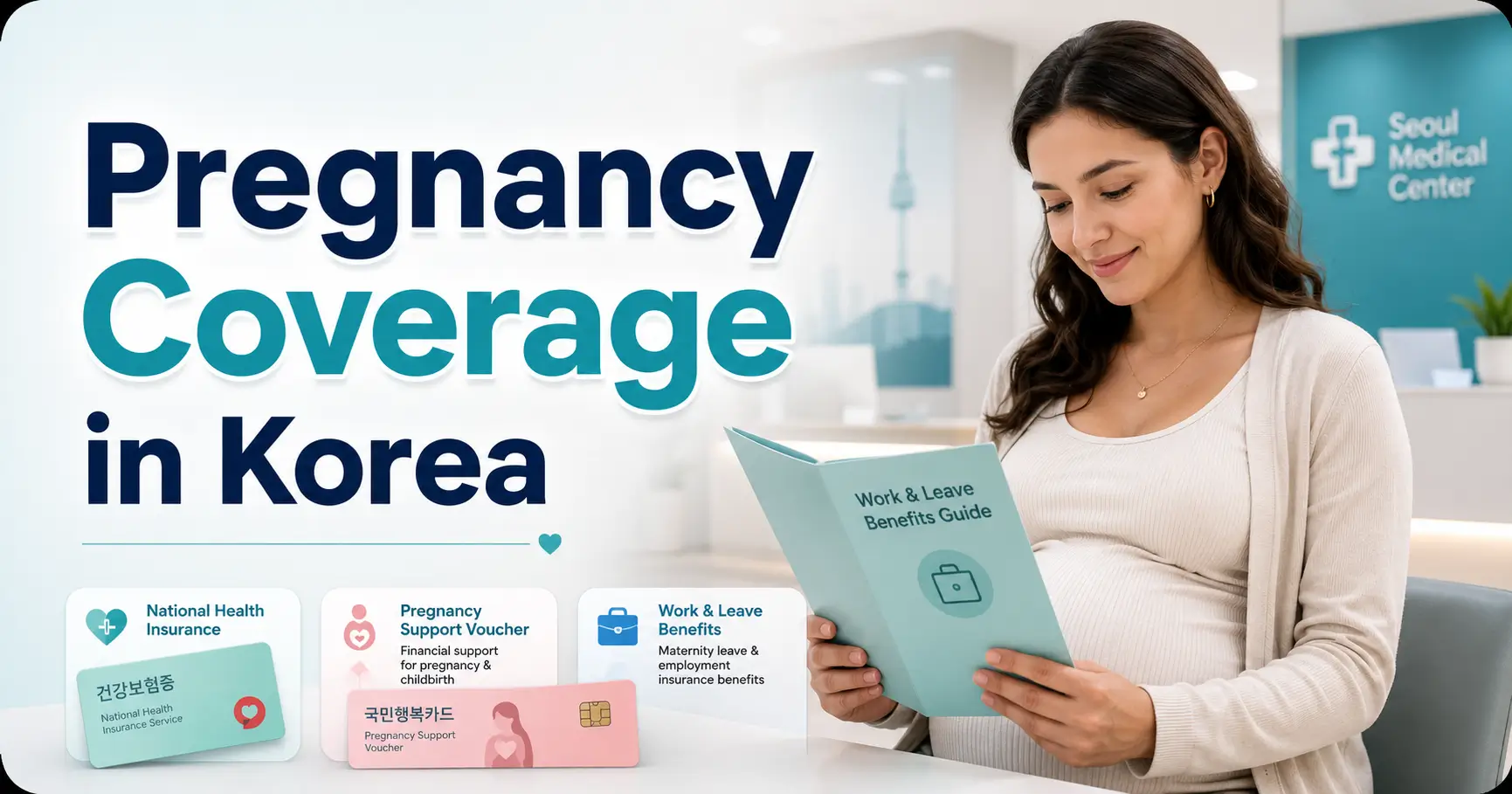
Pregnancy, health insurance, and work benefits in South Korea
Korean Maternity Insurance for Foreign Residents:
What Actually Covers Pregnancy
Pregnancy in Korea can feel wonderfully efficient until three similar-looking systems arrive at the same reception desk. National Health Insurance may reduce medical charges. A National Happiness Card may hold a separate medical voucher. Employment Insurance may replace part of a worker’s income during leave. None of them is simply “maternity insurance.”
For foreign residents, the expensive mistakes usually begin before a hospital bill appears. A spouse was never registered as a dependent. Workplace enrollment was delayed. A private policy excludes an existing pregnancy. A hospital quote includes a private room but not newborn care. One quiet administrative gap can grow teeth.
This guide separates the systems, maps the documents, and gives you the questions to ask before tests, delivery, or maternity leave. The aim is not to predict your exact bill. It is to help you uncover the parts of the bill that are still hiding.
Confirm eligibility
Find your NHIS category, effective date, and dependent status.
Decode the bill
Separate insured care, non-covered care, and optional services.
Protect deadlines
Track voucher, leave-pay, document, and newborn-registration dates.
The useful question is not “Am I covered?” It is “Which system covers which expense, from what date?” 🧭
Snapshot
This article is for foreign employees, students, spouses, regional NHIS subscribers, and internationally insured families arranging prenatal care or childbirth in South Korea. You will learn how to confirm active coverage, apply for pregnancy support, compare hospital charges, review private insurance, and prepare one practical call checklist.
Table of Contents
Before You Act
This article offers general educational information. It cannot confirm your visa eligibility, diagnose a medical condition, interpret an employment contract, guarantee an insurance payment, or estimate a hospital bill without reviewing your records. Confirm important decisions with NHIS, your hospital billing office, your employer or employment center, and an appropriately qualified adviser. Seek urgent medical care promptly when symptoms require it, even if insurance paperwork is unfinished.
Before You Compare Anything, Identify Your Insurance Route
The word foreigner describes nationality, not an insurance category. Two pregnant residents with the same passport may have completely different coverage because one is enrolled through a Korean employer while the other is waiting to qualify as a regional subscriber.
Start by identifying how you are insured today, not how you expect to be insured by delivery. The date on which eligibility becomes active can matter for prenatal examinations, testing, prescriptions, hospital admission, and access to the pregnancy-and-childbirth voucher.
The three common NHIS routes
| Insurance route | Typical reader | First fact to confirm |
|---|---|---|
| Employee-insured member | A foreign resident employed at a covered Korean workplace | The exact employment-based eligibility acquisition date |
| Regional subscriber | A self-employed, non-working, or otherwise independently enrolled resident | Whether the residence and visa conditions for enrollment have been met |
| Dependent of an employee-insured member | A spouse or eligible family member supported by an enrolled worker | Whether NHIS has approved the relationship and income or property requirements |
Foreign workers at covered workplaces are generally enrolled through employment. Many other foreign residents become subject to regional enrollment after staying in Korea for more than six months, but the six-month rule should not be applied mechanically to every visa holder or employee. NHIS also states that its insurance coverage for enrolled foreigners is the same as the coverage provided to Korean citizens.
Who needs another route
- Short-term visitors who are not enrolled in Korean National Health Insurance
- Medical tourists traveling to Korea primarily for maternity care
- Military families using an overseas or military health system
- Employees with an approved exemption based on equivalent foreign or employer coverage
- People whose immigration registration or authorized stay has ended
- Families needing urgent humanitarian, municipal, or social-assistance support
Visitors and uninsured residents should request a self-pay maternity estimate directly from the hospital. A travel policy may cover unexpected pregnancy complications in narrow circumstances, but ordinary prenatal care and planned childbirth are commonly excluded. The policy wording, not the card in your wallet, is the deciding document.
Key Takeaway
Do not begin with your visa label or nationality. Begin with your current NHIS category, effective date, and contribution status.
Korean “Maternity Insurance” Is Really Four Separate Systems
A maternity bill can touch four systems that use different applications, eligibility tests, and deadlines. Mixing them together produces the insurance equivalent of putting four keys on one ring and hoping every door is feeling generous.
1. National Health Insurance medical coverage
NHIS is the main medical-coverage layer. It can apply to covered consultations, tests, treatments, hospital services, and childbirth-related care, subject to the service classification and the patient’s required share.
This is ordinary health insurance, not a pregnancy-only account. A patient may still pay copayments, non-covered charges, upgraded-room fees, and other expenses that fall outside the insured benefit.
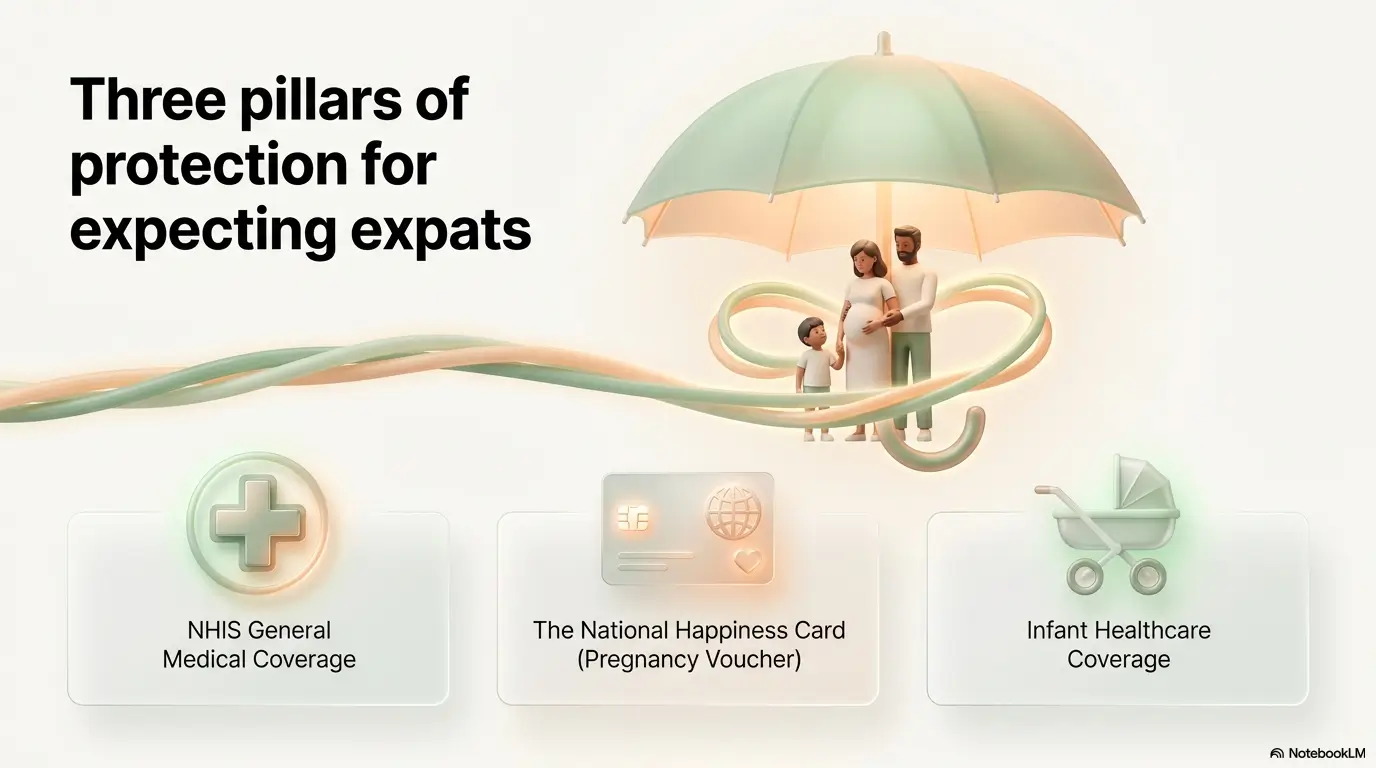
2. The National Happiness Card voucher
The pregnancy-and-childbirth medical-expense benefit is loaded as points onto an eligible National Happiness Card. It helps pay qualifying patient expenses, but it is not an unlimited reimbursement policy and cannot be withdrawn as general spending money.
3. Employment Insurance benefits
Maternity leave and wage-replacement benefits belong to employment law and Employment Insurance. A person can have excellent NHIS medical coverage but fail to qualify for leave pay because of employment status, insured history, application timing, or documentation.
4. Private or international cover
A Korean private policy, international medical plan, employer supplement, or overseas policy may pay expenses that NHIS does not. Yet pregnancy exclusions, waiting periods, direct-billing rules, provider networks, and newborn conditions can leave surprisingly large gaps.
The Four-Part Coverage Map
Medical care
NHIS determines covered services and patient cost-sharing.
Voucher spending
National Happiness Card points pay eligible maternal and infant expenses.
Income during leave
Employment rules determine protected leave and qualifying payments.
Supplemental cover
Private insurance may fill selected gaps, subject to exclusions and limits.
The Coverage Clock: When NHIS Actually Starts
Pregnancy does not automatically accelerate an inactive insurance record. The hospital may confirm pregnancy and prepare an application, but it cannot rewrite your immigration, employment, dependent, or contribution history.
Four dates that should never be blended together
- Your arrival date: when you physically entered South Korea.
- Your foreign-resident registration date: when your immigration identity record became available.
- Your NHIS eligibility date: when the employee, regional, or dependent coverage legally became active.
- Your first maternity-care date: when a hospital, clinic, pharmacy, or laboratory provided the service.
The date that usually controls insurance treatment is the eligibility date in the NHIS record, not the day you received an Alien Registration Card or the day your employer said, “The paperwork should be fine.” Ask for the date, repeat it back, and record it.
Workplace enrollment can create retroactive questions
Employee contributions are generally tied to employment, and NHIS guidance notes that workplace contributions may be applied retroactively from the employment point. If enrollment was reported late, ask both the employer and NHIS how the effective date and prior hospital charges will be handled.
Do not assume that a later correction will automatically update every hospital bill. Keep receipts, itemized statements, eligibility notices, and payment records. Ask the provider whether a corrected insurance status allows reprocessing or refund review.
Dependent status may be the missing bridge
A spouse of an employee-insured member may qualify as a dependent if the relationship and applicable financial conditions are satisfied. Approval is not always automatic, especially when the marriage cannot be verified through Korean records.
NHIS may request a foreign government document showing the marriage or family relationship, Apostille or consular verification, and a notarized Korean translation. The documents must contain enough identifying information to match the applicant to the employee-insured member.
For a broader explanation of employee, regional, and dependent routes, see this guide to Korean National Health Insurance for foreigners.
Show me the nerdy details
Insurance status is not one database field. A hospital may see a claims-eligibility result while the employer is holding payroll records, immigration holds the resident-registration record, and NHIS reviews dependent or regional eligibility. A mismatch can therefore be administrative rather than medical.
Create an audit trail: date of employment, employment contract, pay slips, resident-registration issue date, NHIS notice, contribution payment, dependent application, hospital receipt, and the name or channel of each consultation. A clean timeline often turns a foggy phone call into a fixable records question.
The ₩1 Million Pregnancy Voucher Is Valuable, but It Is Not Cash
Eligible NHIS subscribers or dependents with a confirmed pregnancy or childbirth can apply for pregnancy-and-childbirth medical-expense support. The benefit is delivered as restricted voucher points through a National Happiness Card.
Current voucher amounts and additions
| Pregnancy situation | Support structure | What to verify |
|---|---|---|
| Single fetus | ₩1 million per pregnancy | Eligibility, confirmation, application, and card activation |
| Multiple fetuses | ₩1.4 million basic payment, with additional support designed to bring the total toward ₩1 million per fetus | Whether the additional amount is automatic or requires supporting confirmation |
| Eligible underserved birth area | Possible additional ₩200,000 | Residence location and qualifying residence period at application |
The Ministry of Health and Welfare states that the voucher can pay eligible patient-paid costs for maternal treatment, prescribed medicines, and medical materials, including qualifying covered and non-covered expenses. It may also be used for eligible care and prescribed items for a child under age two. The use period generally ends two years after the expected delivery date, actual birth, miscarriage, or stillbirth date.
What the voucher may help pay
- Eligible prenatal examinations and consultations
- Patient-paid portions of qualifying covered services
- Eligible non-covered maternal medical expenses
- Prescribed medicines and medical materials
- Eligible medical expenses for an infant under age two
Acceptance at a hospital or pharmacy does not mean every item on the receipt qualifies. Ask the cashier or billing office to identify which charges can be settled with voucher points before authorizing payment.
What the voucher is not
- Cash that can be withdrawn
- A living-expense allowance
- Automatic paid maternity leave
- A guarantee that every test is medically covered
- Unlimited delivery insurance
- A substitute for active NHIS eligibility
Key Takeaway
Treat the voucher as a limited medical wallet. Decide which eligible expenses should use those points, and monitor the remaining balance and expiration date.
Why an NHIS-Covered Birth Can Still Produce a Large Bill
“Covered” means an insurance rule applies to a service. It does not mean the patient owes nothing. A maternity invoice may include NHIS-covered services, patient copayments, non-covered medical services, convenience upgrades, and newborn charges on separate accounts.
Ask the hospital to sort the estimate into three columns
| Billing category | Examples | Question to ask |
|---|---|---|
| NHIS-covered care | Covered examinations, treatment, procedures, or hospitalization | What patient copayment applies to my insurance status? |
| Non-covered medical care | Tests, materials, procedures, or services outside ordinary NHIS payment | Is this medically recommended, optional, or available in a covered alternative? |
| Convenience or preference charges | Private room, upgraded accommodation, meals, interpreter coordination, or package services | Can I decline or change this without affecting necessary care? |
Delivery method is not the only cost variable
A vaginal-delivery quote and a cesarean-delivery quote are useful starting points, not complete budgets. Ask whether each estimate includes the prenatal admission assessment, anesthesia, medications, surgical materials, room type, physician fees, newborn testing, pediatric consultation, and complication-related care.
Hospital billing may also be split between the pregnant patient and the baby. A newborn’s tests, treatment, nursery care, or transfer can create a separate account. Confirm how the hospital handles the infant’s temporary identification and later insurance registration.
The international-clinic premium question
An English-speaking international clinic can be worth paying for when consent, complex history, or care coordination would otherwise be difficult. Still, ask whether the international clinic adds consultation, administration, coordination, or interpretation fees that differ from the ordinary obstetrics department.
When language support is the main need, compare the international-clinic route with a standard obstetrics appointment plus professional interpretation. This guide to medical translation in Korea explains what to prepare before a high-stakes consultation.
A quote-preparation checklist that gets better answers
- Expected delivery month
- Single or multiple pregnancy
- Current NHIS category and effective date
- Preferred delivery method, while acknowledging that medical needs may change
- Room preference and acceptable lower-cost alternative
- Anesthesia or pain-management options
- Planned prenatal and genetic testing
- Newborn screening and pediatric services
- Deposit, cancellation, refund, and emergency-admission rules
- Voucher acceptance and payment process
Key Takeaway
A hospital estimate answers “What might we charge?” NHIS answers “Which charges receive insurance treatment?” You need both answers.
Illustrative example: the quote that forgot the baby
A foreign couple requested a childbirth estimate from a large hospital. The total looked manageable, so they chose a private room and stopped comparing.
During a later billing call, they learned the estimate assumed an uncomplicated delivery, excluded several optional prenatal tests, and did not include charges billed separately to the newborn. The private room also had a different cancellation rule after admission.
They did not abandon the hospital. Instead, they asked for three versions: a standard-room estimate, the preferred private-room estimate, and a complication scenario showing which items were impossible to predict. They also confirmed whether the National Happiness Card could be used at discharge.
The lesson was not that private care was a poor choice. It was that a single total had hidden three different decisions: medical necessity, insurance classification, and personal comfort.
For practical admission procedures, deposits, guardians, and hospital documents, read the guide to hospital admission in Korea.
Paperwork First: The Documents That Unlock Coverage
Korean maternity care is often fast once the records agree. The slow part is persuading several databases that one person, one spouse, one pregnancy, and one insurance account belong together.
Build a basic document file before the first expensive test
- Passport
- Alien Registration Card or other accepted residence identification
- NHIS eligibility confirmation
- Employment contract or recent pay slip, when workplace enrollment is relevant
- Marriage or family-relationship certificate
- Apostille or consular authentication, when requested
- Notarized Korean translation, when requested
- Dependent-status application documents
- Pregnancy confirmation or the official voucher application form
- Hospital estimates and itemized receipts
- Card-company or voucher-application confirmation
Run a name-matching check
A misplaced middle name can become a small bureaucratic pebble that rolls through several offices. Compare your name across the passport, foreign-resident record, NHIS account, employer payroll, hospital chart, marriage certificate, bank account, and card application.
- Is the surname placed first or last?
- Is a middle name included, abbreviated, or omitted?
- Are spaces and hyphens consistent?
- Does the date of birth match exactly?
- Has the passport number changed after renewal?
- Does the marriage document use a previous surname?
Get the pregnancy confirmation and application into the same workflow
The pregnancy voucher application normally requires medical-institution confirmation. The official form accepts a resident registration number or foreign registration number, so foreign registration itself does not prevent use of the form. The practical question is whether the applicant is an eligible NHIS subscriber or dependent.
Applications may be available through NHIS, designated card companies, participating financial institutions, government services, local public offices, or health centers, depending on the channel and current procedures. Ask whether the hospital transmits confirmation electronically or gives you a paper form.
Prepare the newborn paperwork before delivery
Do not assume the baby’s insurance registration will finish automatically. The process may involve a birth certificate, immigration reporting, family-relationship proof, the baby’s residence status, and NHIS registration.
Ask the hospital how it temporarily identifies and bills the newborn. Then ask NHIS which documents will be needed after birth and whether claims can be reviewed once registration is completed.
Private and International Insurance: Compare the Exclusions Before the Premium
Private insurance may be useful, but maternity coverage is one of the easiest areas to misunderstand. A policy can sound comprehensive while excluding ordinary pregnancy, planned delivery, fertility treatment, congenital conditions, newborn care, or complications connected to a pre-existing pregnancy.
Questions to ask before buying or renewing cover
- Is pregnancy itself covered, or only unexpected complications?
- Does a waiting period apply before conception, pregnancy confirmation, or delivery?
- Is the current pregnancy excluded as a pre-existing condition?
- Are prenatal consultations, screening, delivery, cesarean birth, and postnatal care treated separately?
- Is there a maternity sublimit inside the annual policy limit?
- Are private rooms, international clinics, and interpreter services covered?
- Does the plan pay the hospital directly or reimburse after payment?
- What records must be submitted in English or translated?
- When does newborn coverage begin?
- Are congenital or neonatal conditions subject to separate exclusions?
Good, Better, Best: a practical coverage setup
| Setup | What it includes | Best suited to | Main risk |
|---|---|---|---|
| Good | Active NHIS, voucher application, and an itemized hospital estimate | Budget-conscious residents comfortable using ordinary Korean medical channels | Non-covered and comfort-related expenses remain |
| Better | Good setup plus written employer benefits, emergency savings, and language support | Working parents who need medical and employment planning | Employer or service support may not insure medical costs |
| Best fit for complex needs | Better setup plus a carefully reviewed international or supplemental policy | Families needing overseas continuity, private facilities, or broad provider access | High premiums can still sit beside maternity exclusions and sublimits |
The most expensive plan is not automatically the strongest maternity plan. A lower-cost policy with clear written maternity terms may be more useful than a premium contract with an elegant brochure and a pregnancy exclusion tucked into page 47.
When a free planning approach may be enough
Additional private coverage may be unnecessary when NHIS is active, the pregnancy voucher is approved, the preferred hospital provides a manageable estimate, and the family can absorb non-covered or comfort-related costs.
Professional policy review may be worth considering when a family has multiple insurers, a high-risk pregnancy, planned care in several countries, employer-funded international coverage, disputed pre-authorization, or newborn coverage concerns. Ask the reviewer to identify exclusions and claim steps in writing rather than offering only a verbal summary.
Key Takeaway
Compare maternity exclusions, waiting periods, sublimits, newborn rules, and payment methods before comparing monthly premiums.
Maternity Leave Pay Lives in a Different System
NHIS helps with healthcare. Employment Insurance and labor rules address leave and qualifying income replacement. Approval under one system does not prove eligibility under the other.
Employees should check insured history and employer classification
South Korea’s official Employment Insurance guidance describes 90 days of maternity leave, 100 days for a qualifying premature birth, and 120 days for a multiple pregnancy. At least 45 days must normally fall after birth, or 60 days for a multiple pregnancy. Ask the employment center about the qualifying premature-birth definition and supporting medical documents. The Ministry of Employment and Labor guidance on Article 74 explains these distinctions. It also lists a 180-day insured-unit-period requirement for ordinary maternity-leave pay and an application window connected to the leave period. Payment responsibility can differ between qualifying priority-support enterprises and larger companies.
Before discussing resignation, unpaid leave, or contract termination, ask the employer and employment center to confirm:
- Whether you are enrolled in Employment Insurance
- Your recorded insured-unit period
- Your planned leave dates
- Whether the employer is classified as a priority-support enterprise
- Which portion is paid by the employer and which by Employment Insurance
- The application start date and final deadline
- Documents the employer must submit
- How contract expiration or a job change affects the application
Freelancers and non-standard workers need a separate eligibility check
A freelancer who invoices clients is not automatically covered by the employee maternity-leave system. Certain insured labor providers and artists may have separate childbirth-benefit routes, while some people outside Employment Insurance may need to review other support programs.
Official guidance for qualifying labor providers includes specific insured-period, work-suspension, income, and application requirements. It also uses a 12-month application deadline following childbirth, miscarriage, or stillbirth for that benefit route.
Do not resign before mapping the timeline
A resignation that feels administratively tidy can complicate insured status, employer documentation, wage calculations, and benefit timing. Confirm the consequences before signing a resignation letter, accepting an unpaid arrangement, or agreeing that a contract should simply “end naturally.”
Save copies of the employment contract, wage statements, Employment Insurance history, leave request, employer response, pregnancy or birth confirmation, and every submitted application.
Seven Costly Mistakes Foreign Parents Can Prevent
Mistakes 1 to 3: enrollment assumptions
- Waiting until delivery to confirm NHIS: Check eligibility before major prenatal testing, not while preparing an admission deposit.
- Assuming a spouse was added automatically: Dependent registration may require relationship evidence, authentication, translation, and NHIS review.
- Applying one six-month rule to everyone: Employment-based enrollment, regional enrollment, visa treatment, and exemptions can follow different paths.
Mistakes 4 and 5: treating support as unlimited insurance
4. Treating voucher points as full delivery insurance: Check the remaining balance, expiry and eligible expenses; costs beyond the voucher still need a payment plan.
5. Assuming a new private policy covers an existing pregnancy: Obtain written confirmation of waiting periods, exclusions, maternity limits and newborn cover before paying.
Mistakes 6 and 7: vague questions and forgotten deadlines
6. Asking only whether the birth is covered: Ask separately about the mother, newborn, room, anesthesia, tests and complications. Save an itemized estimate and its assumptions.
7. Leaving applications until after delivery: Record the voucher expiry, leave-pay application window, and the authority and documents needed for newborn registration. Confirm each deadline with the responsible agency; one completed application does not complete the others.
The one-page maternity insurance file
Identity: passport name, foreign registration number, contact details
NHIS: category, effective date, contribution status, dependent status
Voucher: application date, card, balance, expiration date
Hospital: estimate, non-covered list, room choice, deposit, newborn billing
Work: leave dates, insured period, employer documents, application deadline
When to Call NHIS, the Hospital, or an Employment Adviser
Call NHIS when the insurance record does not match reality
- The hospital sees inactive eligibility
- Your workplace enrollment has not appeared
- A dependent application was rejected or remains pending
- Foreign family documents were not accepted
- Contributions appear missing, duplicated, or charged under the wrong category
- The voucher cannot be issued, activated, or used
- Your card-company record and NHIS record do not match
- You need to confirm newborn-registration documents
NHIS lists 1577-1000 as its general call center and 033-811-2000 for English consultation. Call-center availability and language support can change, so check the official contact page when planning an important call.
Call the hospital before expensive testing or admission
- Request an itemized estimate rather than one bundled total
- Ask which services are covered, non-covered, or optional
- Confirm whether voucher points can be used
- Ask about deposits and refund procedures
- Confirm newborn billing and registration procedures
- Ask about interpreter or international-clinic charges
- Check emergency, after-hours, and transfer policies
Get employment help when work or income is at risk
Seek direct guidance when an employer refuses leave, discourages an Employment Insurance application, asks you to resign, withholds required documents, threatens dismissal, or gives conflicting explanations about pay.
Write down who said what, when it was said, and what document supports the statement. Calm records often travel farther than heated recollections.
Do not delay urgent medical care for paperwork
Insurance verification, translation, deposits, and voucher approval should not postpone emergency assessment. Contact an appropriate medical provider promptly for heavy bleeding, severe pain, breathing difficulty, loss of consciousness, concerning changes in fetal movement, or any symptom your maternity team has told you requires urgent review.
Administrative questions can be repaired later more easily than a delayed medical emergency.
FAQ: Foreign Residents and Korean Maternity Coverage
Can a foreign resident use Korean National Health Insurance for pregnancy?
Generally, yes. A foreign resident who is actively enrolled as an employee-insured member, regional subscriber, or approved dependent receives the NHIS benefit structure applicable to enrolled members. The remaining cost depends on the service, provider, coverage classification, and patient share.
Must I live in Korea for six months before receiving maternity coverage?
Not in every case. The six-month rule is commonly relevant to regional enrollment for foreign residents, while eligible employees can acquire workplace-based coverage through employment. Visa-specific treatment, exemptions, and dependent status should be confirmed directly.
Can I apply for the pregnancy voucher with a foreign registration number?
The official pregnancy-and-childbirth benefit application form provides space for a resident registration number or foreign registration number. The applicant must still satisfy NHIS eligibility and pregnancy-confirmation requirements.
How much is the Korean pregnancy-and-childbirth voucher?
The standard benefit is ₩1 million for a single-fetus pregnancy. A multiple pregnancy receives a ₩1.4 million basic payment, with additional support structured toward ₩1 million per fetus. An eligible resident of a designated underserved birth area may receive an additional ₩200,000. Confirm the rules in effect when applying.
Can the voucher pay non-covered hospital charges?
It can be used for eligible patient-paid maternal and infant medical expenses, including qualifying covered and non-covered charges. That does not make every non-covered product, package, room, or convenience service eligible. Ask the provider before payment.
Can an unmarried foreign partner be registered as a dependent?
This is a document-sensitive question. NHIS publishes separate requirements for recognition of a de facto marital relationship, including evidence of the relationship and specific supporting documents. Obtain case-specific instructions before preparing foreign records.
Is the baby covered automatically after birth?
Do not rely on automatic completion. Confirm the birth documentation, immigration reporting, family relationship, residence status, and NHIS registration steps. Ask the hospital how charges are handled while registration is pending.
Does Korean maternity insurance include paid maternity leave?
Medical coverage and paid leave operate through different systems. NHIS and the pregnancy voucher address qualifying healthcare expenses. Employment Insurance and labor rules determine leave and wage-replacement eligibility.
Are Korean postpartum recovery centers covered by NHIS?
Do not assume that a postpartum care center or package is ordinary NHIS-covered hospital care. Compare accommodation, nursing support, medical services, cancellation terms, newborn policies, and separately billed treatments. The guide to birth recovery centers in Korea explains the practical distinctions.
Your 15-Minute Next Step: Make One Eligibility Call
Before comparing hospitals, private policies, or room packages, make one call that fixes the foundation. Contact NHIS and ask the representative to confirm three items in this order:
- “What is my current insurance category and exact effective date?”
- “Am I eligible for the pregnancy-and-childbirth medical-expense voucher?”
- “Which documents will be required for my spouse and newborn?”
Record the consultation date, call channel, requested documents, and any reference information. Then take the same three answers to the hospital billing office and request an itemized estimate showing covered care, non-covered care, and optional services.
That small sequence turns maternity insurance from a blurry promise into a working map. You may not know the final delivery bill, because childbirth rarely reads the spreadsheet. You will know which questions have answers, which costs remain uncertain, and where your next decision belongs.
Your final checkpoint
Confirm the insurance category. Confirm the date. Confirm the documents. Everything else becomes easier once those three stones are firmly underfoot.
Last reviewed: 2026-09