
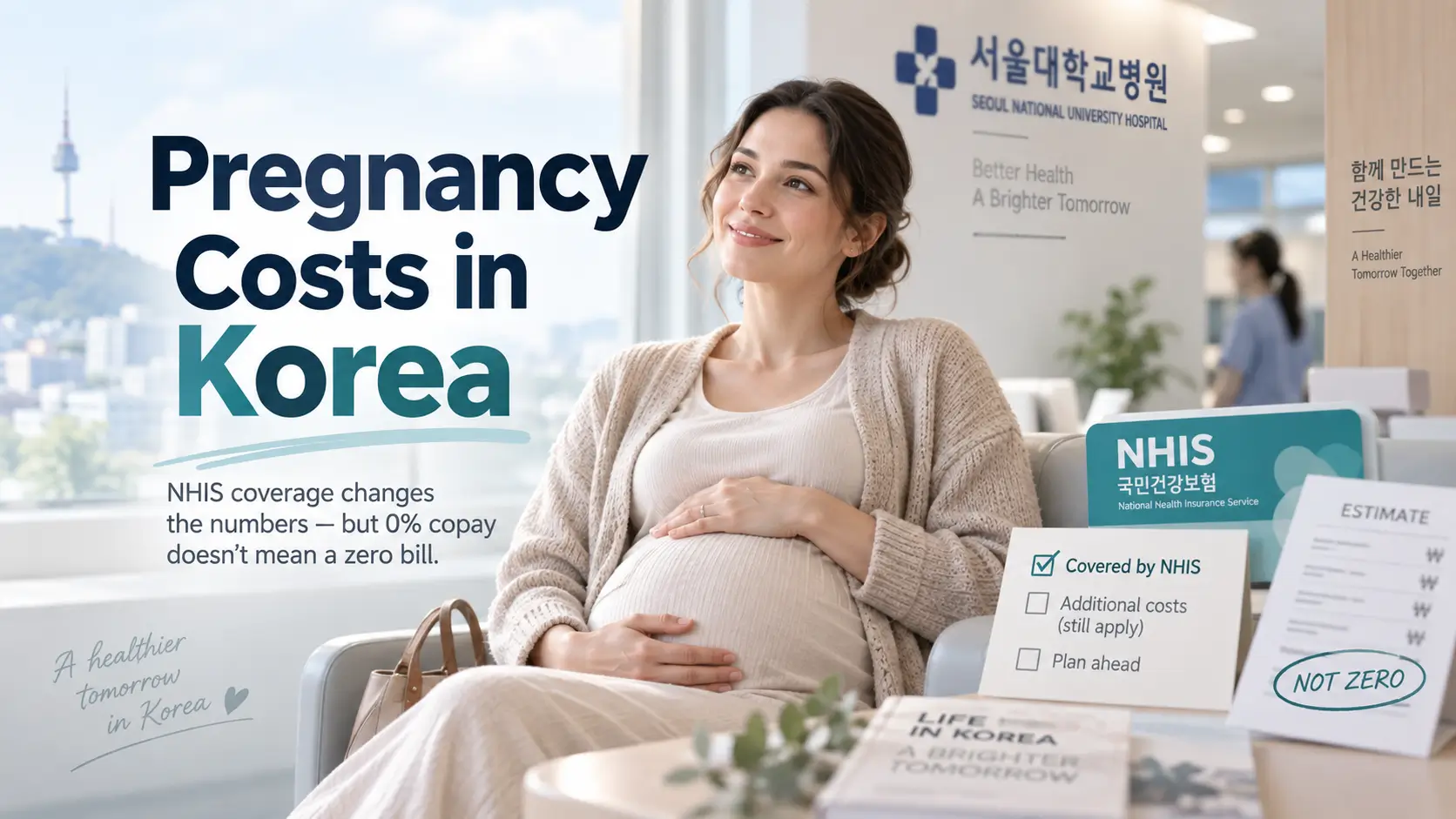
If you are pregnant in South Korea, the number that matters most is not the hospital’s advertised delivery price. It is whether you are covered by Korea’s National Health Insurance Service (NHIS) on the dates you receive care.
For an NHIS-covered foreign resident, pregnancy and delivery can be far less expensive than an uninsured hospital quote suggests. Foreign subscribers and eligible dependents generally receive the same NHIS healthcare benefits as Korean subscribers. Since January 1, 2025, the patient copayment for qualifying NHIS-covered cesarean delivery was reduced from 5% to 0%, putting it alongside covered natural delivery services that already carried a 0% patient copayment.
That does not mean giving birth in Korea produces a zero-won bill. Private rooms, services outside NHIS benefit criteria, extra prenatal scans, optional testing, and other non-covered items can still create substantial out-of-pocket costs. The Korean distinction between covered care and non-covered care is therefore the hinge on which your real budget turns.
| Your situation | What usually matters most | First thing to verify |
|---|---|---|
| Employee enrolled in NHIS | Salary-based premium plus remaining patient charges | Confirm active employee coverage |
| Dependent of an NHIS-covered employee | No separate maternity insurance needs to be created | Confirm dependent status is active |
| Regionally insured foreign resident | Monthly NHIS contribution plus non-covered medical costs | Confirm contribution and eligibility status |
| Tourist or resident without NHIS | Hospital’s self-pay charges | Request a written uninsured estimate |
| Private or international insurance holder | Contract wording and reimbursement limits | Get maternity coverage confirmed in writing |
Table of Contents
The Fast Cost Answer: NHIS Changes the Entire Pregnancy Budget
Korea does not have one national “pregnancy package price.” Your actual cost is a stack of several different expenses:
- your monthly health-insurance contribution,
- prenatal outpatient copayments,
- prenatal tests that fall outside NHIS coverage criteria,
- non-covered hospital charges around delivery,
- room-choice charges,
- medication and follow-up care,
- newborn services,
- and, if you choose one, a separate postpartum care center.
If you are already an NHIS subscriber or dependent, pregnancy itself does not create a special higher NHIS premium. The insurance contribution is determined under Korea’s normal NHIS contribution rules, not according to whether you are pregnant.
If you are still working out whether you are actually enrolled, start with the Korea health insurance guide for expats. The difference between “I live in Korea” and “I am currently an NHIS insured person or dependent” is financially important.
How Much Does NHIS Itself Cost an Expat in 2026?
For 2026, the official employee health-insurance contribution rate is 7.19% of the applicable monthly wage. For an employee insured through a workplace, the employer and employee generally split that health-insurance contribution equally.
You can verify the current rate on the NHIS contribution-rate page. Long-term care insurance is calculated separately, so the amount deducted from a payslip will not be limited to the health-insurance figure alone.
Illustrative employee example
Suppose the applicable monthly wage is KRW 4,000,000.
- KRW 4,000,000 × 7.19% = KRW 287,600 total health-insurance contribution.
- The employee’s 50% share would be KRW 143,800.
- Long-term care insurance would be added separately.
This is an insurance-premium example, not an estimate of pregnancy treatment costs.
Regionally insured foreigners work differently
Foreign residents who are not workplace insured may fall under Korea’s regional insurance system. NHIS calculates regional contributions using the applicable income and property rules, but special contribution rules also apply to many foreign residents.
For 2026, NHIS lists the foreign regional average premium at KRW 158,630 per month including long-term care insurance. For many foreign regional subscribers, an amount calculated below the applicable foreign-resident average may be raised to that average. Visa-based reductions and exceptions exist, and permanent residents, marriage immigrants, students, and other categories can be treated differently.
Do not use KRW 158,630 as a universal expat premium. Check your own record against the NHIS guidance for foreign residents.
Being Pregnant Does Not Automatically Give You NHIS Coverage
This catches some newcomers by surprise. Pregnancy is a medical condition covered within the insurance system once you qualify, but it is not an independent route into NHIS.
A foreign employee working at an NHIS-covered workplace may acquire employee insurance through employment. By contrast, many self-employed or otherwise regionally insured foreigners become subject to mandatory NHIS after meeting the applicable residence requirements, commonly involving more than six months of stay.
Visa type, foreigner registration, employment status, dependent status, and certain exemptions can change the answer. A pregnant visitor who flies into Korea for delivery should therefore not assume that the prices paid by an NHIS-covered resident will apply to her.
Foreign subscribers who are properly enrolled receive NHIS benefits on the same basis as Korean citizens. The decisive word is enrolled.
Korea’s Pregnancy and Childbirth Voucher Can Reduce Your Out-of-Pocket Costs
An NHIS subscriber or dependent with a confirmed pregnancy can apply for Korea’s pregnancy and childbirth medical-expense support, commonly used through the National Happiness Card, or gukmin haengbok card (국민행복카드).
Under the current NHIS rules, the standard support amount is KRW 1,000,000 for a single-fetus pregnancy. Multiple pregnancies receive higher support. Current rules provide additional support for multiples so that eligible twins can reach KRW 2,000,000 in total, while higher-order multiples involve additional eligibility and documentation rules.
An additional KRW 200,000 may apply to an eligible pregnant person registered in a designated medically underserved childbirth area and meeting the required continuous residence period. Foreign residents can qualify under the registration rules when the relevant foreigner-registration requirements are met.
The voucher can be used toward eligible pregnancy and childbirth medical expenses, including patient charges for covered and non-covered care within the program rules. Remaining support can also be used for eligible medical expenses for a covered child under age two.
If the application is made before delivery, the current use period generally runs until two years after the expected delivery date. If it is made after delivery, the period is generally calculated from the actual delivery date. Unused value expires after the applicable period.
The NHIS insurance-benefits page provides the current support amounts and eligibility framework.
For the insurance side beyond NHIS, see the site’s separate guide to Korean maternity insurance for foreigners. It is especially useful if someone is selling you a private product and you are not sure whether it pays for the mother’s pregnancy, the child’s future medical risks, or both.
Natural Delivery and C-Section: A 0% Copayment Does Not Mean a Zero Bill
This is the most important cost distinction in the article.
For qualifying NHIS-covered childbirth services, natural delivery carries a 0% patient copayment. From January 1, 2025, qualifying NHIS-covered cesarean delivery also moved from a 5% patient copayment to 0%.
What disappeared was the patient’s copayment for the covered delivery service. What did not disappear was every possible charge appearing during a hospital stay.
The Ministry of Health and Welfare’s announcement on the cesarean copayment change is worth checking if a hospital estimate appears to be using an older 5% rule.
| Charge | Why it matters | What to ask |
|---|---|---|
| NHIS-covered delivery | Qualifying natural and C-section delivery services have a 0% patient copayment | Is this line an NHIS benefit item? |
| Prenatal ultrasound | Coverage depends on gestational age, type and recognized frequency | Is this scan covered or non-covered? |
| Private or upgraded room | Room choice can add a separate charge | What is the nightly patient charge? |
| Optional tests or services | May sit outside NHIS benefit criteria | Is this medically required and is it non-covered? |
| Newborn care | Routine and additional neonatal care are not one identical package | Which baby charges are included in this estimate? |
| Postpartum center | Usually a separate purchase from the hospital delivery bill | Is this price completely separate from hospital care? |
Prenatal Care Can Still Produce Bills Before Delivery
A foreign parent may hear “delivery has zero copay” and mentally turn the entire pregnancy into a zero-copay event. Korea’s rules are not that simple.
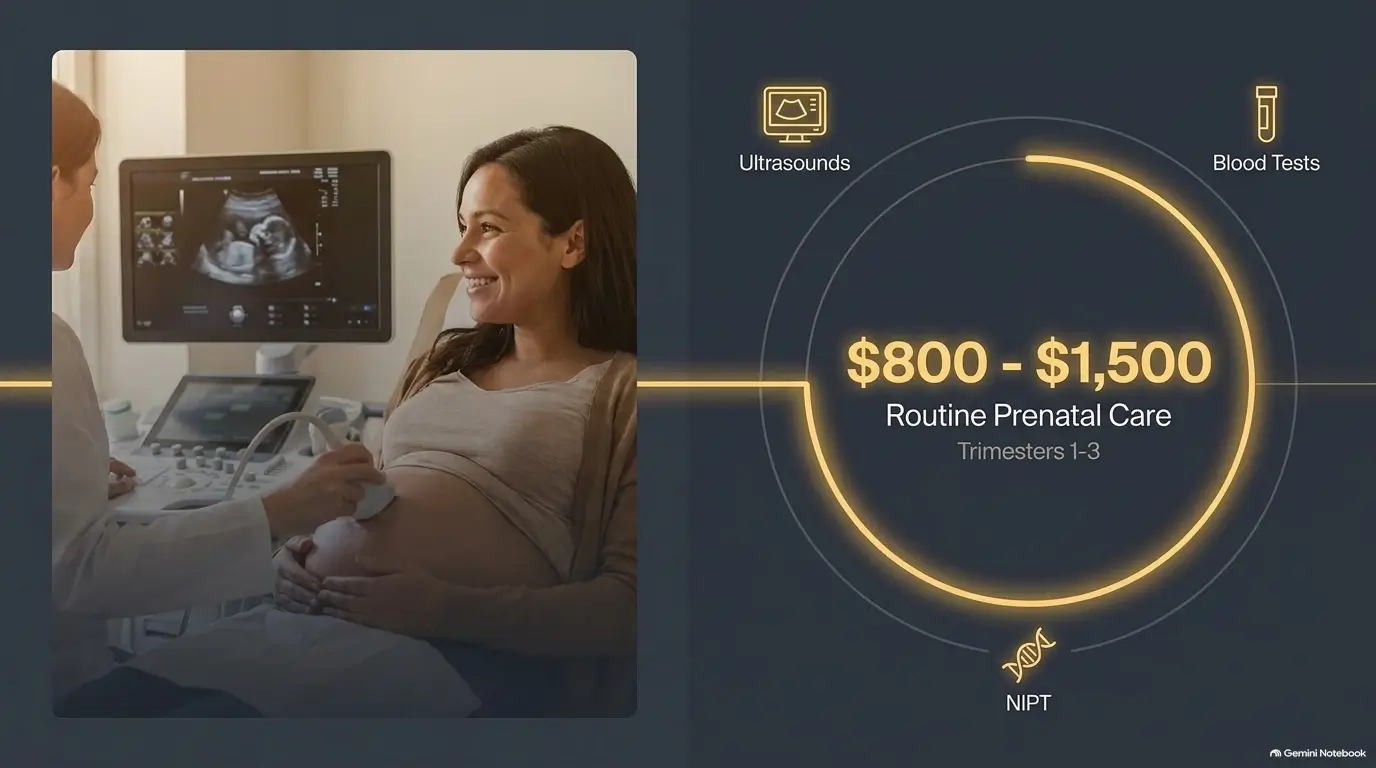
Prenatal outpatient care has its own benefit rules. Ultrasound is a good example. NHIS recognizes prenatal ultrasound within specified gestational periods and frequency limits. An additional scan that falls outside those criteria can become a non-covered service, even when earlier scans were covered.
This means two patients attending the same obstetrics clinic can accumulate different pregnancy costs because one has uncomplicated routine visits while another needs additional imaging, specialist reviews, laboratory testing, medication, or high-risk pregnancy care.
Your National Happiness Card balance is useful here because it can absorb eligible patient charges before you ever reach the delivery room.
The Korean Words That Explain Why Two Hospital Quotes Look So Different
When reading a Korean estimate, look for two categories:
- Covered benefit, geubyeo (급여): a service to which NHIS benefit rules apply.
- Non-covered service, bigeubyeo (비급여): a service for which NHIS does not pay under the applicable benefit rule and the patient generally bears the charge.
A familiar mistake is to translate “I have health insurance” into “the hospital bill is covered.” Korean insurance works line by line. A hospital encounter can contain insured items and non-covered items at the same time.
HIRA states that non-covered prices are set by medical institutions and can differ between hospitals. In 2026, HIRA publishes price information for hundreds of non-covered items across medical institutions. Its non-covered medical fee guidance explains how to compare the disclosed prices.
If you receive a Korean hospital invoice and cannot tell why the patient portion is larger than expected, the breakdown in Korean hospital bills for foreigners can help you separate insurance coverage from provider-set charges.
Your Real Pregnancy Cost Formula
Instead of searching for one misleading national average, build the budget this way:
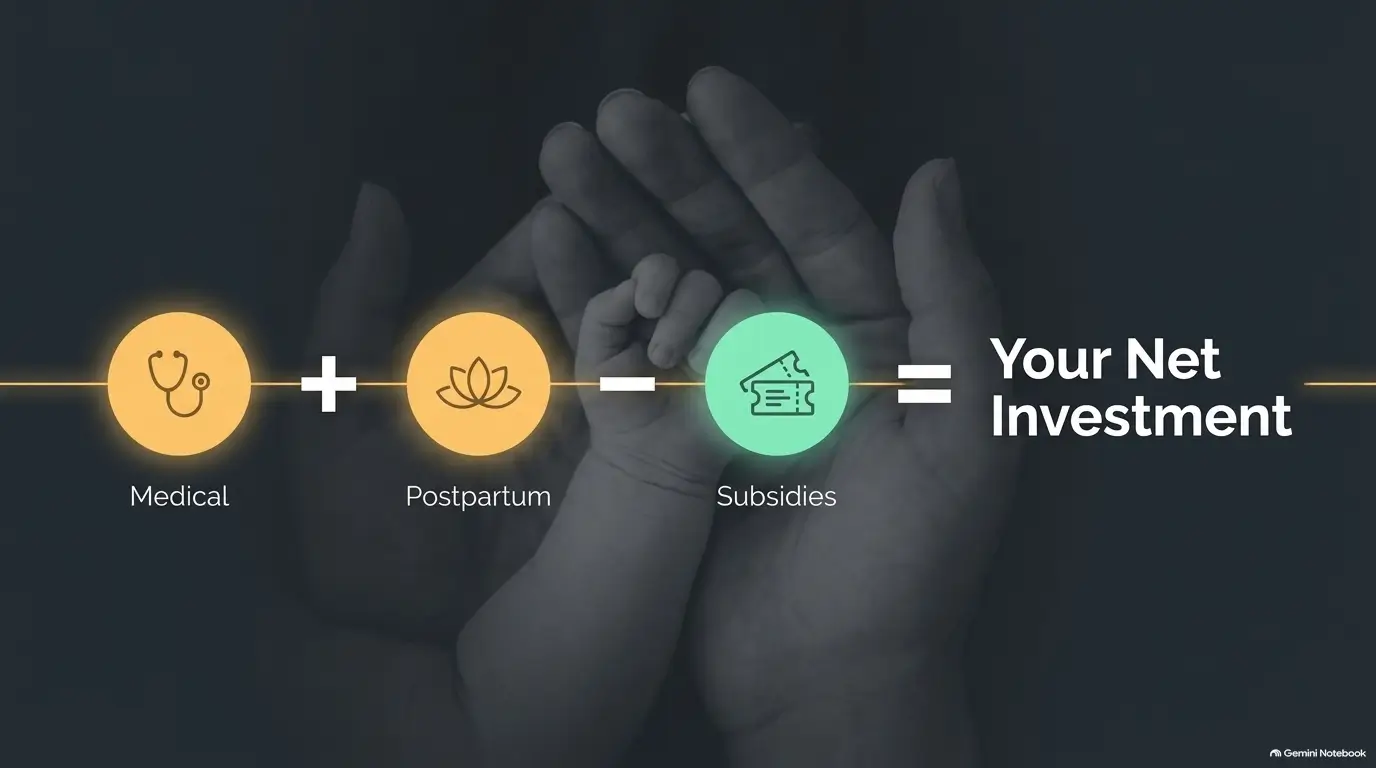
Expected cash cost = NHIS premiums + prenatal patient charges + non-covered prenatal care + non-covered delivery charges + room charges + newborn charges + follow-up care − pregnancy voucher − confirmed private-insurance reimbursement.
This equation exposes why “How much is childbirth in Korea?” is incomplete. The same delivery method can produce very different final bills depending on insurance status and the non-covered choices surrounding it.
Example scenario: an NHIS-covered employee
A foreign employee is already enrolled through work, has a single pregnancy, registers for the KRW 1,000,000 pregnancy and childbirth benefit, and plans to use an ordinary hospital room.
Her budgeting question is not “What does Korean maternity insurance cost?” Her NHIS premium already exists because of her employment. The useful questions are how much of her prenatal spending uses the voucher, which future items will be non-covered, and what the hospital expects her to pay for room choice and other services around delivery.
Example scenario: a pregnant newcomer without NHIS
Another foreign resident has just arrived, is not workplace insured and has not yet acquired regional NHIS eligibility.
She should not budget using the insured patient’s 0% childbirth copayment rule. Her first task is to establish whether and when NHIS eligibility begins. Until coverage is confirmed, she needs a hospital estimate based on her actual uninsured status and a written determination from any private or international insurer she intends to use.
Ask the Hospital These Questions Before Comparing Delivery Prices
A verbal number from the reception desk is not enough. Ask the billing or international-patient desk for a written estimate and work through this list.
- Is this estimate calculated for an NHIS patient or an uninsured patient?
- Which lines are NHIS-covered benefits and which are non-covered?
- Does the delivery estimate already reflect the current 0% copayment rule for qualifying covered natural or cesarean delivery?
- What room category is assumed, and what would a private-room choice add?
- Which prenatal ultrasounds or tests are likely to become non-covered if additional examinations are needed?
- What charges for the baby are included, and which newborn tests or services are separate?
- Are medications, laboratory tests, anesthesia-related services and physician charges included in the estimate?
- Can the National Happiness Card be used for the relevant patient charges?
- Is a deposit required before admission?
- What happens to the estimate if the planned delivery method changes?
That last question matters. A birth plan is not a price guarantee. Medical decisions are made by the treating team according to the patient’s condition, and the cost estimate should be able to survive a change in delivery plan without turning into a financial ambush.
Private Insurance: Ask What It Covers, Not What It Is Called
Private Korean, employer-sponsored and international insurance contracts are not interchangeable with NHIS. They also should not be judged from a product name containing words such as “maternity,” “family,” or “pregnancy.”
Before paying a premium, ask the insurer to confirm in writing:
- whether routine prenatal care is covered,
- whether routine vaginal delivery is covered,
- whether planned and medically necessary C-sections are treated differently,
- whether pregnancy complications are covered,
- whether an already-existing pregnancy is eligible,
- whether there is a waiting period,
- whether newborn care is part of the mother’s benefit or requires separate enrollment,
- the reimbursement limit, deductible or coinsurance,
- and whether direct billing is available at the hospital you intend to use.
A policy that pays generously for complications but excludes routine maternity is financially different from a maternity plan even if both appear useful during pregnancy. Read the benefit schedule, exclusions and waiting-period language before comparing premiums.
If you are considering international rather than Korean coverage, do not cancel existing insurance until NHIS eligibility and the replacement policy’s maternity terms have been confirmed.
Do Not Mix the Delivery Bill With a Korean Postpartum Care Center
Korea’s postpartum care centers, called sanhujoriwon (산후조리원), are culturally prominent enough that foreign families sometimes fold the price into “the cost of giving birth.”
They are better treated as a separate budget decision. Your hospital delivery bill and a stay at a postpartum recovery center are different purchases with different pricing, inclusions and cancellation terms.
If you plan to use one, compare that expense separately using the guide to birth recovery centers in Korea. Otherwise, a seemingly expensive “delivery budget” may actually contain a week or two of private postpartum accommodation hidden inside it.
When English-Language Help Is Worth Paying For
You probably do not need a paid medical coordinator merely because you are foreign. If the hospital has an international clinic and your insurance status is straightforward, the free institutional support may be enough.
DIY may be enough
- Your NHIS status is already confirmed.
- The hospital provides an English estimate.
- The pregnancy is being managed through a routine obstetric pathway.
- You can identify covered and non-covered charges.
One professional or interpreter session may be enough
- A consent form or treatment explanation is difficult to understand.
- You need to compare several hospital estimates written only in Korean.
- An insurer and hospital are describing the same charge differently.
More extensive help may be justified
- The pregnancy is medically complex.
- A large claim has been denied.
- The insurer is overseas and requires extensive medical documentation.
- A disagreement exists over whether treatment was covered, excluded or medically necessary.
If the difficulty is mainly communication rather than medical treatment, medical translation in Korea may be a narrower and less expensive solution than hiring a full medical concierge.
Pregnancy and Delivery Insurance FAQ for Expats in Korea
Can I get the KRW 1 million pregnancy benefit just because I am married to a Korean?
Marriage by itself is not the benefit test. The pregnancy and childbirth benefit is tied to NHIS subscriber or dependent status. A foreign spouse should confirm active NHIS eligibility rather than assuming nationality of the other spouse settles the issue.
Can a tourist use Korea’s 0% delivery copayment rule?
Do not assume so. The copayment rules discussed here apply within the NHIS system. A visitor who is not an NHIS subscriber or dependent should obtain the hospital’s uninsured price and check any travel or international insurance separately.
What if my hospital still quotes a 5% copayment for a C-section?
Ask whether the quote is outdated or whether the charge being discussed is actually a separate non-covered item. The NHIS copayment for qualifying covered cesarean delivery changed from 5% to 0% effective January 1, 2025.
Can I use private insurance instead of NHIS?
That depends on your Korean insurance eligibility and whether an NHIS exemption is legally available in your situation. Having a foreign policy does not automatically remove an NHIS enrollment obligation. Confirm the exemption directly with NHIS before relying on private insurance alone.
What if I discover an unexpected non-covered charge after treatment?
Ask the hospital for an itemized bill showing the charge and whether it was processed as an NHIS benefit or non-covered service. If the classification or amount still appears unclear, compare the item with HIRA’s published information and ask the billing office to identify the exact service code or description.
Your 10-Minute Pregnancy Cost Check
Before comparing another hospital, another insurer or another maternity package, find one document: proof of your current NHIS status.
Then write four lines on a page:
- My NHIS status: employee / dependent / regional / not enrolled.
- My remaining pregnancy and childbirth voucher balance: KRW ____.
- Hospital non-covered items I have been quoted: ____.
- Private-insurance reimbursement confirmed in writing: KRW ____ or not yet confirmed.
If line one is uncertain, resolve it before trusting any delivery-cost estimate. NHIS provides an English consultation line at 033-811-2000, and your hospital can then prepare a quote using the correct insurance status.
Once those four lines are known, Korea’s maternity costs stop looking like a mysterious package price. They become what they really are: insurance contributions, covered medical care, provider-set extras, and a small number of choices you can check before the bill arrives.
Last reviewed: 2026-10