
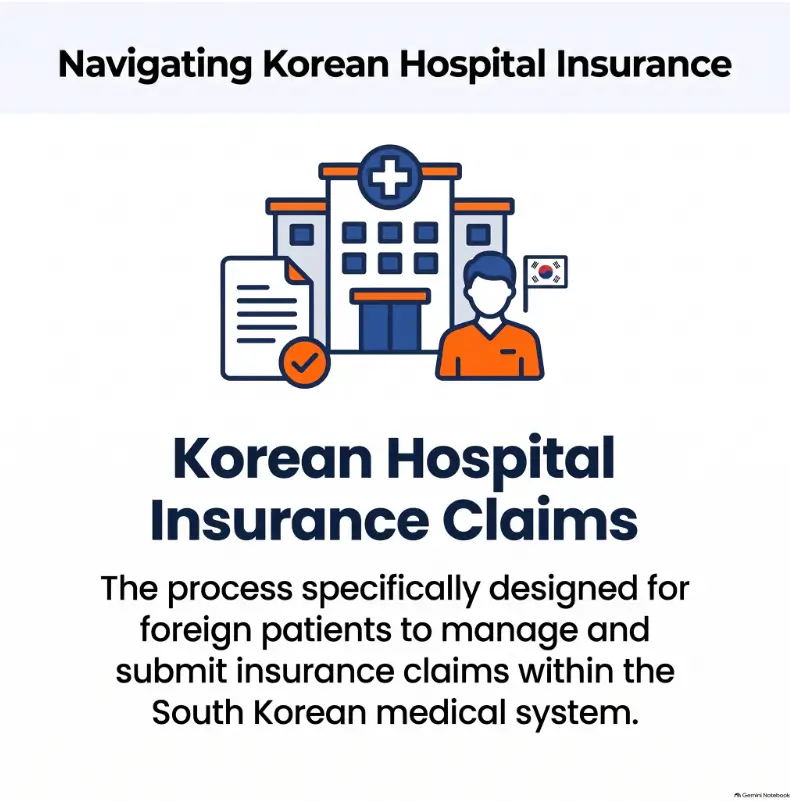
You have paid a Korean hospital bill. Now the practical question is not simply, “Will insurance cover it?” It is: which insurance is supposed to pay, and what evidence does that insurer need?
For most foreign patients, the safest approach is to leave the hospital with the final medical receipt, an itemized statement, and any document needed to prove the diagnosis or treatment. Then confirm your insurer’s exact requirements before paying for extra certificates or translations.
The distinction that changes almost everything is whether you are using Korean National Health Insurance (NHIS), Korean private indemnity insurance, or travel/international insurance. These are not three versions of the same system.
Table of Contents
First Decide Which Insurance Is Supposed to Pay
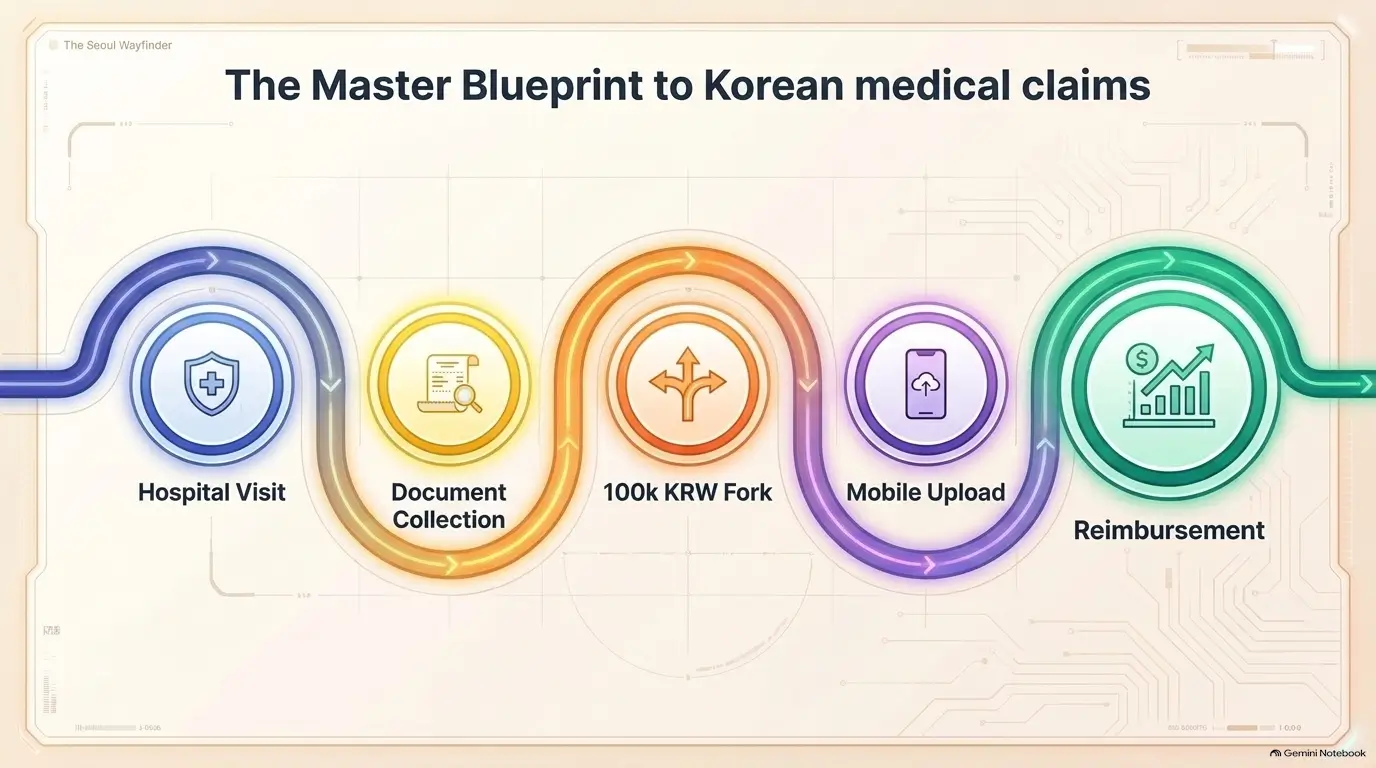
Start here. The paperwork and claim process depend much more on the payer than on your nationality.
| Insurance situation | How payment usually works | What you should do next |
|---|---|---|
| NHIS coverage | Eligible benefits are generally reflected when the hospital calculates your bill | Check the receipt for covered, patient-paid, and non-covered amounts |
| Korean private indemnity insurance (실손의료보험) | You normally claim eligible out-of-pocket medical expenses from the private insurer | Check insurer requirements or whether electronic submission through 실손24 is available |
| Travel or international health insurance | You usually pay the Korean provider and seek reimbursement under your policy | Collect Korean medical evidence, then follow the foreign insurer’s claim rules |
| No insurance applicable | You remain responsible for the bill | Keep the documents anyway in case another reimbursement right later becomes relevant |
Foreign residents who are enrolled in Korean National Health Insurance generally receive the same categories of NHIS benefits as Korean citizens. Eligibility itself, however, is a separate question. The National Health Insurance Service guidance for foreign residents explains current enrollment and benefit rules.
If you are not sure whether NHIS should have applied to your treatment, review our Korea health insurance guide for foreigners before treating the entire hospital bill as an insurance claim.
If the confusing part is the bill itself rather than the claim, start with how Korean hospital bills work for foreign patients. A large number at the bottom of a receipt tells you what you paid. It does not, by itself, tell you what a private insurer will reimburse.
Ask for These Documents Before You Leave the Hospital
You do not need to buy every document available at the medical-record desk. Begin with the records most likely to prove three things: what happened, what treatment you received, and what you paid.
| Document | Korean name to recognize | Why it matters |
|---|---|---|
| Medical expense receipt | 진료비 계산서·영수증 | Shows the hospital charge and amount paid |
| Itemized medical bill | 진료비 세부내역서 | Shows individual tests, procedures, drugs, materials, and other charges |
| Diagnosis or treatment confirmation | 진단서, 진료확인서, 통원확인서 | Helps establish the medical reason for treatment when required |
| Admission and discharge confirmation | 입·퇴원확인서 | Useful when an inpatient claim requires proof of hospitalization dates |
| Prescription | 처방전 | May connect prescribed medication to the diagnosis or visit |
| Pharmacy receipt | 약제비 계산서·영수증 | Evidence of separately purchased prescription medication |
| Medical-record copy | 진료기록 사본 | Useful when the insurer needs more clinical detail than a certificate provides |
Under Korea’s health-insurance billing rules, healthcare institutions providing NHIS benefits issue the applicable medical expense calculation and receipt. Separately, Article 21 of the Medical Service Act gives patients a right to request inspection or copies of their own medical records, subject to the applicable identity and access procedures.
That distinction is useful. A receipt proves payment. An itemized statement explains the charges. A medical certificate or record proves the clinical facts. One document rarely performs all three jobs.
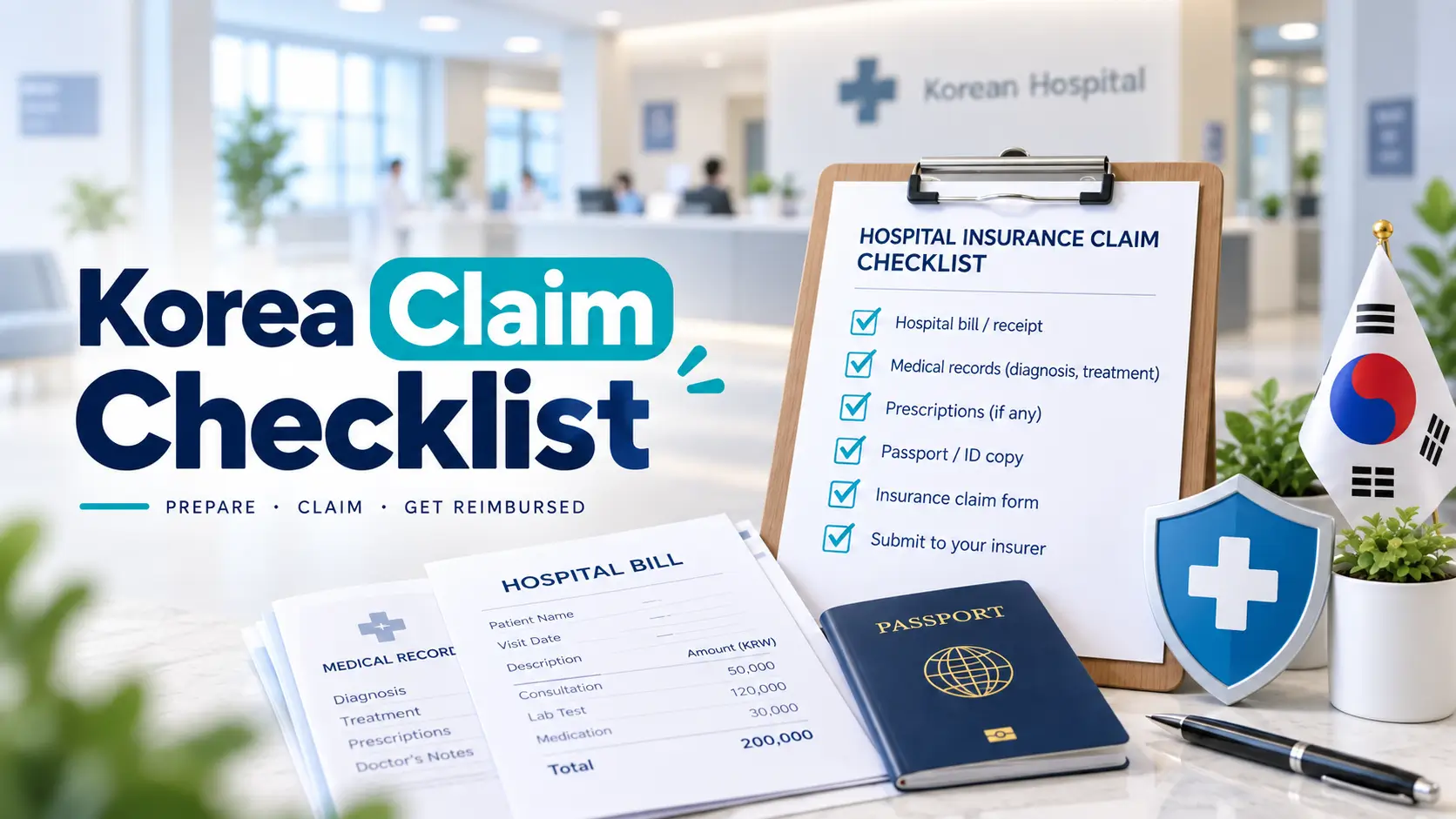
Your 10-Minute Hospital Insurance Claim Checklist
Before leaving the hospital, or before making a return trip solely for paperwork, run through this sequence.
- Confirm the patient name. Make sure the name on the hospital documents can be matched to the insured person. If your passport name, Korean residence-card name, and insurance record differ in spacing or order, keep evidence that connects them.
- Get the final receipt. Ask for the 진료비 계산서·영수증, not merely a card-payment slip.
- Get the itemized statement. Ask for the 진료비 세부내역서 when the insurer may need to see how the total was constructed.
- Check whether the diagnosis appears anywhere usable. Do not automatically purchase a full diagnosis certificate if a less expensive document satisfies the insurer.
- Collect admission evidence if you stayed overnight. Confirm that admission and discharge dates are correct.
- Keep the prescription and pharmacy receipt. Hospital treatment and pharmacy spending may create separate pieces of evidence.
- Photograph or scan everything. Preserve readable copies before mailing originals anywhere.
- Ask the insurer what it requires. Confirm whether it needs originals, English documents, medical records, a claim form, or additional authorization.
- Check the filing deadline in your own policy. Do not assume that another insurer’s deadline applies to yours.
- Submit only through a channel you can document. Save the upload confirmation, email, claim number, or other proof of submission.
A useful sentence at a Korean hospital administration desk is: “보험 청구용으로 진료비 계산서·영수증과 진료비 세부내역서가 필요합니다.” It means you need the medical expense receipt and itemized statement for an insurance claim.
Do Not Confuse a Card Receipt With the Hospital Medical Receipt
This small distinction causes disproportionately large headaches.
A credit-card receipt proves that a transaction occurred. Your insurer may need a hospital-issued medical expense receipt showing the medical billing information instead. Keep the payment slip if you have it, but do not assume it replaces the 진료비 계산서·영수증.
The same principle applies to a bank transfer screenshot. It can help prove payment, but it usually cannot explain what medical services produced the charge.
Read the Korean Bill Before Asking an Insurer to Reimburse It
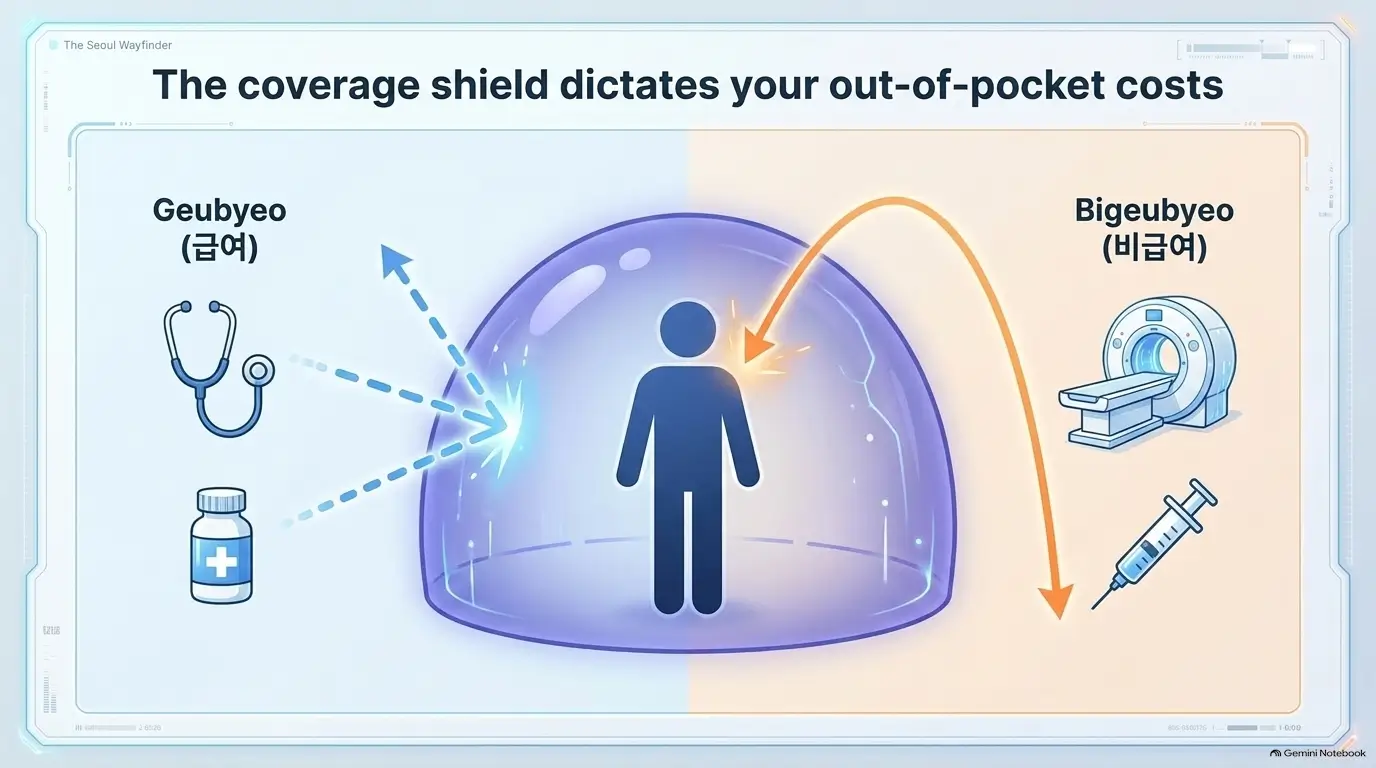
A Korean medical bill may contain amounts treated differently under the National Health Insurance system. In broad terms, you may see charges associated with insured benefits, patient cost-sharing, full patient payment, or non-covered services.
The important insurance lesson is this: “NHIS did not cover it” does not automatically mean “my private insurer will cover it.” Private and travel policies apply their own definitions, exclusions, deductibles, limits, medical-necessity rules, and documentation requirements.
The reverse can also occur. A patient may have paid only part of an NHIS-covered service and then have a valid claim for some of that out-of-pocket amount under Korean private indemnity insurance, depending on the contract.
If an NHIS-enrolled patient believes a charge classified as non-covered or full patient payment may actually have been an NHIS benefit, the Health Insurance Review & Assessment Service operates a medical-expense verification procedure for qualifying cases. This is a question about the Korean health-insurance classification of the charge, not a request for a private insurer to reinterpret its policy.
If You Have Korean Private Indemnity Insurance
Korean private indemnity medical insurance, commonly called 실손의료보험 or simply 실손보험, is separate from NHIS. NHIS determines the national health-insurance side of the bill. Your private insurer determines whether your remaining expense falls within your private contract.
The General Insurance Association of Korea publishes a standardized guide to indemnity medical insurance claim documents. It distinguishes documents for outpatient and inpatient claims and recognizes that some claims can be handled with simplified evidence rather than an expensive diagnosis certificate.
This is a good reason to check before ordering extra certificates. A diagnosis certificate may carry an issuance charge, while another document already produced during your treatment may contain enough information for the claim.
Check 실손24 before returning to the hospital for paper copies
Korea has expanded electronic indemnity-insurance claims through 실손24. The system covers hospitals, clinics, and pharmacies within the national electronic-claim framework, but actual electronic transmission depends on the medical institution being connected to the system.
At a connected provider, the 실손24 service can transmit selected treatment records for an indemnity-insurance claim without requiring the patient to carry the corresponding paper documents from the hospital to the insurer.
Do not assume this works for an overseas travel insurer. 실손24 is designed for Korean indemnity medical insurance claims. A US, UK, Canadian, Australian, or other international insurer may have its own portal and its own evidence requirements.
If You Are Claiming Travel or International Insurance
For a foreign travel or international health policy, the Korean hospital supplies the medical evidence, but your insurer controls the reimbursement requirements.
A practical claim file may include the following, depending on the policy and reason for treatment:
- hospital medical expense receipt;
- itemized medical statement;
- document showing diagnosis or reason for treatment;
- admission and discharge confirmation for hospitalization;
- prescriptions and pharmacy receipts;
- the insurer’s claim form;
- policy or membership information;
- proof of payment;
- bank details for reimbursement;
- medical records if requested;
- accident, police, airline, or other incident documentation when the policy requires it.
Not every claim needs every item. Asking the insurer for its exact checklist before buying additional hospital certificates can save both money and another trip across town.
For a step-by-step filing process, continue with our Korea travel insurance claim guide.
Do You Need English Hospital Documents?
Sometimes. Not automatically.
A Korean hospital may be able to issue certain certificates in English, particularly at larger institutions or international healthcare centers. Availability, wording, processing time, and fees are institution-specific.
Before paying for an English certificate, ask your insurer four questions:
- Will you accept the original Korean document?
- Do you need a translation?
- Must the translation be certified, or is an ordinary translation acceptable?
- Do you require the hospital itself to issue the document in English?
This is one place where a home-country assumption can become expensive. An insurer being based in an English-speaking country does not necessarily mean every Korean receipt must be professionally translated.
If translation is genuinely required, see our guide to medical translation in Korea before ordering a service with more certification than the insurer actually needs.
If You Were Admitted to a Korean Hospital
An inpatient claim usually creates more evidence than a short outpatient visit. Before discharge, confirm that you have a final billing document and know where to request additional records after the medical record is completed.
Depending on the insurer, useful documents may include an admission/discharge confirmation, diagnosis evidence, operative records, test results, or other clinical records. Ask the insurer which records it actually needs rather than requesting the hospital’s entire chart by default.
If you are still preparing for admission rather than filing afterward, our Korean hospital admission guide explains the practical steps foreign patients are likely to encounter.
What Foreign Patients Should Check Before Leaving Korea
A missing document is mildly annoying when the hospital is three subway stops away. It is a different problem when you are already at the airport.
If you will leave Korea soon, check these points before departure:
- Hospital contact details: save the international clinic, medical-record office, or administration number if available.
- Document access: ask whether records can later be requested remotely and what identity documents would be required.
- Original-document requirement: determine whether your insurer needs originals before mailing anything abroad.
- English availability: ask what the hospital itself can issue in English.
- Imaging: if an insurer or follow-up doctor specifically needs scans, ask how copies are supplied.
- Follow-up documents: make sure later pathology or test results will be accessible if they are not finished before departure.
Korean law gives patients access rights to their own medical records, but identity verification and hospital procedures still matter. A foreign patient requesting records from another country may therefore face more friction than someone standing at the records counter with identification in hand.
What to Do If the Insurer Says Your Documents Are Incomplete
Do not immediately order a fresh stack of certificates. First identify the precise evidentiary gap.
Ask the insurer to state which of these is missing:
- proof that you paid the bill;
- an itemized description of the charges;
- a diagnosis;
- the dates of treatment or hospitalization;
- proof that the treatment was medically necessary under the policy;
- a prescription or pharmacy record;
- an accident or incident record;
- a translation;
- an original rather than a copy;
- authorization to obtain additional medical information.
Once the missing fact is clear, ask the hospital for the smallest document that proves it. This is usually better than repeatedly buying broader certificates and hoping one satisfies the claims examiner.
If the Claim Is Denied, Separate the Medical Bill From the Insurance Decision
A Korean hospital can explain what it treated and what it charged. It generally cannot decide what a separate travel or private insurance contract promises to reimburse.
If a claim is rejected, request the insurer’s reason in writing and identify which policy term it is relying on. A denial based on missing documentation requires a different response from a denial based on an exclusion, deductible, benefit limit, pre-existing-condition provision, or dispute over medical necessity.
Do not spend money obtaining additional medical evidence until you know whether additional evidence could actually change the decision. Our Korea travel insurance claim denial guide covers that next decision in more detail.
When Professional Help Is Actually Worth Paying For
Most straightforward hospital reimbursement claims do not begin with a lawyer or paid claims specialist. The first useful work is usually free: obtain the hospital documents, read the policy requirements, and ask the insurer to identify anything missing.
DIY is usually enough when
- the treatment and diagnosis are straightforward;
- the insurer provides a clear document list;
- you have the receipt and supporting medical evidence;
- no denial or coverage dispute exists;
- the filing deadline is comfortably open.
Paid help becomes more rational when
- a significant claim has been denied for a substantive coverage reason;
- the insurer and hospital disagree about what evidence can establish a material fact;
- translation accuracy could materially affect a high-value claim;
- several countries or insurance systems are involved;
- a contractual or legal deadline is close;
- the dispute has moved beyond ordinary document correction.
The question is not “Can I hire someone?” It is “What unresolved problem would I be paying that person to solve?”
Korea Hospital Insurance Claim FAQ
Can I request my Korean hospital records after I have already paid?
Yes. Korean medical law provides patients with access to their own medical records, subject to the applicable identification and hospital procedures. Requesting them while you are still in Korea may nevertheless be easier than arranging access from overseas.
Should I ask the hospital for an English diagnosis certificate immediately?
Not unless you already know it is required. First ask the insurer whether it accepts Korean documents, an ordinary translation, a certified translation, or specifically an English document issued by the hospital.
Can a tourist use 실손24 for travel insurance?
Do not assume so. 실손24 is Korea’s electronic claim infrastructure for Korean indemnity medical insurance. An overseas travel policy normally follows the claim process set by that insurer.
What if my name is different on my passport and Korean hospital record?
Flag the difference before submitting the claim. Variations in spacing, middle names, or Korean registration formats can create an identity-matching problem. Keep copies of the identification documents that connect the hospital patient record to the insured person.
Should I send the insurer my original hospital documents?
Only after checking the insurer’s requirements. If originals are required, scan or photograph them first and use a submission method that gives you evidence of delivery. Never surrender your only copy casually.
Your Next 10 Minutes
Put your Korean hospital paperwork on a table and make three piles: proof of payment, proof of what was treated, and proof of what each charge was for.
If one pile is empty, you now know what to request. If all three are covered, contact the insurer and ask one precise question: “Is anything else required for this specific claim, including translation or original documents?”
That ten-minute check is usually more valuable than collecting every certificate the hospital can print. In insurance claims, paperwork works best when every page has a job.
Last reviewed: 2026-10