
Korea Market Entry Guide
Korea Cybersecurity Certification for B2B Vendors:
Which Approval Actually Opens the Door?
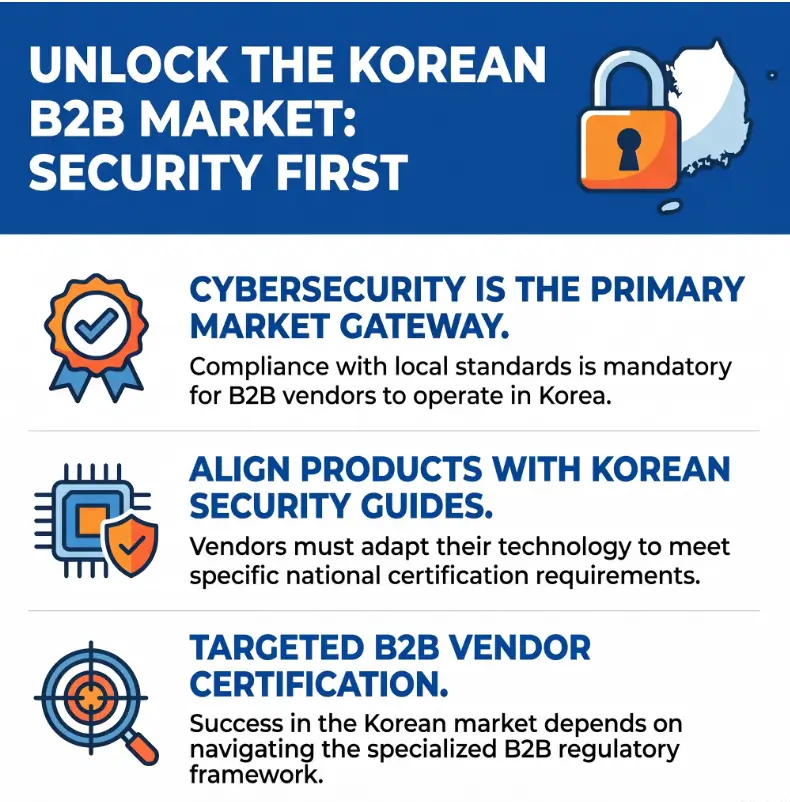
A Korean buyer asks whether your platform has “the Korean security certificate.” The question sounds singular. The answer rarely is. A SaaS service, public-sector cloud, encryption product, firewall, and connected device may each face a different assurance route, even when the sales deck places them all beneath the same cybersecurity umbrella.
The expensive mistake is treating certification as a logo that can be purchased near the end of procurement. Korean approvals attach to defined legal entities, services, systems, deployment models, product versions, operating environments, and evidence. A certificate can be perfectly genuine while covering almost none of what the customer plans to buy.
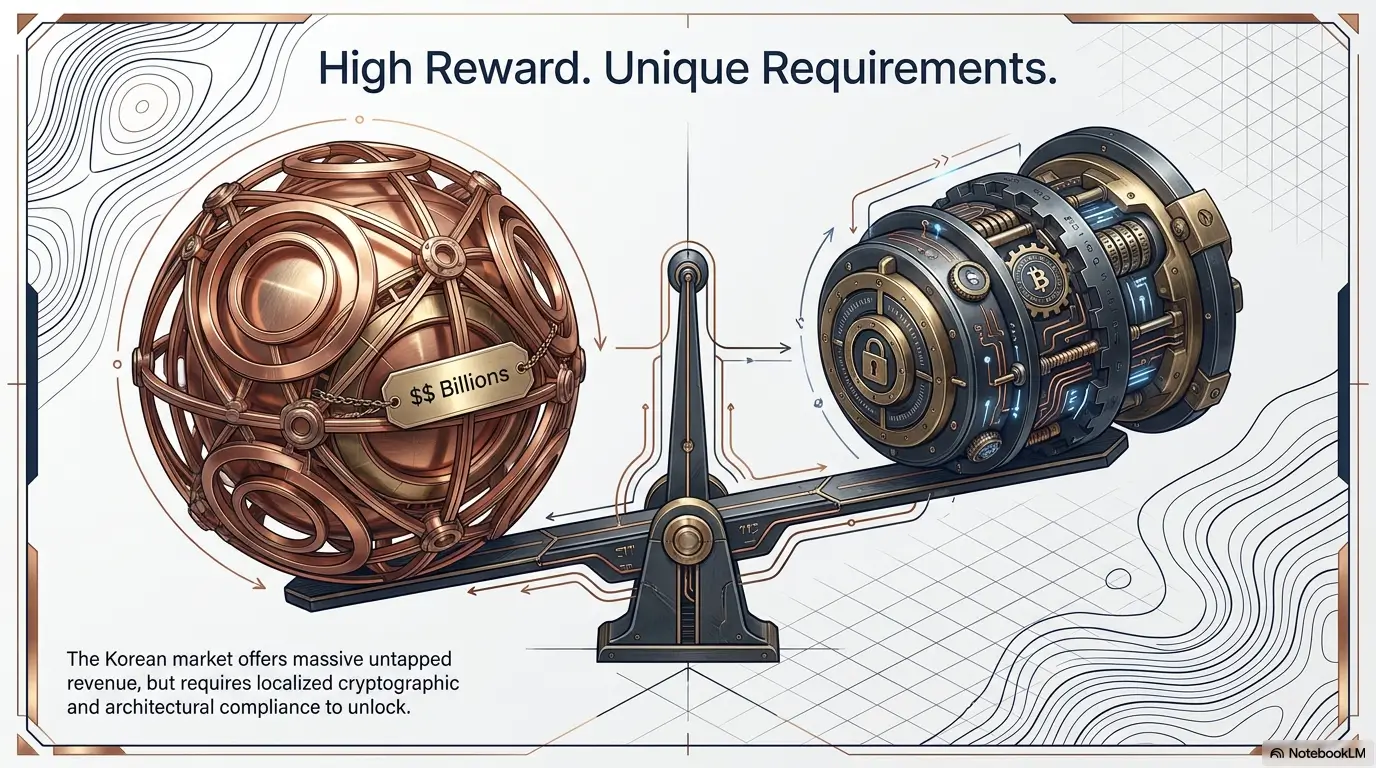
This guide helps U.S. and other foreign B2B vendors separate ISMS, ISMS-P, CSAP, Common Criteria, KCMVP, IoT security certification, and product performance evaluation. More importantly, it shows how to identify the right route before sales promises a deadline that engineering cannot safely keep.
Choose the route
Match the approval to the buyer, product, data, and procurement channel.
Control the scope
Prevent legal-entity, hosting, support, and product-version gaps.
Protect the deal
Ask better questions before budgeting for assessors and remediation.
The certificate is not the door. It is the key cut for one particular lock. 🔐
Snapshot
This article is for SaaS, cloud, cybersecurity, enterprise-software, and IoT vendors evaluating Korean enterprise or public-sector requirements. It will help you distinguish mandatory certification from customer preference, compare the major approval routes, define a defensible scope, and create a one-page decision sheet before contacting an assessor.
Table of Contents
Before You Act: Certification Is Not a Logo Shopping Exercise
This guide provides general educational information about Korean cybersecurity certification and procurement routes. It cannot determine whether a particular company, contract, product, or service is legally required to obtain an approval.
Requirements may depend on the contracting entity, Korean revenue and user thresholds, service architecture, data flows, hosting locations, cryptographic implementation, product configuration, customer classification, tender wording, and rules that change during a procurement cycle.
Before you promise a certification date
Confirm the requirement with the relevant Korean authority, buyer, certification body, or qualified Korean adviser. Ask for the exact rule, scheme, product category, scope, deadline, and acceptance condition in writing. A translated acronym in an email is not yet a compliance roadmap.
Separate legal duties from procurement preferences
A private customer may request ISMS-P evidence because its security team prefers locally recognizable assurance. That request does not automatically mean your company falls within a statutory mandatory-certification category.
The reverse can also happen. A sales team may believe a familiar international certificate is enough, while a Korean public-sector tender specifies a local approval path for the service or product being purchased.
Treat translated requirements carefully
Korean procurement documents may use terms that sound broader or narrower in English than they are in the governing scheme. Request the original Korean clause, the issuing organization, the document version, and the precise acceptance test.
This is also where communication habits matter. A customer may initially say a certification is “needed” when the real meaning is “preferred for security review” or “required before production use.” A careful understanding of Korean business communication can help your team clarify the requirement without making the buyer feel challenged.
The First Fork: Private Enterprise or Korean Public Sector?
Private-sector deals usually start with customer risk
A Korean enterprise buyer may request ISO 27001, SOC reports, penetration-test summaries, privacy documentation, secure-development evidence, incident procedures, subcontractor controls, ISMS or ISMS-P status, and contract-specific safeguards.
The practical question is not simply, “What certificate do Korean companies require?” It is, “What evidence will this buyer accept for this data, deployment, and business process?”
A private manufacturer buying a low-risk collaboration tool may accept international assurance plus a security questionnaire. A financial, healthcare, telecommunications, or large-platform customer may demand deeper local evidence, stricter contractual controls, or a certification scope that clearly includes the purchased service.
Public-sector deals change the map
Government agencies, municipalities, schools, public institutions, and other public buyers may apply Korean cloud, product-security, cryptographic, procurement, or security-conformity requirements that do not appear in an ordinary enterprise sale.
For cloud vendors, CSAP has historically been a central public-market gate. For security products, the route may instead involve Common Criteria, security-function confirmation, performance evaluation, verified cryptographic modules, or another product-specific process.
“Government-ready” is a product choice
A public-sector edition may require different hosting, network controls, administrative access, logging, cryptography, support procedures, deployment documentation, or release governance. These are product and operating-model choices, not decorative paperwork.
When a public-market strategy is serious, build a separate requirements backlog. Mixing public-sector controls into the final month of a private-sector product roadmap is how a manageable project becomes a corridor full of locked doors.
Key takeaway
Choose the market before choosing the certification. “Korean enterprise,” “regulated Korean customer,” and “Korean public sector” are three different sales motions with different evidence burdens.
The Korea Certification Route Map
Korea does not operate one universal cybersecurity certificate for all B2B technology vendors. The main routes answer different questions about an organization, cloud service, security product, cryptographic module, connected device, or performance claim.
| Route | What it primarily evaluates | Common vendor profile | Typical commercial trigger |
|---|---|---|---|
| ISMS | Information-security management for a defined service scope | SaaS, platforms, information-service providers | Mandatory threshold, regulated customer, or voluntary trust signal |
| ISMS-P | ISMS controls plus personal-data processing requirements | Services collecting or managing personal data | Privacy-heavy service scope or buyer expectation |
| CSAP | Security of a defined cloud service | IaaS, SaaS, DaaS, and other eligible cloud services | Korean public-sector cloud use |
| Common Criteria | Security functions of an evaluated product configuration | Firewalls, access-control products, security software | Product-security or public procurement requirement |
| KCMVP | Implementation of a cryptographic module | Encryption, VPN, DRM, SSO, database-security vendors | Specified national or public-sector cryptographic use |
| IoT security certification | Security of connected products and linked mobile applications | Consumer, industrial, building, and medical-connected devices | Product trust, buyer requirement, or market-access planning |
| Performance evaluation | Security-function operation, attack handling, throughput, and efficiency | Network and endpoint security products | Eligible public-sector product introduction or competitive proof |
Management system versus product evaluation
ISMS and ISMS-P examine whether a defined organization and service scope operates an appropriate management system. Common Criteria and KCMVP focus more narrowly on evaluated products, security functions, modules, configurations, and implementation evidence.
A company can therefore hold a management-system certificate without its firewall being a Common Criteria-certified product. A certified cryptographic module does not certify every SaaS workflow that calls it. The nouns matter.
One deal may require more than one route
A public-sector security platform could involve a cloud-service assurance route, product-security evaluation, verified cryptography, and contractual privacy controls. These processes may overlap in evidence, but they are not automatically interchangeable.
The four-question route finder
1. Who buys?
Private enterprise, regulated customer, or public institution?
2. What is sold?
Cloud service, security product, crypto module, or connected device?
3. What is processed?
Personal data, sensitive business data, public information, or none?
4. What must match?
Legal entity, service instance, hosting model, module build, and version.
ISMS or ISMS-P? The Small Letter That Changes the Audit
ISMS protects a defined information service
ISMS evaluates the management system protecting the organizations, physical locations, systems, information assets, and operating activities included in the certification scope.
For a SaaS vendor, the scope might include a Korean-facing service, its production systems, administrative portal, operational personnel, incident processes, access governance, development controls, and supporting infrastructure. It does not necessarily include every corporate office or product the vendor owns.
ISMS-P adds the personal-data lifecycle
ISMS-P adds requirements related to personal-data collection, use, retention, sharing, deletion, data-subject rights, and the systems and personnel involved in those activities.
A vendor processing employee identities, customer profiles, account records, contact information, support transcripts, device identifiers, or behavioral data should map the full lifecycle before deciding that an information-security-only story is commercially sufficient.
Check mandatory ISMS status separately
KISA identifies mandatory ISMS categories that include certain telecommunications and data-center operators, qualifying large hospitals and universities, information-service businesses meeting the applicable annual information-service revenue threshold, and services meeting the applicable average daily-user threshold.
A mandatory entity may generally choose ISMS or ISMS-P. Foreign corporate structures can complicate the analysis because the relevant service provider, revenue, users, contracting entity, and operating entity may not sit in the same company.
Do not count global revenue or users one way merely because it produces a convenient result. Document the methodology and confirm it with the appropriate Korean specialist or KISA help channel.
Voluntary certification can support sales
Companies outside mandatory categories may apply voluntarily. The commercial case is strongest when certification removes repeated buyer objections, supports several Korean accounts, strengthens a regulated-market strategy, or gives a durable answer to local assurance questions.
It is weaker when one small prospect vaguely mentions certification, the service boundary is unstable, or the Korean offering may be replaced within a year.
Key takeaway
Choose ISMS or ISMS-P by the real service and data lifecycle, not by which acronym sounds stronger on a slide. A broader label with the wrong boundary may be less useful than a carefully scoped certificate.
Scope Is the Trapdoor: What the Certificate Really Covers
Name the customer-facing service precisely
List the product editions, domains, applications, APIs, administrative consoles, support functions, data pipelines, mobile clients, and shared services included in the proposed scope.
“Corporate cloud platform” is rarely precise enough. “Korean enterprise edition of Product X, including the production web application, API gateway, administrative portal, and associated customer-support operations” is closer to something engineering and procurement can test.
Trace every organization with production influence
Map the Korean subsidiary, overseas parent, development teams, security operations, support engineers, contractors, hosting providers, and subprocessors that can access, alter, protect, restore, or materially influence the scoped service.
A Korean legal entity may sign the customer contract while a U.S. parent owns the code, an Irish entity contracts with the cloud provider, and a support team in another country holds privileged access. The certificate scope must face this operating reality rather than the neatest box in the organizational chart.
Illustrative example: The certificate that missed the product
A U.S. SaaS vendor sends a Korean prospect its parent company’s security certificate. The certificate is valid, current, and professionally presented.
During procurement, the buyer notices that the certified scope covers corporate IT and an older service hosted in a different cloud region. The Korean service under review uses a newer identity layer, a separate support team, and several subprocessors that do not appear in the scope.
The buyer does not accuse the vendor of dishonesty. It simply asks for more evidence. Sales loses several weeks collecting documents it thought the certificate had already replaced.
The lesson is quiet but expensive: a certificate is not judged by how impressive its logo looks. It is judged by how closely its wording matches the service, entity, systems, and people the customer is trusting.
Use a scope-readiness checklist
- Contracting legal entity identified
- Service owner and operator identified
- Product editions and production domains listed
- Cloud regions and physical locations documented
- Administrative access paths mapped
- Development, support, and security teams included where relevant
- Subprocessors and outsourced operations recorded
- Personal-data systems and handlers mapped for ISMS-P
- Major exclusions written in plain English
- Customer requirement compared against the proposed certificate wording
Show me the nerdy details
A useful scope model has at least six layers: legal entity, customer-facing service, information assets, physical and cloud locations, operational personnel, and third-party dependencies.
For product-focused routes, add the evaluated build, firmware version, cryptographic module version, operating environment, configuration assumptions, linked application, and update process.
Create a traceability sheet connecting each buyer requirement to a system component, control owner, evidence item, and certification boundary. This exposes gaps before the assessor or customer discovers them.
CSAP in 2026: A Live Program Inside a Coming Transition
CSAP still matters now
As of July 2026, Korea continues to operate the Cloud Security Assurance Program, publish current guidance, maintain certification records, and accept cloud-service certifications under the existing framework.
Cloud vendors should therefore not treat CSAP as already abolished. A tender issued today may still rely on current CSAP terminology, categories, records, and maintenance requirements.
A new public-cloud system is planned
In April 2026, the Ministry of Science and ICT and the National Intelligence Service announced a plan to consolidate the existing dual public-cloud procedures into a single NIS-led verification system.
The announced schedule calls for a transition period and full implementation in the second half of 2027. The government also stated that existing CSAP certificates obtained before the new system takes effect will retain their recognized validity.
That creates a planning challenge. Vendors must prepare for the rules applying to the current procurement while tracking the future verification framework that may govern later renewals, new services, or expansion.
Key takeaway
Do not build a 2026 bid from a 2027 headline. Record the tender date, expected contract date, certification milestone, transition rules, and certificate-validity treatment before selecting a route.
Match the deployable cloud service
Cloud assurance attaches to the evaluated service, not to the general reputation of the parent corporation. A globally certified vendor does not automatically make every regional instance, infrastructure dependency, AI feature, or SaaS configuration acceptable for Korean public use.
Identify the service type, applicable category, hosting architecture, multi-cloud dependencies, administrative model, generative-AI integrations, vulnerability-testing approach, and post-certification change process.
Protect the roadmap during transition
- Request the exact certification or verification clause from the buyer.
- Confirm whether the requirement applies at bid, contract, pilot, or production stage.
- Check whether an existing certificate remains acceptable through the contract term.
- Separate current CSAP preparation from future NIS-led verification assumptions.
- Add a contract mechanism for regulatory or scheme changes.
- Assign one owner to track official guidance rather than relying on reseller summaries.
Security Products, Cryptography, and IoT Take Different Roads
Common Criteria evaluates the product
Common Criteria addresses defined security functions in an evaluated product configuration. It may involve a security target, protection profile, evaluation assurance activities, supporting documentation, testing, and configuration assumptions.
The certificate does not silently extend to every future release, deployment mode, optional module, operating system, or affiliate-branded edition. Product changes should be reviewed against the evaluated configuration before marketing repeats the word “certified.”
KCMVP follows the cryptographic module
KCMVP verifies cryptographic modules used for specified national and public-sector purposes. It is relevant to products such as database encryption, VPN, DRM, SSO, secure storage, and other systems whose acceptability depends on an approved module implementation.
Using a recognized algorithm is not the same as using a validated module. The implementation, source, build, operating environment, interfaces, documentation, test materials, key management, and configuration can all matter.
IoT certification includes the connected system
Korea’s IoT security certification program covers connected products and may include the mobile application linked to the device. Assessment areas include identification and authentication, data protection, cryptography, software security, updates and technical support, operating-system and network security, and hardware security.
A manufacturer should map the device, firmware, companion application, backend, provisioning flow, update service, cloud API, administrative interface, and end-of-support policy. Certifying one component while leaving the most exposed update channel outside the design is a brittle victory.
Performance evaluation answers a different question
Information-security product performance evaluation examines areas such as correct security-function operation, attack or malware handling, network or system processing, and resource efficiency.
It may support public-sector use for eligible product classes, but availability and acceptance vary by product type and institution group. Confirm whether the buyer needs Common Criteria, security-function confirmation, performance evaluation, verified cryptography, or a particular combination.
| Buyer asks for | What to clarify | Likely route to investigate |
|---|---|---|
| “A certified firewall” | Product class, institution group, required assurance document, exact version | Common Criteria, security-function confirmation, or performance evaluation |
| “Government-approved encryption” | Required module, product type, operating environment, security-conformity rule | KCMVP and related product requirements |
| “IoT certification” | Device, app, backend, certification grade, model and firmware version | IoT security certification |
| “Public cloud approval” | Current tender rule, service category, transition timing | Current CSAP route and future NIS-led verification planning |
Evidence, Cost, and the Right Level of Outside Help
Build evidence before buying an audit
Certification fees are only one part of the budget. The larger cost often sits in engineering remediation, architecture changes, local documentation, policy implementation, translation, evidence collection, internal-audit work, assessor coordination, and the opportunity cost of key employees leaving normal projects.
Before requesting a formal quote, assemble a basic evidence room. It does not need to be beautiful. It needs to show that controls exist, owners can explain them, and records are reproducible.
- Security and privacy policies
- Asset, system, software, and data-flow inventories
- Risk assessment and treatment records
- Access reviews and privileged-account records
- Secure-development and change-management evidence
- Vulnerability findings and remediation records
- Encryption and key-management documentation
- Incident exercises and response records
- Backup, restoration, and disaster-recovery tests
- Subprocessor register and security clauses
- Internal-audit findings and corrective actions
- Management review records
Free preparation versus paid help
A capable internal security team can complete much of the discovery work using official guidance, existing audit evidence, architecture diagrams, and control inventories. Paid help becomes more valuable when the scheme is unfamiliar, the deadline is binding, the scope crosses several legal entities, or a public-sector product route is involved.
| Approach | Best for | What it includes | Main risk |
|---|---|---|---|
| Good: Internal discovery | Early market validation or one exploratory buyer | Official guidance review, buyer questions, system map, gap list | Misreading scheme-specific terminology |
| Better: Readiness assessment | Qualified pipeline and reasonably stable service | Scope workshop, evidence review, control gaps, remediation roadmap | Paying for advice before the product boundary is settled |
| Best: Coordinated certification program | Binding tender, regulated buyers, or several Korean accounts | Legal analysis, technical readiness, Korean documentation, project governance, assessor coordination | High cost if sales demand remains speculative |
Questions to ask an assessor or adviser
- Which exact scheme and version apply to this service or product?
- Can the applicant be the U.S. parent, Korean subsidiary, or another operating entity?
- What minimum operating period or evidence history is expected?
- Which overseas teams and subprocessors must be included?
- What architecture changes are commonly required for this buyer type?
- Which documents must be prepared in Korean?
- What is included in the quoted fee, and what is excluded?
- How are remediation, retesting, travel, translation, and change reviews billed?
- What happens if the product changes during assessment?
- How will the 2026 to 2027 public-cloud transition affect the proposed route?
The single-employee test
Ask whether the evidence process would survive one senior engineer leaving. If access approvals, key-management decisions, incident records, and architecture knowledge live in one person’s inbox, the control is not yet durable.
The strongest preparation creates repeatable records as a by-product of normal work. An audit folder assembled through heroic archaeology once a year is a warning, not a management system.
Key takeaway
Spend first on scope clarity and evidence durability. A smaller readiness project can prevent a larger assessment from measuring the wrong service.
Mistakes That Turn Certification into an Expensive Detour
Mistake 1: Starting with the certificate name
Begin with the buyer, procurement route, product category, data, deployment, and operating model. The certification route should be an output of that analysis.
Mistake 2: Letting sales own the scope
Sales understands the customer and competitive pressure. Engineering, security, privacy, legal, and operations understand the system. A credible scope needs every voice.
Korean meetings can place extra weight on preparation, hierarchy, and careful phrasing. Reviewing practical Korean business etiquette can help a foreign team ask precise questions without turning a scope discussion into an avoidable contest.
Mistake 3: Assuming international certification is equivalent
ISO 27001, SOC reports, penetration tests, and global privacy programs may reduce duplicated work and strengthen customer confidence. They should not be presented as replacements for Korean statutory, procurement, cloud, product, or cryptographic requirements unless the buyer or governing rule expressly accepts them.
Mistake 4: Freezing the product, then changing everything
Major releases, acquisitions, cloud migrations, new subprocessors, identity redesigns, AI integrations, cryptographic changes, and support-model changes can affect a certified service or evaluated configuration.
Add certification impact review to architecture and release governance. The question should be asked before deployment, not when a customer notices the certificate describes yesterday’s product.
| Common mistake | Safer alternative |
|---|---|
| Promising “Korean certification” in a proposal | Name the exact scheme, scope, status, and dependency |
| Using the parent company’s certificate without checking scope | Compare certificate wording with the contracting entity and purchased service |
| Excluding overseas administrators | Map every team with privileged or operational influence |
| Buying an assessor before confirming the tender rule | Obtain the original clause and buyer interpretation first |
| Budgeting only for assessment fees | Include remediation, documentation, translation, testing, and maintenance |
| Treating certification as a one-time launch task | Plan surveillance, renewal, changes, and continuous evidence |
Administrative requirements in Korea may also move through formal channels that are unfamiliar to overseas teams. A practical introduction to Korean administrative culture can help explain why stamped documents, precise applicant names, formal submissions, and procedural sequencing may receive as much attention as the underlying technology.

FAQ: Korea Cybersecurity Certification for B2B Vendors
Does every foreign SaaS company need ISMS-P?
No. Mandatory status depends on the applicable legal categories and facts, including the relevant service provider, activities, revenue, users, and corporate structure. Companies outside mandatory categories may still pursue voluntary certification when Korean buyer demand justifies it.
Is ISMS-P required whenever Korean personal data is processed?
Not automatically. Processing Korean personal data can create privacy-law responsibilities, but certification duties are determined through separate criteria. Personal-data processing may still make ISMS-P more relevant to customers or to a voluntary certification strategy.
Can ISO 27001 replace ISMS-P?
Do not assume so. ISO 27001 may provide reusable governance, risk, audit, access-control, incident, and supplier evidence. Korean certification has its own scope, criteria, procedures, and legal or commercial effects.
Does a cloud provider’s CSAP cover the SaaS vendor?
Not necessarily. Infrastructure assurance does not automatically certify the application, operational personnel, data processing, development controls, support model, or complete service supply chain.
Is CSAP being discontinued?
Korea announced a transition toward a single NIS-led public-cloud verification system, with full implementation planned for the second half of 2027 after a transition period. As of July 2026, CSAP remains operational, and existing certificates are expected to retain recognized validity under the announced transition approach.
Does encryption software always need KCMVP?
No. KCMVP becomes especially relevant when a specified national or public-sector rule requires a validated cryptographic module. Confirm the buyer, product class, module, deployment, and security-conformity requirement.
How long does ISMS-P remain valid?
An initial ISMS or ISMS-P certification generally receives a three-year validity period. Continuing surveillance assessments are conducted during the cycle, and renewal is required to extend certification.
Can a U.S. company apply without a Korean subsidiary?
Eligibility and practicality depend on the scheme, applicant documentation, contracting structure, responsible personnel, infrastructure, evidence access, and assessment arrangements. Confirm the applicant model before promising a submission date.
Your 15-Minute Korea Certification Decision Sheet
Open a blank document and record the eight items below. Do not polish the language. The purpose is to expose what your team knows, what it is assuming, and what must be confirmed before money changes hands.
- Contracting entity: Which legal entity will sign with the Korean customer?
- Target buyer: Private enterprise, regulated organization, government agency, municipality, school, or public institution?
- Offering type: SaaS, IaaS, DaaS, enterprise software, security product, cryptographic module, or connected device?
- Trigger: Statutory threshold, tender clause, buyer preference, security review, or product-market strategy?
- Data: What personal, sensitive, operational, or public information enters the service?
- Deployment: Where is the service hosted, operated, supported, and administered?
- Scope: Which exact edition, domains, APIs, product version, firmware, mobile app, module, and environment must be covered?
- Deadline: Is approval needed at bid, contract, pilot, deployment, production, or renewal?
Route the result
- ISMS or ISMS-P assessment
- Current CSAP route plus transition planning
- Common Criteria or security-product evaluation
- KCMVP validation
- IoT security certification
- Contractual assurance without certification
- Specialist interpretation required before commitment
Then send the sheet to one person in sales, security, engineering, privacy or legal, and operations. Ask each reviewer to mark only two things: what is factually wrong and what is still unknown.
That small exercise closes the loop. You stop shopping for a prestigious acronym and start identifying the approval that can genuinely unlock the intended customer, service, and deployment.
Last reviewed: 2026-08