
Living in South Korea
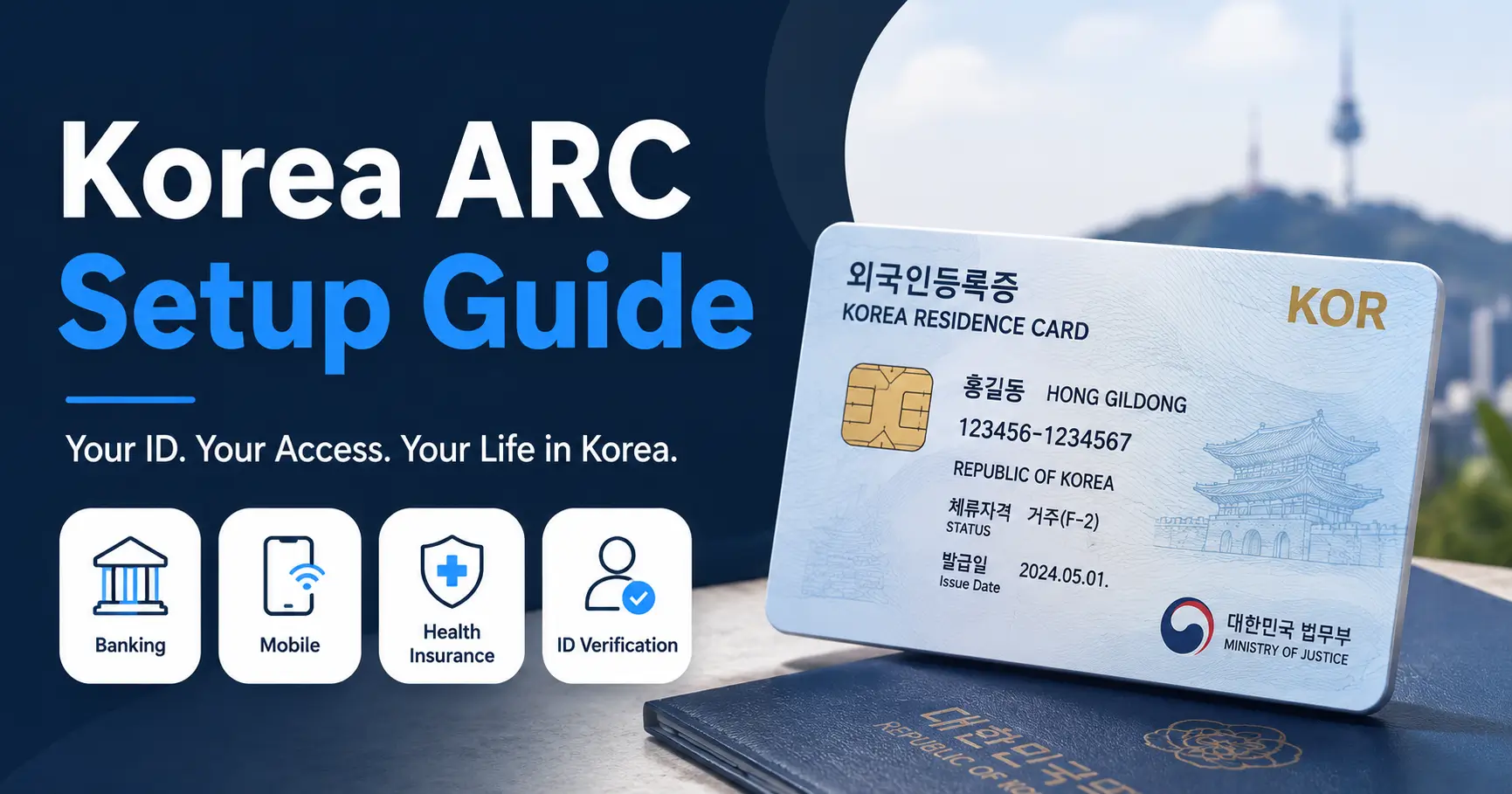
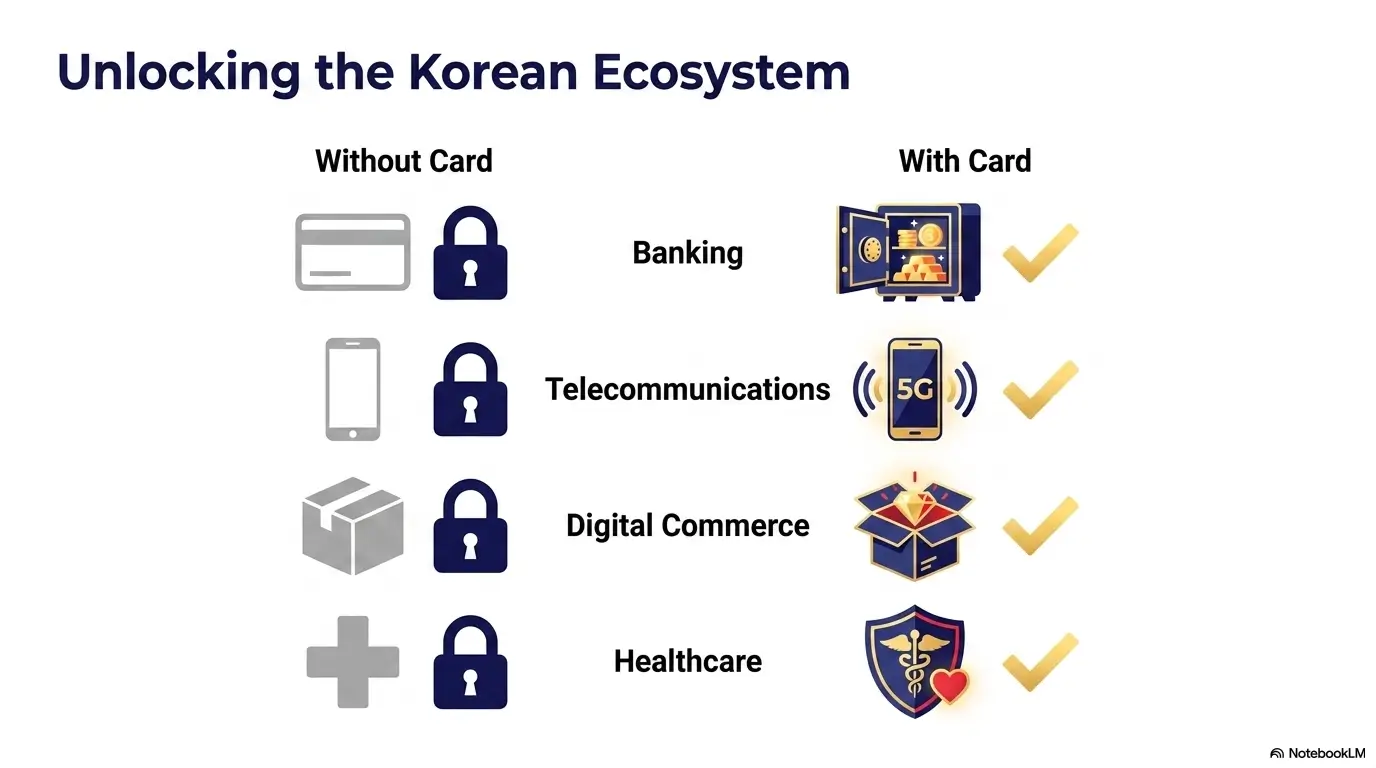
Your Korea Residence Card is a small rectangle with an unusually large job. It connects your immigration identity to bank accounts, mobile service, health insurance, online shopping, government portals, delivery apps, and the phone verification screens that seem to appear whenever you are already running late.
The card does not automatically make every service available. A bank may limit transfers, a carrier may reject a visa category, and an insurer may require separate enrollment documents. Even a missing space or hyphen in your name can turn a routine verification into a three-office scavenger hunt.
This guide shows you the most reliable setup order, the documents worth carrying, the differences between prepaid and postpaid phone plans, and the checks that prevent small record errors from spreading across your Korean accounts.
SETUP ORDER
Know which service to activate first and why the order matters.
COST CONTROL
Compare phone, banking, and insurance options without buying too early.
FEWER ERRORS
Keep your name, number, address, and visa data consistent everywhere.
The central rule: build one clean identity record before connecting ten different services to it. 🪪
Snapshot
This guide is for foreign employees, students, researchers, accompanying family members, working-holiday residents, and other long-term residents in South Korea. It explains how to use a Residence Card for banking, phone service, identity verification, and health-insurance administration, while showing what to confirm before signing contracts or paying fees.
Table of Contents
Before You Act: Your Card Is Identification, Not Approval
A Korean Residence Card can prove who you are and how long you are authorized to stay. It does not promise that a bank will raise your transfer limit, that a carrier will approve a device installment, or that National Health Insurance coverage has already begun.
Policies may differ by visa category, remaining period of stay, employer, university, bank branch, carrier, insurer, and the documents available on the day you apply. Staff interpretation and internal compliance checks can also affect what happens at the counter.
Before You Act
Use this article as a preparation and comparison guide. Confirm immigration deadlines with Korean immigration authorities, insurance eligibility with NHIS or your employer, and financial or telecom contract terms with the institution before relying on them. Approval, pricing, deposits, limits, and required documents can change.
Who this guide fits
- Employees and sponsored professionals staying in Korea long term
- International students, language students, and researchers
- Spouses, children, and other accompanying dependents
- Working-holiday residents who need local banking and phone verification
- F-series residents, permanent residents, and overseas Koreans using domestic residence documentation
Visitors staying briefly may be better served by passport-based prepaid mobile service, an international payment card, and travel insurance. They generally do not need to build the full domestic identity chain described here.
Where this guide stops
This is not a visa-extension guide and cannot determine whether a particular visa permits work, enrollment, family sponsorship, or a specific financial product. Those decisions depend on facts that a general article cannot safely resolve.
Students comparing study routes may also find this guide to Korean language program visas useful. Housing documents often become part of the banking and address-verification process, so newcomers may also want to compare wolse and jeonse for foreign residents.
ARC or Residence Card? The Name Changed, the Search Term Stayed
Foreign residents still commonly say “ARC,” short for Alien Registration Card. You will also see Residence Card, Foreign Residence Card, foreigner registration card, and the Korean term 외국인등록증.
The newer wording is more respectful and increasingly common in official English materials. The older acronym remains useful because bank employees, landlords, schools, employers, online forums, and search results still use it.
What the physical card proves
- Your registered identity in Korea
- Your foreigner registration number
- Your status of stay
- Your authorized residence period
- Other administrative information printed or encoded on the card
That makes the card a central identity document, but not a universal membership pass. A bank may still request employment evidence. A phone carrier may check your visa period. NHIS may require family-relationship documents for dependents.
The Mobile Residence Card is useful, but keep the physical card
Korea began issuing the Mobile Residence Card on January 10, 2025. It gives eligible residents a digital form of identification on a mobile device and can make some in-person identification tasks more convenient.
Acceptance is not perfectly uniform. A bank, phone shop, employer, landlord, insurer, or university may still ask for the physical card, a passport, or an original supporting document. Carrying the physical card during important setup visits remains the safer choice.
Key Takeaway
Use “ARC” when searching or speaking informally, but recognize “Residence Card” and “Foreign Residence Card” as references to the modern document system.
The Best Setup Order for Avoiding the Verification Loop
Korea’s everyday systems often depend on one another. A bank may want a Korean phone number. A postpaid carrier may want a Korean payment method. Online banking may require phone-based identity verification. The resulting circle can feel beautifully engineered, provided you are already inside it.
The way through is to build the chain in stages rather than trying to activate everything on the same afternoon.
1. CHECK
Verify the card name, number, address, and expiration date.
2. CONNECT
Use temporary mobile service until your card is ready.
3. REGISTER
Link the phone number to the exact Residence Card identity.
4. BANK
Open the account and activate every required feature.
5. CONFIRM
Verify insurance enrollment and dependent records separately.
Step 1: Confirm the card details before copying them elsewhere
Compare the card with your passport and immigration records. Check the spelling and order of your English name, your registration number, status of stay, expiration date, and registered address.
A mistake is easiest to correct before it reaches a phone carrier, bank, insurer, employer, university, and payment app. Once copied into six systems, the error grows roots.
Step 2: Use a temporary phone solution when necessary
A passport-based prepaid SIM can bridge the waiting period before the Residence Card arrives. Choose a short commitment and ask whether the number can later be re-registered under your foreigner registration number.
Do not assume a temporary prepaid line will support every form of Korean online identity verification. Its first job is simple communication, not necessarily full access to domestic digital services.
Step 3: Register the Residence Card with the carrier
Once the card is available, ask the carrier to associate your Korean number with your foreigner registration number and exact legal name. Test identity verification before leaving the store or ending the support call.
Steps 4 and 5: Activate banking, then verify insurance
Open the bank account and separately confirm mobile banking, transfer limits, debit-card features, and overseas remittance access. Afterward, verify health-insurance enrollment through your employer, university, family relationship, or NHIS.
Key Takeaway
The practical sequence is temporary phone, Residence Card registration, fully activated bank account, then separate insurance confirmation. The card is the bridge, not the final destination.
Banking With an ARC: Opening the Account Is Only Round One
A Korean bank account can make rent, salary, utility bills, phone payments, transfers, and online shopping much easier. The important distinction is that account opening and full account usability are not the same event.
You may leave with an account number yet still face low transfer limits, incomplete mobile-banking access, delayed debit-card delivery, or additional documentation requirements for overseas remittances.
Bring more than the minimum bank document list
- Physical Residence Card
- Passport
- Korean phone number registered under your identity
- Proof of Korean address, such as a lease or housing confirmation
- Employment certificate, employment contract, university enrollment letter, or similar evidence
- Salary documentation or expected account-purpose evidence
- US taxpayer identification details when requested
- Information about expected international transfers
Official Seoul guidance identifies a foreign registration document and passport as core documents, while also noting that institutions may require additional material. In practice, carrying evidence of why you need the account can reduce a second visit.
Ask for each banking feature by name
| Feature | Why it matters | What to confirm |
|---|---|---|
| Mobile banking | Transfers, balances, bill payment | App access and foreign-name registration |
| Domestic transfers | Rent and everyday payments | Daily and per-transfer limits |
| Debit card | Stores, online purchases, ATMs | Domestic, overseas, and transit functions |
| Overseas remittance | Sending money home | Required documents, fees, limits, and exchange rates |
| Salary designation | May help establish account purpose | Employer requirements and proof needed |
| English notifications | Reduces missed alerts | App, text, and email language options |
Do not merely ask, “Is the account ready?” Ask whether mobile login works, whether you can transfer rent, whether your debit card works online, and what must be done before sending money abroad.
A restricted account may be inconvenient, not final
Korean banks may apply limited-transfer conditions while they confirm the account’s legitimate purpose and complete financial-crime checks. This does not always mean the application failed.
Ask what documents could support a future limit review. A salary statement, employment certificate, tuition record, rent contract, utility bill, or transaction history may be relevant depending on the institution.
Choose a bank by workflow, not logo
The nearest branch may be convenient, but a branch near your employer or university may be more familiar with your visa and documents. Expat-focused support can also matter if you expect frequent remittances or need English-language help.
| Priority | Good option | Better option | Best-fit option |
|---|---|---|---|
| Basic local spending | Nearby branch with debit card | Reliable mobile app and transfers | Branch experienced with foreign residents |
| Salary and bills | Standard account | Employer-linked branch | Account with clear limit-review process |
| International transfers | Occasional branch remittance | Competitive digital remittance access | Strong documentation support and transparent fees |
| English assistance | Translated app screens | Foreign-language phone support | Accessible branch plus multilingual digital support |
Phone Plans After ARC: Prepaid, Postpaid, or MVNO?
A Korean phone number is not merely a way to call people. It can become an authentication key for banking, shopping, delivery, government services, hospital reservations, membership programs, and account recovery.
This is why the cheapest advertised monthly price is not always the lowest-cost choice. A plan that cannot support the verification you need may create extra store visits, replacement SIM fees, lost discounts, and hours of customer-service archaeology.
Prepaid is useful before the card arrives
Passport-based prepaid service is often the simplest bridge for newcomers. It can provide calls, texts, and data while you wait for immigration registration.
- Choose a short validity period if your Residence Card is coming soon.
- Ask whether the same number can be retained after identity registration.
- Check whether top-ups require a Korean card or bank account.
- Confirm the service-expiration rule and any reactivation fee.
- Do not assume passport registration supports full Korean identity verification.
Postpaid can unlock a fuller digital life
A qualifying postpaid line registered under your Residence Card may support Korean mobile identity verification, the PASS app, recurring billing, and easier use of domestic platforms.
Approval can depend on visa status, remaining stay period, payment method, deposit requirements, account history, and the carrier’s internal policy. A Residence Card makes application possible, not automatic.
MVNO plans can save money, but inspect the plumbing
Mobile virtual network operators, often called MVNOs or budget carriers, may offer lower monthly prices. They can work well for residents who know exactly which features they need.
- Can foreign residents complete self-activation?
- Does the provider register your full legal name correctly?
- Will PASS or another required verification method work?
- Is eSIM available for your phone and identity type?
- Can you keep your number when changing providers?
- Is customer support available in a language you can use?
- What happens when your visa or Residence Card is renewed?
| Phone option | Best for | Main advantage | What may be missing |
|---|---|---|---|
| Passport prepaid | New arrivals and short stays | Fast setup with low commitment | Full identity verification and long-term account features |
| Residence Card prepaid | Budget-conscious residents | Cost control with improved identity registration | Some postpaid benefits or bundled discounts |
| Postpaid carrier plan | Long-term residents needing verification | Broader billing and identity features | Possible contract, deposit, or visa requirements |
| MVNO plan | Experienced users seeking lower cost | Competitive monthly pricing | Uneven activation, language, roaming, or verification support |
For a broader look at carrier choices and contract questions, see this guide to Korean phone plans for Americans. Once your line is active, this explanation of Korean identity verification for foreigners can help with the next layer.
Key Takeaway
Price the plan as a service package, not a bucket of data. Reliable identity verification, human support, cancellation flexibility, and number portability can be worth more than a small monthly discount.
One Hyphen Can Break Korean Identity Verification
Mobile verification compares information held by different systems. Your carrier record, Residence Card identity, phone number, and sometimes bank information must agree closely enough for the automated check to recognize one person.
That sounds simple until a middle name is shortened, a hyphen disappears, a space moves, or a staff member enters the name in a different order.
Match the legal name character for character
- Use the same spelling as the Residence Card.
- Preserve the same order of family and given names.
- Keep spaces and hyphens consistent.
- Do not replace your legal name with a nickname.
- Do not invent a Korean name for official registration unless the institution formally supports and records it.
- Ask staff to show or read back the registered name before finishing.
Test verification before leaving the phone store
- Attempt PASS registration or another supported verification process.
- Confirm that verification text messages arrive.
- Check whether the date of birth and name fields are accepted.
- Ask the carrier to compare its record with the physical card.
- Request immediate correction if verification fails.
Real-world example: the invisible middle name
Imagine that your passport and Residence Card show “JORDAN LEE MORGAN,” but your phone record says “JORDAN MORGAN.” Calls and data may work perfectly. The mismatch reveals itself only when a banking app asks the carrier to confirm your identity.
The bank blames the carrier. The carrier says the line is active. The app offers an error code written for someone who already understands the error code.
The practical fix is not another password reset. It is a record comparison: card name, carrier name, phone number, and bank profile. Correct the earliest mismatched record first, then retry after the update has had time to reach the verification system.
A simple troubleshooting map
| Symptom | Likely check | First action |
|---|---|---|
| Verification texts never arrive | Blocked messages or incorrect number | Check carrier messaging settings |
| Name is rejected | Spacing, order, hyphen, or omitted middle name | Compare carrier record with the card |
| PASS registration fails | Line type or identity registration | Ask whether the line supports foreign-resident verification |
| Bank app fails after PASS succeeds | Bank profile mismatch | Review the bank’s registered name and number |
| Old number receives alerts | Institution was not updated | Change the number with each service separately |
Show me the nerdy details
Korean phone authentication is not simply a code sent to any working number. The verification request may compare the subscriber’s name, foreigner registration number or birth information, carrier, phone number, and line ownership status. A technically active SIM can therefore fail identity verification when the subscriber record is incomplete, formatted differently, or registered under another person or organization.
Updates may also take time to appear across connected systems. After correcting a record, note when the change was made, restart the relevant app, and retry later before submitting repeated correction requests to multiple institutions.
Health Insurance: What the ARC Unlocks and What It Does Not
A Residence Card helps NHIS, employers, universities, and insurers identify you. It is not itself proof that coverage is active.
Your route may depend on employment, length of stay, visa category, student status, family status, and whether an exemption or equivalent foreign coverage applies. Confirm the effective date rather than assuming the first payroll deduction, card issue date, or hospital visit tells the whole story.
Employer coverage and individual NHIS enrollment follow different paths
Eligible foreign employees working at a covered workplace are generally enrolled through the workplace system. Contributions are typically divided between the employee and employer according to the applicable rules.
Other foreign residents may enter the locally insured system after meeting applicable residence and visa requirements. Students and dependents can face additional rules, timing differences, or documentary requirements.
| Resident situation | Who to contact first | What to verify |
|---|---|---|
| Employee | Employer payroll or HR | Enrollment date, contribution start, and reported identity |
| University student | University international office | Enrollment route, timing, and student-specific documents |
| Dependent spouse or child | Employer and NHIS | Dependent eligibility and family documents |
| Self-employed or locally insured resident | NHIS | Eligibility date, contribution notice, and household treatment |
| Resident with foreign coverage | NHIS and the relevant organization | Whether an exclusion request is possible and what proof is required |
Dependents need their own documentary trail
Foreign family documents may not automatically appear in Korean administrative databases. NHIS may request evidence establishing marriage, parentage, dependency, income, property, or continued eligibility.
- Residence Card or domestic residence report card
- Marriage certificate or birth certificate
- Documents showing the qualifying family relationship
- Apostille or diplomatic confirmation where required
- Korean translation and notarization where required
- Recent documents meeting the applicable issue-date rules
- Income or property evidence when relevant to dependent status
Do not pay for translation, notarization, or apostille services until you have confirmed the exact document format, date limit, and authentication method. One well-timed call can prevent paying twice for paperwork that is nearly, but not quite, acceptable.
Private insurance can fill selected gaps
National Health Insurance and private insurance serve different purposes. A private policy may address travel risks, accidents, dental costs, critical illness, hospital cash benefits, or other selected expenses, but exclusions and reimbursement rules matter.
- What treatment is covered?
- Are pre-existing conditions excluded?
- Is there a waiting period?
- Does the policy reimburse you after payment?
- Which hospitals or countries are included?
- Is Korean-language documentation required for claims?
- Does coverage end when your visa, employment, or residence changes?
For a fuller explanation of the public system, read this guide to Korean National Health Insurance for foreigners.
Key Takeaway
Treat insurance enrollment as a separate administrative task. Ask who enrolled you, the effective date, the dependent status of each family member, and what evidence proves active coverage.
Address Changes, Expiration, and Lost Cards
Your Residence Card information sits at the center of several private and public records. When your address, visa, name, card, or phone number changes, do not assume every connected organization receives the news automatically.
Immigration updates may not cascade into private accounts
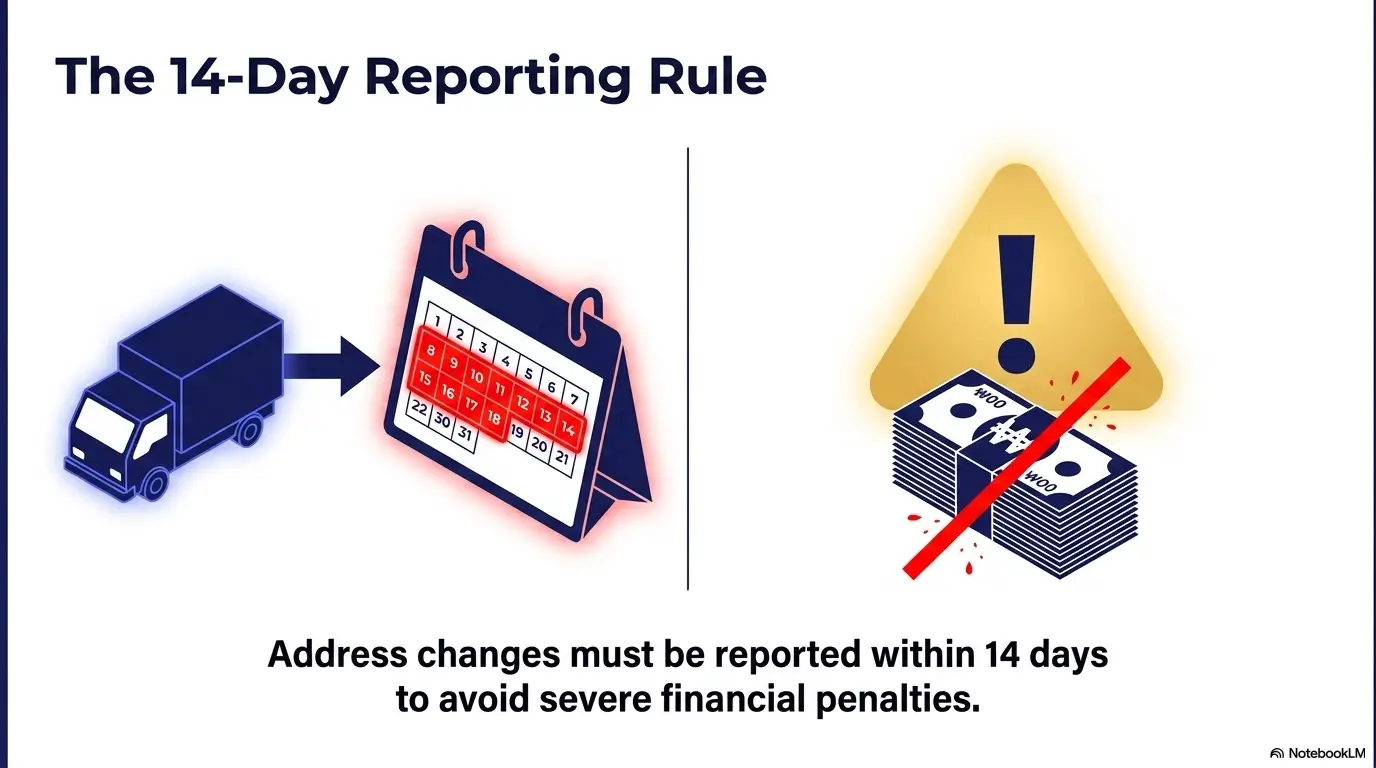
Report the move through the legal channel before treating the address checklist as complete. Immigration Act Article 36 requires registered foreigners to report the new place of stay within 15 days of moving in. The immigration authority’s residence-report guidance separately describes a 14-day period for F-4 domestic-residence reporting. Confirm the procedure for the document and status you actually hold.
Use the competent local office or an accepted immigration/online reporting route, and retain the filing confirmation and address evidence. Merely telling the landlord, carrier, employer or bank does not establish that the statutory report was filed. If online reporting fails or an appointment falls beyond your deadline, contact the competent office or 1345 promptly to confirm a timely filing route.
After an address or status change, make a list of institutions that hold your information. Depending on the situation, that may include your bank, carrier, NHIS, private insurer, employer, university, landlord, delivery accounts, payment services, and government portals.
Keep confirmation numbers, screenshots, receipts, or copies showing when each update was requested. This small paper trail is useful when two systems disagree about which version is current.
Compare contract length with your remaining stay
A discounted phone plan can become expensive if it requires a long commitment, a device installment, or repayment of benefits after early cancellation. Before signing, compare the contract end date with your visa expiration, employment term, school calendar, and expected departure.
- Minimum service period
- Early-termination charge
- Remaining device installments
- Promotional discounts that may be reclaimed
- Required notice period
- Rules for suspension during overseas travel
- Cancellation method after leaving Korea
Changing your phone number has a wide blast radius
A phone number may be tied to bank logins, PASS, shopping accounts, delivery apps, hospital bookings, government services, insurance alerts, and password recovery. Update critical accounts while the old number still works whenever possible.
- Bank and card accounts
- Mobile identity-verification services
- Government and immigration portals
- Employer or university records
- Insurance and hospital accounts
- Shopping, delivery, transit, and subscription services
Lost, expiring, or reissued card: protect the accounts behind it
Report a lost card through the appropriate immigration channel and ask which temporary proof of registration can be used while waiting for replacement. Monitor financial and telecom accounts for unfamiliar activity.
For an expiring card, begin the renewal process within the applicable immigration window. After reissue, compare the new card with the previous record and update institutions that track the card’s expiration date, address, status, or issue information.
If the loss may involve theft or another incident, this practical Korea police report guide explains how to prepare for a report.
Common ARC Mistakes That Create Weeks of Friction
Most Residence Card problems are not dramatic. They are ordinary administrative errors repeated across several systems, which is exactly why they consume so much time.
| Common mistake | Why it causes trouble | Safer alternative |
|---|---|---|
| Using different name formats | Automated identity checks cannot match records | Copy the card format exactly |
| Choosing a long phone contract immediately | Visa or job plans may change | Use temporary service until your timeline is clearer |
| Assuming account opening means full activation | Transfers, apps, or remittances may remain restricted | Test each required function before leaving |
| Assuming insurance starts with card issuance | Coverage follows separate eligibility and reporting rules | Confirm enrollment and effective date directly |
| Ignoring recurring payments before departure | Charges may continue after leaving Korea | Cancel services and automatic payments in writing |
| Lending a registered SIM | Your identity may be tied to billing and verification activity | Keep control of every line registered in your name |
| Updating only immigration records | Private organizations may retain old information | Use an institution-by-institution update checklist |
Do not buy the maximum package before knowing the minimum need
A premium phone plan, international remittance package, private insurance policy, or paid document service may be worthwhile. The expensive part is purchasing it before you know whether your visa, employer, university, existing coverage, or actual usage already solves the problem.
Begin with the smallest setup that supports your immediate needs. Upgrade after you have tested identity verification, payment, coverage, and customer support.
When free help is enough, and when paid help may be useful
| Situation | Free DIY route | When paid help may be worth considering |
|---|---|---|
| Basic account opening | Prepare documents and visit an experienced branch | Complex business, tax, or high-value international needs |
| Phone registration | Use carrier support and test verification | Language barriers combined with repeated record failures |
| Dependent insurance | Confirm requirements directly with NHIS | Multiple foreign documents requiring translation and authentication |
| Address update | Use official reporting channels and a checklist | Unclear legal status, missed deadlines, or conflicting records |
| Departure cleanup | Cancel contracts and automatic payments yourself | Unresolved debt, disputes, or accounts you cannot access remotely |
Paid assistance should remove a specific obstacle, not merely provide a glossy folder of information you could obtain from an official office. Ask what the fee includes, which documents will be prepared, whether translations are notarized, and what happens if an institution requests revisions.
ARC Card FAQ for Expats
Can I open a Korean bank account without an ARC?
Some institutions may provide limited services to a foreign visitor using a passport and supporting documents, but availability varies. Long-term residents generally have more options after receiving a Residence Card. Ask the branch what functions, limits, and later upgrade steps apply.
Can I get a Korean phone number before my Residence Card arrives?
Yes, passport-based prepaid service is commonly used by new arrivals. Confirm how long the service remains valid, whether the same number can be retained, and whether it can later be registered under your foreigner registration number.
Does an ARC guarantee approval for a postpaid phone plan?
No. Carriers may consider visa category, remaining stay period, payment method, deposit requirements, account history, and plan-specific eligibility.
Can foreigners use the PASS identity-verification app?
Many registered foreign residents can use mobile identity-verification services when the line, carrier record, and Residence Card information are compatible. Support can vary by line type and provider, so test the service before relying on it.
Why does my Korean phone verification keep failing?
Common causes include name-order differences, missing middle names, spaces, hyphens, incorrect registration numbers, unsupported prepaid lines, or a phone line registered under another person. Compare the carrier record with the Residence Card first.
Does receiving an ARC automatically enroll me in Korean health insurance?
No. The card identifies you, while NHIS enrollment follows separate eligibility, residence, employment, and reporting rules. Confirm your enrollment route and effective date.
Which bank documents may US citizens be asked for?
In addition to a passport, Residence Card, phone number, address proof, and employment or enrollment evidence, a bank may request US taxpayer information for international tax-compliance purposes. Requirements vary by bank and account type.
Can I keep my Korean bank account after leaving Korea?
Possibly, but access, residency classification, authentication, remittance functions, and contact information may need to be updated. Ask the bank before departure how overseas access works and whether your Korean phone number must remain active.
What happens to my phone contract when my visa expires?
Expiration does not necessarily cancel the contract or erase device installments. Review the contract, update renewed residence documents promptly, and arrange formal cancellation before leaving Korea.
Is the Mobile Residence Card accepted by every bank and carrier?
Do not assume universal acceptance. The digital card is an official identity tool, but an institution may still request the physical card, passport, or original supporting documents for a particular transaction.
Your 15-Minute Next Step: Build an Identity-Matching Folder
Before visiting a bank, phone store, university office, employer, or NHIS branch, create one physical folder and one secure digital folder. The goal is not to collect every document you have ever touched. It is to create one reliable source of truth.
Put these items in the folder
- Passport identification page
- Front and back of the Residence Card
- Exact legal-name transcription
- Foreigner registration number stored securely
- Registered Korean address
- Status of stay and expiration date
- Korean phone number and carrier
- Employment or enrollment certificate
- Lease, housing confirmation, or address evidence
- Insurance enrollment evidence
- Contact details for immigration, bank, carrier, employer, university, and NHIS
Run the three-record check
- Write your name exactly as it appears on the Residence Card.
- Ask your carrier to confirm the name registered to the phone line.
- Ask your bank to confirm the name and phone number in its profile.
If all three match, you have built the cleanest possible foundation for Korean identity verification. If they do not, correct the earliest mismatched record before opening more accounts.
The calmest way forward
Spend the next 15 minutes writing down one exact legal name, one current address, one phone number, and one visa expiration date. That single page can prevent the quiet administrative drift that makes Korean systems feel harder than they need to be.
Last reviewed: 2026-09
Targeted review: October 17, 2026. Added statutory move-report timing, the separate F-4 reporting period and proof-of-filing steps. Updating private accounts remains a separate task.