
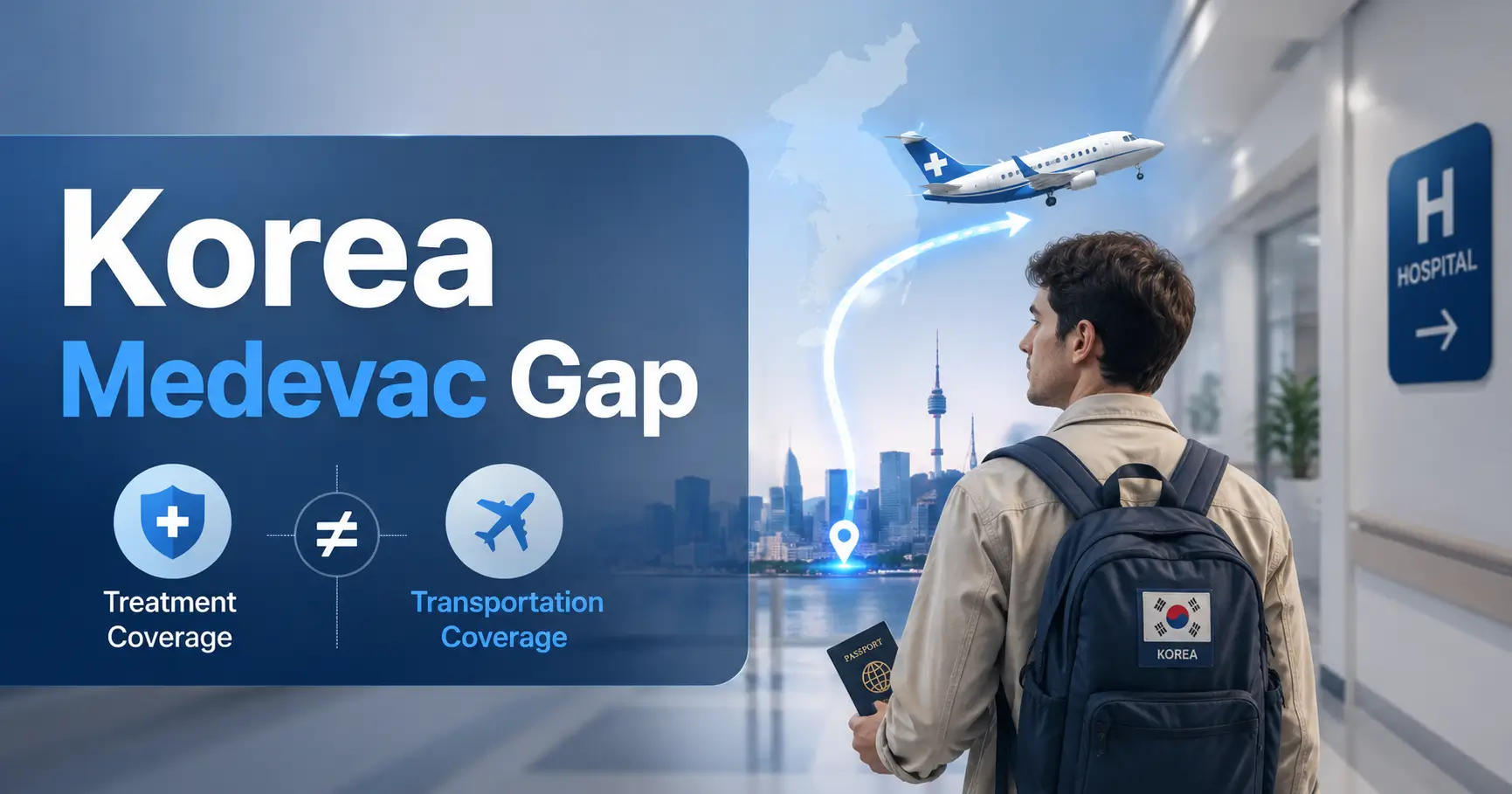
Expat Health & Emergency Planning in South Korea
Medical Evacuation Insurance for Foreigners Living in Korea:
What Your Health Plan May Not Move
Living in South Korea can give foreign residents access to sophisticated hospitals, a nationwide medical system, and, for eligible residents, Korean National Health Insurance. That answers one important question: how will medical care be covered? It does not automatically answer another one: who pays and coordinates the transfer if you need to be moved somewhere else?
That distinction hides inside insurance wording that can look reassuringly simple. A plan might advertise emergency assistance, medical evacuation, repatriation, or a large transportation benefit. Yet the useful part lives deeper in the contract: who decides you need evacuation, where you may be taken, what needs advance approval, and whether “home” is actually one of the permitted destinations.
This guide is designed for foreigners who actually live in Korea, not tourists packing for a ten-day holiday. The goal is not to make Korea sound medically risky. It is to help you separate treatment insurance from transportation protection, identify duplication, compare policies intelligently, and build an emergency plan you could still understand at 2 a.m. from a hospital corridor.
One idea to carry through the whole guide: a big evacuation limit is impressive only after you know what activates it, who controls it, and where it can take you. 🧭
Snapshot
This guide is for expats, international employees, students, retirees, families, and other long-term foreign residents in South Korea. You will learn how Korean medical coverage differs from evacuation protection, which policy clauses matter most, how to spot unnecessary overlap, and how to run a practical 10-minute medevac coverage audit.
Table of Contents
Before You Act
This article provides general insurance and emergency-planning information, not medical advice or a determination of coverage. Policy definitions, exclusions, residency requirements, preauthorization rules, destinations, and payment procedures differ. Confirm important decisions with your insurer, assistance provider, employer benefits team, licensed insurance professional, or other qualified adviser. In a serious medical emergency in Korea, obtain emergency care first rather than delaying treatment to study insurance paperwork.
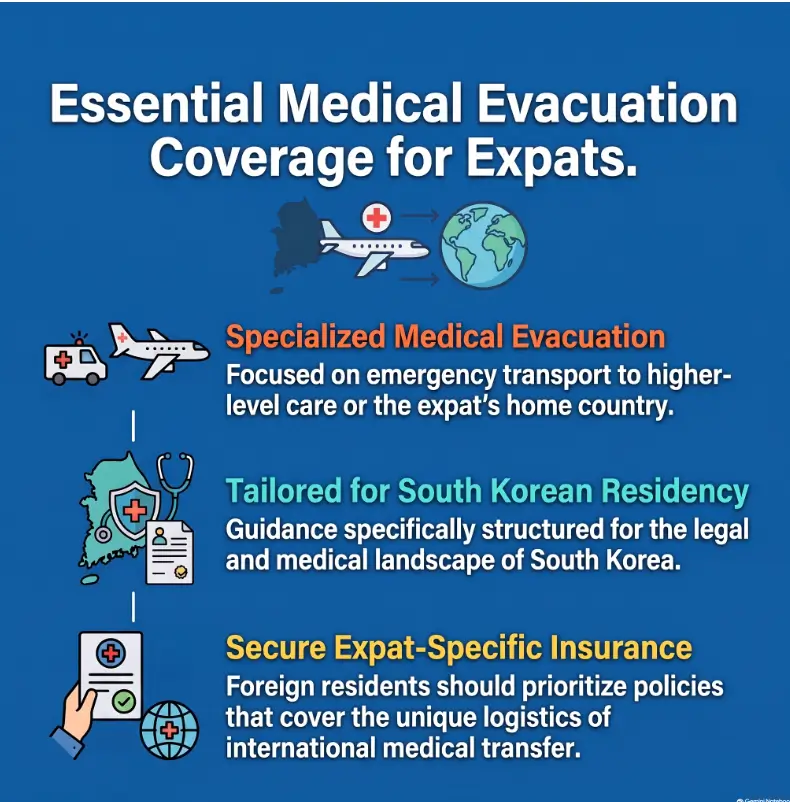
The Coverage Gap Most Foreign Residents Miss
Korean health insurance and evacuation insurance solve different problems
If you are eligible for and enrolled in South Korea’s National Health Insurance, your first instinct may be sensible: “I already have medical insurance. Why would I need another policy?”
The answer begins with separating treatment from transportation. Korea’s National Health Insurance Service states that foreign subscribers receive covered insurance benefits on the same basis as Korean citizens, including benefits related to preventing, diagnosing, treating, and rehabilitating illnesses and injuries.
Medical evacuation insurance addresses a different problem. Depending on the contract, it may help arrange and pay for medically necessary transportation when appropriate care is not available where the patient currently is. That could mean a specialized ground ambulance, medically supported domestic transfer, commercial flight with medical arrangements, or a dedicated aircraft in unusually serious circumstances.
If you need a deeper explanation of how the Korean system works for residents, read our guide to Korean National Health Insurance for foreigners. Treat that as one side of your protection map. Medevac coverage belongs on another side.
Medical treatment, evacuation, and assistance are three separate buckets
Insurance descriptions often place several services beside each other, which makes them feel interchangeable. They are not.
| Coverage bucket | What it generally addresses | Question to ask |
|---|---|---|
| Medical treatment | Hospital, physician, diagnostic, medication, or other eligible medical expenses | Which treatment expenses are covered and where? |
| Medical evacuation | Eligible medically necessary transportation to an appropriate facility | Who approves the move and chooses the destination? |
| Assistance services | Coordination, provider contact, logistics, translation support, or case management depending on the service | What does the assistance team arrange versus merely help locate? |
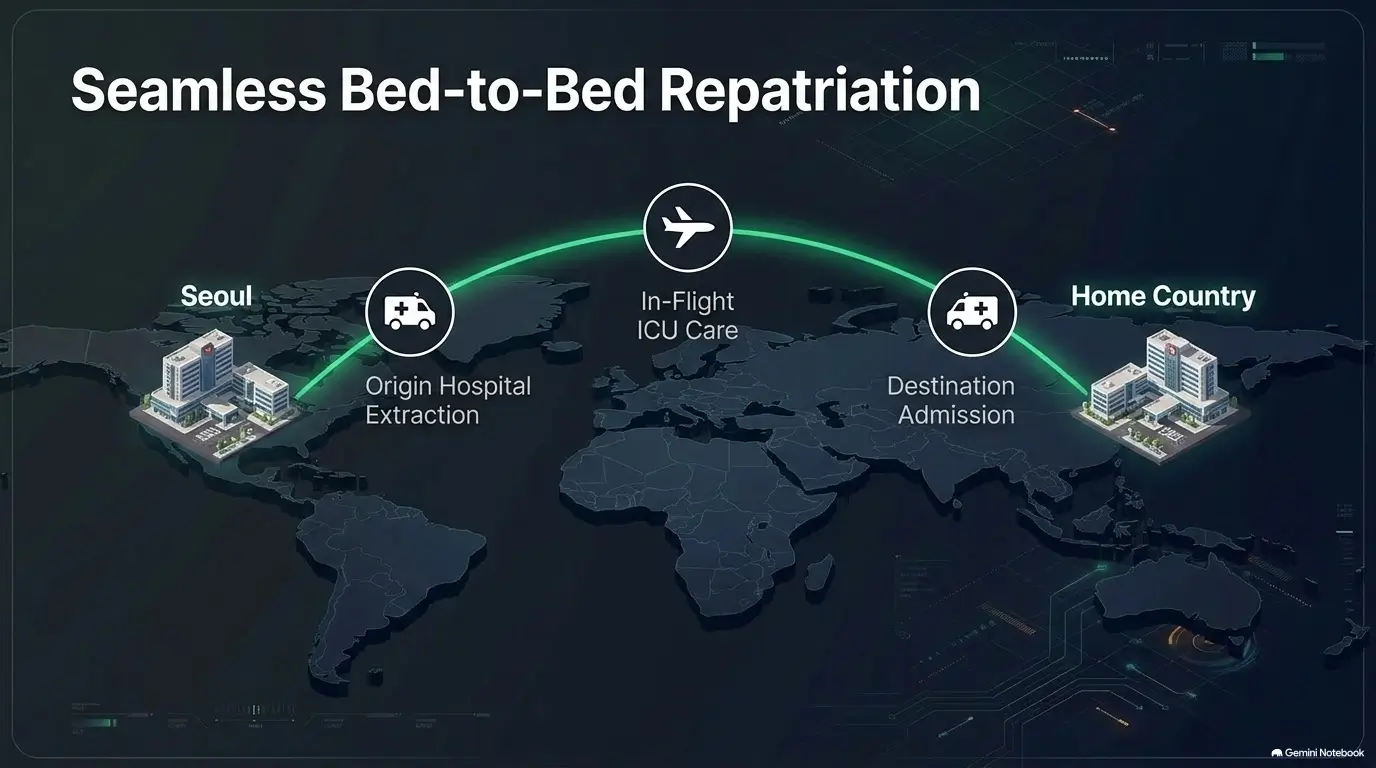
| Medical repatriation | Transportation to a home or residence country when contractual conditions are met | Is returning home actually included? |
Key takeaway: “I have health insurance” does not answer “Who will move me, under what conditions, and to where?” You need both questions answered separately.
Here is where the wording gets slippery
A policy may include phrases such as “24-hour emergency assistance” or “international assistance.” Those labels can be valuable, but they do not tell you by themselves whether an aircraft, medical escort, domestic transfer, international transfer, or trip home is covered.
Marketing language is the shop window. Definitions, exclusions, and benefit conditions are the stockroom. Before paying for additional coverage, walk into the stockroom.
Medevac vs. Repatriation: One Word Can Change the Destination
Medical evacuation does not automatically mean a flight to America
For many U.S. expats, the mental picture of evacuation is simple: something terrible happens in Korea, an aircraft arrives, and the patient is flown to a hospital in the United States.
Insurance contracts may work very differently. Medical evacuation commonly revolves around reaching an appropriate medical facility when adequate care is not available at the current location. CDC guidance treats medical evacuation insurance as distinct from ordinary travel medical insurance and describes it as protection for emergency transportation when appropriate care requires moving the traveler.
For somebody already in Korea, that distinction matters enormously. An approved destination might be another hospital within Korea rather than a hospital thousands of miles away in the United States.
The four words worth circling: nearest appropriate medical facility
Policy wording varies, but expressions such as nearest appropriate facility, nearest suitable facility, or similar language deserve a bright mental highlighter.
Imagine that you are injured outside a major city and the current hospital cannot provide the specialist care the medical team believes you need. If an appropriate hospital in Seoul can provide that care, a policy based on the nearest appropriate facility may consider Seoul the logical destination. Your personal preference for a hospital in California does not necessarily rewrite the contract.
Medical repatriation is a different promise
If your real concern is eventually returning to your home country for ongoing treatment, search specifically for the contract’s medical repatriation language.
Then ask a second question: under what circumstances does that benefit become available? Some arrangements may require medical necessity, stabilization, approval, or other conditions. The word “repatriation” itself is not enough because travel policies may use similar terminology for benefits unrelated to transporting a living patient for treatment.
Policy-reading shortcut: search the document for “evacuation,” “repatriation,” “appropriate facility,” “medical necessity,” “authorization,” “transportation,” “country of residence,” and “home country.” Ten minutes with document search can reveal more than a glossy benefit summary.
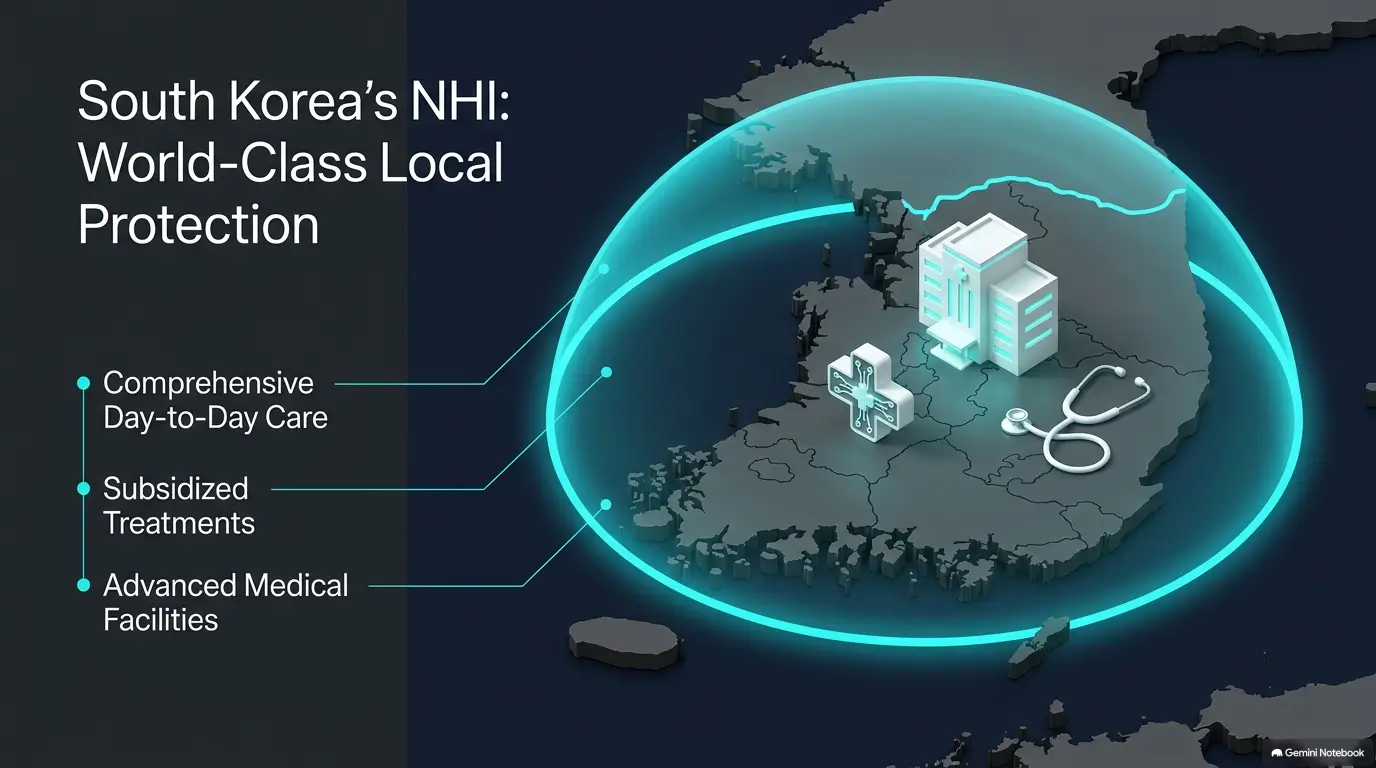
Korea Has Excellent Hospitals. So Why Consider Evacuation Coverage?
The question is access, not a judgment on Korean medicine
Medical evacuation coverage should not be sold through a cartoonish idea that a foreign resident must flee Korea whenever something serious happens. In many emergencies, staying in Korea and receiving treatment at an appropriate Korean hospital may be exactly what makes medical sense.
A more useful question is: Could my location, medical needs, travel habits, or existing coverage create a situation where a specialized transfer becomes important?
Someone living beside major medical centers in Seoul has a different practical exposure from someone working at remote industrial sites, living on an island, hiking frequently, sailing, skiing, or routinely traveling around East and Southeast Asia.
Seoul is not every corner of South Korea
Distance changes logistics. So does the nature of the emergency. A normal ambulance transfer and a medically supported transfer requiring coordination are not the same operational problem.
If your life in Korea involves smaller cities, rural areas, islands, mountain trips, or frequent ferry travel, build the insurance decision around your real routine rather than the address printed on your residence card. Our guides to living and traveling in rural Korea and South Korea island ferry travel can help you think more concretely about where you actually spend time.
A Korean hospital may still be the correct final destination
Buying medevac insurance is not buying an eject button. Medical condition, current location, available care, transportation safety, contract definitions, and the insurer’s approval process can all affect what happens.
This is why preference and medical necessity should live in separate columns when you compare policies. “I would feel more comfortable at home” is understandable. “The contract pays to send me home under these circumstances” is a contractual statement that needs evidence.
Who This Is For, and Who May Not Need Much More Coverage
A stronger case for internationally mobile residents
Additional evacuation protection becomes easier to justify when your life repeatedly crosses borders or takes you away from major medical centers.
- Employees on international assignments whose families also live in Korea
- Digital nomads who treat Korea as a base while traveling around Asia
- International students who travel during semester breaks
- Retirees spending long periods in Korea
- Families with children who want a clearer dependent and companion plan
- People who regularly ski, hike, sail, dive, cycle, or visit islands
- Residents with ongoing medical needs who want to understand transfer options before a crisis
Digital nomads should also compare this question with the broader insurance issues in our South Korea digital nomad insurance guide, especially if Korea is only one stop in a multi-country routine.
The stronger reason not to buy: you already have it
The least glamorous insurance strategy is often the smartest: check what you already own.
- Employer expatriate medical insurance
- International private medical insurance
- University-sponsored health or travel protection
- Travel insurance attached to an eligible trip
- Professional, membership, or assistance programs
- Family coverage through a spouse’s international benefits
The target is not maximum policy count. It is minimum unexplained gap.
Good, Better, Best is about clarity, not spending
| Approach | What you do | Best suited to |
|---|---|---|
| Good | Audit existing NHIS, employer, private medical, university, and travel benefits | Residents who rarely leave major Korean cities and may already have strong benefits |
| Better | Fill a documented evacuation gap with coverage that matches your actual travel area and activities | Frequent regional travelers, outdoor enthusiasts, students, and mobile professionals |
| Best documented | Create a family emergency file with policy numbers, assistance contacts, authorization rules, destination wording, and dependent instructions | Families, retirees, employees on assignment, and anyone managing multiple policies |
Money-saving takeaway
Do not start by shopping. Start by collecting. The cheapest additional policy is the one you discover you do not need because an existing employer or international plan already covers the scenario you were worried about.
Before Comparing a $500,000 Limit, Read These Clauses
Who decides that evacuation is medically necessary?
This is arguably a more useful comparison question than the headline benefit amount.
Check whether the decision depends on the treating physician, an assistance company’s medical team, the insurer, or a defined combination of medical professionals and administrators. Then find out whether the policy requires the assistance provider to organize the transport.
Insurance is particularly unforgiving of assumptions made in expensive moments. If a family independently books specialized transport that the contract required the insurer to approve or arrange, reimbursement may become complicated or unavailable depending on the wording.
Who chooses the hospital?
Look for the person or organization that has contractual authority to determine the destination. “Suitable,” “appropriate,” “nearest,” and “home country” are not decorative adjectives. They can change the result.
A policy with a lower maximum but clearer destination rights for the situation you care about may be more useful than a spectacular limit tied to circumstances that rarely match your needs.
Arrangement versus reimbursement
There is a major operational difference between an assistance company arranging approved transport directly and an insurance policy asking you to arrange something, pay, gather documents, and request reimbursement later.
During a serious admission, the person reading the policy may be your spouse, adult child, coworker, or friend. Design your coverage audit for that person, not for your calm Sunday-afternoon self.
The Four-Gate Medevac Test
Show me the nerdy details
An evacuation benefit can be thought of as a chain of conditions rather than a pile of money. The policy limit answers only the final financial question. Before reaching it, an event may need to satisfy the contract’s definition of a covered illness or injury, medical-necessity standard, geographic rules, exclusions, authorization procedure, transport requirements, and destination provisions.
That is why comparing two plans only by “$250,000 versus $1 million” is incomplete. Compare the activation chain first, then the maximum benefit.
Read CDC Guidance on Medical Evacuation Insurance
Seven Policy Details Worth Comparing Before You Buy
1. Emergency evacuation benefit limit
Start with the maximum only after you understand what qualifies. Specialized international medical transportation can be extremely expensive, and CDC consumer guidance notes that evacuation from a remote area can potentially exceed $100,000.
Still, the useful question is not “Which policy prints the biggest number?” It is “What transportation can this benefit actually pay for in my circumstances?”
2. Destination language
Write the permitted destination in plain English. Do not leave yourself with a paragraph of insurance vocabulary.
- Nearest appropriate hospital?
- Another facility within Korea?
- A regional medical center outside Korea?
- Country of residence?
- Home country?
- Facility chosen by the insurer or assistance provider?
3. Preauthorization and emergency notification
Find the emergency number now. Save it in your phone and your partner’s phone. Put it in a shared document that can be reached without remembering a password hidden behind your own phone’s biometric lock.
Also identify what the contract expects when advance authorization is impossible because immediate care is medically necessary. Never postpone urgent treatment simply to hunt for insurance approval.
4. Pre-existing-condition rules
Anyone with ongoing medical needs should treat this as a first-page issue, not a footnote. Definitions may involve diagnosed conditions, recent symptoms, medication changes, treatment history, stability periods, age restrictions, or policy-specific waivers.
Do not ask only, “Are pre-existing conditions covered?” Ask the provider to show you the contract language that determines whether your type of situation falls within or outside the benefit.
5. Adventure, occupation, and activity exclusions
A Seoul office worker who spends weekends skiing, climbing, scuba diving, sailing, cycling, or competing in organized sports should compare the policy against the weekend version of themselves.
Occupational exclusions deserve similar attention for foreign workers visiting construction sites, vessels, industrial facilities, research sites, or other environments outside ordinary office work.
6. Escort, companion, and dependent benefits
For a single traveler, “How do I get moved?” may be enough. For a family, it is only the first domino.
- Can a medical escort accompany the patient when medically necessary?
- Can a spouse or companion travel?
- What happens to dependent children?
- Are additional accommodation or transportation expenses covered?
- Who coordinates those arrangements?
7. Geographic territory and trips outside Korea
A foreign resident can spend 330 days a year in Seoul and still have their most complicated medical event during a long weekend elsewhere in Asia.
Check geographic territory, excluded countries or regions, maximum trip duration, residency requirements, and whether coverage treats trips originating from Korea differently from trips originating in your home country.
| Before paying, ask | Why it matters |
|---|---|
| Who must approve an evacuation? | Shows whether you can act independently or must use an assistance process |
| Where can I be transported? | Separates appropriate-facility coverage from home-country expectations |
| Must your company arrange the transport? | Helps avoid unauthorized expenses |
| How are pre-existing conditions defined? | Reveals a common source of unexpected exclusions |
| Does coverage follow me outside Korea? | Critical for regional travelers |
| What happens to my spouse or children? | Turns an individual medical plan into a workable family plan |
Common Mistakes: Do Not Discover These During an Admission
Mistake #1: “I have Korean NHIS, so evacuation must be covered”
NHIS and medical evacuation coverage answer different questions. NHIS explains covered healthcare benefits for eligible subscribers. Medevac coverage concerns extraordinary transportation and coordination under a separate contract or benefit.
Mistake #2: buying the largest number on the comparison page
A seven-figure benefit can make a policy feel armored. Then one sentence about authorization, destination, activity exclusions, or pre-existing conditions quietly decides whether the armor fits.
Compare definitions before limits and scenarios before premiums.
Mistake #3: treating all “repatriation” benefits as medical repatriation
Travel insurance terminology can include several benefits involving a return journey. Identify specifically whether the contract covers transportation of a living patient for medical reasons and what triggers that benefit.
Mistake #4: arranging a costly transfer before checking authorization rules
Immediate emergency treatment comes first. Once the patient is receiving appropriate urgent care and a transfer is being considered, the assistance process becomes important.
Know the difference between getting an ambulance to emergency care and independently arranging an expensive non-urgent or specialized transfer that may require insurer approval.
Mistake #5: forgetting the trips you take from Korea
A plan that works beautifully while you remain in South Korea may not provide the protection you expect during trips elsewhere. For international residents, geographic scope is not fine print. It is architecture.
Waste-money warning: duplicate evacuation benefits can be less dangerous than uncovered benefits, but paying repeatedly for the same protection still deserves scrutiny. Put every existing policy into one comparison sheet before adding another premium.
The Emergency Scenario Test: Would Your Policy Actually Work?
Scenario A: a serious accident in Seoul
A serious accident occurs. The first job is not to determine whether your medevac policy has an attractive limit. It is to obtain emergency care.
Official Korean guidance identifies 119 for accidents, injuries, serious illness, ambulance, and emergency rescue assistance.
A practical sequence is:
- Call 119 when emergency assistance is required.
- Reach an appropriate emergency hospital.
- Allow the treating team to assess and stabilize the patient.
- If a further transfer is being considered, contact the insurer or assistance provider according to the contract.
- Confirm authorization, transportation method, and destination before a non-immediate specialized transfer is arranged.
Scenario B: you are far from the specialist care you need
This is where domestic medical transfer provisions matter. Ask whether your policy could coordinate transportation from the current facility to a more appropriate Korean hospital if the contract’s conditions are met.
Do not jump immediately from “local hospital cannot provide this specialist service” to “international evacuation.” The medically and contractually appropriate next step could be a transfer within Korea.
Scenario C: you are stable, but you want treatment back home
This scenario is particularly good at exposing weak assumptions.
If appropriate treatment is available in Korea and the patient is medically stable, personal preference for U.S. treatment may not satisfy an evacuation benefit based on medical necessity. A separate repatriation provision may be relevant, but only its actual terms can tell you.
Real-world example: the policy was not wrong, the expectation was
Imagine an American couple living in Busan. One partner becomes seriously ill while visiting a smaller coastal town. They have international coverage with a generous evacuation benefit and assume it means transportation to the United States.
The treating hospital recommends transfer for specialist care. The assistance team agrees, but identifies an appropriate tertiary hospital elsewhere in Korea. The contract permits medically necessary transport to an appropriate facility, not an automatic journey to the policyholder’s preferred U.S. hospital.
Nothing has necessarily gone wrong with the policy. The problem is that the couple mentally purchased “send me home” while contractually purchasing “move me to appropriate care.”
That is why destination wording deserves to be translated into one plain-English sentence before you buy.
The one-minute scenario test: If you cannot explain who you call, who approves the transfer, who chooses the destination, and who pays or arranges transportation, you do not fully understand the benefit yet.
When to Seek Help Instead of Reading Your Policy
Call for emergency care first when the situation is urgent
For serious illness, injury, fire, or an emergency requiring ambulance or rescue assistance in South Korea, official guidance directs people to call 119.
An insurance policy is not an emergency triage tool. Do not delay medically necessary emergency care while trying to establish whether a later transfer will be reimbursed.
If hospital admission itself feels unfamiliar, our guide to Korean hospital admission explains more of the practical process. Foreign residents concerned about communication can also review our guide to medical translation in Korea.
Contact the assistance provider once immediate care is underway
When a specialized transfer is being discussed, contact the insurer or designated assistance provider using the emergency procedure in the policy. Have the policy number, patient’s name, treating facility, physician contact information if available, and a simple description of what is being proposed.
Do not promise a hospital or transport company that your insurer will pay unless the relevant party has confirmed the arrangement.
Ask a professional when the contract leaves a meaningful question unanswered
- The evacuation destination is ambiguous.
- You have significant pre-existing medical conditions.
- You cannot determine whether repatriation is medical or non-medical.
- You need coverage for dependent children.
- Your employer already provides international benefits.
- You routinely work or travel in locations excluded by ordinary coverage.
- You cannot determine whether you must pay first or the assistance provider arranges transportation.
Check Korea’s Official Emergency Guidance
You can also review the National Health Insurance Service guidance for foreign residents when you need to separate Korean healthcare benefits from the evacuation protection offered by another policy.
FAQ: Medical Evacuation Insurance in Korea
Do foreigners living in Korea need medical evacuation insurance?
Not universally. The case becomes stronger or weaker depending on where you live, how often you travel outside major cities, your health circumstances, international travel frequency, family situation, existing employer or private insurance, and whether you specifically want a pathway for home-country repatriation.
Start with a coverage audit rather than a purchase. If existing insurance already covers the scenarios that concern you, buying another policy may simply duplicate benefits.
Does Korean National Health Insurance cover foreign residents?
Eligible foreign residents who are enrolled can receive National Health Insurance benefits under Korea’s applicable rules. NHIS states that foreigners receive the same covered insurance benefits as Korean citizens.
Eligibility, enrollment status, premiums, and specific benefit rules should be confirmed directly with NHIS for your circumstances.
Does Korean health insurance fly you back to the United States?
Do not assume that Korean National Health Insurance includes international medical evacuation or repatriation simply because it covers eligible medical treatment. Treat international transportation as a separate insurance question and check any employer, international medical, travel, or evacuation contract you hold.
Will medical evacuation insurance automatically send me home?
No automatic assumption should be made. A medical evacuation benefit may transport an eligible patient to an appropriate or suitable facility rather than the person’s preferred home-country hospital.
If returning to the United States, United Kingdom, or another home country is important to you, examine the medical repatriation provisions separately.
Can I buy evacuation coverage after moving to Korea?
Possibly, but eligibility varies. Residency, age, policy type, nationality, trip origin, existing medical conditions, and how long you have already been abroad can matter.
Do not assume a travel policy designed for someone departing from their home country will accept a person who already resides long-term in Korea. Confirm eligibility before paying.
Does evacuation insurance cover my spouse and children?
Coverage structure varies. Some arrangements are individual, some permit family enrollment, and employer plans may handle dependents differently from employees.
Ask not only whether dependents are insured, but also what happens to healthy children if a parent is hospitalized or evacuated.
What happens if I travel outside South Korea?
Check the geographic territory and trip-duration conditions. A long-term resident’s policy may cover international travel, restrict it, or apply different conditions depending on where the event occurs.
Is medical evacuation insurance the same as travel insurance?
No. Travel cancellation or interruption protection, travel medical insurance, assistance services, and medical evacuation insurance are distinct types of protection, although one policy can package several of them together. CDC guidance specifically distinguishes travel insurance, travel health insurance, and medical evacuation insurance.
Run Your 10-Minute Medevac Coverage Audit
You do not need to become an insurance lawyer tonight. You need five answers.
Open every relevant policy you already have, including employer benefits, international medical insurance, university coverage, travel protection, and membership assistance. Then make one row for each plan.
- Maximum evacuation benefit: What is the stated limit?
- Trigger: What makes an evacuation eligible?
- Authority: Who must authorize or determine medical necessity?
- Destination: Where can the patient actually be transported?
- Repatriation: Is medically appropriate transportation to the home or residence country separately included?
| Audit field | Policy A | Policy B | Your unresolved gap |
|---|---|---|---|
| Evacuation limit | Write amount | Write amount | Enough for the covered scenario? |
| Medical-necessity decision | Write decision maker | Write decision maker | Clear or ambiguous? |
| Permitted destination | Write exact rule | Write exact rule | Does it match your expectation? |
| Preauthorization | Write procedure | Write procedure | Can family find it quickly? |
| Medical repatriation | Yes / No / Unclear | Yes / No / Unclear | Do you actually want this? |
| Outside-Korea coverage | Write territory | Write territory | Matches your normal travel? |
Now follow the sequence that keeps this decision clean:
Your 15-Minute Decision Path
That order matters. Starting with insurance shopping encourages you to compare whatever insurers place in the biggest type. Starting with your uncovered scenario forces the policy to answer your question instead.
Before you close the documents, do one more small thing: save the emergency assistance number, policy number, and a one-sentence summary of the authorization process somewhere your spouse, partner, adult child, or trusted contact could find without asking you.
The calm ending to an anxious insurance question
You do not need evacuation insurance simply because you are foreign, and you should not reject it simply because Korea has excellent medical care. The useful answer sits between those extremes: identify the transportation scenario your ordinary health coverage does not solve, confirm what protection you already have, and buy additional coverage only when a real gap remains.
Last reviewed: 2026-09