

There is no single official price for hiring a lawyer to fight an insurance claim in South Korea. Private attorney fees are generally set by the engagement agreement, so the cost can change with the amount in dispute, the complexity of the policy wording, the evidence required, whether negotiations or regulatory mediation come first, and whether the case proceeds through one or more court levels.
The more useful budgeting question is therefore not, “What does an insurance lawyer cost in Korea?” It is: what work are you paying for, what additional expenses sit outside the lawyer’s fee, and how much of your attorney fee could potentially be shifted to the losing side after litigation?
That last point matters because the fee you agree to pay your lawyer and the attorney fee recognized as recoverable litigation costs are two different numbers. Korea’s Rules on Inclusion of Attorney Fees in Litigation Costs place a claim-value-based limit on the amount that can be treated as recoverable litigation costs. Winning a case does not automatically mean the losing insurer reimburses every won on your legal bill.
Table of Contents
Start by Identifying What Kind of Insurance Dispute You Have
“Insurance claim dispute” covers several very different legal problems in Korea. A denied private life, accident, indemnity, property, travel, or liability claim is generally a contractual insurance dispute. A National Health Insurance Service decision belongs to a different administrative system, while automobile accidents may involve direct claims, bodily-injury compensation, fault allocation, and separate damage rules.
If the issue involves Korean National Health Insurance rather than a commercial insurer, start with the separate guide to a Korea health insurance claim denial and appeal. An NHIS or HIRA challenge can involve statutory objection procedures rather than the ordinary private-insurance dispute path discussed here.
Travel insurance has another layer because the loss may occur in Korea while the policy was issued in the United States, United Kingdom, or another country. The guide to a denied Korea travel insurance claim explains how policy jurisdiction, Korean documentation, and the insurer’s stated denial reason can change the escalation route.
For injury-related claims, the underlying event also matters. A medical-treatment dispute may involve both malpractice damages and insurance coverage, while a traffic collision can involve an insurer without being a simple first-party policy dispute. See the guides to Korea medical malpractice lawyer costs and Korea car accident settlements for foreigners when those facts are driving the claim.
What You May Actually Pay a Korean Insurance Lawyer
Korean law does not give consumers a universal retail tariff that tells every private lawyer what to charge for an insurance case. Fee arrangements are contractual. Korean Supreme Court precedent recognizes that agreed attorney compensation is generally governed by the parties’ agreement, although exceptionally excessive agreed compensation can be restricted where the legal requirements for doing so are satisfied. The Supreme Court’s attorney-fee precedent illustrates why the engagement contract matters.
Instead of comparing one headline number, ask each lawyer to separate the quote into stages. An insurance dispute may involve some or all of the following:
- Initial consultation and preliminary case assessment
- Policy, denial-letter, medical-record, accident-record, or financial-document review
- Written legal opinion or claim-value assessment
- Demand letter and settlement negotiations
- Complaint or financial dispute mediation work
- First-instance civil litigation
- Appeal or Supreme Court work under a separate engagement
- Success-based compensation if the agreement provides for it
- Enforcement or collection after judgment
- Translation, interpretation, expert opinions, document certification, travel, and other third-party expenses
A quote that says only “KRW X million for the case” leaves several expensive doors unlocked. Ask whether the quoted amount covers settlement negotiations before filing, every hearing in the first instance, an appeal, expert coordination, post-judgment work, and taxes.
Ask Whether VAT Is Included in the Quote
Do not assume that two identical-looking fee quotes have the same final price. Korea’s statutory value-added tax rate is 10% where VAT applies to the service, so the engagement letter should make clear whether the quoted legal fee is VAT-inclusive or whether VAT will be added separately.
VAT can also matter later when litigation costs are allocated. In a 2022 decision, the Supreme Court held that VAT actually included in attorney fees can, in appropriate circumstances, form part of recoverable attorney litigation costs when it is within the applicable attorney-fee limit and represents a genuine economic burden on the party. The treatment can differ where the litigant can deduct or recover the input VAT. The details are explained in the Supreme Court’s litigation-cost decision on attorney fees and VAT.
Winning Does Not Mean You Recover Your Entire Lawyer Bill
This is one of the most important financial rules to understand before suing an insurer in Korea.
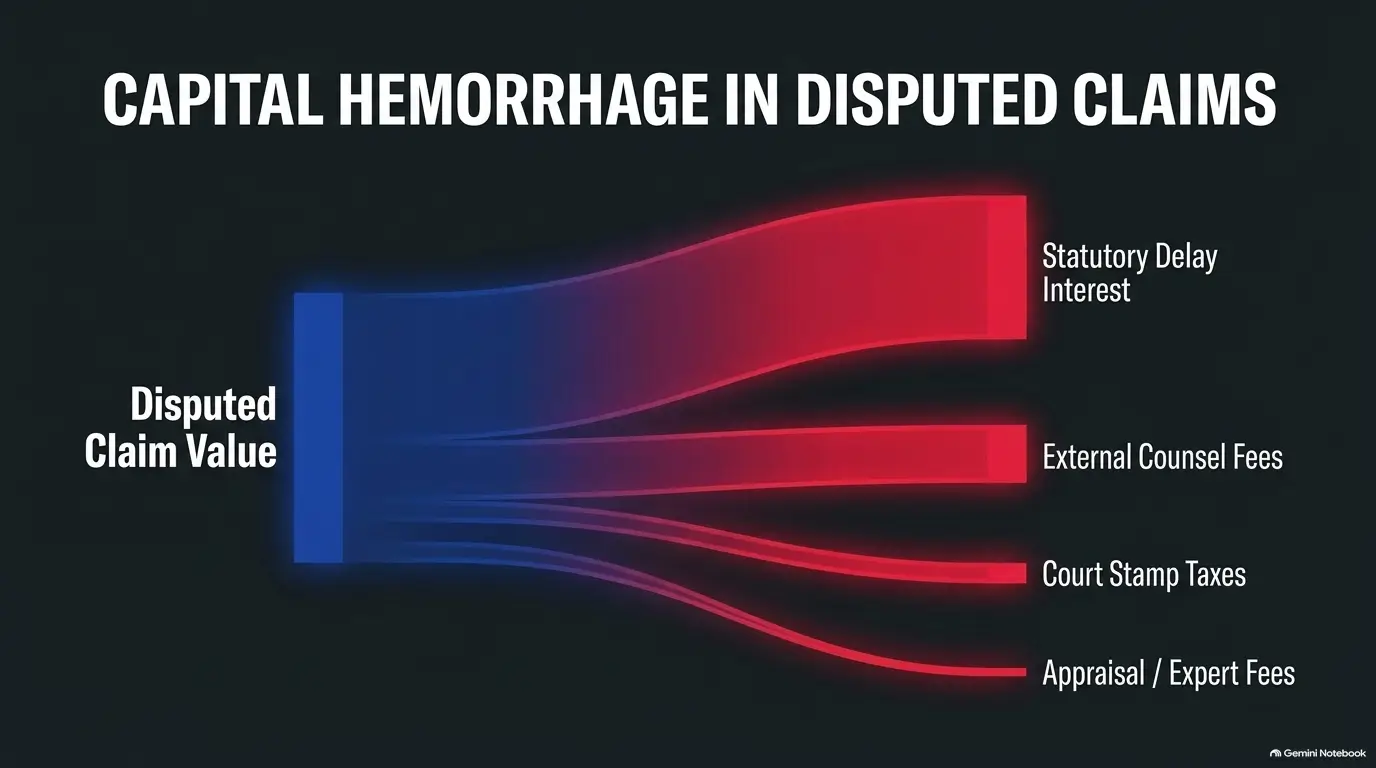
Under the current attorney-fee litigation-cost rules, the amount recognized as litigation costs is calculated for each court level according to the value of the claim. It is also limited by the amount you actually paid or are required to pay under your fee agreement.
The current schedule provides the following basic formula:
| Claim value | Attorney fee amount under the litigation-cost schedule |
|---|---|
| Up to KRW 3 million | KRW 300,000 |
| Over KRW 3 million to KRW 20 million | KRW 300,000 + 10% of the amount over KRW 3 million |
| Over KRW 20 million to KRW 50 million | KRW 2 million + 8% of the amount over KRW 20 million |
| Over KRW 50 million to KRW 100 million | KRW 4.4 million + 6% of the amount over KRW 50 million |
| Over KRW 100 million to KRW 150 million | KRW 7.4 million + 4% of the amount over KRW 100 million |
| Over KRW 150 million to KRW 200 million | KRW 9.4 million + 2% of the amount over KRW 150 million |
| Over KRW 200 million to KRW 500 million | KRW 10.4 million + 1% of the amount over KRW 200 million |
| Over KRW 500 million | KRW 13.4 million + 0.5% of the amount over KRW 500 million |
These figures are not recommended lawyer prices. They are the court-rule figures used when determining how much attorney compensation may be included in litigation costs.
What the rule looks like in actual claim amounts
| Illustrative insurance claim | Schedule amount per court level |
|---|---|
| KRW 10 million | KRW 1 million |
| KRW 30 million | KRW 2.8 million |
| KRW 50 million | KRW 4.4 million |
| KRW 100 million | KRW 7.4 million |
| KRW 200 million | KRW 10.4 million |
| KRW 500 million | KRW 13.4 million |
Suppose you sue an insurer for KRW 50 million and your actual first-instance attorney fee is KRW 7 million. The schedule figure is KRW 4.4 million. That does not mean you automatically receive KRW 4.4 million from the insurer. It establishes a relevant ceiling before other rules are applied.
If you paid less than the schedule figure, the actual paid or payable amount can be the lower limit. If the judgment divides litigation costs between the parties, the allocation percentage affects what can be recovered. Courts also retain authority under the applicable rules to reduce the amount in circumstances recognized by law.
In short, never hire a lawyer on the assumption that “the insurer will pay my legal fees when I win.” The economics should still make sense even if part of the fee remains yours.
Court Costs Sit on Top of Attorney Fees
A litigation budget should separate attorney compensation from court charges. Filing a civil claim can require an filing fee based on the value of the claim and advance payment of service costs. Appeals and further proceedings create additional costs.
The Korean courts publish the applicable filing-fee methodology and procedural guidance through the Supreme Court’s civil complaint guidance. Because court charges can change and electronic filing can affect calculations, use the current court or legal-aid calculator rather than relying on an old blog post’s fixed number.
Large insurance cases can also create expenses that are economically more important than the basic filing fee. Medical disputes may require specialist review. Disability or lost-income cases can require extensive employment and medical evidence. Property losses can require appraisal or engineering evidence. A foreign claimant may also need Korean-English translation and interpretation.
You May Not Need Full Litigation on Day One
Before paying for a full lawsuit, identify exactly why the insurer refused or reduced the claim. Many disputes become clearer when the denial is separated into three questions: what happened, what the contract covers, and how much loss can be proved.
For disputes involving a financial company regulated under Korea’s financial-consumer system, a claimant may be able to seek financial dispute mediation through the Financial Supervisory Service. Korea’s government-supported Easy Law guidance on insurance dispute mediation explains that insurance disputes can be submitted to the Financial Supervisory Service and that other mediation bodies may apply in particular situations.
This can make a staged legal strategy financially sensible. You might pay for an initial document review and legal opinion first, attempt a targeted complaint or mediation second, and authorize full litigation only if the value and evidence justify it.
The cheaper route is not always the better route, however. If a limitation deadline is close, crucial evidence is disappearing, fraud or material misrepresentation is alleged, or the insurer has already taken a firm legal position on a high-value claim, delay can be more expensive than early legal advice.
Watch the Insurance Claim Limitation Period
For claims governed by Korea’s Commercial Act, Article 662 states that an insurance-benefit claim is extinguished by limitation if it is not exercised for three years. The current text can be checked through the National Law Information Center’s Commercial Act Article 662.
Do not turn the phrase “three years” into a homemade deadline calculation. Determining when the limitation period begins and whether a particular procedural event affects it can depend on the claim, underlying facts, and governing law. Public health insurance, foreign-issued policies, statutory compensation systems, and other claims may use different rules.
If the insurer has been negotiating for months, do not assume that correspondence alone has protected every deadline. Ask specifically: What is the limitation date, what event starts it, and what action legally protects the claim?
How to Compare Two Lawyer Quotes
The cheapest initial retainer can become the more expensive engagement if every later step is excluded. Compare written scope rather than the front-page number.
- Is the initial consultation included?
- How many documents will be reviewed before extra charges begin?
- Does the fee include a written legal assessment?
- Are pre-litigation negotiations included?
- Is Financial Supervisory Service mediation included?
- Does the quoted litigation fee cover the entire first instance?
- Would an appeal require a new retainer?
- Is there a success fee, and precisely how is “success” calculated?
- How is a partial settlement treated for success-fee purposes?
- Are VAT and administrative expenses included?
- Who pays translators, medical experts, appraisers, or other specialists?
- Does post-judgment enforcement require a new engagement?
- Can advice and case updates be provided in English if needed?
Success-fee language deserves particular attention. “10% of the amount recovered” and “10% of the economic benefit obtained” may not produce the same result. If the insurer originally denied KRW 100 million and later settles for KRW 60 million, the contract should make it possible to calculate the lawyer’s fee without another dispute beginning the moment the insurance dispute ends.
When Paying for a Lawyer Becomes Easier to Justify
Full representation becomes more economically defensible when the amount at stake is large relative to the legal budget, the insurer relies on a contested policy exclusion, medical or technical causation is disputed, the claim involves serious injury or death, important evidence requires formal collection, multiple insurers or compensation systems overlap, or litigation deadlines have become difficult to manage safely.
For a small documentary disagreement, paying for a focused consultation may be more proportionate than immediately funding a lawsuit. For a six-figure disability, death, business interruption, or serious-injury claim, the cost of misunderstanding one exclusion or evidentiary issue can be substantially larger than the price of early professional review.
Foreign residents comparing Korean public and private medical coverage may also want the broader guide to health insurance in Korea for foreigners. Understanding which system is actually responsible for the disputed expense can prevent you from paying a lawyer to attack the wrong decision-maker.

Lower-Cost Legal Help May Be Available
People who meet applicable eligibility requirements should also check the Korea Legal Aid Corporation. The organization provides legal consultation and legal-aid services and publishes tools for calculating court-related costs. Eligibility and the scope of assistance depend on the applicant and case, so it should not be assumed that every insurance dispute qualifies for free representation.
A Practical Budget Before You Hire Anyone
Before requesting quotes, make a one-page insurance dispute summary. Record the policy type, insurer, claim number, disputed amount, accident or loss date, claim filing date, denial date, exact denial reason, the policy clause cited by the insurer, important deadlines, and the strongest supporting documents.
Then ask the lawyer to price a defined task rather than a cloud of anxiety. “Please review this denial letter, policy, and twenty pages of evidence and tell me whether litigation is economically rational” produces a more useful conversation than “How much to fight my insurance company?”
Finally, compare the legal budget against more than the headline claim amount. Consider the realistically disputed amount, strength of proof, expert and translation costs, possible appeal expense, time required, settlement possibilities, and the portion of attorney fees that may remain unrecoverable even after a favorable judgment.
The safest cost rule is simple: get the engagement scope, VAT treatment, success-fee formula, appeal terms, third-party expenses, and exclusions in writing before you sign. A clear fee agreement cannot guarantee the outcome of an insurance dispute, but it can prevent the legal bill from becoming a second dispute of its own.