
A denied workers’ compensation claim in South Korea is not necessarily the end of the case, and being a foreign employee does not by itself disqualify you from Korean industrial accident compensation. Korean workers’ compensation law generally applies without regard to the worker’s nationality when the person qualifies as a worker and the workplace falls within the Industrial Accident Compensation Insurance Act.
The immediate problem after a denial is usually the clock. Under the current Industrial Accident Compensation Insurance Act, a request for examination of a Korea Workers’ Compensation & Welfare Service decision generally must be filed within 90 days from the date you became aware of the decision. A later request for reexamination is also generally subject to a 90-day period. The current Article 103 examination procedure and Article 106 reexamination procedure make that deadline one of the first things to protect.
If you have just received a non-approval or denial notice, do not begin by arguing with the employer or writing a long emotional statement. First identify why the claim was denied, when you received the decision, what evidence the agency relied on, and which review route applies to your case.
Table of Contents
Foreign Employees Are Not Automatically Excluded From Korean Workers’ Compensation
The basic rule is important because foreign workers sometimes assume that visa status, nationality, or an employer’s failure to complete paperwork automatically destroys a workers’ compensation claim.
Article 6 of Korea’s Industrial Accident Compensation Insurance Act states that the Act applies, in principle, to businesses or workplaces that employ workers, subject to statutory exceptions. The current statutory scope of application does not create a general nationality exclusion.
Korea’s official Easy Law service is even more explicit: its current guidance explains that nationality is not relevant to the basic definition for this purpose and that foreign employees who suffer occupational injuries may, in principle, receive industrial accident compensation benefits. See the government’s guidance on foreign workers and industrial accident insurance.
The Korea Workers’ Compensation & Welfare Service, commonly called COMWEL or 근로복지공단, likewise publishes guidance explaining that foreign workers may apply for industrial accident compensation when they suffer a work-related accident. Its foreign-worker workers’ compensation guidance is a useful starting point for employees who have been told informally that “foreigners are not covered.”
That does not mean every foreign employee automatically wins a claim. The real questions usually become whether you legally qualify as a worker, whether the workplace is covered, whether the accident or disease is sufficiently connected to the job, and whether the evidence supports the claimed injury.
What Does a Workers’ Compensation Denial Actually Mean?
A denial means COMWEL has made an administrative decision that the submitted claim does not satisfy the requirements for the benefit requested. It does not necessarily mean the agency believes no injury occurred.
The distinction matters. Two employees can have the same medical diagnosis yet receive different decisions because the evidence connecting the condition to work is different.
| Possible dispute | What the case may turn on |
|---|---|
| Employee status | Whether the person actually worked under the employer’s direction for wages rather than operating an independent business |
| Accident connection | Whether the injury occurred while performing work or an activity sufficiently connected to employment |
| Occupational disease | Medical evidence, exposure, workload, duration, causation, and competing causes |
| Commuting accident | Route, purpose of travel, deviation from the normal route, and circumstances of the accident |
| Coverage issue | Whether the workplace falls within the statutory industrial accident insurance system |
| Factual disagreement | CCTV, witnesses, work schedules, messages, reports, medical histories, or inconsistent accounts |
Article 37 of the Act recognizes several categories of occupational accident, including accidents arising from work, occupational diseases, and qualifying commuting accidents. The statute requires the necessary relationship between the work and the injury or disease. The official Article 37 occupational-accident criteria are therefore much more important than whether an employer simply says, “This was not a work accident.”
First Step: Read the Exact Reason for Denial
Do not appeal a reason that the decision did not actually use.
Obtain the full written decision and identify the operative language. A denial based on worker status requires a different evidence strategy from a denial based on medical causation. A commuting-route dispute requires different evidence again.
- Write down the date shown on the decision.
- Record the date and method by which you actually received it.
- Identify every stated reason for denial.
- Separate factual findings from legal conclusions.
- Mark evidence the decision mentions.
- Mark important evidence it appears not to discuss.
- Keep the envelope, electronic service notice, text message, or other delivery record.
The last point can look trivial until a deadline dispute appears. Then a boring envelope can suddenly become the most interesting object in the room.
The 90-Day Deadline Deserves Immediate Attention
Under Article 103, a person challenging a covered COMWEL insurance-benefit decision may request examination through the COMWEL office that issued the decision, generally within 90 days from learning of the decision.
Korea’s Easy Law service provides a practical explanation of the same rule in its workers’ compensation examination guidance.
If the examination decision is also unfavorable, Article 106 generally permits a request for reexamination within 90 days from learning of the examination decision. The government’s reexamination guidance explains the filing period and procedural requirements.
There is an important procedural exception. When the original insurance-benefit decision went through the Occupational Disease Judgment Committee, the law permits a claimant in qualifying circumstances to skip the ordinary examination stage and seek reexamination directly. Do not assume that route applies simply because your claim involves an illness. Check what procedure actually produced your decision.
Also do not assume that asking HR to reconsider, negotiating with the employer, obtaining another medical opinion, or waiting for translated records pauses the statutory filing period.
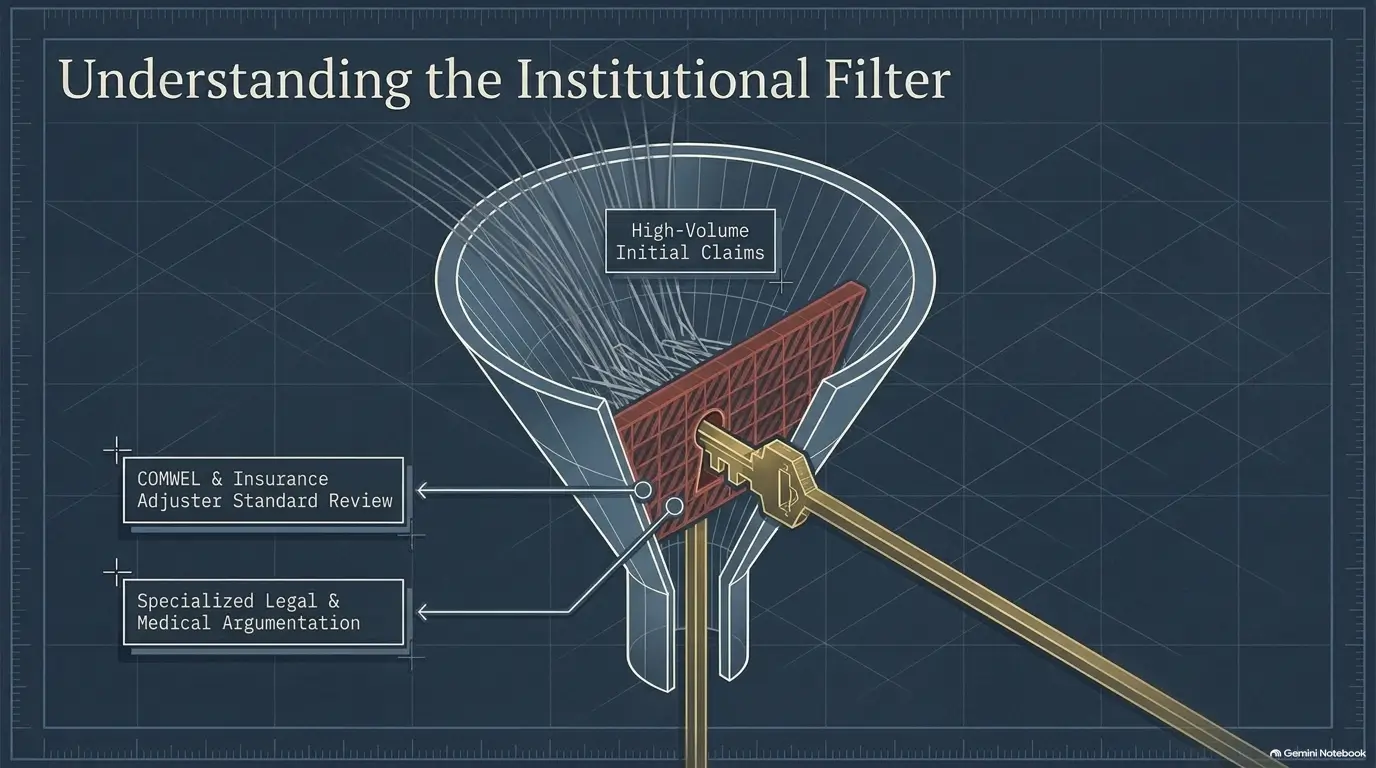
Build the Appeal Around the Denial Reason, Not Around Anger
The strongest review file usually behaves more like a map than a protest letter. Each disputed finding should lead directly to evidence.
If COMWEL disputes whether you were really an employee
Gather evidence showing what the working relationship actually looked like, not merely what the contract called it.
- Employment contract or offer letter
- Payroll records and bank transfers
- Work schedules and attendance records
- Instructions from supervisors
- KakaoTalk, email, Slack, or other work communications
- Company ID cards or internal accounts
- Evidence showing who determined working hours and location
- Evidence showing who supplied equipment or materials
- Tax and insurance records, where relevant
Korean courts have long looked at the real substance of the working relationship rather than relying only on labels. In one Supreme Court case involving a foreign industrial trainee, the court treated the worker as an employee where the person actually worked under the company’s direction and received compensation for that labor.
If COMWEL disputes whether the accident happened because of work
Build a minute-by-minute chronology where possible.
- What task were you performing?
- Who instructed you to perform it?
- Where did the accident occur?
- Who witnessed it?
- Was there CCTV?
- When did symptoms begin?
- When did you first seek treatment?
- What did you tell the first doctor about the mechanism of injury?
- Was an internal accident or safety report created?
A gap between the accident and the first medical record does not automatically decide the claim, but unexplained gaps and inconsistent descriptions can become evidence problems. Preserve the first version of events rather than repeatedly rewriting it until it sounds more legal.
If the claim involves an occupational disease
The evidence may need to establish exposure or workload over weeks, months, or years rather than proving one dramatic event.
- Detailed job history
- Shift schedules and overtime
- Records of repetitive work
- Chemical, dust, noise, vibration, or other exposure information
- Medical records before and after symptoms developed
- Specialist opinions addressing work-related causation
- Workplace health examinations
- Comparable duties performed by coworkers
- Changes in workload before symptoms worsened
Article 37 expressly includes diseases arising from exposure to physical factors, chemicals, dust, pathogens, physically burdensome work, and other work-related causes. It also includes certain mental-health conditions resulting from workplace harassment or abusive customer conduct when the legal requirements are met.
Your Employer’s Failure to Register for Insurance Does Not Automatically End the Claim
This is one of the most important misconceptions for foreign workers employed by small companies, restaurants, factories, construction contractors, or informal workplaces.
For businesses that are mandatorily covered, industrial accident insurance generally arises by operation of law rather than only because the employer remembered to file the correct paperwork. The government’s current industrial accident insurance enrollment guidance explains that employers of covered businesses become insured parties by law and must report the insurance relationship.
Korean case law also illustrates the distinction. In a construction case, a worker’s treatment-benefit claim had been approved even though the employer reported the industrial accident insurance relationship only after the accident. The employer then faced a separate assessment associated with its failure to report the mandatory insurance relationship.
In practical terms, an employer saying “we never registered you for workers’ compensation” should not be treated as a definitive legal answer. The real issue is whether the business and worker were legally within the system.
Foreign Employees Should Separate Workers’ Compensation, Employment, and Immigration Issues
A workplace injury can create several legal problems at the same time, but they may belong to different systems.
| Issue | Typical starting point |
|---|---|
| Workers’ compensation approval or denial | Korea Workers’ Compensation & Welfare Service |
| Unpaid wages or statutory allowances | Employment and Labor Office / Ministry of Employment and Labor |
| Unfair dismissal | Regional Labor Relations Commission where statutory requirements are met |
| Visa or work-status question | Immigration authority / 1345 |
| Administrative lawsuit against a compensation decision | Administrative court procedure |
If the injury led to dismissal, unpaid wages, retaliation, or another employment dispute, those issues should be mapped separately. The site’s guide to Korea Labor Board claims for foreign employees explains the difference between Labor Relations Commission remedies and Employment and Labor Office complaints. A workers’ compensation appeal does not automatically file either of those claims for you.
Likewise, workers’ compensation and immigration status should not be treated as interchangeable systems. A compensation filing does not itself answer whether you can remain in Korea, change employers, or continue working under a particular status of stay.
For immigration-sensitive questions, the 1345 Immigration Contact Center may help identify the correct immigration procedure. If Korean administrative offices themselves are unfamiliar territory, the site’s guide to local district offices and foreign-resident government services in Korea also explains when 1345, immigration, local government, or another agency is the correct door.
Do Not Let Translation Flatten the Evidence
Foreign employees often possess critical evidence in English, Chinese, Vietnamese, Thai, Tagalog, Uzbek, Russian, Nepali, Indonesian, Mongolian, or another language while the Korean administrative process operates primarily in Korean.
Translation should preserve meaning rather than improve the story.
- Keep the original-language document.
- Translate dates, names, job titles, and technical terms consistently.
- Do not translate only the favorable sentence from a longer conversation.
- Preserve timestamps and sender identities.
- Identify slang or ambiguous workplace expressions rather than silently rewriting them.
- Keep complete medical reports where the omitted material could affect causation.
A Korean reviewer needs to understand what the evidence actually says. A beautifully polished translation that changes the substance can do more damage than clumsy but accurate wording.
Evidence to Preserve Before It Disappears
Workplace evidence has a half-life. CCTV may be overwritten. Employees leave. Work chats disappear. Access to company systems may be revoked.
- Request relevant CCTV promptly where appropriate.
- Export important work messages without altering them.
- Download schedules, duty rosters, and timesheets you are lawfully entitled to access.
- Keep wage statements and bank records.
- Save safety instructions, manuals, and training records relevant to the accident.
- Record witness names and current contact information.
- Preserve photographs of the accident location or equipment when lawfully available.
- Keep diagnostic images, medical certificates, prescriptions, and hospital records.
- Save the original denial decision and proof of receipt.
Do not access accounts after your authorization has ended, remove confidential company data unrelated to the claim, secretly alter documents, or pressure coworkers to produce statements. Evidence preservation is not a license to create a second legal problem.
What Benefits May Be at Stake?
The Industrial Accident Compensation Insurance Act provides multiple categories of insurance benefit rather than one universal payment. Article 36 lists benefits including medical-care benefits, temporary disability benefits, disability benefits, nursing benefits, survivors’ benefits, funeral expenses, and vocational rehabilitation benefits, subject to the requirements of each category.
The official Article 36 insurance-benefit list is worth checking because a dispute about medical treatment is not necessarily identical to a later dispute about disability or another benefit.
Do not estimate the value of a case by copying another worker’s settlement or benefit amount. Average wages, treatment periods, disability findings, dependency, benefit type, and the facts of the injury can materially change the result.
Can You Go to Court Instead?
Korean workers’ compensation law provides internal examination and reexamination procedures, but an administrative lawsuit may also become relevant. Government Easy Law guidance notes that a person challenging a workers’ compensation benefits decision may in appropriate circumstances proceed to administrative litigation without completing the internal examination route.
That does not mean court should automatically be the first choice. Litigation introduces questions about the correct defendant, pleadings, medical proof, procedural deadlines, legal costs, Korean-language filings, and litigation strategy.
The general Administrative Litigation Act provides that a cancellation lawsuit normally must be filed within 90 days from learning of the disposition and, subject to statutory qualifications, within one year from the disposition. See the current Article 20 filing-period rule.
Because the interaction between an original decision, examination, reexamination, service of a decision, and litigation can affect the deadline calculation, obtain case-specific Korean legal advice when court proceedings are being considered. Do not calculate a litigation deadline from a blog post alone.
When Professional Help Becomes Especially Valuable
A straightforward workplace accident with contemporaneous records may be manageable with official guidance and organized evidence. Other cases justify earlier professional review.
- The 90-day deadline is close or disputed.
- COMWEL says you were not an employee.
- The employer says you were an independent contractor.
- The claim involves a complex occupational disease.
- The medical evidence contains conflicting opinions.
- The employer denies that the accident occurred at work.
- Important witnesses have changed their accounts.
- The accident caused serious disability or death.
- Your employment and immigration status changed after the accident.
- An administrative lawsuit is being considered.
A Korean certified public labor attorney, commonly called a nomusa or 노무사, may assist with many labor and industrial-accident matters within the professional’s permitted scope. A Korean attorney may be appropriate when court litigation, civil damages, complex legal issues, or overlapping disputes are involved.
Before paying for representation, ask which stage is included: initial claim, examination, reexamination, medical evidence review, hearing preparation, translation, administrative litigation, or a separate employment dispute. “Workers’ compensation case” can hide several different pieces of work.
Where a Foreign Worker Can Ask for Official Help
- Korea Workers’ Compensation & Welfare Service: industrial accident insurance claims and compensation procedures. COMWEL lists its main call center as 1588-0075.
- Ministry of Employment and Labor: labor-law counseling is available through 1350 in Korea. The ministry also lists an overseas counseling number on its English-language website.
- 1345 Immigration Contact Center: immigration, residence status, and foreign-resident procedural questions.
If the employer also dismissed you or withheld wages while you were injured, do not let the workers’ compensation dispute swallow those separate deadlines. Review the site’s foreign-employee Labor Board claims guide and treat each remedy as its own track.
If the dispute arose partly from absence, sick time, vacation accounting, or workplace pressure over taking time away from work, the separate guide to annual leave culture in Korea can help distinguish workplace expectations from formal employment rights. Cultural pressure and legal entitlement are not the same question.
Common Mistakes After a Workers’ Compensation Denial
Waiting for the employer to “fix it”
Your employer may cooperate, oppose the claim, or simply stop responding. Protect your own procedural deadline regardless of internal discussions.
Arguing only that the injury is serious
Severity and work-relatedness are different issues. A devastating medical condition can still require proof connecting it to the employment.
Submitting more documents without explaining them
A 200-page file is not automatically stronger than a 30-page file. Explain what each important document proves and which finding in the denial it addresses.
Assuming a foreign contract controls Korean statutory rights
An English-language employment agreement can be important evidence, but contractual wording does not automatically replace mandatory Korean workers’ compensation rules.
Assuming visa status decides the compensation case
Immigration and workers’ compensation involve different statutes and administrative questions. Confirm each separately rather than treating one government status as the answer to another.
Posting accusations publicly before preserving evidence
A public campaign may feel faster than an administrative file, but it can complicate employment, privacy, confidentiality, or other legal issues. Preserve evidence and protect deadlines before turning the dispute into public content.
FAQ About Denied Korea Workers’ Compensation Claims
Can a foreign employee receive Korean workers’ compensation?
Yes, potentially. Korean government guidance states that nationality itself does not exclude a worker from the Industrial Accident Compensation Insurance Act. The worker, workplace, accident or disease, and requested benefit must still satisfy the applicable legal requirements.
My employer says foreigners are not covered. Is that correct?
Not as a general rule. Official Korean guidance expressly recognizes that foreign workers can receive industrial accident compensation when the statutory conditions are met.
What if my employer never enrolled me in industrial accident insurance?
Do not assume that ends the claim. Businesses subject to mandatory coverage become part of the insurance system by operation of law, and an employer’s reporting or premium problem may be treated separately. The exact result still depends on whether the workplace and worker fall within the Act.
How long do I have to challenge a denial?
A request for examination generally must be filed within 90 days from the date you became aware of the covered insurance-benefit decision. Reexamination is generally subject to another 90-day period from awareness of the examination decision, with a special direct-reexamination route for certain decisions that went through the Occupational Disease Judgment Committee.
Can a pre-existing condition still be work-related?
A prior medical condition does not answer the issue by itself. The relevant analysis may involve whether work caused, materially contributed to, or legally qualifies in relation to the claimed injury or disease under the applicable standards. Medical history can therefore be important evidence for both sides.
Can I appeal after leaving Korea?
Leaving Korea does not by itself explain whether a particular workers’ compensation right survives or whether a filing is timely. Practical issues may include service of documents, Korean-language submissions, medical examinations, representation, banking, and immigration records. Before departure, preserve contact details, obtain complete records, and confirm how future notices will be received.
Should I file a Labor Board claim instead?
Not simply because workers’ compensation was denied. A Regional Labor Relations Commission generally handles different employment remedies, such as qualifying unfair-dismissal claims. Workers’ compensation decisions are handled through the industrial accident compensation system. One workplace event may create both types of dispute, but they remain separate tracks.
Your Next 30 Minutes After Receiving a Denial
- Find the complete written denial decision.
- Write down when and how you received it.
- Calculate a conservative 90-day review deadline and verify it officially.
- Highlight every factual and legal reason given for denial.
- Create a one-page chronology of the accident, symptoms, treatment, and claim process.
- List the five strongest pieces of evidence contradicting the disputed findings.
- Preserve CCTV, messages, schedules, medical records, and witness information before they disappear.
- Identify whether your problem also involves unpaid wages, dismissal, immigration, or another separate proceeding.
- Contact COMWEL or an appropriate Korean professional if the deadline, worker status, medical causation, or procedure is unclear.
A workers’ compensation denial feels like a closed door because it arrives in the language of a finished decision. Procedurally, however, it may be the beginning of a much more specific task: identify the disputed finding, protect the deadline, and build evidence directly around that finding.
For a foreign employee in Korea, the most useful question is therefore not simply, “Was my claim denied?” It is: “Why was it denied, what evidence answers that reason, and which deadline is running now?”
This article provides general information about South Korean workers’ compensation procedures and is not individualized legal, medical, or immigration advice. Procedural choices and deadlines can depend on the exact decision, service date, benefit, and case history.