
Beyond the Postcard:
The True Pulse of Jeju Island
Jeju can fool you in the first ten minutes. The airport doors slide open, the air feels saltier, the palms perform their little vacation ballet, and suddenly it seems easy to file the island under “Korea, but sunnier.” That is the first mistake.
Why Jeju feels culturally different from mainland Korea beyond tourism marketing has less to do with resort brochures and more to do with language, labor, volcanic land, women divers, local ritual, and historical memory. For travelers, Korean culture learners, expats, and heritage visitors, guessing at Jeju’s difference can flatten the place into beaches, cafés, black pork, and tangerines. Pleasant, yes. Complete, no.
You lose the deeper story: how an island learns to survive wind, scarcity, sea work, political distance, and grief.
Jeju is not outside Korea. It is Korea with an island pulse. Its difference can be heard in speech, tasted in food, felt in basalt walls, and noticed in what locals do not rush to explain.
Jeju Cultural Difference at a Glance
Jeju feels different because it formed as an island society shaped by Tamna history, volcanic ecology, maritime labor, Jeju language, haenyeo women divers, shamanic traditions, and the unresolved memory of the Jeju 4·3 Incident.
Tourism tends to sell scenery. Culture asks a better question: what kind of life made this scenery necessary?
- For travelers: it helps you visit with more respect and fewer lazy comparisons.
- For culture learners: it shows how Korean identity changes by region, not just by textbook.
- For writers: it gives you a richer frame than “Korea’s Hawaii.”
- For expats: it explains why local belonging can feel layered, quiet, and weathered.
Table of Contents
Start With This: Jeju Is Not “Korea, But Tropical”
The fastest way to misunderstand Jeju is to make it cute too quickly. Yes, the island has beaches. Yes, the cafés can look arranged by a very patient cloud. Yes, tangerines appear with the confidence of tiny orange ambassadors.
But Jeju’s difference is not a lifestyle filter. It is not just warmer weather stapled onto Korean culture. It is the result of being far enough from the mainland to develop a distinct rhythm, yet close enough to remain inside Korea’s political, linguistic, and emotional history.
The easy mistake American travelers make before they land
Many American travelers arrive with a comparison already packed in the carry-on: “Jeju is Korea’s Hawaii.” The phrase is convenient. It also smuggles in the wrong assumptions.
Hawaii has its own Indigenous history, colonial wounds, and tourism pressures. Jeju has its own island polity history, Korean state relationship, local language, and mass trauma. The comparison sounds helpful until it starts sanding off the grain of both places.
A better opening frame is simpler: Jeju is a Korean island whose culture was shaped by sea distance, volcanic land, labor, ritual, and memory.
Why “island culture” changes more than scenery
Island life changes what people eat, how they store water, where they build walls, how they speak, who does risky work, and how communities remember danger. Geography becomes behavior. Weather becomes etiquette. Scarcity becomes cuisine. Distance becomes pride.
If you already know mainland Korean customs, such as Korean politeness, honorifics, hierarchy, and family obligation, Jeju adds another layer. The polite sentence may be Korean, but the emotional weather behind it may be distinctly island-shaped.
The real question: different from what version of Korea?
Mainland Korea is not one thing either. Seoul office culture, Gyeongsang speech, Jeolla food pride, Gangwon mountain life, and Busan port identity all carry their own local textures. A reader who has only seen Seoul may think Jeju feels “less Korean,” when it may simply feel less Seoul-centered.
That distinction matters. Jeju does not need to be exoticized to be understood. It needs to be placed beside other Korean regions with care.
- Avoid the “Korea’s Hawaii” shortcut.
- Ask how island life changes daily habits.
- Compare Jeju to mainland regions carefully, not competitively.
Apply in 60 seconds: Replace “Korea’s Hawaii” with “a Korean island culture shaped by sea, wind, labor, language, and memory.”
Who This Is For, And Who Should Skip It
This guide is for readers who want the layer under the itinerary. The sort of person who looks at a basalt wall and suspects it is doing more than decorating a walking path. The sort of traveler who can enjoy a seaside café and still wonder who lived here before the latte art arrived.
For travelers who want context before renting a car and chasing waterfalls
Jeju is easier to drive around than to understand. You can visit Seongsan Ilchulbong, waterfalls, markets, museums, and coastal roads in a few days. Understanding why those places feel emotionally different takes longer.
If you are planning a Korea trip, a broader route like a 14-day South Korea itinerary can help you see how Jeju fits beside Seoul, Busan, Gyeongju, and other regions. Jeju should not be treated as an afterthought with a boarding pass.
For K-culture fans who sense Jeju is not just a drama backdrop
K-dramas often use Jeju as shorthand for escape, healing, youth, or emotional reset. That can be lovely. It can also reduce a lived island to a cinematic mood swing.
If your Korea knowledge came through dramas, K-pop, food videos, or language apps, Jeju is an invitation to expand the map. Culture is not only what performs well on screen. Sometimes it is what survives quietly off camera.
Not for readers looking for a quick hotel-and-café itinerary
This is not a “best brunch by the sea” guide. There is nothing wrong with brunch by the sea. A good pastry can rehabilitate a terrible travel day with suspicious speed. But Jeju deserves more than a café ladder.
Use this guide when you want meaning, not just movement.
Not for anyone trying to rank Korean regions as “more authentic”
Jeju is not more authentic than Seoul. A grandmother in a Jeju village and a subway worker in Seoul are both living Korean reality. Authenticity contests usually reveal the visitor’s fantasy, not the place itself.
A healthier question is: what conditions shaped this region’s particular form of Korean life?
Money Block: Should You Read Jeju as Culture, Not Just Travel?
Use this quick yes/no check before writing, filming, or planning a deeper trip.
- Yes / No: Are you comparing Jeju to Seoul or Busan? If yes, study at least one Jeju-specific cultural source first.
- Yes / No: Are you using haenyeo imagery? If yes, explain labor, risk, and community rules.
- Yes / No: Are you mentioning Jeju 4·3? If yes, avoid turning it into a travel “hidden gem.”
- Yes / No: Are you calling Jeju language a dialect for laughs? If yes, stop and reframe.
- Yes / No: Are you writing for first-time travelers? If yes, define terms gently.
Neutral action: Pick one cultural anchor before planning your route: language, haenyeo, 4·3, food, ritual, or volcanic land.
Tamna’s Long Shadow: Jeju Had Its Own Political Memory
Before modern Jeju Province, before resort maps and airport signage, there was Tamna. The old island polity matters because history does not vanish when borders change. It lingers in pride, place names, local storytelling, and the feeling that the island has never been merely a scenic extension of the mainland.
Before “Jeju Province,” there was an island polity
Tamna is commonly remembered as Jeju’s premodern island kingdom or polity. Its long history of interaction with surrounding powers shaped an island consciousness: connected to Korea, China, Japan, and maritime routes, but never reducible to mainland administration alone.
This does not mean modern Jeju is politically separate from South Korea. It means the island carries an older memory of selfhood. Think of it as a room inside the Korean house with its own floorboards.
Why former independence still shapes local pride
Local pride often grows where outside observers once assumed dependence. Island communities tend to remember what it took to survive without immediate help. Weather, distance, and political marginalization can turn self-reliance into identity.
You can see similar patterns in other regional identities across Korea. A helpful companion frame is Korean city identity, where place is never just a postal address. It becomes accent, food memory, school ties, sports loyalties, and family reputation.
Mainland rule did not erase island memory overnight
Administrative integration can happen faster than emotional integration. Governments can rename, tax, regulate, and classify. People still remember who married whom, which village suffered, which shore fed the family, and which old words made outsiders blink.
Jeju’s relationship with mainland authority has included trade, tribute, bureaucracy, migration, discrimination, and state violence. That mix produces a local identity that is Korean, yes, but never paper-thin.
Here’s what no one tells you: distance can become identity
Distance is not only measured in kilometers. It is measured in how long it takes help to arrive, how often your speech is mocked, how easily your grief is believed, and how quickly outsiders turn your home into scenery.
That is why Jeju’s difference cannot be explained by “island vibes.” Vibes are what marketers sell when history makes them nervous.
Jeju Language: The Difference You Can Hear Before You Understand It
Language is one of the clearest signs that Jeju is not just a pretty regional variation. Many linguists and preservation advocates describe Jeju speech as a distinct Koreanic language, not merely standard Korean with a charming accent. It is also widely considered seriously endangered.
Why Jeju speech is more than a cute regional accent
For Korean learners, Jeju can be humbling. You may know textbook phrases, polite endings, and enough ordering vocabulary to survive a restaurant. Then an elder speaks Jeju, and suddenly your language confidence folds itself into a small paper boat.
That is not failure. It is evidence of depth.
Standard Korean, Seoul speech, regional dialects, honorific layers, and Jeju language all sit inside a wider language ecology. If you are curious about broader Korean speech variation, regional dialects in Korea provide a useful doorway before you step into Jeju’s more distinct linguistic terrain.
How language loss turns culture into a ticking clock
When a language weakens, a culture does not simply lose vocabulary. It loses jokes, weather words, kinship nuance, fishing terms, scolding styles, lullabies, ritual phrases, and the old emotional furniture of daily life.
Endangered language is not a museum problem. It is a dinner table problem. It happens when grandparents speak one way, parents understand but answer differently, and children hear the old sounds as background music rather than inheritance.
Why younger Jeju residents may understand less than grandparents
Modern schooling, media, migration, and social pressure favor standard Korean. Younger Jeju residents may still feel deep local pride while speaking far less Jeju language than elders. That does not make them less Jeju. It shows how modern identity often carries loss and adaptation at the same time.
This is where outsiders should tread gently. Language preservation is not helped by treating local speech as a travel trick.
Don’t do this: calling Jeju language “just funny Korean”
Mocking regional speech is a fast way to announce that your cultural sensitivity left the building and took the elevator music with it. Jeju language has been linked to identity, stigma, aging, and preservation work. Treat it with the same respect you would give any endangered language community.
Show me the nerdy details
Jeju language belongs to the Koreanic language family, which means it is related to Korean but has distinctive vocabulary, phonology, grammar, and historical development. The classification debate matters because labels shape funding, education, preservation, and public respect. Calling it “just a dialect” can make preservation seem less urgent. Calling it a separate language can better signal that mutual comprehension with standard Korean is limited, especially for younger standard-Korean speakers encountering older Jeju forms.
- Language carries labor, ritual, humor, and grief.
- Endangerment often happens across generations inside ordinary homes.
- Respectful visitors avoid treating local speech as comic scenery.
Apply in 60 seconds: Learn one Jeju-language greeting or term from a reputable source, then learn what situation it belongs to.
Volcanic Land, Hard Soil, Different Habits
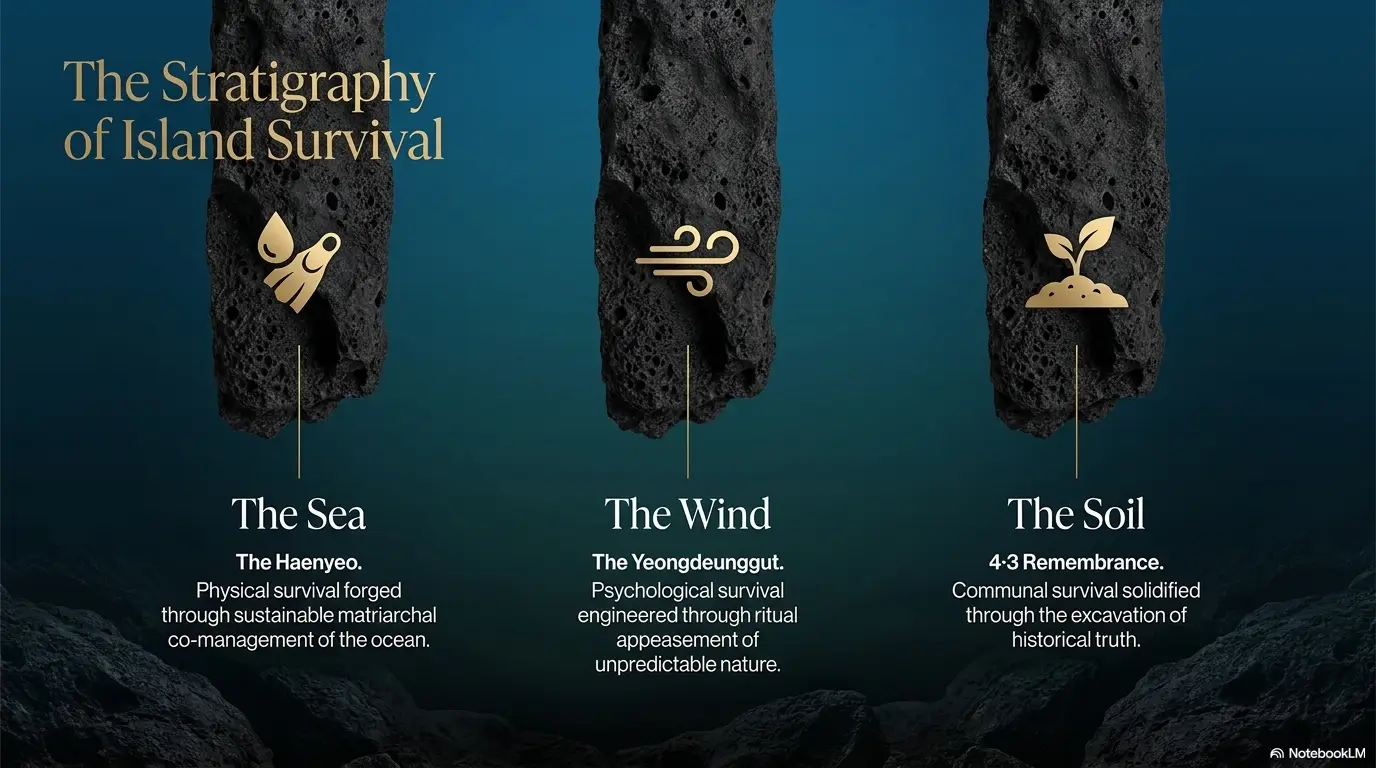
Jeju’s land does not whisper politely. It announces itself in black basalt, wind-bent trees, stone walls, lava tubes, porous ground, and fields that look as if someone negotiated with geology using bare hands.
Culture grows from that negotiation.
Basalt walls, wind, and the architecture of endurance
Those low dark stone walls are not just photogenic borders. They protect fields from wind, mark land, hold soil, and reveal how people worked with rock instead of pretending rock was an inconvenience.
On the mainland, a village may be shaped by river plains, mountains, rice paddies, or dense urban networks. On Jeju, volcanic stone becomes part of the grammar of place. It tells you where labor went.
Why Jeju’s farming and settlement patterns feel physically different
Jeju farming historically required adaptation to wind, soil, water conditions, and isolation. Barley, millet, sweet potatoes, seafood, seaweed, and hardy livestock mattered because they fit the island’s constraints.
Constraint does not sound romantic. It sounds like dinner when the weather is bad and the pantry is honest.
That is why Jeju food and settlement patterns can feel physically different from mainland Korea. They are not just regional flavor. They are survival decisions repeated until they became tradition.
Gotjawal forests and the quiet politics of water
Jeju’s gotjawal forests, formed on lava terrain, are often discussed as ecologically important because they store moisture, host biodiversity, and shape local environmental debates. Water on a volcanic island is not just scenery. It is infrastructure, ecology, and politics braided together.
Once you notice this, Jeju becomes less “pretty island” and more “living system.” The island stops posing. It starts explaining itself.
The island teaches thrift before it teaches charm
A visitor sees charm. A resident remembers maintenance. Wind breaks things. Salt ages things. Distance raises costs. Weather edits plans. Island thrift is not quaint. It is practical intelligence with a weather-beaten jacket.
Jeju Culture: Six Layers Under the Postcard
Basalt, wind, fields, water, and hard soil shape everyday habits.
Fishing, farming, diving, and scarcity turn work into identity.
Speech preserves local memory, humor, and generational distance.
Village rites map fear, care, sea risk, and protection.
Modern identity carries grief, silence, and remembrance.
Marketing brightens the surface while smoothing the harder edges.
Haenyeo Culture: Jeju’s Female Labor Story Is Not a Postcard
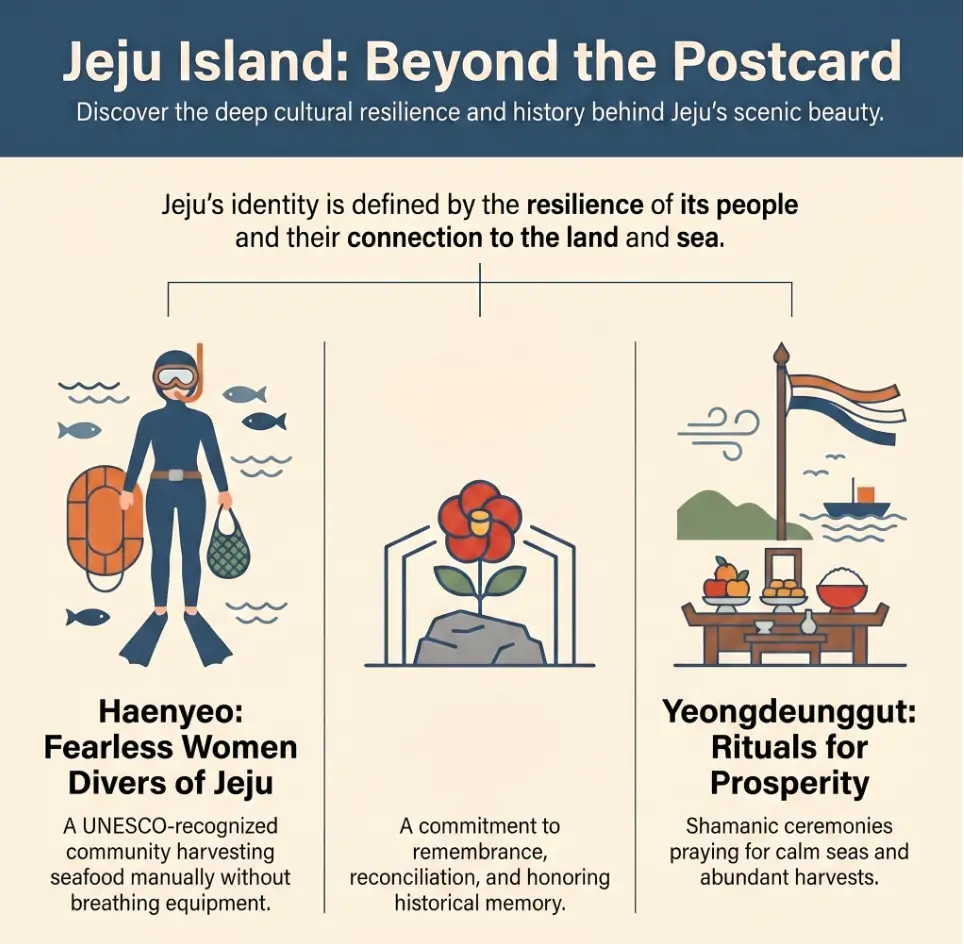
Haenyeo, Jeju’s women divers, are often introduced through a beautiful image: older women in wetsuits walking toward the sea, carrying tools and breath discipline that makes most of us feel lazy for complaining about stairs.
The image matters. But the system behind the image matters more.
Why women divers became a symbol of Jeju toughness
Haenyeo culture developed around women diving without modern breathing equipment to gather seafood such as abalone, sea urchin, and shellfish. Their work supported households, shaped gender roles, and became one of Jeju’s strongest cultural symbols.
UNESCO inscribed Jeju haenyeo culture on its Representative List of the Intangible Cultural Heritage of Humanity in 2016, emphasizing community knowledge, sustainable harvesting, diving practices, and social cooperation.
Community rules, shared risk, and ocean knowledge
Haenyeo culture is not just individual bravery. It includes training, hierarchy, mutual help, ecological restraint, seasonal knowledge, and community rules. The sea is not a stage. It is a workplace with teeth.
That is why respectful writing should avoid reducing haenyeo to “iconic women divers” and leaving it there. Iconic is a nice word that often quits too early.
The danger of turning haenyeo into decorative folklore
Tourism can preserve attention while shrinking meaning. A haenyeo performance or museum display may open the door for visitors, but the real story includes aging divers, fewer young recruits, economic pressure, environmental change, and the difficulty of keeping dangerous labor alive as heritage.
A similar pattern appears across many cultural traditions: once something becomes photogenic, people forget it was once exhausting.
Let’s be honest: tourists often photograph the symbol, not the system
A camera loves the silhouette. Culture lives in the rules, fatigue, income, grief, and jokes after work. If you photograph haenyeo, or write about them, ask what system you are showing. Are you explaining work, or just collecting atmosphere?
Money Block: Respectful Haenyeo Content Decision Card
| If your content says… | Upgrade it with… | Why it matters |
|---|---|---|
| “Jeju’s famous women divers” | Labor, risk, age, community rules | Prevents decorative folklore |
| “A unique photo spot” | A working culture with consent and boundaries | Respects people over imagery |
| “Ancient tradition” | Modern challenges and preservation efforts | Avoids freezing culture in the past |
Neutral action: Before using haenyeo imagery, write one sentence about labor and one sentence about community knowledge.
Shamanic Rituals: Jeju’s Spiritual Map Feels Older Than the Brochure
Jeju’s ritual life gives the island another kind of map. Not the rental car map. Not the Instagram pin map. A map of wind, household safety, sea danger, ancestors, village protection, and the invisible negotiations people make when life feels exposed.
Why Jeju’s village rites still matter culturally
Shamanic ritual in Jeju is not simply “old religion.” It is a cultural language for vulnerability. Island life historically depended on forces people could not control: storms, fishing luck, illness, childbirth, harvest, travel, and death.
Ritual gave communities a way to name fear and bind people together. Modern visitors do not need to share the belief system to respect its cultural function.
Wind, sea, ancestors, and household protection
Jeju’s rituals often reflect an environment where wind and sea are not background. They are active presences. Household protection, village peace, and maritime safety become spiritual concerns because they were practical concerns first.
This is where Jeju can feel older than the brochure. The island’s sacred life is not polished into quiet minimalism. It can be loud, embodied, musical, communal, and alive.
How ritual explains local ideas of vulnerability and care
Ritual helps explain why Jeju culture often carries a sober awareness of risk. Sea labor can kill. Weather can isolate. Political violence can silence families. In that context, care is not only emotional softness. It is preparation, remembrance, and communal obligation.
Pattern interrupt: the sacred is not always quiet
Some visitors imagine the sacred as hush, incense, and tasteful shadows. Jeju reminds us that the sacred can also arrive with drums, food, wind, bright fabric, village noise, and a grandmother who knows exactly where everyone should stand.
That living energy connects Jeju ritual to a wider Korean pattern where performance, costume, and communal memory overlap. For more context on ceremonial aesthetics, Korean ritual costumes can help readers see how dress and ritual meaning often travel together.
Short Story: The Wall Behind the Guesthouse
A traveler once told me the moment Jeju changed for him was not at a famous sunrise peak. It was behind a small guesthouse, where an older owner stopped beside a crooked basalt wall and said, almost casually, “My father rebuilt this after every storm.” The traveler had been photographing the wall all morning because it looked beautiful. After that sentence, it looked tired. Useful. Loyal.
He noticed how the stones did not seal perfectly, how wind could pass through without taking the wall down. That small design lesson stayed with him longer than the beach. Jeju was not asking to be admired from a distance. It was showing how people live with pressure without pretending pressure is not there. The practical lesson is simple: when something in Jeju looks charming, ask what problem it solved first.
Food Tells the Truth: Jeju Cuisine Comes From Constraint
Food is where culture stops pretending to be abstract. Jeju cuisine tells a story of hard land, sea access, household economy, ritual, scarcity, and celebration. It is delicious, yes. But delicious is only the first chapter.
Why pork, seafood, barley, and seaweed carry memory
Jeju food is strongly associated with black pork, seafood, seaweed, barley, buckwheat, and local citrus. These ingredients are not random branding props. They reflect what the island could raise, gather, preserve, trade, and serve.
On mainland Korea, rice carries enormous symbolic weight. On Jeju, other grains and sea foods historically played a bigger role because ecology demanded adaptation. The plate remembers what the land allowed.
Island meals as survival technology, not just “local flavor”
Calling a food “local flavor” can be harmless. It can also make survival sound decorative. Jeju’s older food traditions often turn limited ingredients into practical nourishment: soups, porridges, seaweed dishes, pork preparations, fermented foods, and simple meals that answer weather and labor.
If you are interested in how Korean meals encode social meaning, pieces like why soup is a full meal in Korea and Korean banchan refill rules show how food habits can reveal values beyond taste.
The difference between eating Jeju food and consuming Jeju aesthetics
Eating Jeju food respectfully does not require solemn silence over every spoonful. Joy is allowed. Slurping is not a moral failure. But it helps to know when a dish is tied to work, poverty, ritual, season, or local pride.
Consuming aesthetics means chasing the image. Eating culturally means asking what the image hides.
Don’t do this: reducing Jeju cuisine to black pork and hallabong
Black pork and hallabong are famous for good reason. But if those are your only Jeju food references, you are reading the island through gift-shop lighting.
Try asking about barley, seaweed soup, local fish, buckwheat, village markets, home-style meals, and the role of pork in ritual and household life. The food map gets richer fast.
- Look beyond black pork and citrus.
- Ask what the land and sea made practical.
- Treat simple foods as cultural documents, not lesser dishes.
Apply in 60 seconds: Choose one Jeju dish and research the ingredient that made it historically practical.
The 4·3 Memory: The Cultural Difference Many Guides Avoid
Any serious explanation of Jeju’s cultural difference must eventually walk toward 4·3. Not because every trip must be heavy. Not because joy is forbidden. But because Jeju’s modern identity cannot be understood if this history is treated as a small footnote under a waterfall itinerary.
Why Jeju’s modern identity cannot be understood without 1948
The Jeju 4·3 Incident refers to a period of political conflict, state suppression, armed violence, civilian suffering, and long silence connected to events beginning in the late 1940s and continuing into the 1950s. It left deep marks on families, villages, memory, and public speech.
For many years, open discussion was dangerous or discouraged. That kind of silence does not simply disappear when official recognition begins. It lives in family stories, missing names, memorial spaces, and the careful way elders choose words.
How silence became part of family history
Historical trauma changes conversation. Some families pass down stories directly. Others pass down avoidance. A child may learn that certain village names, dates, or political topics make adults go still. Silence becomes a kind of inheritance.
This is one reason Jeju can feel emotionally different even when nobody explains why. The island has beauty, but beauty does not cancel memory. Sometimes it makes memory more startling.
Why memorial spaces matter even to casual visitors
Memorial spaces help visitors understand that Jeju is not only a leisure destination. They ask for a slower gaze. Even casual travelers can benefit from visiting respectfully, reading quietly, and not treating the site as content fodder.
If your broader Korea learning includes formal systems, bureaucracy, and public institutions, Korean administrative culture offers a useful companion perspective on how state structures can shape daily life. Jeju 4·3 shows a much more painful edge of state power and public memory.
The quiet rule: enjoy Jeju, but do not flatten its grief
You can swim, eat, laugh, drive coastal roads, buy citrus, and still respect grief. The problem is not pleasure. The problem is flattening.
Flattening happens when travel content turns Jeju into a stress-relief product and removes the people who carried the island through fear. A respectful visitor can hold two truths at once: Jeju is beautiful, and Jeju has suffered.
Money Block: 15-Minute Jeju 4·3 Context Prep
Use this before visiting a memorial site, writing about Jeju, or discussing the island with Korean friends.
- Minute 1–3: Learn what the term “Jeju 4·3” refers to in broad terms.
- Minute 4–7: Read one official museum or foundation overview.
- Minute 8–10: Note one village-level or family-level consequence.
- Minute 11–13: Write down one phrase to avoid, such as “dark tourism spot.”
- Minute 14–15: Decide how you will behave: quiet reading, no performative photos, no jokes.
Neutral action: Set aside 15 minutes for context before adding any 4·3 site to a travel plan.
Tourism Marketing: What It Shows, And What It Smooths Over
Tourism marketing has a job: make a place feel visitable. That is not evil. A tourism board cannot fit language endangerment, shamanic ritual, volcanic ecology, gendered labor, and political trauma into one cheerful airport banner. The banner would need therapy and a bigger font.
Still, what marketing smooths over matters.
The polished Jeju: beaches, cafés, waterfalls, stone statues
The polished Jeju is familiar: emerald water, volcanic cones, black pork restaurants, tangerine desserts, stone grandfathers, boutique stays, wind turbines, walking trails, and cafés with ocean windows. This Jeju is real, but edited.
It is the island in good lighting.
The lived Jeju: labor, dialect, mourning, migration, weather
The lived Jeju includes aging haenyeo, village rituals, language loss, mainland migration, real estate pressure, weather damage, family memory, agriculture, school closures, and the administrative details of ordinary life.
If you want a broader sense of Korea beyond tourist surfaces, Korean culture is useful as a general frame. Jeju then becomes a case study in how national culture changes when filtered through local ecology and memory.
Why “healing island” branding can hide difficult history
Jeju is often marketed as a healing island. That can be true for visitors who arrive exhausted from work, grief, parenting, burnout, or city noise. But “healing” can become slippery when the island’s own wounds are left unnamed.
A place can help outsiders rest while still carrying local pain. Mature travel writing allows both.
The open loop: what changes when you stop asking what to see?
When you stop asking only “What should I see?” you begin asking better questions:
- What kind of work shaped this place?
- Which words are disappearing?
- What does the island remember that tourism forgets?
- Who benefits when a culture becomes a brand?
- What would respectful curiosity look like here?
Those questions turn a trip into attention. Attention is the cheapest upgrade in travel, and strangely, the rarest.
Common Mistakes When Writing Or Talking About Jeju
Most Jeju mistakes are not malicious. They come from speed. A traveler has three days, a blogger has a deadline, a video creator has a thumbnail to feed, and suddenly an island becomes a mood board.
Here are the mistakes worth avoiding.
Mistake 1: Treating Jeju as Korea’s Hawaii
The comparison may help a first-time reader imagine beaches and island tourism, but it becomes lazy fast. It risks ignoring Jeju’s Korean context, Tamna memory, Jeju language, haenyeo labor, and 4·3 trauma.
Use it only if you immediately explain why it is incomplete. Better yet, retire it with a small ceremony and a citrus snack.
Mistake 2: Using haenyeo as a visual shortcut without explaining labor
Haenyeo are not mascots. They are workers, elders, community members, culture bearers, and ecological practitioners. If you use their image, include their system.
Mistake 3: Mentioning 4·3 as a footnote instead of a living memory
Jeju 4·3 is not a trivia item. It is tied to families, villages, state violence, public silence, and memorial work. Keep the tone careful. Avoid sensational phrasing. Do not decorate grief.
Mistake 4: Calling Jeju language a dialect joke
Regional speech is often teased in Korea, as in many countries. But Jeju language deserves special care because of its distinctiveness and endangerment. Humor should not punch down at a language trying to survive.
If you are learning Korean, it may help to understand standard forms first through resources like Korean honorifics for foreigners or polite vs casual Korean. Then approach Jeju speech as a local heritage system, not a quirky add-on.
Mistake 5: Assuming tourism popularity means cultural simplicity
The more popular a place becomes, the more simplified its public image often gets. That is true of Paris, Kyoto, Bali, New York, and Jeju. Popularity does not mean shallowness. It means more people are arriving with less context.
Money Block: Jeju Writing and Travel Quote-Prep List
Before you hire a guide, write a blog post, make a video, or brief a travel planner, gather these basics.
- One cultural anchor: haenyeo, 4·3, Jeju language, food, ritual, volcanic ecology, or Tamna history.
- One official source: museum, UNESCO, heritage body, or peace foundation.
- One local behavior rule: photography consent, memorial etiquette, village quiet, or market manners.
- One comparison to avoid: “Korea’s Hawaii,” “primitive,” “exotic,” or “untouched.”
- One respectful question: “What problem did this tradition solve?”
Neutral action: Keep this list beside your notes so the final content does not drift into postcard mode.
FAQ
Why does Jeju feel different from mainland Korea?
Jeju feels different because its island geography, volcanic ecology, older Tamna history, Jeju language, haenyeo labor culture, shamanic traditions, and 4·3 memory shaped a local identity that does not fully match mainland assumptions. It is Korean, but it is Korean through an island lens.
Is Jeju culture completely separate from Korean culture?
No. Jeju is part of Korea, and Jeju people are Korean. The better frame is not “separate” but “regionally distinct.” Jeju shares many Korean cultural patterns while also preserving local differences shaped by distance, ecology, language, labor, and history.
Is Jeju language the same as Korean?
Jeju language is related to Korean, but many scholars and preservation groups describe it as a distinct Koreanic language rather than simply standard Korean with an accent. It has unique vocabulary, grammar, and sound patterns, and it is widely described as endangered.
Why are haenyeo so important to Jeju identity?
Haenyeo matter because they represent more than diving. They carry women’s labor history, sea knowledge, household economics, community cooperation, ecological restraint, and Jeju toughness. Treating them only as a photo subject misses the social system behind the symbol.
What was the Jeju 4·3 Incident?
The Jeju 4·3 Incident was a traumatic period of conflict, suppression, civilian deaths, and long public silence in Jeju’s modern history. It remains central to how many people understand the island’s memory, grief, political relationship with the state, and public remembrance.
How can visitors be respectful in Jeju?
Learn basic context before arriving, avoid lazy comparisons, ask permission before photographing people, behave quietly at memorial spaces, support local businesses, and remember that Jeju is a lived home before it is a travel image.
Is it disrespectful to enjoy beaches and cafés in Jeju?
No. Enjoyment is not disrespect. The issue is flattening. You can enjoy Jeju’s beauty while also understanding haenyeo labor, Jeju language, volcanic ecology, ritual life, and 4·3 memory. A thoughtful visitor can hold pleasure and respect together.
How much time should I spend learning Jeju context before a trip?
Even 15 focused minutes helps. Read one official overview on Jeju 4·3, one page on haenyeo culture, or one reliable introduction to Jeju language. That small investment changes how you interpret museums, villages, food, and local signs.
Next Step: Read Jeju Through One Local Detail
The most useful way to understand Jeju is not to memorize every historical date before breakfast. That would make breakfast resent you. Start smaller. Choose one local detail and let it open the island.
Pick one anchor before your trip or article
Choose one detail: a haenyeo village, a 4·3 memorial site, a basalt wall, a Jeju-language phrase, a local food tradition, a ritual, a market, or a farming landscape.
Then ask what it reveals about survival, belonging, gender, ecology, grief, or pride.
Ask one better question
Instead of asking, “Is this Instagrammable?” ask, “What kind of life made this necessary?”
That one question works almost anywhere in Jeju. It works at a stone wall. It works near a harbor. It works with a bowl of seaweed soup. It works when you hear a word you do not understand.
One concrete action
Before writing or traveling, spend 15 minutes reading about Jeju 4·3 or haenyeo culture from an official or museum source. That single step turns Jeju from scenery into story.
- Pick one anchor before arriving.
- Ask what problem the tradition solved.
- Use official or museum sources for sensitive history.
Apply in 60 seconds: Write down one Jeju detail you want to understand before you decide where to go.
Conclusion: Jeju Is Not a Vibe. It Is a Memory System.
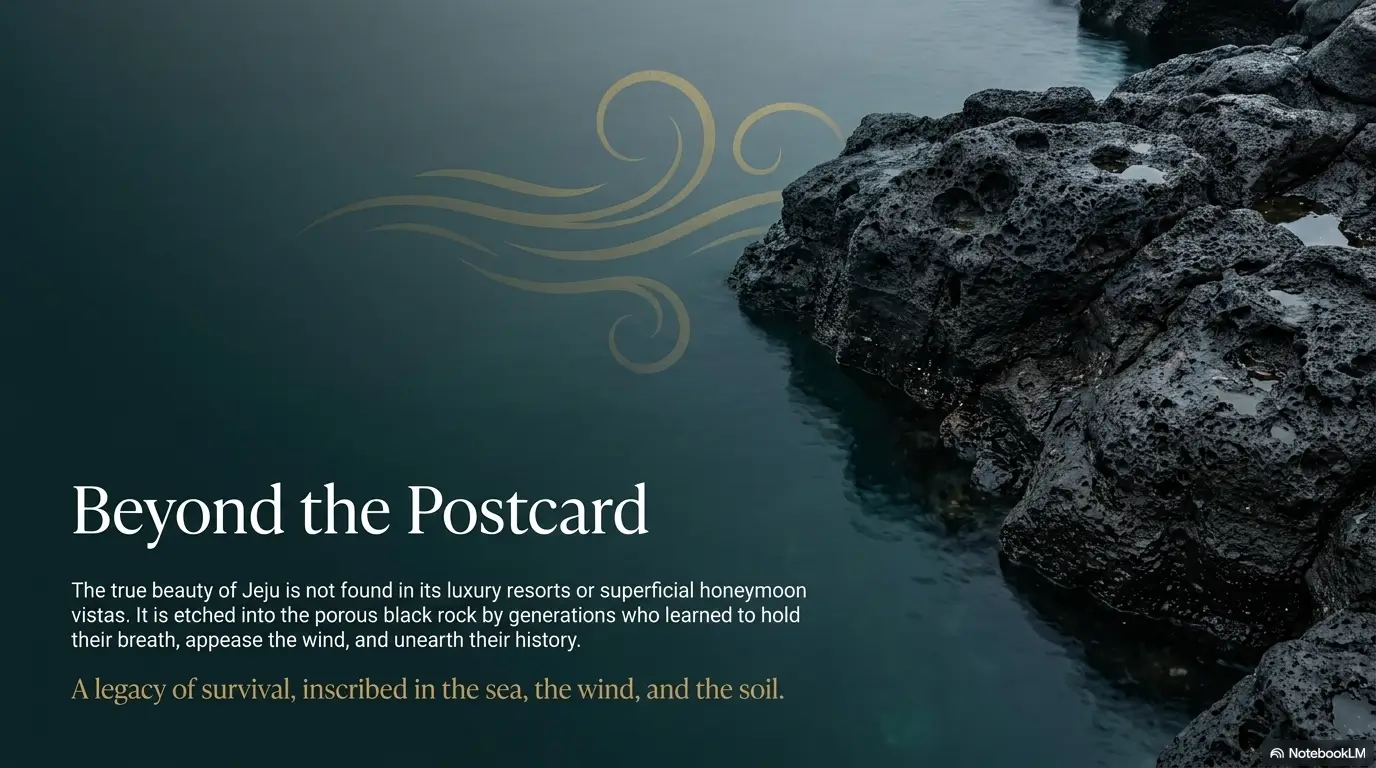
Jeju’s first impression can be bright: sea wind, citrus, cafés, black stone, green hills, and roads that seem to curve toward rest. But the deeper island is made of tougher material. It carries Tamna’s shadow, Jeju language, basalt labor, haenyeo discipline, ritual protection, food born from constraint, and the long memory of 4·3.
That is why Jeju feels culturally different from mainland Korea beyond tourism marketing. The difference is not a slogan. It is a lived system.
The next time you see a Jeju postcard image, let it be a door, not a conclusion. Ask what kind of life built the wall, cooked the meal, kept the word, entered the sea, held the ritual, or remembered the dead.
Your 15-minute next step: choose one Jeju anchor, such as haenyeo culture or Jeju 4·3, and read one official source before planning your next route, article, or conversation.
Last reviewed: 2026-05.