

Navigating Apartment Noise Complaints in Korea: A Survival Guide
The first apartment noise complaint in Korea can feel strangely personal. One evening you are making tea, sliding a chair, taking a call from home, and the next morning the management office is asking whether “impact noise” came from your unit. For foreigners living in Korean apartments, noise complaints and apartment rules in Korea are not just etiquette trivia. They can affect your lease, neighbor relationships, sleep, stress, and the fragile peace of your home.
The tricky part is that Korean apartment life often runs through quiet systems: elevator notices, resident rules, building apps, management offices, landlords, and indirect communication. Guess wrong, and a small ceiling-thump problem can become a doorbell-at-midnight opera.
This guide helps you prevent complaints, respond calmly if someone complains about you, document repeated noise, and know when to ask for formal help. It blends practical apartment habits with Korea-specific communication norms, so you can protect your peace without turning your hallway into a tiny courtroom.
The Home Peace Map
Best first move: do not confront a neighbor while angry. Use the management office, landlord, or written resident rules as your first layer.
- If someone complains about you: acknowledge, ask for details, fix the easy things first.
- If you suffer from noise: keep a simple log before escalating.
- If there are threats: stop treating it as etiquette and seek help.
Table of Contents
First Rule, Don’t Knock Angry
Apartment noise feels intimate because it enters your home without asking. A chair scrape above your head at 12:40 a.m. can feel less like sound and more like a tiny invasion with furniture legs. Still, the first rule in Korea is simple: do not knock angry.
Why direct confrontation can backfire in Korea
In many Korean apartment complexes, direct confrontation can be seen as aggressive, especially late at night. Even if you mean, “Hi, could you maybe keep it down?” the person hearing the bell may receive it as “A stranger is at my door, angry, and now we have a problem.”
Language friction adds paprika to the soup. A phrase translated too literally can sound cold. A note written with an app can accidentally become stern, strange, or theatrical. Nobody wants to become the foreign neighbor who writes a hallway manifesto.
The safer order: management office, landlord, then formal channels
The safer order is usually:
- Check whether the sound is repeated, severe, or a one-time annoyance.
- Write down the time, duration, and type of sound.
- Contact the management office if your building has one.
- Contact your landlord or real estate agent if you are a renter.
- Use formal mediation or public complaint routes only if ordinary channels fail.
If you are new to Korean housing systems, it helps to understand how local offices and public services fit together. For broader admin basics, keep a quiet bookmark for local district offices in Korea, since some housing-adjacent questions eventually touch local public services.
Let’s be honest: your “friendly chat” may not read as friendly
A foreign resident may think, “I will just talk face to face.” That can work with a warm neighbor in daylight. But at night, in a high-rise, after repeated thuds, your face may not be delivering the charming diplomacy you imagine. Your eyebrows may have already filed a complaint.
- Do not visit a neighbor while angry.
- Use management or landlord channels before personal confrontation.
- Keep messages factual, short, and calm.
Apply in 60 seconds: Save your management office number and landlord contact in your phone today.
Korea’s Apartment Noise Culture Is Stricter Than Many Foreigners Expect
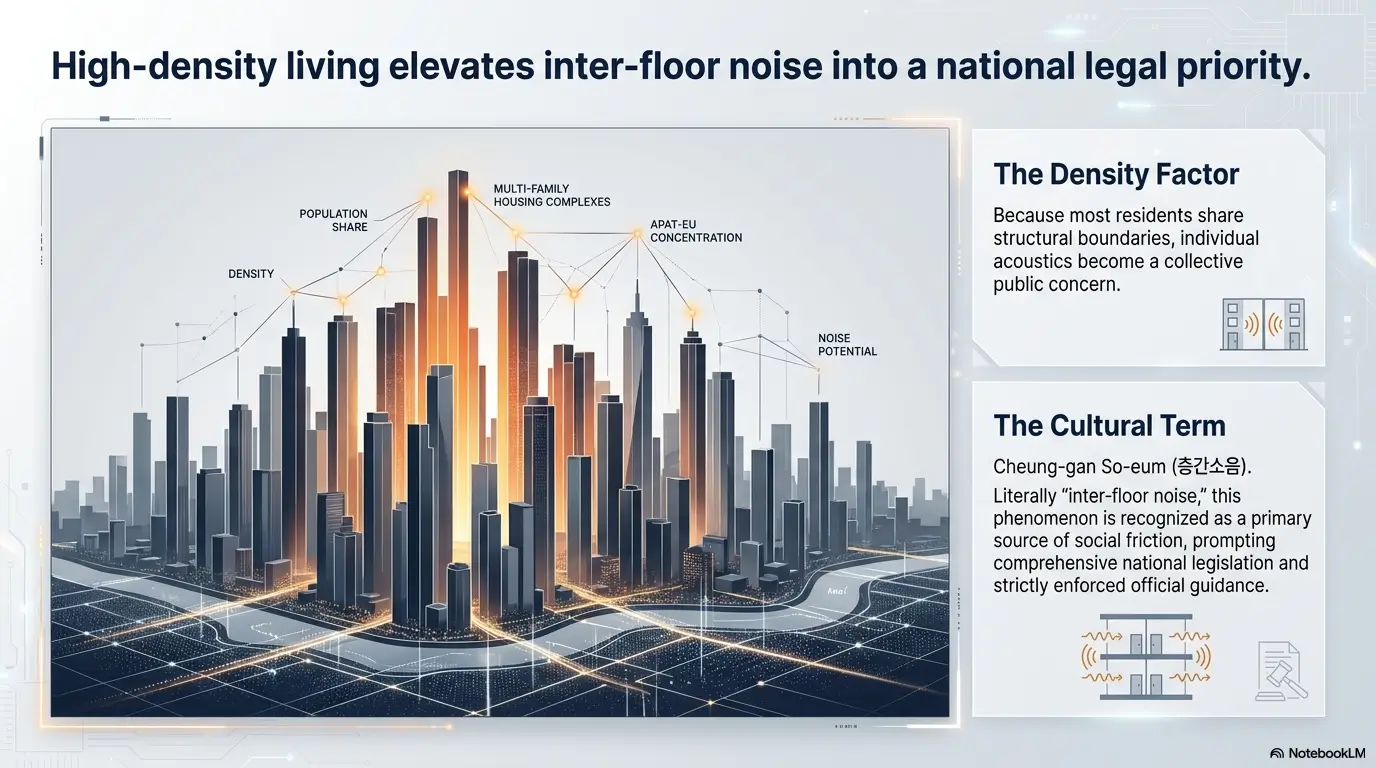
Korea is densely urban, and many residents live in apartment towers, officetels, villas, and mixed-use buildings. The home is private, but the building is intensely shared. That creates a culture where your floor, ceiling, hallway, elevator, balcony, and trash area all become social territory.
Footsteps, chairs, kids running, washing machines, and late-night calls
Common triggers include heavy walking, children running, dragging chairs, dropping objects, washing machines at night, home workouts, guitar practice, barking dogs, gaming voice chat, and deep bass. Bass deserves its own villain cape. It travels through concrete with the confidence of a bad rumor.
Foreign residents are sometimes surprised that “I was just living normally” does not always settle the issue. In a Korean apartment, normal living noise may still become a complaint if it is repeated, late, sharp, or impact-heavy.
Why “normal living noise” can still trigger complaints
Noise complaints are not always about volume. They are about pattern. A single dropped spoon is life. A dropped spoon every night at 1:20 a.m. becomes a tiny percussion festival no one bought tickets for.
Impact noise is especially sensitive because it can feel unpredictable. Airborne noise, such as music or voices, can sometimes be masked. Impact noise, such as running or chair scraping, lands suddenly. The body reacts before the mind has a chance to be diplomatic.
The invisible ceiling: how concrete buildings carry impact sound
Concrete does not always behave like a polite wall. It can transmit vibration through slabs, pipes, and structural elements. That means the unit directly above you may not always be the source. Sound can travel sideways, diagonally, or through mechanical spaces.
Show me the nerdy details
Apartment noise is often split into airborne sound and impact sound. Airborne sound includes voices, TV, music, and barking. Impact sound includes footsteps, dropped objects, chair legs, and exercise jumps. Concrete structures can reduce some airborne noise while still carrying vibration from impact. That is why a low-volume footstep pattern may feel louder than a television. Measuring noise in real life is also tricky because short peaks, building resonance, room position, and time of day all affect how severe the noise feels.
Who This Is For / Not For
This guide is for foreigners trying to live well in Korean housing without accidentally stepping on cultural landmines. It is not a substitute for legal advice, police help, or emergency support.
Good fit: renters, teachers, students, remote workers, military families, and digital nomads
You are in the right place if you are renting an apartment, officetel, villa, one-room, or company-arranged housing. You may be an English teacher, student, remote worker, spouse, military family member, long-term traveler, or new arrival who has learned that Korean buildings have more rules than the microwave buttons suggest.
If you are still setting up housing basics, a move-in check can prevent later disputes. The Korean apartment move-in checklist is a useful companion because photos, appliance checks, and rule questions are easiest before boxes swallow your floor.
Not enough: serious harassment, violent threats, or landlord-tenant litigation
This article is not enough if someone threatens you, follows you, repeatedly bangs on your door, damages property, discriminates against you, or tries to force you out. At that point, the issue is no longer “neighbor etiquette.” It is safety and rights.
If your housing deposit, lease renewal, eviction risk, or legal status is involved, consider qualified legal support. For deposit-related worries, the risk logic in jeonse deposit protection can help you think more carefully about documentation and housing paperwork, even if your current lease is not jeonse.
Best use: prevention first, escalation second
Use this guide as a prevention tool before trouble starts. Once a neighbor dispute becomes emotional, every message becomes heavier. Better to pad the chair legs before the chair becomes a diplomatic incident.
Money Block: Is This a “Handle Calmly” Case?
Use this quick yes/no checklist before deciding your next move.
- Yes/No: Is the noise repeated rather than one-time?
- Yes/No: Do you know the likely time pattern?
- Yes/No: Is there no threat, stalking, or property damage?
- Yes/No: Can management or your landlord help translate the issue?
- Yes/No: Can you write a neutral message without blaming?
Neutral action line: If most answers are yes, start with documentation and management. If safety answers are no, seek help sooner.
Quiet Hours Aren’t Always Written Where You Expect
One of the odd little puzzles of Korean apartment living is that the most important rule may not be in the lease. It may be in an elevator notice, a resident app, a KakaoTalk announcement, a lobby board, or a printed 관리규약, which means resident or management rules.
Check the elevator notices, management app, lobby board, and lease addenda
Look for notices about:
- quiet hours and nighttime appliance use
- renovation and drilling times
- moving-day rules
- pet behavior
- trash sorting and disposal days
- smoking rules
- shared hallway storage
Elevators in Korean apartment buildings are tiny newspapers. Read them. Somewhere between a boiler inspection notice and a recycling reminder, you may find the rule that saves you three awkward conversations.
Why your building’s rules may matter more than internet advice
Internet advice is useful, but your building’s rules matter more. A high-rise apartment complex with a management office may handle complaints differently from a small villa with no full-time office. An officetel may have mixed commercial and residential expectations. A landlord-owned one-room building may rely more on the owner than resident committees.
Korean administrative culture can feel indirect at first. If you want a wider view of how written procedures, offices, and polite persistence work, Korean admin culture is a useful background read.
Here’s what no one tells you: the rule may be social before it is legal
Some rules are not enforced like a courtroom statute. They operate more like a neighborhood temperature gauge. Everyone knows kids will run sometimes. Everyone knows delivery drivers come late. Everyone also knows that repeated late-night noise says, “I have not noticed the people around me.”
That is why prevention has social value. A rug is not just fabric. In apartment life, it is a soft little peace treaty.
The Management Office Is Your First Translation Layer
In many Korean apartment complexes, the management office is not just a maintenance desk. It is a translation layer between private residents and shared rules. It may contact the other unit, post notices, explain quiet hours, or tell you which issues belong to the landlord.
What to say when reporting noise without sounding aggressive
Use neutral wording. Focus on the sound, not the person.
Try this in English first, then translate carefully if needed:
“Hello. I live in unit [number]. I have been hearing repeated impact noise around [time] for the past few days. Could the management office please check or send a general reminder about quiet hours? I would prefer not to contact the neighbor directly.”
Notice what is missing: “They are rude,” “They are doing it on purpose,” and “I will go upstairs myself.” Those sentences may feel satisfying for six seconds. Then they become paperwork confetti.
What to ask if someone complains about you
If the complaint is against you, ask for details calmly:
- What time was the noise reported?
- What type of sound was described?
- Was it impact noise, voices, music, appliance noise, or pet noise?
- Was it reported once or repeatedly?
- Are there building quiet hours I should review?
This keeps the conversation factual. It also protects you from apologizing for mystery noise that may not be yours.
Ask for the building’s “관리규약” or resident rules in writing
Ask for the rules in writing if possible. You can say:
“Could you please share the building resident rules or 관리규약, especially quiet hours, renovation times, trash rules, pet rules, and hallway rules?”
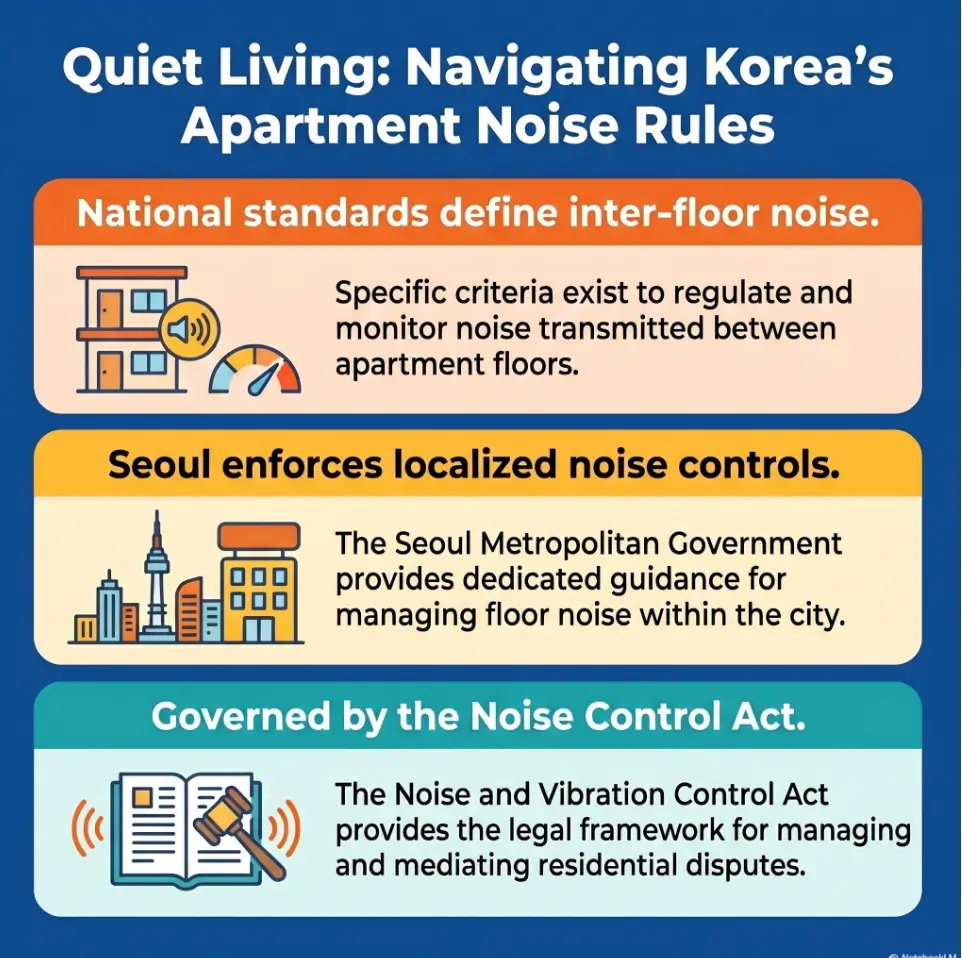
Korean apartment living often runs through the management office, especially in larger complexes. Seoul’s floor-noise ordinance recognizes the goal of preventing floor-noise conflicts and improving residents’ quality of life, while national housing rules provide paths for dispute handling in multi-family housing.
- Ask for written rules, not hallway rumors.
- Report patterns, not personalities.
- Use management before direct confrontation.
Apply in 60 seconds: Message management for the current resident rules and save the reply.
Common Mistakes Foreigners Make After a Noise Complaint
Noise complaints make people defensive. That is normal. But defensiveness is a terrible project manager. It turns small fixes into long arguments and makes every slipper sound like a political statement.
Mistake 1: assuming “I pay rent, so I can live however I want”
Rent gives you the right to use your home. It does not erase shared-building duties. In Korea, your home sits inside a vertical village. Your floor is someone else’s ceiling. Your balcony smoke may become someone else’s living room smell. Your late washing machine may become someone else’s 2 a.m. drum solo.
Mistake 2: knocking upstairs at midnight
Midnight is when reasonable requests put on a leather jacket and start looking like threats. If there is no immediate danger, document the time and contact management during appropriate hours.
Mistake 3: writing a spicy note in Korean you did not fully understand
Translation apps are helpful, but they do not always carry tone safely. A sentence meant as “please be mindful” can come out like “cease your unlawful behavior.” That is not a note. That is a tiny lawsuit wearing tape.
If you need polite wording, learn basic apology and softening phrases. The tone principles in Korean apology phrases can help you avoid sounding sharper than intended.
Mistake 4: using bass speakers, ceiling knockers, or “revenge noise”
Revenge noise is risky. It can make you look like the problem, escalate conflict, and create evidence against you. It also trains your nervous system to live in battle mode. Nobody moved to Korea to become a ceiling percussionist with legal exposure.
Money Block: Decision Card for Your Next Move
| Situation | Better move | Trade-off |
|---|---|---|
| One-time noise | Wait and observe | Less stress, but no immediate relief |
| Repeated late impact noise | Log it and contact management | Slower, but safer |
| Complaint against you | Ask for time, type, and pattern | Requires humility, protects facts |
| Threats or repeated door visits | Seek help, do not engage alone | More serious, but safer |
Neutral action line: Choose the lowest-risk channel that can still create a written record.
Document Quietly Before You Escalate
Documentation is not dramatic. That is its charm. A calm log is more useful than a fiery message, because it shows pattern without demanding everyone trust your memory after three sleepless nights.
Keep a simple log: date, time, duration, type of sound
Your log can be simple:
- Date: May 28
- Time: 11:50 p.m. to 12:15 a.m.
- Type: repeated heavy footsteps and dropped objects
- Location: bedroom ceiling area
- Action taken: no direct contact; logged only
Do not write a novel. You are not submitting “War and Peace: Upstairs Edition.” You are building a pattern that management, landlord, or a mediator can understand.
Recordings may help memory, but they are not magic evidence
Short recordings can help you remember timing and type of noise. But recordings are not always decisive. Phone microphones are imperfect, background noise varies, and legal use may depend on context. Treat recordings as memory support, not a magic wand.
The paper trail: messages to landlord, management office, and agent
Keep messages polite and date-stamped. If you talk by phone, send a brief follow-up message:
“Thank you for speaking with me today. As discussed, the repeated impact noise has occurred around midnight on several days. I will keep a simple log and appreciate any building reminder about quiet hours.”
This kind of message does two things. It keeps everyone calm, and it creates a record without sounding like you are assembling a courtroom dragon.
Short Story: The Chair That Became a Treaty
A foreign teacher in Daejeon once thought her downstairs neighbor disliked her personally. Twice in one week, the management office called about scraping sounds after 10 p.m. She felt embarrassed, then annoyed, then ready to defend her right to sit at her own table. But instead of arguing, she asked for the exact time. Both complaints matched her late grading routine. The culprit was not music, guests, or wild living.
It was one wooden chair on a hard floor, dragged back every time she stood up for tea. She bought felt pads, added a small rug, and messaged management to say she had made changes. The complaints stopped. Nothing grand happened. No apology ceremony. No neighbor friendship montage. Just a chair, a rug, and peace returning like a cat through a half-open door. The lesson is plain: solve the smallest physical cause before fighting the largest emotional story.
When the Complaint Is Against You
Getting a complaint feels unfair, especially if you were simply cooking, walking, cleaning, or existing with bones. But your best response is not instant self-defense. It is calm fact-finding.
Reply calmly, even if the complaint feels unfair
A good response sounds like this:
“Thank you for letting me know. I did not realize noise was being heard downstairs. Could you please tell me the time and type of noise reported? I will check my routine and make reasonable changes.”
This protects your dignity without pouring gasoline on the floor.
Offer practical fixes: rugs, chair pads, slippers, appliance timing
Start with low-cost fixes:
- felt pads under chairs and table legs
- soft indoor slippers
- rugs in walking areas
- washing machine use before late evening
- reduced bass on speakers
- kids’ play mats if you have children
- moving home workouts away from late hours
Pet owners should also think about barking, elevator stress, and hallway behavior. The social expectations around animals are changing quickly, and Korean pet culture can help foreign residents understand why one cute bark may land differently in a shared building.
Don’t confess to things you did not do
Be cooperative, but do not confess to mystery sounds. Sound can travel strangely. If you were not home, say so politely. If the reported time does not match your activity, ask management to check whether other units may be involved.
Pattern interrupt: you may be “too loud” only in one room
Sometimes the solution is not “be silent everywhere.” It is “stop doing one thing in one place.” A rolling chair over laminate. A child jumping near the bedroom wall. A laundry machine on spin cycle touching a cabinet. A speaker placed against a shared wall.
- Time matters.
- Noise type matters.
- Room location matters.
Apply in 60 seconds: Put felt pads under the loudest chair before tonight.
When You Are the One Suffering From Noise
Noise suffering is real. Sleep loss makes even gentle people feel made of cracked glass. Still, you need a process that keeps you credible and safe.
Separate occasional life noise from repeated disturbance
Before escalating, ask whether the noise is occasional or patterned. A family gathering, moving day, or one dropped object is different from nightly jumping, repeated bass, or early-morning appliance noise.
That does not mean you must endure everything. It means your complaint becomes stronger when it names a repeated pattern.
Ask management to contact the unit, not reveal you as the complainant if possible
You can ask management to send a general reminder rather than naming you. Not every building can guarantee anonymity, but it is reasonable to request discretion.
Try:
“Could you please send a general quiet-hours reminder first? I would prefer not to be identified unless necessary.”
Use neutral wording: “repeated impact noise” beats “they are terrible people”
Neutral wording is powerful because it is harder to dismiss. “Repeated impact noise after midnight” sounds specific. “The upstairs people are awful” sounds emotional, even if it feels true at 1:00 a.m. under the thunder-feet orchestra.
Noise Response Flow
Pause. Is it one-time or repeated?
Date, time, duration, sound type.
Management office or landlord first.
Threats or door visits change the plan.
Use formal channels if patterns continue.
Formal Help Exists, But It Is Not Instant Magic
Korea treats inter-floor noise as more than neighbor drama. National housing law and environmental dispute systems recognize that repeated apartment noise can become a serious residential problem. But formal help is not instant magic. It is a process, and processes move at process speed: sturdy shoes, no fireworks.
Korea’s mediation route for ongoing inter-floor noise
Under Korea’s multi-family housing management framework, residents affected by ongoing inter-floor noise may seek steps through management and, when unresolved, may use dispute mediation channels. The Ministry of Environment has also addressed inter-floor noise standards, including stricter direct-impact noise standards, which shows that the issue is treated as a public residential-environment concern.
Public complaint systems in Korea can feel unfamiliar, especially if you come from a country where calling a landlord is the whole plan. For a broader map, Korea’s public complaint system explains how official complaints often depend on category, office, and documentation.
What mediation can do, and what it may not fix quickly
Mediation may help clarify facts, encourage cooperation, or create a structured conversation. It may not immediately stop every sound. It may not solve poor building design. It may not make a neighbor emotionally generous by Friday.
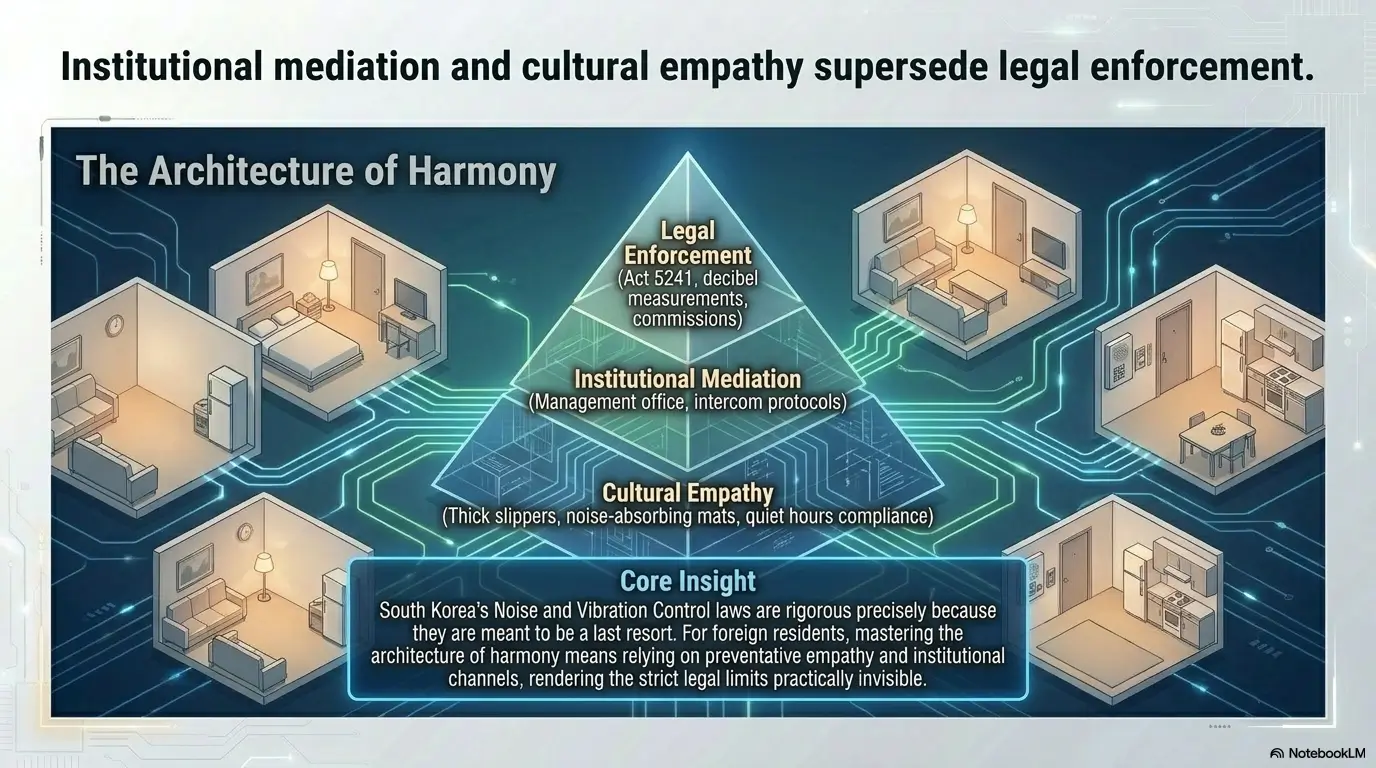
That is why your strongest tools are boring: logs, polite messages, written rules, management involvement, and steady escalation.
Why patience and documentation matter more than dramatic evidence
Dramatic evidence feels satisfying, but patterns usually matter more. Ten short entries showing repeated late-night impact noise can be more useful than one angry audio clip sent with seventeen exclamation points.
Money Block: Complaint Prep List
Before asking for mediation or stronger action, gather:
- building name and unit number
- your lease or housing contact details
- management office messages
- landlord or agent messages
- noise log with dates, times, and sound types
- any building quiet-hour notices or resident rules
- photos of rugs, pads, or fixes if the complaint is against you
Neutral action line: Put these items in one phone folder so you are not searching while stressed.
Apartment Rules That Surprise Foreign Residents
Noise is only one slice of Korean apartment life. Many conflicts begin because a foreign resident misses a building norm that everyone else assumes is obvious. The problem is not intelligence. It is invisible context.
Trash sorting and disposal times
Korea takes trash sorting seriously. Food waste, recyclables, general waste, large items, and special disposal may all have different rules. Some buildings have exact disposal times. If you place trash out early or sort incorrectly, you may hear about it quickly.
For a practical survival guide, recycling in Korea for foreigners can prevent the classic “standing in the trash area holding plastic like a confused raccoon” moment.
Pet noise, elevator etiquette, and shared hallway behavior
Pets may need to be held or kept close in elevators. Hallways are usually not storage spaces for bikes, boxes, shoe racks, or mysterious objects from your last move. Shared space is watched carefully because everyone pays for it, cleans around it, and silently judges it with the precision of a tea ceremony.
Smoking on balconies or near windows
Balcony or window smoke can trigger complaints even when you are technically inside your unit. Smoke travels through windows, vents, and shared air paths. Many buildings post smoking reminders, and some neighbors will report it quickly.
Moving-day noise, drilling, piano practice, and home workouts
Moving, drilling, and renovation work often have allowed hours. Piano practice may be tolerated at certain times but not late. Home workouts are a modern complaint machine, especially jumping, burpees, treadmill use, and kettlebell drops. Your fitness journey should not sound like furniture learning to fight.
- Read posted notices regularly.
- Ask about trash, pets, smoking, and renovation rules.
- Remember that shared space is socially sensitive.
Apply in 60 seconds: Take photos of current elevator and lobby notices so you can translate them later.
When to Seek Help
Most noise issues should move through calm channels. Some should not. If the situation becomes threatening, repeated, discriminatory, or tied to your housing security, seek help sooner.
If there are threats, intimidation, or repeated visits to your door
If someone threatens you, repeatedly comes to your door, follows you, blocks your exit, damages property, or creates fear, do not keep trying to be politely brave. Contact building management, your landlord, local authorities, or a qualified support service. Safety outranks etiquette.
If you need to explain a conflict politely in Korean, Korean indirect communication can help you understand why softer wording often works better in ordinary disputes. But soft wording is not a shield against danger.
If your landlord ignores a serious recurring issue
If your landlord dismisses repeated problems, keep written records. Use dates and neutral language. Ask what step they will take and by when. If the issue affects habitability, safety, or lease rights, consider legal support.
If you are accused unfairly and your housing is at risk
If repeated complaints against you are false or exaggerated, do not respond with emotion alone. Gather evidence: your schedule, messages, visitor records, travel dates, appliance use, and any fixes you made. Ask management to verify whether sound could be coming from another unit.
If language barriers are making the dispute worse
Bring in a translator, bilingual friend, agent, employer housing contact, or local support center if needed. Language barriers can turn small issues into identity conflicts. You are not just translating words. You are translating temperature.
Next Step: Do This Before Your First Complaint
The best noise complaint is the one you never need to file. A little prevention at move-in can save weeks of awkward hallway weather.
Ask your management office for the building rules in writing
Ask for quiet hours, trash rules, pet rules, smoking rules, renovation times, moving-day procedures, and emergency contacts. If the rules are only in Korean, translate them and save a copy.
For broader newcomer etiquette, Korean politeness can help you understand why small signals, respectful wording, and indirect channels often matter more than blunt efficiency.
Save the management office number and landlord contact
Save the numbers in English and Korean if possible. Add your building name and unit number. During stress, your phone should not become a treasure hunt.
Add rugs, chair pads, and appliance quiet hours before problems start
A few small physical changes prevent many complaints:
- felt pads for chairs
- rug near the sofa or dining table
- soft slippers
- laundry before late evening
- speaker bass reduced
- exercise mat for workouts
- pet calming routine near elevators and hallways
Money Block: Five-Tier Peace Setup
| Tier | Action | Best for |
|---|---|---|
| Tier 1 | Save contacts and rules | Every resident |
| Tier 2 | Chair pads and slippers | Daily impact noise |
| Tier 3 | Rugs and play mats | Kids, pets, home office |
| Tier 4 | Appliance quiet schedule | Laundry and cleaning noise |
| Tier 5 | Document and ask management | Repeated disputes |
Neutral action line: Start with Tier 1 and Tier 2 before a complaint ever arrives.
- Ask for rules early.
- Reduce impact noise physically.
- Keep contact channels ready.
Apply in 60 seconds: Add “quiet hours?” to your move-in question list.
FAQ
Can I call the police for apartment noise in Korea?
You can contact police if there is immediate danger, threats, harassment, violence, or serious late-night disturbance that cannot safely wait. For ordinary recurring apartment noise, building management, landlord contact, and documentation are usually the better first steps. Do not use emergency channels for minor one-time sounds.
Should I talk directly to my noisy upstairs neighbor?
Sometimes, but not while angry and not late at night. In many Korean apartment buildings, it is safer to ask the management office to contact the unit or send a general notice. Direct confrontation can escalate quickly, especially with language barriers.
What counts as inter-floor noise in Korea?
Inter-floor noise usually refers to noise transmitted between units in multi-family housing, especially impact noise such as footsteps, running, dropped objects, and chair dragging. Voices, music, pets, and appliances may also become complaints depending on the building, timing, and repetition.
Can my landlord help with a noise complaint?
Yes, especially if you rent and do not know the management process. Your landlord or real estate agent may help contact the management office, explain resident rules, or communicate with another unit. Keep your messages factual and written when possible.
Are Korean apartments poorly soundproofed?
Some are better than others. Newer buildings may have improved standards, but impact sound can still travel through concrete structures. The issue is not always “bad construction.” It can be a mix of building design, flooring, furniture, habits, and time of day.
What should I do if a neighbor complains about my child?
Stay calm, ask for the time and type of noise, then make reasonable changes. Play mats, rugs, earlier active play, slippers, and a short message through management can help. Do not promise total silence. Children make noise, but repeated impact late at night should be reduced where possible.
Can foreigners use Korean noise dispute mediation services?
Foreign residents can generally seek help through building management, landlords, public complaint routes, or mediation channels when eligible. The practical challenge is often language and documentation, so keep records and ask for translation support if needed.
Is revenge noise illegal or risky in Korea?
Revenge noise is risky even if you feel wronged. It can escalate the dispute, make you look responsible for harassment, and weaken your credibility. Use logs, management, landlord channels, and formal help instead.
What if the noise is from construction, not a neighbor?
Check posted construction notices first. Many buildings require renovation work to happen during allowed hours. If construction happens late, early, or without notice, contact management or your landlord and document the date, time, and type of work.
What Korean phrase should I know for apartment noise?
“층간소음” means inter-floor noise. “관리사무소” means management office. “관리규약” means resident or management rules. Even if you do not speak Korean well, recognizing these words helps you understand notices and messages faster.
Conclusion
The first noise complaint in Korea can feel like a verdict on your character. It usually is not. Most apartment conflicts are a tangle of building acoustics, quiet-hour expectations, indirect communication, and small habits that nobody explained at move-in.
Your best protection is not being perfectly silent. It is being prepared. Know the rules. Save the contacts. Use the management office. Document repeated problems. Fix the easy physical causes. Stay calm enough that your next message reads like a solution, not a spark.
Do this within 15 minutes: save your management office and landlord contacts, then message for the current resident rules, including quiet hours, trash rules, renovation times, pet rules, and smoking rules. That tiny step turns a future hallway storm into a manageable conversation.
Last reviewed: 2026-05.