
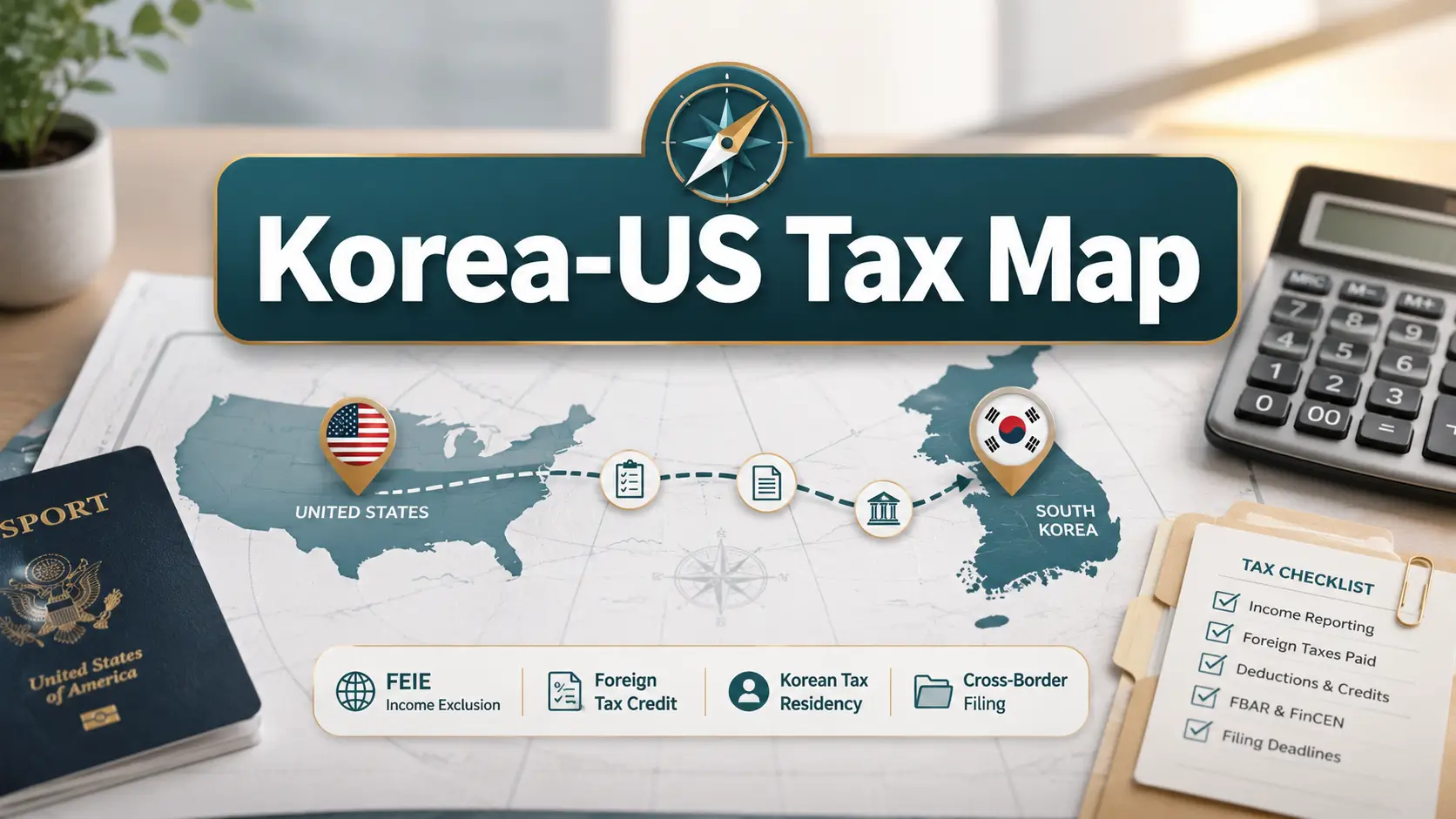
US Expat Tax Guide for Korea
US Expats in Korea Tax Guide:
FEIE, FTC, and Korean Tax Residency
Living in South Korea can feel wonderfully practical: fast trains, bright convenience stores, health clinics that move with astonishing speed, and bank apps that ask for three kinds of verification before letting you breathe. Taxes, unfortunately, are less elegant. A US citizen in Seoul, Busan, Jeju, Daegu, or a quiet officetel near a subway line may still have one foot in the US tax system while becoming visible to the Korean tax system too.
The danger is not usually one giant mistake. It is a handful of small ones: choosing the Foreign Earned Income Exclusion because it sounds famous, forgetting Korean tax paid after the US return was filed, treating FBAR and FATCA as twins, or assuming that a visa label decides tax residency. The paperwork becomes a little brass band in a narrow hallway.
This guide gives you a practical Korea-US tax map. You will learn how FEIE, Foreign Tax Credit, Korean tax residency, treaty claims, Korean bank accounts, and filing deadlines fit together so you can ask better questions, organize better records, and avoid paying for professional help before you know what you need.
Compare relief tools
Know when FEIE, FTC, or a split approach deserves attention.
Map Korea residency
Understand why 183 days is only the front door, not the whole house.
Prevent form chaos
Separate tax returns, FBAR, FATCA, HomeTax, and records before filing season bites.
Best first move: build a one-page income map before choosing FEIE or FTC. It is boring in the most profitable way. 🧾
Snapshot
This guide is for US citizens and green-card holders living, working, freelancing, teaching, retiring, or investing in South Korea. It helps you compare FEIE and FTC, spot Korean tax residency risks, organize FBAR and FATCA records, and decide when DIY filing is reasonable versus when a US-Korea tax professional may be worth the cost.
Table of Contents
Before You Act: What This Guide Can And Cannot Do
Tax planning for US expats in Korea is not a napkin puzzle. It touches two tax systems, bank reporting, exchange rates, filing deadlines, treaty language, and sometimes immigration status, pension records, stock compensation, or Korean business registration.
This article is educational. It can help you understand the moving parts, build a cleaner question list, and avoid common filing mistakes. It cannot decide your residency, calculate your exact US or Korean tax, tell you whether to make a treaty claim, or replace a qualified tax professional who reviews your documents.
Before-you-act checklist
- Confirm the current tax year’s IRS forms, limits, and filing instructions.
- Check Korean National Tax Service guidance before assuming nonresident status.
- Do not claim Foreign Tax Credit on income already excluded under FEIE.
- Keep FBAR, FATCA, and income tax filing duties separate in your mind and records.
- Ask a qualified US-Korea tax professional before taking a treaty position or fixing missed prior-year filings.
The goal is not to make you your own tax attorney by sunset. The goal is to prevent fog. Fog is expensive.
Who should read this carefully
This guide is especially useful if you are a US citizen or green-card holder working for a Korean employer, teaching English, freelancing, running a creator business, receiving US investment income, retiring in Korea, or working remotely for a US company while living in Korea.
It also helps mixed-income households: one Korean salary, one US brokerage account, some freelance income, a Korean pension balance, and a bank app full of statements you will later wish you downloaded sooner.
Who should pause and get advice
Professional help becomes more important if you have RSUs, stock options, crypto gains, rental income, a Korean business, self-employment income, missed FBARs, Form 8938 issues, Korean severance, pension distributions, treaty claims, or a year split between Korea and the United States.
Those situations can still be organized. They are not automatically disasters. But they are not “quick software interview” territory either.
Fast Answer For US Expats In Korea
US expats in Korea usually still file a US tax return because US citizens and resident aliens generally report worldwide income to the United States. The main double-tax relief tools are the Foreign Earned Income Exclusion, the Foreign Tax Credit, and sometimes treaty-based analysis. For 2026, the IRS lists the FEIE maximum exclusion as $132,900 per qualifying person.
Korean tax residency is a separate question. It often turns on domicile, residence, work facts, family, assets, and the 183-day concept. A person may feel temporary in daily life but still look resident on paper.
Key takeaway
Paying Korean tax does not automatically finish your US tax obligation. Filing a US return does not automatically satisfy Korean filing duties. Treat the two systems as overlapping maps, not as substitutes.
The three-question shortcut
Before getting lost in forms, ask three questions:
- What countries may tax each income item?
- What relief tool applies: FEIE, FTC, treaty analysis, or none?
- What reporting form exists even if no extra tax is due?
That third question matters. FBAR, Form 8938, and other informational filings can create trouble even when your actual tax bill is small.
The income map beats the tax rumor
Tax advice from expat group chats often arrives with confidence and missing facts. Someone says, “Just use FEIE.” Someone else says, “Korea already taxed it.” A third person mentions a treaty with the energy of a magician pulling a silk scarf from a sleeve.
The better first step is plain: list each income item by country, payer, type, tax withheld, and payment date. A Korean salary is not the same as US dividends. Freelance income is not the same as pension income. Crypto gains are not wages just because they happened while you were sitting in Itaewon.
Korea Tax Residency: The 183-Day Trap Is Only The Front Door
The common expat version of Korean tax residency is simple: stay 183 days and you are a resident. That is useful as a warning light, but it is not the whole dashboard.
Korean residency analysis may consider domicile, residence, occupation, family living together in Korea, property, and other facts that show where your real center of life sits. Tax residency is often less about the story you tell yourself and more about the paper trail you leave behind.
Domicile, residence, and the center-of-life problem
Domicile is not just where you slept last night. It points toward the place where your living relationship is rooted. Family, housing, work, belongings, assets, and ordinary routines can all matter.
A remote worker may say, “I am only in Korea for a year.” But a one-year lease, Korean employer records, a spouse or children living in Korea, Korean health insurance, and local financial accounts may tell a more settled story.
Why 183 days can matter across years
The 183-day concept is important because it can move a foreigner from “probably nonresident” toward “resident enough to examine closely.” The nuance is that tax law does not always respect the neat emotional boundary of December 31.
For 2026 and beyond, Korea residency analysis may be more sensitive to consecutive residence across two tax years. A person arriving in late summer and staying through spring should not assume that “I never hit 183 days in one calendar year” ends the inquiry.
Your lease may speak louder than your passport
Passports show movement. Leases show settlement. Employment contracts show economic connection. School records, family residence, insurance enrollment, and bank statements add texture.
If you rent an officetel, enroll in local services, keep your family in Korea, and work from Korea day after day, your “temporary” feeling may not be the strongest evidence.
Korea residency evidence tracker
- Arrival and departure dates, including short trips outside Korea.
- Lease start date, renewal terms, and housing deposit records.
- Employment contract, workplace location, and expected work period.
- Family residence, school enrollment, and dependent location.
- Korean bank, pension, insurance, brokerage, and business records.

US Filing Basics: The Return Does Not Disappear Overseas
A US passport is a beautiful document until filing season arrives wearing sensible shoes. US citizens and green-card holders generally keep US filing duties even when they live abroad, earn abroad, and pay tax abroad.
The US return starts with worldwide income. Then you look for relief, credits, exclusions, deductions, treaty positions, and reporting forms. That order matters. You do not begin by deleting Korea from the story.
April, June, October: the expat deadline stack
US expats often get an automatic extension to file until mid-June, but this does not always mean interest disappears if tax is owed. Many taxpayers also request an extension to October to finish documents properly.
The practical problem in Korea is timing. Korean year-end settlement, withholding documents, global income filing, local income tax, and revised records may not line up perfectly with US filing habits.
State tax residue: the old address that keeps biting
Federal tax is only one layer. State tax can linger like a forgotten umbrella in a taxi. A former state may care about domicile, voter registration, driver’s license, property, business ties, spouse location, or the address used by banks and brokerages.
If you left California, New York, New Jersey, Massachusetts, Virginia, or another high-attention state, do not assume moving to Korea automatically closed the state tax door. Check your state’s rules and document your move carefully.
Paid Korean tax is not the same as filed US tax
This is one of the most expensive misunderstandings. Paying Korean tax may help you claim Foreign Tax Credit, but it does not replace the US return. Likewise, filing a US return does not solve Korean filing obligations for global income, freelance income, or local tax.
Key takeaway
Think in layers: US federal return, possible US state return, Korean income tax, Korean local income tax, FBAR, FATCA, and recordkeeping. One completed task rarely means the entire stack is finished.
FEIE Vs FTC: The Choice That Changes The Whole Return
The Foreign Earned Income Exclusion gets the louder reputation. The Foreign Tax Credit often does the quieter, better work for Korea-based taxpayers, especially when Korean income tax is significant.
Neither tool is morally superior. They are instruments. A cello is not better than a trumpet if the song needs brass.
What FEIE covers, and what it does not
FEIE can exclude qualifying foreign earned income, such as salary, wages, and certain self-employment income, if you meet the requirements. For 2026, the maximum exclusion is $132,900 per qualifying person.
FEIE does not exclude everything in your financial life. Dividends, interest, rent, capital gains, pension income, many retirement distributions, and crypto gains are not magically covered just because you earned or held them while living in Korea.
The Physical Presence Test is a day count with teeth
The Physical Presence Test generally requires 330 full days in a foreign country or countries during a 12-month period. Travel days can be slippery. A short US visit, layover, emergency trip, or casual weekend flight can create day-count problems.
Do not rely on memory. Use passport stamps, airline records, calendar entries, and credit card clues. A tax return built on vibes has the structural strength of wet tissue.
Why FTC often deserves first look in Korea
The Foreign Tax Credit may reduce US tax using foreign income taxes paid or accrued to Korea, subject to limitations and categories. This can be powerful when Korean tax is meaningful and US tax on the same income would otherwise apply.
FTC can also preserve possibilities that FEIE may reduce, such as certain US tax attributes. The right answer depends on income level, Korean tax paid, US tax bracket, filing status, children, credits, self-employment income, passive income, and future carryovers.
| Situation | FEIE may be worth comparing when | FTC may be worth comparing when |
|---|---|---|
| Korean salary | Income is within the exclusion limit and Korean tax is low | Korean tax is high enough to offset US tax efficiently |
| US remote job from Korea | You qualify under physical presence or bona fide residence rules | You pay Korean income tax on the same earned income |
| Freelance income | You have qualifying foreign earned income | You paid Korean tax and need to manage US self-employment tax separately |
| US dividends or capital gains | Usually not covered by FEIE | May require separate FTC basket analysis if foreign tax applies |
| Mixed income household | One earner qualifies cleanly for FEIE | Credits, baskets, and carryovers may produce a better long-term outcome |
Using FEIE And FTC Together Without Double Dipping
FEIE and FTC can sometimes appear on the same return, but not on the same income in the wrong way. The phrase to remember is painfully simple: no double dipping.
If you exclude income under FEIE, you generally cannot also claim a Foreign Tax Credit for taxes tied to that excluded income. The sequencing and allocation matter.
When using both can make sense
Using both may make sense when your earned income exceeds the FEIE limit, or when you have different types of income with different tax treatment. For example, a Korea-based employee may exclude part of qualifying salary but still need FTC analysis for income above the exclusion threshold or for other income categories.
The calculation should not be guessed. Tax software can help, but only if the inputs are clean. The software interview does not know that your Korean withholding certificate arrived after you filed unless you tell it.
Foreign housing exclusion or deduction: useful, but not automatic
Some expats may qualify for a foreign housing exclusion or deduction. This can matter in expensive areas of Seoul where rent and key money arrangements create unusual cash flow.
Still, housing benefits are not “free extra FEIE.” They have rules, limits, location considerations, and documentation needs. Save your lease, payment records, employer housing benefit details, and any reimbursement documents.
Self-employment tax: the stubborn guest
FEIE may reduce income tax, but it does not automatically erase US self-employment tax. Freelancers, consultants, creators, tutors, and solo business owners in Korea should be especially careful here.
The US and Korea have a social security totalization agreement, which may affect where social security contributions apply. But the details depend on your work arrangement, certificates, and status. This is a classic “ask before filing” area.
Key takeaway
FEIE is about excluding qualifying earned income from US income tax. It is not a blanket shield for passive income, bank reporting, Korean filing, or every payroll-related obligation.
Infographic: The Korea-US Tax Flow
1. Identify income
Salary, freelance, dividends, rent, pension, crypto, equity, business.
2. Check residency
US status continues; Korea may examine days, domicile, work, family, assets.
3. Compare relief
Run FEIE-first and FTC-first scenarios before choosing.
4. Report accounts
FBAR and FATCA may apply even when no extra tax is due.
5. Review edge cases
Treaty claims, RSUs, crypto, pension, severance, missed filings.
Korea-US Tax Treaty And Special Situations
The Korea-US tax treaty can be helpful, but it is not a magic eraser for US citizens. Many US citizens remain taxable by the United States even when a treaty clarifies how income is treated between the two countries.
Treaty claims are where confident internet summaries become especially dangerous. The treaty may matter, but the saving clause, income article, residency rules, and disclosure requirements can matter too.
What the treaty can clarify
A treaty can help analyze pensions, dividends, interest, royalties, teacher or researcher income, business profits, dependent personal services, and residency tie-breaker issues. It may also help determine whether Korea or the United States has first taxing rights in specific situations.
But “the treaty exists” is not the same as “the treaty removes my tax.” Read that sentence twice if someone in a forum writes in all caps.
Form 8833 and treaty position risk
Certain treaty-based return positions may require disclosure on Form 8833. Not every treaty-related item requires it, but assuming no disclosure is needed can be risky.
If your tax outcome depends on a treaty position, that is a strong signal to hire someone who works with cross-border US tax. A cheap filing service may be enough for a simple salaried employee. It may not be enough for treaty analysis.
Real-world example: teacher with Korean salary and US investments
Imagine a US citizen teaching English in Korea. She earns a Korean salary, has Korean withholding, keeps a US brokerage account, receives US dividends, and has a Korean bank account that briefly exceeds the FBAR threshold because of housing deposit movement.
Her Korean salary may require FEIE versus FTC comparison. Her US dividends are not erased by FEIE. Her Korean bank account may create FBAR reporting even if the money is not income. If she moved midyear, state tax questions may still need attention.
This is why the first step is not “Which form do I file?” It is “What exactly happened, in which country, on which date, with which account?”
Show me the nerdy details
The FEIE and FTC decision is not only about this year’s tax bill. It can affect carryovers, excluded income allocation, eligibility for certain credits, housing calculations, and the treatment of excess foreign tax paid. FTC is also divided into categories, often called baskets, so foreign tax paid on one type of income does not automatically offset US tax on every other type.
A careful preparer may run multiple scenarios: FEIE only, FTC only, FEIE plus partial FTC where allowed, and no exclusion if other credits or future carryovers produce a better long-term result. The correct answer can change when Korean tax is paid late, when exchange rates shift, or when the taxpayer has children, self-employment income, or passive income.
FBAR, FATCA, And Korean Bank Accounts
Korean bank accounts are easy to open in daily life only after you have survived the identity verification obstacle course. For US reporting, they need a separate mental folder.
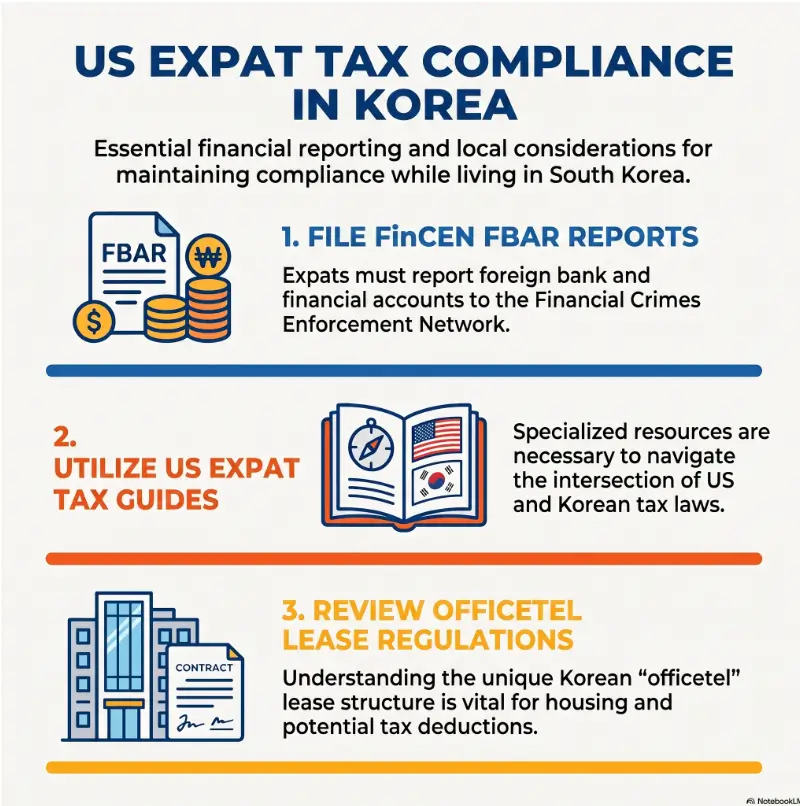
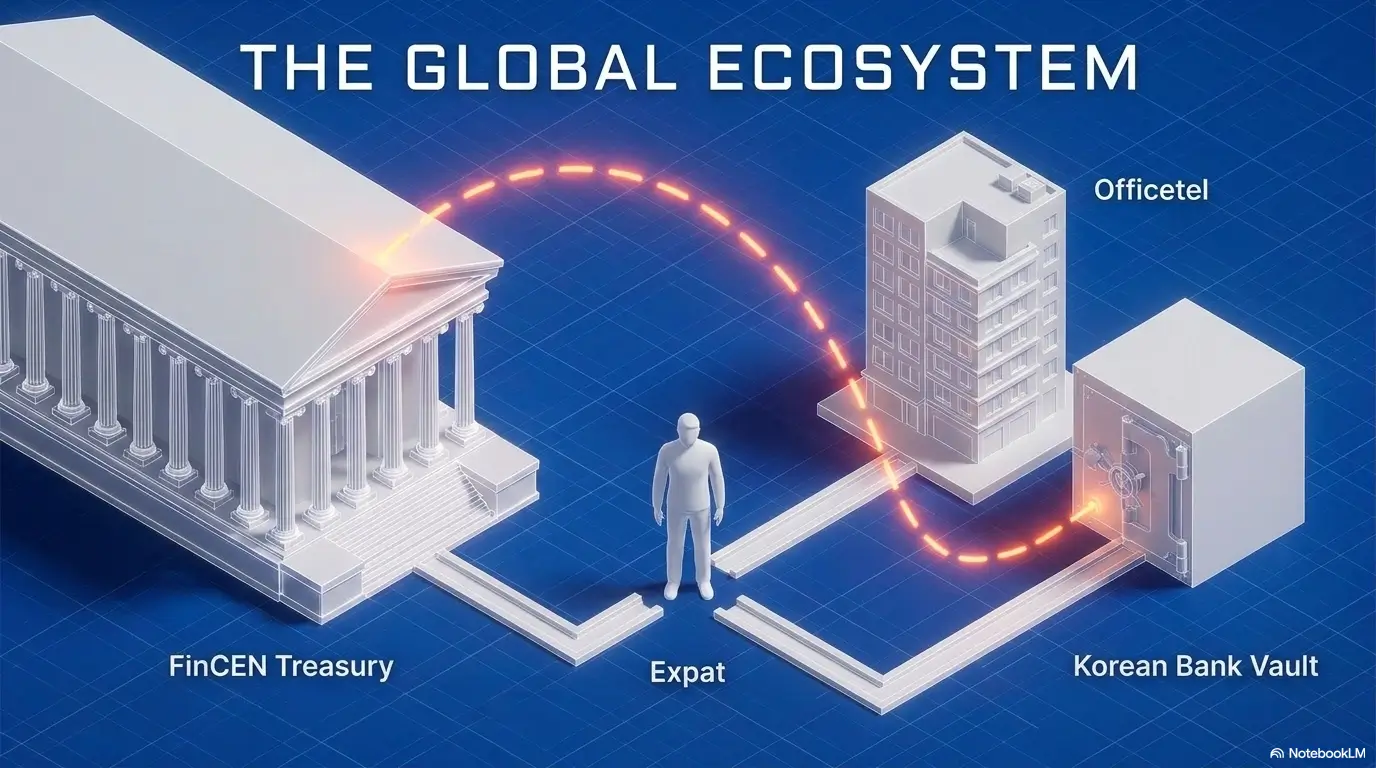
FBAR and FATCA are not the same thing. FBAR is filed through FinCEN, not with your Form 1040. Form 8938, when required, is attached to your tax return. The thresholds, account types, and filing mechanics differ.
FBAR threshold logic for Korean accounts
A US person generally must file an FBAR if the aggregate value of foreign financial accounts exceeds $10,000 at any time during the calendar year. “Aggregate” is the little word with sharp elbows. It means you add accounts together.
A Korean checking account, savings account, securities account, or other foreign financial account may count. A housing deposit moving through your account can also create a temporary balance spike that matters for reporting.
Form 8938 is separate from FBAR
Form 8938 under FATCA has different thresholds and applies to specified foreign financial assets. Some taxpayers file FBAR but not Form 8938. Others may need both.
Do not ask, “Did I report my Korean account?” Ask, “Did I check FBAR separately from Form 8938?” That tiny wording change prevents a lot of filing confusion.
What records to save before the fog arrives
- Bank name and branch information.
- Account number and ownership details.
- Maximum balance during the year.
- Year-end balance.
- Statements showing large transfers, housing deposits, salary, and investment movement.
- Exchange rate method used for reporting.
The Korean Filing Layer Before May
Korea’s tax calendar has its own rhythm. Salaried employees often go through year-end settlement with their employer. Freelancers, mixed-income earners, and people with global income issues may need to think about Korean comprehensive income tax filing, commonly associated with May.
The US expat mistake is treating Korean documents as an afterthought. In reality, Korean withholding and filing records may be the backbone of your US Foreign Tax Credit claim.
Employment income and year-end settlement
If you work for a Korean employer, year-end settlement can feel like the employer filed everything for you. It may settle Korean wage tax, but it does not automatically settle your US return, FBAR, Form 8938, state tax, or non-wage income.
Save your wage statements, withholding records, pension details, health insurance records, and any employer-provided housing or benefit information.
Freelancers, creators, and mixed-income expats
Freelancers in Korea need extra care because income may be reported, withheld, or documented differently from standard employment. A creator paid by US platforms, Korean clients, affiliate networks, and consulting contracts can quickly become a spreadsheet opera.
Track payer country, payment platform, invoice currency, Korean tax withheld, business expenses, and whether money was paid into a Korean or US account. Those details can affect both Korean and US analysis.
HomeTax documents to save
HomeTax can be useful, but do not wait until the last possible week to download what you need. Save PDFs and screenshots in a clearly named folder.
Korean document folder checklist
- Korean wage and withholding statements.
- Year-end settlement records.
- Comprehensive income filing confirmation, if applicable.
- Local income tax payment records.
- National pension and health insurance records.
- Freelance withholding certificates and business expense receipts.
- Bank statements showing salary, transfers, deposits, and investment movement.
A clean folder can save billable hours if you hire a tax preparer later. Nobody wants to pay a professional to watch you hunt through downloads named “document_final_final2.pdf.”
Common Mistakes That Cost Money, Time, Or Sleep
Most Korea-US expat tax problems are not dramatic. They are small cracks that quietly collect rain. The earlier you spot them, the cheaper they are to fix.
Mistake: choosing FEIE because it is famous
FEIE is popular because it is easy to describe: exclude foreign earned income up to a limit if you qualify. But Korea’s income tax environment can make FTC more attractive in some cases.
The safer move is to compare scenarios before choosing. This is especially true if you have Korean tax paid, children, US credits, income above the FEIE limit, or future tax planning concerns.
Mistake: forgetting Korean tax paid after US filing
If Korean tax is finalized after your US filing, your US return may need careful handling. Depending on your method and facts, you may need to amend, track accrued taxes, or coordinate timing more thoughtfully next year.
This is one reason many expats extend their US return. Filing early can feel virtuous, but filing with missing Korean tax data can create more work later.
Mistake: treating exchange rates casually
Exchange rates touch wages, taxes paid, account balances, transfers, expenses, and asset values. A casual conversion can create inconsistencies across forms.
Pick a reasonable, supportable method for each reporting need and keep a note explaining what you used. The goal is not poetic perfection. The goal is consistency you can explain.
| Common mistake | Why it hurts | Safer alternative |
|---|---|---|
| Using FEIE automatically | May miss a better FTC outcome | Run FEIE-first and FTC-first comparisons |
| Ignoring Korean residency facts | Can understate Korean filing duties | Track days, domicile facts, work, family, and assets |
| Combining FBAR and Form 8938 | May miss one required filing | Review each form separately |
| Claiming FTC on excluded income | Can create incorrect US tax treatment | Allocate taxes carefully between excluded and non-excluded income |
| Forgetting state tax | Old domicile can create filing exposure | Check former state rules and document your move |
| Saving records too late | Statements and confirmations become harder to find | Download quarterly and after filing milestones |
When To Get Professional Help
DIY tax filing can be reasonable for a simple Korea-based employee with clean records, one employer, no major passive income, no state complications, no missed filings, and no treaty positions. But “simple” should be earned, not assumed.
Professional help is not always cheap. Still, paying for one careful review can be less painful than paying later to untangle a filing knot that has learned to reproduce.
Free vs paid help: what each is good for
Free official resources are useful for understanding rules, forms, deadlines, and definitions. Paid tax software can help with structured input. A cross-border tax professional can help interpret facts, compare strategies, and review edge cases.
| Option | Best for | Watch out for |
|---|---|---|
| Official IRS, FinCEN, and NTS pages | Checking current rules and forms | They explain rules, not your full fact pattern |
| DIY tax software | Simple returns with clean data | Cross-border prompts may not catch every Korea-specific issue |
| Expat tax preparation service | Routine US expat returns, FEIE or FTC comparison | Confirm Korea familiarity before paying |
| US-Korea tax specialist | Treaty claims, RSUs, business income, missed filings, audits | Higher cost, but often better suited for complex facts |
| Korean tax accountant | Korean filing, local tax, HomeTax, freelance or business reporting | May not prepare US forms or FBAR |
Questions to ask before hiring a tax professional
- Do you regularly prepare US returns for people living in South Korea?
- Can you compare FEIE and FTC scenarios instead of defaulting to one?
- Do you handle FBAR and Form 8938 review?
- How do you treat Korean pension, severance, and employer benefits?
- Can you coordinate with a Korean accountant if needed?
- What documents do you need before giving a fixed quote?
- What is included in the fee, and what costs extra?
Good, better, best support plan
| Tier | What it looks like | Best fit |
|---|---|---|
| Good | Use official resources, build an income map, file carefully with software | Simple salaried employee with no state, FBAR complexity, or treaty issue |
| Better | Use software plus one professional review before filing | Remote worker, freelancer, or mixed-income taxpayer with Korean withholding |
| Best | Coordinate US expat preparer and Korean tax accountant | RSUs, business income, crypto, rental income, missed filings, pension, severance, treaty claim |
Key takeaway
The best tax professional is not always the most expensive one. It is the one whose experience matches your problem: Korea residency, US expat forms, Korean-source income, US investments, or prior-year cleanup.
FAQ
Do US expats in Korea have to file US taxes?
Usually, yes. US citizens and green-card holders generally file US tax returns reporting worldwide income, even while living in Korea. Whether tax is actually owed depends on income, deductions, credits, exclusions, filing status, and foreign tax paid.
Can I use FEIE if I work remotely for a US company from Korea?
Possibly. The key questions are where the services are performed, whether the income is foreign earned income, and whether you meet the Physical Presence Test or Bona Fide Residence Test. Remote work can qualify in some cases, but the facts must be checked carefully.
Is Foreign Tax Credit better than FEIE in Korea?
Sometimes. FTC may be better when Korean income tax is high enough to offset US tax efficiently, or when preserving certain US tax attributes matters. FEIE may be attractive when qualifying earned income is within the exclusion limit and foreign tax is low. Compare both before deciding.
Does Korea tax US citizens after 183 days?
Korea tax residency can involve 183-day residence concepts, but the analysis may also include domicile, occupation, family, assets, and broader living facts. Do not treat the 183-day rule as the only test.
Can I claim both FEIE and FTC on the same return?
Sometimes, but not as a double benefit on the same excluded income. If income is excluded under FEIE, you generally cannot claim FTC for foreign taxes tied to that excluded income. Allocation and sequencing matter.
Do Korean bank accounts trigger FBAR?
They can. A US person generally files FBAR if the aggregate value of foreign financial accounts exceeds $10,000 at any time during the calendar year. Korean checking, savings, brokerage, and certain other accounts may count.
Does the Korea-US tax treaty prevent double taxation?
It can help, but it does not automatically erase US tax for US citizens. Treaty analysis depends on the income type, residency facts, saving clause, and disclosure requirements. Get professional advice before relying on a treaty position.
What happens if I paid Korean tax after filing my US return?
You may need to review whether the US return should be amended or whether the tax was properly accrued or paid for Foreign Tax Credit purposes. This is a timing issue worth discussing with a tax professional, especially if the amount is large.
Build Your One-Page Korea-US Tax Map In 15 Minutes
The best next step is not buying software, emailing a preparer, or doom-scrolling expat tax stories at midnight. Start with a one-page map. It turns tax anxiety into visible parts.
Open a blank document or spreadsheet. Make six columns: income item, payer country, income type, amount, Korean tax paid or withheld, and US form concern. Then fill in what you know.
15-minute Korea-US tax map
- List every income item: Korean salary, US salary, freelance, dividends, interest, rent, pension, crypto, equity, business.
- Mark each item as earned, passive, pension, rental, capital gain, or business income.
- Count Korea days and US days using travel records, not memory.
- List Korean bank and brokerage accounts with maximum balances.
- Collect Korean withholding, HomeTax records, local income tax proof, and year-end settlement files.
- Compare FEIE-first and FTC-first before filing or hiring help.
That map will not finish your return. It will do something better: it will reveal what kind of return you actually have. Simple, mixed, risky, late, treaty-sensitive, or professional-help-worthy.
Tax clarity often begins as a dull little list. Then, quietly, the whole room gets brighter.
Last reviewed: 2026-07