

Reading the Korean Sidewalk: Beyond the Stroller
A foreigner in Korea may turn one corner and feel the city has quietly traded nursery wheels for tiny paws. In some Korean neighborhoods, fewer strollers and more pets are not just a cute street scene, they are a small public clue to a much larger private story.
The mistake is reading that clue too quickly. Visitors often notice dog strollers and pet cafés before they notice the daycare centers and family routines tucked above street level. Guess wrong, and a sharp cultural observation turns into a lazy slogan about “choosing pets over babies.”
This guide helps you read the sidewalk with care, exploring how low fertility, housing pressure, and urban design shape what becomes visible. We compare what a neighborhood makes easy, profitable, hidden, and emotionally possible.
Table of Contents
The First Thing Foreigners Notice: A Leash Where They Expected a Stroller
The sidewalk signal feels obvious, but it can mislead
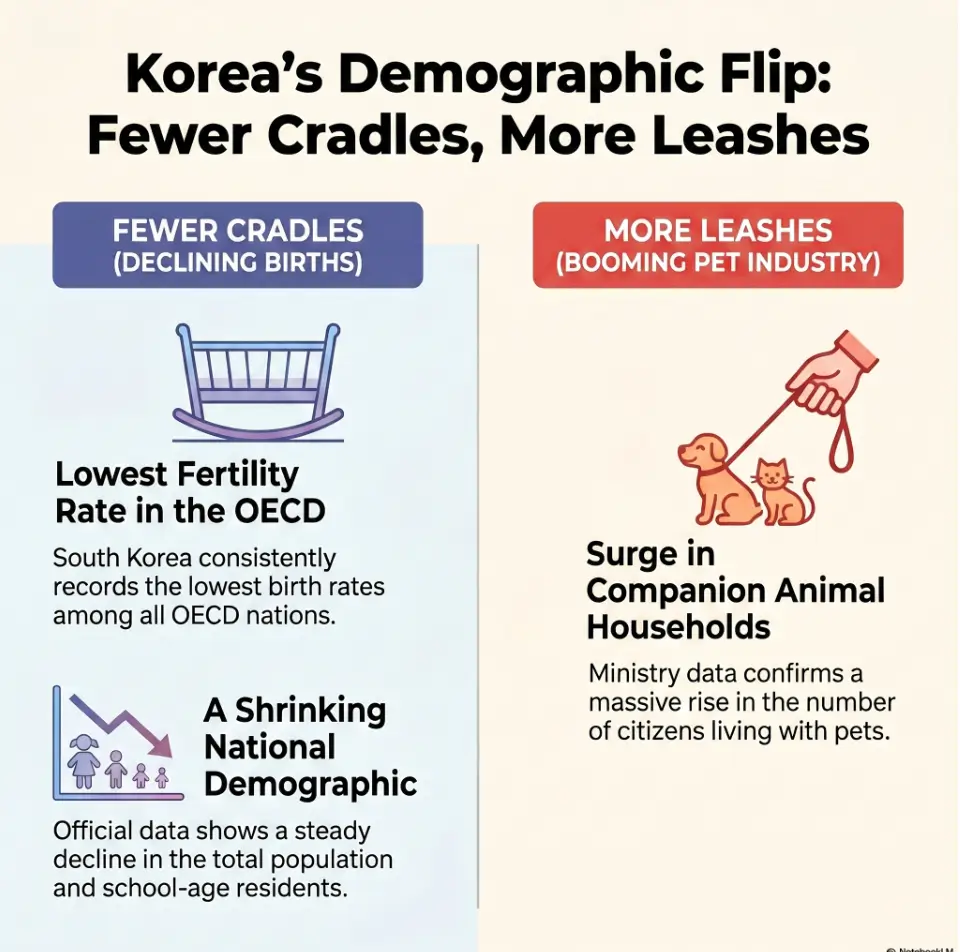
In some Korean neighborhoods, especially stylish urban ones, foreigners notice a small visual riddle: fewer baby strollers, more dogs in padded bags, sling carriers, cafés, grooming shops, and sometimes actual pet strollers.
That contrast lands fast. The brain loves a bright symbol. A stroller usually means baby. A leash usually means dog. But in a dense Korean neighborhood, those symbols can cross wires. A stroller may carry a toy poodle. A baby may be inside a daycare center upstairs. A family may live three subway stops away near a school district.
I remember walking through a café street in Seoul one cold afternoon and seeing three dogs in quilted coats before I saw one toddler. My first thought was too quick. The street was not giving me a census. It was giving me a mood board.
The better reading: a visible block tells you what that block makes easy, profitable, and socially comfortable.
Neighborhoods are not national averages
A visitor’s route often runs through places designed for adults with disposable income: university zones, officetel districts, high-rent apartment areas, expat-friendly streets, restaurant alleys, shopping corridors, and café neighborhoods with lighting so curated it looks like the sidewalk has a brand manager.
Those places naturally show more young workers, couples, students, remote workers, and pet owners. Families with babies may be nearby, but their routines often orbit daycare, playgrounds, pediatric clinics, apartment courtyards, grandparents’ homes, and school-adjacent streets. For a more family-centered lens, it helps to compare this street-level impression with how Korean childcare pickup routines shape daily family movement.
The real question is not “pets or kids?”
The tempting question is, “Did pets replace children?” It is catchy, but too flat. Real life rarely fits inside a slogan without banging its elbows.
A sharper question is: What does this neighborhood reward, pressure, hide, and make convenient? That question opens the whole map: housing costs, family timing, work hours, social expectations, loneliness, consumption, transit, and public space.
- Visitor routes often pass through adult leisure zones.
- Families may be present but less visible.
- Pet businesses are built for street-level attention.
Apply in 60 seconds: Before forming a theory, ask whether you are standing in a school zone, café zone, office zone, or apartment zone.
Korea’s Baby Math: The Demographic Backdrop Behind the Sidewalk
The birthrate is low, even after a recent rebound
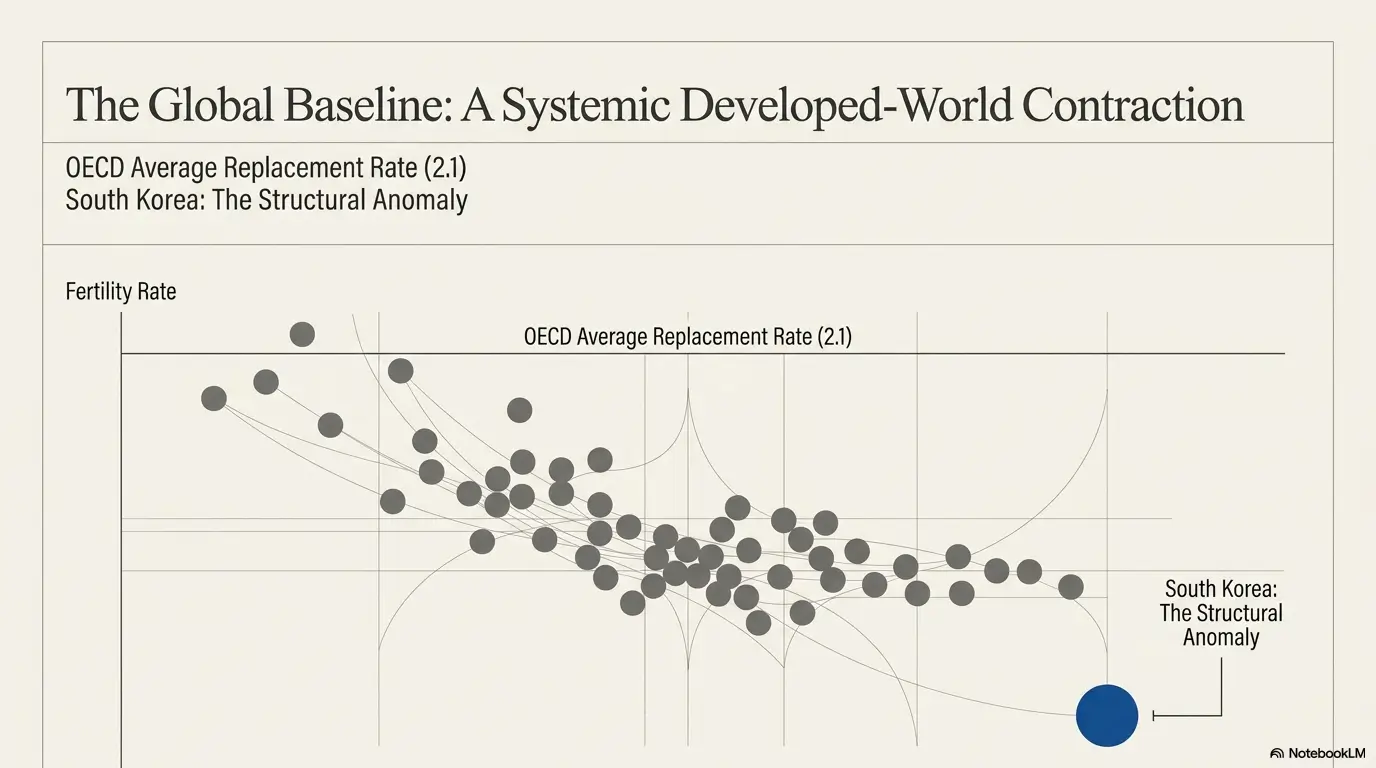
Korea’s fertility rate is one of the most discussed demographic facts in the world, and for good reason. Statistics Korea reported that the total fertility rate rose to 0.80 in 2025, after 0.75 in 2024 and 0.72 in 2023. That is a rebound, but it remains far below the replacement level commonly described as around 2.1 births per woman.
Those numbers sound abstract until you walk through a neighborhood and realize data has a street sound. Fewer births over many years eventually means fewer babies in elevators, fewer toddlers in parks, fewer small shoes outside daycare rooms, and fewer stroller traffic jams on ordinary weekday afternoons.
The city does not announce demographic change with a trumpet. It changes the background hum.
Fewer births means fewer everyday baby sightings
When births stay low, the effect stacks quietly. One low-birth year is a headline. Several low-birth years become a playground with more empty swings at 10 a.m., a subway car with more commuters than children, and a brunch street where the loudest small creature has a bow on its collar.
This does not mean children are absent. It means the odds of casually seeing babies in certain public places can drop. Visibility and existence are cousins, not twins. The bigger social ripple is easier to understand when placed beside the wider effects of Korea’s low birth rate.
Don’t read one street as a census
Here’s the trap. A visitor sees five dogs, no babies, and a pet boutique selling pumpkin-shaped sweaters. The mind tries to convert that into a national theory before the coffee cools.
But one street may reveal local rent, business mix, school access, building type, transit flow, and weekend leisure patterns more than the entire country. A trendy café district is not Korea. It is one page in a large book, and it may be printed on very expensive paper.
Decision Card: What Did You Actually Observe?
| Observation | Better interpretation |
|---|---|
| Many dogs in carriers | Pet-friendly leisure street, small-dog culture, dense walking routes |
| Few strollers | Low births, visitor-route bias, families elsewhere, timing of day |
| Pet cafés and groomers | Visible commerce, not proof that children vanished |
Neutral action: Compare at least two neighborhood types before making a cultural claim.
The Pet Boom Is Real, But It Is Not a Simple Replacement Story
Pets have moved from backyard animals to family members
Korea’s pet culture has changed dramatically. Companion animals are now woven into daily routines, household spending, emotional life, consumer products, and identity. The Ministry of Agriculture, Food and Rural Affairs reported that 29.2 percent of Korean households were raising pets in 2025. In plain English: roughly 3 in 10 households.
That is not a small side note. It changes what the city sells, photographs, welcomes, restricts, and celebrates.
Pets today are not only “animals at home.” They are companions, schedule anchors, walking partners, grief cushions, date filters, and sometimes tiny dictators with better coats than their owners. I say that with respect. Anyone who has watched a 3-kilogram dog refuse a rainy walk knows power comes in compact packaging.
Dogs dominate the visible pet scene
Dogs are especially visible because they must go outside. Government-linked survey reporting in 2025 showed dogs made up the large majority of pet-owning households, while cats were a smaller share and often less visible because many stay indoors.
That matters. A cat can shape a home without changing the sidewalk. A dog changes the sidewalk twice a day.
Pet strollers create a visual twist
The pet stroller is the perfect symbol because it plays a visual trick. From a distance, the object says “baby.” Up close, the passenger has whiskers, a sweater, and the calm authority of a retired opera critic.
Foreigners remember that moment because it compresses a cultural question into one image. But again, the image is not the answer. It is the doorway.
The Neighborhood Filter: Where Families Live, Where Visitors Walk
Family-heavy areas may be less tourist-visible
Families with young children often organize life around practical geography. They look for larger apartments, childcare access, schools, playgrounds, quieter parks, pediatric clinics, safer crossings, and sometimes help from grandparents.
Those spaces may not overlap with where foreigners spend most of their first weeks in Korea. Tourists and new expats often walk through Hongdae, Itaewon, Seongsu, Gangnam shopping corridors, university areas, and food streets. These neighborhoods are alive, but they are not neutral samples.
In my own first weeks in Seoul, I over-read everything. A bakery became an economic indicator. A dog salon became sociology. A quiet apartment entrance became a mystery novel. Eventually I learned that the city speaks in zones, and each zone has its own grammar. That is also why Korean city identity can feel different from district to district, even inside the same metropolitan map.
Pet-friendly commerce is designed to be seen
Pet commerce loves visibility. Grooming salons need cute windows. Pet boutiques display tiny coats. Dog cafés announce themselves with friendly signs. Veterinary clinics and pet hotels often sit where owners can reach them easily.
Childcare, by contrast, can be more routine-bound and less performative. Daycare centers, kindergartens, and pediatric clinics exist, but they may be inside buildings, near apartment complexes, or located where residents already know to go.
The Instagram street is not the whole city
A stylish street can exaggerate pet visibility because pets fit the leisure economy. They can join café walks, shopping loops, photo outings, park strolls, and weekend errands. A baby can do some of that too, of course, but parenting logistics are heavier. Nap schedules do not care about your latte foam.
Street-Level Visibility Map
Daily walks, carriers, pet strollers, grooming shops, dog cafés, patios.
Daycare, schools, hagwons, apartments, family parks, indoor playrooms.
Tourist routes often favor cafés, shopping, transit, nightlife, and adult leisure.
What life does this block make easy, visible, expensive, or hidden?
Housing Pressure: Why a Baby Can Feel Like a Bigger Apartment Problem
Small homes change family timing
Housing is one of the quiet engines behind family timing. In Korea’s dense cities, a baby is not only an emotional decision. It can become a square-meter decision, a deposit decision, a mortgage decision, a school-district decision, and a commute decision.
For young adults, especially in Seoul and nearby commuter areas, family formation may feel tied to housing security. Marriage and childbirth often arrive with expectations: a stable home, enough space, access to childcare, and a plan for education costs later. That is a lot to ask of people who are already negotiating rent, loans, career pressure, and the price of one innocent-looking grocery basket.
Pets also require space, but the threshold feels different
Pets are not cheap or effortless. Food, vet visits, grooming, insurance-like products, boarding, toys, training, and time all add up. A pet can absolutely be a serious commitment.
Still, many households may perceive pet care as more flexible than raising a child. A dog can fit into a smaller apartment more easily than a family plan shaped by daycare pickup, school admissions, private education, and long-term career trade-offs. For foreign residents, even the basic home setup becomes clearer with a practical Korean apartment move-in checklist.
Don’t make the “selfish generation” mistake
It is easy, and unfair, to blame young adults. That shortcut is popular because it requires no empathy and no math. A better analysis looks at structure: housing prices, job insecurity, work hours, childcare burdens, education expectations, and gendered labor at home.
People do not make family decisions in a vacuum. They make them in apartments, offices, subway cars, parental phone calls, bank apps, and Sunday-night dread.
Mini Calculator: Is This a Visibility Pattern or a Family Pattern?
Use this simple mental calculator during a 10-minute walk.
- Count pet-facing businesses: groomers, pet cafés, vets, boutiques.
- Count child-facing spaces: schools, playgrounds, daycare signs, pediatric clinics.
- Count apartment entrances versus commercial storefronts.
Output: If pet-facing commerce is street-level and child spaces are tucked away, your impression may be about visibility more than population.
Neutral action: Repeat the scan in a family apartment district before drawing a broader conclusion.
Work Culture and Time Poverty: The Quiet Engine Under the Trend
Parenting needs time that many workers do not feel they have
Parenting asks for time in large, non-negotiable blocks. Babies need pickup, sleep routines, sick days, doctor visits, meals, play, laundry, and the endless small repairs of being human. A child does not politely wait for a quarterly report to end.
Korea has made policy efforts around work-family balance, parental leave, and childcare support. Still, many adults experience work pressure, career competition, long commutes, and cultural expectations around performance. Even when policies improve, workplace habits can take longer to soften. A related everyday clue appears in annual leave culture in Korea, where time off can carry its own social weather.
That gap matters. A country can offer support on paper while people still feel the daily risk of being the worker who leaves early.
Pets fit into fragmented urban schedules more easily
Pets also need care, and responsible pet ownership is not a lifestyle accessory you can hang by the door. But for some adults, pet care may feel more compatible with fragmented schedules than parenting.
A dog walk can happen late. Pet hotels can cover travel. A groomer can handle certain tasks. A vet visit is serious, but it is not the same as navigating years of daycare, school, exams, and family expectations.
Let’s be honest… affection also needs somewhere to go
Cities can be lonely even when they are crowded. Korea’s single-person households, delayed marriage, and competitive work rhythm create emotional weather. Pets can offer companionship, routine, warmth, and a reason to go outside.
That does not make pets substitutes for children. It makes them part of how people build livable days. Sometimes love arrives with homework. Sometimes it arrives with a squeaky toy shaped like a duck.
- Parenting requires inflexible time.
- Pet care can feel more schedule-flexible.
- Workplace culture can lag behind official policy.
Apply in 60 seconds: When reading a neighborhood, ask what kind of care the local schedule seems to support.
Gender Expectations: The Part Visitors May Not See
Childrearing is not just a private choice
Birthrate discussions often sound like arithmetic, but they are also about gender, labor, identity, and risk. In many societies, including Korea, women can face career penalties, social judgment, unequal household labor, and heavy expectations around parenting.
That matters because childbirth is not simply “having a baby.” It can mean renegotiating work, marriage, family obligations, money, body, sleep, identity, and future promotion. The stroller may be cute. The system behind it can be heavy.
I once heard a Korean office worker describe marriage as “not one decision, but twenty decisions wearing one coat.” That phrase stayed with me. Family life can be beautiful, but it also comes with institutions attached, including the delicate gravity of Korean in-law expectations.
Marriage delay changes the sidewalk
In Korea, marriage and childbirth remain closely linked for many people. When marriage happens later, or does not happen at all, babies become less visible in everyday public life, especially in neighborhoods dominated by workers, students, and single-person households.
So the stroller-pet contrast is partly about family timing. Later marriage means later first births. More single-person homes mean more adult-centered neighborhoods. More adult-centered neighborhoods mean more cafés, small apartments, late dinners, and pets that travel well in carriers.
Pets become socially legible companionship
A dog walk is socially easy to understand. It is companionship without a wedding hall, school district, or in-law choreography. For singles, couples without children, older adults, and people between life stages, pets can offer an emotionally visible form of household life.
That visibility matters. A dog on the street says, “Someone is cared for here.” It is a public sign of private attachment.
Show me the nerdy details
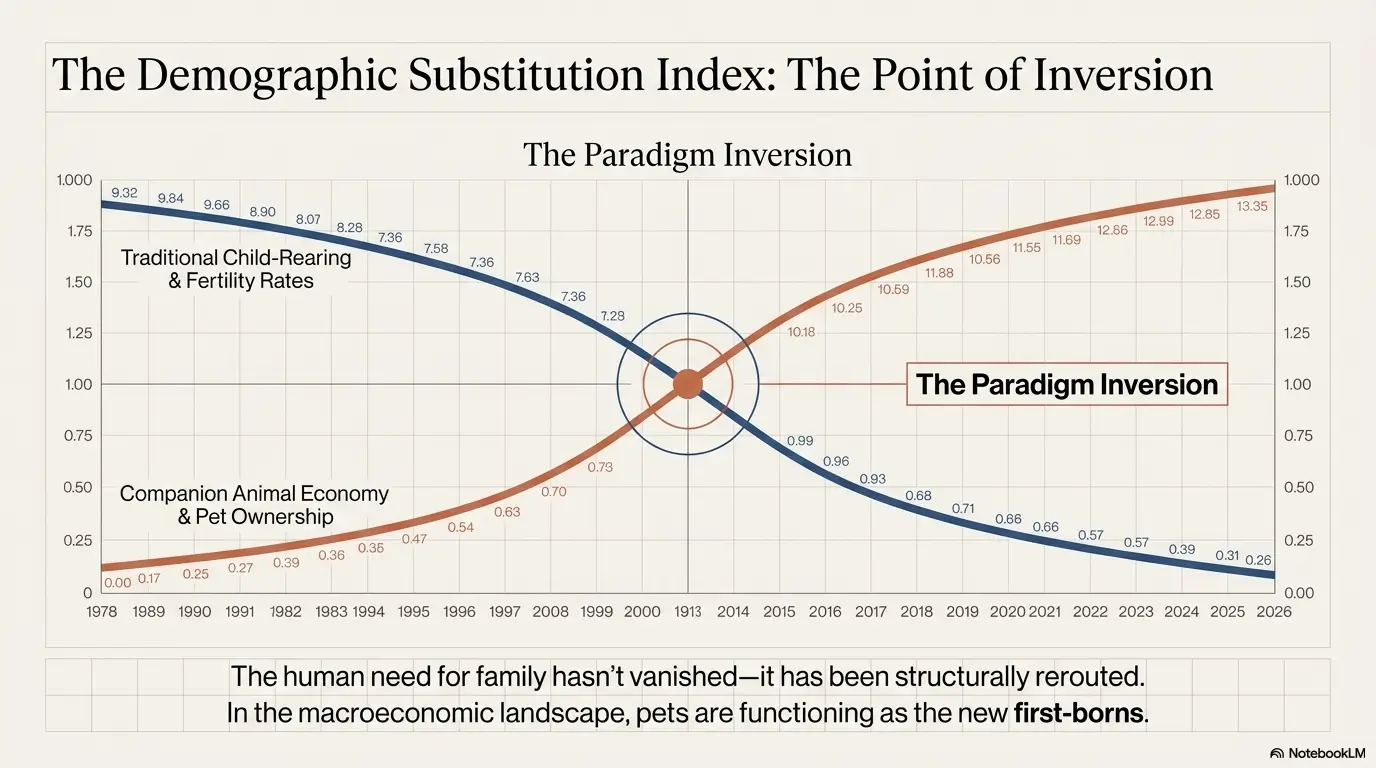
When people interpret pet visibility as “replacement,” they often confuse correlation with causation. Low fertility and rising pet ownership can happen at the same time because both respond to deeper forces: urban housing, smaller households, later marriage, work pressure, consumer services, and changing ideas of companionship. To analyze the pattern well, separate three layers: demographic counts, public visibility, and emotional meaning.
Public Space Clues: Why Pets Show Up and Children Disappear
Dogs are walked; babies are scheduled
Dogs create daily public signals. They need walks. They stop at corners. They sniff lampposts with investigative seriousness. They appear in parks, alleys, elevators, and outside convenience stores.
Babies and toddlers have different routes. They may be in daycare during the day, at home with family, in indoor playrooms, in apartment courtyards, or traveling by car. Older children may be in school, after-school academies, sports lessons, music lessons, or study spaces.
So a foreigner walking through a commercial street at 3 p.m. may see pet life more clearly than child life, even when families live nearby.
Korea’s pet economy makes animals publicly visible
Pet culture has a storefront. Grooming salons, veterinary clinics, pet hotels, dog cafés, pet bakeries, and specialty shops turn private attachment into public commerce.
This is one reason the trend feels so strong. A baby does not usually need a cupcake-shaped birthday cake from a storefront window. A dog apparently might. And somehow the cake will look better than my last three attempts at baking.
Children’s spaces are more gated by age and routine
Children’s spaces often have invisible borders. Schools are not tourist spaces. Daycare centers are not casual public hangouts. Hagwons have schedules. Apartment playgrounds may sit inside residential complexes. Family restaurants may be away from nightlife streets.
As a result, foreigners may undercount children because they are not entering the right social rooms. School routines, meals, and age-based spaces become more visible when you read them through topics like South Korean school lunch culture rather than through café streets alone.
Coverage Tier Map: How Strong Is Your Observation?
| Tier | What you checked | Confidence |
|---|---|---|
| 1 | One café street | Very low |
| 2 | One neighborhood at two times of day | Low |
| 3 | Commercial street plus apartment area | Useful |
| 4 | School zone, park, transit, café street | Strong |
| 5 | Several districts across weekdays and weekends | Best for writing or analysis |
Neutral action: Upgrade your observation by one tier before publishing a claim.
Common Mistakes Foreigners Make When Reading the Scene
Mistake 1: Assuming pets “replaced” children
This is the most viral version of the story, and the least useful. Pets are part of the story, not the villain of the story.
Some people may choose pets instead of children. Others want children but feel blocked by housing, work, health, partnership, money, or caregiving expectations. Others do not want children and also do not want pets. Humans are inconveniently varied. Culture writing should make room for that.
Mistake 2: Treating Seoul as all of Korea
Seoul is powerful, dense, expensive, and symbolically loud. It also does not represent every Korean city, town, or rural area. Busan, Daegu, Daejeon, Gwangju, Jeju, satellite cities, and smaller towns all have different rhythms.
Even within Seoul, Gangnam, Mapo, Songpa, Jongno, Yongsan, Seongdong, and Nowon can show very different family and pet patterns.
Mistake 3: Ignoring invisible children
Children may be in daycare, schools, hagwons, apartment complexes, weekend parks, playgrounds, grandparents’ homes, or family-centered restaurants. If you are walking through a boutique shopping street at night, you are not exactly positioned like a census worker.
Mistake 4: Turning observation into judgment
A good cultural observation should be curious, not smug. Sneering at parents is lazy. Sneering at child-free adults is lazy. Sneering at pet owners is also lazy, though admittedly some dog strollers have more suspension than my first bicycle.
The humane reading is sharper: modern urban life is changing how love, time, money, and public space fit together.
- Do not blame individuals for structural pressure.
- Do not turn a tourist route into a national claim.
- Do not mistake visibility for total reality.
Apply in 60 seconds: Replace “Koreans prefer pets to babies” with “This neighborhood makes pet life more visible than family life.”
Who This Is For / Not For
This is for culture-curious observers
This guide is for expats, tourists, US students in Korea, international couples, remote workers, travel writers, bloggers, and anyone who notices a pattern and wants to understand it without turning people into props.
It is especially useful if you write about Korea for readers who have never been there. A single vivid detail can help readers enter a place. But if the detail is overworked, it becomes a cardboard cutout wearing a hanbok and holding a latte. Nobody needs that.
This is for writers who want nuance
If you are writing a blog post, newsletter, travel essay, or social caption, the stroller-pet contrast can be a strong opening. It is tactile, memorable, and easy to visualize.
But the payoff should be nuance. Use the image to open the door, then walk readers through demographics, neighborhood design, housing, work, gender, and daily routines.
This is not for demographic doom-scrolling
This is not a panic piece. It is not anti-pet, anti-parent, anti-child-free, or anti-Korea. It is also not a claim that every Korean neighborhood looks the same.
Some Korean neighborhoods have plenty of children. Some streets are full of school uniforms at the right hour. Some parks fill with families on weekends. Some apartment courtyards sound like scooters, jump ropes, and snack negotiations. The city contains multitudes, plus at least one dachshund in a raincoat.
Short Story: The Dog Stroller at the Crosswalk
One evening near a subway station, I stood at a crosswalk beside what I thought was a baby stroller. The woman beside it adjusted the blanket with the same careful tenderness I had seen parents use on sleeping infants. Then the passenger lifted its head: a gray-muzzled dog with cloudy eyes and a red scarf.
People smiled, the light changed, and the tiny procession rolled forward. At first, the scene felt comic. Then it felt tender. The stroller was not a joke about missing babies. It was a tool for an old companion whose legs no longer managed the city well. That is the lesson hidden in many street observations. The visible thing may be real, but the first interpretation is often too small. A stroller can mean age, affection, convenience, disability, heat, distance, crowding, or care. Sometimes a sidewalk is not making an argument. It is carrying someone home.
The Better Explanation: Korea’s Sidewalk Is a Social Barometer
Pets, strollers, and cafés all point to pressure
The stroller-pet contrast is powerful because it gathers several pressures into one visible scene. Korea’s low fertility, delayed marriage, dense housing, adult-centered neighborhoods, work intensity, single-person households, pet-friendly commerce, and shifting companionship norms all show up at street level.
That does not mean one caused the other in a tidy line. A pet stroller did not make the birthrate fall. A café street did not single-handedly change marriage culture. A dog boutique is not a demographic policy paper with tiny sweaters.
But together, they are signs. They show what feels possible, what feels delayed, what feels expensive, what feels comforting, and what urban life has learned to sell beautifully.
A neighborhood can reveal what feels possible
Some neighborhoods make pet ownership publicly visible and family formation less visible. The block may favor small apartments, young workers, cafés, transit, and adult leisure. It may have pet shops at eye level and family life tucked into apartment towers nearby.
That is why the best interpretation is local and layered. “I saw more pets than babies” can be true. The leap to “Korea replaced babies with pets” is where the bridge collapses.
The most honest answer has several doors
The honest answer is a hallway of doors. Behind one door is fertility. Behind another is housing. Another holds work culture. Another holds gender. Another holds single-person households. Another holds pet commerce. Another holds loneliness. Another holds love.
Open only one door and the story feels clever. Open several and it becomes true enough to be useful.
FAQ
Why do foreigners see so many dogs in Korean neighborhoods?
Dogs are highly visible in dense urban life because owners walk them, carry them in bags, bring them to pet-friendly cafés, visit grooming salons, and move through the same compact sidewalks as everyone else. Cats may be common too, but they are usually less visible because they stay indoors.
Does Korea really have fewer babies now?
Yes. Korea has one of the world’s lowest fertility rates. Statistics Korea reported a total fertility rate of 0.80 in 2025, up from recent lows but still far below the replacement level often described as about 2.1. That long-term low-birth pattern affects what people notice in public spaces.
Are Koreans choosing pets instead of children?
That phrasing is too simple. Some people may prefer pets, some may prefer child-free life, and some may want children but face barriers. Housing costs, delayed marriage, work pressure, childcare expectations, education costs, and gendered caregiving all shape family decisions.
Why are pet strollers common in Korea?
Pet strollers can help with small dogs, older pets, crowded sidewalks, long walks, subway transitions, hot pavement, health issues, and owner convenience. They also fit Korea’s dense, walkable urban areas where people often move between cafés, transit, parks, and apartment buildings.
Are there Korean neighborhoods with many children?
Yes. Family-heavy apartment complexes, school zones, suburban districts, parks, daycare clusters, and areas near academies can show many more children than trendy commercial streets. Time of day matters too. You may see more children near schools in the afternoon or in parks on weekends.
Why do cats seem less visible than dogs in Korea?
Cats often shape household life more than street life. Many cats stay indoors, so they do not create daily sidewalk signals in the same way dogs do. Dogs need walks, visit groomers more visibly, and are more likely to appear in carriers, parks, and cafés.
Is this trend only happening in Korea?
No. Many wealthy urban societies show delayed family formation, smaller households, rising pet spending, and more adult-centered neighborhoods. Korea stands out because its fertility rate has been exceptionally low, making the sidewalk contrast feel sharper to foreign observers.
What should visitors avoid saying?
Avoid jokes that reduce Korean adults to “pet parents who gave up on babies.” It may sound clever for three seconds, then collapses into cardboard. A better sentence is: “In some neighborhoods, pet life is more visible than family life because of demographics, housing, work, and urban design.”
Quote-Prep List: What to Gather Before Writing About This Trend
- The neighborhood type: university, office, apartment, tourist, school, or café district.
- The time and day: weekday lunch, school pickup, weekend evening, or late night.
- The visible businesses: pet shops, schools, clinics, parks, cafés, hagwons.
- The public route: main street, apartment courtyard, park path, subway exit, or shopping alley.
- The claim size: one block, one district, one city, or Korea as a whole.
Neutral action: Gather these notes before publishing a cultural explanation.
Next Step: Read One Korean Block More Carefully
Do a 10-minute neighborhood scan
The next time you walk through a Korean neighborhood, try a simple 10-minute scan. Count what the street is designed for: apartment entrances, schools, hagwons, pet shops, cafés, playgrounds, clinics, offices, parks, and transit exits.
Do not count only babies and dogs. Count the architecture of daily life. The answer often sits in the storefronts, stairwells, signs, and schedules.
Ask what the neighborhood makes easy
Instead of asking, “Why are there more pets than babies?” ask, “What kind of life does this neighborhood make convenient?”
That question is kinder and sharper. It lets you notice that a café street may welcome dogs more visibly than toddlers, that a school district may hide family life inside apartment routines, and that a nation’s demographic anxiety can appear as something as small as a quiet playground or a dog in a quilted vest. For a wider view of how this looks outside youthful café districts, compare the scene with Korea’s aging neighborhoods.
Turn the observation into a better story
The hook was the leash where you expected a stroller. The answer is not a punchline. It is a map.
Fewer strollers and more pets in some Korean neighborhoods are not simply cute urban contrast. They are quiet evidence of how modern life rearranges love, time, money, housing, gender, work, and public space. The dog stroller is memorable because it looks like a symbol. The real skill is reading it without making it carry more than it can hold.
- Name the neighborhood type.
- Separate visibility from population.
- Connect the scene to housing, work, family timing, and commerce.
Apply in 60 seconds: On your next walk, write one sentence that begins, “This block makes ____ visible and ____ less visible.”
Last reviewed: 2026-05.
Tags: Korean culture, South Korea demographics, pet culture, expat Korea, urban life
Meta description: Why some Korean neighborhoods show fewer strollers and more pets, explained through birthrates, housing, work, and urban design.