
Cross-border tax and banking guide for expats in South Korea
Korea Overseas Remittance Tax Questions for Expats:
What the Wire Does Not Tell You
A transfer screen makes international money movement look almost weightless. Enter an account number, check the exchange rate, tap confirm, and the won slips quietly across a border. The tax story underneath it can be far heavier.
Korea generally does not impose a separate tax simply because your money is wired overseas. What matters is whether the funds came from salary, freelance work, a property sale, investment gains, a family gift, a genuine loan, or savings already held by the same beneficial owner.
This guide helps you separate Korean tax, bank documentation, foreign-exchange review, and U.S. reporting into distinct lanes. That small act of separation can prevent the classic expat headache: one transfer, three filing systems, and a folder full of documents you wish you had saved six months earlier.
Classify the money
Identify the income, sale, gift, loan, or savings behind the wire.
Separate the filings
Do not confuse a bank transfer review with Korean or U.S. tax compliance.
Build the evidence
Create a source-of-funds trail before the money leaves Korea.
The safest remittance is not necessarily the smallest one. It is the one whose story can be proved. 🧾
Snapshot
Who this is for: U.S. citizens, green card holders, employees, teachers, freelancers, business owners, retirees, and other English-speaking expats moving money from South Korea. What it solves: confusion about remittance tax, Korean residency, gifts, FBAR, Form 8938, and bank documents. Your next move: classify the funds and build a one-page evidence file before initiating the transfer.
Table of Contents
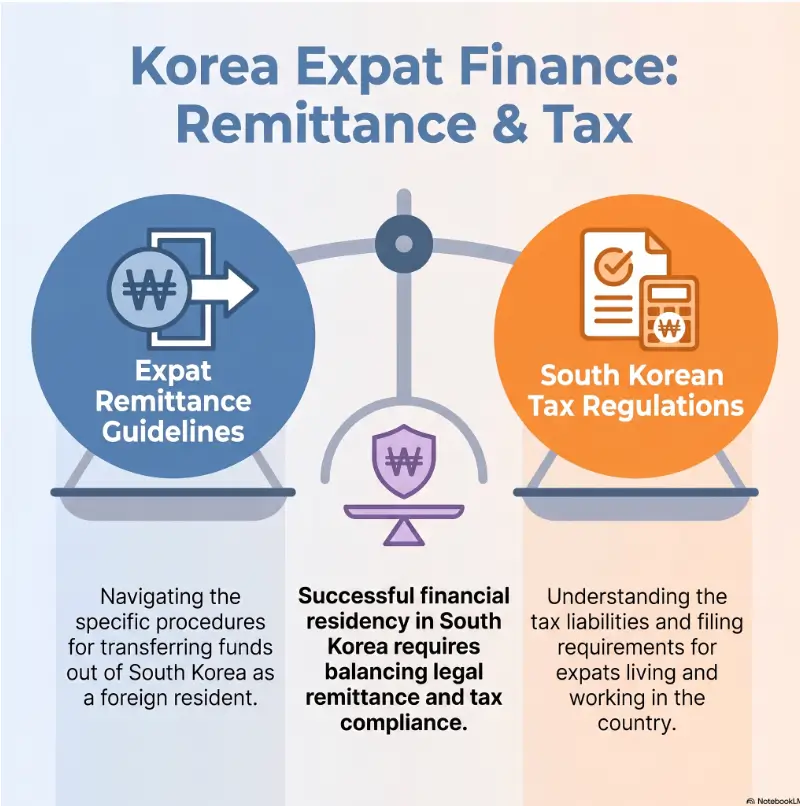
Before You Transfer: Separate the Wire From the Tax Story
Before You Act
This article offers general educational guidance, not personal Korean or U.S. tax advice. Residency, treaty eligibility, beneficial ownership, gift treatment, filing thresholds, and bank requirements depend on your facts and may change. Confirm significant transfers with your designated foreign-exchange bank and a qualified cross-border tax professional.
The transfer is usually not the tax event
A wire is merely the movement of money from one account to another. The tax character usually comes from the transaction underneath it.
If the money represents salary, freelance revenue, dividends, interest, rental income, business profits, or capital gains, tax questions may have arisen before you opened the remittance app. If it represents a gift or loan, the relevant obligations may depend on the recipient, the relationship, and the legal substance of the arrangement.
One transfer can enter four different compliance lanes
| Compliance lane | The main question | Typical evidence |
|---|---|---|
| Korean income or gift tax | What does the money represent, and has the underlying tax been handled? | Tax returns, withholding records, contracts, acquisition and sale records |
| Korean banking and foreign exchange | Can the bank verify the source, purpose, owner, and recipient? | Statements, payslips, invoices, sale contracts, family or loan documents |
| U.S. income tax | Was the underlying income properly reported on the U.S. return? | Form 1040 workpapers, Korean tax certificates, income statements |
| U.S. foreign-account reporting | Did Korean account balances or foreign assets cross a reporting threshold? | Maximum annual balances, ownership details, account numbers |
These lanes overlap, but they are not interchangeable. A bank approving your transfer does not certify that your Korean tax filing is complete. Reporting a Korean bank account on an FBAR does not prove that the income deposited into it was correctly reported.
Key takeaway
Do not begin with “How much can I send?” Begin with “What is this money, who owns it, and which filings already apply?”
Residency Comes First, and Your Visa Is Not the Answer
Korean resident versus nonresident tax treatment
Korean tax residency is based on residence and domicile facts, not simply the label printed on your visa. Korean residents are generally taxed on a broader income base, while nonresidents are generally taxed on Korean-source income. :contentReference[oaicite:0]{index=0}
Relevant facts can include how long you have lived in Korea, where your family lives, where your permanent home is maintained, the nature of your work, and whether a departure appears temporary. Immigration records are useful evidence, but they are not the entire residency analysis.
The short-term foreign resident rule is often misunderstood
A foreign resident who has maintained a domicile or place of residence in Korea for five years or less during the preceding ten-year period may receive special treatment for certain foreign-source income. Broadly, that income may be taxed in Korea only when it is paid in Korea or remitted into Korea. :contentReference[oaicite:1]{index=1}
Notice the direction of travel. This rule concerns foreign-source income being paid or remitted into Korea. It does not mean that sending Korean funds outward magically changes the original source or reverses an earlier tax event.
Arrival and departure years need a timeline
Partial years are where tidy assumptions begin to fray. Build a dated chronology showing entry and departure dates, employment periods, income payment dates, property sales, account openings, family moves, and any periods spent outside Korea.
- Date you first entered Korea for the current period of residence
- Dates your employment, freelance work, or business activity began and ended
- Where your spouse, children, and permanent home were located
- When the income was earned, paid, deposited, and converted
- Whether the transfer occurs before or after your Korean departure
Foreign residents can consult the current English-language materials published by Korea’s National Tax Service rather than relying on a blog post copied from an older tax year. The NTS published its 2026 individual income tax guide for foreigners on April 30, 2026. :contentReference[oaicite:2]{index=2}
Classify the Money Before the Bank Does
Korean salary already handled through payroll
Accumulated salary is usually the cleanest remittance story when your employer reported the wages, withheld Korean tax, and completed the appropriate year-end settlement or income reporting.
Keep the chain visible from employer to Korean account to overseas account. Useful records include payslips, employment certificates, annual wage statements, withholding receipts, Korean tax-payment certificates, and bank statements showing the salary deposits.
A precise purpose description might read: “Transfer of accumulated Korean employment income from my Korean account to my U.S. account.” Use wording that matches the actual facts, not wording chosen merely because it sounds convenient.
Freelance and business income can carry unfinished work
Freelancers and small business owners should pause before transferring gross receipts as though they were personal savings. Comprehensive income tax, withholding, deductible expenses, VAT, contractor payments, and business-account records may still need to be reconciled.
The danger is not the overseas destination. It is losing the ability to explain how a large account balance was built when business and personal funds have been stirred together like two soups in one bowl.
Investment, property, and digital-asset proceeds need longer records
Sale proceeds require more than a final deposit screenshot. Preserve acquisition records, sale agreements, brokerage statements, loan payoff records, closing documents, expense records, and any Korean tax calculations or payment certificates.
For digital assets, retain exchange transaction histories, wallet records, acquisition costs, transfers between wallets, conversion dates, and evidence connecting the asset owner to the Korean bank deposit. The goal is traceability, not a dramatic stack of screenshots with no beginning or end.
A source-of-funds map by transfer type
| Money type | Questions to settle | Documents worth saving |
|---|---|---|
| Employment savings | Were wages and withholding properly reported? | Payslips, wage statement, employment certificate, account history |
| Freelance income | Were income, expenses, VAT, and withholding reconciled? | Invoices, contracts, receipts, tax return, payment statements |
| Property proceeds | Who owned the property, what was the gain, and were loans repaid? | Purchase and sale contracts, closing statement, tax records |
| Investments | What was the cost basis, sale value, and beneficial ownership? | Broker statements, trade confirmations, tax calculations |
| Expense reimbursement | Was this repayment of a documented cost rather than income? | Receipts, reimbursement request, original payment evidence |
| Digital assets | Can the asset history be followed into the Korean bank account? | Exchange exports, wallet history, acquisition records, bank deposit |
Key takeaway
The best source-of-funds file begins with the original earning or asset event. A transfer receipt shows only the final footstep.
Gift, Loan, or Your Own Money?
Start with the beneficial owner
A transfer from your Korean account to your own overseas account is different from money sent to a parent, spouse, child, partner, friend, or business associate. The account name matters, but the deeper question is who funded, controlled, and economically owned the money.
Joint accounts do not automatically create joint ownership of every deposit. A reviewer may still ask whose earnings funded the account and whether the other holder received unrestricted use of the funds.
Family support can become a Korean gift-tax question
Korean gift-tax analysis is recipient-centered. The recipient’s residence, the property transferred, the parties’ relationship, prior gifts, and available deductions can all matter. NTS materials state that a resident donee may have gift-tax obligations, while a nonresident donee’s exposure can depend on property acquired in Korea. :contentReference[oaicite:3]{index=3}
Where a Korean gift-tax return is required, the general deadline is no later than three months after the last day of the month in which the gift was received. :contentReference[oaicite:4]{index=4}
Do not assume that calling a payment “family support” makes it tax-neutral. Everyday language is warm and flexible. Tax classifications tend to prefer sharper edges.
A genuine loan needs genuine behavior
A loan should exist before the transfer, not appear later when someone asks an uncomfortable question. Useful evidence can include written principal terms, a repayment schedule, an appropriate interest analysis, actual repayments, and records showing that both parties intended repayment.
- Identify the lender and borrower clearly.
- State the principal amount and currency.
- Set repayment dates and a maturity date.
- Address interest and local tax consequences.
- Make repayments through traceable accounts.
- Keep the signed agreement with the transfer receipt.
The memo line can become evidence
Transfer descriptions such as “loan,” “gift,” “support,” or “investment” should match your documents and actual conduct. A cheerful memo typed in ten seconds can linger much longer than expected.
Expats who regularly struggle with Korean account names, identity matching, and mobile authentication may also find the site’s guide to Korean identity verification for foreigners useful before attempting a time-sensitive transfer.
The U.S. Overlay: Income, FBAR, and Form 8938
Worldwide income reporting continues while you live abroad
U.S. citizens and resident aliens generally remain subject to U.S. filing rules on worldwide income while living in Korea. Living abroad can create access to exclusions, credits, and treaty provisions, but it does not by itself switch off the filing system. :contentReference[oaicite:5]{index=5}
The taxable item is usually the salary, dividend, interest, gain, rental income, or business profit, not the later act of transferring the balance to a U.S. bank.
FBAR follows maximum account balances, not the amount transferred
A U.S. person generally must file an FBAR when the aggregate value of reportable foreign financial accounts exceeds $10,000 at any time during the calendar year. The test looks across reportable accounts, not merely the amount left on December 31. :contentReference[oaicite:6]{index=6}
Transferring the entire Korean balance to the United States before year-end does not erase the account’s earlier maximum value. Save monthly statements or an annual balance record before closing the account.
Form 8938 is separate from FBAR
Form 8938 reports specified foreign financial assets with a federal income tax return when the applicable threshold is met. FBAR is filed separately through FinCEN. Filing one does not automatically satisfy the other. :contentReference[oaicite:7]{index=7}
For specified individuals living abroad, the IRS currently lists higher Form 8938 thresholds than for taxpayers living in the United States. An unmarried taxpayer or married taxpayer filing separately may trigger the form above $200,000 on the final day of the tax year or above $300,000 at any time. For married taxpayers filing jointly, the corresponding amounts are $400,000 and $600,000. Eligibility to use the living-abroad thresholds must still be confirmed. :contentReference[oaicite:8]{index=8}
| U.S. obligation | What it generally reports | Where it is filed | Common misunderstanding |
|---|---|---|---|
| Federal income tax return | Taxable worldwide income and related tax benefits | IRS | “I moved the money, so the transfer itself is the income.” |
| FBAR | Financial interest or signature authority over qualifying foreign accounts | FinCEN BSA E-Filing | “My balance was low at year-end, so no FBAR is possible.” |
| Form 8938 | Specified foreign financial assets above applicable thresholds | Attached to the federal tax return | “FBAR and Form 8938 are the same report.” |
| Form 3520 in relevant cases | Certain foreign gifts, bequests, trusts, or trust transactions | IRS, filed separately as instructed | “A gift is never reportable because it is not salary.” |
Foreign tax credits and the treaty can reduce double tax, not double paperwork
Qualifying Korean income tax may support a U.S. foreign tax credit, subject to ownership, payment, income-category, limitation, and coordination rules. The IRS generally requires the tax to be imposed on you, paid or accrued, and to qualify as an income tax or a tax in lieu of an income tax. :contentReference[oaicite:9]{index=9}
The Korea-U.S. income tax treaty can affect particular income categories and residency questions. It is a tool for analysis, not a universal promise that no tax or filing will remain. The IRS maintains an official page for the treaty text and technical explanation. :contentReference[oaicite:10]{index=10}
Show me the nerdy details
Income reporting asks: What taxable income arose during the year?
FBAR asks: Did your combined reportable foreign accounts exceed the balance threshold at any point?
Form 8938 asks: Did the value of your specified foreign financial assets exceed the threshold that applies to your filing status and residence?
Remittance review asks: Who owns the funds, where did they come from, why are they moving, and does the documentation support that story?
Key takeaway
A $9,000 transfer can still matter if your combined Korean account balances previously crossed the FBAR threshold. The wire amount and the account-reporting test measure different things.
What Korean Banks and Remittance Providers May Ask For
Why the bank asks about source and purpose
A bank’s questions may reflect foreign-exchange requirements, anti-money-laundering controls, sanctions screening, fraud prevention, internal transaction limits, or account-specific risk review. They are not necessarily an accusation and are not the same as a tax assessment.
The most efficient response is not “It is my money.” That may be true, but it leaves several practical questions unanswered. A stronger explanation identifies the original source, current beneficial owner, recipient, transfer purpose, and supporting records.
Prepare documents by transfer type
- Salary savings: employment certificate, payslips, wage statement, tax-payment record, bank statements
- Freelance or business funds: contracts, invoices, receipts, business registration records, filed returns
- Property proceeds: title and purchase records, sale agreement, closing statement, loan payoff, tax documents
- Investment proceeds: brokerage statements, trade confirmations, cost-basis records, ownership evidence
- Gift: donor and recipient identities, relationship evidence, gift agreement, tax review
- Loan: signed agreement, repayment schedule, interest terms, repayment evidence
- Own-account transfer: statements showing that both sending and receiving accounts belong to the same beneficial owner
Compare remittance options on more than the advertised fee
The cheapest-looking service is not always the lowest-cost route once the exchange-rate margin, receiving-bank fee, processing time, transfer limits, document handling, and failed-transfer policy are considered.
| Option | May suit | What to compare before paying | Possible drawback |
|---|---|---|---|
| Traditional Korean bank | Large, documented transfers or customers needing branch support | FX margin, fees, document requirements, designated-bank rules, processing time | More paperwork or slower review |
| Regulated remittance app | Routine personal transfers within the service’s supported limits | Total delivered amount, identity matching, limits, recipient support, receipt quality | Complex proceeds may not fit a simple app workflow |
| Specialist foreign-exchange service | Larger conversions where pricing and execution support matter | Licensing, client-money handling, rate method, settlement process, cancellation terms | Onboarding and documentation may be extensive |
| Cross-border adviser plus bank | Property, gifts, businesses, prior filing gaps, or dual-residency disputes | Scope, credentials, written deliverables, country coverage, fee structure | Higher professional cost |
Contact the provider before selling an asset, closing your Korean account, or approaching a contractual deadline. A transfer held for review is inconvenient. A transfer held for review on the final afternoon of a property closing is a small opera of panic.
Reduce Korean document friction early
Confirm whether the bank needs Korean-language certificates, originals, recent issue dates, notarization, translated agreements, or matching addresses. Your local administrative office may issue certain residence or family documents, so the guide to using local district offices in Korea may help with the practical side of document collection.
Mistakes That Turn a Routine Wire Into a Paper-Trail Problem
Mistake 1: Treating a bank limit as a tax exemption
A service limit, simplified-document threshold, or daily transfer cap is an operational rule. It does not automatically determine Korean income tax, gift tax, U.S. income reporting, FBAR, or Form 8938.
Mistake 2: Artificially splitting one transfer
Breaking one planned payment into smaller wires does not change the underlying source or beneficial ownership. It may also make the activity harder to explain when the sequence is viewed as a whole.
Send in commercially sensible stages only when there is a real reason, such as scheduled tuition, contractual installments, or regular household support, and document that reason.
Mistake 3: Calling family support a loan after the fact
A retroactive label is weak when there was no agreement, no repayment date, no interest analysis, and no actual repayment. Decide whether the transfer is a gift or loan before it is sent.
Mistake 4: Closing the Korean account before saving records
Download statements, maximum-balance information, transfer receipts, account-opening documents, tax certificates, and transaction exports before departure. Access can become difficult after your Korean phone number, identity certificate, visa status, or mobile banking authentication changes.
Real-world example: the transfer that looked simpler than it was
Daniel worked in Korea for four years and sent accumulated salary to his U.S. checking account before leaving. The transfer itself was straightforward, but his evidence folder was not.
His Korean account also contained freelance payments and proceeds from selling company shares. He had saved the final wire receipt, but not the brokerage cost basis, several freelance invoices, or a record of the account’s highest annual balance.
The problem was not that the money had crossed the Pacific. The problem was that three sources had merged into one balance, while the records explaining them were scattered across an expired work email, a closed brokerage login, and a Korean phone number he no longer controlled.
The practical lesson is plain: separate income categories before transferring, export records before closing accounts, and preserve maximum balances for U.S. reporting. Documentation is cheapest while every login still works.
Key takeaway
Do not wait for the bank or tax preparer to ask for records. By then, the easiest evidence may already be behind a cancelled phone number or closed account.
DIY, Paid Tools, or Cross-Border Professional Help?
When a careful DIY file may be enough
A straightforward own-account transfer of documented Korean salary may not require a bespoke legal memorandum. A careful reader can often gather payroll records, confirm account ownership, preserve balances, contact the bank, and provide the documents to an existing tax preparer.
DIY does not mean guessing. It means the facts are simple enough to document and the relevant professionals can answer narrow questions without reconstructing a maze.
When paid tax or recordkeeping tools can help
Paid tax software, bookkeeping tools, document translation, secure cloud storage, or a one-time professional review may be worth considering when you have several accounts, multiple currencies, freelance activity, investments, or a history of missed records.
Before paying, confirm whether the tool supports foreign addresses, Korean income documents, foreign tax credits, FBAR information gathering, Form 8938, amended returns, and human review. A glossy “expat” label does not guarantee that Korean tax questions are included.
Good, better, and best compliance support
| Setup | What it includes | Best fit | Questions before paying |
|---|---|---|---|
| Good: organized DIY | One-page summary, source documents, bank confirmation, balance records | Own-account salary savings with current filings | Are any gifts, investments, business funds, or prior omissions involved? |
| Better: targeted professional review | DIY file plus review by a Korean or U.S. specialist | Mixed income, moderate investments, uncertain residency, unfamiliar forms | Which country and forms are within the written scope? |
| Best: coordinated cross-border advice | Korean and U.S. professionals align classification, filings, timing, and documents | Property, private companies, trusts, large gifts, prior filing gaps, dual residency | Who coordinates the advice, and will conclusions be provided in writing? |
Questions to ask a cross-border tax professional
- Do you regularly advise individuals with both Korean and U.S. filing obligations?
- Will you analyze the underlying funds, or only prepare the transfer paperwork?
- Does your scope include Korean residency, gifts, capital gains, FBAR, and Form 8938?
- How do you coordinate with an adviser in the other country?
- Will I receive a written list of assumptions, conclusions, and unresolved questions?
- What documents should I collect before closing my Korean accounts?
- Is the fee fixed, hourly, or dependent on additional forms?
Seek advice before transferring, rather than paying a professional to excavate your intent afterward, when the money is tied to property, private-company shares, stock options, digital assets, trusts, large family payments, or prior unfiled reports.
Build a One-Page Remittance File
Use a five-part framework
The Five-Part Remittance File
1. Classify
Salary, sale, investment, gift, loan, reimbursement, or own savings?
2. Identify
Sender, recipient, account holder, and beneficial owner.
3. Trace
Connect the original source to the Korean deposit and proposed wire.
4. Check
Review Korean tax, bank rules, and home-country filings separately.
5. Preserve
Save statements, returns, contracts, receipts, and written advice.
Write one sentence that describes the transfer
Your sentence should be precise enough that a bank employee, tax preparer, or future version of you can understand the transfer without a telephone interview.
- “Transfer of accumulated Korean employment income from my account to my account.”
- “Transfer of net proceeds from the documented sale of Korean real estate.”
- “Gift from parent to adult child, subject to Korean and recipient-country review.”
- “Repayment of documented loan principal under the agreement dated [date].”
Edit the wording to match your actual facts. Do not borrow a sentence from this list when the ownership or source is different.
Create a dated evidence folder
- Save identity and account-ownership documents for sender and recipient.
- Export the Korean account statements covering the accumulation of funds.
- Add the original income, sale, gift, or loan records.
- Include Korean returns, withholding certificates, and payment receipts.
- Record each Korean account’s maximum value for the calendar year.
- Save the provider’s quote, exchange rate, fee disclosure, and transfer receipt.
- Add emails or written advice from the bank and tax professionals.
- Store a backup outside any Korean service that depends on your local phone number.
Run three independent checks
Korean tax check: Has the underlying salary, gain, business income, gift, or other transaction been correctly classified and reported?
Bank and foreign-exchange check: Does your provider accept the proposed purpose, amount, recipient, and source documents?
Home-country check: Do U.S. income, FBAR, Form 8938, gift, trust, or other reporting rules apply?
Qualifying Korean residents may also face separate Korean overseas financial-account reporting obligations, while certain short-term foreign residents may be exempt. Confirm the current annual rules rather than assuming this reporting system applies only to Korean citizens. :contentReference[oaicite:11]{index=11}
FAQ
Is money sent from Korea to my U.S. bank account taxable?
The transfer itself is not usually a separate taxable event when you move your own documented funds between accounts you beneficially own. The underlying money may still involve taxable salary, business income, interest, dividends, investment gains, property gains, or other income.
Do I pay Korean tax again when transferring Korean salary overseas?
Properly reported salary is not normally taxed a second time merely because the resulting savings are transferred abroad. Confirm that payroll withholding, year-end settlement, and any required Korean return have been completed, then preserve the records showing the salary deposits.
Can I send money to my parents without creating a gift?
Possibly, but the purpose and facts matter. A reimbursement, payment for property, loan repayment, and unrestricted family gift are not the same. Identify the recipient, beneficial owner, relationship, consideration received, and whether repayment is expected before sending.
Does Korea report my bank account or remittance to the IRS?
Financial institutions may collect tax-residency information and may have reporting obligations under international information-exchange systems. Do not treat possible institutional reporting as a substitute for your own U.S. return, FBAR, Form 8938, or other filing duties.
Is an FBAR required if I transfer the balance out before year-end?
It can be. FBAR uses the aggregate maximum value of reportable foreign accounts at any time during the calendar year, not just the December 31 balance. :contentReference[oaicite:12]{index=12}
Do I need both FBAR and Form 8938 for Korean accounts?
You may. The forms have different thresholds, filing locations, definitions, and coverage. Review each test independently rather than assuming one filing cancels the other.
Can I claim a U.S. foreign tax credit for Korean income tax?
Qualifying Korean income taxes may be eligible for the foreign tax credit, subject to U.S. rules and limitations. The answer can depend on who paid the tax, the income category, whether the tax was refunded, and whether an exclusion was also claimed.
What if a U.S. person receives a large gift from someone in Korea?
Certain large gifts or bequests received by a U.S. person from a foreign person may trigger Form 3520 reporting even when the receipt is not treated as ordinary income. The IRS advises recipients to review the form’s separate requirements and deadlines. :contentReference[oaicite:13]{index=13}
What documents should I keep after leaving Korea?
Keep Korean bank statements, maximum annual balances, transfer confirmations, payslips, wage statements, filed tax returns, tax-payment certificates, investment and property records, gift or loan agreements, exchange-rate records, and written professional advice. Preserve them in a format that does not depend on an active Korean phone number.
Your Fifteen-Minute Pre-Transfer Check
Before opening your banking app, take fifteen minutes and create a note with five lines:
- Money: What does the balance represent?
- Ownership: Who beneficially owns the sending and receiving funds?
- Tax: Which Korean and home-country filings apply?
- Bank: Which documents has the provider confirmed it needs?
- Evidence: Where is the dated folder that proves the story?
If any line cannot be answered in one or two clear sentences, pause the transfer and investigate that line. You do not need to turn an ordinary wire into a doctoral thesis. You do need enough clarity that the tax return, bank explanation, and account records tell the same story.
That is the quiet advantage of preparing early. The money may cross the border in seconds, but its paper trail will arrive already packed.
Final takeaway
Your best next step is not choosing a transfer service. It is writing the one-sentence source-of-funds explanation that every later decision will need.
Last reviewed: 2026-08