
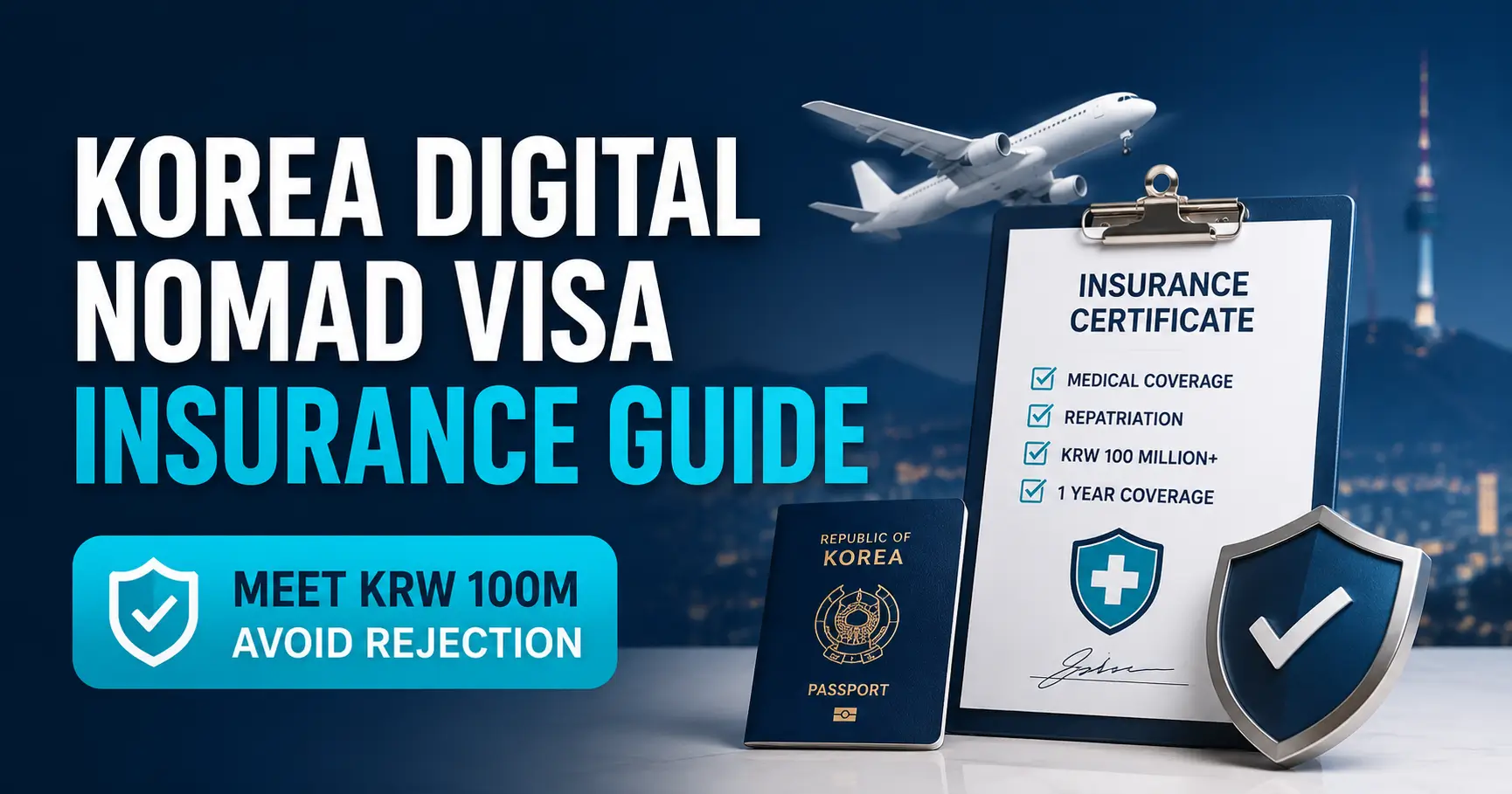
Korea F-1-D Workation Visa Guide
Korea Digital Nomad Visa Insurance Requirements:Avoid a Costly Rejection
A policy can look wonderfully international, carry a generous benefit limit, and still produce a certificate that says almost nothing a visa reviewer needs. That is the quiet danger here. You are not merely buying medical protection. You are buying protection that must also survive an administrative reading.
Korea’s national F-1-D guidance calls for individual medical insurance with at least KRW 100 million in coverage for medical treatment and repatriation during the stay. Yet individual Korean missions may describe the threshold, required duration, currency equivalent, and supporting documents differently.
This guide turns that fog into a buying checklist. You will learn how to compare travel and international health policies, inspect the certificate before paying, document coverage for dependents, and assemble an insurance packet that does not make the reviewer play detective.
Decode the rule
Understand the KRW 100 million threshold without guessing how benefits are counted.
Compare documents
Judge policies by certificates, dates, exclusions, and repatriation wording.
Prevent repeat purchases
Catch weak proof before a cheap quote becomes an expensive second policy.
The safest policy is not simply the one with the biggest number. It is the one whose documents answer every reviewer question before it is asked. 🧾
Snapshot
Who this is for: U.S. and UK remote employees, overseas business owners, qualifying independent professionals, and accompanying families preparing an F-1-D application. What it solves: uncertainty about coverage limits, one-year policy dates, repatriation wording, dependents, and proof documents. Your next move: request a draft visa certificate before paying for the policy.
Table of Contents
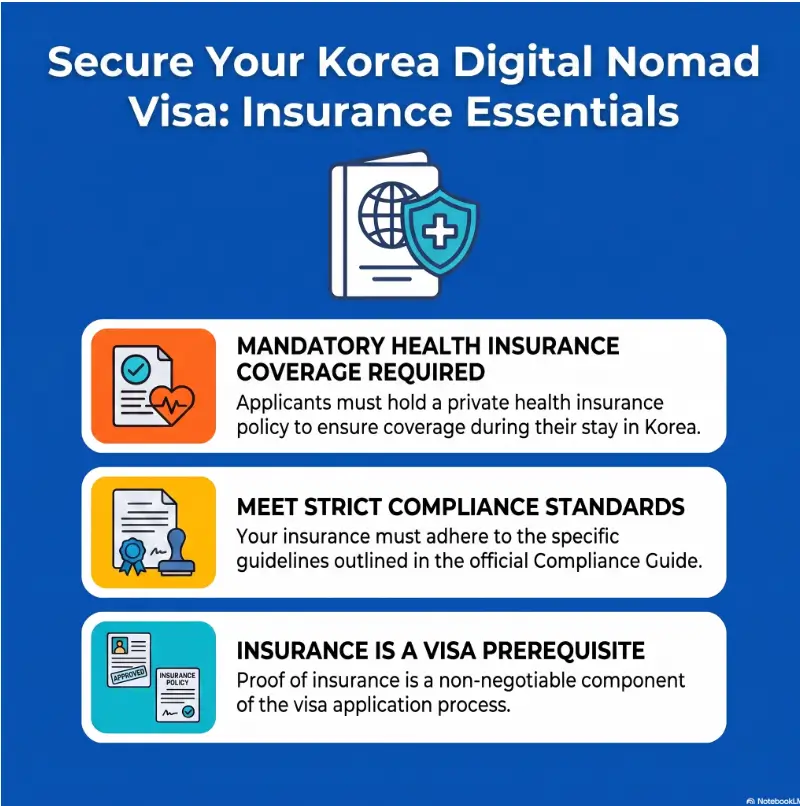
Before You Act: Treat the Consulate Checklist as the Final Filter
This article explains how to read and compare insurance for Korea’s F-1-D Workation Visa. It cannot determine whether a particular policy will be accepted by your assigned embassy, consulate, visa center, or immigration office.
Visa instructions can be revised, and two Korean missions may express the same national requirement using different currencies, document lists, or duration language. Your application is therefore governed by the current instructions of the office that will actually review it, not by a forum post, an insurer’s advertising page, or another applicant’s approval story.
Before You Act
Compare the official national guidance with your assigned mission’s current checklist. Ask the mission to clarify any unclear limit, duration, dependent, or currency requirement in writing. Insurance agents can explain their contracts, but they cannot promise visa approval.
Keep screenshots or PDF copies of the checklist you relied on. A dated copy gives you a clean record if instructions change while you are gathering documents.
Use three layers of verification
- National rule: Check the Korea Immigration Service guidance for the basic F-1-D insurance standard.
- Jurisdiction rule: Read the checklist published by the Korean mission responsible for your residential address.
- Policy evidence: Confirm that the issued certificate and policy wording prove every requested element.
That order matters. Starting with random insurance quotes is a little like shopping for a key before examining the lock.
The Insurance Rule in 60 Seconds
Fast Answer
Korea’s national F-1-D guidance requires individual medical insurance with coverage of at least KRW 100 million for medical treatment and repatriation to the applicant’s home country during the stay. A reviewing mission may also state a local currency equivalent, require a full year of coverage, or request detailed proof showing benefits and dates.
The KRW 100 million requirement, translated into plain English
The national guidance does not merely ask whether you “have health insurance.” It calls for individual medical insurance with at least KRW 100 million of coverage for medical treatment and repatriation to the home country during the stay. The same guidance lists a certificate of medical insurance among the application documents. :contentReference[oaicite:0]{index=0}
In practical terms, your documents should let a reviewer confirm four things without inference:
- The insured person is the visa applicant or dependent named in the application.
- The policy operates in South Korea.
- The medical benefit satisfies the required threshold or accepted equivalent.
- The policy includes repatriation to the insured person’s home country.
Why “medical treatment and repatriation” must appear together
Medical treatment pays for eligible care after illness or injury. Repatriation pays for an eligible return to the home country when medical circumstances require it, subject to the policy’s definitions and assistance procedures.
These are related benefits, but they are not interchangeable. A plan may offer a large medical maximum while providing no home-country repatriation. Another may include “emergency transport” that only moves a patient to the nearest suitable hospital.
That is why the benefit table matters more than a glossy phrase such as “complete worldwide protection.” The adjective is marketing. The benefit definition is the contract.
One national rule, several consular expressions
A Korean mission may restate the national won threshold using euros, dollars, pounds, or local checklist language. For example, the Korean Consulate in Seattle’s January 2026 F-1-D instructions describe EUR 70,000 of medical treatment and emergency return coverage and state that the insurance must cover one year in Korea. :contentReference[oaicite:1]{index=1}
That does not automatically make EUR 70,000 the universal figure for every U.S. or UK applicant. It makes it the published instruction that Seattle applicants should examine while it remains current.
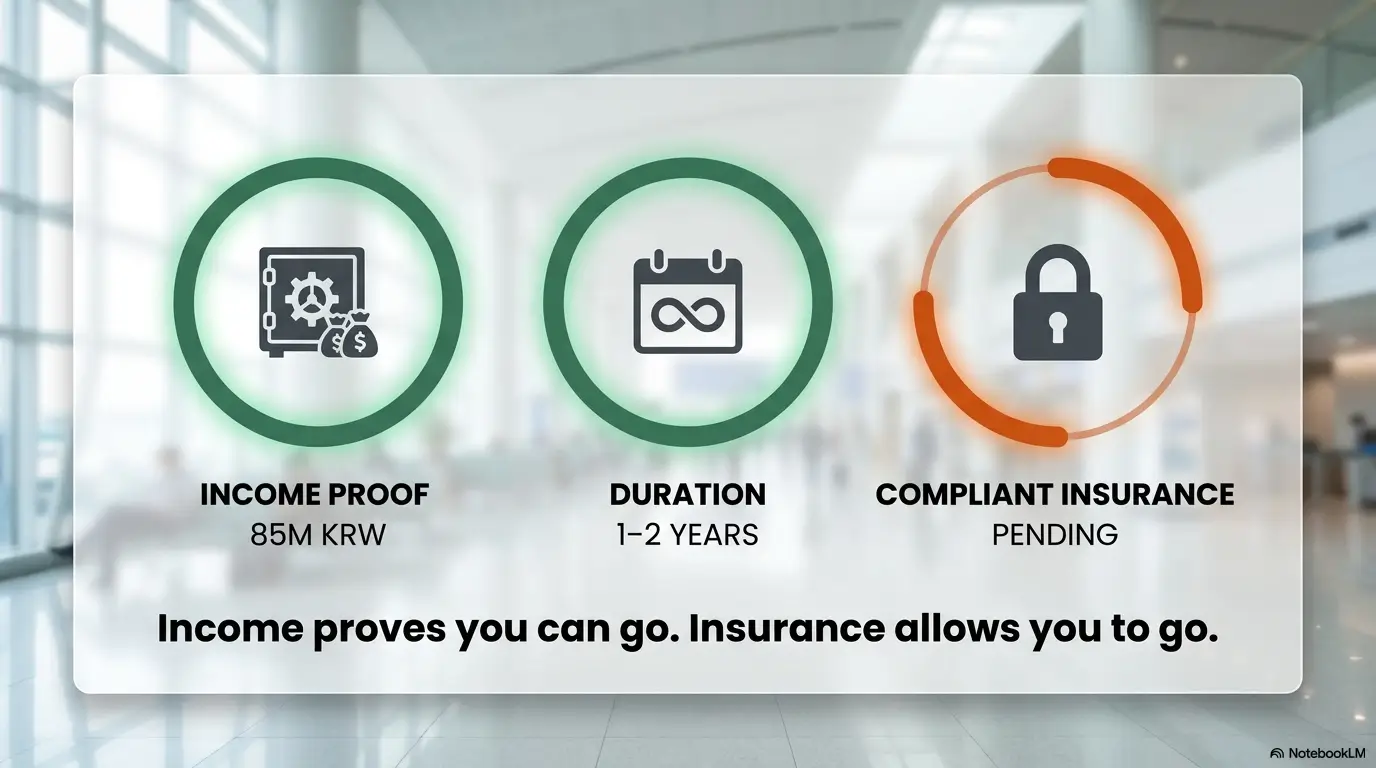
Who the F-1-D Visa Fits, and Who Should Keep Looking
A potential fit for overseas employees and business owners
The national guidance identifies overseas business owners and foreigners affiliated with international companies who can perform their work remotely and have worked in the same industry for at least one year. Accompanying family members may also be eligible.
A salaried employee may use an employment verification letter and income records. An owner may need business registration, tax, bank, client, or operational documents that show a real overseas business and a credible history.
Independent professionals need an evidence trail, not only a job label
“Freelancer” covers everything from a long-established consultant with registered business activity to someone who completed two small projects last month. The visa guidance is framed around overseas employment or business ownership, so independent applicants should confirm how their mission wants that status documented.
Useful evidence may include business registration, contracts, invoices, tax returns, client payment records, and a concise description of how work is performed remotely. Do not assume that a marketplace profile alone proves an overseas business.
Not designed for taking a job from a Korean employer
F-1-D status restricts local employment and profit-making activity in Korea. Someone whose actual plan is to join a Korean company, sell services locally, or operate a Korean-facing business may need a different immigration route.
This distinction also affects insurance shopping. A policy designed for a tourist, a posted employee, an international resident, and a locally employed worker may have very different eligibility rules.
Quick fit checklist before you shop for insurance
- You work for an overseas organization or operate a documented overseas business.
- Your work can be performed remotely from South Korea.
- You can prove the required employment or industry history.
- You can document income under your mission’s current standard.
- You do not intend to take unauthorized local employment.
- You know which Korean mission or immigration office will review the application.
- You know which family members will apply with you.
If the first five points remain unsettled, solve eligibility before buying a nonrefundable annual policy.
The KRW 100 Million Puzzle: What Does the Limit Really Mean?
Is it one combined limit or two separate benefits?
The national wording connects a KRW 100 million threshold with medical treatment and repatriation, but a real policy may display those benefits in separate rows. For example, medical expenses might have one maximum while repatriation has a smaller sublimit.
Do not quietly choose the interpretation most favorable to the policy. Ask the reviewing mission whether it expects:
- A medical maximum of at least KRW 100 million plus a separately stated repatriation benefit
- A combined overall maximum covering both categories
- Each category to meet a stated minimum
- The mission’s own published foreign-currency equivalent
The safest document usually shows a medical maximum comfortably above the stated threshold and a clearly identified home-country repatriation benefit. “Assistance included” is not the same as a measurable insured benefit.
Per person, per policy, and family aggregate are different numbers
A family policy may advertise a large total maximum while limiting each insured person to a smaller amount. It may also impose a family aggregate that is shared across all claims.
Consider a policy showing a USD 250,000 family maximum for four people but only USD 50,000 per insured person. The headline number sounds generous. The individual limit is the number a reviewer may care about.
| Limit wording | What it may mean | What to verify |
|---|---|---|
| Per insured person | Each named person receives the stated maximum | Confirm every applicant is named |
| Per policy period | The maximum applies across the full coverage term | Check whether prior claims reduce the available amount |
| Family aggregate | All insured family members share one pool | Ask whether an individual sublimit also applies |
| Per incident | A new maximum may apply to each eligible event | Confirm whether an annual cap still limits total claims |
| Schedule maximum | Different treatments have separate caps | Look beyond the overall headline benefit |
What happens when the certificate uses another currency?
A certificate may state benefits in U.S. dollars, pounds, euros, or another currency. Exchange rates move, so a foreign-currency limit sitting barely above today’s conversion can become awkward by the submission date.
Use the figure published by your reviewing mission when one is provided. When it is not, ask whether the mission wants a specific exchange-rate source or conversion date. Choosing a limit with breathing room is usually more sensible than balancing on the threshold like a coffee cup on a train table.
Show me the nerdy details
Insurance limits can be structured as an overall maximum, a benefit-specific sublimit, a per-person maximum, a per-event maximum, or an aggregate shared across several people. A certificate may display only the overall maximum while the policy schedule contains smaller caps for hospitalization, outpatient care, ambulance transport, evacuation, or repatriation.
The deductible is another layer. A policy can technically carry a large maximum while requiring the insured person to pay a substantial amount before benefits begin. The national guidance does not explain how deductibles should be assessed, but a mission requesting “coverage details” may review them.
For visa evidence, think in two columns: the maximum visible on the certificate and the usable benefit defined in the contract. Your application packet should make both understandable.
Policy Wording That Can Make or Break the Application
“Worldwide coverage” is weaker than naming South Korea
A certificate saying “worldwide excluding the United States” may cover Korea, but it requires the reviewer to interpret the geography. A certificate stating “coverage valid in the Republic of Korea” removes the puzzle.
Ask the insurer to name South Korea directly, especially when the contract has regional exclusions, sanctioned-country clauses, residence restrictions, or separate coverage zones.
Emergency evacuation is not always repatriation home
Emergency medical evacuation commonly means transportation to the nearest facility capable of providing suitable care. Medical repatriation generally refers to returning the insured person to the home country when medically necessary and authorized under the policy.
Some policies combine the benefits. Others separate them. Still others provide transport coordination but make payment conditional on prior approval from an assistance company.
Your certificate should use language that clearly addresses return to the home country, not only transport to “an appropriate facility.”
Deductibles and exclusions hiding beneath the certificate
Two policies with identical benefit limits can offer very different protection. Before choosing by price, compare:
- Per-claim and annual deductibles
- Coinsurance or percentage cost sharing
- Outpatient and prescription caps
- Pre-existing condition exclusions
- Mental health limitations
- Pregnancy and maternity exclusions
- Sports, motorcycle, and activity exclusions
- Waiting periods
- Direct billing availability
- Prior authorization rules for evacuation or repatriation
A visa reviewer may focus on threshold and wording, while you must also live with the policy after arrival. The cheapest compliant-looking certificate can still be a poor medical plan.
The six details your proof-of-insurance letter should display
- Full legal name: Matching the passport exactly.
- Destination: South Korea or the Republic of Korea stated clearly.
- Policy dates: Exact start and end dates.
- Medical maximum: With currency and whether it is per person.
- Repatriation benefit: Explicitly covering return to the home country.
- Policy identification: Policy number, insurer name, and a verifiable contact.
It is also helpful when the document shows the deductible, territorial scope, and confirmation that coverage remains valid during residence in Korea rather than only during short trips.
Real-world example: The certificate that looked complete
Imagine Maya, a remote product designer applying with her spouse. She buys a twelve-month policy advertising USD 500,000 in emergency medical coverage. The confirmation email arrives instantly, so she adds it to the visa folder and moves on.
Two weeks later, she notices that the one-page certificate lists only her name. It says “worldwide travel assistance,” but never names Korea, gives no repatriation amount, and shows the policy as renewable monthly despite the annual quote.
The insurer can issue a detailed letter, but only after the policy starts. Cancellation carries an administrative fee.
Maya’s mistake was not choosing insufficient insurance. It was paying before examining the document that had to prove sufficiency. A draft certificate request would have revealed every gap while she still had choices.
Key Takeaway
Never evaluate a visa policy only from the sales page. Ask for a sample or draft certificate, benefit schedule, and relevant policy definitions before payment.
The One-Year Trap: Compare Duration Before Price
Why a 90-day travel plan may fail a one-year application
The F-1-D stay is generally granted for one year and may be extended for one additional year under the national guidance. A short-trip policy covering only the flight dates does not necessarily match a one-year residence application.
Some travel insurers cap each trip at 30, 60, 90, or 180 days even when the policy itself is sold as “annual.” Read the maximum trip duration, not only the policy term.
Entry date, visa issuance date, and policy start date are different clocks
The visa may be issued before you enter Korea. The authorized stay typically begins in relation to entry and immigration processing, while the insurance begins on the date written in the contract.
Starting coverage too early can cause it to expire before the intended stay ends. Starting it too late can leave a gap on arrival or fail a document review.
When your departure date is uncertain, ask the insurer whether the start date can be changed before departure and whether the certificate can be reissued without canceling the policy.
Monthly renewable insurance creates avoidable questions
A monthly subscription may promise continuous coverage as long as payments continue. Yet its certificate may prove only the current month, not a committed one-year term.
That does not mean every renewable plan is unacceptable. It means the evidence is weaker unless the insurer can state that coverage is arranged for the full period required by the reviewing mission.
Travel insurance, expat coverage, or existing U.S. health insurance?
| Option | When it may work | Document challenge | Best question to ask |
|---|---|---|---|
| Good: Long-stay travel medical | Healthy applicants seeking emergency-focused protection | Trip-duration caps and narrow repatriation wording | Can you issue a one-year certificate naming Korea and all required benefits? |
| Better: Annual international travel medical | Frequent travelers needing broader territorial coverage | An annual policy may still limit each trip | Does coverage remain active for one continuous year in Korea? |
| Best document fit: International major medical | Families, longer stays, or readers wanting routine and emergency care | Higher premiums and possible underwriting | Is home-country repatriation included or available as a rider? |
| Existing domestic health plan | Applicants whose plan genuinely covers overseas treatment | Domestic cards and summaries may not prove Korea coverage or repatriation | Will the administrator issue a visa-specific overseas coverage letter? |
A broad guide to travel insurance for South Korea can help you compare ordinary trip coverage with the longer-duration proof needed for a residence-style visa.
What drives the price of F-1-D insurance?
There is no single Korea digital nomad visa insurance price. Quotes vary according to age, health history, deductible, destination zone, policy duration, medical maximum, cancellation terms, outpatient benefits, and whether dependents are included.
Budget-conscious applicants should compare total cost rather than the first premium shown. Add possible certificate fees, installment charges, currency conversion, cancellation penalties, and the cost of buying replacement coverage if the documents fail.
Dependents Change the Insurance Math
Does a spouse need a separate certificate?
A spouse may appear on the same family policy, but the visa packet should still prove that the spouse is an insured person with qualifying coverage. A separate policy is not always necessary. Separate evidence may be.
If one certificate lists only the primary applicant and refers vaguely to “family members,” request a revised document naming every insured applicant.
How children should appear on the documents
Each dependent child’s name should match the passport and family-relationship evidence. Confirm the child’s effective date, medical maximum, deductible, and repatriation benefit.
Do not assume a policy automatically covers newborns, pregnancy, congenital conditions, school activities, or a child’s pre-existing medical needs. Those questions affect real protection even when the certificate satisfies the basic visa checklist.
The family aggregate can shrink impressive coverage
Suppose a policy displays a KRW-equivalent benefit well above the visa threshold but shares that amount among five people. Ask the mission whether the stated requirement must be demonstrated individually and ask the insurer for the per-person limit.
The word “individual” in the national guidance is a strong reason to make each person’s coverage visible rather than relying on a household headline.
Five questions to ask about a family policy
- Is every applicant named on the certificate?
- Is the medical maximum per person or shared?
- Does each person have home-country repatriation coverage?
- Do children have different deductibles or benefit caps?
- Can the insurer issue separate certificates without separate policies?
After arrival, longer-term residents may also need to understand Korean National Health Insurance rules for foreigners. Enrollment in Korea’s public system should not be assumed to replace the pre-application private insurance evidence requested for the F-1-D visa.
Family Rule of Thumb
One household policy is fine only when the paperwork clearly proves qualifying coverage for each visa applicant. Shared love is wonderful. Shared ambiguity is less charming.
Build a Visa-Ready Insurance Packet
Put the clearest evidence first
A reviewer should be able to verify the essential facts on the first page, then move deeper only when necessary. Arrange the packet in this order:
- Visa-specific certificate: Names, Korea coverage, dates, medical maximum, and repatriation.
- Policy schedule: The formal record of insured people, term, currency, and selected benefits.
- Benefit table: Medical, evacuation, and repatriation limits.
- Relevant definitions: Pages defining repatriation and territorial coverage.
- Payment or enrollment confirmation: Supporting evidence that the policy is active or bound.
- Translation or currency note: Only when requested or needed for clarity.
- Written clarification: Any email from the mission addressing unusual wording.
Do not bury the certificate beneath sixty pages of terms. More paper does not always produce more certainty. Sometimes it merely grows a small forest on the reviewer’s desk.
Copy this visa-specific certificate request
Certificate Request Template
I am applying for South Korea’s F-1-D Workation Visa. Before purchasing, please confirm whether you can issue a signed certificate or official letter showing:
- My full legal name and the names of all insured dependents
- Coverage valid in the Republic of Korea
- Exact policy start and end dates
- The medical-treatment maximum and currency, stated per insured person
- Medical repatriation or return to the home country, including its limit
- The deductible, policy number, insurer name, and contact information
Please send a sample or draft of this document and confirm the cancellation terms before I pay.
The five-step proof flow
From Insurance Quote to Visa-Ready Proof
1. Find the reviewer
Identify the mission or immigration office with jurisdiction.
2. Capture the rule
Save the current threshold, duration, and document instructions.
3. Request a draft
Ask the insurer to show the exact certificate before payment.
4. Audit the wording
Check names, Korea, dates, limits, repatriation, and exclusions.
5. Build the packet
Place the certificate first and supporting definitions behind it.
Remember that approval is not the end of medical planning
Keep digital and printed policy copies after entering Korea. Save the international assistance number separately from the insurer’s ordinary customer-service line.
It also helps to understand how hospital admission in Korea works and when medical translation support may be worth arranging. A policy card is useful, but it does not explain symptoms at 2 a.m.
Eight Insurance Mistakes That Cause Delays or Repeat Purchases
| Common mistake | Why it creates risk | Safer alternative |
|---|---|---|
| Submitting only an insurance card or receipt | It proves purchase, not benefits, destination, or duration | Submit a detailed certificate and benefit schedule |
| Showing evacuation without home-country repatriation | Transport may stop at the nearest suitable hospital | Request explicit return-to-home-country wording |
| Using a certificate that never mentions Korea | The reviewer must interpret territorial coverage | Ask the insurer to name the Republic of Korea |
| Buying coverage only for booked flight dates | The policy may not cover the requested visa period | Align dates with the mission’s duration requirement |
| Relying on a family headline limit | Each person may have a smaller sublimit | Show per-person benefits for every applicant |
| Using a stale exchange-rate conversion | The foreign-currency amount may fall below the threshold | Use the mission’s published equivalent or seek confirmation |
| Trusting the sales page | Marketing summaries omit exclusions and contract definitions | Review the certificate, schedule, and policy wording |
| Following another mission’s checklist | Jurisdiction-specific instructions may differ | Use the office responsible for your address |
The cheapest quote becomes expensive when you must replace it
A low premium can be perfectly reasonable when the insurer provides strong documents, suitable coverage, and fair cancellation terms. The problem begins when price is compared before evidence quality.
Before paying, calculate the cost of failure:
- Nonrefundable premium or cancellation fee
- Express document charges
- Lost visa appointment or mailing window
- Replacement policy cost
- Changed flight or accommodation plans
- Additional time spent obtaining revised evidence
An insurance card is a door key, not the building plan
The card helps a hospital or assistance provider identify the policy. It rarely explains the maximum benefit, territorial scope, repatriation definition, or one-year term.
Keep the card for care. Use the certificate and schedule for the visa.
Loss-Prevention Rule
Do not buy from a provider that refuses to show what the visa certificate will say. A vague promise today often becomes a very precise exclusion tomorrow.
Before You Buy: Run the Five-Question Verification Test
Five yes-or-no questions
- Will the policy cover eligible medical treatment inside South Korea?
- Is the stated individual limit at least KRW 100 million or the reviewing mission’s accepted equivalent?
- Does it include medical repatriation or return to the insured person’s home country?
- Will the certificate cover the entire period requested by the reviewing mission?
- Can the insurer issue an official document displaying every required detail?
A “maybe,” “normally,” or “it should” is not a yes. Ask for the relevant contract page or a written statement.
Provider red flags worth pausing over
- The sales representative says the plan is “visa approved” but cannot identify the reviewing authority.
- The insurer will not provide a sample certificate before purchase.
- The certificate is generated automatically and cannot be revised.
- The annual plan limits each trip to a much shorter period.
- Repatriation appears only in a nonbinding marketing summary.
- The provider cannot explain whether family limits are per person.
- The cancellation period expires before the certificate is issued.
Pattern interrupt: no written confirmation, no purchase
This rule may feel strict when departure planning is already crowding your calendar. It is still easier than explaining an ambiguous certificate after the policy becomes nonrefundable.
Written confirmation also reveals service quality. If a provider cannot answer a pre-sale documentation question clearly, consider how it may handle an urgent claim from another time zone.
Use a quote comparison scorecard
| Comparison factor | Weight | What earns full marks |
|---|---|---|
| Visa certificate quality | 25% | All names, Korea, dates, limits, and repatriation shown clearly |
| Coverage duration | 20% | Continuous coverage for the period requested by the mission |
| Medical protection | 20% | Adequate usable benefits, not merely a large headline maximum |
| Repatriation wording | 15% | Home-country return is explicit and benefit limits are visible |
| Cancellation flexibility | 10% | Reasonable refund or date-change terms before departure |
| Price | 10% | Competitive total cost after fees and currency charges |
Price matters. It simply should not receive more influence than the document that determines whether the policy is useful for the application.
Korea Digital Nomad Visa Insurance FAQ
How much health insurance does the Korean digital nomad visa require?
The national F-1-D guidance states at least KRW 100 million in individual medical insurance coverage for medical treatment and repatriation to the home country during the stay. Your assigned Korean mission may publish a foreign-currency equivalent or additional documentation instructions.
Does the KRW 100 million include both treatment and repatriation?
The national wording connects the threshold with both medical treatment and repatriation but does not explain every possible policy structure. Because policies use combined limits, sublimits, and separate benefits, ask the reviewing mission how it wants those amounts documented.
Must the policy cover the entire first year?
Some missions explicitly request one year of insurance, including the Seattle consulate’s published F-1-D checklist. Check your own mission rather than assuming that short-term or monthly renewable coverage will be accepted.
Can I use my existing U.S. health insurance?
Possibly, when the plan genuinely covers treatment in South Korea, includes the required repatriation benefit, and can issue suitable proof. Many domestic plans provide limited overseas emergency reimbursement and do not include medical repatriation, so review the contract rather than relying on the member card.
Is ordinary travel insurance accepted?
A long-stay travel medical policy may work when its duration, individual medical limit, territorial coverage, repatriation benefit, and certificate satisfy the reviewing office. A standard 30-day vacation plan may not match a one-year application.
Does the certificate need to mention South Korea?
National guidance may not prescribe a single certificate format, but naming South Korea makes the territorial coverage easier to verify. When the certificate only says “worldwide,” ask the insurer to clarify whether any regional or residence exclusions apply.
Do my spouse and children need separate insurance?
They may be insured under one family policy, but each visa applicant should be named and have clearly documented qualifying coverage. Ask whether the benefit maximum is per person or shared and whether your mission wants separate certificates.
Can I cancel the policy after the visa is approved?
Canceling may leave you uninsured and could conflict with the purpose of an ongoing insurance requirement. Proof may also matter during entry, foreigner registration, or an extension. Treat the policy as protection for the stay, not a temporary prop for the application.
What should I do when my consulate lists euros, pounds, or dollars?
Use the current figure published by that office and verify that your policy’s stated currency and limit meet it. Avoid relying on a conversion calculated months earlier or a threshold copied from another jurisdiction.
Will a policy qualify if it excludes pre-existing conditions?
The basic visa guidance focuses on coverage and repatriation rather than providing a detailed rule for every exclusion. However, an exclusion can make the policy much less useful to you personally. Applicants with ongoing conditions should compare definitions, waiting periods, stability clauses, and available international medical options carefully.
Your 15-Minute Next Step: Request One Document
Do not spend tonight comparing twenty nearly identical quote pages. Spend fifteen minutes creating the document standard every quote must pass.
The 3-5-4-3 plan
- Three minutes: Open your assigned Korean mission’s current F-1-D checklist and save a dated copy.
- Five minutes: Copy the certificate request template from this guide and add your family members’ names and intended dates.
- Four minutes: Send it to each insurer you are seriously considering.
- Three minutes: Create a folder named “F-1-D Insurance Proof” for certificates, policy schedules, mission replies, and cancellation terms.
When the replies arrive, compare documents first, coverage second, and price third. That sequence does not ignore cost. It prevents you from paying twice.
The final check
Your certificate should tell a complete six-part sentence: who is insured, where coverage applies, when it operates, how much medical coverage exists, how repatriation is covered, and which policy provides it.
Immediately before submission, return to the official pages rather than relying on the copy you saved weeks earlier. Visa instructions can move quietly, like a platform change announced after you have already carried the suitcase downstairs.
The right policy should protect both your application and your actual year in Korea. Get the certificate right before the premium leaves your account, and the rest of the insurance decision becomes far less mysterious.
Last reviewed: 2026-08