
Korean Trademark Registration Cost: MOIP (Formerly KIPO) Fees, Attorney Fees and Rejection Risk
A Korean trademark can look inexpensive if you see only the filing fee. For a straightforward electronic application, the current government filing fee starts at KRW 52,000 per class. But filing is only the first invoice. If the mark is approved, a registration fee follows, and a foreign applicant without an address or place of business in Korea generally needs a Korean patent agent to handle the filing.
The bigger financial question is therefore not simply “How much does KIPO charge?” It is whether your proposed mark, goods and services, class strategy, Korean representative and clearance search are strong enough to avoid paying for an application that later collides with an earlier mark or receives a refusal.
This guide is for foreign founders, companies, creators and brand owners considering Korean trademark protection. For a simple one-class application with no more than 10 designated goods or services, the current MOIP official-fee baseline is KRW 52,000 to file electronically plus KRW 201,000 if the mark proceeds to lump-sum registration. Professional fees, searches, office-action responses, extra classes, additional designated goods, priority claims and opposition work can raise the total. If you have no address or place of business in Korea, confirm your Korean representative before attempting to file.
Table of Contents
This article can help you understand the cost structure and identify questions to ask before filing. It cannot determine whether your particular mark is registrable or whether an earlier trademark creates a legal conflict. Check the current MOIP fee schedule immediately before payment, and obtain professional advice when your brand is commercially important, an earlier similar mark exists, you are claiming foreign priority, or a refusal or opposition has already been issued.
What a Korean Trademark Actually Costs
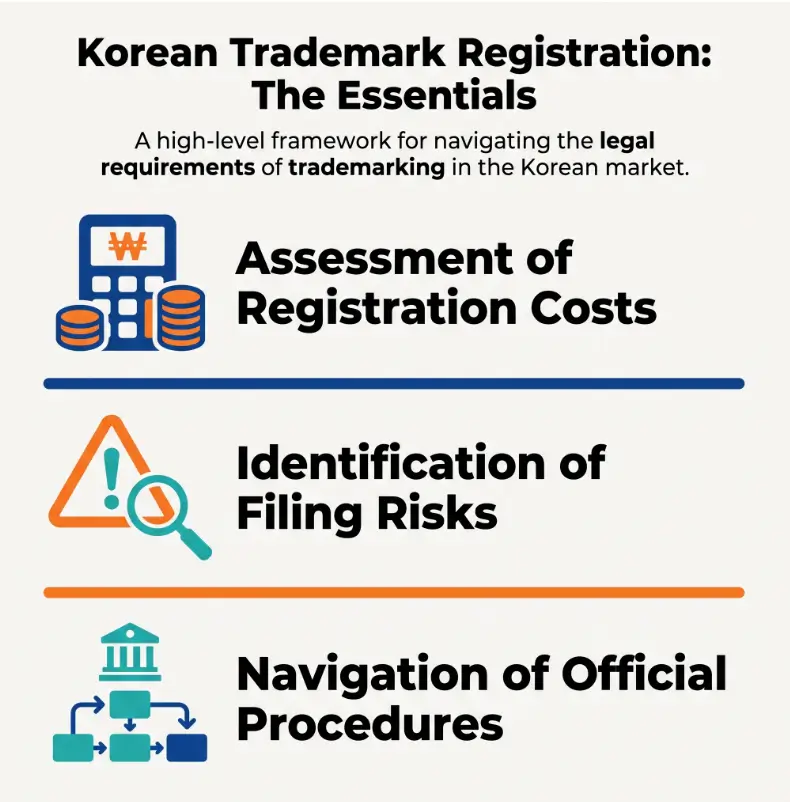
The most useful way to budget a Korean trademark is to separate government charges from professional charges and risk-response charges. Mixing them together is how a KRW 52,000 filing fee turns into a surprisingly large invoice later.
For a straightforward one-class electronic filing containing no more than 10 designated goods or services, the basic official cost through successful lump-sum registration is currently KRW 253,000: KRW 52,000 at filing plus KRW 201,000 at registration. That is a government-fee baseline, not an all-inclusive cost for a foreign applicant.
| Cost layer | When it appears | What can increase it |
|---|---|---|
| Official filing fee | When the application is filed | Additional classes, paper filing, more than 10 designated goods/services per class |
| Search and professional preparation | Before filing | Number of marks, classes, similar marks, Hangul variations, scope of legal analysis |
| Prosecution cost | During examination | Provisional refusal, amendments, written arguments, evidence |
| Registration fee | After allowance | Classes, number of designated goods/services, payment method |
| Dispute cost | If challenged | Opposition, appeal, invalidation or infringement issues |
| Future maintenance | At renewal | Classes and number of designated goods/services |
The distinction matters because an inexpensive filing is not necessarily an inexpensive trademark strategy. If you select the wrong goods, fail to search a Korean-language variant, or file a descriptive mark that receives a refusal, the professional work required afterward can dwarf the original government fee.
MOIP/KIPO Trademark Fees by Class
MOIP publishes trademark charges in Korean won. The fee structure is class-based, with additional charges when a class contains more than 10 designated goods or services.
| Official fee | Current amount | How to read it |
|---|---|---|
| Electronic trademark application | KRW 52,000 | Per class |
| Paper trademark application | KRW 62,000 | Per class |
| Extra designated goods/services | KRW 2,000 each | For each item beyond 10 in a class at filing |
| Priority claim | KRW 18,000 electronic / KRW 20,000 paper | Where a qualifying priority claim is made |
| Preferential examination request | KRW 160,000 | Separate from normal examination and subject to eligibility requirements |
| Lump-sum registration | KRW 201,000 | Per class after allowance |
| Extra designated goods/services at registration | KRW 2,000 each | For each item beyond 10 in a class |
| Registration by installments | KRW 122,000 per installment | MOIP lists a two-installment option; extra-goods charges also apply |
| Ten-year renewal, lump sum | KRW 300,000 | Per class, subject to additional-goods charges |
You can verify the current amounts directly on the MOIP trademark Fees and Payments page. Because government fee schedules can change, that page should win over an old law-firm article, an old invoice or a cached search result.
Example 1: one class with 10 or fewer designated goods
Assume you file electronically, use one class and have no more than 10 designated goods or services. If the mark is accepted and you pay the registration fee in a lump sum, the official-fee arithmetic is:
- Electronic application: KRW 52,000
- Lump-sum registration: KRW 201,000
- Basic official total: KRW 253,000
This does not include a professional search, patent-attorney fee, translation work, priority documents, response to a refusal or opposition proceedings.
Example 2: one class with 15 designated goods
Five items exceed the 10-item threshold. Based on the current fee table, that creates an extra KRW 10,000 at filing and another KRW 10,000 at lump-sum registration. The government-fee total becomes KRW 273,000, assuming no other charge applies.
This illustrates an important budgeting point: the number of classes is not the only variable. The number of individually designated goods or services inside each class can matter too.
Show me the nerdy details: Nice classes are only part of the search
Korean applications designate goods and services under the Nice Classification, and a single trademark can cover multiple classes. But a serious Korean clearance search should not stop at typing your brand name and checking the same Nice class.
KIPRIS also exposes Korean search fields including designated goods and similar-group codes. Those tools help identify goods or services Korea may regard as related for examination purposes. This is one reason a professional clearance opinion can be more useful than an exact-match search alone.
The practical question is not merely “Is this spelling already registered?” It is “Is there an earlier mark that may be considered legally similar for the goods or services I intend to claim?”
Why Attorney Fees Can Exceed the Government Fees
There is no single government-set “Korean trademark lawyer fee.” Professional charges are privately quoted, and overseas searchers should also understand the terminology: trademark prosecution in Korea is commonly handled by a registered patent attorney, or byeonrisa (변리사), rather than by the type of general-practice lawyer an American or British reader may picture.
Publicly advertised provider menus illustrate how wide the scope can be. Current published examples we reviewed range from roughly US$250 for a basic one-class filing professional fee to around US$600 per class for broader attorney-led filing packages. Some providers separately price clearance searches and registration-stage handling, while others bundle those functions. Office-action responses are commonly outside the basic filing quote.
Those examples are useful only as a market check. They are not an official tariff, not a promise of what your case will cost, and not a recommendation of a particular provider. A sophisticated clearance analysis for a valuable consumer brand should not be compared with a bare filing service as though they were the same product.
| Ask whether the quote includes | Why it matters |
|---|---|
| Identical and similar-mark clearance search | A filing service may simply submit what you give it without providing a meaningful risk opinion. |
| Nice class and designated-goods drafting | Overly narrow drafting can leave gaps; careless breadth can increase fees or objections. |
| Korean similar-group analysis | Conflicts may not be obvious from an exact-name search. |
| One or multiple marks | A word mark, logo and Korean-language version may require separate strategy and filings. |
| Official filing fees | Some quotes show professional fees first and add MOIP charges later. |
| Reporting routine MOIP notices | Ask what communication is included during prosecution. |
| Provisional-refusal response | This can create a substantial additional professional fee. |
| Registration-stage handling | Allowance does not eliminate the later registration payment and administrative work. |
| VAT, courier, translation or disbursements | Small excluded charges make superficially similar quotes difficult to compare. |
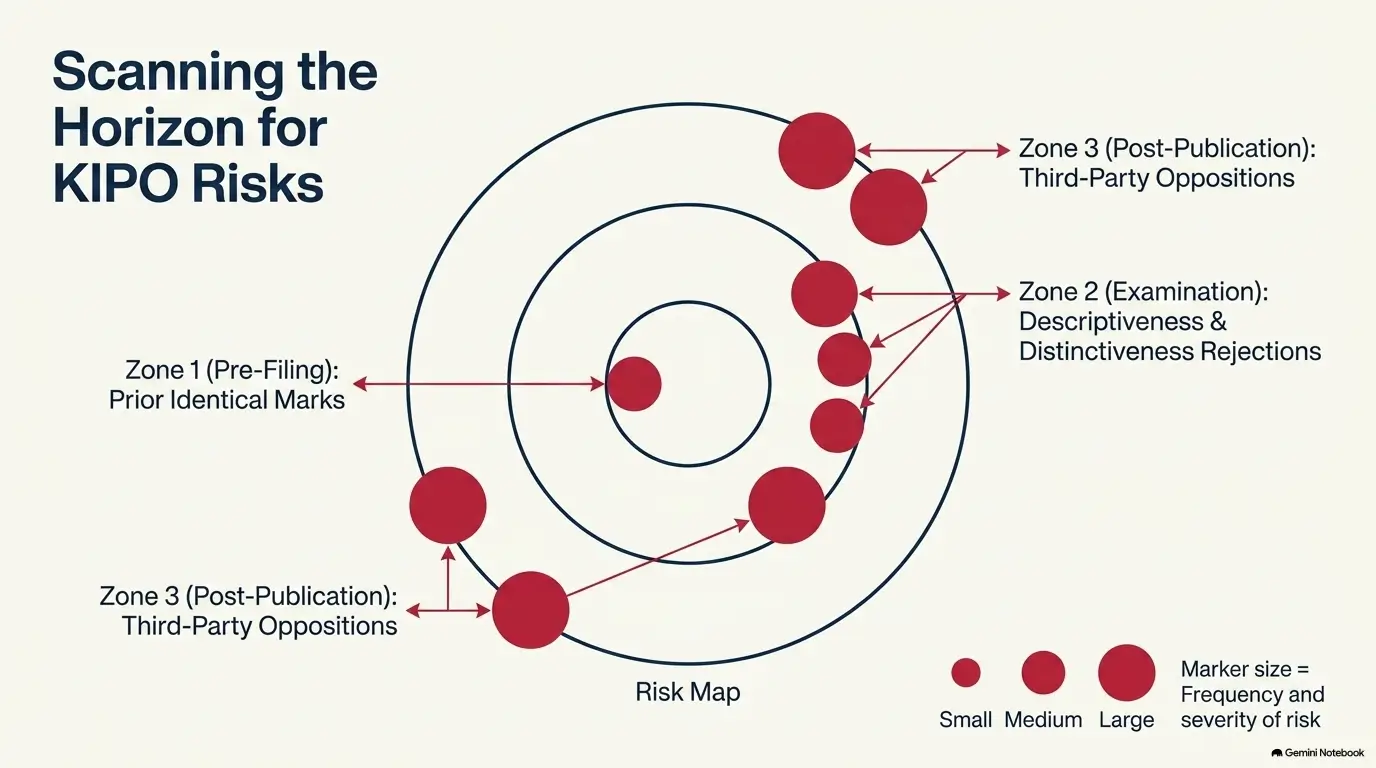
The Rejection Risks Worth Paying to Reduce
A universal “Korean trademark rejection rate” is not a very useful purchasing metric. Your risk depends on the mark itself, earlier rights and the goods or services claimed. A fanciful brand with a clean clearance search is a very different application from a descriptive English word being filed for a crowded consumer category.
1. The mark is not distinctive enough
MOIP requires a trademark to function as a source identifier. Marks consisting of ordinary product names, customary expressions or wording that merely describes characteristics of the goods can face refusal. A company may love a phrase precisely because it tells customers what the product does; trademark law may dislike it for the same reason.
2. An earlier mark is identical or legally similar
This is where pre-filing searching earns its keep. Do not search only the identical spelling. Examine similar wording, pronunciation, visual appearance, Korean transliterations and the relationship between the goods or services.
The official KIPRIS trademark database allows searches by trademark name, application and registration number, goods classifications, similar-group information and other fields. It is an excellent starting point, but interpreting a close result is a legal-analysis problem rather than a database problem.
3. Your goods and services are drafted badly
Trademark protection attaches to specified goods and services. Filing the wrong class or a poorly chosen list can create two opposite problems: you can pay for protection you do not need while failing to cover what your business actually sells.
A SaaS company, for example, may need to distinguish downloadable software from software-as-a-service or other technology services. A fashion brand may sell clothing today but plan retail, cosmetics or accessories tomorrow. More classes are not automatically better; they are more expensive and should correspond to the commercial protection you actually need.
4. A formal filing requirement is missed
MOIP’s current application guidance says an application may be treated as never properly submitted in certain fundamental situations, including when the applicant information, mark or designated goods are missing, the application is not in Korean, or a person with no Korean address or place of business files without the required Korean patent agent.
5. A third party opposes the application
Passing examination is not necessarily the final quiet moment. After publication in the Trademark Publication Gazette, any person may file an opposition within two months. MOIP describes that two-month period as non-extendable.
This matters especially where you already know of a competitor, distributor, former business partner or owner of a similar mark. A cheap filing strategy that ignores an obvious commercial conflict can simply move the cost from the filing stage to the opposition stage.
Foreign Applicants Face One Extra Filing Rule
Foreign ownership does not by itself prevent Korean trademark protection. The important practical distinction is whether the applicant has an address or place of business in the Republic of Korea.
MOIP’s current filing guidance states that where an applicant has no address or place of business in Korea, the filing must come through a patent agent in Korea. For a U.S., UK, Canadian, Australian or other overseas company applying directly from abroad, the representative cost therefore belongs in the initial budget rather than being treated as an optional upgrade.
The application itself requires applicant information, the trademark and the designated goods and classes. A power of attorney may also be required when a representative is involved. If you claim priority from an earlier qualifying foreign trademark application, Korea generally requires the Korean filing within six months of the priority application, while the priority documentation must be submitted within the separate period specified by MOIP.
Do not send a Korean provider only your company nickname and logo file. Give the exact legal applicant name and address that should own the right. Cleaning up ownership mistakes later is a poor use of professional fees.
- Korean IP Law Basics for Foreigners
- South Korea Patent Application Guide
- Korean Copyright Registration for Foreigners
- Korean Business Contracts: What Foreign Companies Should Check
- Korean Legal System for Foreigners
From Filing to Registration: Where Time and Money Accumulate
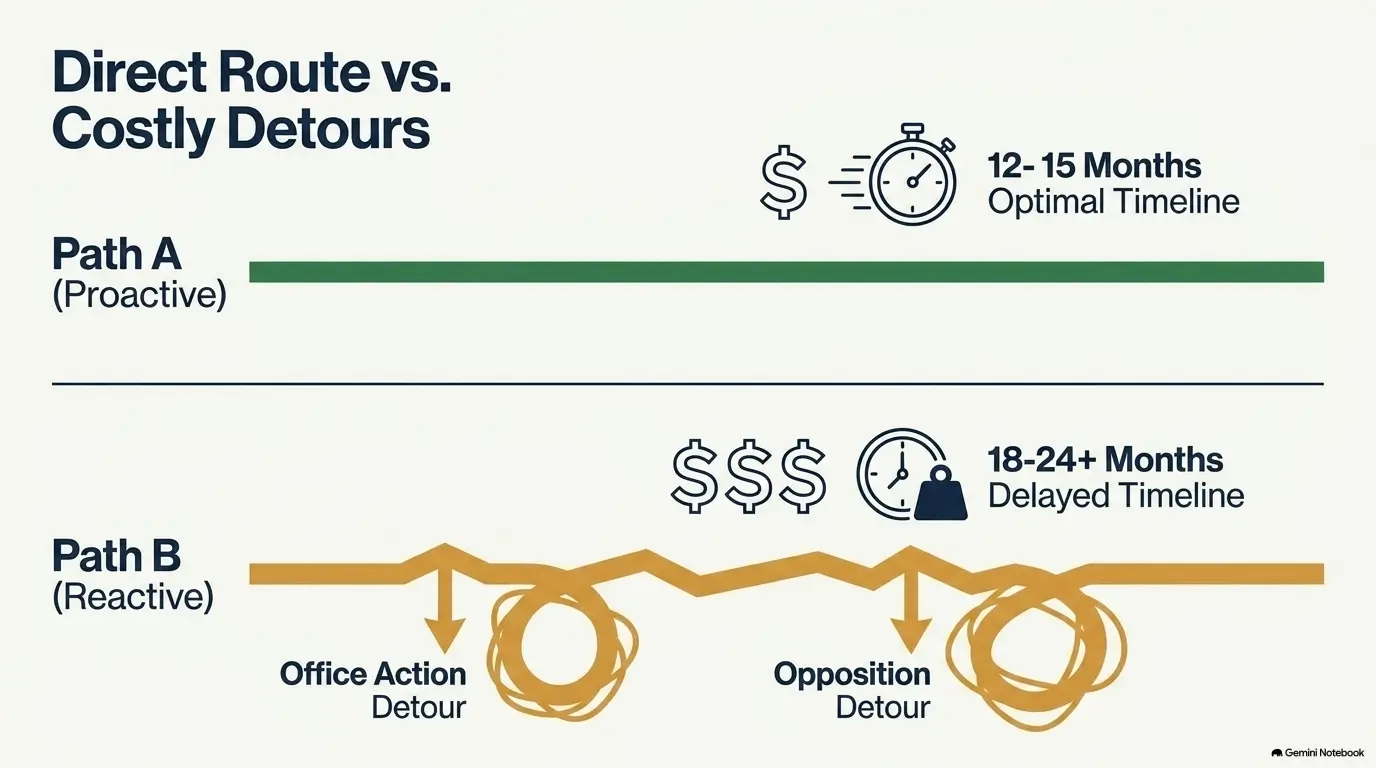
A normal Korean trademark application moves through filing, formality review, substantive examination, publication, opposition and registration. The expensive forks in the road are usually a refusal, opposition or poorly scoped application rather than the routine filing mechanics.
There is an important timing nuance. MOIP’s current application-procedure page says trademark examination generally takes about five months from filing. Separately, MOIP reported that average trademark pendency was 11.9 months in 2025, down from 12.6 months in 2024.
Those numbers should not be treated as contradictory guarantees. “Examination” and overall pendency are different measures, and an individual application can move faster or slower depending on workload, refusals, amendments, opposition and other procedural events. If a product launch or Korean distribution contract depends on registration, build a buffer instead of promising the business team a registration date based on a generic estimate.
If MOIP identifies grounds for rejection, it issues a notice and gives the applicant an opportunity to submit arguments, evidence or an amendment. If a final refusal follows, MOIP’s current guidance describes a 30-day period from delivery of the certified refusal decision for an appeal to the Intellectual Property Trial and Appeal Board. A live refusal is therefore a deadline problem, not just a branding problem.
DIY, One Consultation or Full Representation?
Professional help is not equally valuable in every trademark. A Korean-resident applicant with a highly distinctive mark and a simple one-class specification may be comfortable doing substantial preparation independently. An overseas applicant, however, must first account for Korea’s representative requirement when no Korean address or place of business exists.
| Approach | Best fit | Main limitation |
|---|---|---|
| DIY research | Early-stage name screening, KIPRIS searches, identifying likely classes | A search result does not tell you how an examiner will assess legal similarity |
| One professional clearance consultation | You can handle business decisions but want risk analysis before committing to the mark | You still need to know who will file, monitor and respond later |
| Full prosecution representation | Foreign nonresident, valuable launch, multiple classes, close prior marks, priority claim or complicated specification | Higher upfront professional cost |
| Dispute/appeal team | Opposition, final refusal, infringement or strategic conflict | Costs can become materially larger than routine filing |
For a commercially important overseas brand, one of the most rational places to spend money is before the application is filed. A good pre-filing review can tell you that the proposed mark is weak, that a competitor is too close, that the Korean transliteration deserves separate attention, or that your proposed goods list is protecting the wrong thing.
Questions to ask a Korean trademark professional before paying
- Are you quoting one trademark or several versions of the mark?
- How many Nice classes are included?
- How many designated goods or services are included in each class?
- Does the quote include a similarity search or only an identical-mark search?
- Will you review Hangul transliterations or Korean equivalents where relevant?
- Are MOIP filing fees included or passed through separately?
- Is the professional fee per application, per class or both?
- What happens to the fee if MOIP issues a provisional refusal?
- Is registration-stage handling included?
- Are VAT, translation, courier or other disbursements extra?
- Who monitors the application and opposition period?
- If the mark is refused, what would an appeal be quoted separately?
Suppose an overseas skincare company plans to print Korean packaging and appoint a distributor next month. The brand name appears clear in a simple exact-match search, but a Korean patent attorney identifies a phonetically similar registered mark covering closely related goods. Paying for that search did not “make registration more expensive.” It exposed the expensive problem before packaging, distributor agreements and advertising turned a naming issue into a rebranding project.
Trademark Filing Mistakes That Become Expensive
The most costly trademark mistakes are rarely arithmetic mistakes. They are scope and timing mistakes.
- Searching only the exact English spelling. Similar pronunciation, appearance and Korean transliterations can matter.
- Choosing classes by copying a foreign registration. Your Korean commercial plan and Korean examination context should drive the goods-and-services strategy.
- Assuming one application protects every version of the brand. Korea applies a single-application-for-a-single-trademark structure even though one mark may cover multiple classes.
- Budgeting only the filing fee. Registration, representation and possible response fees belong in the forecast.
- Adding every conceivable product “just in case.” More classes and excessive designated goods can create unnecessary cost and complexity.
- Waiting until a Korean launch is irreversible. Clearance is much cheaper before packaging, storefronts, distributor appointments and app listings are committed.
- Ignoring a refusal deadline. Once an official notice arrives, the question is no longer whether you want to deal with it eventually.
- Using the wrong legal owner. Decide whether the trademark should belong to the individual founder, Korean entity, foreign parent or another group company before filing.
There is also a post-registration trap. MOIP states that a registered mark can become vulnerable to cancellation if it remains unused for three or more consecutive years. Registration is therefore the beginning of an asset-management problem, not a ceremonial certificate to forget in a folder.
Official Sources to Verify Before Filing
Trademark fees and procedures can change. For a consequential filing, verify the rule you are relying on at the source rather than trusting an old pricing article.
- MOIP Fees and Payments for Trademarks — current filing, registration, renewal and related government charges.
- MOIP Trademark Application Procedure — filing requirements, examination, publication, opposition, refusal and appeals.
- KIPRIS Trademark Search — Korea’s IP database for searching applications and registrations.
- MOIP notice on the updated agency name and registration certificates — useful if older documents still refer to KIPO.
If a professional’s statement about an official fee conflicts with MOIP’s live fee page, ask why before paying. Sometimes the difference is a professional service charge, payment-processing cost or different filing method. Sometimes it is simply an outdated price list.
Korean Trademark Registration FAQ
How much does a Korean trademark cost for one class?
For one electronically filed class containing no more than 10 designated goods or services, the current basic MOIP filing fee is KRW 52,000. If the application proceeds to registration and the registration fee is paid in a lump sum, another KRW 201,000 is due. That produces a KRW 253,000 basic official-fee total before professional fees and other extras.
Does a foreigner need a Korean lawyer to register a trademark?
The decisive issue is not nationality alone. MOIP states that an applicant with no address or place of business in Korea must proceed through a patent agent in Korea. Overseas applicants should therefore budget for Korean representation. Trademark filing and prosecution work is commonly handled by a Korean patent attorney, or byeonrisa.
Does my U.S., UK or EU trademark automatically protect me in Korea?
No. Trademark protection is territorial. A foreign registration does not by itself produce Korean trademark rights. Depending on your portfolio, you may pursue a direct Korean application or seek Korean protection through an applicable international route such as the Madrid System. Either route still encounters Korean examination requirements.
How long does Korean trademark registration take?
Do not treat a single online estimate as a guaranteed registration date. MOIP’s current procedure page says examination generally takes about five months, while MOIP reported average trademark pendency of 11.9 months for 2025. Refusals, amendments, opposition and procedural circumstances can extend an individual case.
What happens if MOIP rejects my trademark application?
A provisional refusal is not necessarily the end of the application. MOIP provides an opportunity to submit written arguments, evidence or permissible amendments addressing the examiner’s grounds. If a final refusal is issued, the current MOIP procedure describes an appeal route to the Intellectual Property Trial and Appeal Board, with an important filing deadline.
Is a trademark search required before filing?
A clearance search is not the same thing as the filing itself, but skipping it can be false economy. At minimum, search KIPRIS for exact and similar marks relevant to your goods and services. Where the brand has substantial commercial value or the results are close, professional similarity analysis is easier to justify.
Should I register the English name and Korean Hangul version?
Sometimes, but not automatically. The answer depends on how Korean consumers, distributors and competitors are likely to use the brand and how similar marks already appear on the register. If the Hangul rendering functions as an important commercial version of the brand, ask whether it deserves separate protection rather than assuming the English filing solves every transliteration problem.
How long does a Korean trademark registration last?
A Korean trademark right generally lasts 10 years from registration and may be renewed in further 10-year periods. Keep renewal costs and actual use of the mark in your long-term IP budget rather than treating registration as a one-time expense.
Your Next 15 Minutes
Before requesting a trademark quote, build a one-page Korean filing brief. It will make every professional quote more comparable and may expose a weak assumption before you spend anything.
- Exact word mark or logo you want to protect
- Exact legal name and address of the proposed owner
- Products and services you sell in Korea now
- Products and services you realistically expect to add
- Likely Nice classes
- English, Hangul and other brand variations customers may use
- Any earlier U.S., UK, EU or other foreign application and its filing date
- Any similar Korean mark already found on KIPRIS
- Your planned Korean launch date
Then run a preliminary KIPRIS search and send the same brief to any professionals you ask to quote. The goal is not to buy the cheapest filing. It is to know, before committing the brand, what Korea will protect, what the filing really costs and where the application is most likely to become expensive.
Last reviewed: 2026-09