
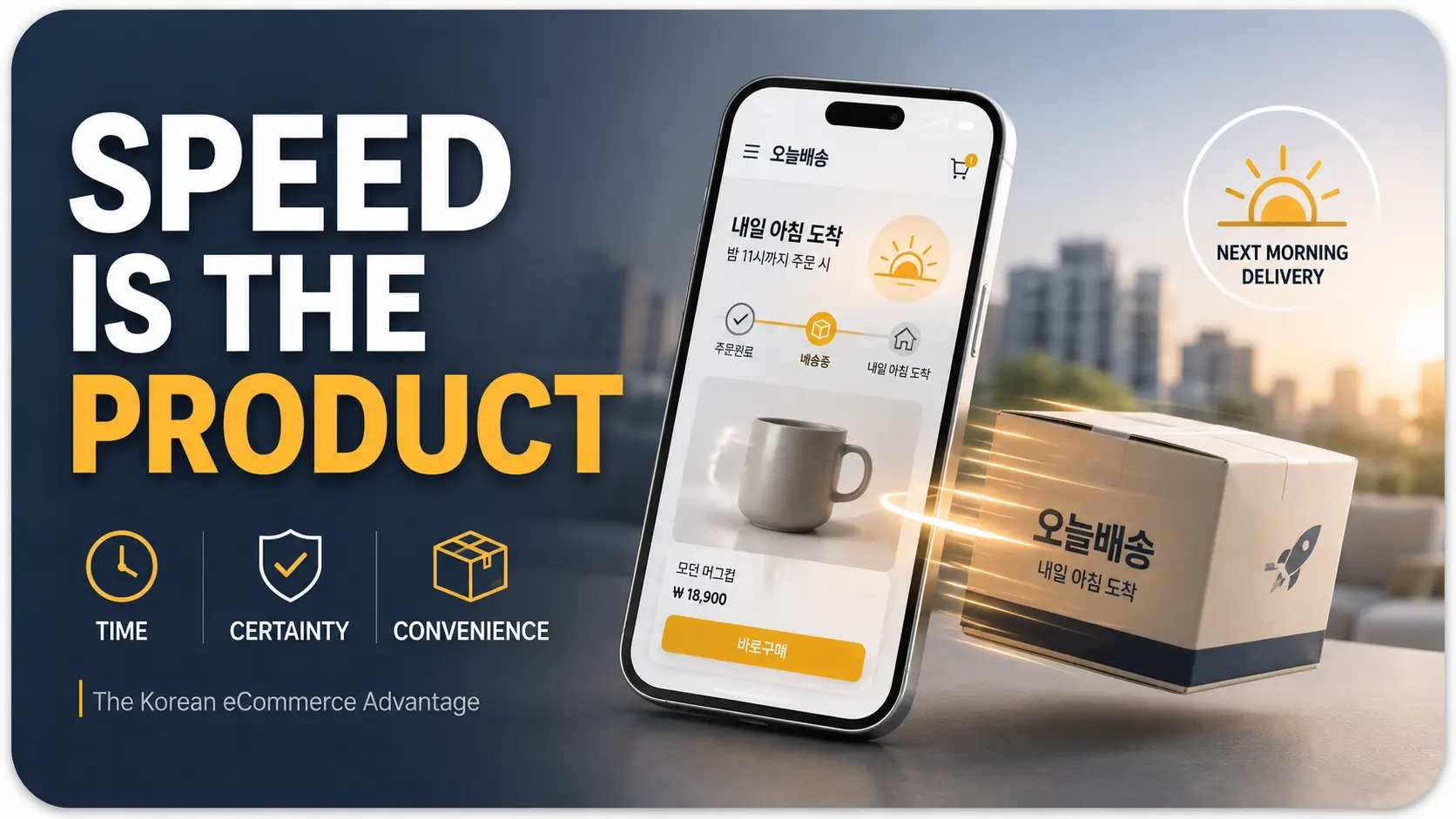
Korean Ecommerce, Explained
How Online Shopping in Korea Feels Different
Because Speed Is the Product
In much of the United States or United Kingdom, fast delivery is presented as a reward: pay for a membership, meet a spending threshold, or choose the expensive shipping option. In South Korea, speed often feels less like an upgrade and more like the floor beneath the entire shopping experience. The item and its arrival time are mentally bundled together.
That changes more than delivery. It changes when people shop, what they are willing to order online, how many items they buy at once, and how quickly a forgotten carton of milk becomes a completed transaction. Checkout, payment, tracking, apartment access, fulfillment, and customer expectations move as one tightly rehearsed system.
This guide explains why online shopping in Korea feels unusually immediate without reducing the answer to “Korea has fast shipping.” You will see where the speed comes from, what it costs, which habits it creates, and what retailers elsewhere can learn without trying to photocopy an entire country.
See the system
Understand how density, mobile payments, fulfillment, and apartment living reinforce one another.
Compare fairly
Separate genuine operational advantages from simplistic “Korea versus Amazon” comparisons.
Use the lesson
Find practical ways to improve timing, trust, and checkout clarity in any market.
Central idea: Korean ecommerce does not merely move parcels quickly. It sells the feeling that tomorrow’s problem can be solved before breakfast. ⚡
Article snapshot
This guide is for travelers, expats, culture readers, ecommerce professionals, and anyone curious about why Korean online shopping feels unusually fast. It explains the logistics and psychology behind the experience, identifies the trade-offs, and ends with a seven-day audit you can use to evaluate any shopping app.
Table of Contents
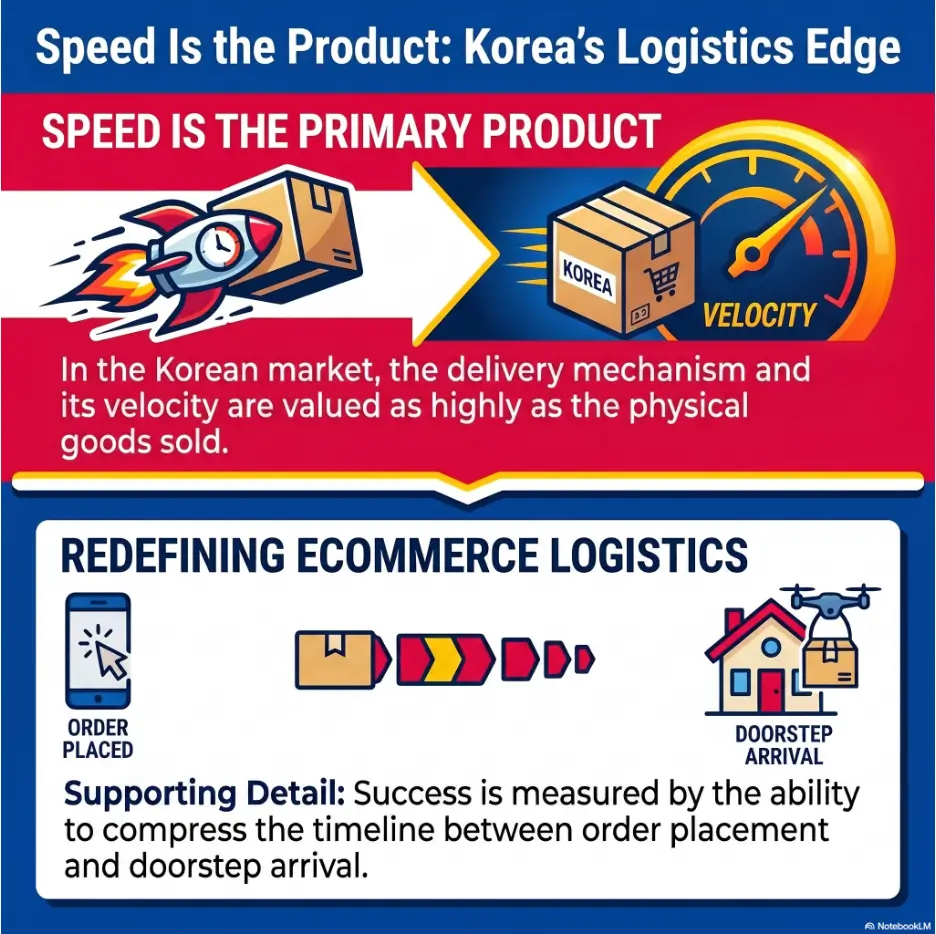
Korea Sells Time, Not Just Products
Imagine two identical boxes of laundry detergent. One is slightly cheaper but may arrive sometime between Wednesday and Saturday. The other costs a little more and is promised at your door before tomorrow morning. The second listing is not merely selling detergent. It is selling the removal of a small domestic worry.
That is the emotional center of fast online shopping in Korea. The platform is not asking only, “Which product do you want?” It is also asking, “How soon would you like this problem to disappear?” For a commuter returning to an apartment at 9 p.m., a parent discovering an empty diaper drawer, or a student who needs a charger before class, arrival time becomes part of the item’s practical value.
Why the delivery promise can matter more than the brand
Traditional retail theory often places brand, price, quality, and selection at the center of a purchase. Korean ecommerce adds another powerful variable: certainty of arrival. A familiar brand that comes later may lose to a perfectly acceptable alternative that comes sooner.
This is especially true for low-risk, repeat-purchase categories. Most people do not wish to conduct a candlelit symposium before choosing kitchen towels, bottled water, trash bags, instant rice, shampoo, or pet pads. When quality differences feel manageable, the delivery promise can become the deciding feature.
The important word is not simply fast. It is specific. “Ships quickly” leaves room for interpretation. “Expected before 7 a.m. tomorrow” gives the shopper a usable plan. The order now belongs to the household schedule.
How “arrives tomorrow” changes a shopper’s definition of value
Value is often described as quality divided by price. In everyday life, however, value also includes saved time, avoided travel, lower uncertainty, and reduced mental load. A parent may gladly pay a modest premium to avoid stopping at a crowded store after work. A freelancer may choose the listing that prevents tomorrow’s workday from being interrupted.
Fast delivery can therefore compete with physical retail on a deeper level. A nearby store once held the advantage because it offered immediate possession. Korean ecommerce narrows that gap until “I will buy it on my phone tonight” feels almost as dependable as “I will pick it up on my way home.”
The psychological shift is subtle. Once shoppers believe common items can arrive predictably and quickly, keeping backup stock at home feels less necessary. Pantries, bathroom cabinets, and utility closets can become leaner. The logistics network starts functioning as an external cupboard.
The hidden product inside every Korean order
The visible product may be strawberries, batteries, a phone case, or face cleanser. The hidden product is a compressed timeline. The platform takes a future errand and folds it into the present with a few taps.
This does not mean every order in Korea arrives instantly, nor that every resident has identical service. Rural areas, islands, merchant-fulfilled items, imported products, weather events, and order cutoffs all matter. The larger point is that leading services have trained many urban shoppers to treat quick, trackable fulfillment as normal rather than exceptional.
Key takeaway
In Korean ecommerce, time is often bundled into the product. The winning listing may not be the cheapest or most famous. It may be the one that fits tomorrow morning with the least uncertainty.
One Tap, Then Motion: Why Korean Checkout Feels Almost Frictionless
Fast delivery would feel far less impressive if the shopper had to wrestle with account creation, repeated address fields, card numbers, delivery instructions, and several confirmation screens. Korean shopping platforms often pair physical speed with interface speed. The package starts moving quickly because the decision is allowed to move quickly.
This combination matters. Logistics may create the capability, but checkout design allows shoppers to use that capability without a ceremony. The result is a purchase flow that can feel less like “going shopping” and more like sending a short message.
Mobile-first shopping removes the pauses US and UK buyers expect
Korea’s high smartphone adoption and dense digital-service culture encouraged shopping experiences designed around the phone rather than adapted from desktop websites. Product discovery, reviews, payment, delivery tracking, and customer service can live inside one continuous mobile environment.
A buyer may discover a product through a search result, live-commerce clip, social post, platform recommendation, or previous-order list. Instead of moving between tabs and re-entering information, the shopper often stays inside the same account and payment system.
The journey becomes compressed:
- Search for the item or open a previous purchase.
- Check the delivery date displayed near the price.
- Confirm the saved address and delivery note.
- Use a stored payment method.
- Receive an immediate order confirmation.
Each removed pause seems small. Together, they change the emotional weight of buying. A five-minute administrative task becomes a thirty-second reflex.
Saved addresses and integrated payments compress the buying journey
Saved information is not uniquely Korean, but its integration with fast fulfillment makes it more consequential. When a platform already knows where the parcel should go, how the building is accessed, where packages are usually left, and how the customer prefers to pay, checkout becomes confirmation rather than composition.
Apartment living adds another layer. A delivery note might specify a shared entrance method, security desk, parcel room, or preferred placement outside the unit. Once that instruction is stored, the buyer does not need to reconstruct the final fifty feet of the delivery journey each time.
Readers unfamiliar with Korean apartment routines may find it useful to compare this with the practical details in a Korean apartment move-in checklist. Ecommerce speed depends not only on warehouses and vans, but also on whether the destination can absorb a steady stream of unattended deliveries.
Why fewer checkout decisions can produce more frequent purchases
Every checkout decision creates a small chance to stop. Should I make an account? Is shipping worth it? Where is my wallet? Did I type the postal code correctly? Can I be home during the delivery window? A platform that removes these questions does more than save time. It reduces opportunities for reconsideration.
This is convenient when the purchase is sensible and planned. It is less helpful when the purchase is emotional, repetitive, or unnecessary. Friction can be annoying, but it occasionally protects the buyer from the buyer.
That is why a fast Korean checkout can produce the comic little moment many shoppers know: the confirmation appears so quickly that the mind arrives a second later and asks, “Wait, did I already order it?” The machine has completed the transaction before the internal committee has found its chairs.
Friction audit: where does your checkout slow down?
- Count the taps from product page to confirmed order.
- Note every field the shopper must type manually.
- Mark any screen that repeats information already supplied.
- Check whether the arrival promise remains visible throughout checkout.
- Identify the first point where the shopper feels uncertain.
Dawn Delivery Changed What “Planning Ahead” Means
Dawn delivery is one of the clearest examples of logistics becoming part of daily rhythm. A customer places an eligible grocery order in the evening, goes to bed, and wakes to find the order delivered in the early morning. The service is not simply faster standard shipping. It rearranges when household planning can happen.
Before this model became familiar, forgetting breakfast ingredients at night usually meant changing the menu, visiting a late-opening store, or waiting until morning. Dawn delivery inserts another option: restore the plan while the household sleeps.
How early-morning delivery turns bedtime into a shopping deadline
Traditional grocery shopping is organized around store hours and travel. Dawn delivery is organized around an order cutoff. The practical question becomes, “Can I remember what we need before the evening deadline?”
That change creates a new household ritual. After dinner, someone checks the refrigerator, notices the missing eggs, adds fruit and yogurt, and completes the order before bed. Shopping slips into a quiet gap that previously belonged to television, dishes, or scrolling.
The cutoff also creates urgency. A visible countdown can encourage customers to finish an order they might otherwise postpone. This is useful when the order is needed. It can also turn an ordinary shopping list into a small race against the clock.
Why groceries can arrive before the household wakes up
Dawn delivery requires a chain of operations to work backward from the promised arrival. Inventory must be available, orders must be picked after evening demand becomes visible, refrigerated and frozen items must be packed appropriately, routes must be built, and drivers must reach buildings during low-traffic hours.
Korea’s urban density makes this chain more plausible. A vehicle can serve many households within a compact apartment district. The early hour reduces road congestion, while unattended drop-off allows the route to continue without arranging individual handovers.
The doorstep or designated building area becomes a temporary extension of the cold chain. Insulated packaging, ice packs, sealed bags, and clear handling instructions help bridge the time between delivery and the customer opening the door.
The categories that became easier to buy only after logistics accelerated
Speed does not merely improve an existing category. It can change whether people consider the category suitable for ecommerce at all. Fresh produce, chilled meals, bakery items, meat, seafood, dairy products, and last-minute breakfast ingredients become more attractive online when delivery is both quick and predictable.
The same logic extends beyond groceries. A beauty product needed before a trip, a cable required for the next workday, a school supply discovered missing at 10 p.m., or a household cleaner needed after a spill all become plausible online purchases when the arrival window is narrow enough.
Speed expands the online basket by conquering urgency. Products that once belonged to the corner shop, pharmacy, supermarket, or convenience store can enter ecommerce when the platform offers a credible answer to “But I need it tomorrow morning.”
Short Story: The breakfast that arrived while everyone slept
At 10:40 p.m., Mina opened the refrigerator and found half a lemon, a jar of mustard, and the sort of empty shelf that looks personally offended. Her parents were visiting at eight the next morning.
She added eggs, strawberries, milk, bread, and coffee to a dawn-delivery order. The app displayed an early-morning arrival, accepted her saved address, and confirmed the purchase before the kettle finished boiling.
At 6:15 a.m., a notification showed that the bags had been left outside. Breakfast was not rescued by heroic planning. It was rescued by a logistics system built to forgive late planning.
The lesson is not that everyone should order groceries at bedtime. It is that fast fulfillment sells recovery. The customer is buying food, but also buying a way back from a small mistake.
Key takeaway
Dawn delivery does more than shorten a route. It turns evening decisions into morning inventory, allowing households to recover from forgotten errands without changing the next day’s plan.
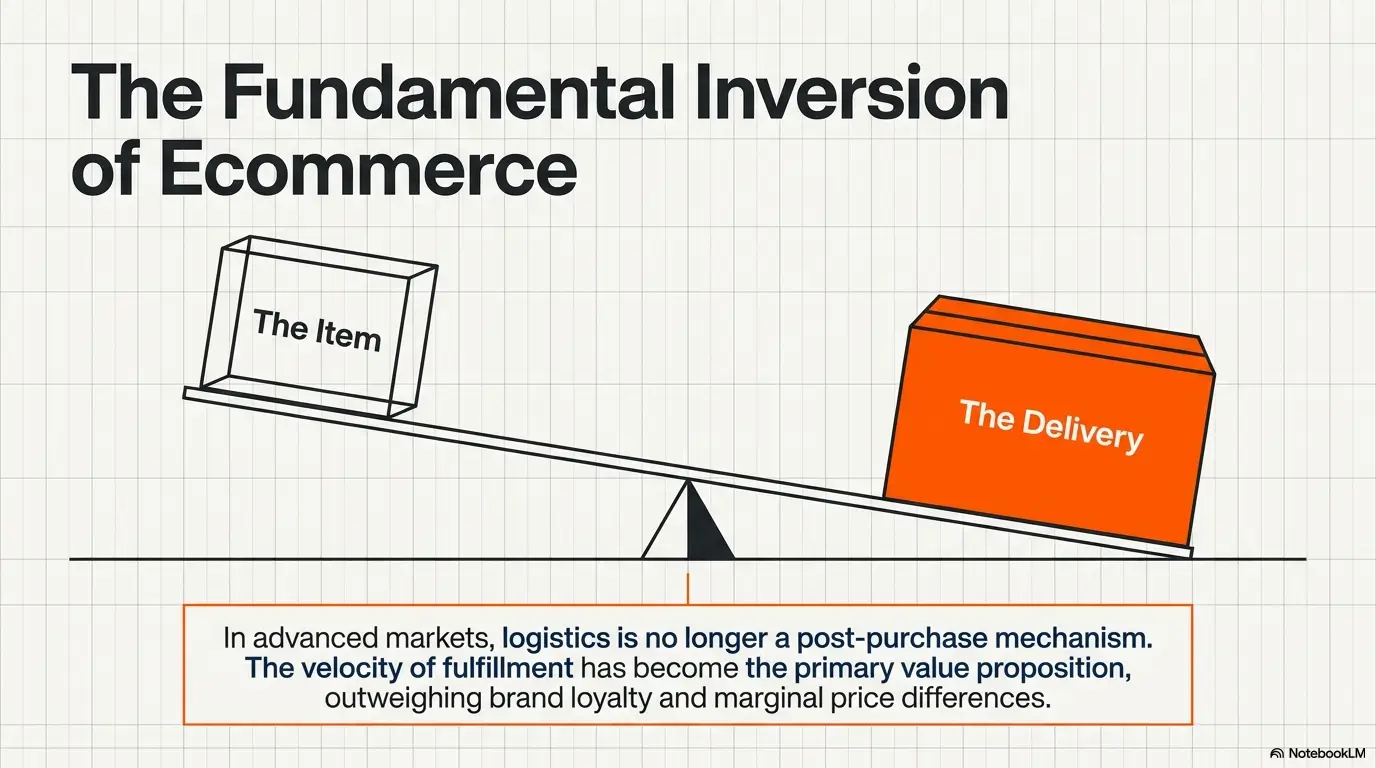
Dense Cities Give Korean Ecommerce Its Structural Advantage
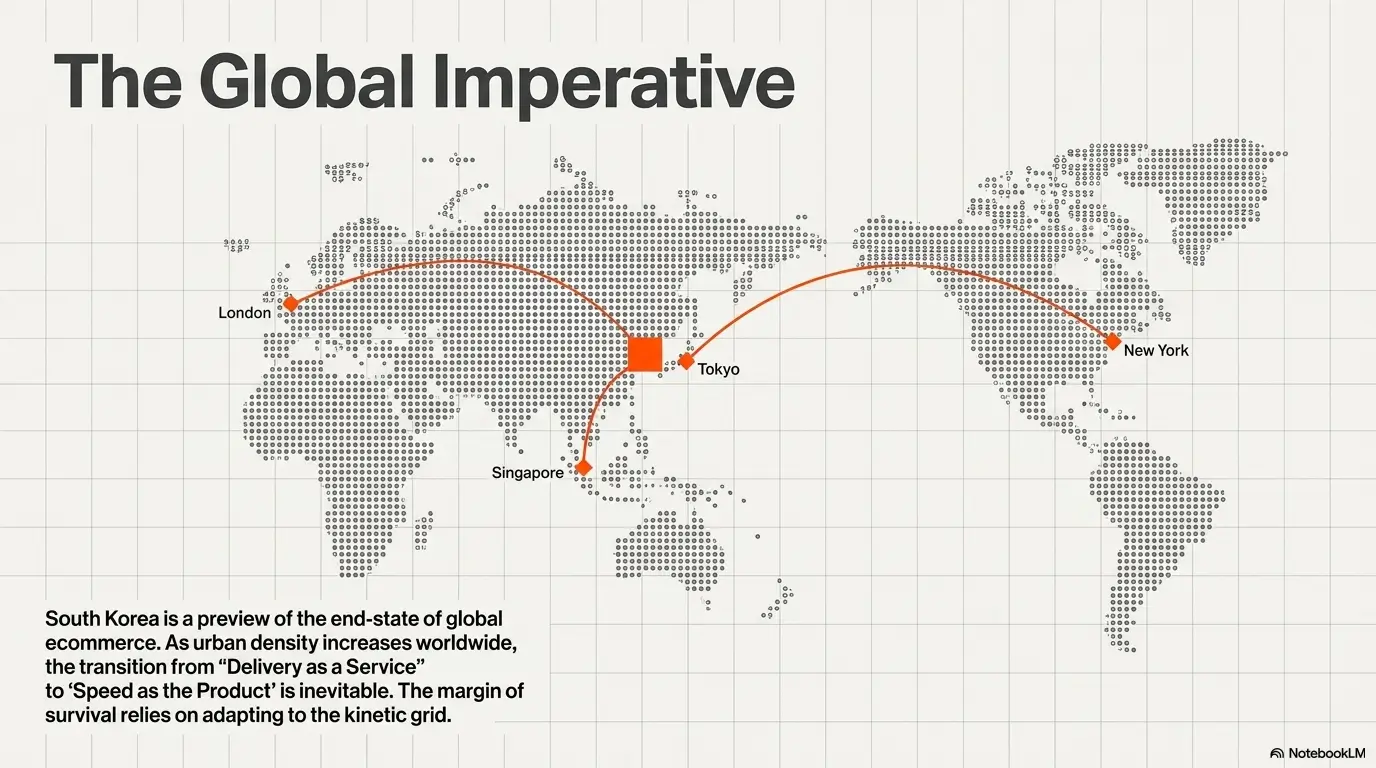
It is tempting to explain Korean ecommerce through software: better apps, smoother payments, smarter routing. Software matters, but an app cannot shorten the physical distance between ten thousand customers. Geography still gets a vote.
South Korea’s dense urban areas, widespread apartment living, compact delivery zones, and developed transport infrastructure make each delivery route potentially more productive. The network can reach many doors without driving the long suburban distances common in parts of the United States.
Apartment clusters make each delivery stop more productive
A detached-house route may require a vehicle to travel from one driveway to another, sometimes covering substantial distance between customers. A large Korean apartment complex can concentrate hundreds or thousands of households within a small footprint.
One entrance, one parking area, or one cluster of towers may represent many deliveries. Elevators add vertical travel, and access procedures can still create delays, but the density of orders can offset those costs.
Density also improves the odds that multiple nearby customers order within the same period. That supports route consolidation, more frequent delivery waves, and narrower service zones. The driver is not crossing a county to deliver three toothbrushes.
Shorter routes allow platforms to promise narrower delivery windows
Delivery promises depend on variance. The more uncertain the route, the wider the promised window must become. Long distances, traffic bottlenecks, sparse stops, difficult parking, and individual handovers all add uncertainty.
Compact urban routes reduce some of that variance. They do not eliminate storms, traffic, access problems, damaged goods, or sorting errors. They do, however, make precision more economically realistic.
This resembles the value of accurate public transport information. A bus that arrives in twelve known minutes may feel more useful than one that arrives “soon.” Readers interested in Korea’s broader culture of precise movement can see a similar pattern in Korean bus arrival apps, where visibility often matters almost as much as raw speed.
Why Korea’s model cannot be copied by software alone
A retailer can purchase routing software, redesign an app, and add real-time notifications. It cannot instantly create dense residential patterns, shorten highways, change local labor markets, build urban fulfillment sites, or persuade every customer to accept unattended delivery.
This is where many international comparisons become unfair. A platform serving central Seoul and a platform serving rural Montana may both be excellent operators, but they are solving different equations. The miles, housing forms, traffic patterns, order density, and delivery expectations are not interchangeable.
Any company attempting Korean-style speed must first ask whether the market has enough concentrated demand to support it. Same-day service in a dense neighborhood may be viable. Promising the same service across a sprawling region may create heroic marketing and miserable economics.
The overlooked role of entrances, elevators, and shared drop-off spaces
The last stage of delivery is often treated as a minor detail, but it can determine whether a route stays on schedule. Buildings with predictable access procedures, security desks, parcel areas, elevators, and accepted doorstep delivery allow drivers to complete stops without waiting for each customer.
That does not mean access is always simple. Gated entries, missing instructions, busy elevators, parking restrictions, and building rules can complicate deliveries. Still, the broad acceptance of unattended parcel drop-off reduces the need to coordinate a face-to-face exchange.
The Korean Speed Stack
1. Nearby inventory
Fulfillment stock is positioned close enough to major demand zones.
2. Dense demand
Many customers live within compact apartment districts.
3. Compact routes
Drivers can complete more stops with less distance between them.
4. Drop and move
Unattended delivery reduces the need to schedule handovers.
5. Visible arrival
Notifications close the loop and reassure the customer.
Explore Official Korean Statistics
Speed Is the Product, but Reliability Is the Brand
A fast promise may win the first order. A reliable promise wins the habit. Shoppers will tolerate many things once; they build routines only around services they believe will perform repeatedly.
This distinction is essential. A platform that occasionally delivers in four hours but frequently misses its stated window may feel less valuable than a platform that consistently arrives the next morning. Reliability converts speed from a stunt into infrastructure.
Why a precise arrival promise builds more trust than vague fast shipping
“Fast shipping” describes the seller’s intention. “Order within two hours for delivery tomorrow” gives the buyer a decision rule. One is promotional language; the other can be used to plan breakfast, work, childcare, travel, or household tasks.
Precision reduces the need for contingency planning. When a buyer trusts the date, the buyer does not purchase a backup item, visit another store, or keep checking the tracking page. The service has borrowed a piece of the customer’s future and promised to return it on time.
Real-time notifications make the order feel continuously visible
Online shopping contains a peculiar gap. The customer pays, the product disappears into a network, and possession comes later. Notifications fill that gap with evidence: order accepted, packed, handed to the carrier, approaching, delivered.
Visibility changes the emotional experience even when it does not change the physical speed. A parcel arriving in twelve hours with clear updates may feel faster than a parcel arriving in ten hours without them.
Good tracking answers the questions a customer would otherwise ask customer service. Has the order actually been accepted? Is it delayed? Was it left outside? Do I need to take action? Each useful update removes a small cloud of uncertainty.
Why one late delivery can feel larger than it should
High reliability creates high expectations. Once a shopper organizes a meal, meeting, school day, or trip around a specific arrival, lateness becomes more than inconvenience. It breaks the plan that the delivery promise encouraged the customer to make.
This is the paradox of excellent service. The better the normal experience becomes, the more visible the exception feels. A delay that would seem ordinary in a slower system can feel like a breach in a fast one.
The parcel has become a tiny appointment
When an app promises a specific date or narrow period, the parcel enters the calendar even if no formal event is created. The buyer may wait to cook, postpone leaving home, listen for the entrance notification, or plan to refrigerate groceries.
That is why service recovery matters. A clear delay notice, revised estimate, refund process, or simple explanation preserves more trust than silence. Customers can adapt to bad news more easily than to missing information.
Reliability scorecard
| Signal | Weak experience | Strong experience |
|---|---|---|
| Promise | “Ships soon” | Specific date or window |
| Tracking | Long silent gaps | Useful milestone updates |
| Delay handling | Customer discovers it | Platform explains it early |
| Delivery proof | Unclear status | Time, location, or photo confirmation |
Key takeaway
Fast delivery creates attention. Dependable timing creates trust. The most valuable promise is not the shortest one a retailer can advertise, but the shortest one it can keep repeatedly.
The Convenience Loop Quietly Changes Shopping Behavior
Convenience is rarely neutral. When an action becomes easier, people usually do more of it. Elevators change how buildings are used. Contactless payment changes how small purchases feel. Fast ecommerce changes the threshold at which a passing need becomes an order.
The Korean shopping experience demonstrates this with unusual clarity. Speed, stored payment, personalized recommendations, and reliable tracking form a loop. Each successful order teaches the customer that the next order will also be easy.
Speed shortens the distance between wanting and buying
In a slower system, desire must survive several obstacles. The buyer may need to visit a store, wait for the weekend, combine the item with a larger order, compare shipping costs, or accept a long delivery estimate. Some desires fade before purchase.
In a faster system, the desire encounters fewer cooling-off periods. A product seen during a commute can be ordered before the train reaches the next station. A household shortage noticed at night can be resolved before sleep.
This is excellent when the product solves a genuine need. It is more complicated when the platform is simply excellent at turning boredom into parcels.
Low effort makes forgotten household items easy to replace immediately
Household management contains hundreds of tiny inventory decisions. Toothpaste is low. The trash bags are nearly gone. The dog has two meals left. The printer paper has vanished into a school project.
When ordering is easy, these observations can become transactions the moment they occur. The shopper no longer needs to maintain a perfect written list or remember the item during the next store visit. Memory can be outsourced to immediate action.
This is one reason delivery apps can become deeply woven into family routines. They are not merely stores. They are repair tools for ordinary forgetfulness.
Why shoppers may place several small orders instead of one weekly order
Traditional shopping rewards consolidation. Driving to a supermarket takes time, so households try to buy enough to justify the trip. Delivery fees also encourage larger baskets when each order carries a noticeable charge.
Memberships, free-shipping thresholds, merchant-supported delivery, and fast fulfillment can weaken that incentive. Instead of one carefully planned weekly order, a household may place several smaller orders as needs appear.
Smaller orders reduce planning effort and may reduce food waste when shoppers buy only what they need. They can also increase packaging, delivery frequency, and impulse spending. Convenience gives with one hand and sends a cardboard box with the other.
Let us be honest: convenience can become its own shopping trigger
Sometimes the platform solves a need. Sometimes the ease of the platform creates the purchase. A prominent coupon, countdown, recommendation, or overnight-delivery badge can make an item feel urgent even when the household has survived nobly without it.
A practical defense is to separate urgent replenishment from recreational browsing. Keep a saved list for actual household shortages, and consider a twenty-four-hour pause for nonessential purchases. The goal is not to reject convenience. It is to remain the person using the tool rather than the person being gently rolled downhill by it.
Show me the nerdy details
A useful way to think about purchase frequency is to separate monetary cost from transaction cost. Transaction cost includes time spent searching, typing, traveling, waiting, coordinating, and worrying about arrival.
When a platform lowers transaction cost, the minimum value required to justify an order also falls. A shopper may not travel twenty minutes for one box of cereal, but may order it if checkout takes thirty seconds and delivery is bundled into a membership.
This helps explain why fast ecommerce can increase order frequency even when total household consumption changes only modestly. The same purchases are divided into smaller, more immediate decisions.
Key takeaway
Fast delivery does not only serve existing demand. By lowering the effort required to act, it can create more frequent, smaller, and less deliberative purchases.
Common Mistakes Americans Make When Comparing Korean Shopping
International comparisons are useful until they become cartoons. Korean ecommerce is sometimes described as a magical version of American online retail where everything arrives immediately and nobody ever searches for a missing parcel. Reality is more textured.
Services vary by region, product, seller, order time, membership, and delivery network. The strongest analysis compares systems rather than selecting one famous platform from each country and asking which truck moves faster.
Mistake: assuming Korea simply has “better Amazon”
The phrase is attractive because it is easy. It is also incomplete. Korean ecommerce includes large marketplaces, retailer-owned channels, grocery specialists, brand stores, department-store platforms, social commerce, live commerce, local delivery services, and merchant-fulfilled listings.
Different services compete on different combinations of selection, freshness, authenticity, price, membership, delivery time, and customer support. A platform that excels at everyday essentials may not be the preferred place for luxury goods, imported products, niche electronics, or secondhand items.
Mistake: comparing delivery fees without comparing ecosystems
A visible delivery fee is only one part of the cost. Some customers pay through memberships. Some receive free delivery above a threshold. Some costs are included in product prices or supported by the seller. Some promotions temporarily remove fees. Returns may follow another set of rules.
A fair comparison asks what the customer receives across a month, not only what appears beside one order. How often does the person shop? Which product categories qualify? Are returns convenient? Does the membership include streaming, discounts, groceries, or other services?
Mistake: overlooking geography, density, and labor structure
A fast service is produced by roads, facilities, workers, inventory placement, route density, building access, customer behavior, and local regulation. Treating it as an app feature erases most of the actual machine.
Labor expectations matter in particular. Overnight sorting and early-morning delivery require people to work at hours when much of the city is asleep. The convenience experienced at the front door is connected to schedules and physical demands elsewhere in the network.
Mistake: treating every Korean platform as interchangeable
Customers choose platforms based on category, price, trust, delivery eligibility, seller reputation, membership status, interface preference, and payment compatibility. The fastest option for groceries may not be the cheapest option for appliances. The easiest app for a Korean resident may be difficult for a visitor without local verification.
Cultural familiarity should not be mistaken for universal preference. Some shoppers enjoy rapid, recommendation-heavy interfaces. Others prefer slower comparison, fewer notifications, in-person inspection, or buying from neighborhood stores. A system can be highly optimized without being ideal for every person.
| Comparison question | Oversimplified answer | More useful answer |
|---|---|---|
| Why is Korea faster? | Better apps | Apps plus density, fulfillment, access, labor, and customer habits |
| Is delivery free? | Yes or no | It depends on memberships, thresholds, sellers, categories, and promotions |
| Does everything arrive overnight? | Yes | Eligibility varies by product, address, inventory, cutoff, and service |
| Can foreigners use every app? | Just download it | Phone verification, language, address, and payment requirements may apply |
Do Not Copy the Speed Without Counting the Cost
Convenience arrives at the customer’s door looking clean and simple. The complicated parts have been moved out of sight. Someone stored the inventory, picked the order, packed the cold items, sorted the parcel, drove the route, found the entrance, and handled the exceptions.
A mature understanding of Korean ecommerce should admire the coordination without pretending the speed is weightless. Every compressed timeline applies pressure somewhere.
Faster fulfillment can shift pressure onto warehouses and delivery workers
Short delivery promises create strict internal deadlines. Orders placed late in the evening may need to be picked, packed, sorted, and dispatched while customers sleep. Peaks caused by promotions, weather, holidays, or sudden demand can intensify the workload.
Companies can reduce risk through staffing, automation, route design, rest policies, realistic order cutoffs, safety procedures, and workload monitoring. Customers cannot see most of these systems, but they are part of the true price of dependable speed.
The ethical lesson is not that fast delivery is inherently wrong. It is that a sustainable service should not rely on treating human limits as a software bug.
Packaging waste grows when convenience favors smaller, more frequent orders
Fresh and frozen deliveries may require insulated bags, boxes, liners, ice packs, protective materials, and individual wrapping. Even when some materials are recyclable or reusable, collecting, cleaning, and processing them requires infrastructure and customer participation.
Small orders can magnify the packaging-to-product ratio. One tube of toothpaste arriving alone may require more material per item than the same tube included in a consolidated household order.
Consumers can reduce this effect by combining nonurgent items, choosing reusable packaging programs where available, following local sorting rules, and avoiding multiple orders placed within minutes of one another. The nation’s detailed recycling expectations can surprise newcomers, so a practical guide to recycling in Korea for foreigners can be useful after the boxes begin to gather.
Failed deliveries and returns become expensive at high velocity
Speed amplifies mistakes. An incorrect address, unsuitable product, inaccurate listing, damaged item, or customer ordering error can produce a reverse journey almost as complicated as the original delivery.
Returns require collection, inspection, refund processing, repackaging, resale, liquidation, or disposal. For low-value items, the cost of reversing the transaction may approach or exceed the value of the product.
Better product descriptions, accurate sizing, clear photographs, verified reviews, packaging discipline, and sensible recommendation systems can prevent more waste than an elegant return screen can repair.
Why the fastest promise is not always the most sustainable one
A slower consolidated route may use capacity more efficiently than multiple urgent deliveries. A specific next-day window can sometimes provide nearly the same customer value as same-hour delivery while allowing better batching.
This is where customer psychology becomes important. Many shoppers do not truly need the product immediately. They need confidence. A retailer may be able to offer a dependable date, good tracking, and a modest incentive for slower delivery instead of racing every parcel across the city.
Speed-cost checklist
- Could nonurgent orders be consolidated without disappointing customers?
- Are delivery windows realistic during peak demand?
- Does packaging match the product rather than the platform’s worst-case scenario?
- Are workers given enough time, rest, and safe procedures?
- Can clearer product information prevent avoidable returns?
- Is the company measuring reliability, not merely headline speed?
Visit the Korea Consumer Agency
Key takeaway
The customer experiences speed as simplicity, but the network experiences it as deadlines, labor, packaging, routing, and exception handling. Responsible speed must work for the entire chain.
What US and UK Retailers Can Learn Without Rebuilding Korea
Most retailers cannot reproduce Korean urban density, apartment patterns, or consumer infrastructure. Fortunately, the most transferable lesson is not “deliver everything at dawn.” It is “remove uncertainty from the customer’s day.”
A retailer can create meaningful value without owning a fleet of midnight vans. Better promises, cleaner checkout, useful updates, and honest service boundaries can improve the experience immediately.
Make delivery promises specific instead of merely optimistic
Replace broad claims such as “fast,” “expedited,” or “usually ships quickly” with information the customer can act on. Show an estimated arrival date before checkout. Explain order cutoffs. Identify remote-area exceptions. Update the estimate when inventory or carrier conditions change.
The goal is not to present impossible precision. It is to make the uncertainty legible. “Expected Tuesday to Wednesday” may be more valuable than a cheerful lightning icon attached to no usable commitment.
Remove one unnecessary step from mobile checkout
A retailer does not need a complete technical rebuild to improve conversion. Start by finding one repeated field, confusing choice, hidden fee, unnecessary account requirement, or poorly placed arrival estimate.
Test the checkout on a small phone using one hand. Do not use saved staff credentials. Pretend you are a tired customer standing in a hallway with groceries in the other arm. The interface will reveal its little cruelties quickly.
Use order updates to reduce uncertainty, not create notification clutter
Not every internal event deserves a customer notification. Useful updates correspond to meaningful questions: Was the order accepted? Has it shipped? Is the estimate changing? Is it arriving today? Where was it left?
A stream of promotional alerts mixed with operational messages makes important information harder to find. Separate marketing from fulfillment. The customer who wants to know whether the groceries arrived should not have to pass through a coupon carnival.
Compete on dependable timing before chasing same-hour delivery
Same-hour delivery attracts headlines, but many customers would receive more value from a reliable two-hour scheduled window tomorrow. Before shortening the promise, improve the rate at which the current promise is kept.
This protects margins and trust. A company that promises less and performs well creates a sturdy habit. A company that promises fireworks and delivers smoke creates customer-service tickets.
Good, better, best: a realistic service ladder
Good
Show a credible arrival range before payment.
Better
Add useful milestone updates and proactive delay notices.
Best
Offer dependable scheduled windows in zones where operations support them.
Read the FTC Internet Shipping Guidance
What Korean Shopping Reveals About the Future of Ecommerce
Korean ecommerce offers a preview of what happens when online retail stops competing only with other websites and begins competing with the household clock. The question is no longer merely whether a platform has the product. The question is whether it can place the product inside a routine.
This may shape ecommerce far beyond Korea. Retailers will compete not only for transactions, but for moments: before breakfast, after school, during the commute, before a trip, or immediately after something runs out.
Delivery windows may become part of product positioning
Two listings for the same product may eventually be presented as different practical offers. One is cheaper and arrives later. One arrives at a scheduled time. One uses consolidated shipping. One includes installation. Arrival conditions become attributes alongside size, color, and price.
This gives consumers more control when the options are explained honestly. A shopper can choose urgency when urgency is real and select a slower, more efficient method when it is not.
Platforms could compete for routines, not individual transactions
A service that reliably handles weekly groceries, pet supplies, toiletries, and school materials becomes embedded in family life. The customer is no longer choosing a retailer from scratch each time. The platform has become the default response to a category of problems.
This is more powerful than loyalty created by points alone. Habit grows from repeated relief. The platform remembers the address, payment, previous products, preferred delivery method, and recurring needs. Every successful order lowers the effort required for the next one.
Predictive replenishment may make checkout nearly invisible
Subscription services already automate repeated purchases. The next step is more flexible prediction: reminders based on previous intervals, suggested baskets, household inventory signals, or one-tap confirmation before a product is likely to run out.
This can be genuinely helpful for pet food, filters, diapers, cleaning supplies, or other predictable items. It can also become intrusive if recommendations are difficult to control or designed to increase consumption rather than solve needs.
The best version gives the customer visibility and authority. It says, “You usually need this around now. Would you like it?” The worst version quietly turns the household into a subscription farm.
What happens when waiting becomes the luxury option?
Fast systems make immediate access ordinary, but they may also create a countertrend. Some shoppers will choose slower delivery for environmental reasons, lower prices, fewer interruptions, or the pleasure of deliberate purchasing.
Waiting can become a signal of intention. A made-to-order object, carefully consolidated shipment, neighborhood purchase, or scheduled weekly delivery may feel calmer and more thoughtful than an endless sequence of urgent boxes.
The future may therefore contain both extremes: nearly invisible replenishment for essentials and intentionally slow commerce for products where anticipation, craftsmanship, or sustainability adds value.
Key takeaway
The future of ecommerce may not be a universal race toward instant delivery. It may be a menu of timing choices, with speed, predictability, consolidation, and sustainability treated as distinct product features.
FAQ
Why is online shopping delivery so fast in South Korea?
Fast delivery is supported by dense cities, large apartment complexes, nearby fulfillment capacity, mobile-first shopping, stored payments, unattended drop-off, real-time tracking, and strong competition among platforms. No single factor explains the experience. The speed comes from the way physical infrastructure and digital systems reinforce one another.
Does every online order in Korea arrive the same day?
No. Delivery depends on the product, seller, inventory location, customer address, order cutoff, membership, weather, and service type. Options may include same-day, overnight, dawn, next-day, scheduled, or standard delivery. Imported and merchant-fulfilled products may take considerably longer.
What is dawn delivery in Korea?
Dawn delivery generally refers to eligible orders placed by an evening cutoff and delivered during the early morning, often before the customer wakes. It is strongly associated with groceries and chilled foods, although exact times, locations, minimum orders, and eligible products vary by service.
Is Korean online shopping faster than Amazon in the United States?
Some Korean urban services provide faster or more predictable delivery than many US customers receive, especially for groceries and daily essentials. However, neither country is uniform. Service in central Seoul should not be compared directly with service in rural America without considering distance, density, infrastructure, and product availability.
Which products are commonly delivered overnight in Korea?
Depending on the platform and address, shoppers may receive groceries, prepared foods, household supplies, toiletries, beauty products, pet supplies, small electronics, office materials, and other daily essentials overnight or the next day. Fresh and frozen items usually require specialized packing and eligible delivery zones.
Do shoppers in Korea pay extra for fast delivery?
Sometimes. Costs may be covered through a membership, minimum purchase requirement, visible fee, seller subsidy, promotional offer, or product pricing. Because policies vary, shoppers should compare the total monthly value of a service rather than assuming every fast order is free.
Can tourists and foreigners use Korean shopping apps?
Access varies. Some services may require a Korean phone number, local identity verification, a Korean-issued payment method, a correctly formatted local address, or a Korean-language interface. Long-term residents often have more options after establishing local phone and banking services than short-term visitors do.
Is ultra-fast delivery in Korea environmentally sustainable?
The answer is mixed. Dense routes can allow efficient consolidation, but frequent small orders, chilled packaging, returns, and urgent delivery can increase material and transport costs. Sustainability depends on route efficiency, packaging design, reusable systems, customer behavior, and whether nonurgent orders are consolidated.
What is the best Korean shopping app for a newcomer?
There is no universal best choice. The right app depends on language support, verification requirements, address coverage, payment compatibility, product category, membership value, and delivery needs. Newcomers should first confirm that they can create an account and complete payment before comparing speed or promotions.
Run a Seven-Day “Speed Is the Product” Audit
The fastest way to understand this idea is not to admire Korean logistics from a distance. It is to examine how timing affects your own choices. For one week, study a shopping app you already use. You are not trying to become a warehouse analyst before breakfast. You are looking for the moment when convenience turns into value.
Choose one shopping app you use regularly
Select a service where you are likely to make at least one ordinary purchase. Groceries, household goods, beauty products, electronics, books, or pet supplies all work. Avoid switching between several apps because the goal is to observe one complete customer journey.
Record checkout steps, delivery promise, updates, and actual arrival
Create a note with four simple columns. Record what the platform promised and what actually happened. Include your emotional response, especially any moment when you felt uncertain, reassured, rushed, or tempted to add another item.
| Audit field | What to record |
|---|---|
| Checkout | Number of taps, manual fields, hidden fees, and repeated information |
| Promise | Displayed date, time window, cutoff, and eligibility conditions |
| Visibility | Order, packing, shipping, delay, and delivery notifications |
| Reality | Actual arrival, delivery location, condition, and difference from the promise |
| Behavior | Whether speed changed the product, quantity, or timing of your purchase |
Identify the single moment when uncertainty enters the experience
Perhaps the delivery date disappears during checkout. Perhaps the tracking remains silent for hours. Perhaps the parcel is marked delivered without a location. Perhaps the arrival is clear, but the return process is hidden.
Do not immediately ask how to make the service faster. First ask how to make that uncertain moment clearer. The cheapest operational improvement may be better information rather than a shorter route.
Your fifteen-minute next step
Open the last order you placed online. Write down the promised arrival, number of status updates, actual arrival, and one moment when you wondered what was happening. Then answer one question: would clearer timing have created more value than faster shipping?
That question closes the loop. Korean ecommerce feels different because it recognizes that customers are not merely buying objects. They are buying fewer errands, repaired plans, narrower uncertainty, and a small piece of tomorrow returned to them. The parcel matters. The rescued hour is often what wins.
Final practical reminder
Do not measure a shopping experience only by how quickly the box reaches the door. Measure how much uncertainty the service removes before, during, and after the purchase. Precision is often the quieter, more durable form of speed.
Last reviewed: 2026-06