
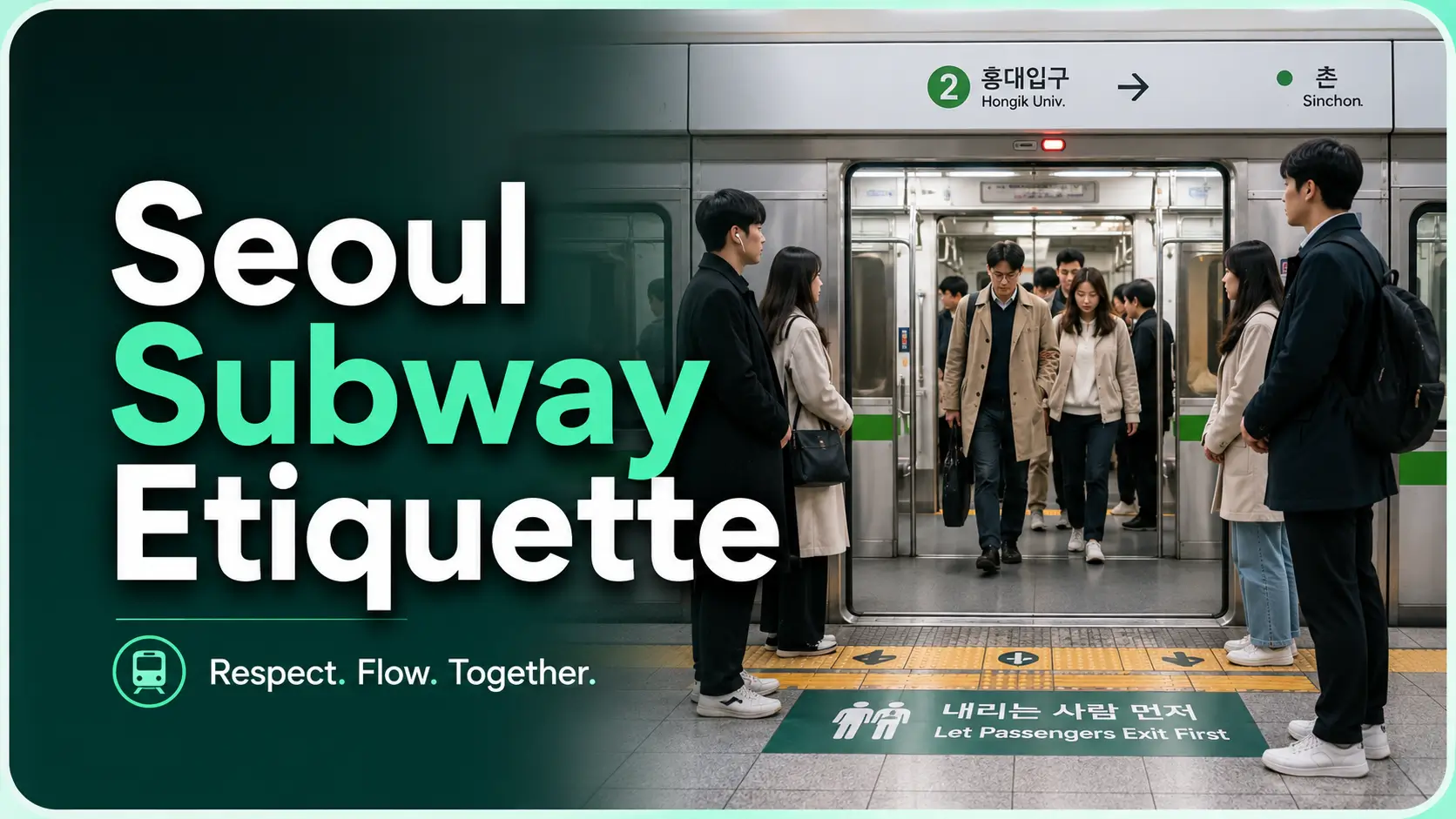
Seoul Subway Culture Guide
Why Korean Subway Etiquette Feels Stricter
Even Without Many Spoken Rules
The Seoul subway can feel like a moving concert hall before the first note begins. People line up, shuffle, lower their voices, angle their bags, avoid certain seats, and somehow make a crowded train car feel less chaotic than it has any right to be. For a first-time visitor from the US or UK, the quiet can feel almost ceremonial.
But Korean subway etiquette is not simply about strictness. It is about shared reading. Riders are expected to notice the flow before they enter it: who is getting off, who needs the seat, whose backpack is in the way, and whether a phone call has become public weather. The rules are often soft, but the social signal is sharp.
This guide explains the practical logic behind Korean subway manners without turning Korean culture into a cardboard stereotype. You will learn what to do, what to avoid, and how to ride in Seoul without feeling watched by an invisible etiquette committee in sensible shoes.
Read the flow
Know where to stand, when to move, and how to avoid blocking exits.
Reduce awkwardness
Handle seats, calls, bags, food, and crowded doors with quiet confidence.
Understand the why
See how public harmony, speed, and indirect cues shape everyday behavior.
🚇 The goal is not to act perfectly Korean. It is to become easy to share space with.
Snapshot: This article is for tourists, exchange students, expats, business travelers, military families, and culture-curious readers using the Seoul subway for the first time. It solves the “Am I doing something rude without knowing it?” problem and gives you a simple way to board, ride, and exit with less stress.
Table of Contents
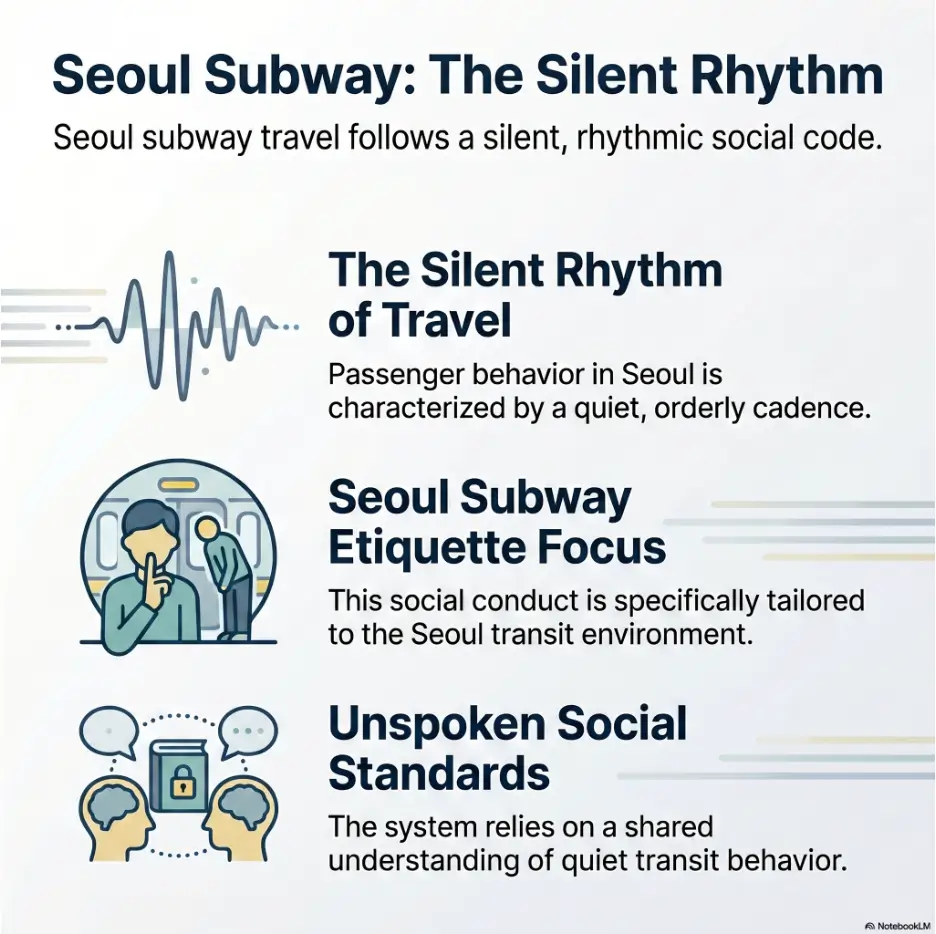
The Silent Rulebook Starts Before You Board
Korean subway etiquette begins on the platform, not inside the train. Before the doors open, the station floor is already giving instructions: where to wait, where to leave space, which direction people are walking, and how the crowd is preparing to move.
For visitors from cities where transit lines can feel more improvisational, this can be surprising. The platform in Seoul often works like a quiet rehearsal room. Everyone may look casual, but most people are following a shared script.
Platform lines organize more than feet
Marked waiting lines are not just decorative paint. They help riders form predictable lanes so passengers can exit first and boarding can happen without a small human traffic storm at every door.
This matters because Seoul stations move huge numbers of people through narrow moments. A train stops. Doors open. Passengers have only seconds to leave, others have only seconds to board, and the platform has to breathe in both directions without choking.
If you stand inside the exit path, you may not receive a lecture. You may simply feel the pressure of people flowing around you. That pressure is the message.
The first mistake is standing where people need to exit
The most visible beginner mistake is waiting directly in front of the subway doors. It seems harmless, especially if you are eager to board or worried about missing the train. But in Seoul, blocking the exit path can feel like putting a chair in a hallway during a fire drill.
The better move is simple: stand to the side of the door markings, let passengers leave, then board. This one behavior instantly makes you look more aware, more considerate, and less like you are wrestling the city for personal victory.
Even during rush hour, the principle stays the same. The crowd may compress, but the order still matters. People off first. People on second. The whole system depends on that tiny act of patience.
Here’s the tiny clue tourists miss
Watch the feet. Seoul subway riders often position themselves before the train arrives, leaving a center lane for exiting passengers. The sign on the floor helps, but the crowd is often the better teacher.
If everyone is standing slightly to the left and right of the door zone, do not become the heroic statue in the middle. Step aside, follow the waiting line, and let the train empty first.
Key takeaway
Before boarding, ask one question: “Am I standing where someone needs to exit?” If the answer is yes, move sideways. That one adjustment solves more subway awkwardness than any phrasebook.
Why “Quiet” Feels Like a Public Agreement
Seoul subway cars are not silent in an absolute sense. Trains rattle, doors chime, announcements play, children talk, and people occasionally take calls. Still, the overall sound level often feels controlled.
The key difference is that many riders treat the train as shared interior space, not as an outdoor street corner. Your voice does not belong only to you once it bounces around a packed metal carriage.
Phone calls are not banned, but they are socially expensive
A short, quiet phone call is unlikely to cause a public scandal. But a loud or emotional call can make you stand out quickly, especially during commute hours when riders are already carrying fatigue like a second bag.
In many US transit settings, a loud call may be annoying but ordinary. In Seoul, it can feel more intrusive because the surrounding norm is quieter. The call becomes the loudest object in the car.
If you must answer, keep it brief. Lower your voice, say you are on the subway, and move the longer conversation to a station platform or later moment. This is not about being timid. It is about not making strangers sit inside your appointment, argument, dinner plan, or conference call.
Earbuds are etiquette armor
Earbuds are more than entertainment gear in Seoul. They are a small civic tool. They keep your music, video, game, or language lesson from becoming the train’s surprise soundtrack.
This matters most for tourists using navigation videos, translation audio, or social media clips. A few seconds of speaker volume can feel bigger inside a quiet car than it would in a café or hotel lobby.
Before you play anything, check whether the sound is coming through your phone speaker. If it is, pause first. The train car is not auditioning for your algorithm.
Let’s be honest: your volume travels farther than you think
Subway cars are strange little echo chambers. A private joke at one end can become shared weather three rows away. A group conversation that feels normal to you may sound enormous to the person trying to survive the last 20 minutes of their commute.
This does not mean you must ride like a monk under oath. It means your default voice should be smaller than your restaurant voice. Think “quiet table for two,” not “airport reunion near baggage claim.”
| Situation | Better subway choice | Why it works |
|---|---|---|
| Answering a call | Keep it short and quiet | Reduces the feeling that strangers are trapped in your conversation |
| Watching a video | Use earbuds or mute | Prevents accidental speaker noise |
| Traveling in a group | Talk softly and lean closer | Keeps your group from filling the whole car with sound |
| Using translation audio | Lower volume before playing | Avoids sudden bursts of sound in a quiet space |
For a deeper cultural parallel, the way calls are managed in public connects naturally with Korean phone call culture, where timing, tone, and indirect awareness often matter as much as the words themselves.
Priority Seats Carry More Meaning Than the Sign Shows
Priority seating is one of the easiest parts of Korean subway etiquette to misunderstand. A visitor sees an empty seat. The body is tired. The seat is right there. The math seems simple.
But in Seoul, some priority seats carry an expectation even when nobody visibly needs them. The seat may be empty, but the social meaning is not.
The seat is empty, but the expectation is not
Priority seats are intended for older adults, pregnant passengers, disabled riders, injured riders, and people who need seating support. In some places, passengers may sit there and give up the seat when needed. In Seoul, many riders avoid certain priority seats altogether as a sign of respect and readiness.
This is especially noticeable near the ends of train cars, where priority zones are clearly marked. A tourist may see empty seats and wonder why people are standing. The answer is not always law. Often, it is social habit.
If you are able-bodied and do not need the seat, the safest etiquette choice is to avoid priority seats unless the train is extremely empty and local riders are using them casually too.
Don’t treat priority seating like a normal empty chair
The mistake is not just sitting. The bigger mistake is sitting with no awareness: headphones in, bag on lap, eyes locked on the phone, body language saying, “I have retired from society.”
If you have a legitimate need, use the seat. Invisible needs are real. But if you do not need it, choosing a regular seat or standing is usually the cleaner move.
This is also where visitors should avoid making quick judgments about others. Someone young may have an injury, chronic pain, pregnancy, dizziness, or another need you cannot see. Subway etiquette works best when it is aware without becoming nosy.
The pink-seat signal visitors should understand
Pregnancy priority seats are often marked in pink. These seats are designed to make seating support easier for pregnant passengers, including those who may not visibly look pregnant.
For visitors, the simplest rule is this: do not use pink pregnancy seats unless you are pregnant or have a clear need. The visual cue is strong, and sitting there casually can attract attention even if no one says anything.
Key takeaway
When in doubt, treat priority seats as reserved in practice. You do not need to memorize every subway sign. Just keep those seats available unless you genuinely need one.
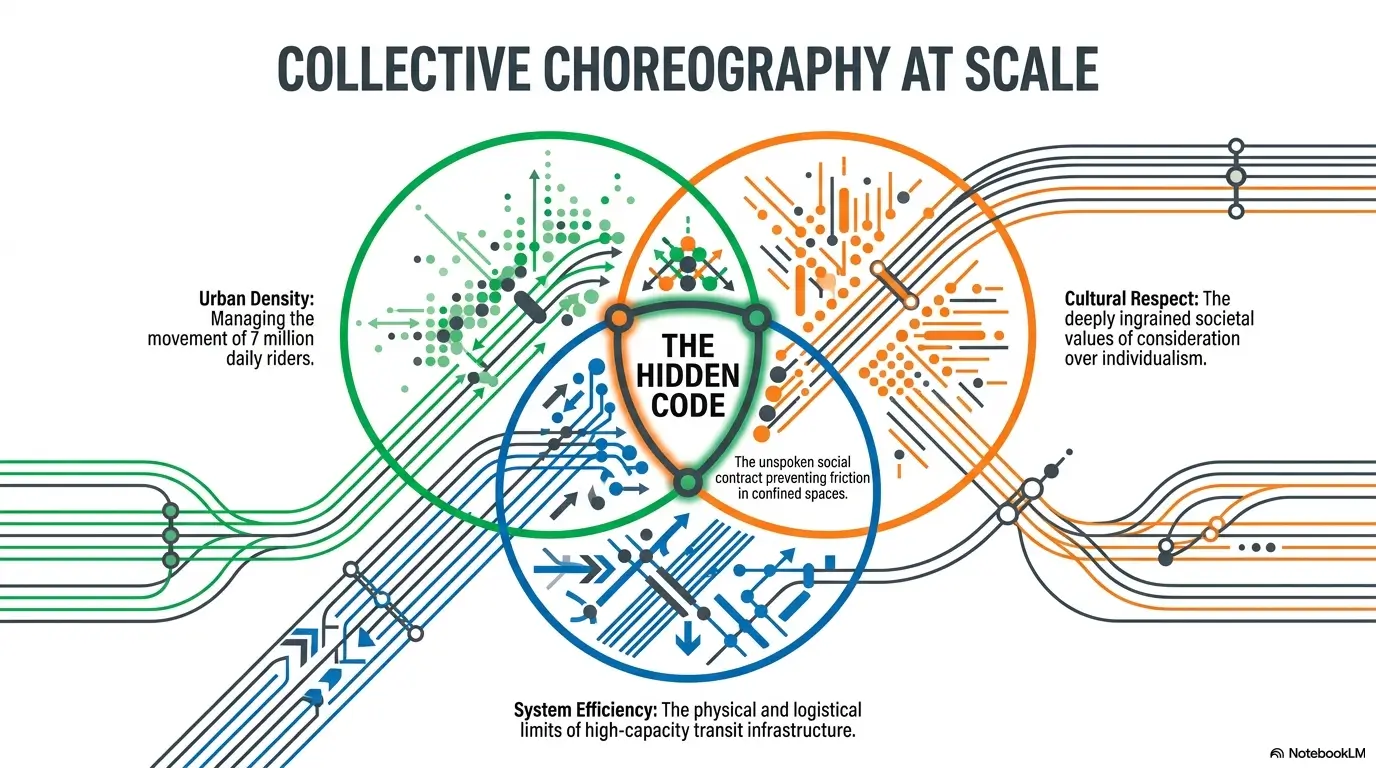
Personal Space Works Differently in a Crowded City
The Seoul subway can pack strangers close enough to know who had coffee, hair spray, or an ambitious garlic lunch. Yet the social expectation is not casual intimacy. It is controlled compactness.
This is the paradox many visitors miss: physical distance may shrink, but behavioral boundaries become more important. You can be close without being intrusive.
Close bodies do not mean casual behavior
In a crowded train, brushing shoulders may be unavoidable. But leaning, sprawling, loud laughing, swinging bags, or dramatic gestures can feel disruptive because everyone is already managing limited space.
The polite body in a crowded Seoul subway is compact. Arms stay close. Bags stay controlled. Feet do not form personal territory. Phone screens do not hover inches from someone’s face.
If this sounds overly careful, remember the density. When everyone is packed together, small movements become public events. A backpack turn can become a three-person collision ballet nobody bought tickets for.
Bags, elbows, and backpacks become public objects
Your backpack may feel like part of your body, but on a crowded train it becomes furniture. It occupies space, bumps people, and blocks movement behind you.
A common considerate move is to wear your backpack in front, hold it low, or place it between your feet when standing safely. This is especially useful near doors, poles, and transfer stations where passengers move quickly.
Suitcases need similar awareness. If you are arriving from Incheon Airport or moving between hotels, keep luggage close and avoid parking it across the flow of people. The goal is not to disappear. The goal is to become easy to pass.
The invisible border is behavioral, not physical
In a roomy setting, personal space is measured in inches. In a crowded subway, it is measured in behavior. Are you still? Are you quiet? Are you aware of your bag? Are you giving people a way through?
This is why a crowded Seoul train can feel oddly calm. People may be close, but many are working to reduce their social footprint.
Quick self-check for crowded cars
- Is my backpack touching someone behind me?
- Is my suitcase blocking a path to the door?
- Can someone reach the pole without leaning over me?
- Am I taking up more standing room than I need?
- Would I be easy to move around if the next station is busy?
The Door Area Has Its Own Social Gravity
The door area is the most dramatic part of the subway car. It attracts people who want to exit soon, people who are afraid of being pushed too deep inside, and people who do not realize they have become a cork in the bottle.
In Seoul, standing near the door comes with responsibility. You are not just standing. You are part of the station-by-station flow system.
Standing near the door means you have a job
If you stand by the doors, you may need to step out briefly when the train stops. This lets passengers behind you exit without squeezing past your shoulder, suitcase, or heroic refusal to move.
Stepping out does not mean you are leaving the train forever. It means you are making room, then stepping back in. Local riders do this so smoothly that it can look like the train is breathing.
The key is confidence. Step out, turn slightly aside, let people off, then re-enter before boarding finishes. Do not panic. The doors are not a trapdoor in a pirate ship.
Don’t freeze when the doors open
Freezing near the doors is a common visitor reaction. You are not sure if you should exit. You worry the train may leave. You hold your spot. Meanwhile, the people behind you begin calculating whether they can flow around you without creating a domino incident.
Instead, use a simple rule: if you are blocking people who need to get off, step out and to the side. Keep your body near the door, watch the flow, and re-board when the exit stream clears.
This habit is especially useful at major transfer stations such as Seoul Station, Gangnam, Hongdae, Sadang, Jongno 3-ga, Express Bus Terminal, and Sindorim. These stations can turn a quiet car into a human river in three seconds.
One step out can save ten people trouble
The door rule is really a kindness multiplier. One person stepping out can let several passengers leave smoothly. One person refusing to move can slow down a whole cluster of riders.
Think of the door area as a hinge. A hinge works because it moves. If you become fixed in place, the whole door moment gets stiff.
The Seoul Subway Flow Framework
1. Scan
Check door lines, exit paths, and crowd direction before the train arrives.
2. Wait
Let passengers exit before stepping into the train.
3. Compact
Lower your volume, control your bag, and avoid sprawling.
4. Flow
Step aside or briefly out when doors open and people need space.
Why No One Corrects You, Yet Everyone Notices
One of the strangest parts of Korean subway etiquette for some Western visitors is the lack of direct correction. You may do something awkward and nobody says a word. Then you feel the glances, the slight shift away, the quiet rearranging of bodies.
This can feel harsher than being told, “Hey, don’t stand there.” Silence has its own volume.
Korean subway etiquette often relies on indirect feedback
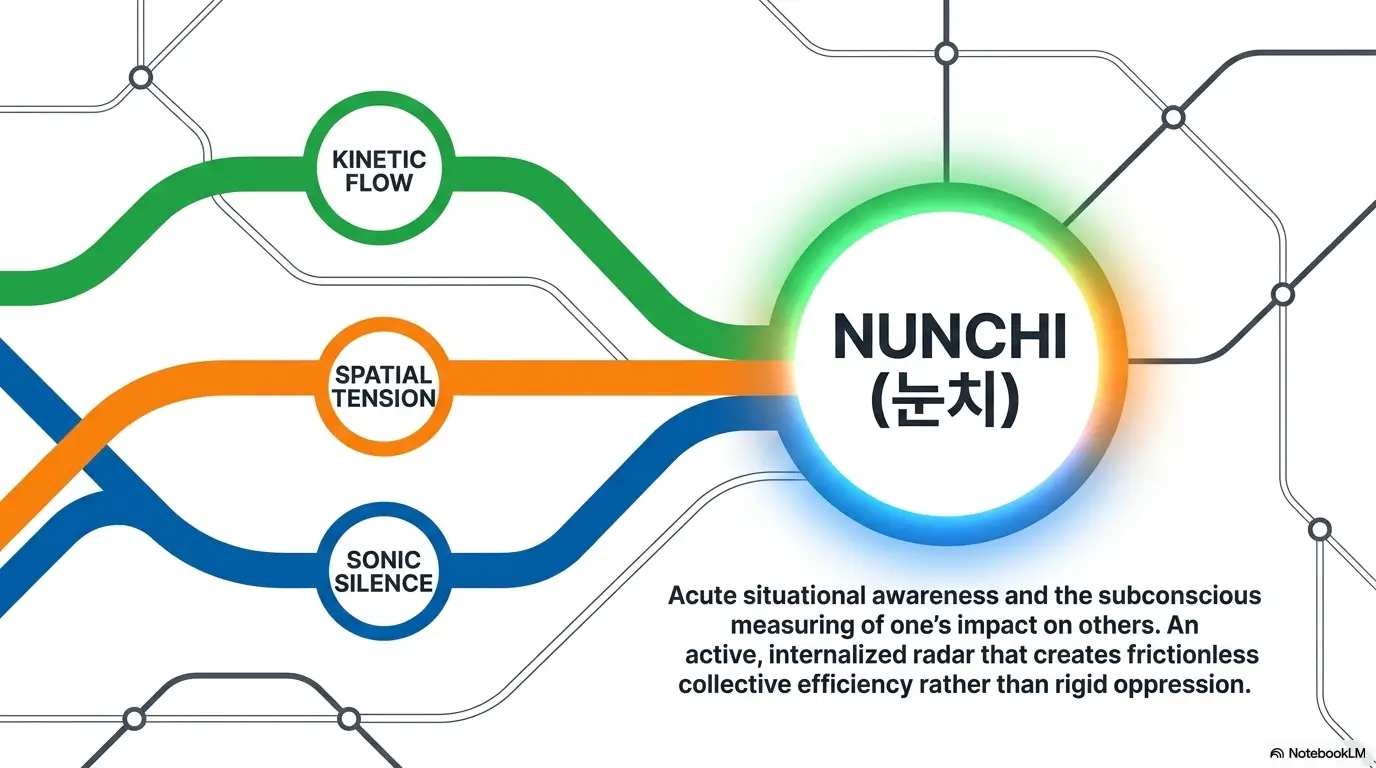
Public correction can embarrass both the person being corrected and the person correcting. So feedback often arrives indirectly: a look, a pause, a small movement, or a collective adjustment around the person causing friction.
This does not mean everyone is judging you intensely. Many people are simply trying to keep their day moving. But the absence of spoken correction does not always mean your behavior fits the norm.
For readers interested in this broader style of communication, Korean indirect communication helps explain why what is not said can still carry social meaning.
The awkward part: quiet judgment can feel louder than scolding
US and UK visitors often come from cultures where public irritation may be verbal, sarcastic, or visibly impatient. In Seoul, correction may be quieter. That quiet can make a visitor overthink everything.
The cure is not paranoia. It is adjustment. If you notice that people are moving around you, looking toward your bag, or waiting for you to clear a door, change your position. Make the moment smaller instead of turning it into a personal trial.
A calm, quick correction is usually enough. Step aside. Lower your voice. Move your bag. Stand away from the priority seat. The city will not issue a lifelong certificate of awkwardness.
Not every glance means you did something wrong
This is important: do not over-read every look. People glance for many reasons. They may be checking the station map above you, looking for a friend, noticing your suitcase, or simply zoning out after a long day.
Good cultural awareness should make you more relaxed, not less. The point is to notice patterns, not to become a detective of every eyebrow.
Key takeaway
If you sense friction, adjust quietly. Korean subway etiquette usually rewards fast self-correction more than perfect knowledge.
Who This Guide Is For, and Who It Is Not For
This guide is practical, not moralistic. It is not here to rank cultures or declare one transit style superior. Seoul is not one personality. Riders vary by age, route, neighborhood, time of day, mood, and crowd pressure.
Still, first-time riders benefit from a clear starting map. Etiquette is easier when you know what the room is asking of you.
This is for first-time Seoul riders who want fewer awkward moments
If you are visiting Seoul for a week, studying abroad, staying near a US military base, traveling for work, or moving to Korea as an English teacher, subway etiquette will touch your daily life quickly.
You do not need to become an expert in Korean social norms before buying a T-money card. You do need a few reliable habits: wait to the side, keep your voice low, control your bag, avoid priority seats, and move with the doors.
If you lose something while learning the system, the practical guide to Korea subway lost and found can help you understand what to do next without wandering through station offices in a fog of panic.
This is for culture readers who like practical nuance
Some readers are not planning a trip this month. They are simply curious about why public life works differently in different places. Korean subway manners are a useful window into a bigger question: how do people share crowded space without turning every moment into a negotiation?
The answer is part design, part habit, part social expectation, and part repetition. A subway system teaches people how to behave by making certain actions easier and others more awkward.
That is why platform lines, priority signs, phone etiquette, and body language matter. They are small pieces of a larger public rhythm.
This is not a license to stereotype Korean riders
It is tempting to say “Koreans always do this” or “Koreans never do that.” Real life is messier. You will see people talking loudly, taking calls, eating snacks, pushing, sitting in priority seats, and ignoring lines. No society behaves like its etiquette posters all day.
The better frame is probability, not purity. Certain behaviors are more expected, more noticed, or more socially costly in Seoul subway spaces than visitors may anticipate.
Traveler readiness checklist
- I can identify where passengers exit before I board.
- I know which seats to avoid unless I need them.
- I can keep my bag compact during crowded rides.
- I know how to step out briefly when blocking the door.
- I understand that silence may still be feedback.
Common Mistakes That Make Foreign Riders Stand Out
Most subway mistakes are not dramatic. They are small mismatches between what a visitor thinks is normal and what the local setting expects. The good news is that small mistakes are easy to fix.
Here are the ones that most often make foreign riders look out of step, even when they mean no harm.
Talking as if the train is a private living room
Group travel is joyful. Seoul has a way of making friends excited: neon signs, late-night food, café discoveries, subway transfers that feel like underground cities. The problem starts when that excitement enters the train at full volume.
If your group is speaking English loudly, you may stand out twice: once because of the volume, and once because the language is easier for other foreign visitors to notice too. The solution is not silence. It is scale.
Use a smaller voice. Keep conversations brief in crowded cars. Save the big story for the street, restaurant, hotel lobby, or riverside bench where it can stretch its legs.
Eating messy food on the train
Food culture in Korea is generous, fragrant, and gloriously tempting. The subway is not the best place to test how far that fragrance can travel.
Messy, smelly, or spill-prone food can make nearby riders uncomfortable. Think saucy street food, open soup containers, crumbly pastries, fried snacks with strong smell, or anything that could land on someone’s coat during a sudden stop.
A sealed drink or small, tidy snack may be tolerated in some situations, but the polite default is to wait. Seoul has food waiting above ground. The train car does not need to become a moving picnic mat.
Boarding before passengers exit
This mistake deserves repetition because it is so visible. Boarding before passengers exit slows everyone down and creates instant friction.
If you are worried about missing the train, remember that pushing in early often delays the process more than waiting properly. The doors are designed for fast exchange, not a tug-of-war.
Stand aside, let the exit stream clear, then board with purpose. You will look calmer, and the crowd will have one less obstacle.
Assuming no spoken warning means no problem
This is the most subtle mistake. In some places, if nobody complains, you assume everything is fine. In Korea, especially in public transit, silence can also mean people are tolerating discomfort rather than addressing it directly.
Look for context. Are others speaking at your volume? Are others sitting where you are sitting? Are people making space around your luggage because it is blocking the door? The answers are often right in front of you.
| Mistake | What it communicates | Better habit |
|---|---|---|
| Standing in the door center | You are not reading the flow | Wait to the side and let riders exit |
| Using speaker audio | Your media has become public | Mute or use earbuds |
| Casually taking priority seats | You may not understand reserved-space norms | Choose regular seating or stand |
| Wearing a large backpack on your back | You may be bumping people invisibly | Hold it low or wear it in front |
| Eating strong-smelling food | You are making others share the smell | Wait until you leave the train |
The Cultural Logic Behind “Read the Room”
The phrase “read the room” is useful, but it can sound vague. In Seoul subway etiquette, it means converting observation into action. You notice the flow, then you adjust.
This does not require perfect cultural fluency. It requires attention. The subway is constantly telling you what kind of rider it needs you to be.
Public harmony is treated as a shared task
In a dense city, public harmony is not a decorative value. It is practical infrastructure. If everyone insists on maximum personal expression in a crowded train, the ride becomes slower, louder, and more stressful.
That is why quietness, compact posture, orderly boarding, and seat awareness matter. They reduce friction before conflict appears.
This does not mean Korean riders are always calm or perfectly polite. It means the public expectation often favors reducing disturbance over announcing individuality.
Efficiency and politeness often overlap
Many Korean subway manners are not only about respect. They are also about speed. Letting passengers exit first is polite, but it is also efficient. Standing compactly is considerate, but it also creates capacity. Lowering volume is respectful, but it also helps everyone endure a long commute.
This is why etiquette can feel stricter even without direct enforcement. The system has taught people that small disruptions multiply quickly.
One loud group, one blocked door, one abandoned suitcase position, or one person standing in the wrong place can slow or sour the experience for many others.
The subway rewards people who become easy to move around
This is the most useful principle in the whole article: become easy to move around. If you remember nothing else, remember that.
Easy-to-move-around riders do not block doors. They do not spread bags across paths. They do not hold long calls in quiet cars. They do not treat priority seats like lucky finds. They notice when their body, voice, or belongings have become obstacles.
Key takeaway
Korean subway etiquette is less about memorizing rules and more about reducing friction. Ask, “Am I making the ride smoother or harder for the people around me?”
Show me the nerdy details
Dense transit systems depend on predictable micro-behaviors. When many people share a narrow space, small actions produce chain reactions. A rider standing in the exit path delays exiting passengers, which delays boarding passengers, which increases crowd pressure on the platform, which makes the next boarding wave more anxious. Etiquette works like soft traffic engineering: it creates habits that reduce decision time.
This is why the same behavior can feel different in different cities. A loud call in a half-empty outdoor station may be mildly annoying. The same call in a crowded Seoul subway car can feel much larger because the surrounding norm is quieter, the space is enclosed, and riders have limited escape options. Public manners are not only moral codes. They are crowd tools.
Short Story: Mina, the suitcase, and the door
Mina arrived in Seoul after a long flight and took the subway with one suitcase, one backpack, and the fragile confidence of a person who had slept badly over the Pacific.
At the first busy transfer station, she stood near the door and froze. People behind her needed to get off. Nobody yelled. Nobody touched her. But the air changed. A man shifted around her suitcase. A student glanced down at the wheels. Mina suddenly understood that her luggage had become a wall.
At the next stop, she tried again. When the doors opened, she stepped onto the platform, pulled her suitcase close, let people exit, then stepped back in.
Nothing dramatic happened. That was the lesson. Good etiquette did not make her the star of the train. It made her disappear gently into the flow.
What US Riders May Misread at First
Culture shock often begins with a false translation. A visitor sees quiet and translates it as coldness. They see order and translate it as rigidity. They see indirect feedback and translate it as secret hostility.
Sometimes those feelings are understandable. A new city can make every small uncertainty feel louder. But the subway becomes easier when you separate emotional interpretation from practical function.
Quiet does not always mean cold
Reserved behavior in transit can be a form of consideration. People may be quiet not because they dislike strangers, but because they know strangers are tired, crowded, and trapped in the same moving room.
Korean warmth often appears more strongly in other settings: shared meals, helpful directions, neighborhood relationships, workplace bonds, and family rituals. The subway is a functional space. It asks for restraint before friendliness.
This is similar to how different settings in any culture ask for different versions of politeness. A library voice, a restaurant voice, and a stadium voice do not mean the speaker has three personalities. The room changes the volume.
Orderly does not mean unfriendly
Order can feel stiff when you are used to more casual public space. But on the Seoul subway, order often protects everyone’s time and energy.
People line up not because they are joyless. They line up because the train comes, the doors open, the platform fills, and everyone needs the exchange to work. A clean line is a kindness to strangers you will never meet.
You may notice the same pattern in other areas of Korean public life, including paperwork, appointments, and civic systems. The article on Korean admin culture offers a useful parallel for understanding how procedure and social expectation often travel together.
Strictness is often the feeling of entering a well-rehearsed system
The Seoul subway can feel strict because many riders already know the choreography. When you do not know it yet, you feel late to rehearsal.
That feeling is not failure. It is the normal discomfort of entering a public rhythm that formed before you arrived. Watch for a few rides, copy the best local habits, and the system becomes less intimidating.
Misreading map for US and UK visitors
| What you may feel | What may actually be happening | What to do |
|---|---|---|
| People seem cold | They are keeping transit space calm | Do not force friendliness in a crowded car |
| The rules feel strict | The system depends on predictable flow | Copy platform lines and door behavior |
| No one says anything | Feedback may be indirect | Adjust quietly when you notice friction |
Key takeaway
Do not mistake transit quiet for personal rejection. In Seoul, subway restraint often means, “Let’s all make this crowded ride easier.”
FAQ: Korean Subway Etiquette for First-Time Visitors
Is it rude to talk on the subway in Korea?
Not always. Quiet conversation is usually fine, especially with one travel companion. Loud group talk, long phone calls, speaker audio, or emotional conversations are more likely to feel inconsiderate in a crowded car.
Can tourists sit in priority seats on Korean subways?
It is better to avoid priority seats unless you have a clear need. Many riders treat those seats as reserved in practice, especially seats marked for older adults, disabled passengers, injured riders, or pregnant passengers.
Why do Koreans line up so carefully for subway doors?
Lines help passengers exit and board quickly. In a crowded city, predictable door behavior reduces pushing, confusion, and delays. The line is both etiquette and crowd management.
Is eating allowed on the Seoul subway?
Small drinks may be tolerated, but messy, smelly, or spill-prone food is a bad idea. Even when something is not loudly forbidden, it can still feel inconsiderate in a shared train car.
Should I take off my backpack on a crowded train?
You do not need to remove it completely, but holding it low, placing it between your feet, or wearing it in front is more considerate. A backpack on your back can bump people without you noticing.
Why does Korean subway etiquette feel stricter than in the US?
Many expectations are enforced through shared cues rather than direct reminders. Because many riders already follow the same rhythm, visitors can feel the rules strongly even when nobody says anything.
What should I do if I accidentally break a subway etiquette rule?
Adjust quickly and calmly. Move aside, lower your voice, control your bag, or give up the seat if needed. Do not make the moment bigger than it needs to be.
Are Korean subway riders unfriendly to foreigners?
Usually not. Most riders are focused on efficiency, quiet, and personal boundaries in a crowded space. Reserved transit behavior should not be automatically read as hostility.
Next Step: Ride Like You Are Part of the Flow
The best Korean subway etiquette is almost invisible. It does not ask you to perform a perfect cultural imitation. It asks you to leave fewer sharp edges in a crowded day.
For your next ride, use the three-second scan before boarding. Look at the platform lines. Look at where people will exit. Check your bag. Notice whether you are near priority seating. Lower your volume before the train arrives.
That scan takes less time than unlocking your phone. It saves you from the most common mistakes and helps you enter the subway as part of the rhythm instead of a surprise cymbal crash.
Use the three-second scan
Before the train arrives, ask: Where are people exiting? Where is the waiting line? Is my bag in someone’s way? Am I about to stand in the door path?
Inside the train, ask: Am I too loud? Am I blocking the door? Am I sitting where someone else may need support? Can people move around me easily?
Match the room before the room corrects you
If the car is quiet, be quiet. If people are standing away from priority seats, avoid them. If riders step out at busy stops, do the same when you are blocking the door.
This is how you learn without embarrassment. The room is giving you instructions. You only have to notice them before they become awkward.
Key takeaway
Your 15-minute next step: take one subway ride while practicing the three-second scan at every station. Watch doors, bags, seats, sound, and flow. By the end, the system will feel less mysterious.
Good etiquette is not grand. It is the small mercy of not making strangers work harder around you. In Seoul, that mercy has a rhythm: wait, notice, soften, move. Once you hear it, the subway feels less strict and more beautifully tuned.
Last reviewed: 2026-05