
Korea culture guide
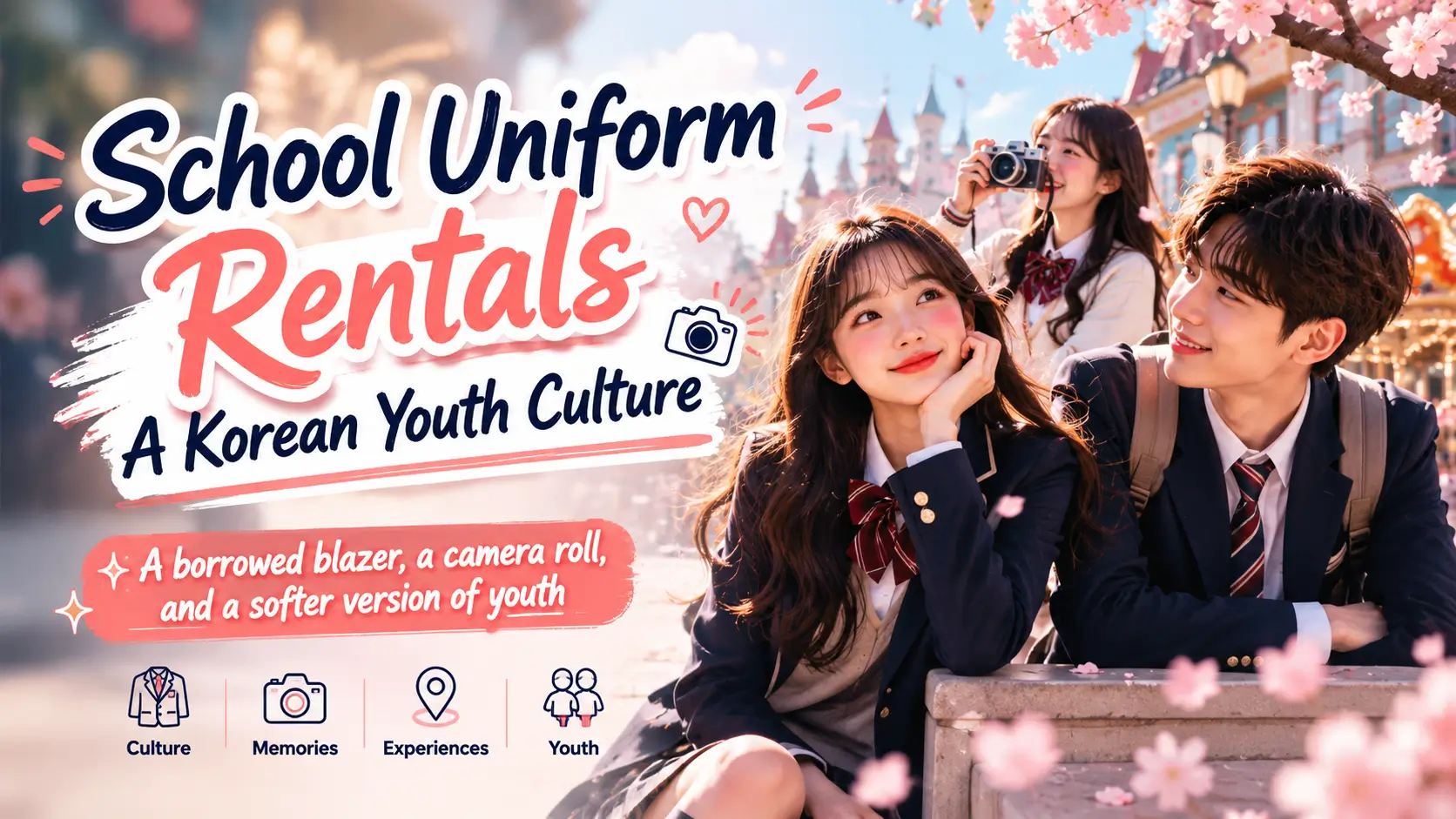
How School Uniform Rentals Became Part of Youth Leisure Culture in Korea
A borrowed blazer, a camera roll, and a softer version of youth
In Korea, a school uniform can mean early buses, exam pressure, hallway friendships, convenience-store snacks, first love, and the strict choreography of adolescence. Yet near theme parks and busy Seoul neighborhoods, that same uniform has become something lighter: a rented costume for a date, a friend trip, a tourist memory, or a few hours inside a K-drama-tinted afternoon.
This article explains why school uniform rentals in Korea are not just a cute travel add-on. They sit at the crossing of theme parks, K-drama nostalgia, K-pop styling, photo culture, youth identity, and the Korean love of carefully designed experiences. The appeal is not only the outfit. It is the feeling that the day has suddenly acquired a plot.
For travelers, parents, culture-curious readers, and anyone wondering why adults would rent something associated with school, the answer is richer than “because it looks good in photos.” It is about borrowing a mood without becoming trapped in it, a tiny time machine with a return deadline.
Understand the trend
See how uniforms moved from school rules to leisure style.
Plan smarter photos
Know where the experience fits best, from Jamsil to Hongdae.
Avoid awkward mistakes
Learn what to check before renting, wearing, and returning the outfit.
✨ The small promise: by the end, the school uniform rental trend will feel less like a strange tourist novelty and more like a readable piece of modern Korean leisure culture.
Snapshot
This guide is for travelers, K-drama and K-pop fans, parents of teen visitors, study-abroad planners, and culture readers who want to understand Korean school uniform rentals before trying or explaining the experience. You will learn why the trend grew, where it works best, what mistakes to avoid, and how to approach it with both fun and respect.
Table of Contents
The Uniform Became a Costume, Not Just Clothing
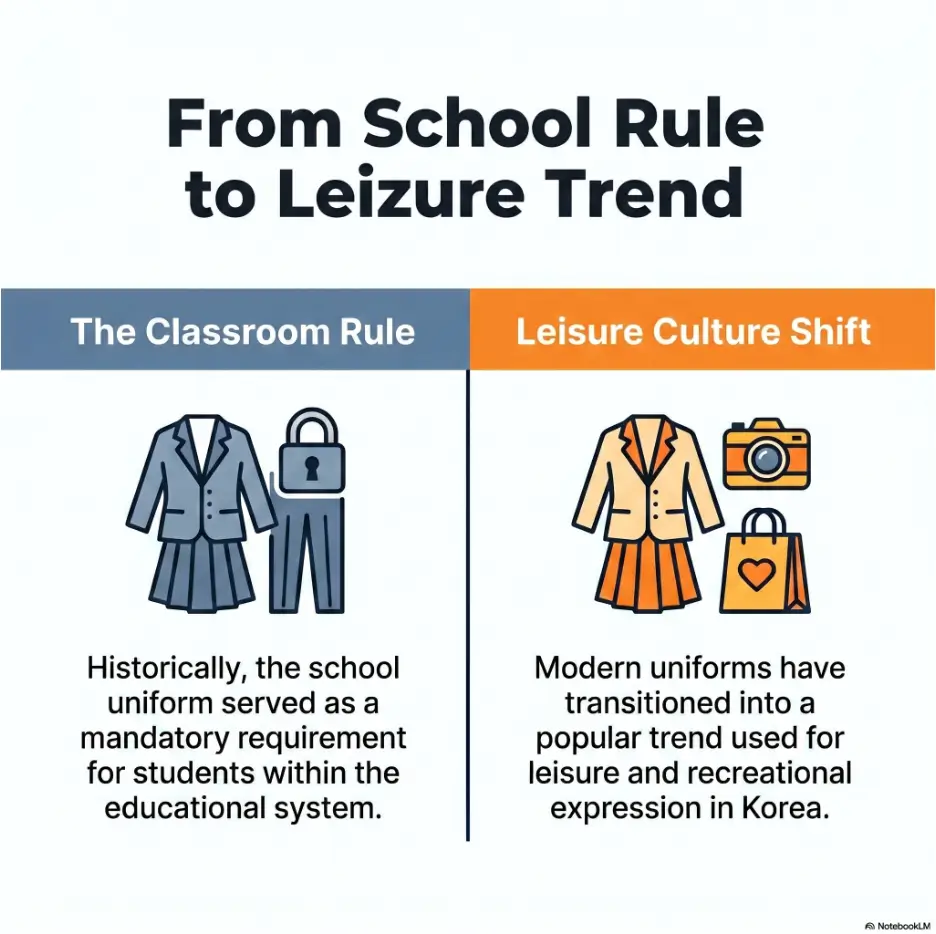
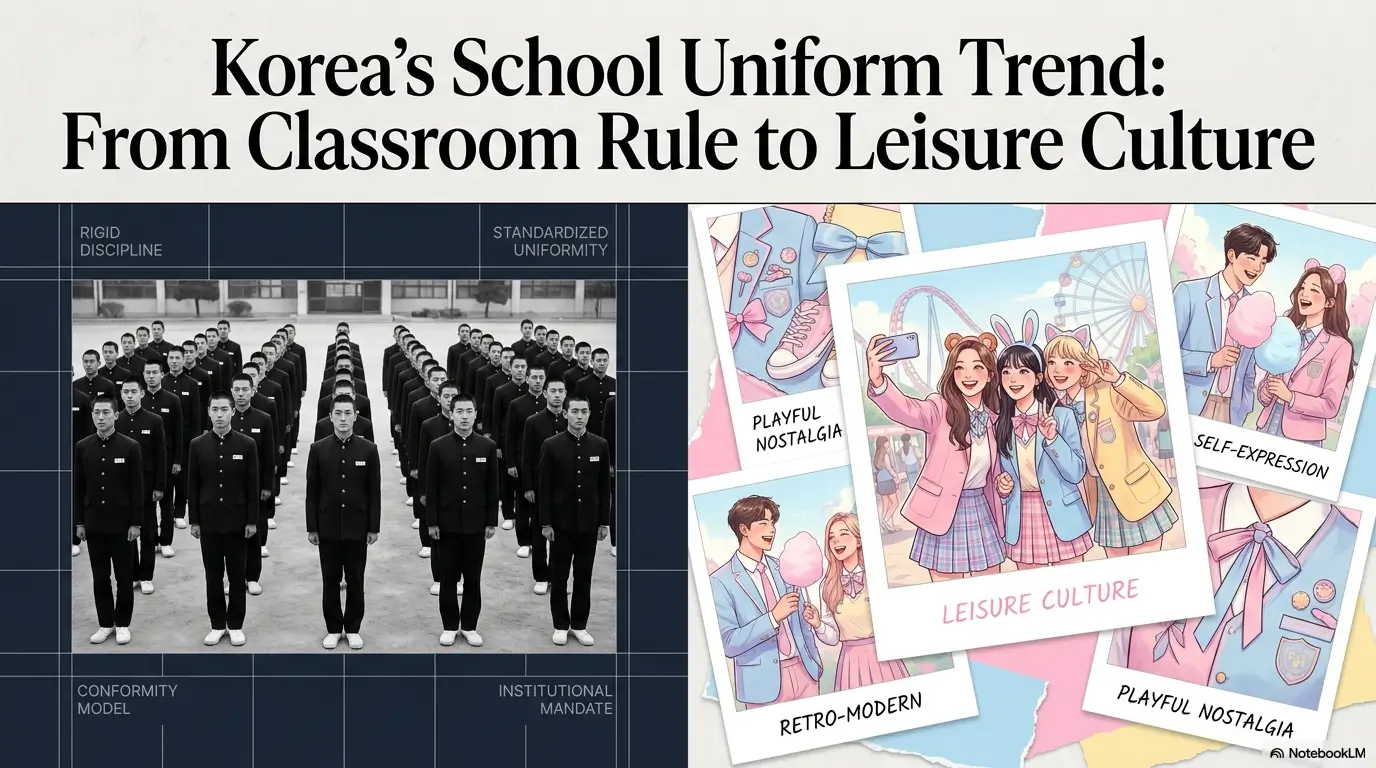
A school uniform begins as a rule. It tells students where they belong, what institution claims them during the day, and how much personal expression can fit inside a collar, tie, skirt, trousers, or blazer. In Korean school life, uniforms can carry memories of classrooms, cram schools, friendships, gossip, discipline, and academic pressure.
Rental culture changes the meaning. The uniform leaves the school gate and enters a leisure setting. Suddenly it is no longer a requirement. It becomes a “character skin” for a few hours, a way to try on a youthful mood without accepting the actual demands of student life.
That shift is important. The outfit is familiar enough to feel emotionally loaded, but distant enough to feel playful. It sits between memory and performance, which is exactly where many modern travel experiences thrive.
From school rule to weekend role-play
When students wear uniforms every day, the clothing can feel ordinary or even restrictive. When visitors rent similar pieces for a theme park day, the same silhouette becomes theatrical. A blazer is no longer just a blazer. It becomes a signal that the day has been arranged around friendship, photos, and shared play.
This is why uniform rental is different from simply buying a preppy outfit. Rental gives the experience a beginning and an end. You select the pieces, wear them through a planned route, photograph the result, and return everything before closing time. The temporary nature makes it safer, lighter, and easier to enjoy.
In that sense, school uniform rental belongs to the same family as themed cafés, photo booths, couple outfits, and seasonal pop-up spaces. It is not only about consumption. It is about turning an ordinary day into a small, readable story.
Why the same outfit feels different after graduation
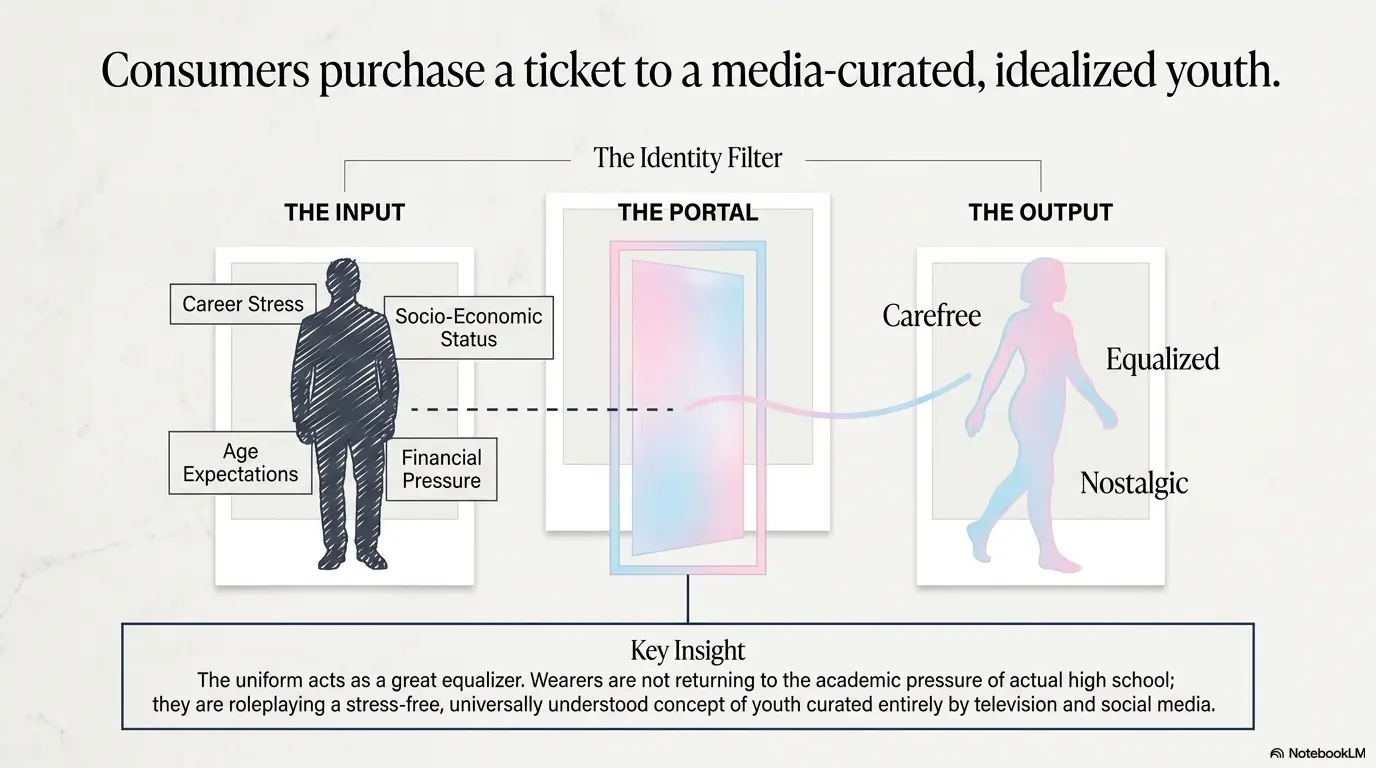
For adults and college-age visitors, school uniforms can create emotional distance from a stressful life stage. Exams are over. Attendance rules are gone. No homeroom teacher is checking skirt length or tie neatness. What remains is a softened image of youth: friends, snacks, first crushes, bus rides, and late sunlight on a school corridor.
That distance matters because nostalgia often edits memory. It does not erase difficulty, but it frames the past through warmth, humor, or wistfulness. A rented school uniform lets people engage with that edited memory without pretending the original experience was always easy.
International visitors may feel this even if they never attended school in Korea. Their memory is borrowed from dramas, music videos, webtoons, variety shows, and travel content. The uniform becomes a passport into a visual language they already recognize.
Here’s what no one tells you
The appeal is not only “looking cute.” It is the temporary permission to enter a younger, brighter version of the self without making a permanent identity claim.
That is why the experience works for couples, friend groups, tourists, and even adults who would never wear school-inspired clothes in daily life. The rental says, “This is only for today.” That sentence removes embarrassment. It also gives the photo a frame.
Key takeaway
Korean school uniform rental works because the outfit has two lives. In school, it is structure. In leisure, it becomes mood, memory, and performance.
Theme Parks Turned Uniforms Into a Shared Ritual
Theme parks are perfect soil for school uniform rentals. They already operate outside ordinary time. People arrive expecting rides, snacks, music, bright lights, staged spaces, and a little theatrical silliness. A rented uniform fits that atmosphere neatly because the whole day is already a chosen performance.
At Lotte World in Seoul, the connection is especially visible. The park is easy to reach by subway, surrounded by Jamsil’s urban attractions, and packed with backdrops that look good in photos. A school uniform turns the visit into a themed outing before the first ride even begins.
Everland and other leisure destinations use a similar logic. The uniform gives groups a shared visual identity, which makes the day feel more planned and memorable. It also helps visitors answer the quiet travel question: “What kind of day are we having?” The answer becomes visible in the outfit.
Lotte World made the look visible
Lotte World is one of the clearest examples because the surrounding area supports the entire ritual. Visitors can arrive near Jamsil Station, choose a rental shop, try on different combinations, then walk into a theme park where the outfit feels natural instead of strange.
The park’s indoor and outdoor spaces also help. Carousels, castle-like structures, night lights, cafés, and lakeside paths create a visual setting where a school-inspired look feels cinematic. A regular travel outfit might document the day. A uniform helps stage it.
For foreign visitors, this matters because the rental process lowers the effort barrier. Instead of searching for a costume, styling every piece, and guessing what looks right, travelers can select a package that already carries the intended mood.
Everland expanded the “uniform day” formula
Everland-linked rentals show how the idea spread beyond one Seoul location. Once visitors understand that a uniform can be part of the amusement park itinerary, it becomes less unusual. It is no longer a costume party. It is a day plan.
The structure of rental businesses also makes the trend feel official. Many shops or booking pages include rental hours, deposits, ID rules, size ranges, outfit components, and add-on options. That structure turns a playful idea into a repeatable product.
This is one reason the trend travels well online. A uniform day has a clear script: choose, dress, walk, ride, photograph, snack, return. The steps are simple enough for first-time visitors, but flexible enough for people who want their own spin.
The group photo became the souvenir
In the past, a souvenir might have been a keychain, a mug, or a printed ticket. Now the souvenir is often the image: four friends in matching ties, a couple in coordinated cardigans, a solo traveler standing under bright park lights with a grin that says, “I cannot believe I did this, but I am glad I did.”
The uniform creates coherence in the photo. It ties the group together visually. It also signals that the day was not accidental. It was chosen, styled, and shared.
Planning note
For theme parks, comfort beats perfection. A cardigan that photographs beautifully is less useful if it makes you overheat by lunch. Build the outfit around walking, weather, and return time.
K-Drama and K-Pop Taught the World How to Read the Look
Many international visitors do not encounter Korean school uniforms first through actual schools. They encounter them through screens. K-dramas, K-pop stages, web dramas, music videos, and promotional photos have trained viewers to read the uniform as an emotional symbol.
That symbolism is powerful because it is fast. A school uniform can signal first love, rivalry, friendship, academic pressure, innocence, rebellion, class identity, or transformation before a character says a word. It is visual shorthand, stitched into a blazer.
When tourists rent uniforms, they are often renting access to this shared visual code. The outfit does not need to copy a specific character. It only needs to evoke the emotional weather of Korean youth media.
K-drama made uniforms emotional shorthand
School scenes in Korean dramas often carry intense emotional weight. A hallway glance can feel enormous. A rooftop conversation can reshape a friendship. An after-school snack run can become the quiet center of a romance.
The uniform helps audiences recognize that emotional setting instantly. It says: this is a stage of life where small gestures feel large, where reputation matters, where friendship can become family, and where the future is both thrilling and heavy.
For visitors, wearing a rented uniform can feel like stepping into that grammar for a moment. They are not only putting on clothes. They are entering a familiar story shape.
K-pop made the silhouette fashionable
K-pop styling helped detach the school uniform silhouette from strict institutional dress. Idol stages often remix blazers, ties, pleated skirts, vests, knee socks, cardigans, and sporty details into polished performance fashion.
The result is not a documentary version of school life. It is stylized, bright, and sometimes exaggerated. That matters because rental shops often lean toward the same photo-friendly universe. The outfits may feel “school-inspired” rather than school-accurate.
Accessories do much of the cultural work. A ribbon softens the look. A loose tie adds casual energy. A cardigan makes it sweeter. A blazer makes it formal. A backpack or photo booth prop gives the image a plot.
Don’t flatten it into cosplay
It is tempting to call Korean school uniform rental “K-drama cosplay,” but that can be too narrow. Many people are not trying to become one character. They are participating in a broader media aesthetic that blends school romance, idol styling, youth fashion, and travel photography.
The distinction helps readers understand the trend with more care. It is not always imitation. Often it is atmosphere.
Show me the nerdy details
The uniform rental trend works through semiotics, the study of signs. The blazer, tie, skirt, vest, or cardigan does not only cover the body. It points to a cluster of meanings: youth, school pressure, friendship, hierarchy, romance, innocence, and transformation.
Rental culture then changes the sign. The uniform no longer says “I attend this school.” It says “I am choosing a school-inspired leisure role for a limited time.” That tiny shift from obligation to choice is why the same clothing can feel strict in one setting and playful in another.
Instagram Made the Rental Economy Click
Social media did not invent the pleasure of dressing up. People have always used clothing to mark occasions. What social media changed was the speed, scale, and reward system. A photo-ready outfit now gives a day structure before the day even begins.
School uniform rentals solve a very modern problem: “How do we make this outing look like something?” The answer is immediate. Matching or coordinated uniforms create a theme, and a theme makes casual travel photos feel intentional.
This is why timed rentals make sense. Four hours can be enough for a micro-story: choose outfits, take street photos, visit a theme park entrance, eat something sweet, take a photo booth strip, and return the clothes. The rental does not need to last forever. The image does.
The outfit solves the photo problem
Many travelers arrive with cameras but no clear visual plan. They know they want memories, but they do not know what kind. A uniform gives the day a concept in seconds.
For groups, this is especially useful. Different outfits can make group photos feel scattered. Coordinated uniforms create unity without requiring everyone to wear identical pieces. One person can choose a blazer, another a cardigan, another a vest, and the group still reads as one story.
This is also why school uniform rental appeals to content creators. It gives them a recognizable visual hook, a location-friendly costume, and a reason for viewers to stop scrolling.
Four hours is enough for a micro-story
Short rental windows fit the experience economy. People increasingly buy compact activities that can be inserted into a travel day: a café, a photo booth, a themed rental, a walking route, a small performance, a workshop.
A school uniform rental is ideal for this because it does not require deep planning. It can be layered onto an existing itinerary. You can rent before Lotte World, before a Hongdae walk, before a studio shoot, or before a casual afternoon with friends.
The limited time adds energy. Return deadlines are annoying if ignored, but useful if respected. They give the day rhythm.
The camera changed the value of clothing
Rental clothing does not need to last because the image lasts. That is the core economics of the trend. The outfit is temporary, but the photo becomes part of the traveler’s digital archive.
This can sound shallow until we remember that photographs have always shaped memory. A family album, a graduation portrait, a passport photo, a wedding snapshot, a blurry concert image: each one helps the past keep its edges. Uniform rental simply gives a casual outing the visual discipline of an occasion.
Seoul Neighborhoods Turned Uniforms Into a Walking Experience
Uniform rental is not limited to theme parks. Seoul itself can become the set. Subway exits, convenience stores, cafés, lakeside paths, shopping streets, photo booths, and small alleys all become part of the performance.
This is one reason the trend fits Korea so well. Korean leisure culture often blends movement, food, styling, and photography into one smooth afternoon. A date might include a café, a walk, a photo booth, street food, shopping, and a seasonal installation. The rented uniform simply gives that route a visual spine.
For readers planning a trip, the neighborhood matters. A uniform that feels perfect near a theme park might feel odd in a formal museum or quiet memorial space. The best route supports the mood instead of fighting it.
Hongdae adds youth-culture texture
Hongdae works naturally for school uniform rentals because it already carries youth-culture energy. It is associated with street fashion, cafés, busking, small shops, nightlife, art students, and photo-friendly corners. A school-inspired outfit does not feel out of place there. It joins the street’s existing theater.
For travelers who do not want a full theme park day, Hongdae can make the rental feel more flexible. You can build a lighter route around photo booths, dessert cafés, accessory shops, and casual street photos.
That said, Hongdae is still a real neighborhood, not a private photo studio. Good manners matter. Avoid blocking narrow sidewalks, photographing strangers closely, or treating local businesses as props without buying anything or asking when needed.
Jamsil links uniforms to theme-park fantasy
Jamsil is one of the strongest location clusters because Lotte World, Seokchon Lake, shopping spaces, food options, and rental shops reinforce each other. The outfit makes sense before, during, and after the park visit.
This helps visitors avoid the “now what?” problem. After renting, there are obvious places to go. After taking photos, there are obvious places to eat or rest. After the park, there are obvious ways to finish the outing before returning the outfit.
For first-timers, that convenience is golden. A trend feels less intimidating when the geography already tells you what to do next.
The city becomes the classroom set
One charming part of the trend is that ordinary city spaces become cinematic. A convenience store snack can look like an after-school scene. A subway entrance can feel like the beginning of a field trip. A lakeside walk can turn into the soft closing shot of the day.
This does not mean visitors should treat Seoul as a stage without people. It means the city’s everyday textures help explain why the rental works. The uniform is not only worn inside a shop. It moves through real urban life, collecting scenes as it goes.
For a broader cultural route, readers may also enjoy pairing this article with guides on Korean school uniform culture, Korean teen life, and Korean couple culture. Those topics help the rental trend feel less isolated and more connected to daily Korean social patterns.
Who School Uniform Rental Is For, and Who Should Skip It
School uniform rental is not automatically for everyone, and that is fine. The best cultural experiences are not mandatory. They work when the visitor’s expectations match the activity.
Some people want a playful photo day. Others want a deeper educational experience. Some travelers enjoy dressing up. Others feel self-conscious in themed clothing. Some families see it as harmless fun. Others may feel uneasy about school-themed fashion. A good guide should make room for all of that.
Best fit: culture-curious visitors
The experience works well for K-drama fans, K-pop fans, friend groups, couples, solo travelers, study-abroad visitors, and content creators who want a light cultural activity. It is especially enjoyable for people who like themed outings and do not mind being photographed.
It also works for travelers who want a low-stakes way to participate in Korean youth aesthetics without needing perfect language skills or deep local knowledge. The rental shop provides structure. The city provides the backdrop.
Good fit: families with teens
Families with teens may enjoy the experience if expectations are discussed first. Parents should talk about comfort, modesty preferences, sizing, walking plans, and photo boundaries. A teen who loves the idea online may feel shy once standing outside in a uniform. That shift is normal.
A practical family approach is to choose a short rental window, pick a location with easy bathrooms and food options, and agree on when photos stop. Nothing ruins a sweet travel memory faster than one parent becoming the unpaid director of a four-hour photo shoot.
Not for everyone: discomfort matters
Skip the experience if school-themed clothing feels uncomfortable, if you dislike photo-driven activities, or if you would rather spend the time on history, food, museums, or language learning. There is no cultural prize for forcing yourself into a rented blazer you secretly resent.
Also skip it if your group cannot agree on tone. If one person wants sincere photos and another wants to mock the concept, the outing can become awkward. Better to choose a different shared activity than turn the day into a tiny diplomacy summit with socks.
Fit checklist
- You enjoy styled photos or themed travel activities.
- Your group agrees on the route, budget, and return time.
- You are comfortable wearing school-inspired clothing in public.
- You understand the look is leisure styling, not a perfect copy of school life.
- You can follow shop rules without rushing or arguing at return time.
Common Mistakes That Make the Experience Feel Awkward
The uniform rental experience is simple, but small mistakes can make it feel stressful. Most problems come from treating the outfit as the whole plan. It is not. It is one part of a day that still includes weather, walking, money, phones, bags, food, and human patience.
The smoothest outings are planned lightly but clearly. You do not need a military schedule. You do need to know where the shop is, how long the rental lasts, what you must bring, and what happens if you return late.
Mistake 1: Treating it like a real school uniform
Rental uniforms are often curated for leisure, trend appeal, and photography. They may borrow from real uniform design, but they are not always documentary representations of actual Korean schools. Expect styling, not strict authenticity.
This matters because over-explaining the outfit as “what Korean students really wear” can mislead readers or travel companions. A better description is “school-inspired rental fashion used for photos and outings.” That phrase is less dramatic, but far more accurate.
Mistake 2: Forgetting deposits, IDs, and return times
Many rental shops require some combination of ID, deposit, rental agreement, time limit, or late fee. Rules vary by shop, location, and booking platform. Check before you arrive, especially if you are traveling with minors or only carrying digital documents.
Return time is the quiet villain of many rental days. It seems far away until the group is across town, someone’s phone battery is low, and the subway transfer suddenly feels like a puzzle designed by a tired octopus.
Mistake 3: Choosing style over comfort
A theme park day is not a studio portrait. You will walk, sit, stand, eat, sweat, wait, and possibly shiver. Shoes matter. Layers matter. Pockets matter. Weather matters. The perfect photo outfit can become a tiny fabric prison if it ignores the actual plan.
Before choosing, ask yourself: Will I still like this after three hours? Can I climb stairs? Can I sit comfortably on rides or benches? Do I need a jacket? Is there a place to keep my original clothes?
Let’s be honest…
The best-looking outfit is the one you can actually wear for the full plan without becoming a steamed dumpling of regret.
| Mistake | Why it causes friction | Better move |
|---|---|---|
| Booking too far from your main route | You lose time returning the outfit | Choose a shop near the park or photo area |
| Ignoring weather | Cold, rain, or heat can ruin comfort | Check layers, jackets, and umbrella rules |
| Forgetting ID or deposit | You may not be able to rent | Read the shop rules before leaving your hotel |
| Overpacking the day | Return deadlines become stressful | Plan one main route and one backup stop |
| Copying photos without context | It can feel forced or disrespectful | Use inspiration, but keep your behavior considerate |
Key takeaway
The outfit can make the day charming, but logistics protect the charm. Confirm ID rules, deposit, rental hours, late fees, weather, and walking comfort before you commit.
The Nostalgia Is Real, But It Is Complicated
It is easy to romanticize school uniforms from the outside. They photograph well. They carry a clean silhouette. They appear in dramas during emotional scenes. But for people who actually wore them, uniforms can hold mixed memories.
For some Koreans, a school uniform may recall friendship, first love, and youthful freedom after class. For others, it may recall exams, hierarchy, appearance rules, bullying, discipline, or exhaustion. Often it holds all of those at once.
This complexity does not cancel the rental trend. It explains why the trend has emotional charge. The uniform works because it is not neutral.
For Koreans, uniforms can carry mixed memories
Korean school life is often discussed through intense education culture, friendships, after-school academies, exams, and social belonging. A uniform can become the fabric container for all of that. It can represent community and control at the same time.
That is why adult Koreans may approach rental uniforms in different ways. Some may find them funny and nostalgic. Some may find them childish. Some may enjoy the trend only when it is clearly playful rather than pretending school life was always soft and cinematic.
For foreigners, nostalgia may be borrowed
International visitors often approach the uniform through media memory rather than lived Korean school experience. They may recognize the look from dramas or idol styling, but not from actual classroom routines, exam seasons, or school rules.
Borrowed nostalgia can still be meaningful. People are moved by stories from places they did not grow up in. The key is humility. Enjoy the mood, but do not claim the memory as if it were fully yours.
The tension is part of the trend
The rental works because it sits between reality and fantasy. It is sincere and artificial, local and global, nostalgic and commercial. That tension gives the experience its fizz.
In other words, it is not really about pretending to be a student. It is about stepping into a softened timeline, taking a few photos, and returning to adult life with a slightly fuller camera roll.
Short Story: The cardigan at Jamsil Station
Mina, a 29-year-old visitor from London, almost canceled the rental when she saw the school-style cardigan in the mirror. “I look ridiculous,” she said, tugging at the sleeve.
Her friend did not argue. She only asked, “Ridiculous in a bad way, or ridiculous in a holiday way?” That small distinction saved the afternoon.
They chose comfortable shoes, set a phone alarm for the return time, and kept the plan simple: lake walk, snack, Lotte World photos, coffee, return. By sunset, the cardigan had stopped feeling like a costume and started feeling like punctuation.
The lesson was not “be brave for photos.” It was gentler: choose the version of the experience your body can enjoy, your schedule can support, and your future self will not have to explain with a wince.
Why Businesses Love the Uniform Rental Model
From a business point of view, school uniform rental is elegant. It has clear demand, repeatable inventory, easy packaging, and strong word-of-mouth. It pairs naturally with tourism, theme parks, photo studios, travel apps, and neighborhood walking routes.
The product is also emotionally legible. A visitor can understand it from a single photo. That makes marketing easier than for experiences that require long explanation.
Low barrier, high photo value
The basic promise is simple: rent an outfit, look coordinated, take better photos, enjoy a themed outing. That low barrier is powerful. Visitors do not need special skills, language fluency, or deep planning to understand the appeal.
For rental shops, the clothes can be reused, styled in many combinations, and packaged at different price points. For travel platforms, the experience is easy to list and easy to explain. For visitors, it is easy to add to an itinerary.
Add-ons make the outfit expandable
Add-ons are natural in this model. Jackets, bags, socks, ties, ribbons, studio photos, extended time, and location bundles can all increase the value of the rental. The customer begins with the core outfit, then chooses how complete the story should feel.
This is not automatically bad. Add-ons can improve comfort and style. The problem comes when visitors do not understand what is included. Always check whether the listed price covers the full outfit you imagined.
Reviews spread the look faster than ads
A friend-group photo can sell the experience better than a formal advertisement. It shows the outfit, the location, the group energy, and the emotional payoff in one image.
This is why the trend travels so quickly through social media. Every customer can become a tiny billboard, but one that looks like a memory rather than a sales pitch.
Key takeaway
Uniform rental is commercially strong because it is easy to understand, easy to photograph, easy to package, and easy for customers to recommend through their own images.
A Practical Framework for Planning a Uniform Rental Day
If you are thinking about trying school uniform rental in Korea, treat it as a small experience design project. The goal is not to do everything. The goal is to create one smooth, comfortable, memorable route.
The best planning question is simple: “Where will this outfit make sense?” Once you answer that, the rest becomes easier.
Uniform Rental Day Framework
1. Choose mood
Cute, nostalgic, sporty, romantic, or friend-trip energy.
2. Match location
Theme park, Hongdae walk, photo booth, lake route, or studio.
3. Check rules
ID, deposit, time limit, included pieces, and late fees.
4. Protect comfort
Shoes, weather, layers, bags, food breaks, and walking distance.
5. Capture memory
Pick a few photo stops instead of chasing every possible angle.
6. Return calmly
Set an alarm and leave enough transit time to avoid late stress.
Choose the day around one main scene
Do not plan ten photo locations unless your group genuinely enjoys that pace. Choose one main scene. It might be Lotte World at night, a Hongdae photo booth route, Seokchon Lake in soft light, or a café-and-street walk.
One main scene keeps the day from becoming frantic. It also gives your photos a stronger identity. A focused memory is often better than a crowded one.
Use a simple decision table
| Visitor type | Best route | Why it works | Watch out for |
|---|---|---|---|
| First-time tourist | Jamsil and Lotte World | Easy geography and strong photo settings | Return time after park activities |
| K-drama fan | Café, photo booth, street walk | Feels like a casual youth scene | Overstaging every photo |
| Family with teens | Short rental plus one main location | Lower pressure and easier comfort control | Sizing, modesty, and tired feet |
| Couple | Theme park plus lake or café | Romantic without needing a formal shoot | Weather and crowd timing |
| Content creator | Hongdae or studio-linked route | Strong visual variety in a compact area | Respecting businesses and pedestrians |
Pack like the outfit is borrowed
Because the outfit is rented, your behavior should be a little more careful than usual. Avoid messy foods while wearing pale shirts. Be mindful of makeup transfer. Keep receipts, rental slips, or shop messages accessible. Store your original clothes safely if the shop provides a bag or locker process.
A small crossbody bag can be more useful than a bulky backpack. Keep phone battery, transit card, ID, payment card, and emergency cash easy to reach.
Quick prep list
- Confirm shop location and opening hours.
- Check ID, deposit, and accepted payment methods.
- Confirm what the basic package includes.
- Set a return alarm at least 45 to 60 minutes before the deadline.
- Choose comfortable shoes before choosing accessories.
- Pick two or three photo stops, not twelve.
- Save the shop address in your map app.
When to Pause, Adjust, or Skip the Experience
This topic is low risk compared with medical, legal, or financial decisions, but there are still moments when stopping or adjusting is wise. A playful experience should not become uncomfortable, unsafe, or disrespectful.
Pause if someone in your group feels embarrassed beyond ordinary shyness, if the outfit does not fit properly, if weather makes the plan miserable, or if the rental rules are unclear. A good memory rarely begins with ignoring the obvious.
Stop if the plan depends on pressure
If one person is being pushed into wearing the outfit for photos, the experience has already lost its charm. This matters especially for teens, shy travelers, and anyone sensitive about appearance.
Make participation flexible. One person can rent the full outfit, another can choose a cardigan, and another can skip the rental and still join the day. Friendship does not require matching socks.
Adjust if the location feels wrong
Some spaces are better for playful photos than others. Theme parks, cafés, shopping streets, photo booths, and casual walking areas tend to fit the mood. Quiet memorials, religious spaces, formal institutions, and crowded commuter areas may not.
When in doubt, choose restraint. You can still enjoy the outfit without turning every place into a backdrop.
Seek local guidance for minors or school visits
If a family, school group, or youth travel program is involved, check rules carefully. A commercial rental near a theme park is different from wearing school-inspired clothing near an actual school or formal educational setting.
For organized trips, follow the guidance of the tour leader, host institution, or local coordinator. Cultural fun should not create confusion about identity, access, or student status.
Key takeaway
A respectful uniform rental day is playful, voluntary, location-aware, and easy to exit. When the mood turns pressured or the setting feels wrong, adjust the plan.
FAQ
Why do people rent school uniforms in Korea?
People rent school uniforms in Korea for theme parks, photos, dates, friend outings, and media-inspired experiences. The outfit creates a playful youth-culture mood without requiring visitors to be students.
Is school uniform rental in Korea only for teenagers?
No. Rentals are often enjoyed by couples, adult friend groups, tourists, families, and content creators. Adults may approach the outfit through nostalgia, humor, fashion, or K-drama-inspired play.
Where do tourists usually rent school uniforms in Seoul?
Popular areas include Jamsil near Lotte World and youth-oriented neighborhoods such as Hongdae. Some travelers also connect rentals with theme parks, photo studios, or casual Seoul walking routes.
Is Korean school uniform rental connected to K-drama?
Yes, partly. K-dramas helped international viewers understand school uniforms as symbols of youth, friendship, romance, rivalry, and coming-of-age stories. Rental culture turns that visual language into a short leisure experience.
How long can you rent a Korean school uniform?
Rental time varies by shop and package. Some rentals are designed for a few hours, while others may last a full day. Always check return deadlines, late fees, and shop hours before planning your route.
Do school uniform rentals include the full outfit?
Many packages include core pieces such as a shirt, skirt or trousers, tie, vest, or knitwear. Jackets, bags, socks, ribbons, and other accessories may cost extra depending on the shop.
Is it respectful to rent a school uniform in Korea?
It can be respectful when treated as a light cultural leisure activity, not as a joke about students or Korean school life. Follow shop rules, dress appropriately, and avoid mocking real school culture.
What should visitors check before booking?
Check location, rental time, deposit, ID rules, size availability, included items, return deadline, weather, and whether accessories or jackets cost extra.
Your 15-Minute Next Step Before You Book
School uniform rentals became part of youth leisure culture in Korea because they compress many feelings into one easy-to-book activity: nostalgia, media fantasy, friendship, styling, photography, and the gentle thrill of becoming slightly fictional for an afternoon.
The trend is not really about school. It is about a softer timeline. A group of friends adjusts ties near a subway station. A couple chooses cardigans before a theme park date. A traveler steps into Seoul with borrowed clothing and borrowed youth, knowing the spell has a return time.
Your next step is simple: choose one location, one mood, and one practical route. In the next 15 minutes, open your map, pick either Jamsil, Hongdae, or another rental-friendly area, then write down three things: your rental window, your main photo stop, and your return plan. That small triangle protects the whole day.
Do that, and the experience can stay what it should be: light, stylish, respectful, and memorable. A blazer, after all, is only fabric. The story is what you do while wearing it.
15-minute planning card
- Location: Choose one rental area that fits your route.
- Mood: Pick cute, nostalgic, sporty, romantic, or friend-trip styling.
- Comfort: Confirm shoes, weather, layers, and walking time.
- Rules: Check ID, deposit, included pieces, and return deadline.
- Memory: Choose two or three photo stops and leave space to actually enjoy the day.
Last reviewed: 2026-05