

Korea, housing, and the price of adulthood
How Korea’s Housing Market Anxiety Shapes
Marriage, Fertility, and Career Choices
A home is supposed to be quiet. Four walls, a kettle, a hallway where shoes wait like small witnesses. But in South Korea, housing has become much louder than shelter. It now speaks into dating, marriage timing, childbirth, job choices, family money, gender expectations, and the soft dread that adulthood may require a deposit larger than courage.
For US and UK readers, Korea can look like a distant case study: Seoul apartments, jeonse deposits, chaebol careers, ultra-low fertility. Yet the emotional mechanism is familiar.
When rent, loans, location, and job security begin to decide the shape of a life, people do not simply “choose later.” They build smaller dreams because the floor feels unstable.
This guide explains how Korean housing anxiety moves through ordinary choices: whether to marry, whether to have a first or second child, whether to take a safer job, whether to accept help from parents, and whether to believe that the future has room for more than survival.
Understand the pressure
See why housing is not just a budget issue, but a life-script issue.
Connect the choices
Trace the chain from rent and deposits to marriage, babies, work, and family help.
Avoid easy myths
Move past “young people just don’t want kids” and look at confidence instead.
🏠 Core idea: Korea’s housing market is not only pricing homes. It is pricing time, confidence, family formation, and the right to imagine a larger life.
Snapshot
This article is for readers who want to understand South Korea’s housing anxiety as a social and demographic force, not just a real estate story. You will learn how housing pressure shapes marriage timing, fertility decisions, job choices, parental support, gender risk, and policy trust, then use a simple 15-minute tracing exercise to read one life choice as a housing signal.
Table of Contents
Safety and Scope Before We Start
This article explains social and economic patterns. It is not a home-buying guide, investment forecast, legal opinion, immigration guide, or personal financial plan.
Korea’s housing system includes rules, loan products, rental contracts, family norms, and regional differences that can change quickly. If you are signing a lease, transferring a deposit, applying for a mortgage, or choosing a neighborhood in Korea, speak with a qualified local professional before money moves.
Key takeaway
- This article is analysis, not personal financial advice.
- Housing pressure is only one part of Korea’s marriage and fertility story.
- The best reading is layered: housing, work, education, gender, family, and trust.
Apply in 60 seconds: As you read, replace “housing prices” with “future confidence.” The article will become much clearer.
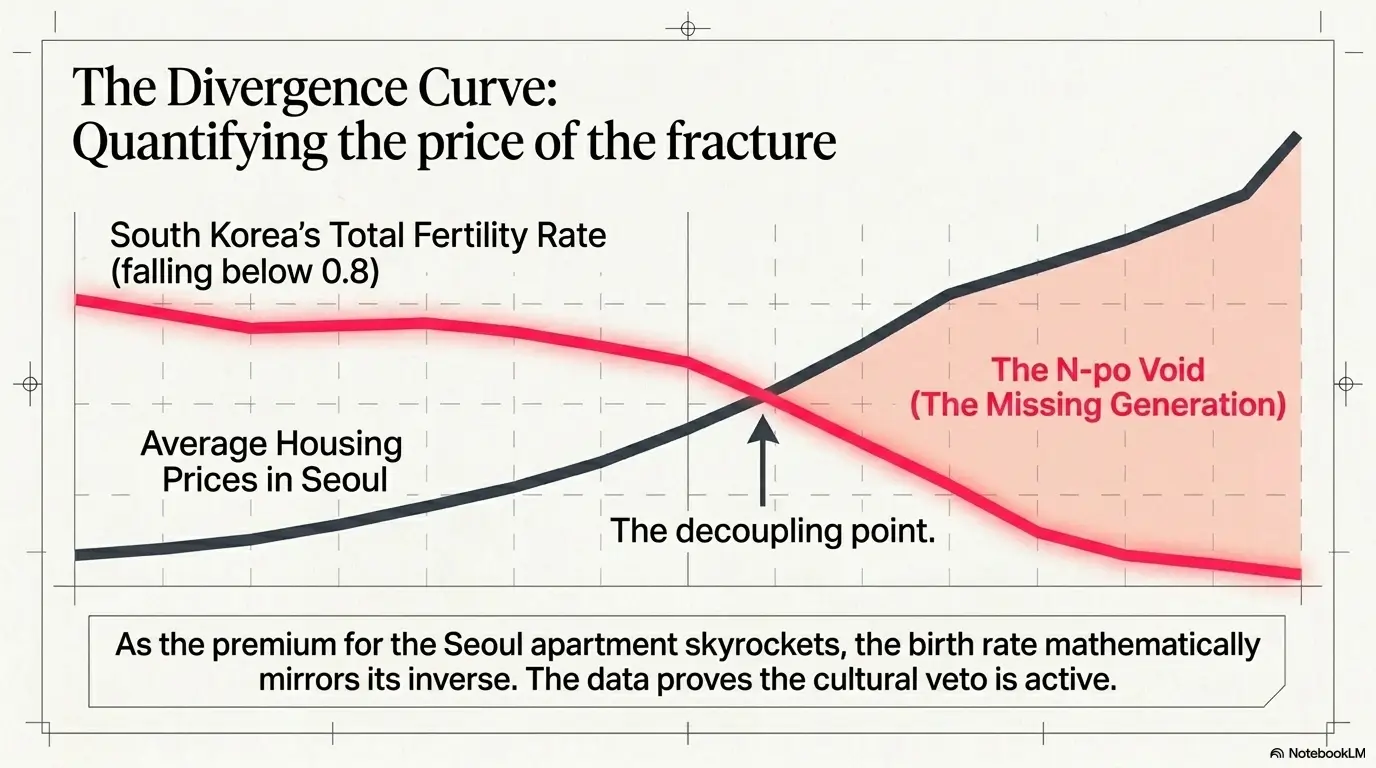
The freshest public data also deserves caution. South Korea’s total fertility rate dropped to 0.72 in 2023, rose to 0.75 in 2024, and provisional reporting for 2025 showed a rise to 0.80, but experts remain careful because births are still far below replacement level and population decline continues.
That is the first important lesson. A small rebound can be real and still not erase the structure beneath it. A kettle can whistle even when the stove is still too hot.
Why Housing Anxiety Became a Life-Planning Problem
The apartment is no longer just shelter
In many countries, housing is expensive. In Korea, especially around Seoul, housing often becomes a public signal of whether adulthood has “started properly.” The apartment is not just where a couple sleeps. It is where parents judge readiness, where relatives measure stability, and where a future child is imagined before that child exists.
That makes housing anxiety different from ordinary budgeting. A rent increase hurts the monthly spreadsheet. A blocked path to stable housing can shake the entire timeline: graduation, job, marriage, home, child, second child, aging parents, retirement.
For a young couple, a home can become the first large public test of private love. The question is not only, “Can we afford this?” It becomes, “Can we prove to everyone that our life is safe enough to begin?”
Why Seoul housing works like a social scoreboard
Seoul concentrates jobs, elite schools, hospitals, culture, networks, and status. That concentration turns location into more than convenience. A Seoul address can feel like access. A long commute can feel like a quiet demotion.
This is not unique to Korea. London, New York, San Francisco, Toronto, and Sydney all have their own geography of pressure. But Korea’s capital-region pull is especially intense because so many professional, educational, and social signals gather in one orbit.
For readers comparing Korea with the US or UK, the key difference is not that Korean families care about housing and Western families do not.
The difference is how tightly housing can connect to marriage timing, parental approval, children’s education, and the symbolic idea of a “proper” family start.
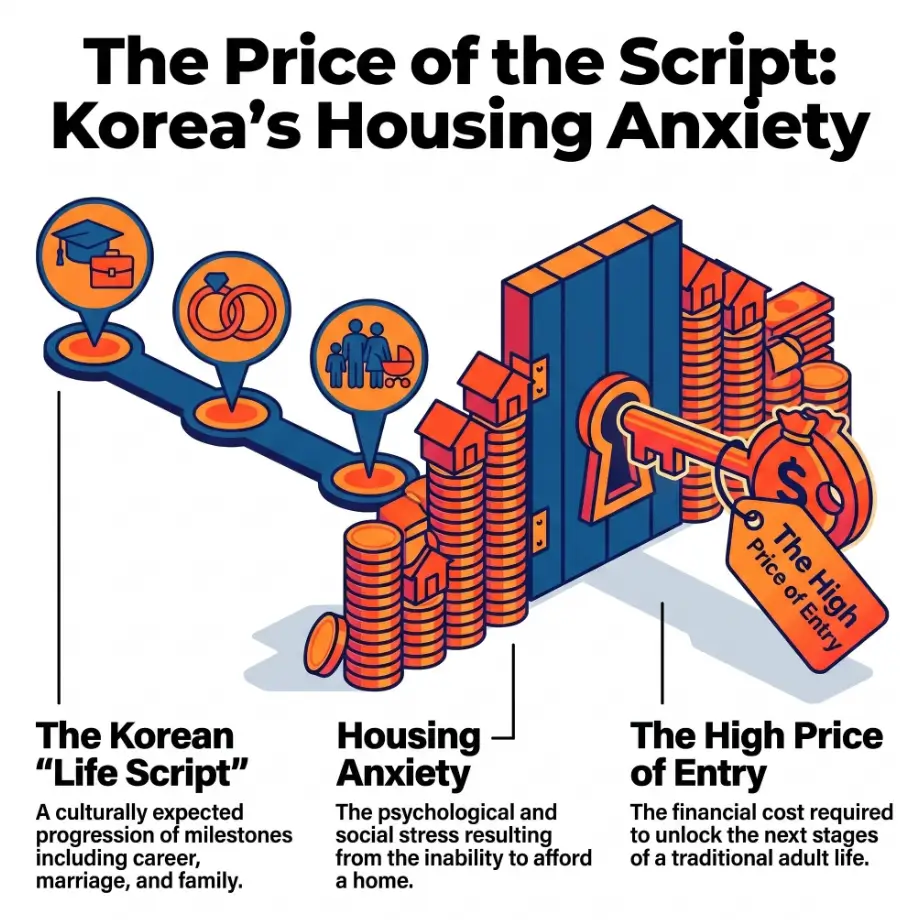
The hidden timeline: school, job, marriage, home, child
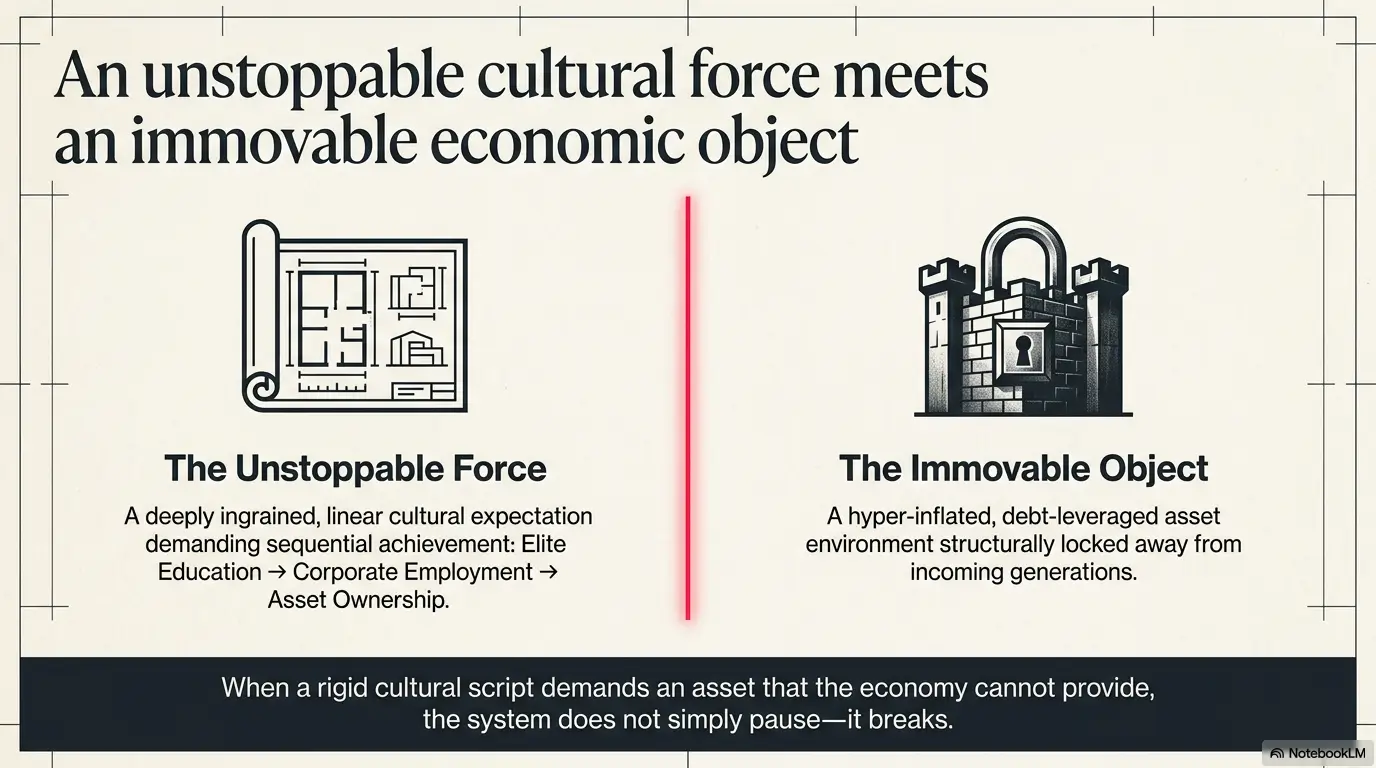
Many Korean life choices still carry an implied order. Study hard. Enter a reputable university. Get a stable job. Marry. Secure housing. Have a child. Educate that child well. Help them repeat the climb.
When one link becomes too expensive, the whole chain tightens. A person may not reject marriage. They may feel that marriage has a cover charge.
They may not reject children. They may feel that parenting begins with a housing deposit, a school district, and a tutoring budget sitting together at the table like stern uncles.
That is why housing anxiety becomes a life-planning problem. It turns private hopes into timed financial hurdles. It does not say, “Never.” It says, “Not yet,” then repeats itself until “not yet” starts to sound like “not possible.”
The Marriage Delay Loop
Housing as the unofficial engagement test
In Korea, the decision to marry often comes with practical questions that arrive early and sit heavily: Where will you live? Who pays the deposit? How close is it to work? Is the place suitable for children? Can both families accept the arrangement?
These questions are sensible. They are also exhausting. Romance may begin in cafés and group chats, but marriage planning can quickly move to bank balances, apartment listings, parental contributions, and the quiet mathematics of face-saving.
For a couple with stable affection but limited savings, housing can become the first vow before the actual vows: “We need a place first.” Then the place keeps moving farther away.
Jeonse, deposits, and the weight of upfront money
One feature that often surprises US and UK readers is jeonse, Korea’s large lump-sum deposit rental system. Instead of paying monthly rent in the familiar way, tenants may place a very large deposit with the landlord and receive it back at the end of the contract, assuming all goes well.
That structure can reduce monthly rent, but it moves stress to the front door. A couple may need savings, loans, or parental help before they can even step into what looks like “normal” married life.
For a deeper practical look at the rental-risk side, readers can compare this social analysis with a more operational guide to jeonse deposit protection in Korea. The emotional point here is simple: when the entry ticket is huge, love can feel undercapitalized.
Why marriage can feel financially reckless
Marriage is not only a personal decision. It is a public merger of expectations. In Korea, that merger often includes families, housing norms, wedding expenses, job status, and future childcare questions.
A couple may be emotionally ready but financially spooked. One partner may worry that marriage will lock them into a city, a mortgage, a commute, or a family role they are not ready to perform. Another may worry that waiting too long will make children harder, family approval weaker, or savings goals even more unreachable.
This is the loop: housing is needed to marry, marriage is needed to justify certain housing support, and both are tied to childbirth timing. The door opens, then asks for another key.
Key takeaway
- Marriage delay is not always a lack of desire.
- Housing can become an unofficial readiness exam.
- Large deposits make family help more important, which can make marriage less private.
Apply in 60 seconds: When you see “late marriage,” ask what housing step the couple may be trying to clear first.
Fertility Choices Under a Mortgage-Shaped Cloud
Why birth decisions shrink when housing feels temporary
Having a child is partly a question of hope. Hope needs space. Not luxury, not marble countertops, not a nursery with curated moon-shaped lamps. Just enough stability for parents to believe next year will not collapse under this year’s rent.
Housing insecurity can shrink fertility intentions because children make uncertainty louder. A one-bedroom apartment that feels romantic at 29 can feel impossible at 34 with a stroller, childcare pickup, two work schedules, and grandparents asking about school districts.
OECD analysis connects Korea’s low fertility to a wider conflict between work, family, housing costs, care systems, and gender inequality, not to one simple cause. It also notes that high housing costs and private education costs are major hurdles to having children.
The second child problem: space, childcare, tutoring, and fear
The first child asks, “Can we begin?” The second child asks, “Can we keep going?” That second question can be harder.
A second child may require a bigger apartment, more childcare support, more paid leave coordination, more school planning, and more help from grandparents. It may also increase the chance that one parent, often the mother, experiences career slowdown or exit.
In Korea, education pressure adds another layer. Parents are not only calculating diapers and daycare. They are often imagining hagwons, exam preparation, neighborhood school reputation, and the social cost of “falling behind.” Housing becomes the container for all of that fear.
How housing turns parenting into a spreadsheet
Many people want children in the abstract. The spreadsheet asks whether the abstract can survive actual Tuesday.
Monthly mortgage payment. Childcare. Lost income during leave. Commute time. Grandparent availability. Education costs. Medical costs. Moving costs. Interest rate risk. Deposit risk. Future school district. One column becomes ten.
This is why a birth-rate statistic can look cold while the lived decision is hot with feeling. People are not only deciding whether a baby is wanted. They are deciding whether their life has enough slack to protect that baby without breaking the parents.
Utility Block: Fertility Confidence Check
Use this as an analytical tool, not a personal command. A family’s decision may be affected by:
- Can the couple stay in the same home for several years?
- Is childcare reachable without crushing the commute?
- Would one parent face a serious career penalty?
- Is the housing choice tied to a school district or future tutoring plan?
- Would a second child require a move the family cannot afford?
- Would parental help create pressure, control, or emotional debt?
Readers interested in the downstream social effects can pair this section with a broader guide to Korea’s low birth rate effects and Korea’s shrinking schools. Housing is not the only engine, but it is one of the gears that makes the whole machine grind.
Career Choices When the Job Becomes a Roof
Why secure employment can outrank meaningful work
When housing feels fragile, the job stops being only a job. It becomes a roof with a salary attached.
This can make secure employment more attractive than creative work, start-ups, small firms, freelancing, or career switches. The question changes from “What work fits me?” to “What work lets a bank, landlord, parent, or future spouse believe I am safe?”
That stability premium appears in many economies, but Korea’s intense status hierarchy around schools, firms, and public-sector jobs can sharpen it. The dream job may still matter. It just has to pass the housing test first.
Public-sector dreams, chaebol pressure, and stability
A government job, a major corporate role, or a recognized professional track can carry more than income. It can carry credibility. In a housing-stressed environment, credibility has monetary value because it can affect loans, family negotiations, and marriage confidence.
This does not mean every young Korean wants the same life. Many do not. Korea has entrepreneurs, artists, freelancers, small-business owners, and people quietly building different versions of adulthood. But the pressure of housing can punish risk-taking before risk has a fair chance to breathe.
For readers trying to understand work norms behind this, Korean office culture offers useful context. Long hours and hierarchy do not float separately from family planning. They sit in the same room, drinking the same bitter coffee.
Career mobility gets smaller when housing risk gets bigger
Housing anxiety can reduce career mobility in three ways. First, people may avoid changing jobs if the new role looks less stable on paper. Second, they may stay near Seoul even when a better quality of life exists elsewhere. Third, they may postpone training or career pivots because the short-term income dip feels dangerous.
This matters for the whole economy. A society that scares young adults away from career experimentation may lose innovation, small business formation, regional renewal, and personal satisfaction. People become excellent at enduring. Endurance is noble, but it is a poor substitute for a flexible life.
Parents, Deposits, and Family-Class Inequality
When parental help becomes the invisible housing subsidy
In a high-cost housing system, parental help can become the subsidy that does not appear in public policy charts. A deposit from parents can shorten the road to marriage, reduce loan pressure, improve location, and make childbirth feel less frightening.
But this help is uneven. Some families can provide a deposit without trembling. Others provide help by working longer, borrowing, cutting their own retirement comfort, or simply saying sorry with empty hands.
Research on Korean young renters has found that housing cost burdens can affect both young adults and their parents, especially when parental financial support becomes part of current housing expenses.
Why young renters carry financial and emotional debt
Money from parents is rarely just money. It can carry gratitude, pressure, guilt, advice, control, comparison, and unspoken expectations about marriage, childbirth, and where the couple should live.
A young adult may feel lucky and trapped at the same time. Lucky because help makes independence possible. Trapped because independence funded by family can feel less independent than the word promises.
This is especially important for readers who only look at income. Two couples with similar salaries may have radically different life options if one receives family housing help and the other does not. The same paycheck can live in different universes.
The family bank: helpful, painful, and unequal
The family bank can help a couple avoid years of delay. It can also reproduce class differences before inheritance officially begins. In that sense, housing support becomes early inheritance wearing everyday clothes.
This matters for social trust. If young adults feel that effort alone cannot secure a stable home, their faith in the future weakens. If marriage depends on family assets, then the family you were born into can quietly shape the family you are able to form.
For related cultural background, see why Korean adults living with parents is more complex than laziness and how Korean grandparents often become part of the childcare system. Housing, childcare, and family obligation often travel together.
Short Story: The Deposit Envelope
Minji and her fiancé had found an apartment with morning light, the kind that made even instant coffee look ceremonial. The building was not fancy. The elevator sighed. The kitchen was narrow enough for two people to argue politely.
Then came the deposit. Her parents offered help in a white envelope, placed on the table as if it were both blessing and apology. Her fiancé smiled, bowed, thanked them, and went quiet on the bus ride home.
That night, Minji realized the apartment was not only a place. It was a negotiation between love, pride, family money, and fear.
The lesson is not that parental help is bad. The lesson is that housing pressure changes the emotional meaning of help. A deposit can open a door, but it may also leave fingerprints on the handle.
Who This Is For and Not For
This is for readers connecting housing with demographic change
This guide is for readers who want to understand why Korea’s housing market keeps appearing in conversations about marriage and low fertility. It is useful for students, journalists, policy readers, expats, investors trying to understand social context, and anyone studying East Asian demographic change.
It is also useful for US and UK readers who see similar patterns at home: expensive cities, delayed marriage, longer commutes, family help with down payments, and career choices shaped by housing cost.
This is not a home-buying guide
This article will not tell you whether to buy an apartment in Seoul, rent in Busan, sign a jeonse contract, or move to a satellite city. Those are real decisions with legal and financial risk.
If you need practical housing steps, start with guides like a Korean apartment move-in checklist or apartments for rent in Seoul, South Korea. This article is the map of social pressure around those decisions.
This is not a one-cause explanation
Housing does not explain everything. Korea’s marriage and fertility patterns also involve education expenses, gender expectations, work culture, long hours, care infrastructure, regional inequality, and changing values.
The strongest analysis does not crown one cause king. It watches how causes shake hands in the hallway.
Common Mistakes That Flatten the Story
Mistake: blaming young adults for “not wanting families”
This is the laziest explanation and, unfortunately, it travels well. It turns a structural problem into a personality complaint.
Many young adults do want partnership, children, or family life. They may also want financial safety, equal care labor, reasonable work hours, and housing that does not make parenthood feel like stepping onto a frozen pond in dress shoes.
The more useful question is not, “Why are they selfish?” It is, “What would make a long-term family decision feel less dangerous?”
Mistake: treating housing prices as separate from work culture
Housing and work culture are deeply connected. A long commute affects childcare pickup. Overtime affects household labor. Job insecurity affects loan confidence. Workplace penalties affect childbirth timing.
If a couple needs two incomes to manage housing but the workplace assumes one parent can disappear into unpaid care work, the math breaks. The home budget and the office calendar are not separate documents. They are stapled together.
Mistake: comparing Korea directly with the US
US readers may recognize housing stress, but Korea’s systems are not identical. Jeonse, Seoul concentration, family involvement in marriage, education pressure, and employment hierarchy create a different social rhythm.
Comparison is useful when it reveals mechanisms. It becomes sloppy when it erases context. Korea is not a mirror. It is more like a high-contrast photograph: some features look familiar because they are sharper there.
Mistake: assuming a birth-rate bump fixes the structure
Recent reporting showed South Korea’s fertility rate rising to 0.75 in 2024 and provisionally to 0.80 in 2025, helped by increased marriages, post-pandemic timing effects, and a larger cohort entering prime family-forming years. But experts caution that housing costs, education expenses, and care infrastructure remain serious constraints.
A rebound matters. It may show that people respond when timing, policy, and sentiment improve. But it does not prove the floor has been rebuilt.
The Seoul Effect
Jobs pull people toward the capital region
Seoul is not just a city in Korea’s imagination. It is a gravitational field. Jobs, universities, hospitals, media, government, corporate headquarters, and cultural prestige gather there and around the broader capital region.
That creates a hard choice. Move closer to opportunity and face higher housing pressure, or move farther out and risk longer commutes, weaker networks, and a sense of being socially offstage.
For a single adult, that trade-off is tiring. For a couple planning children, it becomes a daily operating system.
Housing scarcity turns geography into hierarchy
When certain neighborhoods are tied to schools, commute access, asset growth, and social prestige, geography becomes hierarchy. A location is no longer only a place. It becomes a label.
This can make “just move elsewhere” sound practical but incomplete. Moving elsewhere may reduce housing cost, but it can also affect job access, school planning, family support, dating prospects, and identity.
Housing anxiety is not always about the cheapest possible roof. It is often about the cheapest roof that does not close too many doors.
Commuting becomes a tax on family life
A long commute is a tax paid in minutes, patience, sleep, and missed dinners. For parents, it can become a childcare problem disguised as transportation.
If both parents work far from home, pickup time becomes a stress test. If one parent’s job is more flexible, that parent may absorb more care work. If grandparents live nearby, they may become the emergency bridge. If no bridge exists, the family pays with money, time, or burnout.
That is why transit, housing, childcare, and workplace flexibility belong in the same policy conversation. They are not separate drawers in a cabinet. They are the same drawer, overstuffed and refusing to close.
Infographic: The Housing Anxiety Flow
1. Price pressure
Rent, deposits, loans, and Seoul-area costs rise.
2. Stability test
Couples ask if marriage is financially safe enough.
3. Family math
Children become tied to space, care, school, and time.
4. Job caution
Secure work outranks risk, mobility, or personal fit.
5. Family bank
Parents fill gaps, creating help and inequality.
6. Trust question
Policy must lower fear, not only issue benefits.
Gender Expectations Hiding in Plain Sight
Why women may carry more downside risk
Housing stability does not erase gender inequality. A couple can have an apartment and still face unequal expectations about childcare, housework, in-law duties, and career sacrifice.
OECD analysis argues that as Korean women’s education and labor-market opportunities have improved, the personal cost of childbearing and career sacrifice has become more visible. That helps explain why some women postpone or forgo marriage and childbirth, rather than entering a life script that feels unfair.
Housing may be the loud cost, but gender can be the hidden contract. If the home is stable but the labor inside it is unequal, the fear remains.
Dual-income households are treated as optional, then required
Modern housing costs often require two incomes. Traditional family expectations may still treat one parent’s career as more interruptible. That contradiction can be brutal.
A household may need both salaries to afford housing, but once a child arrives, workplace culture and family norms may quietly ask one person to become the flexible parent. If that flexibility damages career growth, the household’s long-term financial safety can weaken.
This is where the “bigger apartment” answer fails. Space matters. But space without equal care, reliable childcare, and workplace support is only a larger room for the same old argument.
In-laws, marriage, and the private-public home
In Korea, marriage can involve two families more directly than many Western readers expect. Housing choices may carry questions about family support, proximity, holidays, care obligations, and status.
That does not mean every Korean family behaves the same way. But the broader cultural pattern helps explain why housing can feel public. The couple’s home may be private space, but the road into it often passes through family approval.
For related context, readers may find Korean in-law expectations and meeting Korean parents helpful. The housing conversation is rarely just about square meters.
Key takeaway
- Housing stability helps, but it does not solve unequal care work.
- Women may face higher career and family-risk costs after childbirth.
- A fair home requires time, labor, and respect, not only more space.
Apply in 60 seconds: When analyzing fertility, ask who is expected to pay the career cost of care.
Policy Promises and Why Cash Can Feel Too Small
Housing assistance can help, but trust matters
Korea has tried many family and housing supports, including loans, housing supply programs, newlywed support, and childbirth-related benefits. These programs can matter. A lower loan burden or better rental pathway can change the timing of marriage and childbirth for some households.
Recent research on Korean housing policy and childbirth intentions found that respondents reported higher childbirth intentions when preferred housing support was provided, with housing quality and safe living conditions also important, not affordability alone.
But policy does not operate in a vacuum. People must trust that support is accessible, meaningful, stable, and not swallowed by rising prices. A benefit that looks generous in a press release can feel small against the wall of a Seoul apartment listing.
Cash incentives struggle when the life script feels unaffordable
Cash benefits can help with immediate costs. They are less powerful when the deeper worry is long-term confidence.
A couple deciding whether to have a child is not only asking, “Will we receive a payment?” They are asking, “Can we stay housed? Can we keep working? Can we find childcare? Can we educate this child? Will one of us be punished at work? Will our parents need to rescue us?”
That is why policy must reduce fear, not only reduce one bill. The real target is not a single expense. It is the feeling that family life has become a risky luxury product.
The policy question: reduce costs, or reduce fear?
The answer is both. Lower costs matter. More housing supply, safer rental systems, fairer lending, childcare expansion, workplace reform, and regional opportunity all matter.
But fear has its own momentum. If people believe housing will keep outrunning wages, if they believe childcare will fail at the worst moment, or if they believe women will be penalized for motherhood, then even better benefits may not fully change behavior.
Demography follows confidence. Income matters, but confidence tells income what it is allowed to become.
Show me the nerdy details
Housing can influence fertility through several pathways. The first is the direct cost channel: rent, deposits, mortgage payments, loan interest, and moving costs reduce disposable income. The second is the stability channel: families may delay marriage or childbirth until they believe they can stay in one place. The third is the space channel: larger families often require larger homes, especially when remote work, childcare, and education routines share the same rooms.
The fourth is the expectation channel: people decide based not only on current cost, but on what they think future housing, education, and work pressures will become. The fifth is the family-transfer channel: parental help changes who can form a household earlier, which can widen class differences. These channels overlap, which is why one cash benefit rarely changes the full decision.
When to Seek Help or Stop
If you are reading this as analysis, keep going. If you are making a real housing, marriage, immigration, or financial decision in Korea, pause before turning social insight into action.
Seek professional help if you are signing a lease, wiring a deposit, borrowing money from family, reviewing a jeonse contract, applying for government support, or making a cross-border tax or residency decision. The emotional story may be universal, but the paperwork is local and picky. Paperwork has tiny teeth.
Utility Block: Stop-and-Ask Checklist
- Stop before transferring a large housing deposit without contract review.
- Stop before assuming a government benefit applies to your visa, income, or household type.
- Stop before comparing Korean housing directly with US or UK rental norms.
- Stop before treating a birth-rate rebound as proof that deeper pressures are gone.
- Stop before blaming one generation, one gender, or one city for a multi-layered issue.
For foreigners in Korea, housing choices can also intersect with registration, insurance, visa status, and local administration. Guides such as Korea resident registration and local district offices in Korea can help explain the administrative side of daily life.
Key takeaway
- Social analysis is useful, but real contracts need local review.
- Housing, visas, family money, and benefits can overlap in messy ways.
- When the decision involves large money or legal status, slow down.
Apply in 60 seconds: Write down the exact decision you are making. If it includes money, contract terms, or residency status, get qualified help.
FAQ
How does Korea’s housing market affect marriage?
It can delay marriage by making couples feel they need stable housing, a large deposit, parental help, or a safer job before marrying. Housing becomes an unofficial readiness test, not just a place to live.
Why are housing costs linked to Korea’s low fertility rate?
Housing costs affect whether couples feel stable enough to have children. They also connect to childcare access, commute time, school planning, parental support, and whether both parents can keep working.
Is Seoul housing anxiety worse than the rest of Korea?
Seoul and the capital region carry especially strong pressure because jobs, schools, hospitals, and social status are concentrated there. Other regions have housing issues too, but the Seoul effect turns location into a national mood.
What is jeonse, and why does it matter for marriage?
Jeonse is a Korean rental system built around a large lump-sum deposit. It matters because young couples may need major savings, loans, or parental help before they can set up a household.
Do young Koreans avoid having children mainly because of housing?
Housing is important, but it is not the only cause. Work culture, childcare, education costs, gender expectations, income security, and changing values all shape fertility decisions.
How do career choices change when housing feels unaffordable?
People may prioritize stable jobs over meaningful or risky work. Public-sector roles, major companies, and secure career paths can feel more attractive because they support housing loans, family approval, and marriage confidence.
Why do parents play such a large role in young adults’ housing plans?
Large deposits and high housing costs often make parental help important. That help can open doors, but it can also create emotional debt and widen inequality between families.
Can government housing support raise Korea’s birth rate?
It may help some couples, especially if support is meaningful, stable, and tied to good housing quality. But housing support works best alongside childcare, workplace reform, gender equality, and education-cost relief.
Read One Housing Choice as a Life-Choice Signal
The easiest mistake is to stare at Korea’s housing market as a price chart. Prices matter, of course. But the chart is only the shadow. The real object is the life behind it: the wedding delayed, the second child postponed, the safer job chosen, the commute endured, the parent who gives money quietly, the daughter who calculates whether motherhood will cost her career.
So here is the practical next step. Take 15 minutes and choose one ordinary Korean life choice: staying with parents, delaying marriage, choosing a public-sector job, moving farther from Seoul, postponing a second child, or accepting family help for a deposit.
Then trace the chain. What housing fear sits underneath it? What work pressure strengthens it? What family expectation softens or worsens it? What policy would reduce the fear, not just the bill?
15-Minute Reader Exercise
- Pick one Korean life choice that looks personal.
- Write the housing pressure that may sit underneath it.
- Add the work, family, gender, or education pressure connected to it.
- Ask what would make that choice feel safer.
That question turns Korea’s housing market from a real estate topic into a human map.
Korea is not an exception sealed behind glass. It is a warning signal for other high-cost societies where adulthood is still praised as a personal milestone while being priced like a luxury subscription. The lesson is not that everyone must marry, buy, or have children. The lesson is that a healthy society should make those choices feel genuinely possible, not financially theatrical.
Last reviewed: 2026-05