
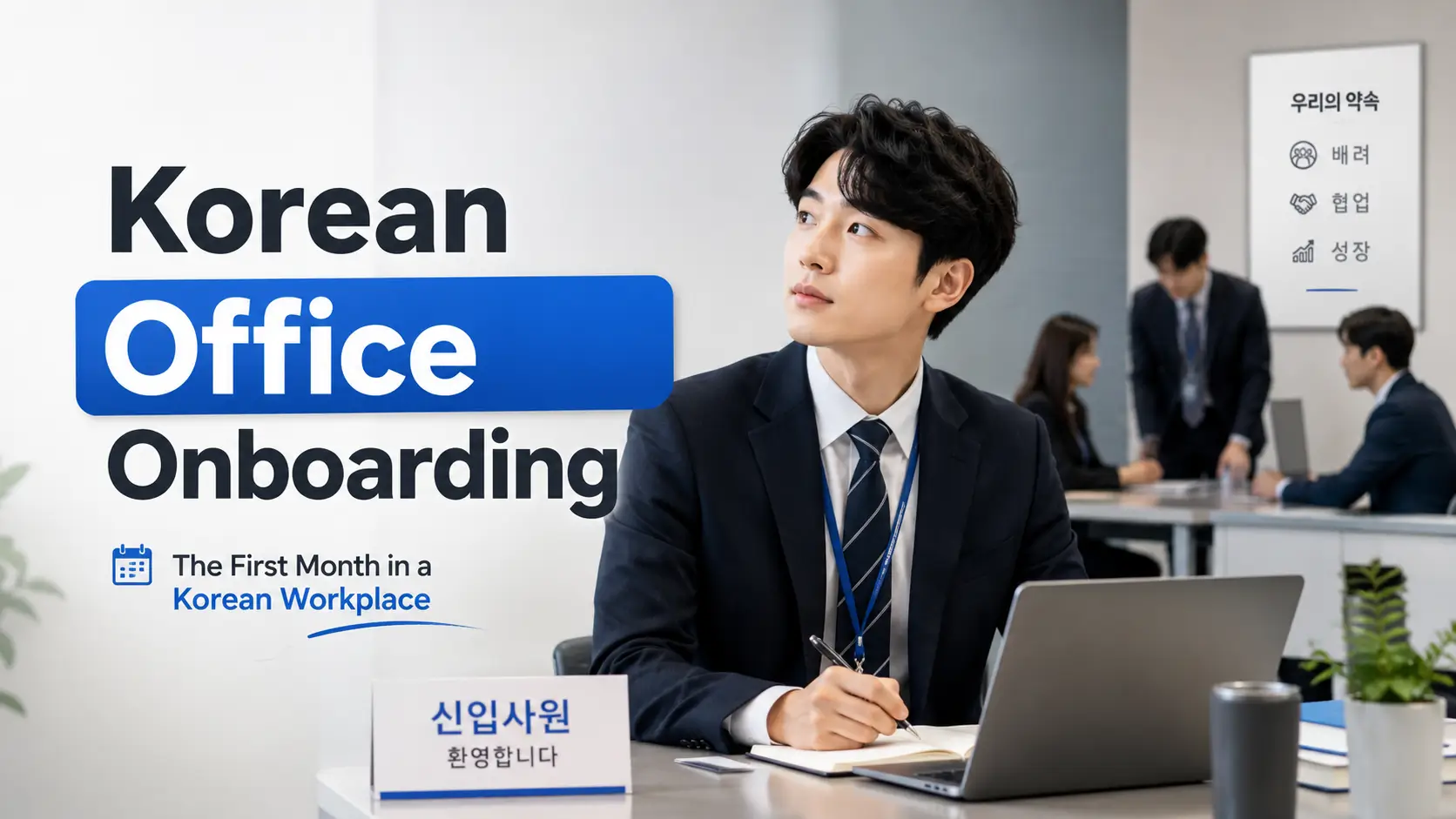
The First 30 Days: Decoding the Quiet Choreography of the Korean Office
A Korean office may welcome a new hire with a clean desk, a polite bow, and a lunch invitation, yet the real onboarding often begins in the pauses between those moments. Onboarding is less about memorizing a manual and more about learning the rhythm of titles, timing, hierarchy, and nunchi.
For Anglo-American professionals, this environment can feel disorienting. A soft “we’ll review it” may not mean yes. A silent senior manager may be the person everyone is actually reading. Without a map, small misunderstandings can harden into awkward reputations before your real work has a chance to speak.
This guide helps you decode the culture faster:
- • Week One: Navigating the visible signals and initial introductions.
- • Social Dynamics: How lunch and hoesik shape your sense of belonging.
- • Trust Building: How to ask questions and build rapport without losing your personality.
Watch the hidden signals. That is where the first month really begins.
Table of Contents
First Month, First Signals: What Korean Offices Teach Before They Explain
The hidden curriculum starts on day one
The first month in a Korean office is not only onboarding. It is social tuning. The new employee learns how fast people reply, how carefully they phrase disagreement, who gets copied on messages, when lunch happens, and which senior person can turn a vague comment into an actual decision.
In many Korean workplaces, socialization happens through a blend of formal HR orientation and informal pattern-reading. The formal side may include company history, policies, benefits, compliance rules, security training, workflow tools, and a tour of the office. The informal side is quieter. It arrives through greetings, seating, shared meals, chat-room etiquette, small corrections, and the surprising power of not speaking too soon.
Why “orientation” is only half the onboarding story
A US employee may expect onboarding to answer: “What do I do?” A Korean office often also answers: “How do I belong here without creating friction?” That second question is the hidden curriculum. It can feel invisible until you step on it, like a floor cable during a presentation.
In my own cross-cultural work, I have seen newcomers feel confused because nobody openly said, “Please wait until the manager finishes before adding your idea.” Yet the room taught it. Eyes moved. Pens paused. A junior colleague gently changed the subject. The lesson was there, wearing slippers.
The first social test: watching before performing
New employees are often expected to observe before pushing too hard. This does not mean “be passive.” It means collect signals before changing the music. Notice who speaks first, how updates are formatted, which words soften disagreement, and how much context people include before asking for help.
- Watch how decisions move before trying to speed them up.
- Notice who translates manager intent into daily action.
- Track repeated rituals: greetings, lunch, reports, chat replies, meeting order.
Apply in 60 seconds: Start a private “signals list” with three columns: people, rituals, and phrases.
Who This Is For, And Who Should Read Something Else
Best for expats, global managers, HR writers, and Korea-curious job seekers
This guide is for people trying to understand the first month inside a Korean office without turning culture into a museum label. It is useful for foreign employees joining a Korean company, US managers working with Korean branches, HR writers building onboarding materials, and job candidates preparing for a Korean workplace.
It also helps Korean-culture researchers who want practical workplace detail: not just “hierarchy exists,” but how hierarchy shows up in a Monday morning meeting, a group lunch, a KakaoTalk-style team chat, or a project update that travels through three people before landing on the decision-maker’s desk.
Useful for US teams working with Korean branches or vendors
US teams often misread Korean office behavior through their own workplace assumptions. A delayed “no” may look evasive. A senior person’s silence may look disengaged. A junior employee’s careful wording may look uncertain. Sometimes that is true. Often it is context management.
For global teams, the useful question is not “Which culture is better?” That question produces mostly conference-room confetti. The better question is: “What behavior creates trust here?” In Korean offices, trust often grows through reliability, respect for role boundaries, and the ability to read timing.
Not for stereotyping every Korean company into one tidy box
Korean offices differ. A chaebol headquarters, gaming startup in Pangyo, public agency in Sejong, hospital administration office, foreign-owned tech branch, and family-run manufacturing firm may all socialize new employees differently.
Age matters too. Younger Korean workers often question older norms around long hours, after-work drinking, and automatic deference. Global companies may use more explicit onboarding checklists. Startups may speak more casually, then suddenly become very hierarchical when investors, founders, or senior engineers enter the room. Culture is not a statue. It is a live wire with manners.
The company matters: chaebol, startup, public sector, and foreign-owned offices differ
Think of Korean office socialization as a dial, not a switch. Traditional firms may place more weight on titles, seniority, group meals, and after-work bonding. Startups may emphasize speed, product ownership, and direct chat tools. Public-sector offices may value procedure and careful approval paths. Foreign-owned offices may blend Korean social expectations with Western HR language.
Eligibility checklist: Is this guide the right map for you?
- Yes if you are joining, managing, researching, or writing about Korean office onboarding.
- Yes if your main concern is first-month behavior, not labor law or visa rules.
- Maybe if you are comparing one specific employer. Company reviews and direct employee conversations matter more.
- No if you need legal advice about contracts, overtime, termination, discrimination, or immigration.
Neutral next step: Pair this cultural guide with company-specific information before making career decisions.
Day One Decoded: Titles, Greetings, Seats, And The Quiet Map Of Power
Why job titles matter more than they seem
On day one, titles are not decorative. They are traffic signs. In many Korean offices, titles such as daeri, gwajang, chajang, bujang, team leader, manager, director, or executive help define how information moves. Even when people seem friendly, the title system may still shape who approves, who explains, who challenges, and who stays silent.
A new employee may be introduced by name, team, role, and sometimes age or experience. That introduction quietly places the person within the office map. In a US office, a first-name culture can flatten the surface. In a Korean office, even a warm welcome may still sit on a carefully tiered structure. The cake can be friendly and architectural at the same time. For a deeper look at this naming layer, see how Korean titles versus first names can change the whole temperature of a conversation.
Greeting order: small gesture, large meaning
Greeting order matters because it shows whether the newcomer understands relative status. A simple bow, a polite verbal greeting, and a moment of eye contact can carry more meaning than a paragraph about professionalism.
New hires often learn quickly whom to greet first in the morning, how formal their language should be, and whether the office uses names, titles, or hybrid address forms. In English-speaking global teams, this can be confusing because everyone may write “Hi David” in email, while in Korean conversation the same person is “Team Leader Kim.” Two languages, two gravity fields.
Desk placement, meeting seating, and who speaks first
Seating can reveal the social diagram. Senior employees may sit in more central or visible positions. Meeting rooms may have informal “power seats.” The person closest to the screen is not always the person with the most influence. The person who says little may be the one everyone watches.
I once watched a new employee choose a seat near the head of a meeting table because it had the best outlet. Technically brilliant. Socially crunchy. A colleague quietly redirected him with the grace of a stagehand moving furniture before the curtain rose. That small correction echoes a broader pattern in Korean seating hierarchy, where placement can quietly say what nobody wants to announce.
Don’t do this: acting casual before the room gives permission
Casualness is earned differently across offices. A Korean team may joke, snack, and speak warmly, but still expect new employees to keep a respectful baseline until they understand the room. Jumping into teasing, blunt criticism, or overly informal speech too early can make a newcomer look careless rather than confident.
First-Month Socialization Map
Learn titles, greetings, seating, team chat tone, and who explains what.
Decode pace, reporting format, question timing, and approval routes.
Build trust through reliability, small wins, careful updates, and lunch rhythm.
Show judgment: ask better questions, reduce friction, and understand group expectations.
The Buddy, The Senior, The Manager: Three Guides With Different Jobs
The buddy explains the practical maze
Many Korean offices informally assign a nearby coworker or junior-senior colleague to help the new employee survive the practical maze. This person may explain where files live, how expense claims work, which messenger channel matters, how lunch is handled, and which printer is possessed by office goblins.
The buddy is often the safest person for “small” questions. Small is in quotation marks because small questions are rarely small during week one. Where do I submit this? Should I copy the team leader? Is this wording too direct? Am I supposed to join lunch? These are tiny hinges on big doors.
The senior models what “acceptable” looks like
A senior colleague may not formally train the new employee, but their behavior becomes a living template. The new hire watches how the senior reports progress, how they disagree, when they joke, when they defer, and how they protect the manager’s time.
This modeling can be more influential than a training deck. If the senior sends concise updates twice a day, that is a clue. If they soften disagreement with context before making a recommendation, that is another clue. If they always confirm instructions after a meeting, there is your treasure map.
The manager watches fit, pace, and judgment
The manager may be evaluating more than technical performance. In the first month, managers often notice whether a new employee asks for help appropriately, reacts well to correction, respects team process, and completes small assignments without turning them into a twelve-act opera.
That does not mean personality should disappear. It means the new hire needs to show judgment. A good first-month rhythm is simple: listen carefully, confirm expectations, deliver small things cleanly, and ask questions that prove you tried to understand the context first.
Here’s what no one tells you: your real teacher may be the person correcting your tiny habits
In many offices, the person who corrects your tiny habits may be doing you a favor. They might tell you to use a title, rephrase a message, wait before sending a reply, or join a team lunch. The delivery may feel indirect. The lesson may be gold.
Decision card: Ask the buddy, senior, or manager?
| Question type | Best first stop | Why it works |
|---|---|---|
| Tools, files, office routines | Buddy | Low-risk, practical, fast. |
| Tone, reporting style, meeting behavior | Senior colleague | They know the team’s unwritten standard. |
| Priorities, deadlines, approval | Manager | Authority matters when direction affects work. |
Neutral next step: When unsure, ask your buddy how the team usually handles that kind of question.
Nunchi In Week One: The Soft Skill That Feels Like Office Weather
Reading silence, pauses, and indirect feedback
Nunchi is often translated as the ability to read the room. That is accurate, but too flat. In the office, nunchi is closer to reading social weather: pressure changes, temperature shifts, a cloud that means “please do not ask that in front of everyone.” Readers who want the deeper workplace version can explore nunchi at work in Korea as a practical companion to this first-month map.
In Korean workplaces, silence may not mean nothing. A pause can signal discomfort, disagreement, hierarchy, or the need to wait for a senior person. Indirect feedback may arrive as “Maybe we can review it again,” “That might be difficult,” or “Let’s consider another option.” The words are soft. The message may be firm.
When “we’ll think about it” may not mean yes
New employees from direct-communication cultures can get tangled here. “We’ll think about it” may mean genuine review. It may also mean no, not now, or please do not push this in the meeting. The difference depends on tone, timing, who is present, and what happens afterward. This is closely related to the cultural weight behind what “maybe” can mean in Korean communication, especially when a soft phrase carries a firmer boundary.
One useful habit is to confirm next steps without forcing public confrontation. For example: “Would it be helpful if I revised the draft with option B and sent it by tomorrow morning?” That gives the team a concrete path while leaving room for face-saving.
How new hires learn when to speak, wait, or follow up
A new hire learns nunchi by watching repeated patterns. Who asks clarifying questions in meetings? Who waits until after the meeting? Who sends a follow-up message instead of challenging live? Who can disagree directly because they have seniority, history, or technical authority?
This is where copying one coworker can be risky. The senior engineer who says “That won’t work” may have ten years of trust in the bank. The new employee who says the same sentence on day four may have an overdraft fee.
Pattern interrupt: the loudest person is not always the most influential one
In some Korean offices, influence is not measured by volume. The decisive person may speak late. The person who summarizes may be shaping the decision. The quiet colleague who knows the executive’s preference may be the true interpreter of the room.
Show me the nerdy details
For first-month workplace socialization, nunchi works as a real-time feedback system. The new hire observes verbal signals, nonverbal cues, rank differences, timing, and repeated outcomes. Over time, they build a prediction model: which topics need private discussion, which updates require senior review, which questions are safe in groups, and which phrases soften disagreement without hiding the issue. This is not mind-reading. It is pattern recognition under social constraints.

Lunch Is Not Just Lunch: How Meals Build Team Membership
Group meals as informal onboarding
In many Korean offices, lunch is not merely the refueling station between spreadsheets. It is a soft onboarding room with soup. New employees learn who sits with whom, whether the team eats together daily, how decisions are casually discussed, and which topics are safe outside the meeting room.
For a foreign employee, a team lunch can feel ambiguous. Is it optional? Is it expected? Should I pay? Should I wait for the senior person to start eating? The safest early move is to participate when invited, observe the rhythm, and ask a trusted coworker about norms if you are unsure. This is why Korean office lunch culture deserves its own mental file folder, not just a hungry footnote.
What rookies learn from who pays, who orders, and who leaves first
Meals can reveal hierarchy in small, practical ways. A senior person may pay, the team may split, the company may cover it, or everyone may use a meal card. Ordering may be communal. Leaving first may feel awkward if senior people are still seated.
This does not mean every lunch is a ceremony. Many teams are casual. Some eat at their desks. Some disappear to the convenience store like well-dressed raccoons. The point is to notice your team’s actual pattern rather than importing assumptions.
The lunch table as a low-stakes training room
Lunch often teaches the newcomer how people talk when the laptop lids close. A manager may soften. A senior may share context that never appears in the official meeting. A colleague may explain why a client is sensitive, why a deadline matters, or why one internal stakeholder needs extra care.
These moments build social knowledge. Not gossip. Not office surveillance. More like a field guide to the ecosystem: who prefers short messages, who needs data, who reacts badly to surprises, who saves the day quietly at 6:20 p.m.
Don’t do this: treating every meal invitation as purely optional or purely mandatory
The mistake is thinking lunch is always one thing. In some teams, declining repeatedly may slow relationship-building. In others, nobody cares. In global or younger teams, individual lunch time may be normal. Context wins.
- Join early invitations when practical, especially in week one.
- Notice payment, seating, ordering, and leaving patterns.
- Use lunch to learn context, not to perform personality fireworks.
Apply in 60 seconds: After lunch, write down one useful thing you learned about team rhythm.
Hoesik After Work: Bonding Ritual, Pressure Valve, Or Boundary Test?
Why after-work gatherings still matter in some offices
Hoesik refers to after-work team gatherings, often involving dinner and sometimes alcohol. In traditional settings, it has been used to build team cohesion, help juniors connect with seniors, and create a space where office formality loosens. The tie comes off. The hierarchy does not always leave the building.
For new employees, hoesik can accelerate belonging. A teammate may become warmer after one shared meal. A manager may explain team history. A senior may reveal the real reason a process exists. Suddenly the office has human edges, not just org-chart bones.
How younger workers are changing the old script
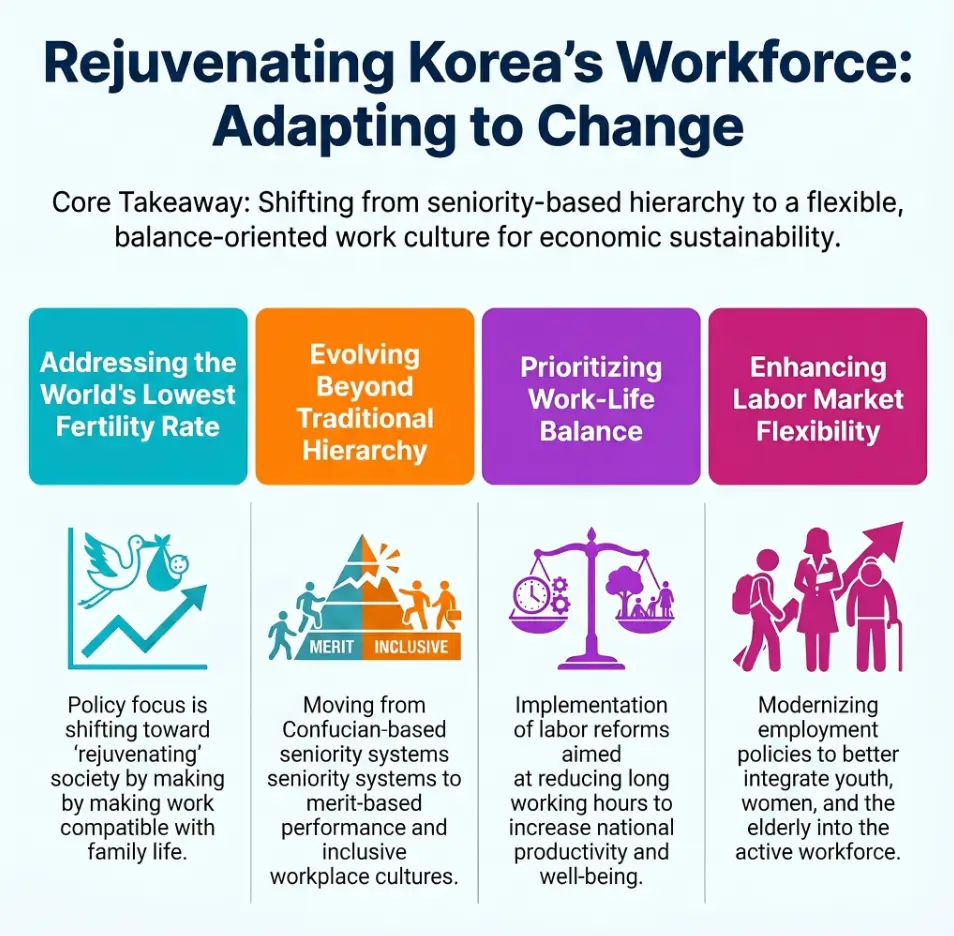
Korean workplace expectations are changing. Younger workers are more likely to value work-life balance, mental health, and personal boundaries. Companies are also more aware of harassment, drinking pressure, and employee retention. A forced all-night drinking culture is increasingly criticized, even if it has not disappeared everywhere.
The Ministry of Employment and Labor has emphasized better working conditions and reduced working hours as part of employment policy. The OECD has also discussed Korea’s long-hours culture and work-life challenges. These broader shifts matter because socialization no longer means simply “stay late and endure.” The new script is messier, but more humane.
Drinking culture, non-drinkers, and polite exits
If alcohol appears, new employees may worry about refusal. A practical approach is to keep it simple and respectful: “I don’t drink much, but I’m happy to join dinner,” or “I’ll have a soft drink tonight.” You do not need a courtroom defense of your liver. A more detailed phrasebook for this exact moment is useful, especially when you need to refuse alcohol in Korea without making the room freeze.
For polite exits, thank the organizer, say you enjoyed meeting everyone, and give a clear reason if needed. In the first month, attending part of an event may be better than disappearing from every invitation. But safety and personal boundaries still matter.
The careful question: is this relationship-building or unpaid emotional overtime?
Hoesik sits in the gray zone. It can be generous bonding. It can also become pressure. The difference depends on frequency, tone, choice, alcohol pressure, gender dynamics, and whether declining quietly damages someone’s standing.
Coverage tier map: How intense is after-work socializing?
- Tier 1: Rare team dinners, easy to decline, no alcohol pressure.
- Tier 2: Monthly meals, polite attendance expected, early exits accepted.
- Tier 3: Regular gatherings, relationship-building affects team comfort.
- Tier 4: Frequent events, declining may require careful explanation.
- Tier 5: Heavy pressure, alcohol expectations, blurred boundaries, high fatigue risk.
Neutral next step: Ask a trusted coworker how often the team usually gathers and whether partial attendance is normal.
Short Story: The Dinner That Explained The Office
On a rainy Thursday in Seoul, a new analyst named Mina joined her first team dinner. She had spent four days trying to understand why her manager never answered her questions directly in meetings. At dinner, nobody gave her a lecture. Instead, a senior colleague folded lettuce around grilled pork and said, “Our team leader likes options, not problems.” That one sentence rearranged the week.
Mina realized her questions had been landing too early, before she had prepared possible paths. The next morning, she sent a short update: “I found two options. I recommend A because it saves time, but B is safer if the client changes scope.” The manager replied in eight minutes. “Good. Proceed with A.” The lesson was not that dinner magically solved hierarchy. It was simpler: informal spaces sometimes reveal the operating manual nobody had time to write.
Week Two Reality Check: The New Hire Learns The Pace
Fast execution, slow permission: the Korean office paradox
By week two, the newcomer often discovers a paradox. Execution may be fast. Approval may be slow. A team can move at lightning speed on deliverables while still routing decisions through senior people, clients, or internal stakeholders.
This can frustrate US employees used to individual ownership. The temptation is to ask, “Why can’t I just do it?” Sometimes you can. Sometimes the answer is because the work sits inside a relationship system where surprise is expensive. In many Korean offices, reducing surprise is part of competence.
Why asking too many “why” questions can feel disruptive
“Why” questions are not rude by default. But repeated public “why” questions in the first month can sound like resistance, especially if the newcomer has not yet shown understanding of the existing process. It may feel to others as if the new employee is auditing the team before joining it.
A better structure is to pair curiosity with respect for context. Instead of “Why do we do it this way?” try: “I want to understand the background so I can follow the process correctly. Is this format mainly for the client, or for internal approval?” Same curiosity. Less thunder.
How to ask questions without sounding resistant
Good first-month questions show effort. They are specific, timed well, and connected to action. Ask after you have checked available materials. Offer a guess. Confirm the next step.
- “I checked the previous report and saw this format. Should I follow it for this client too?”
- “I may be missing context. Is the priority speed, accuracy, or manager approval?”
- “Would you prefer a short summary first, then details if needed?”
- “I drafted two options. Could you tell me which direction fits the team style?”
Let’s be honest: confusion often wears a polite face
Many new hires pretend to understand too early. This is universal, not uniquely Korean. The office nod is an international species. It migrates well.
In Korean settings, the pressure to preserve harmony can make confusion more polished. A new employee may hesitate to say, “I don’t understand.” A manager may assume silence means the instruction landed. The antidote is gentle confirmation: “To make sure I understood, I’ll send the draft by 3 p.m., using last month’s format, and copy the team leader.” Beautiful. Boring. Life-saving.
- Ask for context privately when the topic is sensitive.
- Offer a draft, guess, or option before asking for correction.
- Confirm deadlines, format, and approval path in writing.
Apply in 60 seconds: Rewrite one “why” question into a context-seeking question with a proposed next step.
Common Mistakes New Employees Make In Korean Offices
Mistake 1: assuming friendliness means flat hierarchy
A senior colleague may laugh with you at lunch and still expect formal respect in a meeting. A manager may use casual English and still prefer Korean-style reporting order. Friendliness softens hierarchy; it does not automatically delete it.
The practical fix is to keep a respectful default until you see repeated evidence that casual behavior is welcome in that specific context. One joke does not rewrite the constitution.
Mistake 2: skipping small rituals because they seem inefficient
Greetings, brief check-ins, group lunches, farewell comments, and small acknowledgments can look inefficient to newcomers. But in many Korean offices, these rituals maintain the relationship layer that makes work smoother later.
Efficiency is not only speed. Sometimes it is fewer bruised feelings, fewer misunderstood messages, and fewer meetings that begin with invisible frost on the windows.
Mistake 3: asking for radical clarity too early
Clarity is good. Radical clarity at the wrong time can feel like pressure. A new employee who demands exact decision rights, immediate feedback, and blunt answers in week one may be seen as impatient rather than proactive.
Try graduated clarity. First observe. Then confirm small expectations. Then ask for patterns. Then propose improvements after earning trust.
Mistake 4: copying one coworker’s behavior without reading status differences
This mistake is sneaky. A newcomer sees one coworker speak bluntly, skip a dinner, or joke with a manager, then copies it. But that coworker may have seniority, personal history, rare expertise, or protected status inside the team.
Behavior is not just behavior. It has a biography.
Mistake 5: treating silence as agreement
Silence may mean agreement, discomfort, hierarchy, disagreement, confusion, or “I need to ask someone else before responding.” The safest move is to confirm next steps without cornering anyone. In many cases, understanding Korean silence in conversation can help newcomers stop filling every pause with nervous office confetti.
Mini calculator: First-month misunderstanding risk
Neutral next step: Use the score to choose one conversation, not to panic-polish your personality.
The First Performance Signals: What Managers Notice Before Results Arrive
Responsiveness: speed as social proof
During the first month, responsiveness can become a proxy for reliability. This does not mean answering every message in twelve seconds like a caffeinated meerkat. It means acknowledging instructions, confirming deadlines, and showing that work is moving.
A short reply can do a lot: “Received. I’ll review and send the first draft by 4 p.m.” That sentence creates calm. It tells the manager they do not need to chase you through the digital forest.
Humility: learning without shrinking
Korean office socialization often rewards humility, especially for newcomers. But humility should not mean self-erasure. The strongest posture is: “I am learning the team’s way, and I can still contribute.”
Good humility sounds like this: “I may not have the full context yet, but based on the data, option A seems safer. Could you check whether that fits our usual approach?” Respectful. Useful. Not hiding behind the fern.
Reliability: doing the small thing exactly right
Managers often notice small execution before major brilliance. Did the new employee follow the file name format? Did they send the report to the right people? Did they arrive on time? Did they remember the correction from yesterday?
The first month is a trust deposit period. Small accurate actions build balance. Dramatic ideas are welcome later, after the account has funds.
Group fit: whether your work creates less friction for others
Group fit does not mean becoming identical. It means your presence makes work smoother, not harder. You communicate clearly. You do not surprise senior people unnecessarily. You share updates before problems become smoke signals.
- Respond clearly, even when the final work is not ready.
- Show humility while still offering useful options.
- Make other people’s work easier through clean handoffs.
Apply in 60 seconds: Send one status update today that includes progress, next step, and timing.
Korea’s Office Culture Is Changing, But Not Disappearing
Hierarchy is softening, not vanishing
Korean office hierarchy has changed, especially in startups, global firms, and younger teams. Some companies use English names. Some reduce title layers. Some encourage open feedback. But hierarchy often remains visible in decisions, meeting order, approval paths, and subtle communication choices.
The practical middle is to respect the old grammar while listening for the new accent. A team may say it values flat communication, but still expect juniors to brief seniors before a major meeting. Both can be true. Workplace culture enjoys contradictions. It keeps consultants employed.
Work-life balance is becoming a stronger expectation
South Korea has long been known for long working hours, though policy and social expectations have been shifting. Labor discussions increasingly include shorter hours, flexible work, burnout, birth-rate concerns, and quality of employment. The Ministry of Employment and Labor has publicly emphasized improving working conditions and reducing working hours. OECD analysis has also connected Korea’s long-hours culture with broader social challenges.
This matters for first-month socialization because younger employees may resist older assumptions. A new hire may still need to understand hoesik, hierarchy, and responsiveness, but they also enter a workplace where boundaries are more discussable than they were a generation ago. That shift is especially visible in conversations around annual leave culture in Korea, where old loyalty signals and newer work-life expectations often meet at the same calendar.
Global companies bring new onboarding scripts
Foreign-owned offices and global teams may use clearer onboarding plans, written role expectations, anti-harassment policies, feedback templates, and manager check-ins. Yet the local team may still operate with Korean communication instincts. The result is a hybrid office: part handbook, part nunchi.
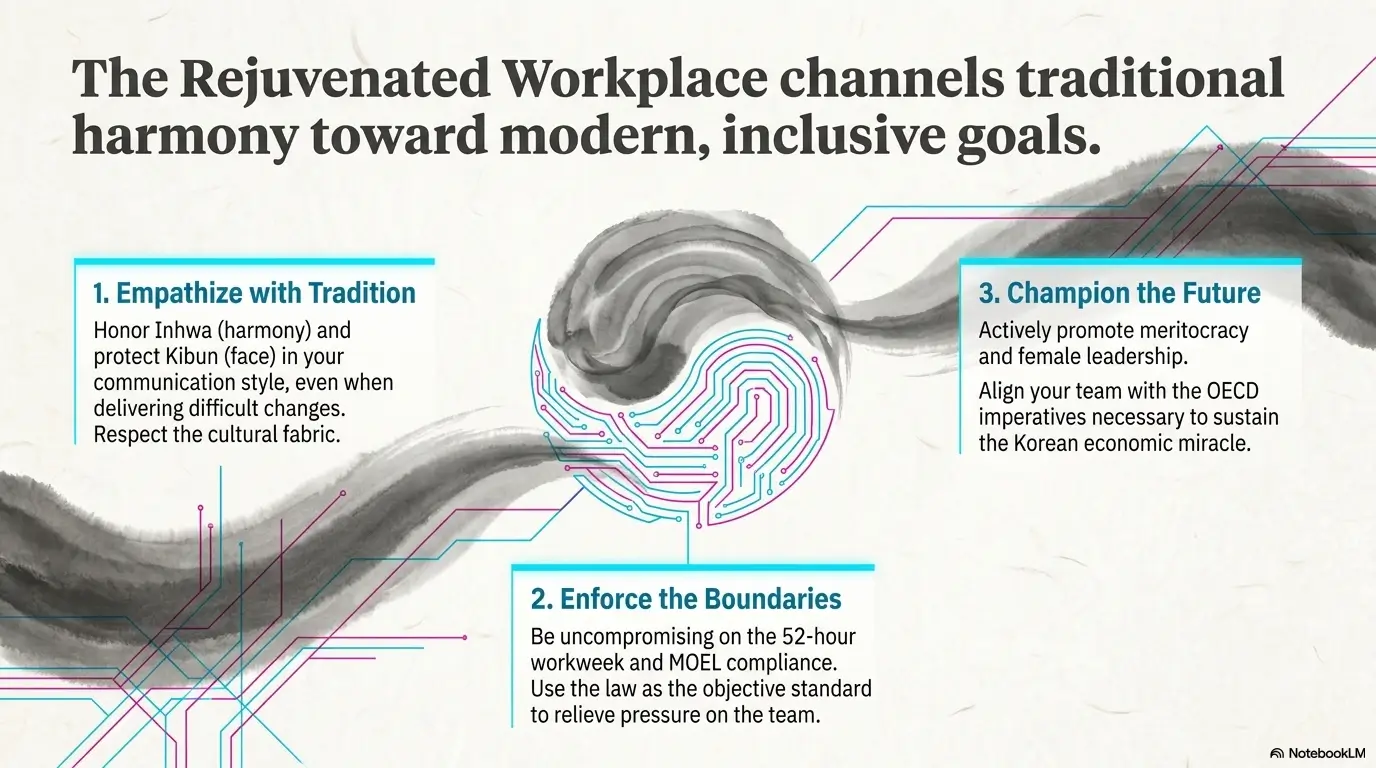
New employees do best when they do not assume the global script cancels the local one. Ask both kinds of questions: “What does the policy say?” and “How does our team actually do this?” The first protects you. The second helps you belong.
The practical middle: respect the old grammar while noticing the new accent
The safest cultural advice is not “act Korean” or “be yourself no matter what.” Both are too blunt. The better answer is adaptive authenticity. Keep your values. Learn the room. Build trust before trying to redesign the furniture.
Quote-prep list: What to gather before comparing Korean office cultures
- Company type: chaebol, startup, public sector, foreign-owned, or small business.
- Team age mix: mostly senior, mixed, or younger workforce.
- Communication tools: email-heavy, messenger-heavy, meeting-heavy, or hybrid.
- After-work expectations: rare, monthly, frequent, optional, or unclear.
- Decision style: manager-led, consensus-led, founder-led, client-led, or data-led.
Neutral next step: Ask one current employee, “What surprised you most in your first month here?”
FAQ
How long does it take a new employee to adjust in a Korean office?
Many new employees understand the basics within the first month, but deeper adjustment often takes 3 to 6 months. The first month teaches visible patterns: greetings, titles, lunch routines, reporting style, and question timing. Later months teach subtler patterns: decision politics, client sensitivities, and how much directness the team can handle.
Are Korean offices always hierarchical?
No. Korean offices vary widely by industry, company age, leadership style, and team composition. However, hierarchy and seniority still influence many workplaces, even when the surface feels casual. A startup may use first names but still defer strongly to the founder. A global company may encourage open feedback but still route sensitive decisions through senior managers.
What is the biggest first-month culture shock for Americans in Korean workplaces?
The biggest shock is often indirect communication combined with hierarchy. American employees may expect direct feedback, explicit decision rights, and open debate. In many Korean offices, disagreement may be softened, questions may be timed carefully, and decisions may depend on senior approval. The adjustment is not silence. It is learning when, where, and how to speak.
Is hoesik still important for new employees in Korea?
It depends on the company. In some traditional offices, hoesik still matters for bonding and informal trust. In younger, global, or more flexible workplaces, it may be occasional or clearly optional. New employees should not assume every gathering is mandatory, but they should also avoid dismissing every invitation as irrelevant. Ask a trusted coworker what is normal on that team.
What should a new employee avoid during the first month?
Avoid acting overly casual before understanding the room, publicly challenging processes too early, ignoring titles, repeatedly skipping team rituals without context, assuming silence means agreement, and copying a senior colleague’s behavior without considering status. The first month is best used for observation, clean execution, and careful relationship-building.
How can foreign employees ask questions without seeming rude?
Use context and proposed action. Instead of asking “Why do we do this?” say, “I want to understand the background so I can follow the team process correctly. Is this mainly for internal approval or for the client?” This shows respect, curiosity, and practical intent. Private questions are often safer than public challenges during the first month. It also helps to understand broader Korean indirect communication, because the safest wording often carries both clarity and care.
Do Korean startups socialize new hires differently from traditional companies?
Often, yes. Korean startups may socialize employees through fast project ownership, chat tools, product meetings, founder culture, and peer learning rather than formal hierarchy alone. But startups can still have strong informal power structures. The founder, lead engineer, investor-facing manager, or long-time employee may carry more influence than their title suggests.
What does “reading the room” mean in Korean office culture?
Reading the room means noticing context before acting. It includes watching who speaks first, how disagreement is softened, when silence appears, how people react to a suggestion, and whether a topic belongs in a meeting or private follow-up. In Korean, this skill is often discussed through nunchi, the ability to sense social timing and mood.
Next Step: Build A 30-Day Korean Office Socialization Map
Write down the five rituals you notice first
The fastest way to understand a Korean office is to record repeated behavior. Do not write a grand theory on day two. Write five rituals. Who greets whom? Does the team eat together? How are instructions confirmed? What happens before meetings? How do people leave for the day?
This little map turns confusion into evidence. It also prevents the classic newcomer mistake: treating one awkward moment as the entire culture. One rainy Tuesday is not a civilization.
Track who gives instructions, who interprets them, and who approves them
In many Korean offices, the person who gives the instruction, the person who explains it, and the person who approves the final result may not be the same person. Mapping this triangle can save weeks of confusion.
- Instruction: Who assigns the work?
- Interpretation: Who explains what the assignment really means?
- Approval: Who decides whether it is good enough?
- Influence: Who changes the direction quietly?
Choose one safe question to ask your buddy or senior this week
A safe question is specific, respectful, and easy to answer. Try: “For team updates, do people prefer a short message first or a full explanation?” Or: “When I have a concern, is it better to ask during the meeting or follow up afterward?”
That one question can unlock the office operating system. Not all at once. More like finding the light switch in a guest room.
Concrete action: make a “signals list” after each workday for five days
For five workdays, write down three signals at the end of each day. Keep it private and nonjudgmental. You are not collecting evidence for a cultural courtroom. You are learning the weather.
30-day signals list template
| Signal | What I noticed | Possible meaning | Next small action |
|---|---|---|---|
| Meeting order | Senior speaks last | Decision may come after discussion | Wait before concluding |
| Lunch | Team eats together twice a week | Relationship rhythm matters | Join when possible |
| Feedback | “Review again” means revise | Soft wording can be firm | Send improved draft |
Neutral next step: Review your list every Friday and look for repeated patterns, not isolated awkward moments.
Conclusion
The first month in a Korean office is a map drawn in small gestures. A greeting. A pause. A lunch seat. A senior colleague’s correction. A manager’s brief reply. At first, these signals may feel scattered, like coins dropped in a dark room. Then the pattern appears.
How new employees are socialized in Korean offices during the first month is not simply through manuals or HR sessions. It happens through hierarchy awareness, team rhythm, nunchi, meals, reporting habits, and the slow earning of trust. The smartest newcomer does not try to become someone else. They learn the room well enough to contribute without adding unnecessary friction. For a broader foundation, Korean business etiquette can help connect these first-month signals to meetings, greetings, meals, and professional respect.
For the next 15 minutes, do one practical thing: create your 30-day Korean office socialization map. Write three columns: rituals, people, and signals. Add what you noticed today. Tomorrow, add three more. By the end of one week, the office will already feel less like a locked door and more like a room with visible handles.
Last reviewed: 2026-05.
Tags: Korean workplace culture, Korean office onboarding, nunchi at work, hoesik, expat work in Korea
Meta description: Learn how new employees are socialized in Korean offices during the first month, from nunchi and hierarchy to lunch, hoesik, and trust.