
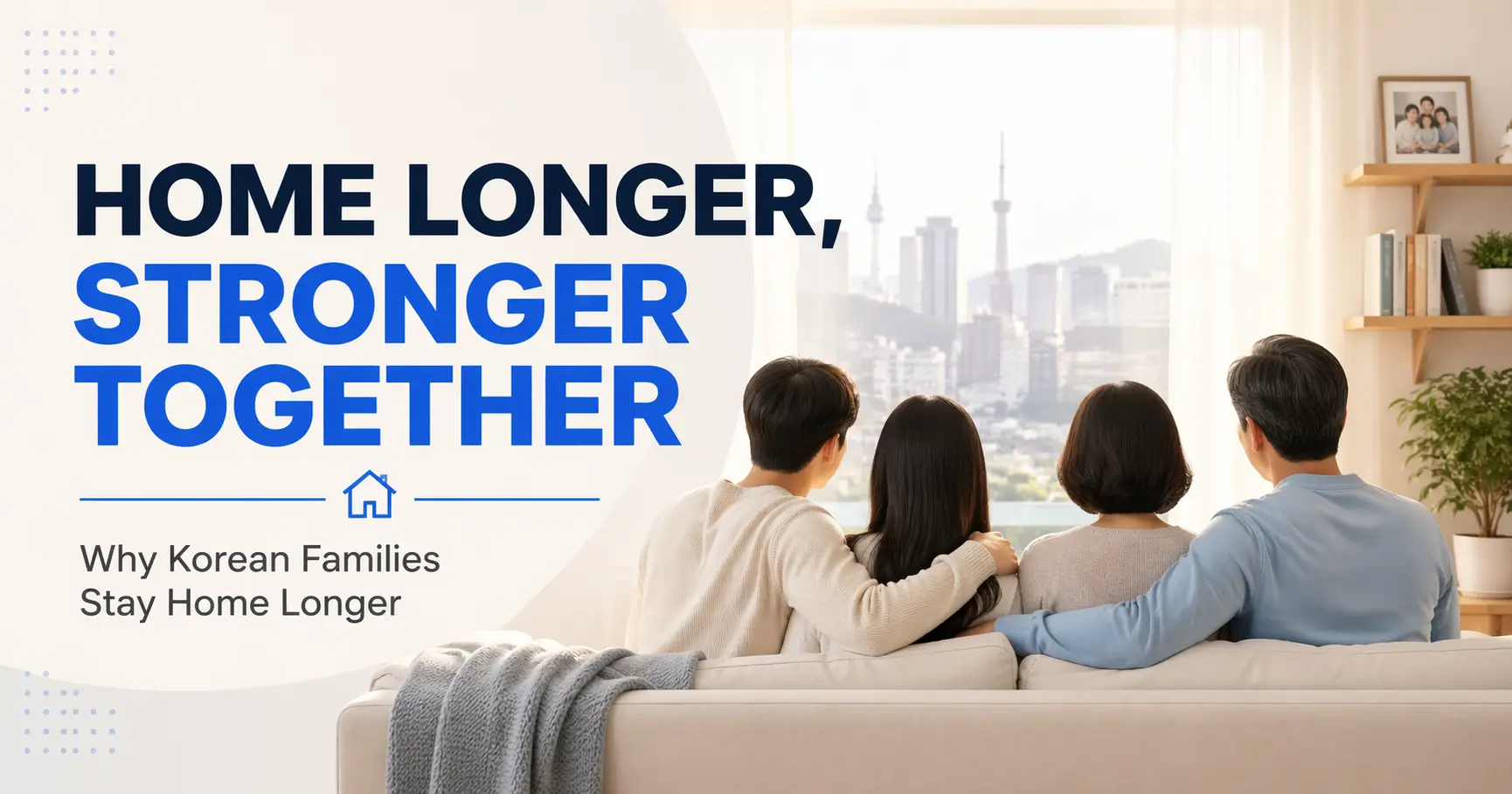
The Hidden Architecture of the Korean Household
In South Korea, more than three-quarters of people in their twenties still live with their parents. Through an Anglo-American lens, this can look startling, until you see the machinery underneath. Korean families handle adult children living at home not simply as a story of dependence, but as a strategic response to housing deposits, delayed marriage, and intense career pressures.
What might look like “stalled adulthood” often translates to disciplined saving and mutual support. In these households, money becomes morality, and the timing of independence is a carefully calculated family negotiation.
“The question is not just who moved out. It is what the family is trying to protect, and what it would cost to leave too soon.”
This guide provides the instruments to separate stereotype from structure, exploring the practical evidence trail through demographics, housing costs, and the honest friction of modern family logic.
Table of Contents
Why “Living at Home” Means Something Different in Korea
One of the fastest ways to misunderstand Korea is to treat the physical arrangement as the meaning. Same apartment. Same adult child. Same toothbrush next to the sink. Entirely different social story.
In many US conversations, moving out early is read as a ritual of adulthood. It does cultural work even when it is financially awkward. A tiny studio with a heroic rent payment can look like independence with good lighting. In Korea, the moral drama often lands elsewhere. The better question is not, “Did you leave?” but “Are you preparing well, contributing fairly, and moving toward the next life stage without damaging the family in the process?”
In Korean families, co-residence often reads as duty before dependency
That shift matters. A son or daughter staying home may still be expected to study hard, work steadily, help with errands, respect household rhythms, and save for a future housing deposit or marriage. The arrangement can carry obligation on both sides. Parents provide shelter and meals. Adult children often provide emotional presence, practical help, and a kind of long-game family cooperation.
The same household setup can carry very different meanings in the US and Korea
I once watched two friends describe the same reality in opposite moral weather. The American friend heard “thirty and living with parents” and pictured stalled adulthood. The Korean friend heard it and asked, quietly, “Saving for what?” That question changes the frame. It moves the issue from identity to purpose.
Let’s be honest: people often compare floor plans when they should be comparing family philosophy
A home is not just a building. It is a theory of adulthood. In many Korean households, adulthood does not arrive as a dramatic exit scene with cardboard boxes and a final hug in the driveway. It often arrives more gradually, through work, reciprocity, restraint, and timing.
- The meaning is relational, not only individual
- Practical timing can matter more than symbolic independence
- Household duty often travels in both directions
Apply in 60 seconds: Replace “Why have they not moved out?” with “What is this household trying to protect or prepare for?”
Start With Context: Why Adult Children Stay Home Longer
If you want the short structural answer, start with housing, education, work entry, and marriage timing. None of these operate alone. Together, they stretch the runway.
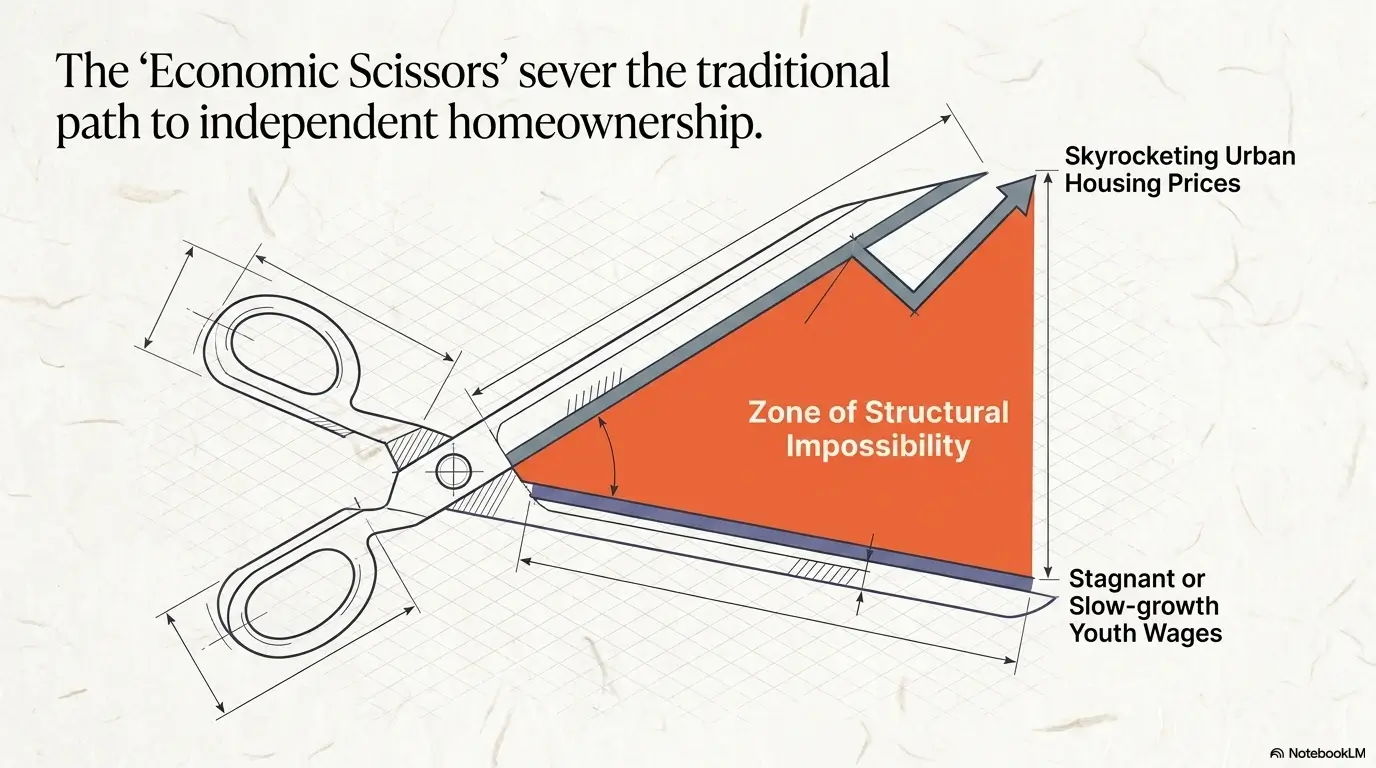
Housing prices and deposit-heavy rental systems change the timeline
Korea’s housing system has long included large upfront deposit structures in parts of the rental market. Even when people do not enter a classic jeonse arrangement, the broader housing environment can still make early independent living feel punishingly expensive. OECD housing work has repeatedly pointed to affordability pressure in Korea, especially for younger adults. So yes, culture matters. But culture is walking on an expensive floor. If you want to understand why those deposit structures feel so decisive, it helps to see how jeonse deposit protection shapes real housing risk for ordinary renters.
Education, job entry, and delayed marriage stretch the path to independent living
Students may stay in education longer. Job competition can be intense. Early career wages do not always keep pace with urban housing costs. Then there is marriage timing. Statistics Korea reported that the average age at first marriage in 2024 was 33.9 for men and 31.6 for women. Once marriage happens later, moving out later stops looking like a strange exception and starts looking like a calendar that shifted beneath everyone’s feet. That broader delay also connects to the social effects of Korea’s low birth rate, where later marriage and deferred family formation ripple through everyday household decisions.
Family interdependence is not always a fallback, sometimes it is the default plan
Some Western readers imagine a failed launch. Many Korean families imagine staged preparation. The difference is subtle but important. The home is not always Plan B. Sometimes it is the original plan until school, work, savings, or marriage make the next move sensible.
OECD data released in 2025 noted that more than three-quarters of people in Korea aged 20 to 29 live with their parents. That number does not mean every household is happy, traditional, or identical. It simply means the arrangement is common enough that it cannot be explained by personal weakness alone. When a pattern is that large, structure is in the room.
Decision Card: What makes living at home last longer?
When housing costs dominate: families often prioritize saving, delayed exit, and shared meals.
When status expectations dominate: families may still want independence, but only once it looks respectable and stable.
Time trade-off: moving out earlier may buy privacy now but delay savings for years.
Neutral action: Compare the cost of independence with the cost of postponing other milestones.
Show me the nerdy details
Korean co-residence patterns sit at the intersection of labor-market entry, housing affordability, and marriage timing. Once average marriage ages rise and entry-level housing remains expensive, parent-child co-residence becomes less a moral anomaly and more a rational adaptation. That does not erase conflict. It explains why the arrangement persists even among highly educated young adults.
Not Failure, but Timing: How Korean Parents Often Frame It
Many Korean parents do worry. They worry about job prospects, marriage timing, housing costs, social reputation, and whether their children are truly preparing or merely orbiting the refrigerator. But worry is not the same thing as seeing the child as a failure.
Many parents see the home as a launch platform, not an emergency shelter
There is a practical tenderness in this. A parent may think, “Stay until you can do this properly.” That sentence is full of both care and pressure. It is loving, but it is not exactly relaxed. The family home becomes a runway with snacks and expectations.
Stability can be valued more than early symbolic independence
A US parent might admire the child who moves out with almost nothing but determination. A Korean parent may feel more reassured by steadier sequencing: finish school, get a stable job, save seriously, then move. The admired trait is not dramatic self-separation. It is disciplined readiness.
Here’s what no one tells you: “moving out later” may sound less alarming than “moving out unprepared”
I have heard variations of the same family logic in many cultures, but in Korea it often arrives with a sharper practical edge. Pride is expensive. Rent is more expensive. If the child leaves too soon and boomerangs back under stress, that can feel worse than staying a little longer with a clear purpose. And once that move finally happens, the practical realities can look a lot like the concerns in a Korean apartment move-in checklist, where deposits, logistics, and setup costs arrive all at once.
This is why co-residence can be emotionally mixed. Parents may approve of the arrangement in principle while quietly resenting the laundry volume, electric bill, or vague life plan. Adult children may appreciate the support while feeling half-adult, half-guest. Nobody is fully wrong. Everyone is a little cramped.
Eligibility checklist: Is the household reading co-residence as preparation rather than failure?
- Yes or No: Is there a visible goal such as savings, exams, or marriage timing?
- Yes or No: Does the adult child contribute through money, chores, or caregiving?
- Yes or No: Do parents describe the situation as temporary or strategic?
- Yes or No: Are there signs of forward movement, not just comfort?
Neutral action: If most answers are yes, the family may be framing home as a staging ground, not a dead end.
Beneath the Harmony: What Tensions Quietly Build at Home
Now for the part tourists miss. Co-residence can be warm. It can also be claustrophobic in socks.
Privacy, routines, and household authority do not disappear just because everyone is older
An adult child may earn a salary and still be asked where they are going. A parent may say nothing directly and still communicate disapproval through silence, timing, or the way dishes are set down. In many Korean homes, authority is not always theatrical. It can be atmospheric. Readers who have noticed similar tension in conversation itself may also recognize the logic behind Korean silence in conversation, where what is unsaid can weigh almost as much as what is spoken.
Financial dependence can blur into emotional dependence if boundaries stay vague
When money, meals, loyalty, and decision-making all share the same apartment, roles can tangle. A parent who subsidizes housing may feel entitled to stronger opinions about dating, jobs, or schedules. An adult child who helps a parent with errands, technology, or emotional support may feel both dutiful and cornered.
Love and frustration often share the same kitchen table
I remember a friend laughing while describing family life in Seoul: “Nobody says there is a curfew. The apartment just develops one.” That is exactly the sort of invisible rule outsiders miss. In many homes, people are not obeying a posted sign. They are reading weather.
This is why simplified stories fail. Korean family life is not only about obedience, filial piety, or comfort. It is about constant adjustment. A mother cooks because she cares. A daughter comes home early because she is considerate. Both may privately wish for more space. Harmony, in many homes, is not the absence of conflict. It is conflict folded carefully and put away before guests arrive.
- Privacy shrinks even when affection remains
- Money can quietly purchase influence
- Unspoken rules often matter more than explicit rules
Apply in 60 seconds: When reading a Korean household, look for hidden negotiations, not just visible obedience.
Money First, Pride Second: The Practical Logic Families Use
There is a sentence many families never say out loud because it sounds unromantic. Here it is anyway: household arrangements are often financial strategy wearing emotional clothing.
Saving for housing, exams, or marriage can outweigh the cultural prestige of moving out early
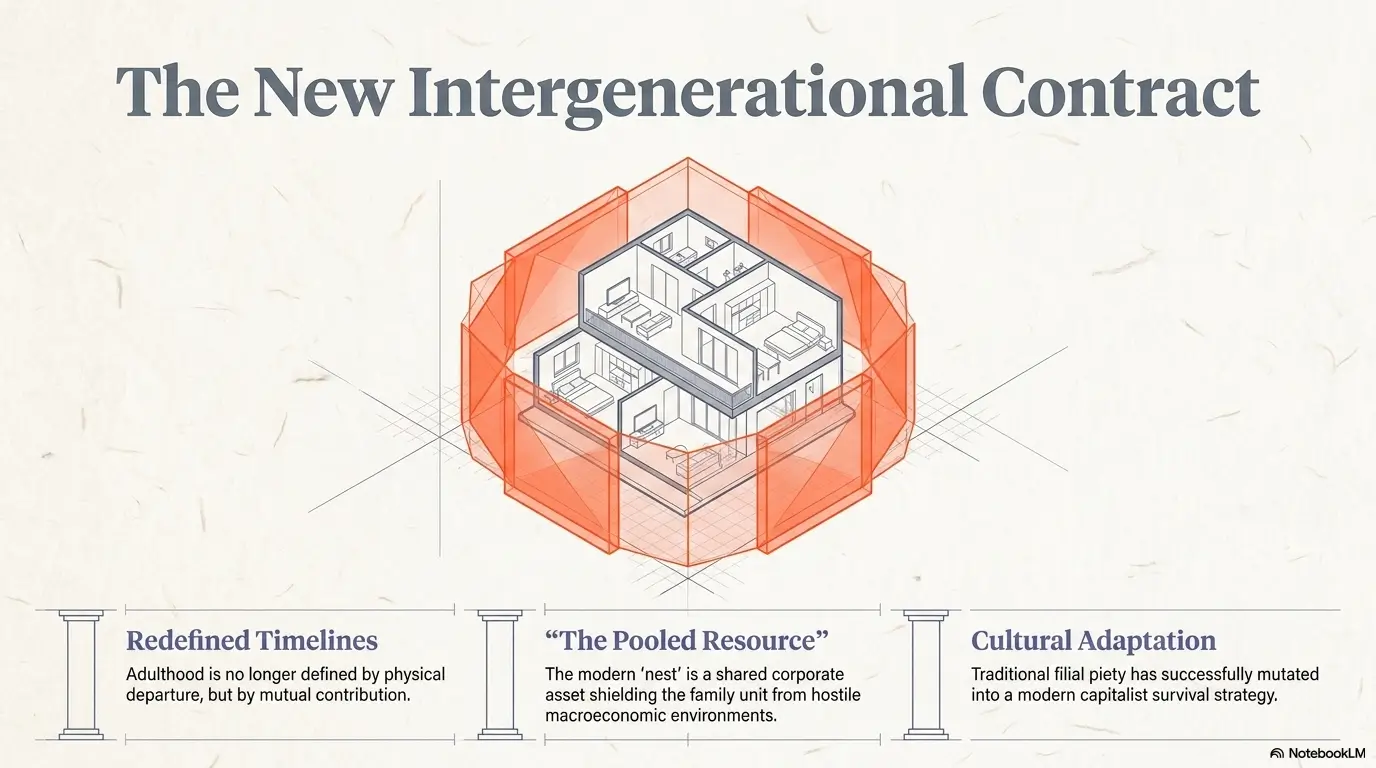
If independent living drains savings needed for a housing deposit, further training, or wedding expenses, staying home longer can look less like delay and more like sequencing. Many families would rather tolerate friction now than fragility later.
Shared meals and shared bills can function as a family economic strategy
This part is easy to overlook from the outside. One kitchen can lower food costs. One household can spread utility expenses. One parent-owned or long-held home can absorb adult children more easily than a market-rate rental can release them. It is not glamorous. It is arithmetic with side dishes.
The real question is often not “Why are they still home?” but “What would moving out too early cost?”
That question often produces a calmer answer. Early exit may cost savings momentum, commuting efficiency, emotional support, or future marriage readiness. In some families, it can also complicate caregiving for older parents or grandparents. Co-residence sometimes survives not because it is ideal, but because alternatives are worse.
| Choice | Likely upside | Likely cost | Notes |
|---|---|---|---|
| Stay at home longer | Higher savings rate, meals, family support | Less privacy, more scrutiny, slower symbolic independence | Often viewed as strategic if goals are clear |
| Move out early | Autonomy, dating privacy, adult identity | Rent burden, weaker savings, possible return home later | Can be admired, but not always seen as financially wise |
Mini calculator: If living at home lets a person save even the equivalent of one rent payment plus food costs each month, the difference over 12 months can become the seed of a deposit, exam fund, or emergency reserve. The exact math varies, but the logic is simple: delayed independence can create earlier stability.
Neutral action: Compare one year of savings at home versus one year of solo rent before judging the arrangement.
There is nothing poetic about spreadsheet truth, but families live inside it all the time. A household can be tender and tactical at once.
Who This Is For, and Who It Is Not For
This is for US readers trying to understand Korean family norms without flattening them into stereotypes
If you are reading Korean households through a Western default setting, this article is meant to slow that reflex down. Not to scold it. Just to recalibrate it.
This is for cross-cultural couples, expats, students, and writers comparing household expectations
It is especially useful if you have ever thought, “Why does this family seem loving and intense at the same time?” Welcome. That is often the correct first impression. For readers trying to connect home life with romance expectations, Korean couple culture offers another angle on how intimacy and social expectation often travel together.
This is not for readers looking for a single rule that applies to every Korean household
Korea is not a museum diorama. There is no one script. Seoul differs from smaller cities. Class matters. Parents differ. Younger generations improvise. Some homes are warm and flexible. Some are controlling. Some are simply tired and making do.
I once heard someone ask for “the Korean rule” on moving out. That question itself is the problem. Families are not software settings. They are negotiations shaped by money, history, personality, and mood. Sometimes even by who last touched the rice cooker.
Quote-prep list: Before you compare Korean and Western households, gather these clues
- What stage of school or career is the adult child in?
- Is housing cost the main driver or only one factor?
- Does the family expect marriage to change the living arrangement?
- How are chores, money, and privacy actually handled?
Neutral action: Gather context first. Interpretation gets cheaper once assumptions stop doing all the work.
Do Not Read It Too Fast: Common Western Misreadings
Cross-cultural misunderstanding often happens at high speed. We see a behavior, import our own meanings, and call it insight. It is not insight. It is luggage.
Mistaking co-residence for immaturity can miss the economic and cultural structure underneath
If a pattern is common across a large share of young adults, the cause cannot be reduced to laziness or fear of adulthood. Structure matters. Housing markets matter. Marriage timing matters. Family obligation matters. Maturity can look different when adulthood is measured by contribution and readiness rather than early separation alone.
Assuming parents always approve can erase the daily friction many families still navigate
Many outsiders romanticize Korean family closeness. They imagine patient mothers, grateful children, and tidy respect. Real homes are messier. Parents may worry that a son is too comfortable. Daughters may feel overmanaged. Adult children may deeply love their parents and still dream of locking a door that no one knocks on.
Not every adult child at home is “stuck,” and not every adult child living alone is “free”
Living alone can mean autonomy. It can also mean debt, isolation, and performative adulthood financed by anxiety. Living at home can mean dependence. It can also mean disciplined saving and strong intergenerational support. Moral clarity is rarely that neat.
The trick is to separate appearance from function. What is the household doing well? What is it sacrificing? What future is it buying, and what tension is it tolerating to buy it?
- Shared housing is not automatically failure
- Parental acceptance is not automatically peace
- Solo living is not automatically freedom
Apply in 60 seconds: Ask what trade-off each living arrangement creates before deciding what it means.
Common Mistakes When Interpreting Korean Family Life
Do not treat Korea as culturally frozen or uniformly traditional
Korea changes quickly. Younger adults do not simply inherit a static script and obey it forever. They improvise, resist, reinterpret, and sometimes quietly renegotiate every detail. That is especially visible in Korean teen life and young adult transitions, where expectation and self-definition are already in lively argument.
Do not confuse practical co-living with total parental control
Some adult children at home enjoy significant autonomy. Others do not. The arrangement alone does not tell you which is true. You need the operating details: money, tone, household authority, curfews, guests, chores, and how conflict is handled.
Do not assume the same norm applies equally in Seoul, smaller cities, and rural areas
Regional housing markets, commuting patterns, and family expectations differ. The polished urban apartment in your imagination may not represent the country any more than one Brooklyn kitchen represents America. Even the texture of everyday life can shift with Korean city identity, where local history and pace shape how norms are actually lived.
Let’s be honest: outsiders often overread obedience and underread negotiation
Someone bows their head, answers softly, comes home for dinner, and suddenly an outsider thinks, “Ah yes, total submission.” Not so fast. Many families maintain peace through tact, timing, and strategic silence. Agreement is often partial. Compliance can be temporary. Respect may be sincere and still coexist with private resistance.
Here’s what no one tells you: many family arrangements survive through quiet compromise, not perfect agreement
I once heard a Korean friend describe home life as “group chat diplomacy, but offline.” It was funny because it was true. Households often continue not because everyone shares one worldview, but because people adjust around each other with remarkable patience and occasional theatrical sighing. The same pattern becomes easier to spot if you have seen how Korean group chat culture blends coordination, hierarchy, and subtle emotional weather.
Infographic: How to Read Adult Children Living at Home in Korea
“They failed to become independent.”
Savings, marriage timing, caregiving, exam prep, and housing pressure may all be shaping the choice.
“What is this family optimizing for, and what tension are they absorbing in exchange?”
Marriage Changes the Clock: Why Leaving Home Is Often Tied to Life Stage
In many Western households, turning eighteen or finishing college can feel like a symbolic doorway. In Korea, the more historically resonant doorway has often been marriage.
In many families, moving out is historically linked more to marriage than to turning eighteen
That older social pattern still echoes even as Korea modernizes. Not every family thinks this way, of course. But the lingering logic matters. Moving out may not be framed as proof of adulthood on its own. It may be bundled with the formation of a new household.
A delayed marriage age naturally reshapes the household timeline
When the average first marriage age rises into the early thirties, the old household timeline stretches with it. This does not mean everyone wants marriage. It means social expectations around housing and family formation are no longer synchronized with earlier generations.
When marriage timing changes, housing expectations change with it
If marriage is later, independent housing may also be later, more selective, or more financially strategic. Some couples even spend more time planning deposits and housing feasibility than the romance genre would consider elegant. Real life is often less violin, more calculator. Readers interested in how that next household stage is socially framed may also want to see Korean wedding cash gift etiquette, where marriage still carries unmistakable social choreography.
There is also a subtle emotional effect. If moving out historically signaled “I am starting my own family unit,” then moving out alone may carry a different symbolic weight than it does in the US. Not wrong. Just different. And different enough to reshape family expectations in daily life.
Short Story: A Korean graduate student I knew once described her twenties as “living in the hallway between my parents’ house and my future house.” She was working, saving, commuting, and occasionally snapping at everyone by Sunday evening. She did not feel like a child. She felt like someone in transit without a separate address.
Her mother treated the arrangement as normal, even helpful. Her American classmate found it baffling. “Why not just move out?” he asked. She stared at him for a second, then laughed the sort of laugh people make when two realities miss each other by several feet. “Because,” she said, “for what price, and for which future?” That was the whole issue in one sentence.
The Hidden Negotiation: How Families Manage Boundaries Without Saying Everything Out Loud
If you want to understand how Korean households actually function, watch the micro-signals. Tone. Timing. Chore patterns. Door etiquette. Guest etiquette. The refrigerator as message board. The rice cooker as diplomacy device.
Chores, curfews, meals, and guest etiquette can become soft battlegrounds
Few families sit down and draft a household constitution. More often, boundaries emerge through routine. Coming home very late may not trigger a direct lecture, but it may produce a noticeably cool breakfast. Bringing a partner over may be technically allowed yet socially inconvenient. Helping with groceries may buy goodwill that no formal negotiation ever could.
Respect is often performed through tone, timing, and restraint as much as through rules
This is easy to miss if you expect American-style explicitness. In many Korean families, respect can be shown by not forcing a direct clash, choosing the right moment to raise a topic, or complying partially without public argument. It is not always ideal. Sometimes it is simply the most efficient way to keep the household from turning into a percussion ensemble. The same social rhythm appears in Korean indirect communication, where clarity often arrives wrapped in timing, tone, and implication.
Some of the biggest household agreements are implied rather than formally discussed
I have watched people describe family rules with phrases like “It is not exactly a rule, but…” That “but” is doing heroic labor. It contains years of shared assumptions, emotional memory, and practical compromise.
Show me the nerdy details
High-context family systems often rely less on direct declaration and more on inference, role awareness, and conflict minimization. This does not make boundaries weaker. It can make them harder for outsiders to see. A household may function through repeated implied agreements that would seem vague to someone used to explicit verbal contracts.
Coverage tier map: What changes from household to household?
Tier 1: Warm support, high autonomy, low conflict.
Tier 2: Strong support, moderate expectations, occasional privacy strain.
Tier 3: Financial logic dominates, boundaries are fuzzy, tension is manageable.
Tier 4: Heavy scrutiny, frequent conflict, emotional dependence grows.
Tier 5: Co-residence feels suffocating or coercive despite material support.
Neutral action: Do not judge the arrangement by address alone. Judge it by how authority, privacy, and contribution actually work.
Not All Homes Work the Same: What Class, Region, and Generation Change
The sentence “Koreans do this” usually collapses under five minutes of real observation.
Urban professional families may normalize extended co-residence differently from older rural households
Seoul and other large urban areas place especially strong pressure on housing choices. Long commutes, steep rents, and career clustering make living at home more understandable, even for highly educated adults. In smaller cities or rural areas, the details can differ, though family expectations may still remain strong.
Younger parents may offer more autonomy while still expecting family-minded behavior
Many younger parents are less rigid than caricatures suggest. They may be more open about dating, work experimentation, or personal space. Yet they may still expect adult children to act with restraint, help at home, and think about family consequences. Freedom expands, but it rarely becomes purely individual.
Economic pressure can make the same arrangement feel cooperative in one home and suffocating in another
Class matters here. A spacious home with clear boundaries can make co-residence feel strategic and calm. A cramped apartment with stress, caregiving burdens, or unstable income can make the same arrangement feel exhausting. The moral interpretation should never float free of material conditions.
I once visited two households only a few subway stops apart. In one, the adult child had a room, a door, and a plan. In the other, three generations were sharing limited space and everyone seemed one dropped spoon away from despair. Same category on paper. Entirely different lived reality.
- Urban housing pressure reshapes choices
- Younger parents may be flexible without abandoning family-minded expectations
- Space and income determine whether support feels calm or suffocating
Apply in 60 seconds: Before generalizing, ask what the home can materially sustain and what the family culturally expects.
Next Step: Compare Values Before You Compare Behavior
We can close the loop now. That bedroom door from the opening was never just about whether someone had left home. It was about what the family believes adulthood should protect.
Many Western readers instinctively optimize for independence first. Many Korean families, though certainly not all, have often optimized for stability, savings, marriage timing, and interdependence. Once you see that, the arrangement becomes less mysterious. It may still be frustrating. It may still be emotionally costly. But it no longer looks irrational.
The most useful question is not whether one model is superior in the abstract. It is what each model rewards and what each one hides. Early independence can produce confidence, privacy, and faster identity formation. It can also produce financial fragility. Extended co-residence can produce savings, support, and family continuity. It can also produce blurred boundaries and quiet resentment. Every household is trading one set of discomforts for another.
So here is the practical next step for a reader, writer, student, or partner trying to understand Korea better: compare values before you compare behavior. Ask what the household is optimizing for. Ask what risks it is avoiding. Ask what future milestone is shaping the present. That alone will make you more accurate, and usually kinder.
Decision Card: How should you interpret an adult child living at home in Korea?
When the household has a clear goal: interpret it as strategic co-residence.
When boundaries are weak and conflict is chronic: interpret it as support mixed with strain, not simple harmony.
When housing and marriage timing dominate: interpret it through structure before personality.
Neutral action: In the next 15 minutes, write down the family’s likely priorities in order: savings, stability, caregiving, privacy, marriage, autonomy.
FAQ
Why do Korean adults live with their parents longer than many Americans?
Because the issue is shaped by more than personal preference. Housing affordability, deposit-heavy rental realities, intense education and career pressure, later marriage, and family duty all pull in the same direction. The arrangement often makes practical sense even when it creates tension.
Is living at home in Korea seen as embarrassing?
It can be, but not automatically. Context matters. If the adult child is working, studying, saving, or moving toward a clear goal, many families read the arrangement as practical rather than shameful. The embarrassment tends to grow when there is no visible plan, weak contribution, or chronic dependence.
Do Korean parents usually charge adult children rent?
There is no single rule. Some do not charge formal rent at all. Others expect contributions through bills, groceries, household expenses, or family support in other forms. In many homes, contribution matters more than the exact label attached to it.
At what age do most Koreans move out?
There is no one universal age because moving out is often tied less to a birthday than to work stability, housing feasibility, and marriage timing. OECD figures showing very high rates of co-residence among people in their twenties suggest that leaving home later is common enough to be socially legible, not unusual.
Is this mainly about culture or mainly about money?
It is both. Money explains a great deal, especially housing pressure. Culture explains why staying home can remain socially meaningful, acceptable, or even expected under those conditions. The most accurate answer is that structure and family values reinforce each other.
Do unmarried adults face more pressure to stay or leave?
Sometimes both. Unmarried adults may stay longer because marriage has historically functioned as a clearer transition point into an independent household. At the same time, families may pressure them to prepare seriously, save, and move toward socially recognizable adulthood rather than drift indefinitely.
How does living at home affect dating and marriage expectations in Korea?
It can complicate privacy, guest etiquette, and perceptions of readiness. Some families see staying home as financially wise preparation for marriage. Others worry it delays the social and emotional independence associated with forming a new household. Dating can become one of the quiet pressure points in the arrangement.
Are younger Koreans changing these norms?
Yes, but not in one simple direction. Many younger adults want more autonomy and emotional independence. Many younger parents also appear more flexible than older stereotypes suggest. But housing costs and delayed marriage continue to keep co-residence common, so values are changing inside constraints that have not disappeared.
In 15 minutes, you can test your own interpretation. Take one real or imagined Korean household and write down five things it may be optimizing for: independence, savings, marriage timing, caregiving, emotional closeness, or stability. Then ask which one you assumed was primary before reading this. That tiny exercise often reveals the whole misunderstanding. The point is not to romanticize Korean family life or to condemn Western individualism. It is to read people with better instruments. Homes are moral worlds in miniature. If you listen carefully, even a crowded apartment can explain an entire social philosophy.
Last reviewed: 2026-04.